REVIEW 2 major objections 4 minor 106 references
Single-particle cryo-electron microscopy: Mathematical theory, computational challenges, and opportunities
T0 review · 2 major / 4 minor · reviewed 2026-08-14 · deepseek-v4-flash
Pith's one-line read This paper argues that two simplified statistical models—multi-reference alignment and multi-target detection—capture the essential difficulty of single-particle cryo-EM reconstruction and yield sample-complexity scaling laws that apply…
desk verdict A clear, honest survey of cryo-EM mathematics built around MRA/MTD; no new results, but a solid map with one loose sample-complexity qualifier to fix. read the letter →
The pith
A machine-rendered reading of the paper's core claim, the machinery that carries it, and where it could break.
The reading
What carries the argument
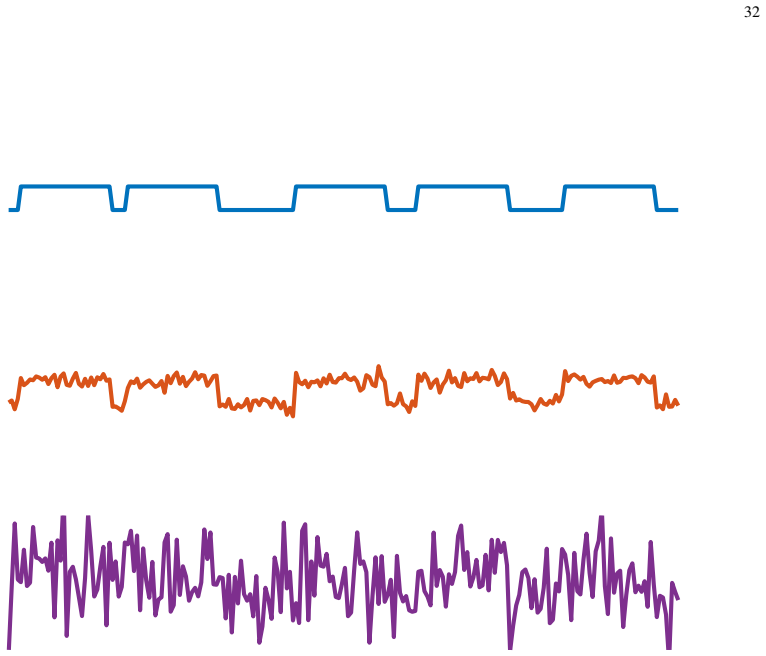
The load-bearing machinery is the pair of abstract generative models together with the method of moments and its invariant-polynomial language. Multi-reference alignment encodes the unknown-orientation part of cryo-EM as a group action channel $y_i = T_i(g_i \circ x) + \varepsilon_i$, while multi-target detection encodes particle picking as a sparse binary convolution $y = x * s + \varepsilon$. The sample-complexity mechanism is the variance of estimated moments: the $q$-th moment has estimation variance scaling like $\sigma^{2q}/N$, so the lowest moment that distinguishes two candidate signals sets the SNR exponent. The bispectrum—the Fourier-domain third-order invariant—is the concrete object that both proves identifiability and underpins algorithms for classification and ab initio modeling. On the computational side, the review identifies expectation-maximization with marginalization over nuisance variables as the framework for high-resolution refinement, and steerable PCA as the dimensionality-reduction tool that exploits rotational invariance.
What would settle it
Simulate a known 3-D volume with uniformly random orientations, no blur, and additive white Gaussian noise, then measure the number of images needed to reach a fixed reconstruction accuracy as the noise grows; if the required $N$ does not track $\mathrm{SNR}^{-3}$ as $\mathrm{SNR}\to 0$, the central law fails. A second check for the multi-target-detection claim is to generate micrographs from a known volume at SNR levels where particle picking is impossible and test whether a bispectrum-based direct inversion still recovers the volume.
Extended reading notes
Core claim
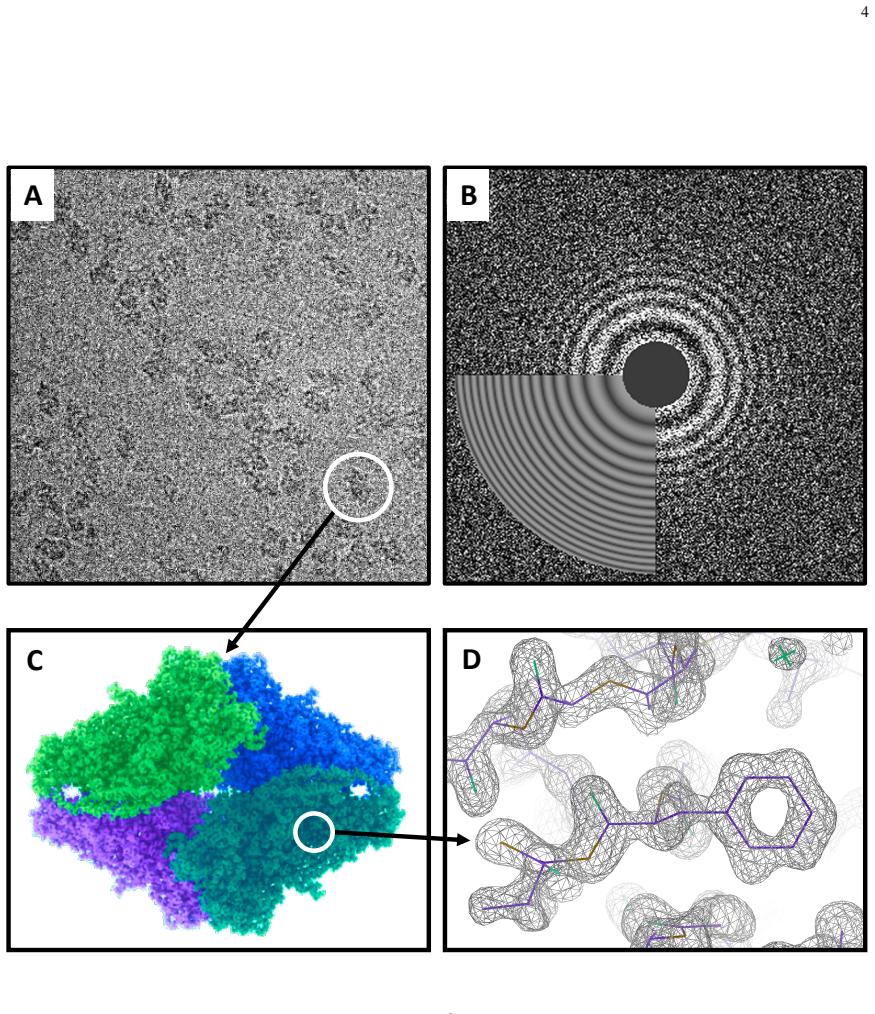
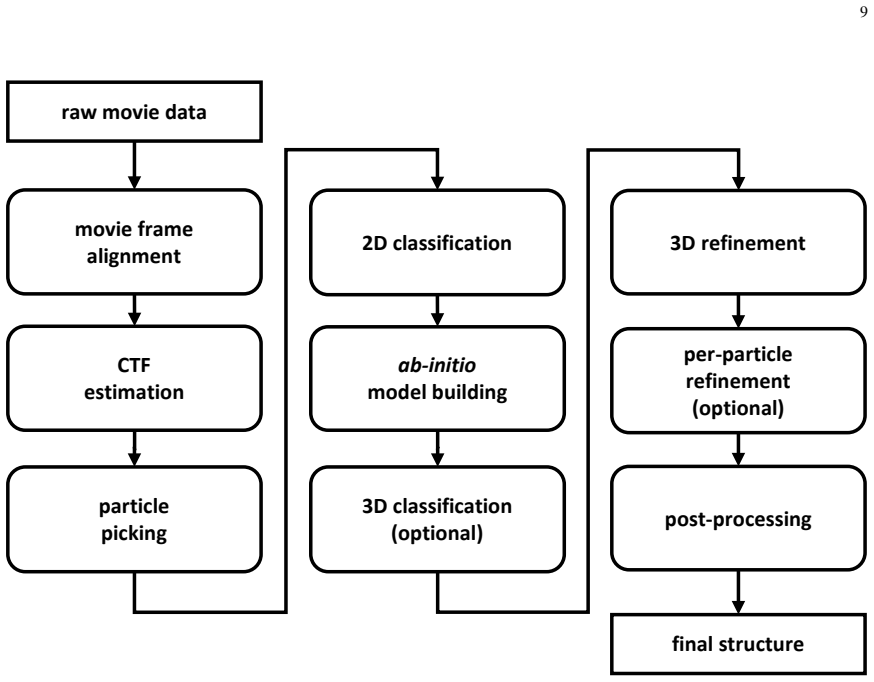
The paper's central claim is that two deliberately simplified models carry the mathematical essence of cryo-EM. In multi-reference alignment, observations take the form $y_i = T_i(g_i \circ x) + \varepsilon_i$ with unknown group elements $g_i$; the cryo-EM forward model is a special case with $G = SO(3)$ and $T$ the tomographic projection followed by the microscope's point-spread function. The paper surveys the result that in the low-SNR limit, any estimator fails unless the number of images $N$ grows like $\mathrm{SNR}^{-\bar q}$, where $\bar q$ is the order of the first moment that identifies the signal, so the problem's sample complexity is determined by a lowest-order moment. For the idealized cryo-EM setup, uniform rotations give $\bar q = 3$ and generic non-uniform rotations give $\bar q = 2$, yielding $N \sim 1/\mathrm{SNR}^3$ and $N \sim 1/\mathrm{SNR}^2$, respectively. In multi-target detection, $y = x * s + \varepsilon$ with an unknown binary location signal $s$, and the paper reports that third-order statistics (the bispectrum) recover $x$ provably at any noise level, with numerical evidence that several signals can be recovered from a mixture of such blind deconvolution problems. The review then maps the standard pipeline—motion correction, contrast-transfer-function estimation, particle picking, 2-D classification, ab initio modeling, and refinement—onto these statistical problems, with maximum-likelihood expectation-maximization as the workhorse estimator.
Load-bearing premise
The load-bearing premise is that the simplified statistical models retain the essential difficulty of real cryo-EM: the sample-complexity statements assume perfect particle picking, no microscope focusing blur, and white Gaussian noise, and if those omissions hide a structurally important feature, the theoretical scaling laws may not transfer to practice.
Editorial extensions
If this is right
- No estimator can beat the $1/\mathrm{SNR}^{3}$ barrier in the uniform-view, low-SNR regime, so improvements must come from exploiting non-uniformity of viewing directions, not from better algorithms alone.
- With non-uniform rotation distributions, second-order statistics suffice, so moment-based ab initio methods can succeed with fewer particles—provided the high-dimensional second moment can be estimated accurately.
- Multi-target detection gives a principled route to end-to-end reconstruction: instead of detecting particles first, algorithms can estimate the structure directly from micrographs using third-order statistics.
- The maximum-likelihood framework with marginalization over rotations and translations is the backbone of high-resolution refinement, and its failure modes (non-convexity, model bias) are shared across the field's software packages.
- If the information-computational gap observed in the abstract models carries over, computationally efficient algorithms may require higher-order moments than the information-theoretic minimum, making the choice of moment order a genuine complexity trade-off.
Reading between the lines
- I would expect the $1/\mathrm{SNR}^{3}$ and $1/\mathrm{SNR}^{2}$ laws to be optimistic for real data: including contrast-transfer zero-crossings and spatially correlated noise should raise the lowest identifying moment and hence worsen the SNR exponent, but this remains unproven.
- A testable consequence of the multi-target-detection picture is that a single algorithm could, in principle, reconstruct a structure from raw simulated micrographs at SNR levels where every particle-picking method fails; running that experiment would separate the model's value from the field's practice.
- The full analysis of multi-target detection that the paper says is lacking would deliver the first end-to-end sample-complexity guarantee for cryo-EM, and would settle whether particle picking is a statistical necessity or merely a computational convenience.
- The heterogeneity problem could be attacked with the same moment machinery: if conformations form a low-dimensional family, the lowest moment identifying the family may again determine sample complexity, a question the paper leaves open.
Signed reviews
Editorial analysis
A structured set of objections, weighed in public.
Referee Report
Summary. This survey paper introduces the computational pipeline of single-particle cryo-EM and presents two abstract statistical models—multi-reference alignment (MRA) and multi-target detection (MTD)—as frameworks for analyzing the sample complexity of cryo-EM. It covers the forward model, the main reconstruction approaches (ML-EM, ab initio methods, common-lines, method of moments), building blocks such as motion correction, CTF estimation, particle picking, 2-D classification, and denoising, and closes with open problems. The paper's central quantitative claim is that, under perfect particle picking and no CTF, the sample complexity of the cryo-EM problem scales as 1/SNR^3 for uniform distributions of rotations and 1/SNR^2 for generic non-uniform distributions, based on the MRA theory for the shift-free case.
Significance. The paper fills a useful niche: it is a concise, mathematically oriented survey that connects cryo-EM practice to rigorous statistical models. The MRA sample-complexity results give falsifiable predictions and an information-theoretic baseline for a simplified cryo-EM model; the method-of-moments discussion and the pointers to the MTD framework are valuable for researchers in signal processing and high-dimensional statistics. The survey is well written and the standard results (Fourier slice theorem, ML-EM, bispectrum) are presented accurately with appropriate references. The main caveat is the precision of the sample-complexity statements in Section VI-A, where the no-translation assumption must be stated explicitly.
major comments (2)
- [Section VI-A] The sentence 'For the cryo-EM setup, assuming perfect particle picking and no CTF, it was shown that the sample complexity scales as 1/SNR3 for uniform distribution ... and 1/SNR2 for generic non-uniform distribution' omits the no-translation assumption. Earlier in the same section the paper notes 'the cryo-EM setup (without shifts so that G = SO(3))', but the later crisp sentence drops this qualifier. The forward model (II.2) contains unknown 2-D shifts t_i, and random translations multiply Fourier moments by the characteristic function of the shift distribution, which can change which moment identifies the structure and the associated SNR exponent. The cited works [11], [77] cover the shift-free MRA case. This is a caveat, not a demonstrated error, but it is load-bearing for the paper's headline quantitative claim; the paper should say 'without per-image translations' in the sample-complexity sentence or explicitly state that no theorem is claimed for the shifted model.
- [Sections VI-B and VII-C] The paper says the MTD model 'paves the way to fully model the cryo-EM problem, including most of its important features' and later states that one can 'reconstruct structures directly from the micrograph, without particle picking and at any SNR level, given enough data [20]'. These statements are stronger than the paper's own qualifier in Section VI-B that 'a full analysis of this model is still lacking.' Since [20] is a preprint and no theorem is supplied, the survey should clearly mark the direct-reconstruction-from-micrographs claim as conjectural or ongoing work rather than an established result.
minor comments (4)
- [Section IV-A] 'marginilzing' should be 'marginalizing' in the sentence preceding Eq. (IV.3).
- [Section V-B] 'the goal it to invert its action' should be 'the goal is to invert its action'.
- [Section V-E] The section title 'Denoising and dimensionally reduction techniques' should be 'Denoising and dimensionality reduction techniques'.
- [Section VI-A] The notation '1/SNR3' and '1/SNR2' should be typeset as 1/SNR^3 and 1/SNR^2 for readability.
Circularity Check
No circularity: the sample-complexity statements report previously proved theorems on the explicitly shift-free MRA model, and no conclusion is assumed in the premises.
full rationale
This paper is a survey and tutorial, not a new derivation whose conclusion is assumed in its premises. The central quantitative sample-complexity claims in Section VI-A are presented as reports of external theorems: the general moment-to-sample-complexity relation is attributed to [4], the third-moment identification to [11], and the second-moment result for non-uniform rotations to [77]. The text explicitly delimits the model as 'the cryo-EM setup (without shifts so that G = SO(3))' (Section VI-A), so the later sentence 'For the cryo-EM setup, assuming perfect particle picking and no CTF' is a shorthand for the already-stated shift-free MRA instance rather than a construction that builds the desired conclusion into the model. The paper performs no fitting, does not rename a fitted parameter as a prediction, and does not invoke a uniqueness theorem from the same authors in place of an argument; it simply surveys proved results. The MTD discussion rests on self-citations [20], [21], but those are external peer-reviewed/arXiv mathematical works whose stated assumptions do not include the survey's conclusions, and the paper explicitly acknowledges the unresolved scope: 'A full analysis of this model is still lacking' (Section VI-B). Self-citation is present and frequent, but it is normal scholarly attribution and not load-bearing circularity, because the cited results are not equivalent by definition to the survey's inputs. No circular step can be exhibited from the text.
Assumptions & free parameters
assumptions (5)
- domain assumption The imaging model Eq. (II.1): I_i = h_i * T_{t_i} P R_{omega_i} phi + noise.
- domain assumption Noise is Gaussian and white after motion correction (Section II, Section III-a).
- standard math The Fourier slice theorem (Eq. III.2).
- domain assumption The MRA and MTD models (Eq. VI.1, VI.2) are faithful abstractions of cryo-EM.
- domain assumption The CTF model Eq. (V.1) is accurate.
Cite this review
Pith. "Pith review of Single-particle cryo-electron microscopy: Mathematical theory, computational challenges, and opportunities." pith.science (2026). https://pith.science/paper/OMGFULJ5
@misc{pith2026190800574,
  author       = {Pith},
  title        = {Pith review of: Single-particle cryo-electron microscopy: Mathematical theory, computational challenges, and opportunities},
  year         = {2026},
  howpublished = {\url{https://pith.science/paper/OMGFULJ5}},
  note         = {Machine review of arXiv:1908.00574}
}
read the original abstract
In recent years, an abundance of new molecular structures have been elucidated using cryo-electron microscopy (cryo-EM), largely due to advances in hardware technology and data processing techniques. Owing to these new exciting developments, cryo-EM was selected by Nature Methods as Method of the Year 2015, and the Nobel Prize in Chemistry 2017 was awarded to three pioneers in the field. The main goal of this article is to introduce the challenging and exciting computational tasks involved in reconstructing 3-D molecular structures by cryo-EM. Determining molecular structures requires a wide range of computational tools in a variety of fields, including signal processing, estimation and detection theory, high-dimensional statistics, convex and non-convex optimization, spectral algorithms, dimensionality reduction, and machine learning. The tools from these fields must be adapted to work under exceptionally challenging conditions, including extreme noise levels, the presence of missing data, and massively large datasets as large as several Terabytes. In addition, we present two statistical models: multi-reference alignment and multi-target detection, that abstract away much of the intricacies of cryo-EM, while retaining some of its essential features. Based on these abstractions, we discuss some recent intriguing results in the mathematical theory of cryo-EM, and delineate relations with group theory, invariant theory, and information theory.
Figures

Figures from the paper (5 more)


Reference graph
Works this paper leans on
-
[11]
Estimation under group actions: recovering orbits from invariants,
A. S. Bandeira, B. Blum-Smith, J. Kileel, A. Perry, J. Weed, and A. S. Wein, “Estimation under group actions: recovering orbits from invariants,” arXiv preprint arXiv:1712.10163 , 2017
arXiv 2017
-
[77]
N. Sharon, J. Kileel, Y . Khoo, B. Landa, and A. Singer, “Method of moments for 3-D single particle ab initio modeling with non-uniform distribution of viewing angles,” arXiv preprint arXiv:1907.05377 , 2019. 41
work page Pith review arXiv 1907
-
[20]
Toward single particle reconstruction without particle picking: Breaking the detection limit
T. Bendory, N. Boumal, W. Leeb, E. Levin, and A. Singer, “Toward single particle reconstruction without particle picking: Breaking the detection limit,” arXiv preprint arXiv:1810.00226 , 2018
work page Pith review arXiv 2018
-
[1]
https://www.ebi.ac.uk/pdbe/emdb/empiar/
-
[2]
http://www.ebi.ac.uk/pdbe/emdb/
-
[3]
Multireference alignment is easier with an aperiodic translation distribution,
E. Abbe, T. Bendory, W. Leeb, J. M. Pereira, N. Sharon, and A. Singer, “Multireference alignment is easier with an aperiodic translation distribution,” IEEE Transactions on Information Theory , vol. 65, no. 6, pp. 3565–3584, 2018. 37
2018
-
[4]
Estimation in the group action channel,
E. Abbe, J. M. Pereira, and A. Singer, “Estimation in the group action channel,” in 2018 IEEE International Symposium on Information Theory (ISIT) . IEEE, 2018, pp. 561–565
2018
-
[5]
Building Rome in a day,
S. Agarwal, Y . Furukawa, N. Snavely, I. Simon, B. Curless, S. M. Seitz, and R. Szeliski, “Building Rome in a day,” Communications of the ACM , vol. 54, no. 10, pp. 105–112, 2011
2011
Show all 106 references
-
[6]
Fundamental limits in multi-image alignment,
C. Aguerrebere, M. Delbracio, A. Bartesaghi, and G. Sapiro, “Fundamental limits in multi-image alignment,” IEEE Transactions on Signal Processing , vol. 64, no. 21, pp. 5707–5722, 2016
2016
-
[7]
Deep learning for validating and estimating resolution of cryo-electron microscopy density maps,
T. K. Avramov, D. Vyenielo, J. Gomez-Blanco, S. Adinarayanan, J. Vargas, and D. Si, “Deep learning for validating and estimating resolution of cryo-electron microscopy density maps,” Molecules, vol. 24, no. 6, p. 1181, 2019
2019
-
[8]
How cryo-EM is revolutionizing structural biology,
X.-C. Bai, G. McMullan, and S. H. Scheres, “How cryo-EM is revolutionizing structural biology,” Trends in biochemical sciences, vol. 40, no. 1, pp. 49–57, 2015
2015
-
[9]
Statistical guarantees for the EM algorithm: From population to sample-based analysis,
S. Balakrishnan, M. J. Wainwright, and B. Yu, “Statistical guarantees for the EM algorithm: From population to sample-based analysis,” The Annals of Statistics , vol. 45, no. 1, pp. 77–120, 2017
2017
-
[10]
Non-uniformity of projection distributions attenuates resolution in cryo-EM,
P. R. Baldwin and D. Lyumkis, “Non-uniformity of projection distributions attenuates resolution in cryo-EM,” BioRxiv, p. 635938, 2019
2019
-
[12]
Non-unique games over compact groups and orientation estimation in cryo-EM,
A. S. Bandeira, Y . Chen, and A. Singer, “Non-unique games over compact groups and orientation estimation in cryo-EM,” arXiv preprint arXiv:1505.03840 , 2015
2015 arXiv
-
[13]
Notes on computational-to-statistical gaps: predictions using statistical physics,
A. S. Bandeira, A. Perry, and A. S. Wein, “Notes on computational-to-statistical gaps: predictions using statistical physics,” Portugaliae Mathematica, vol. 75, no. 2, pp. 159–186, 2018
2018
-
[14]
2.3 ˚A resolution cryo-EM structure of human p97 and mechanism of allosteric inhibition,
S. Banerjee, A. Bartesaghi, A. Merk, P. Rao, S. L. Bulfer, Y . Yan, N. Green, B. Mroczkowski, R. J. Neitz, P. Wipf et al. , “2.3 ˚A resolution cryo-EM structure of human p97 and mechanism of allosteric inhibition,” Science, vol. 351, no. 6275, pp. 871–875, 2016
2016
-
[15]
Rapid solution of the cryo-EM reconstruction problem by frequency marching,
A. Barnett, L. Greengard, A. Pataki, and M. Spivak, “Rapid solution of the cryo-EM reconstruction problem by frequency marching,” SIAM Journal on Imaging Sciences , vol. 10, no. 3, pp. 1170–1195, 2017
2017
-
[16]
A parallel nonuniform fast Fourier transform library based on an exponential of semicircle
A. H. Barnett, J. Magland, and L. af Klinteberg, “A parallel nonuniform fast Fourier transform library based on an exponential of semicircle” kernel,” SIAM Journal on Scientific Computing , vol. 41, no. 5, pp. C479–C504, 2019
2019
-
[17]
Atomic resolution cryo-EM structure of β-galactosidase,
A. Bartesaghi, C. Aguerrebere, V . Falconieri, S. Banerjee, L. A. Earl, X. Zhu, N. Grigorieff, J. L. Milne, G. Sapiro, X. Wu, and S. Subramaniam, “Atomic resolution cryo-EM structure of β-galactosidase,” Structure, vol. 26, no. 6, pp. 848–856, 2018
2018
-
[18]
2.2 ˚A resolution cryo-EM structure of β-galactosidase in complex with a cell-permeant inhibitor,
A. Bartesaghi, A. Merk, S. Banerjee, D. Matthies, X. Wu, J. L. Milne, and S. Subramaniam, “2.2 ˚A resolution cryo-EM structure of β-galactosidase in complex with a cell-permeant inhibitor,” Science, vol. 348, no. 6239, pp. 1147–1151, 2015
2015
-
[19]
Uniqueness of tomography with unknown view angles,
S. Basu and Y . Bresler, “Uniqueness of tomography with unknown view angles,” IEEE Transactions on Image Processing, vol. 9, no. 6, pp. 1094–1106, 2000
2000
-
[21]
Multi-target detection with application to cryo-electron microscopy,
——, “Multi-target detection with application to cryo-electron microscopy,” Inverse Problems, 2019. 38
2019
-
[22]
Bispectrum inversion with application to multireference alignment,
T. Bendory, N. Boumal, C. Ma, Z. Zhao, and A. Singer, “Bispectrum inversion with application to multireference alignment,” IEEE Transactions on Signal Processing , vol. 66, no. 4, pp. 1037–1050, 2018
2018
-
[23]
Denoising and covariance estimation of single particle cryo-EM images,
T. Bhamre, T. Zhang, and A. Singer, “Denoising and covariance estimation of single particle cryo-EM images,” Journal of structural biology , vol. 195, no. 1, pp. 72–81, 2016
2016
-
[24]
Optimization methods for large-scale machine learning,
L. Bottou, F. E. Curtis, and J. Nocedal, “Optimization methods for large-scale machine learning,” Siam Review, vol. 60, no. 2, pp. 223–311, 2018
2018
-
[25]
Heterogeneous multireference alignment: A single pass approach,
N. Boumal, T. Bendory, R. R. Lederman, and A. Singer, “Heterogeneous multireference alignment: A single pass approach,” in 2018 52nd Annual Conference on Information Sciences and Systems (CISS) . IEEE, 2018, pp. 1–6
2018
-
[26]
Convolutional neural networks for automated annotation of cellular cryo-electron tomograms,
M. Chen, W. Dai, S. Y . Sun, D. Jonasch, C. Y . He, M. F. Schmid, W. Chiu, and S. J. Ludtke, “Convolutional neural networks for automated annotation of cellular cryo-electron tomograms,” Nature methods, vol. 14, no. 10, p. 983, 2017
2017
-
[27]
High- resolution noise substitution to measure overfitting and validate resolution in 3D structure determination by single particle electron cryomicroscopy,
S. Chen, G. McMullan, A. R. Faruqi, G. N. Murshudov, J. M. Short, S. H. Scheres, and R. Henderson, “High- resolution noise substitution to measure overfitting and validate resolution in 3D structure determination by single particle electron cryomicroscopy,” Ultramicroscopy, vol...
2013
-
[28]
Maximum likelihood from incomplete data via the EM algorithm,
A. P. Dempster, N. M. Laird, and D. B. Rubin, “Maximum likelihood from incomplete data via the EM algorithm,” Journal of the Royal Statistical Society: Series B (Methodological) , vol. 39, no. 1, pp. 1–22, 1977
1977
-
[29]
Optimal shrinkage of eigenvalues in the spiked covariance model,
D. L. Donoho, M. Gavish, and I. M. Johnstone, “Optimal shrinkage of eigenvalues in the spiked covariance model,” Annals of statistics , vol. 46, no. 4, p. 1742, 2018
2018
-
[30]
Electron microscopy of frozen water and aqueous solutions,
J. Dubochet, J. Lepault, R. Freeman, J. Berriman, and J.-C. Homo, “Electron microscopy of frozen water and aqueous solutions,” Journal of Microscopy , vol. 128, no. 3, pp. 219–237, 1982
1982
-
[31]
Fast fourier transforms for nonequispaced data,
A. Dutt and V . Rokhlin, “Fast fourier transforms for nonequispaced data,” SIAM Journal on Scientific computing, vol. 14, no. 6, pp. 1368–1393, 1993
1993
-
[32]
Inverse problems of trapped objects,
P. Elbau, M. Ritsch-Marte, O. Scherzer, and D. Schmutz, “Inverse problems of trapped objects,” arXiv preprint arXiv:1907.01387, 2019
1907
-
[33]
On the correction of the contrast transfer function in biological electron microscopy,
J. Frank and P. Penczek, “On the correction of the contrast transfer function in biological electron microscopy,” Optik, vol. 98, no. 3, pp. 125–129, 1995
1995
-
[34]
Advances in the field of single-particle cryo-electron microscopy over the last decade,
J. Frank, “Advances in the field of single-particle cryo-electron microscopy over the last decade,” Nature protocols, vol. 12, no. 2, p. 209, 2017
2017
-
[35]
Continuous changes in structure mapped by manifold embedding of single-particle data in cryo-EM,
J. Frank and A. Ourmazd, “Continuous changes in structure mapped by manifold embedding of single-particle data in cryo-EM,” Methods, vol. 100, pp. 61–67, 2016
2016
-
[36]
Measuring the optimal exposure for single particle cryo-EM using a 2.6 ˚A reconstruction of rotavirus VP6,
T. Grant and N. Grigorieff, “Measuring the optimal exposure for single particle cryo-EM using a 2.6 ˚A reconstruction of rotavirus VP6,” Elife, vol. 4, p. e06980, 2015
2015
-
[37]
cisTEM, user-friendly software for single-particle image processing,
T. Grant, A. Rohou, and N. Grigorieff, “cisTEM, user-friendly software for single-particle image processing,” Elife, vol. 7, p. e35383, 2018
2018
-
[38]
Common lines modeling for reference free ab-initio reconstruction in cryo- EM,
I. Greenberg and Y . Shkolnisky, “Common lines modeling for reference free ab-initio reconstruction in cryo- EM,” Journal of structural biology , vol. 200, no. 2, pp. 106–117, 2017
2017
-
[39]
Accelerating the nonuniform fast Fourier transform,
L. Greengard and J.-Y . Lee, “Accelerating the nonuniform fast Fourier transform,” SIAM review, vol. 46, no. 3, pp. 443–454, 2004
2004
-
[40]
Cryo-EM structures reveal mechanism and inhibition of DNA targeting by a CRISPR-Cas surveillance complex,
T. W. Guo, A. Bartesaghi, H. Yang, V . Falconieri, P. Rao, A. Merk, E. T. Eng, A. M. Raczkowski, T. Fox, 39 L. A. Earl et al. , “Cryo-EM structures reveal mechanism and inhibition of DNA targeting by a CRISPR-Cas surveillance complex,” Cell, vol. 171, no. 2, pp. 414–426, 2017
2017
-
[41]
APPLE picker: Automatic particle picking, a low-effort cryo-EM framework,
A. Heimowitz, J. And ´en, and A. Singer, “APPLE picker: Automatic particle picking, a low-effort cryo-EM framework,” Journal of structural biology , vol. 204, no. 2, pp. 215–227, 2018
2018
-
[42]
The potential and limitations of neutrons, electrons and X-rays for atomic resolution microscopy of unstained biological molecules,
R. Henderson, “The potential and limitations of neutrons, electrons and X-rays for atomic resolution microscopy of unstained biological molecules,” Quarterly reviews of biophysics , vol. 28, no. 2, pp. 171–193, 1995
1995
-
[43]
Avoiding the pitfalls of single particle cryo-electron microscopy: Einstein from noise,
——, “Avoiding the pitfalls of single particle cryo-electron microscopy: Einstein from noise,” Proceedings of the National Academy of Sciences , vol. 110, no. 45, pp. 18 037–18 041, 2013
2013
-
[44]
Tilt-pair analysis of images from a range of different specimens in single-particle electron cryomicroscopy,
R. Henderson, S. Chen, J. Z. Chen, N. Grigorieff, L. A. Passmore, L. Ciccarelli, J. L. Rubinstein, R. A. Crowther, P. L. Stewart, and P. B. Rosenthal, “Tilt-pair analysis of images from a range of different specimens in single-particle electron cryomicroscopy,” Journal of mole...
2011
-
[45]
Robust w-estimators for cryo-EM class means,
C. Huang and H. D. Tagare, “Robust w-estimators for cryo-EM class means,” IEEE Transactions on Image Processing, vol. 25, no. 2, pp. 893–906, 2016
2016
-
[46]
Jolliffe, Principal component analysis
I. Jolliffe, Principal component analysis . Springer, 2011
2011
-
[47]
The reconstruction of structure from electron micrographs of randomly oriented particles,
Z. Kam, “The reconstruction of structure from electron micrographs of randomly oriented particles,” Journal of Theoretical Biology , vol. 82, no. 1, pp. 15–39, 1980
1980
-
[48]
Cryo-EM structure of human rhodopsin bound to an inhibitory G protein,
Y . Kang, O. Kuybeda, P. W. de Waal, S. Mukherjee, N. Van Eps, P. Dutka, X. E. Zhou, A. Bartesaghi, S. Erramilli, T. Morizumi et al. , “Cryo-EM structure of human rhodopsin bound to an inhibitory G protein,” Nature, vol. 558, no. 7711, p. 553, 2018
2018
-
[49]
The resolution revolution,
W. K ¨uhlbrandt, “The resolution revolution,” Science, vol. 343, no. 6178, pp. 1443–1444, 2014
2014
-
[50]
The steerable graph Laplacian and its application to filtering image datasets,
B. Landa and Y . Shkolnisky, “The steerable graph Laplacian and its application to filtering image datasets,” SIAM Journal on Imaging Sciences , vol. 11, no. 4, pp. 2254–2304, 2018
2018
-
[51]
Statistical tomography of microscopic life,
A. Levis, Y . Y . Schechner, and R. Talmon, “Statistical tomography of microscopic life,” in Proceedings of the IEEE Conference on Computer Vision and Pattern Recognition , 2018, pp. 6411–6420
2018
-
[52]
Structure of the TRPV1 ion channel determined by electron cryo- microscopy,
M. Liao, E. Cao, D. Julius, and Y . Cheng, “Structure of the TRPV1 ion channel determined by electron cryo- microscopy,” Nature, vol. 504, no. 7478, p. 107, 2013
2013
-
[53]
Three-dimensional single-particle imaging using angular correlations from X-ray laser data,
H. Liu, B. K. Poon, D. K. Saldin, J. C. Spence, and P. H. Zwart, “Three-dimensional single-particle imaging using angular correlations from X-ray laser data,” Acta Crystallographica Section A: Foundations of Crystallography , vol. 69, no. 4, pp. 365–373, 2013
2013
-
[54]
Single-particle cryo-EM structure of a voltage-activated potassium channel in lipid nanodiscs,
D. Matthies, C. Bae, G. E. Toombes, T. Fox, A. Bartesaghi, S. Subramaniam, and K. J. Swartz, “Single-particle cryo-EM structure of a voltage-activated potassium channel in lipid nanodiscs,” Elife, vol. 7, p. e37558, 2018
2018
-
[55]
Breaking cryo-EM resolution barriers to facilitate drug discovery,
A. Merk, A. Bartesaghi, S. Banerjee, V . Falconieri, P. Rao, M. I. Davis, R. Pragani, M. B. Boxer, L. A. Earl, J. L. Milne et al., “Breaking cryo-EM resolution barriers to facilitate drug discovery,” Cell, vol. 165, no. 7, pp. 1698–1707, 2016
2016
-
[56]
Cryo-EM reconstruction of continuous heterogeneity by Laplacian spectral volumes,
A. Moscovich, A. Halevi, J. And ´en, and A. Singer, “Cryo-EM reconstruction of continuous heterogeneity by Laplacian spectral volumes,” arXiv preprint arXiv:1907.01898 , 2019
1907 arXiv
-
[57]
Natterer, The Mathematics of Computerized Tomography
F. Natterer, The Mathematics of Computerized Tomography . Society for Industrial and Applied Mathematics, 2001
2001
-
[58]
Consistent estimates based on partially consistent observations,
J. Neyman and E. L. Scott, “Consistent estimates based on partially consistent observations,” Econometrica, vol. 16, no. 1, pp. 1–32, 1948. 40
1948
-
[59]
The development of cryo-EM into a mainstream structural biology technique,
E. Nogales, “The development of cryo-EM into a mainstream structural biology technique,” Nature methods, vol. 13, no. 1, p. 24, 2015
2015
-
[60]
Cryo-EM: a unique tool for the visualization of macromolecular complexity,
E. Nogales and S. H. Scheres, “Cryo-EM: a unique tool for the visualization of macromolecular complexity,” Molecular cell, vol. 58, no. 4, pp. 677–689, 2015
2015
-
[61]
Denoising linear models with permuted data,
A. Pananjady, M. J. Wainwright, and T. A. Courtade, “Denoising linear models with permuted data,” in 2017 IEEE International Symposium on Information Theory (ISIT) . IEEE, 2017, pp. 446–450
2017
-
[62]
On lines and planes of closest fit to systems of points in space,
K. Pearson, “On lines and planes of closest fit to systems of points in space,” The London, Edinburgh, and Dublin Philosophical Magazine and Journal of Science , vol. 2, no. 11, pp. 559–572, 1901
1901
-
[63]
Gridding-based direct Fourier inversion of the three-dimensional ray transform,
P. A. Penczek, R. Renka, and H. Schomberg, “Gridding-based direct Fourier inversion of the three-dimensional ray transform,” JOSA A, vol. 21, no. 4, pp. 499–509, 2004
2004
-
[64]
A common lines approach for ab-initio modeling of cyclically-symmetric molecules,
G. Pragier and Y . Shkolnisky, “A common lines approach for ab-initio modeling of cyclically-symmetric molecules,” arXiv preprint arXiv:1901.10888 , 2019
1901 arXiv
-
[65]
cryoSPARC: algorithms for rapid unsupervised cryo-EM structure determination,
A. Punjani, J. L. Rubinstein, D. J. Fleet, and M. A. Brubaker, “cryoSPARC: algorithms for rapid unsupervised cryo-EM structure determination,” Nature methods, vol. 14, no. 3, p. 290, 2017
2017
-
[66]
A stochastic hill climbing approach for simultaneous 2D alignment and clustering of cryogenic electron microscopy images,
C. F. Reboul, F. Bonnet, D. Elmlund, and H. Elmlund, “A stochastic hill climbing approach for simultaneous 2D alignment and clustering of cryogenic electron microscopy images,” Structure, vol. 24, no. 6, pp. 988–996, 2016
2016
-
[67]
Processing of cryo-EM movie data,
Z. Ripstein and J. Rubinstein, “Processing of cryo-EM movie data,” in Methods in enzymology. Elsevier, 2016, vol. 579, pp. 103–124
2016
-
[68]
CTFFIND4: Fast and accurate defocus estimation from electron micrographs,
A. Rohou and N. Grigorieff, “CTFFIND4: Fast and accurate defocus estimation from electron micrographs,” Journal of structural biology , vol. 192, no. 2, pp. 216–221, 2015
2015
-
[69]
SE-sync: A certifiably correct algorithm for synchronization over the special Euclidean group,
D. M. Rosen, L. Carlone, A. S. Bandeira, and J. J. Leonard, “SE-sync: A certifiably correct algorithm for synchronization over the special Euclidean group,” The International Journal of Robotics Research , vol. 38, no. 2-3, pp. 95–125, 2019
2019
-
[70]
Validating maps from single particle electron cryomicroscopy,
P. B. Rosenthal and J. L. Rubinstein, “Validating maps from single particle electron cryomicroscopy,” Current opinion in structural biology , vol. 34, pp. 135–144, 2015
2015
-
[71]
Robust evaluation of 3D electron cryomicroscopy data using tilt-pairs,
C. J. Russo and L. A. Passmore, “Robust evaluation of 3D electron cryomicroscopy data using tilt-pairs,” Journal of structural biology , vol. 187, no. 2, pp. 112–118, 2014
2014
-
[72]
Deep consensus, a deep learning-based approach for particle pruning in cryo-electron microscopy,
R. Sanchez-Garcia, J. Segura, D. Maluenda, J. M. Carazo, and C. O. S. Sorzano, “Deep consensus, a deep learning-based approach for particle pruning in cryo-electron microscopy,” IUCrJ, vol. 5, no. 6, 2018
2018
-
[73]
RELION: implementation of a Bayesian approach to cryo-EM structure determination,
S. H. Scheres, “RELION: implementation of a Bayesian approach to cryo-EM structure determination,” Journal of structural biology , vol. 180, no. 3, pp. 519–530, 2012
2012
-
[74]
Semi-automated selection of cryo-EM particles in RELION-1.3,
——, “Semi-automated selection of cryo-EM particles in RELION-1.3,” Journal of structural biology, vol. 189, no. 2, pp. 114–122, 2015
2015
-
[75]
Prevention of overfitting in cryo-EM structure determination,
S. H. Scheres and S. Chen, “Prevention of overfitting in cryo-EM structure determination,” Nature methods , vol. 9, no. 9, p. 853, 2012
2012
-
[76]
Maximum- likelihood multi-reference refinement for electron microscopy images,
S. H. Scheres, M. Valle, R. Nu ˜nez, C. O. Sorzano, R. Marabini, G. T. Herman, and J.-M. Carazo, “Maximum- likelihood multi-reference refinement for electron microscopy images,” Journal of molecular biology , vol. 348, no. 1, pp. 139–149, 2005
2005
-
[78]
A method for the alignment of heterogeneous macromolecules from electron microscopy,
M. Shatsky, R. J. Hall, S. E. Brenner, and R. M. Glaeser, “A method for the alignment of heterogeneous macromolecules from electron microscopy,” Journal of structural biology , vol. 166, no. 1, pp. 67–78, 2009
2009
-
[79]
A maximum-likelihood approach to single-particle image refinement,
F. Sigworth, “A maximum-likelihood approach to single-particle image refinement,” Journal of structural biology, vol. 122, no. 3, pp. 328–339, 1998
1998
-
[80]
Classical detection theory and the cryo-EM particle selection problem,
F. J. Sigworth, “Classical detection theory and the cryo-EM particle selection problem,” Journal of structural biology, vol. 145, no. 1-2, pp. 111–122, 2004
2004
-
[81]
An adaptation of the Wiener filter suitable for analyzing images of isolated single particles,
C. V . Sindelar and N. Grigorieff, “An adaptation of the Wiener filter suitable for analyzing images of isolated single particles,” Journal of structural biology , vol. 176, no. 1, pp. 60–74, 2011
2011
-
[82]
Angular synchronization by eigenvectors and semidefinite programming,
A. Singer, “Angular synchronization by eigenvectors and semidefinite programming,” Applied and computational harmonic analysis, vol. 30, no. 1, pp. 20–36, 2011
2011
-
[83]
Mathematics for cryo-electron microscopy,
——, “Mathematics for cryo-electron microscopy,” Proceedings of the International Congress of Mathemati- cians, 2018
2018
-
[84]
Three-dimensional structure determination from common lines in cryo-EM by eigenvectors and semidefinite programming,
A. Singer and Y . Shkolnisky, “Three-dimensional structure determination from common lines in cryo-EM by eigenvectors and semidefinite programming,” SIAM journal on imaging sciences , vol. 4, no. 2, pp. 543–572, 2011
2011
-
[85]
A clustering approach to multireference alignment of single-particle projections in electron microscopy,
C. Sorzano, J. Bilbao-Castro, Y . Shkolnisky, M. Alcorlo, R. Melero, G. Caffarena-Fern ´andez, M. Li, G. Xu, R. Marabini, and J. Carazo, “A clustering approach to multireference alignment of single-particle projections in electron microscopy,” Journal of structural biology , v...
2010
-
[86]
Survey of the analysis of continuous conformational variability of biological macromolecules by electron microscopy,
C. Sorzano, A. Jim ´enez, J. Mota, J. Vilas, D. Maluenda, M. Mart ´ınez, E. Ram ´ırez-Aportela, T. Majtner, J. Segura, R. S ´anchez-Garc´ıa et al. , “Survey of the analysis of continuous conformational variability of biological macromolecules by electron microscopy,” Acta Crys...
2019
-
[87]
Fast, robust, and accurate determination of transmission electron microscopy contrast transfer function,
C. Sorzano, S. Jonic, R. N ´u˜nez-Ram´ırez, N. Boisset, and J. Carazo, “Fast, robust, and accurate determination of transmission electron microscopy contrast transfer function,” Journal of structural biology , vol. 160, no. 2, pp. 249–262, 2007
2007
-
[88]
A review of resolution measures and related aspects in 3D electron microscopy,
C. Sorzano, J. Vargas, J. Ot ´on, V . Abrishami, J. de la Rosa-Trev ´ın, J. G ´omez-Blanco, J. Vilas, R. Marabini, and J. Carazo, “A review of resolution measures and related aspects in 3D electron microscopy,” Progress in biophysics and molecular biology , vol. 124, pp. 1–30, 2017
2017
-
[89]
EMAN2: an extensible image processing suite for electron microscopy,
G. Tang, L. Peng, P. R. Baldwin, D. S. Mann, W. Jiang, I. Rees, and S. J. Ludtke, “EMAN2: an extensible image processing suite for electron microscopy,” Journal of structural biology, vol. 157, no. 1, pp. 38–46, 2007
2007
-
[90]
The spectral representation and transformation properties of the higher moments of stationary time series,
J. Tukey, “The spectral representation and transformation properties of the higher moments of stationary time series,” Reprinted in The Collected Works of John W. Tukey , vol. 1, pp. 165–184, 1953
1953
-
[91]
Determination of the spatial orientation of arbitrarily arranged identical particles of unknown structure from their projections,
B. Vainshtein and A. Goncharov, “Determination of the spatial orientation of arbitrarily arranged identical particles of unknown structure from their projections,” in Soviet Physics Doklady , vol. 31, 1986, p. 278
1986
-
[92]
Angular reconstitution: a posteriori assignment of projection directions for 3D reconstruction,
M. Van Heel, “Angular reconstitution: a posteriori assignment of projection directions for 3D reconstruction,” Ultramicroscopy, vol. 21, no. 2, pp. 111–123, 1987
1987
-
[93]
Use of multivariates statistics in analysing the images of biological macromolecules,
M. Van Heel and J. Frank, “Use of multivariates statistics in analysing the images of biological macromolecules,” Ultramicroscopy, vol. 6, no. 1, pp. 187–194, 1981
1981
-
[94]
Single particle electron cryomicroscopy: trends, issues and future perspective,
K. R. Vinothkumar and R. Henderson, “Single particle electron cryomicroscopy: trends, issues and future perspective,” Quarterly reviews of biophysics , vol. 49, 2016. 42
2016
-
[95]
Structure determination from single molecule X-ray scattering with three photons per image,
B. von Ardenne, M. Mechelke, and H. Grubm ¨uller, “Structure determination from single molecule X-ray scattering with three photons per image,” Nature communications, vol. 9, no. 1, p. 2375, 2018
2018
-
[96]
A brief look at imaging and contrast transfer,
R. Wade, “A brief look at imaging and contrast transfer,” Ultramicroscopy, vol. 46, no. 1-4, pp. 145–156, 1992
1992
-
[97]
SPHIRE-crYOLO is a fast and accurate fully automated particle picker for cryo-EM,
T. Wagner, F. Merino, M. Stabrin, T. Moriya, C. Antoni, A. Apelbaum, P. Hagel, O. Sitsel, T. Raisch, D. Prumbaum et al. , “SPHIRE-crYOLO is a fast and accurate fully automated particle picker for cryo-EM,” Communications Biology, vol. 2, no. 1, p. 218, 2019
2019
-
[98]
Deeppicker: a deep learning approach for fully automated particle picking in cryo-EM,
F. Wang, H. Gong, G. Liu, M. Li, C. Yan, T. Xia, X. Li, and J. Zeng, “Deeppicker: a deep learning approach for fully automated particle picking in cryo-EM,” Journal of structural biology , vol. 195, no. 3, pp. 325–336, 2016
2016
-
[99]
Gctf: Real-time CTF determination and correction,
K. Zhang, “Gctf: Real-time CTF determination and correction,” Journal of structural biology , vol. 193, no. 1, pp. 1–12, 2016
2016
-
[100]
Fast steerable principal component analysis,
Z. Zhao, Y . Shkolnisky, and A. Singer, “Fast steerable principal component analysis,” IEEE Transactions on Computational Imaging, vol. 2, no. 1, pp. 1–12, 2016
2016
-
[101]
Rotationally invariant image representation for viewing direction classification in cryo-EM,
Z. Zhao and A. Singer, “Rotationally invariant image representation for viewing direction classification in cryo-EM,” Journal of structural biology , vol. 186, no. 1, pp. 153–166, 2014
2014
-
[102]
MotionCor2: anisotropic correction of beam-induced motion for improved cryo-electron microscopy,
S. Q. Zheng, E. Palovcak, J.-P. Armache, K. A. Verba, Y . Cheng, and D. A. Agard, “MotionCor2: anisotropic correction of beam-induced motion for improved cryo-electron microscopy,” Nature methods, vol. 14, no. 4, p. 331, 2017
2017
-
[103]
Reconstructing continuously heterogeneous structures from single particle cryo-EM with deep generative models,
E. D. Zhong, T. Bepler, J. H. Davis, and B. Berger, “Reconstructing continuously heterogeneous structures from single particle cryo-EM with deep generative models,” arXiv preprint arXiv:1909.05215 , 2019
1909 arXiv
-
[104]
Unsupervised particle sorting for high-resolution single-particle cryo-EM,
Y . Zhou, A. Moscovich, T. Bendory, and A. Bartesaghi, “Unsupervised particle sorting for high-resolution single-particle cryo-EM,” preprint, 2019
2019
-
[105]
A deep convolutional neural network approach to single-particle recognition in cryo-electron microscopy,
Y . Zhu, Q. Ouyang, and Y . Mao, “A deep convolutional neural network approach to single-particle recognition in cryo-electron microscopy,” BMC bioinformatics, vol. 18, no. 1, p. 348, 2017
2017
-
[106]
A Bayesian approach to beam-induced motion correction in cryo-EM single-particle analysis,
J. Zivanov, T. Nakane, and S. H. Scheres, “A Bayesian approach to beam-induced motion correction in cryo-EM single-particle analysis,” IUCrJ, vol. 6, no. 1, 2019
2019
Reviewed August 14, 2026 · model on record in the stance chip above.
Discussion (0). Continue with ORCID to comment.