REVIEW 2 major objections 2 minor 1 cited by
Charmonium-nucleon femtoscopy as a possible probe of the nucleon gravitational form factor
T0 review · 2 major / 2 minor · reviewed 2026-07-03 · grok-4.3
Pith's one-line read The J/ψ-N and ψ(2S)-N correlation functions exhibit sensitivity to the nucleon D-form factor.
desk verdict The paper sketches a model linking charmonium-nucleon femtoscopy to the D-form factor but leaves the key approximation untested. read the letter →
The pith
A machine-rendered reading of the paper's core claim, the machinery that carries it, and where it could break.
The reading
What carries the argument
Effective potential from the leading chromoelectric dipole term in the QCD multipole expansion, expressed in terms of nucleon energy and pressure distributions from gravitational form factors.
What would settle it
A direct measurement of the J/ψ-N correlation function in an experiment that differs significantly from the one predicted by varying the D-form factor in the potential would falsify the sensitivity.
Extended reading notes
Core claim
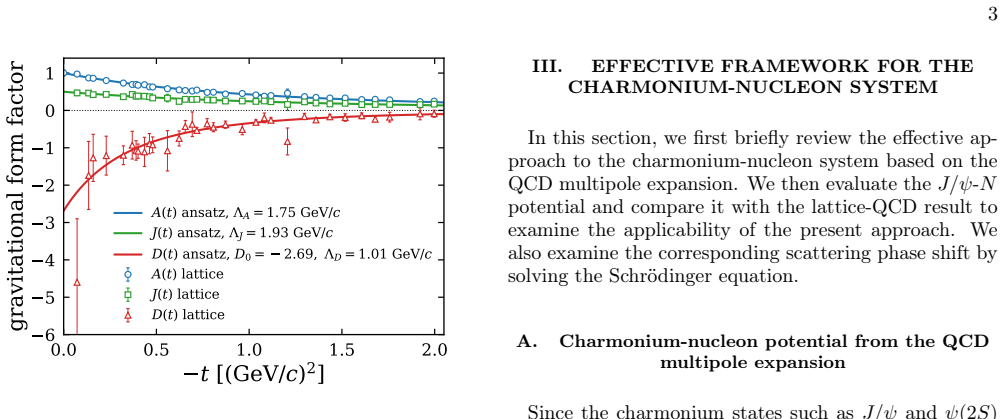
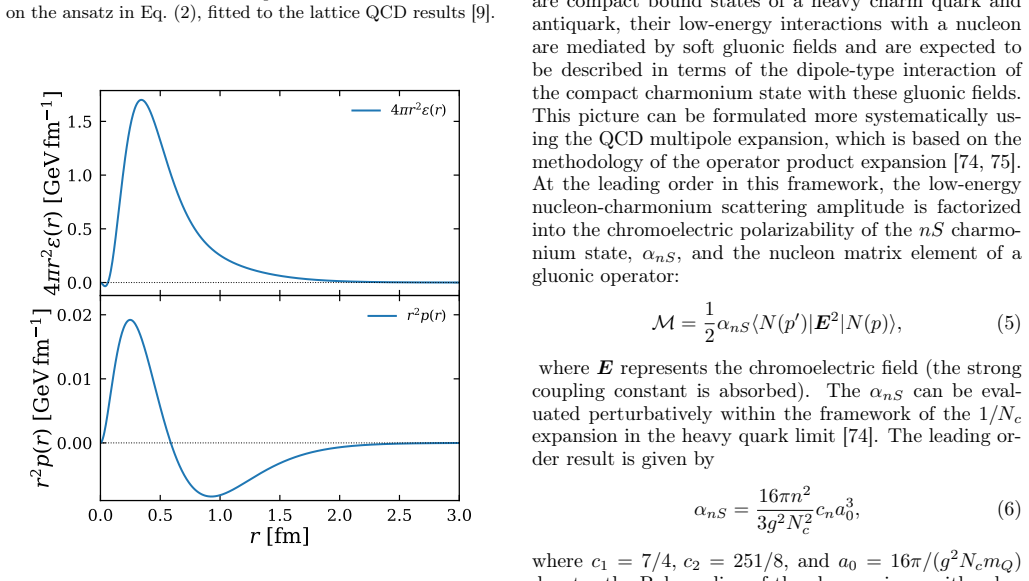
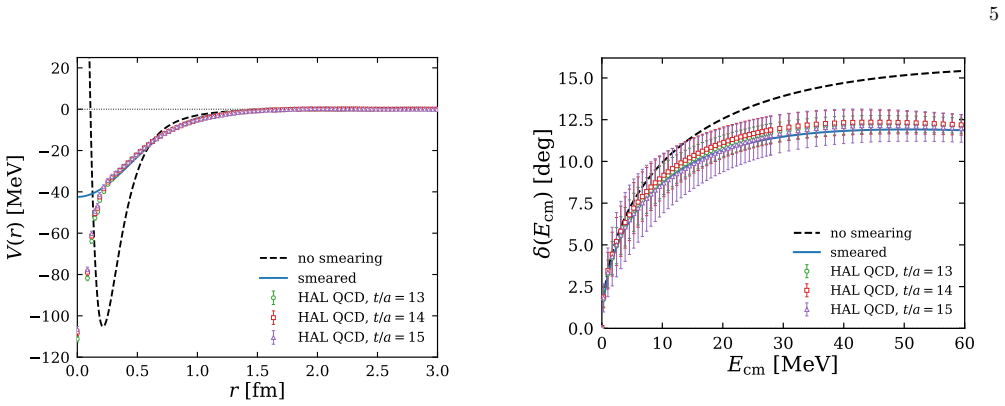
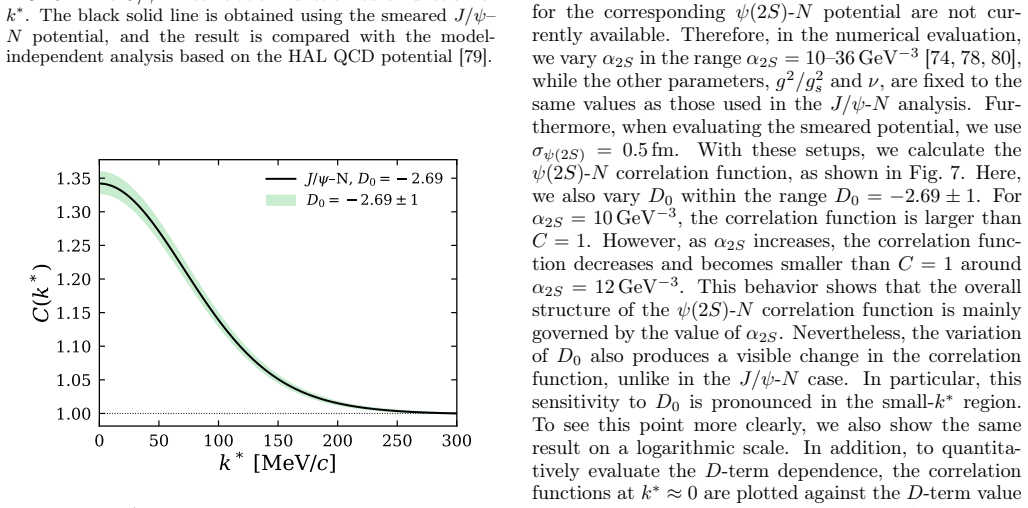
The J/ψ-N and ψ(2S)-N correlation functions exhibit sensitivity to the nucleon D-form factor, allowing femtoscopy to serve as a probe of the gravitational form factors. The effective potential is expressed in terms of the energy and pressure distributions inside the nucleon, constructed from the gravitational form factors fitted to lattice-QCD data, with remaining parameters fixed by reproducing the HAL QCD potential outside the short-distance region and the scattering phase shift.
Load-bearing premise
The effective potential constructed from the leading chromoelectric dipole term accurately represents the charmonium-nucleon interaction at the distances relevant for the correlation function.
Editorial extensions
If this is right
- The correlation function for the J/ψ-N system can be evaluated using the constructed potential.
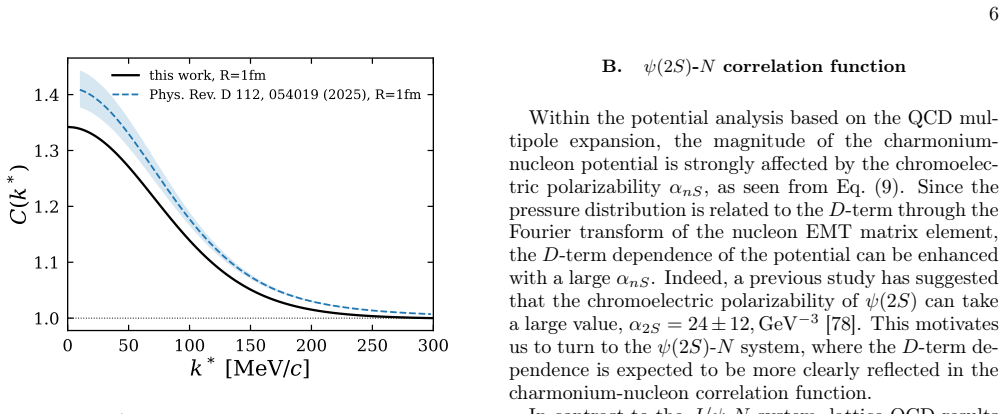
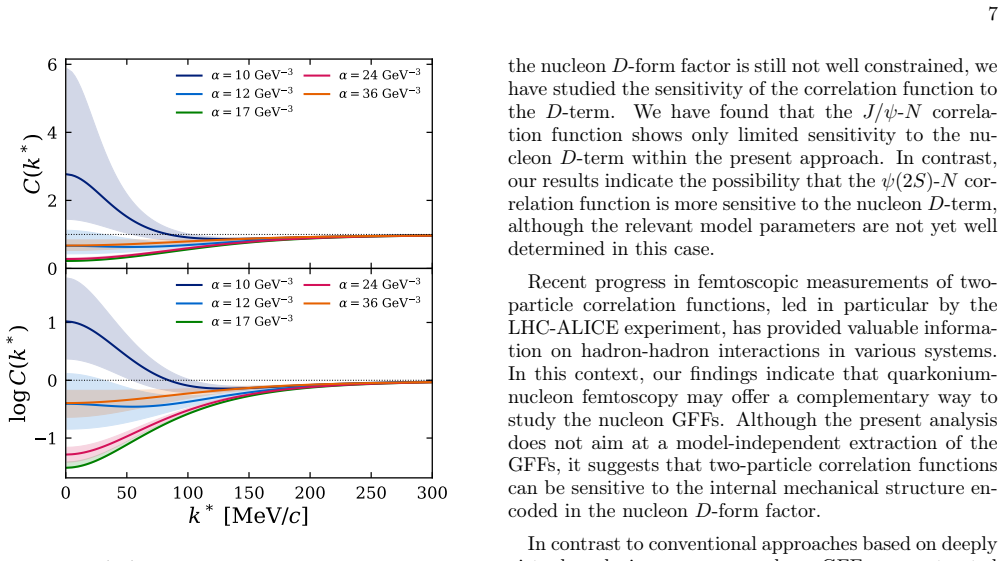
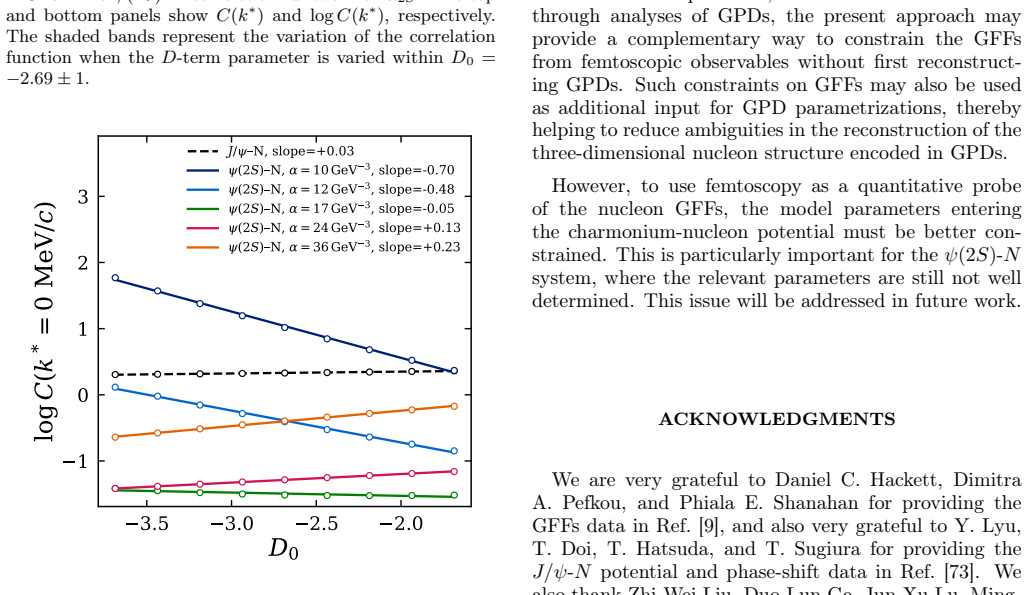
- The ψ(2S)-N correlation function can be similarly computed and shows sensitivity to the D-form factor.
- Femtoscopy of these systems can serve as a probe of the nucleon gravitational form factors.
- The potential reproduces the HAL QCD results outside short distances when parameters are fixed accordingly.
Reading between the lines
- Experimental data on these correlation functions could provide constraints on the D-form factor independent of lattice calculations.
- The approach might be generalized to other heavy mesons interacting with nucleons to study similar structure properties.
- Confirmation would require dedicated measurements in high-energy collisions where such pairs are produced.
Signed reviews
Editorial analysis
A structured set of objections, weighed in public.
Referee Report
Summary. The manuscript constructs an effective charmonium-nucleon potential from the leading chromoelectric dipole term of the QCD multipole expansion, with the nucleon's energy and pressure distributions obtained from gravitational form factors (GFFs) fitted to lattice QCD. Model parameters are fixed by matching the resulting J/ψ-N potential to the HAL QCD potential for r larger than a short-distance cutoff and to the associated phase shift. The J/ψ-N and ψ(2S)-N correlation functions are then computed and shown to exhibit sensitivity to the D-form factor, leading to the claim that femtoscopy can serve as a probe of nucleon GFFs.
Significance. If the leading-dipole approximation and parameter-fixing procedure remain valid in the distance window controlling the correlation functions, the work supplies a concrete, falsifiable link between lattice GFFs and a measurable femtoscopic observable, offering an independent route to the D-term that complements existing lattice and phenomenological approaches.
major comments (2)
- [effective potential construction] The central sensitivity claim rests on the assertion that the leading chromoelectric dipole potential accurately represents the interaction at distances 0.5–2 fm. No explicit estimate or bound is provided on the size of higher-multipole corrections in this interval (see the section constructing the effective potential from the multipole expansion and the subsequent comparison with HAL QCD data).
- [correlation function results] The correlation functions are evaluated after fixing parameters to reproduce the HAL QCD potential outside a short-distance cutoff. The manuscript does not report a quantitative propagation of the lattice GFF fit uncertainties or of the cutoff choice into the final C(q) curves, leaving the statistical significance of the reported D-form factor dependence unquantified (see the results section on J/ψ-N and ψ(2S)-N correlation functions).
minor comments (2)
- [GFF definitions] The notation for the energy and pressure distributions extracted from the GFFs should be defined explicitly with reference to the standard decomposition of the energy-momentum tensor matrix element.
- [figures] Figure captions for the correlation functions should state the momentum range over which C(q) is plotted and whether the curves include Coulomb or other long-range corrections.
Simulated Author's Rebuttal
We thank the referee for the constructive comments and the positive overall assessment. We address each major comment below, indicating where revisions will be made.
read point-by-point responses
-
Referee: [effective potential construction] The central sensitivity claim rests on the assertion that the leading chromoelectric dipole potential accurately represents the interaction at distances 0.5–2 fm. No explicit estimate or bound is provided on the size of higher-multipole corrections in this interval (see the section constructing the effective potential from the multipole expansion and the subsequent comparison with HAL QCD data).
Authors: We agree that an explicit estimate or bound on higher-multipole corrections would strengthen the presentation. The leading dipole approximation is justified by the multipole expansion and by the matching to HAL QCD data in the relevant range, which constrains the net effect of higher terms. We will add a short discussion of the expected suppression of higher multipoles (scaling with powers of the charmonium size over distance) in the revised manuscript, while noting that a precise numerical bound would require additional higher-order lattice calculations not available here. revision: partial
-
Referee: [correlation function results] The correlation functions are evaluated after fixing parameters to reproduce the HAL QCD potential outside a short-distance cutoff. The manuscript does not report a quantitative propagation of the lattice GFF fit uncertainties or of the cutoff choice into the final C(q) curves, leaving the statistical significance of the reported D-form factor dependence unquantified (see the results section on J/ψ-N and ψ(2S)-N correlation functions).
Authors: We accept this point. The revised manuscript will include error bands on the correlation functions propagated from the lattice GFF fit uncertainties and will show results for a range of cutoff values. This will allow a quantitative assessment of the robustness and statistical significance of the D-form factor dependence. revision: yes
Circularity Check
No significant circularity; derivation uses external inputs without self-referential reduction
full rationale
The paper constructs the effective potential from GFFs fitted to independent lattice-QCD data, fixes auxiliary parameters by matching to external HAL QCD results, and then computes correlation functions to illustrate their dependence on the D-form factor. This dependence follows directly from the model construction but does not constitute a 'prediction' that reduces to the inputs by definition or via self-citation; the central claim is a proposal that femtoscopy measurements could constrain the GFFs, which remains falsifiable against future data and does not rely on any of the enumerated circular patterns. No load-bearing self-citation, ansatz smuggling, or fitted-input-renamed-as-prediction is present in the provided text.
Assumptions & free parameters
free parameters (1)
- remaining model parameters after GFF input
assumptions (2)
- domain assumption QCD multipole expansion in leading chromoelectric dipole approximation accurately describes charmonium-nucleon interaction
- domain assumption Gravitational form factors fitted to lattice-QCD data correctly yield the energy and pressure distributions inside the nucleon
Cite this review
Pith. "Pith review of Charmonium-nucleon femtoscopy as a possible probe of the nucleon gravitational form factor." pith.science (2026). https://pith.science/paper/OMHDVWEN
@misc{pith2026260700650,
  author       = {Pith},
  title        = {Pith review of: Charmonium-nucleon femtoscopy as a possible probe of the nucleon gravitational form factor},
  year         = {2026},
  howpublished = {\url{https://pith.science/paper/OMHDVWEN}},
  note         = {Machine review of arXiv:2607.00650}
}
abstract
We investigate the charmonium-nucleon interaction, focusing on its connection with the internal structure of the nucleon encoded in the gravitational form factors. To describe this interaction, we employ an effective potential based on the QCD multipole expansion within the leading chromoelectric dipole approximation. In this framework, the potential is expressed in terms of the energy and pressure distributions inside the nucleon. We first construct these distributions from the gravitational form factors fitted to lattice-QCD data. The remaining model parameters are then fixed by requiring that the resulting $J/\psi$-$N$ potential reproduce the HAL QCD potential outside the short-distance region, as well as the scattering phase shift estimated from the HAL QCD data. Based on this potential, we evaluate the $J/\psi$-$N$ correlation function and further investigate the $\psi(2S)$-$N$ system. We then examine the sensitivity of these correlation functions to the nucleon $D$-form factor.
Figures
Figures from the paper (4 more)
Forward citations
Cited by 1 Pith paper
-
Chromoelectric and chromomagnetic matching to scalar and spin-two nucleon structure
A consistent matching framework shows the chromomagnetic-to-chromoelectric ratio rescales the gluonic spin-two/scalar response by (1+rho)/(1-rho) in aligned quarkonium-nucleon scattering.
Reference graph
Works this paper leans on
-
[1]
M. V. Polyakov and P. Schweitzer, International Journal of Modern Physics A33, 1830025 (2018), https://doi.org/10.1142/S0217751X18300259. 8
-
[2]
V. D. Burkert, L. Elouadrhiri, F. X. Girod, C. Lorcé, P. Schweitzer, and P. E. Shanahan, Rev. Mod. Phys.95, 041002 (2023)
work page 2023
-
[3]
P. E. Shanahan and W. Detmold, Phys. Rev. Lett.122, 072003 (2019)
work page 2019
-
[4]
M. Kawaguchi, M. Harada, and Y.-L. Ma, Phys. Lett. B 876, 140400 (2026), arXiv:2512.23937 [hep-ph]
- [5]
- [6]
- [7]
-
[8]
D. Fujii, A. Iwanaka, and M. Tanaka, Physical Review D 112, 10.1103/2ngy-t5zp (2025)
Show all 87 references
-
[9]
D. C. Hackett, D. A. Pefkou, and P. E. Shanahan, Phys. Rev. Lett.132, 251904 (2024)
2024
-
[10]
I. V. Anikin, Phys. Rev. D99, 094026 (2019)
2019
-
[11]
Avelino, Physics Letters B795, 627 (2019)
P. Avelino, Physics Letters B795, 627 (2019)
2019
-
[12]
Yanagihara and M
R. Yanagihara and M. Kitazawa, Progress of The- oretical and Experimental Physics2019, 093B02 (2019), https://academic.oup.com/ptep/article- pdf/2019/9/093B02/29583246/ptz093.pdf
2019
-
[13]
K. A. Mamo and I. Zahed, Phys. Rev. D101, 086003 (2020)
2020
-
[14]
M. J. Neubelt, A. Sampino, J. Hudson, K. Tezgin, and P. Schweitzer, Phys. Rev. D101, 034013 (2020)
2020
-
[15]
Varma and P
M. Varma and P. Schweitzer, Phys. Rev. D102, 014047 (2020)
2020
-
[16]
Chakrabarti, C
D. Chakrabarti, C. Mondal, A. Mukherjee, S. Nair, and X. Zhao, Phys. Rev. D102, 113011 (2020)
2020
-
[17]
Freese and G
A. Freese and G. A. Miller, Phys. Rev. D103, 094023 (2021)
2021
-
[18]
J. Y. Panteleeva and M. V. Polyakov, Phys. Rev. D104, 014008 (2021)
2021
-
[19]
Freese and G
A. Freese and G. A. Miller, Phys. Rev. D104, 014024 (2021)
2021
-
[20]
Kim and H.-C
J.-Y. Kim and H.-C. Kim, Phys. Rev. D104, 074019 (2021)
2021
-
[21]
S. Owa, A. Thomas, and X. Wang, Physics Letters B 829, 137136 (2022)
2022
-
[22]
D. A. Pefkou, D. C. Hackett, and P. E. Shanahan, Phys. Rev. D105, 054509 (2022)
2022
-
[23]
J. More, A. Mukherjee, S. Nair, and S. Saha, Phys. Rev. D105, 056017 (2022)
2022
-
[24]
Fujita, Y
M. Fujita, Y. Hatta, S. Sugimoto, and T. Ueda, Progress of Theoretical and Experimental Physics2022, 093B06 (2022), https://academic.oup.com/ptep/article- pdf/2022/9/093B06/45762953/ptac110.pdf
2022
-
[25]
Choudhary, B
P. Choudhary, B. Gurjar, D. Chakrabarti, and A. Mukherjee, Phys. Rev. D106, 076004 (2022)
2022
-
[26]
Kim, B.-D
J.-Y. Kim, B.-D. Sun, D. Fu, and H.-C. Kim, Phys. Rev. D107, 054007 (2023)
2023
-
[27]
Won, J.-Y
H.-Y. Won, J.-Y. Kim, and H.-C. Kim, Phys. Rev. D 106, 114009 (2022)
2022
-
[28]
Won, H.-C
H.-Y. Won, H.-C. Kim, and J.-Y. Kim, Phys. Rev. D 108, 094018 (2023)
2023
-
[29]
Hatta, Phys
Y. Hatta, Phys. Rev. D109, L051502 (2024)
2024
-
[30]
W.-Y. Liu, E. Shuryak, and I. Zahed, Phys. Rev. D110, 054005 (2024)
2024
-
[31]
Goharipour, H
M. Goharipour, H. Hashamipour, H. Fatehi, F. Irani, K. Azizi, and S. V. Goloskokov (MMGPDs Collabora- tion), Phys. Rev. D112, 014016 (2025)
2025
-
[32]
Broniowski and E
W. Broniowski and E. R. Arriola, Gravitational form fac- tors and mechanical properties of the nucleon in a meson dominance approach (2025), arXiv:2503.09297 [hep-ph]
2025
-
[33]
Sugimoto and T
S. Sugimoto and T. Tsukamoto, Progress of Theoretical and Experimental Physics2025, 10.1093/ptep/ptaf094 (2025)
2025 doi
-
[34]
S. Nair, C. Mondal, S. Xu, X. Zhao, and J. P. Vary, Proton gravitational structure and mass decomposition on the light front (2025), arXiv:2506.07554 [hep-ph]
2025
-
[35]
Cao, F.-K
X.-H. Cao, F.-K. Guo, Q.-Z. Li, B.-W. Wu, and D.- L. Yao, The European Physical Journal Special Topics 10.1140/epjs/s11734-025-02025-9 (2025)
2025 doi
-
[36]
Stegeman and R
R. Stegeman and R. Zwicky, Gravitationald-form factor: Theσ-meson as a dilaton confronted with lattice data (2026), arXiv:2508.18537 [hep-ph]
2026
-
[37]
Dehghan, F
Z. Dehghan, F. Almaksusi, and K. Azizi, Journal of High Energy Physics2025, 25 (2025)
2025
-
[38]
Yao, Y.-Z
Z.-Q. Yao, Y.-Z. Xu, D. Binosi, Z.-F. Cui, M. Ding, K. Raya, C. D. Roberts, J. Rodríguez-Quintero, and S. M. Schmidt, The European Physical Journal A61, 92 (2025)
2025
-
[39]
Cao, F.-K
X.-H. Cao, F.-K. Guo, Q.-Z. Li, and D.-L. Yao, Nature Communications16, 6979 (2025)
2025
-
[40]
Won, H.-C
H.-Y. Won, H.-C. Kim, and J.-Y. Kim, Journal of High Energy Physics2024, 173 (2024)
2024
-
[41]
Azizi and U
K. Azizi and U. Özdem, The European Physical Journal C80, 104 (2020)
2020
-
[42]
Lorcé, H
C. Lorcé, H. Moutarde, and A. P. Trawiński, The Euro- pean Physical Journal C79, 89 (2019)
2019
-
[43]
M. V. Polyakov and H.-D. Son, Journal of High Energy Physics2018, 156 (2018)
2018
-
[44]
V. D. Burkert, L. Elouadrhiri, and F. X. Girod, Nature 557, 396 (2018)
2018
-
[45]
V. D. Burkert, L. Elouadrhiri, and F. X. Girod, De- termination of shear forces inside the proton (2021), arXiv:2104.02031 [nucl-ex]
2021
-
[46]
Duran, Z.-E
B. Duran, Z.-E. Meziani, S. Joosten, M. K. Jones, S. Prasad, C. Peng, W. Armstrong, H. Atac, E. Chu- dakov, H. Bhatt, D. Bhetuwal, M. Boer, A. Camsonne, J.-P. Chen, M. M. Dalton, N. Deokar, M. Diefenthaler, J. Dunne, L. El Fassi, E. Fuchey, H. Gao, D. Gaskell, O. Hansen, F. Ha...
2023
-
[47]
Chatagnon, V
P. Chatagnon, V. Kubarovsky, R. Paremuzyan, S. Stepa- nyan, M. Tenorio, R. Tyson, A. G. Acar, P. Achen- bach, J. S. Alvarado, M. J. Amaryan, W. R. Armstrong, H. Avakian, N. A. Baltzell, L. Barion, M. Bashkanov, M. Battaglieri, F. Benmokhtar, A. Bianconi, A. S. Biselli, S. Boia...
2026
-
[48]
Moutarde, P
H. Moutarde, P. Sznajder, and J. Wagner, The European Physical Journal C78, 890 (2018)
2018
-
[49]
Kumerički, S
K. Kumerički, S. Liuti, and H. Moutarde, The European Physical Journal A52, 157 (2016)
2016
-
[50]
R.Dupré, M.Guidal, S.Niccolai,andM.Vanderhaeghen, The European Physical Journal A53, 171 (2017)
2017
-
[51]
Moutarde and T
H. Moutarde and T. C. group at Saclay, AIP Conference Proceedings1374, 133 (2011)
2011
-
[52]
Christiaens, M
G. Christiaens, M. Defurne, D. Sokhan, P. Achen- bach, Z. Akbar, M. J. Amaryan, H. Atac, H. Avakian, C. A. Gayoso, L. Baashen, N. A. Baltzell, L. Barion, M. Bashkanov, M. Battaglieri, I. Bedlinskiy, B. Benkel, F. Benmokhtar, A. Bianconi, A. S. Biselli, M. Bondi, W. A. Booth, F...
2023
-
[53]
Collaboration, Physical Review Letters127, 10.1103/physrevlett.127.172301 (2021)
A. Collaboration, Physical Review Letters127, 10.1103/physrevlett.127.172301 (2021)
2021 doi
-
[54]
Collaboration, First direct access to theρ 0p in- teraction via correlation studies at the lhc (2025), arXiv:2508.09867 [nucl-ex]
A. Collaboration, First direct access to theρ 0p in- teraction via correlation studies at the lhc (2025), arXiv:2508.09867 [nucl-ex]
2025
-
[55]
Collaboration,K 0 S −K 0 S femtoscopy in pb−pb collisions at √snn =5.02tev at the lhc (2026), arXiv:2605.02321 [nucl-ex]
A. Collaboration,K 0 S −K 0 S femtoscopy in pb−pb collisions at √snn =5.02tev at the lhc (2026), arXiv:2605.02321 [nucl-ex]
2026 arXiv
-
[56]
Acharyaet al.(ALICE), JHEP04, 113, arXiv:2601.15081 [nucl-ex]
S. Acharyaet al.(ALICE), JHEP04, 113, arXiv:2601.15081 [nucl-ex]
-
[57]
I. J. Abualrobet al.(ALICE), Phys. Lett. B874, 140252 (2026), arXiv:2510.14448 [nucl-ex]
2026
-
[58]
I. J. Abualrobet al.(ALICE), Phys. Lett. B874, 140227 (2026), arXiv:2509.24519 [nucl-ex]
2026
-
[59]
Acharyaet al.(ALICE), Phys
S. Acharyaet al.(ALICE), Phys. Lett. B871, 139921 (2025), arXiv:2505.01061 [nucl-ex]
2025
-
[60]
Acharyaet al.(ALICE), Eur
S. Acharyaet al.(ALICE), Eur. Phys. J. A61, 194 (2025), arXiv:2502.20200 [nucl-ex]
2025
-
[61]
Rzesa (ALICE), Nuovo Cim
W. Rzesa (ALICE), Nuovo Cim. C47, 195 (2024)
2024
-
[62]
Acharyaet al.(ALICE), Phys
S. Acharyaet al.(ALICE), Phys. Lett. B856, 138915 (2024), arXiv:2312.12830 [hep-ex]
2024
-
[63]
Acharyaet al.(ALICE), Phys
S. Acharyaet al.(ALICE), Phys. Lett. B845, 138145 (2023), arXiv:2305.19093 [nucl-ex]
2023
-
[64]
Acharyaet al.(ALICE), Eur
S. Acharyaet al.(ALICE), Eur. Phys. J. A59, 298 (2023), arXiv:2303.13448 [nucl-ex]
2023
-
[65]
Acharyaet al.(ALICE), Phys
S. Acharyaet al.(ALICE), Phys. Rev. C107, 054904 (2023), arXiv:2211.15194 [nucl-ex]
2023
-
[66]
Humanic (ALICE), Rev
T. Humanic (ALICE), Rev. Mex. Fis. Suppl.3, 0308039 (2022)
2022
-
[67]
Acharyaet al.(ALICE), Phys
S. Acharyaet al.(ALICE), Phys. Lett. B844, 137223 (2023), arXiv:2204.10258 [nucl-ex]
2023
-
[68]
Acharyaet al.(ALICE), Phys
S. Acharyaet al.(ALICE), Phys. Lett. B833, 137335 (2022), arXiv:2111.06611 [nucl-ex]
2022
-
[69]
Acharyaet al.(ALICE), Phys
S. Acharyaet al.(ALICE), Phys. Lett. B822, 136708 (2021), arXiv:2105.05683 [nucl-ex]
2021
-
[70]
D. L. Mihaylov (ALICE), Nucl. Phys. A1005, 121760 (2021)
2021
-
[71]
Mikhaylov (ALICE), J
K. Mikhaylov (ALICE), J. Phys. Conf. Ser.1690, 012099 (2020)
2020
-
[72]
Rzęsa (ALICE), Proc
W. Rzęsa (ALICE), Proc. SPIE Int. Soc. Opt. Eng. 11581, 1158114 (2020)
2020
-
[73]
Krein and T
G. Krein and T. C. Peixoto, Few-Body Systems61, 49 (2020)
2020
-
[74]
Y. Lyu, T. Doi, T. Hatsuda, and T. Sugiura, Physics Letters B860, 139178 (2025)
2025
-
[75]
M. E. Peskin, Nuclear Physics B156, 365 (1979)
1979
-
[76]
Bhanot and M
G. Bhanot and M. E. Peskin, Nuclear Physics B156, 391 (1979)
1979
-
[77]
M. I. Eides, V. Y. Petrov, and M. V. Polyakov, Phys. Rev. D93, 054039 (2016)
2016
-
[78]
Sugiura, Y
T. Sugiura, Y. Ikeda, and N. Ishii, EPJ Web Conf.175, 05011 (2018), arXiv:1711.11219 [hep-lat]
2018 arXiv
-
[79]
M. V. Polyakov and P. Schweitzer, Phys. Rev. D98, 034030 (2018)
2018
-
[80]
Liu, D.-L
Z.-W. Liu, D.-L. Ge, J.-X. Lu, M.-Z. Liu, and L.-S. Geng, Phys. Rev. D112, 054019 (2025). 10
2025
-
[81]
I. A. Perevalova, M. V. Polyakov, and P. Schweitzer, Phys. Rev. D94, 054024 (2016)
2016
-
[82]
Nochi, T
K. Nochi, T. Kawanai, and S. Sasaki, Phys. Rev. D94, 114514 (2016)
2016
-
[83]
Kawanai and S
T. Kawanai and S. Sasaki, Phys. Rev. D92, 094503 (2015)
2015
-
[84]
Hentschinski and E
M. Hentschinski and E. Padrón Molina, Phys. Rev. D 103, 074008 (2021)
2021
-
[85]
M. I. Eides, V. Y. Petrov, and M. V. Polyakov, The Eu- ropean Physical Journal C78, 36 (2018)
2018
-
[86]
Barnes, S
T. Barnes, S. Godfrey, and E. S. Swanson, Phys. Rev. D 72, 054026 (2005)
2005
-
[87]
Kharzeev, Classical chromo-dynamics of relativistic heavy ion collisions (2002), arXiv:hep-ph/0204014 [hep- ph]
D. Kharzeev, Classical chromo-dynamics of relativistic heavy ion collisions (2002), arXiv:hep-ph/0204014 [hep- ph]
2002 arXiv
Reviewed July 3, 2026 · model on record in the stance chip above.
Discussion (0). Continue with ORCID to comment.