REVIEW 3 major objections 5 minor 5 cited by
Triple (and quadruple) soft-gluon radiation in QCD hard scattering
T0 review · 3 major / 5 minor · reviewed 2026-08-14 · deepseek-v4-flash
Pith's one-line read This paper establishes the complete tree-level current for emission of three soft gluons in any QCD hard-scattering process, with arbitrary relative energies and for massless or massive hard partons.
desk verdict First complete triple-soft-gluon current, with a verification gap that a referee should ask the authors to close. read the letter →
The pith
A machine-rendered reading of the paper's core claim, the machinery that carries it, and where it could break.
The reading
What carries the argument
The load-bearing object is the tree-level soft-gluon current $J(q_1,q_2,q_3)$, a colour operator that multiplies the reduced hard-scattering amplitude in the soft limit; its decomposition into symmetrized products of lower-multiplicity currents plus an irreducible three-gluon correlation $\Gamma^{(3)}$ is what makes the computation complete without energy ordering. The other central object is the colour quadrupole operator $Q_{imkl} = \frac{1}{2} f^{ab,cd}\left(T^a_k\{T^c_i,T^d_m\}T^b_l + \mathrm{h.c.}\right)$, which isolates the irreducible quadrupole correlation in the squared current. Its antisymmetries, Jacobi identity, and colour-conservation properties are what make the quadrupole component collinear safe and make it vanish for scattering with only two hard partons.
What would settle it
Compute a concrete three-soft-gluon tree amplitude, such as $e^+e^- \to q\bar{q} g g g$, with an independent Feynman-diagram program at several phase-space points where the three soft-gluon energies are comparable, and compare the leading $1/\xi^3$ singular term with Eqs. (3.1), (3.4), and (3.7); any mismatch at that order would refute the claimed universality.
Extended reading notes
Core claim
The paper claims that Eqs. (3.1), (3.4), and (3.7) give the complete tree-level soft current $J^{a_1 a_2 a_3}_{\mu_1\mu_2\mu_3}(q_1,q_2,q_3)$ for triple soft-gluon radiation in any QCD hard-scattering process, valid for arbitrary relative soft energies and for massless or massive hard partons. The current is expressed as symmetrized products of single- and double-gluon currents plus an irreducible three-gluon correlation $\Gamma^{(3)}$ built from two structure constants. For squared amplitudes, the three-gluon correlation separates into a colour-dipole part proportional to $C_A^2$ and a colour-quadrupole part $Q_{imkl}$, and the quadrupole part is gauge invariant, collinear safe, and irreducible to dipoles. Applying this to three hard partons gives different eigenvalues for quark and gluon colour states, so the standard Casimir replacement $C_F \to C_A$ fails at this order. For two hard partons and four soft gluons, the paper identifies the colour monster contribution with a quartic Casimir invariant and computes the first $O(1/N_c^2)$ correction to the multi-eikonal BCM formula.
Load-bearing premise
The load-bearing premise is that the leading soft singularity comes solely from attaching the soft gluons to the external hard-parton legs, with internal-line attachments power suppressed; the four-gluon colour structure additionally assumes that a topological colour argument extends an energy-ordered computation to arbitrary energies.
Editorial extensions
If this is right
- Any QCD hard-scattering process at order $\alpha_S^3$ can use the same triple-soft current, so soft singularities no longer need energy-ordering or process-specific approximations.
- For amplitudes with three or more hard partons, triple soft-gluon radiation produces colour quadrupole correlations that are absent in one- and two-gluon emission.
- The quadrupole part of the squared current is collinear safe, so all collinear singularities of the three-gluon squared current sit in the dipole part and match the known multiparton collinear factorization pattern.
- For three hard partons, the quadrupole term makes quark and gluon results differ beyond the Casimir replacement $C_F \to C_A$, meaning Casimir scaling fails at $O(\alpha_S^3)$.
- For two hard partons, quadruple soft-gluon radiation contains the colour monster term, which is tied to quartic Casimir invariants and produces the first $O(1/N_c^2)$ correction to the BCM multi-eikonal formula.
Reading between the lines
- The collinear safety of the quadrupole component implies that any subtraction scheme or parton shower that keeps only angular-ordered dipole radiation will miss the quadrupole term entirely; its numerical relevance in typical LHC phase space is a testable question not settled in the paper.
- Combining Eq. (5.6) with a Monte Carlo phase-space generator would give a quantitative estimate of quadrupole versus dipole contributions for specific processes, which the paper does not provide.
- The explicit $O(1/N_c^2)$ colour monster term supplies a concrete field-theoretic origin for the quartic-Casimir part of the four-loop cusp anomalous dimension; computing that cusp term independently and matching Eq. (7.16) would test whether the connection is exact.
- Because the current depends only on colour charges and external momenta, the same triple-gluon result should apply unchanged to any coloured hard particles in a conjugate pair of representations, not only quarks and gluons.
Signed reviews
Editorial analysis
A structured set of objections, weighed in public.
Referee Report
Summary. This paper derives the tree-level soft current for triple soft-gluon emission in QCD hard scattering, for arbitrary relative soft energies and for both massless and massive hard partons. The current is expressed in terms of irreducible non-abelian correlations, and the squared current is decomposed into dipole and quadrupole colour correlations. The paper then applies the result to processes with three and two hard partons, studies energy-ordered and collinear limits, derives violation of Casimir scaling for three hard partons, and presents partial results for quadruple soft-gluon radiation from two hard partons, including the colour-monster contribution and a first correction to the multi-eikonal BCM formula.
Significance. If correct, the result is the first complete N=3 soft-gluon current and squared current, going beyond previous energy-ordered and process-specific results. The paper contains several valuable independent cross-checks: the colour-stripped current agrees with the Berends-Giele iterative procedure (Eq. (3.10)), the energy strong-ordering limits agree with the BCM and related results, the current is checked in axial and covariant gauges, and collinear limits reproduce expected factorization factors. These checks make a gross error unlikely. The main caveat is that the central algebraic derivation is not fully exhibited; the current-conservation check is delegated to an unpublished thesis, and the squared-current decomposition is stated after 'straightforward but cumbersome' manipulations without reproducible intermediate algebra.
major comments (3)
- [§3, Eq. (3.7)] The current conservation relation (2.8) for the explicit triple-gluon current is asserted to follow from 'a straightforward algebraic calculation [32]', but [32] is an unpublished Laurea thesis. Appendix A proves that a conserved current can be constructed by the projector in Eq. (A.1); it does not prove that the displayed expression in Eqs. (3.1), (3.4) and (3.7) satisfies Eq. (2.8). This property is load-bearing because Eq. (4.6) replaces physical polarization sums by -g^mu nu, and the entire squared-current and collinear-safety analysis depends on it. Please provide either an explicit derivation of Eq. (2.8) for the given current or a reproducible machine-checkable algebraic verification.
- [§5.1–5.3, Eqs. (5.1), (5.4)–(5.6), (5.20)] The decomposition of |J(q1,q2,q3)|^2 into dipole and quadrupole irreducible correlations is not demonstrated in the paper: Eq. (5.1) is said to follow from 'straightforward (though quite cumbersome) algebraic manipulations', and no intermediate algebra or ancillary computer-algebra file is provided. The subsequent claims of quadrupole collinear safety in §5.4 and of Casimir-scaling violation in §6.2 rest directly on this decomposition. Please include a complete derivation, a supplementary notebook, or a clearly specified independent numerical check of Eqs. (5.4)–(5.6) and (5.20).
- [§7.3, Eqs. (7.15)–(7.18)] The general colour structure of W^(4) in Eq. (7.15) is stated for arbitrary soft energies on the basis of a topological colour-coefficient argument, while the explicit functions w^(4)(L)_BC and w^(4)(S)_BC are computed only in the energy-ordered region E_l << E_4, l=1,2,3. The statement that energy ordering affects only the momentum dependence and not the colour factors is essential for the colour-monster and Casimir-scaling conclusions of §7.3. Please present the topological diagram-colour analysis in more detail, or supply an independent verification of Eq. (7.15) outside the energy-ordered region.
minor comments (5)
- [§2.1, after Eq. (2.8)] There is a typo in 'the multigluon current J of Eq. (2.5) con be expressed'; it should read 'can be expressed'.
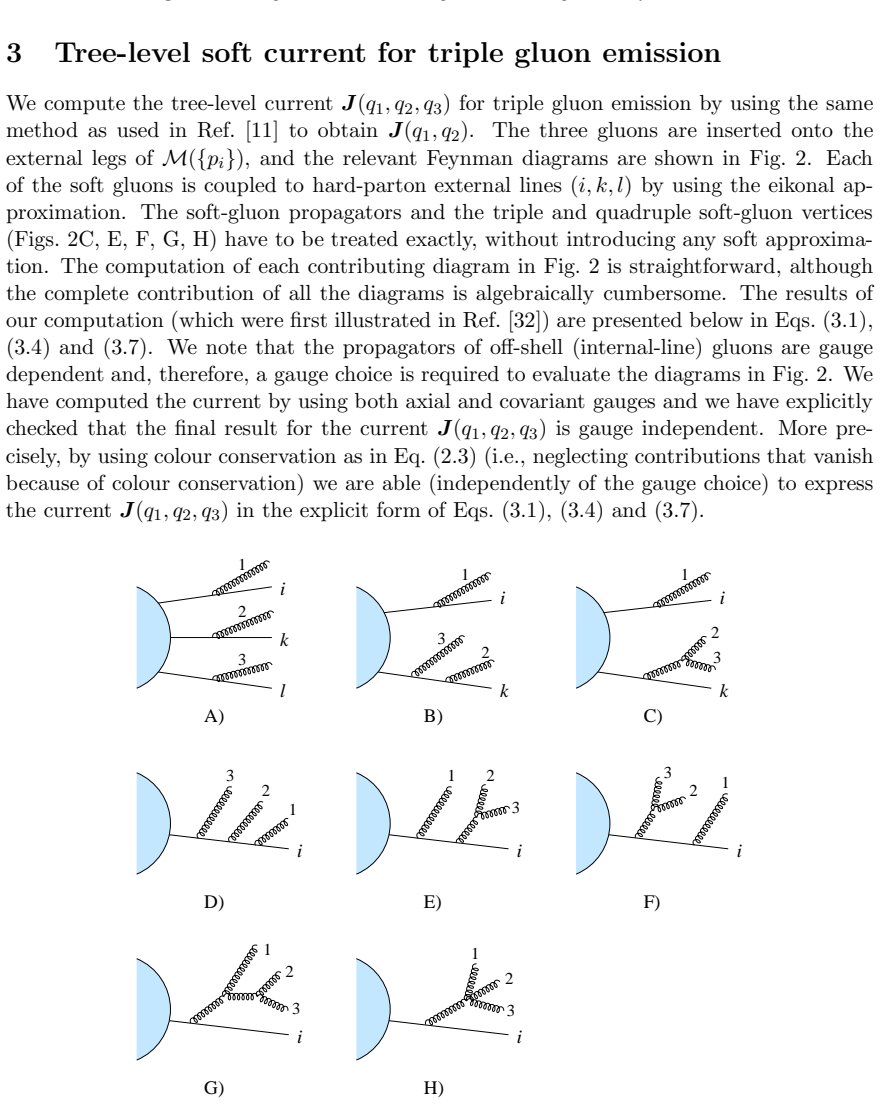
- [§3, Fig. 2] In the manuscript rendering, the diagram labels in Fig. 2 are very difficult to read; please provide a cleaner figure or a caption that identifies the topologies A–H.
- [§5.2, Eq. (5.10)] The notation w^(2)_3i and w^(2)_3k is introduced by describing a momentum replacement; please make the replacement explicit in the notation, for example by writing w^(2)_ik(p_i -> q3, p_k) or a similar definition before first use.
- [§5.3, Eqs. (5.13)–(5.14)] The abbreviation 'ineq. perms.' is used without definition at first occurrence; please define it as the sum over inequivalent cyclic/permutation chains of the named momenta.
- [Appendix C] The scalar-product shorthand such as pi q_l and pk q_l is used in the long expressions before the defining remark '(ki · km ≡ kikm)'; please move the definition to the beginning of Appendix C.
Circularity Check
No circularity: the triple-soft current is derived from QCD Feynman rules, given explicitly, and checked against independent Berends–Giele and BCM benchmarks; no fitted input or self-citation chain forces the central claim.
full rationale
The paper's central claims are self-contained derivations, not disguised inputs. The soft factorization formula (2.5) is a standard external starting point cited to Refs. [9,10,31], including the independent work of Feige and Schwartz, and it is not the result being derived. The double-gluon current (2.11)–(2.13) is taken from Ref. [11], a published parameter-free prior result, and is used only as an ingredient in the triple-gluon construction. The triple current itself is computed from the explicit Feynman diagrams in Fig. 2, with gauge independence checked in both axial and covariant gauges, and with the colour-ordered soft factor independently reproduced using the Berends–Giele iterative procedure of Ref. [27]. The energy-ordered limits of the squared current are compared with the independent BCM results [23] and with Refs. [24,28], and agreement is reported. No parameter is fitted, and no assertion is justified solely by a self-citation whose content is equivalent to the claimed result. The two caveats noted in the manuscript are verification gaps rather than circular steps: the explicit check that Eq. (3.7) satisfies current conservation (2.8) is delegated to the unpublished Laurea thesis [32], and the squared-current algebra leading to (5.1) is described as cumbersome rather than displayed in full. However, the formulas are printed in the paper, Appendix A gives a general proof of the existence of a conserved form, and the Berends–Giele and BCM cross-checks provide independent support that a gross algebraic error is absent. Similarly, the four-gluon colour structure in Eq. (7.15) is derived from Eq. (7.3) and lower-multiplicity results, with explicit energy-ordered computations; the topological colour argument extends the coefficient structure to arbitrary energies but does not define the target result into existence. The derivation chain therefore does not reduce to its own inputs, and no circularity is present.
Assumptions & free parameters
assumptions (5)
- domain assumption Universal soft-gluon factorization formula (2.5): the leading 1/xi^N singularity is J(q_1,...,q_N)|M({p_i})>.
- domain assumption Eikonal approximation for emission from external hard lines, with soft-gluon propagators and multi-gluon vertices treated exactly.
- domain assumption Conventional dimensional regularization (CDR), d=4-2epsilon, with d-2 gluon polarization states.
- standard math Colour conservation (2.3) for colour-singlet amplitudes permits neglect of gauge-dependent terms.
- standard math SU(N_c) colour algebra identities, including Jacobi identities and quartic Casimir relations.
Cite this review
Pith. "Pith review of Triple (and quadruple) soft-gluon radiation in QCD hard scattering." pith.science (2026). https://pith.science/paper/OMMFPZXY
@misc{pith2026190801616,
  author       = {Pith},
  title        = {Pith review of: Triple (and quadruple) soft-gluon radiation in QCD hard scattering},
  year         = {2026},
  howpublished = {\url{https://pith.science/paper/OMMFPZXY}},
  note         = {Machine review of arXiv:1908.01616}
}
abstract
We consider the radiation of three soft gluons in a generic process for multiparton hard scattering in QCD. In the soft limit the corresponding scattering amplitude has a singular behaviour that is factorized and controlled by a colorful soft current. We compute the tree-level current for triple soft-gluon emission from both massless and massive hard partons. The three-gluon current is expressed in terms of maximally non-abelian irreducible correlations. We compute the soft behaviour of squared amplitudes and the colour correlations produced by the squared current. The radiation of one and two soft gluons leads to colour dipole correlations. Triple soft-gluon radiation produces in addition colour quadrupole correlations between the hard partons. We examine the soft and collinear singularities of the squared current in various energy ordered and angular ordered regions. We discuss some features of soft radiation to all-loop orders for processes with two and three hard partons. Considering triple soft-gluon radiation from three hard partons, colour quadrupole interactions break the Casimir scaling symmetry between quarks and gluons. We also present some results on the radiation of four soft gluons from two hard partons, and we discuss the colour monster contribution and its relation with the violation (and generalization) of Casimir scaling. We also compute the first correction of ${\cal O}(1/N_c^2)$ to the eikonal formula for multiple soft-gluon radiation with strong energy ordering from two hard gluons.
Figures

Forward citations
Cited by 5 Pith papers
-
Dissecting Exclusive Multijet Cross Sections
A general leading-power factorization framework for exclusive multijet resolution variables, with a new rapidity regulator and an all-order factorizing k_T-ness variable.
-
The Three-Point Energy Correlator in the Coplanar Limit
A new tau_p projection makes the coplanar limit of the three-point energy correlator a TMD-factorized trijet observable, resummed to N3LL, the first trijet event shape at this order.
-
Non-abelian soft radiation data for a celestial theory
Non-abelian soft-emission data imply that celestial OPE coefficients depend on gluon energy fractions, breaking holomorphic factorization and associativity, while single-soft logarithms can be reabsorbed into the runn...
-
Triple real-emission contribution to the zero-jettiness soft function at N3LO in QCD
The paper provides the technical derivation and cross-checks of the triple-real-emission piece of the N3LO zero-jettiness soft function, confirming the result announced in arXiv:2409.11042.
-
Tree-level soft emission for two pairs of quarks
Two-pair soft quark current is derived at tree level, and its square reduces to double-dipole, dipole, and triple-color correlations.
Reference graph
Works this paper leans on
-
[32]
Torrini, Laurea Thesis (in italian), University of F lorence (Florence, Italy, 2013)
A. Torrini, Laurea Thesis (in italian), University of F lorence (Florence, Italy, 2013)
work page 2013
-
[1]
C. Anastasiou, C. Duhr, F. Dulat, E. Furlan, T. Gehrmann, F. Herzog and B. Mistl- berger, Phys. Lett. B 737 (2014) 325 [arXiv:1403.4616 [hep-ph]]
arXiv 2014
-
[2]
C. Anastasiou, C. Duhr, F. Dulat, F. Herzog and B. Mistlbe rger, Phys. Rev. Lett. 114 (2015) 212001 [arXiv:1503.06056 [hep-ph]]
arXiv 2015
-
[3]
Mistlberger, JHEP 1805 (2018) 028 [arXiv:1802.00833 [hep-ph]]
B. Mistlberger, JHEP 1805 (2018) 028 [arXiv:1802.00833 [hep-ph]]
arXiv 2018
-
[4]
S. Moch, B. Ruijl, T. Ueda, J. A. M. Vermaseren and A. Vogt, JHEP 1710 (2017) 041 [arXiv:1707.08315 [hep-ph]]. 57
arXiv 2017
-
[5]
S. Moch, B. Ruijl, T. Ueda, J. A. M. Vermaseren and A. Vogt, Phys. Lett. B 782 (2018) 627 [arXiv:1805.09638 [hep-ph]]
arXiv 2018
-
[6]
Ø. Almelid, C. Duhr and E. Gardi, Phys. Rev. Lett. 117 (2016) no.17, 172002 [arXiv:1507.00047 [hep-ph]]
arXiv 2016
-
[7]
S. Frixione, Z. Kunszt and A. Signer, Nucl. Phys. B 467 (1996) 399 [hep-ph/9512328]; S. Frixione, Nucl. Phys. B 507 (1997) 295 [hep-ph/9706545]
arXiv 1996
Show all 53 references
-
[8]
Catani and M
S. Catani and M. H. Seymour, Nucl. Phys. B 485 (1997) 291 [Erratum Nucl. Phys. B 510 (1998) 503] [hep-ph/9605323]
1997 arXiv
-
[9]
Z. Bern, V. Del Duca, W. B. Kilgore and C. R. Schmidt, Phys. Rev. D 60 (1999) 116001 [hep-ph/9903516]
1999 arXiv
- [10]
- [11]
-
[12]
J. M. Campbell and E. W. N. Glover, Nucl. Phys. B 527 (1998) 264 [hep-ph/9710255]
1998 arXiv
-
[13]
D. A. Kosower and P. Uwer, Nucl. Phys. B 563 (1999) 477 [hep-ph/9903515]
1999 arXiv
- [14]
-
[15]
Bierenbaum, M
I. Bierenbaum, M. Czakon and A. Mitov, Nucl. Phys. B 856 (2012) 228 [arXiv:1107.4384 [hep-ph]]
2012 arXiv
- [16]
-
[17]
S. M. Aybat, L. J. Dixon and G. F. Sterman, Phys. Rev. D 74 (2006) 074004 [hep-ph/0607309]
2006 arXiv
-
[18]
Becher and M
T. Becher and M. Neubert, JHEP 0906 (2009) 081 (Erratum: JHEP 1311 (2013) 024) [arXiv:0903.1126 [hep-ph]]; A. Ferroglia, M. Neubert, B. D . Pecjak and L. L. Yang, JHEP 0911 (2009) 062 [arXiv:0908.3676 [hep-ph]]
2009 arXiv
-
[19]
J. R. Andersen et al. , Les Houches 2017: Physics at TeV Colliders Standard Model Working Group Report , arXiv:1803.07977 [hep-ph]
2017 arXiv
-
[20]
Luisoni and S
G. Luisoni and S. Marzani, J. Phys. G 42 (2015) no.10, 103101 [arXiv:1505.04084 [hep-ph]]
2015 arXiv
-
[21]
Becher, A
T. Becher, A. Broggio and A. Ferroglia, Lect. Notes Phys . 896 (2015) pp.1 [arXiv:1410.1892 [hep-ph]]
2015 arXiv
- [22]
-
[23]
Bassetto, M
A. Bassetto, M. Ciafaloni and G. Marchesini, Phys. Rept . 100 (1983) 201
1983
-
[24]
Catani and M
S. Catani and M. Ciafaloni, Nucl. Phys. B 236 (1984) 61
1984
-
[25]
Catani and M
S. Catani and M. Ciafaloni, Nucl. Phys. B 249 (1985) 301
1985
-
[26]
Fiorani, G
F. Fiorani, G. Marchesini and L. Reina, Nucl. Phys. B 309 (1988) 439
1988
-
[27]
F. A. Berends and W. T. Giele, Nucl. Phys. B 313 (1989) 595
1989
-
[28]
Y. L. Dokshitzer, V. A. Khoze, A. H. Mueller and S. I. Troi an, Basics of perturbative QCD (Editions Fronti` eres, Gif-sur-Yvette, 1991). 58
1991
-
[29]
Delenda and K
Y. Delenda and K. Khelifa-Kerfa, Phys. Rev. D 93 (2016) no.5, 054027 [arXiv:1512.05401 [hep-ph]]
2016 arXiv
-
[30]
C. G. Bollini and J. J. Giambiagi, Nuovo Cim. B 12 (1972) 20; J. F. Ashmore, Lett. Nuovo Cim. 4 (1972) 289; G. M. Cicuta and E. Montaldi, Lett. Nuovo Cim. 4 (1972) 329; R. Gastmans and R. Meuldermans, Nucl. Phys. B 63 (1973) 277
1972
-
[31]
Feige and M
I. Feige and M. D. Schwartz, Phys. Rev. D 90 (2014) 10, 105020 [arXiv:1403.6472 [hep-ph]]
2014 arXiv
-
[33]
Gnendiger et al
C. Gnendiger et al. , Eur. Phys. J. C 77 (2017) no.7, 471 [arXiv:1705.01827 [hep-ph]]
2017 arXiv
-
[34]
Siegel, Phys
W. Siegel, Phys. Lett. B 84 (1979) 193
1979
-
[35]
Bern and D
Z. Bern and D. A. Kosower, Nucl. Phys. B 379 (1992) 451
1992
-
[36]
Del Duca, A
V. Del Duca, A. Frizzo and F. Maltoni, Nucl. Phys. B 568 (2000) 211 [hep-ph/9909464]
2000 arXiv
-
[37]
T. G. Birthwright, E. W. N. Glover, V. V. Khoze and P. Marq uard, JHEP 0505 (2005) 013 [hep-ph/0503063], JHEP 0507 (2005) 068 [hep-ph/0505219]
2005 arXiv
-
[38]
B. I. Ermolaev and V. S. Fadin, JETP Lett. 33 (1981) 269 [Pisma Zh. Eksp. Teor. Fiz. 33 (1981) 285]; V. S. Fadin, Yad. Fiz. 37 (1983) 408
1981
-
[39]
A. H. Mueller, Phys. Lett. 104B (1981) 161
1981
-
[40]
Y. L. Dokshitzer, V. S. Fadin and V. A. Khoze, Z. Phys. C 15 (1982) 325; Y. I. Azimov, Y. L. Dokshitzer, V. A. Khoze and S. I. Troyan, Z. Phys. C 27 (1985) 65
1982
-
[41]
S. J. Parke and T. R. Taylor, Phys. Rev. Lett. 56 (1986) 2459
1986
- [42]
-
[43]
Duhr and T
C. Duhr and T. Gehrmann, Phys. Lett. B 727 (2013) 452 [arXiv:1309.4393 [hep-ph]]
2013 arXiv
-
[44]
S. D. Badger and E. W. N. Glover, JHEP 0407 (2004) 040 [hep-ph/0405236]
2004 arXiv
-
[45]
van Ritbergen, A
T. van Ritbergen, A. N. Schellekens and J. A. M. Vermaser en, Int. J. Mod. Phys. A 14 (1999) 41 [hep-ph/9802376]
1999 arXiv
-
[46]
G. P. Korchemsky, Mod. Phys. Lett. A 4 (1989) 1257
1989
-
[47]
Catani, D
S. Catani, D. De Florian and M. Grazzini, arXiv:1904.10 365 [hep-ph]
1904
-
[48]
J. G. M. Gatheral, Phys. Lett. 133B (1983) 90; J. Frenkel and J. C. Taylor, Nucl. Phys. B 246 (1984) 231
1983
- [49]
-
[50]
Gardi, E
E. Gardi, E. Laenen, G. Stavenga and C. D. White, JHEP 1011 (2010) 155 [arXiv:1008.0098 [hep-ph]]; E. Gardi, J. M. Smillie and C. D . White, JHEP 1306 (2013) 088 [arXiv:1304.7040 [hep-ph]]
2010 arXiv
-
[51]
Mitov, G
A. Mitov, G. Sterman and I. Sung, Phys. Rev. D 82 (2010) 096010 [arXiv:1008.0099 [hep-ph]]
2010 arXiv
-
[52]
Almelid, C
Ø. Almelid, C. Duhr, E. Gardi, A. McLeod and C. D. White, J HEP 1709 (2017) 073 [arXiv:1706.10162 [hep-ph]]. 59
2017 arXiv
-
[53]
Bonciani, S
R. Bonciani, S. Catani, M. L. Mangano and P. Nason, Phys. Lett. B 575 (2003) 268 [hep-ph/0307035]. 60
2003 arXiv
Reviewed August 14, 2026 · model on record in the stance chip above.
Discussion (0). Continue with ORCID to comment.