REVIEW 5 major objections 4 minor 1 cited by
ACT DR6 Leads to Stronger Evidence for Dynamical Dark Matter
T0 review · 5 major / 4 minor · reviewed 2026-08-06 · deepseek-v4-flash
Pith's one-line read Combining ACT DR6, DESI DR2, and DESY5 data, the paper reports 3.4σ evidence that dark matter has an evolving equation of state, with pressure proportional to the cosmic scale factor.
desk verdict Careful ACT DR6 constraint work on a CPL-like dark-matter EoS, but the headline 3.4σ detection is contradicted by the paper's own single-parameter SDDM null and by dataset-dependent significance shifts. read the letter →
The pith
A machine-rendered reading of the paper's core claim, the machinery that carries it, and where it could break.
The reading
What carries the argument
The central object is the CPL-style dark-matter equation of state ωdm(a)=ωdm0+ωdma(1−a), inserted into the Friedmann equations through ΩDM(a)=Ωdm $a^{{-3(1+ωdm0+ωdma)}}$ $e^{{3ωdma(a−1)}}$. The paper develops DDMCAMB, a modified version of the CAMB Boltzmann code, to compute background and perturbation evolution for arbitrary dark-matter equation-of-state models, and fits three models—full DDM, single-parameter proportional SDDM, and DDME with a CPL dark-energy component—to ACT DR6, DESI DR2, DESY5, and Planck data with MCMC. The load-bearing identity is the linear relation ωdma=−ωdm0, which reduces the two free parameters to one and makes the dark-matter pressure track the scale factor directly.
What would settle it
Re-run the ACT+DESI+DESY5 fit with the comoving sound horizon treated as a free parameter or calibrated by a local distance ladder; if ωdma drops to within about 1σ of zero, the 3.4σ is a calibration artefact. A second check is to compute the model-selection evidence for DDM against ΛCDM, since the single-parameter proportional model already returns ωdm=0.006±0.015.
Extended reading notes
Core claim
The central discovery is that a dark-matter equation of state of the form ωdm(a)=ωdm0+ωdma(1−a) is preferred over pressureless cold dark matter at the 3.4σ level when ACT DR6 CMB data are combined with DESI DR2 BAO and DESY5 supernovae. The best-fit values ωdma=0.088±0.030 and ωdm0=−0.084±0.029 are consistent with the linear relation ωdma=−ωdm0, implying that the dark-matter equation of state is proportional to the scale factor a. ACT data alone independently support that same relation, matching the earlier Planck-based result. The paper also finds that adding Planck lowers the significance to 2.98σ and adding DESY1 large-scale-structure data lowers it to 1.50σ, while the proportional relation remains. The broader claim is that the dark sector is likely dynamical dark matter plus dynamical dark energy rather than cold dark matter plus a cosmological constant.
Load-bearing premise
The 3.4σ result rests on the assumption that the ACT+DESI+DESY5 combination measures the dark-matter evolution parameter without a systematic bias; the paper itself notes that combining CMB and DESI data produces a larger Hubble constant through the CMB's sound-horizon calibration, and if that bias mimics the signal, the evidence would vanish.
Editorial extensions
If this is right
- Dark matter would not be cold and pressureless: its equation of state evolves with the scale factor, with negative pressure today if ωdm0<0.
- Because the relation ωdma=−ωdm0 is confirmed by ACT independently of Planck, the dark-matter equation of state can be described by a single parameter proportional to a.
- The same data combinations show roughly 2σ evidence for coexisting dynamical dark matter and dynamical dark energy, supporting the replacement of cold dark matter plus a cosmological constant by an evolving dark sector.
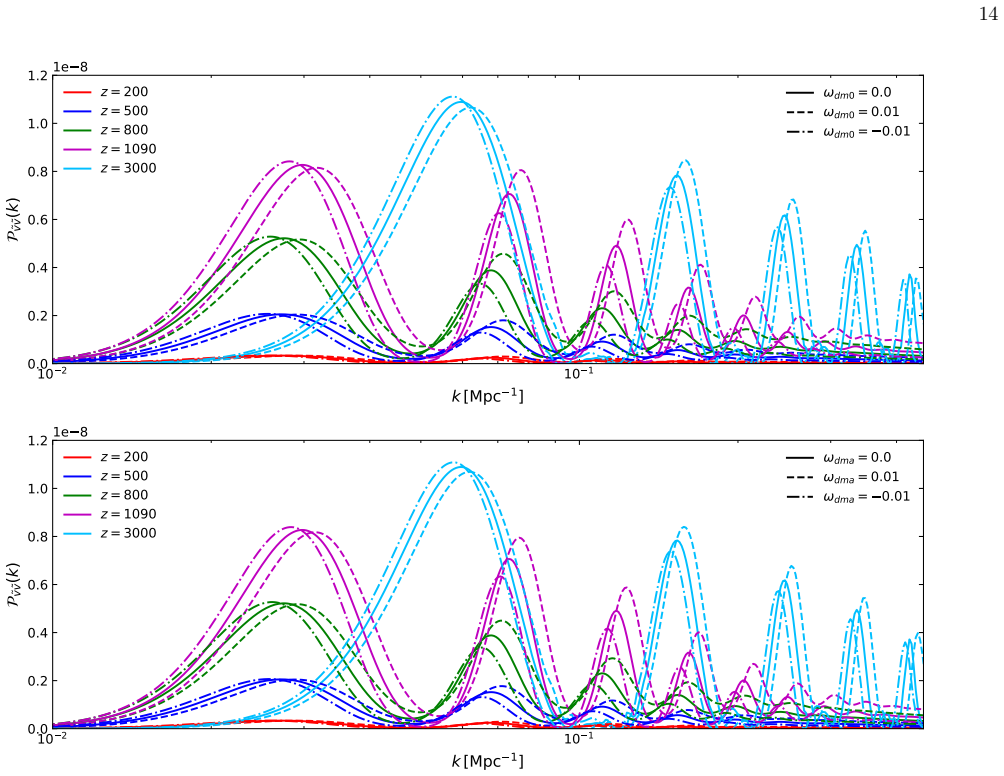
- The DDM parameter space allowed by the tight ACT+DESI+DESY5 constraints produces measurable changes in the matter power spectrum, CMB lensing potential, velocity spectra, and lensing-galaxy correlations, so future surveys can test the model.
- Adding Planck or DESY1 lowers the significance to about 3σ or 1.5σ, so the strength of the evidence depends on which datasets are combined.
Reading between the lines
- Beyond the paper: a 3.4σ parameter significance in a two-parameter extension is not automatically model-selection evidence; the paper's own single-parameter SDDM fit shows no preference (ωdm=0.006±0.015), so a Bayesian comparison of DDM against ΛCDM could be considerably weaker.
- Beyond the paper: the rd-induced Hubble-constant bias the authors flag implies a clean test—re-fit with rd calibrated from the local distance ladder or left free—and if ωdma then returns to zero, the headline signal is a distance-scale artefact.
- Beyond the paper: the negative today's pressure implied by ωdm0≈−0.08 predicts suppressed small-scale structure growth (lower S8) relative to ΛCDM, a signature that DESI and next-generation lensing surveys should be able to check within a few years.
Editorial analysis
A structured set of objections, weighed in public.
Referee Report
Summary. The paper introduces a CPL-like parameterization for the dark matter equation of state, ωdm(a)=ωdm0+ωdma(1−a), and constrains it with ACT DR6 CMB anisotropy and lensing, DESI DR2 BAO, and DESY5 supernova data. It claims a 3.4σ detection of nonzero ωdma and states that ACT independently confirms the linear relation ωdma=−ωdm0, so that the DM EoS is proportional to the scale factor. The paper also constrains a one-parameter 'proportional' DDM model and a model with dynamical DE, and it presents forecasts for LSS observables. The central claim is that dark matter is not cold and pressureless over cosmic time.
Significance. If the 3.4σ detection were real, the paper would provide an important observational challenge to the standard CDM paradigm and would motivate new particle and modified-gravity scenarios. The work expands the parameter space explored in the authors' earlier study and uses an independent ACT DR6 likelihood, which is a useful cross-check. However, the evidence as presented is not robust: the quoted 1σ error gives only 2.9σ, the one-parameter SDDM version of the same model shows no preference for evolving DM from the same data (ωdm=0.006±0.015 in Table I), and adding DESY1 reduces the significance to 1.5σ. These internal checks, together with the authors' own warning about rd/H0 bias in CMB+DESI combinations, mean the central claim is not sustained.
major comments (5)
- [DDM evidence induced by ACT; Table I] The 3.4σ number in the abstract is not supported by the quoted errors. Table I lists ωdma=0.088±0.030 for ADS, which is 2.9σ from zero, and ωdm0=−0.084±0.029, also 2.9σ. If the 3.4σ significance is computed from a joint marginalized statistic or a profile likelihood, the paper should state the statistic and its definition; as written, the reader cannot reproduce the headline significance.
- [Table I and SDDM discussion] The SDDM result in Table I is internally inconsistent with the claim that ACT confirms the proportional relation. SDDM is the same model restricted to ωdma=−ωdm0, so its single parameter should track the DDM best fit along that line. Yet for ADS, SDDM gives ωdm=0.006±0.015, i.e., no preference for a non-zero DM EoS, whereas the DDM best fit lies at ωdm0=−0.084 and ωdma=0.088. This means the apparent DDM signal is not a robust preference along the claimed proportionality direction; it emerges only when the second EoS parameter is added. The paper does not reconcile this contradiction.
- [DDM versus LSS] The dataset-dependence of the result is not described accurately. Adding DESY1 changes ωdma from 0.088±0.030 to 0.039±0.026, a 1.5σ effect, and adding Planck to ADS lowers it to 0.063±0.025, below the 3σ threshold. The paper then excludes DESY1 on the grounds that it introduces inconsistencies. Because the exclusion is motivated by the effect it has on the result, the quoted 3.4σ should be treated as a selection-dependent finding rather than a robust detection.
- [Discussions and conclusions] The paper itself states that the combination of CMB and DESI gives biased constraints because the CMB-derived rd induces a larger H0, and it invokes this bias to explain the anomalous positive ωdm in SDDM for the AD data. Since the same mechanism could plausibly bias ωdma upward, the paper should verify with a concrete test, such as marginalizing over rd or comparing with a free sound-horizon calibration, that the ADS preference for ωdma>0 is not a propagation of this known bias. Without such a test, the unbiasedness assumption behind the headline claim is unsupported.
- [DDM evidence induced by ACT; Fig. 1] The 'confirmation' of the linear relation ωdma=−ωdm0 is a post-hoc reading of the posterior degeneracy. The one-dimensional constraints in Fig. 2 and the SDDM row in Table I show that the data do not independently prefer this line. The paper should report a model comparison, such as Δχ² or Bayesian evidence, for DDM, SDDM, and ΛCDM before treating the relation as a confirmed physical property.
minor comments (4)
- [Discussions and conclusions] The sentence 'we propose a conjecture that DM obeys the directly proportional DM EoS ωdma = ωdma emerged on cosmic scales' is not grammatical and should read ωdm(a)=ωdm a; as printed, it is meaningless.
- [Introduction and Supplementary A] The authors refer to their previous DDM work as 'Ref. [1]', but in the bibliography Ref. [1] is Penzias and Wilson (1965); the previous DDM paper is Ref. [69]. This makes it difficult to follow the line of reasoning.
- [Data and methodology] No statement of code or data availability is given; since the analysis uses a custom modification of CAMB (DDMCAMB), a public release or a clear statement of availability is needed for reproducibility.
- [Table I] The paper does not define how the 2σ upper limits in Table I are computed, whether marginal or profile; adding a footnote would remove ambiguity.
Circularity Check
The claimed ACT 'confirmation' of the proportional DM EoS is read off the same two-parameter fit that produced the relation, and the paper's own SDDM null shows the 3.4σ signal is not a stable, independent prediction.
-
fitted input called prediction
[Abstract; Section 'DDM evidence induced by ACT'; Table I]
"Interestingly, ADS gives ωdma = 0.088 ± 0.030 indicating a 3.40 σ evidence of DDM ... ADS and APDS further help confirm the proportional DM EoS (see Fig. 1)."
The '3.4σ evidence' is a marginalized parameter estimate of the two-parameter DDM fit, and the proportional relation ωdma = −ωdm0 is then read off the very same posterior (Fig. 1) and elevated to a 'confirmation.' That is a fitted input called a prediction. The paper's own Table I shows the single-parameter SDDM model, which imposes exactly that relation, gives ωdm = 0.006 ± 0.015 for the same ADS data — no DDM preference and inconsistent with the DDM best-fit on the line (ωdm0 ≈ −0.084). Thus the confirmation reduces to a degeneracy of the fitted two-parameter model, and the headline significance is not robust to restricting the model to the claimed relation.
full rationale
The new data (ACT DR6, DESI DR2, DESY5) are external and the MCMC pipeline is standard, so the numerical constraints are not circular in themselves. However, the central interpretative claim — that ACT independently confirms the linear relation ωdma = −ωdm0 and hence a directly proportional DM EoS — is a posterior degeneracy of the same fit presented as an independent confirmation. The SDDM model, which is exactly the proportional relation, yields no preference from the same ADS data (ωdm = 0.006 ± 0.015), demonstrating that the 3.4σ signal is driven by the extra freedom in ωdm0 rather than by data preference for the proportional model. The paper's own discussion of rd-induced H0 bias provides a plausible spurious-signal mechanism, and the arithmetic (0.088/0.030 ≈ 2.9σ) does not match the quoted 3.4σ. These are correctness risks; the circular element is specifically the use of the fitted posterior to 'confirm' the relation it was used to infer. Because the underlying data are external and the model is not defined in terms of the measured parameters, the partial circularity score is 6 rather than higher.
Assumptions & free parameters
free parameters (6)
- ωdm0 (today's DM equation of state) =
-0.084 ± 0.029 (ADS, DDM)
- ωdma (evolution amplitude) =
0.088 ± 0.030 (ADS, DDM)
- ωdm (single-parameter proportional EoS) =
0.006 ± 0.015 (ADS, SDDM)
- ω0, ωa (DE EoS parameters in DDME) =
ω0 ≈ -0.758 ± 0.072, ωa ≈ -1.10 ± 0.50 (APDS)
- c_s,eff (DM effective sound speed) =
scanned up to 3e-5 in LSS plots; presumably 0 in MCMC
- σdm (DM shear) =
scanned O(1e-3) in LSS plots; presumably 0 in MCMC
assumptions (5)
- standard math Friedmann equations and GR background evolution
- ad hoc to paper Dark matter is a perfect fluid with CPL-like EoS ωdm(a)=ωdm0+ωdma(1−a)
- domain assumption DM perturbation equations with effective sound speed and shear (Eqs. 1-2 of Supplementary)
- ad hoc to paper The linear relation ωdma = -ωdm0 is a physical property rather than a degeneracy direction
- domain assumption Sroll2 likelihood provides an unbiased τ prior
Cite this review
Pith. "Pith review of ACT DR6 Leads to Stronger Evidence for Dynamical Dark Matter." pith.science (2026). https://pith.science/paper/OMNU4YVG
@misc{pith2026250623029,
  author       = {Pith},
  title        = {Pith review of: ACT DR6 Leads to Stronger Evidence for Dynamical Dark Matter},
  year         = {2026},
  howpublished = {\url{https://pith.science/paper/OMNU4YVG}},
  note         = {Machine review of arXiv:2506.23029}
}
abstract
Dark matter is fundamental to the composition, structure, and evolution of the universe. Combining the ACT's cosmic microwave background, DESI's baryon acoustic oscillations with DESY5 type Ia supernova observations, we find a $3.4\,\sigma$ evidence for dynamical dark matter (DDM) with an equation of state, $\omega_{dm}(a)=\omega_{dm0}+\omega_{dma}(1-a)$. Independent of the Planck measurements, the ACT data confirms the linear relation $\omega_{dma}=-\omega_{dm0}$, inducing that the equation of state of dark matter is directly proportional to the scale factor $a$. Furthermore, the effects of DDM on the large-scale structure observables are thoroughly studied. Our findings are of great significance for understanding cosmic acceleration, structure growth, and the fate of the universe.
Figures


Figures from the paper (9 more)



Forward citations
Cited by 1 Pith paper
-
Revisiting cosmic acceleration with DESI BAO
Constraints from DESI BAO, Planck CMB, and three SN catalogs yield a negative jerk parameter at z=0 in the CPL model, suggesting cosmic acceleration is slowing.
Reference graph
Works this paper leans on
-
[1]
and interpreted as a remnant of the early universe in Ref. [2]. In 1992, the cosmic background explorer (COBE) satellite provided the first detailed maps of the CMB [3], confirming the Big Bang theory and detecting the anisotropies in the CMB at the level of 10 −5, which are believed to be the seeds of the large-scale structure (LSS) we observe in the uni...
1992
-
[2]
Cosmic Black-Body Radiation,
R. H. Dicke, P. J. E. Peebles, P. G. Roll and D. T. Wilkin- son, “Cosmic Black-Body Radiation,” Astrophys. J. 142, 414-419 (1965)
1965
-
[3]
A Measurement of excess antenna temperature at 4080-Mc/s,
A. A. Penzias and R. W. Wilson, “A Measurement of excess antenna temperature at 4080-Mc/s,” Astrophys. J. 142, 419-421 (1965)
1965
-
[4]
Observa- tional evidence from supernovae for an accelerating uni- verse and a cosmological constant,
A. G. Riess et al. [Supernova Search Team], “Observa- tional evidence from supernovae for an accelerating uni- verse and a cosmological constant,” Astron. J.116, 1009- 1038 (1998)
1998
-
[5]
Structure in the COBE differential microwave radiometer first year maps,
G. F. Smoot et al. [COBE], “Structure in the COBE differential microwave radiometer first year maps,” As- trophys. J. Lett. 396, L1-L5 (1992)
1992
-
[6]
Cosmic Microwave Background Anisotropies,
W. Hu and S. Dodelson, “Cosmic Microwave Background Anisotropies,” Ann. Rev. Astron. Astrophys. 40, 171-216 (2002)
2002
-
[7]
Measurements of Ω and Λ from 42 high redshift super- novae,
S. Perlmutter et al. [Supernova Cosmology Project], “Measurements of Ω and Λ from 42 high redshift super- novae,” Astrophys. J. 517, 565-586 (1999)
1999
-
[8]
https://map.gsfc.nasa.gov
Show all 120 references
-
[9]
Observational Probes of Cosmic Acceleration,
D. H. Weinberg et al. , “Observational Probes of Cosmic Acceleration,” Phys. Rept. 530, 87-255 (2013)
2013
-
[10]
https://www.cosmos.esa.int/web/planck
-
[11]
Nine-Year Wilkinson Mi- crowave Anisotropy Probe (WMAP) Observations: Final Maps and Results,
C. L. Bennett et al. [WMAP], “Nine-Year Wilkinson Mi- crowave Anisotropy Probe (WMAP) Observations: Final Maps and Results,” Astrophys. J. Suppl. 208, 20 (2013)
2013
-
[12]
too-big-to-fail
and the Two-Degree Field Galaxy Redshift Survey (2dFGRS) in 2005 [13], the accumulated BAO observa- tions have independently demonstrated the validity of the ΛCDM model [12–20]. However, this model is im- perfect. Besides confronting two intractable challenges, namely the cosm...
2005 arXiv
-
[14]
Detection of the Baryon Acoustic Peak in the Large-Scale Correlation Function of SDSS Luminous Red Galaxies,
D. J. Eisenstein et al. [SDSS], “Detection of the Baryon Acoustic Peak in the Large-Scale Correlation Function of SDSS Luminous Red Galaxies,” Astrophys. J. 633, 560-574 (2005)
2005
-
[15]
The 2dF Galaxy Redshift Sur- vey: Power-spectrum analysis of the final dataset and cosmological implications,
S. Cole et al. [2dFGRS], “The 2dF Galaxy Redshift Sur- vey: Power-spectrum analysis of the final dataset and cosmological implications,” Mon. Not. Roy. Astron. Soc. 362, 505-534 (2005)
2005
-
[16]
The 6dF Galaxy Survey: Baryon Acoustic Oscillations and the Local Hubble Constant,
F. Beutler et al. [6dF], “The 6dF Galaxy Survey: Baryon Acoustic Oscillations and the Local Hubble Constant,” Mon. Not. Roy. Astron. Soc. 416, 3017-3032 (2011)
2011
-
[17]
Completed SDSS-IV extended Baryon Oscillation Spectroscopic Survey: Cosmological implications from two decades of spectroscopic surveys at the Apache Point Observatory,
S. Alam et al. [eBOSS], “Completed SDSS-IV extended Baryon Oscillation Spectroscopic Survey: Cosmological implications from two decades of spectroscopic surveys at the Apache Point Observatory,” Phys. Rev. D 103, no.8, 083533 (2021)
2021
-
[18]
Angular Baryon Acoustic Oscillation measure at z = 2 .225 from the SDSS quasar survey,
E. de Carvalho, A. Bernui, G. C. Carvalho, C. P. Novaes and H. S. Xavier, “Angular Baryon Acoustic Oscillation measure at z = 2 .225 from the SDSS quasar survey,” JCAP 04, 064 (2018)
2018
-
[19]
The clustering of the SDSS-IV extended Baryon Oscillation Spectroscopic Survey DR14 quasar sample: first measurement of baryon acoustic os- cillations between redshift 0.8 and 2.2,
M. Ata et al. [eBOSS], “The clustering of the SDSS-IV extended Baryon Oscillation Spectroscopic Survey DR14 quasar sample: first measurement of baryon acoustic os- cillations between redshift 0.8 and 2.2,” Mon. Not. Roy. Astron. Soc. 473, no.4, 4773-4794 (2018)
2018
-
[20]
DESI 2024 VI: Cosmological Constraints from the Measurements of Baryon Acoustic Oscillations,
A. G. Adame et al. [DESI], “DESI 2024 VI: Cosmological Constraints from the Measurements of Baryon Acoustic Oscillations,” [arXiv:2404.03002 [astro-ph.CO]]
2024 arXiv
-
[21]
DESI 2024 III: Baryon Acoustic Oscillations from Galaxies and Quasars,
A. G. Adame et al. [DESI], “DESI 2024 III: Baryon Acoustic Oscillations from Galaxies and Quasars,” [arXiv:2404.03000 [astro-ph.CO]]
2024 arXiv
-
[22]
DESI 2024 IV: Baryon Acoustic Oscillations from the Lyman Alpha Forest,
A. G. Adame et al. [DESI], “DESI 2024 IV: Baryon Acoustic Oscillations from the Lyman Alpha Forest,” [arXiv:2404.03001 [astro-ph.CO]]
2024 arXiv
-
[23]
The Cosmological Constant Problem,
S. Weinberg, “The Cosmological Constant Problem,” Rev. Mod. Phys. 61, 1 (1989)
1989
-
[24]
The Cosmological constant,
S. M. Carroll, “The Cosmological constant,” Living Rev. Rel. 4, 1 (2001)
2001
-
[25]
The Cosmological Con- stant and Dark Energy,
P. J. E. Peebles and B. Ratra, “The Cosmological Con- stant and Dark Energy,” Rev. Mod. Phys. 75, 559-606 (2003)
2003
-
[26]
Cosmological constant: The Weight of the vacuum,
T. Padmanabhan, “Cosmological constant: The Weight of the vacuum,” Phys. Rept. 380, 235-320 (2003)
2003
-
[27]
P. J. Steinhardt, ”Critical Problems in Physics.” Prince- ton University Press (1997)
1997
-
[28]
Quintessence, cosmic coincidence, and the cosmological constant,
I. Zlatev, L. M. Wang and P. J. Steinhardt, “Quintessence, cosmic coincidence, and the cosmological constant,” Phys. Rev. Lett. 82, 896-899 (1999)
1999
-
[29]
Snowmass2021 - Letter of in- terest cosmology intertwined I: Perspectives for the next decade,
E. Di Valentino et al. , “Snowmass2021 - Letter of in- terest cosmology intertwined I: Perspectives for the next decade,” Astropart. Phys. 131, 102606 (2021). 6
2021
-
[30]
Snowmass2021 - Letter of interest cosmology intertwined II: The hubble constant tension,
E. Di Valentino et al., “Snowmass2021 - Letter of interest cosmology intertwined II: The hubble constant tension,” Astropart. Phys. 131, 102605 (2021)
2021
-
[31]
Cosmology Intertwined III: f σ8 and S8,
E. Di Valentino et al. , “Cosmology Intertwined III: f σ8 and S8,” Astropart. Phys. 131, 102604 (2021)
2021
-
[32]
Cosmology intertwined: A review of the particle physics, astrophysics, and cosmology asso- ciated with the cosmological tensions and anomalies,
E. Abdalla et al. , “Cosmology intertwined: A review of the particle physics, astrophysics, and cosmology asso- ciated with the cosmological tensions and anomalies,” JHEAp 34, 49-211 (2022)
2022
-
[33]
The CosmoVerse White Paper: Addressing observational tensions in cosmology with sys- tematics and fundamental physics,
E. Di Valentino et al. , “The CosmoVerse White Paper: Addressing observational tensions in cosmology with sys- tematics and fundamental physics,” [arXiv:2504.01669 [astro-ph.CO]]
-
[34]
Observational and the- oretical constraints on singular dark matter halos,
R. A. Flores and J. R. Primack, “Observational and the- oretical constraints on singular dark matter halos,” As- trophys. J. Lett. 427, L1-4 (1994)
1994
-
[35]
Evidence against dissipationless dark matter from observations of galaxy haloes,
B. Moore, “Evidence against dissipationless dark matter from observations of galaxy haloes,” Nature 370, 629 (1994)
1994
-
[36]
The unexpected diversity of dwarf galaxy rotation curves,
K. A. Oman et al. , “The unexpected diversity of dwarf galaxy rotation curves,” Mon. Not. Roy. Astron. Soc. 452, no.4, 3650-3665 (2015). doi:10.1093/mnras/stv1504
2015 doi
-
[37]
Too big to fail? The puzzling darkness of massive Milky Way subhaloes,
M. Boylan-Kolchin, J. S. Bullock and M. Kaplinghat, “Too big to fail? The puzzling darkness of massive Milky Way subhaloes,” Mon. Not. Roy. Astron. Soc. 415, L40 (2011)
2011
-
[38]
The Great disk of Milky Way satellites and cosmological sub-structures,
P. Kroupa, C. Theis and C. M. Boily, “The Great disk of Milky Way satellites and cosmological sub-structures,” Astron. Astrophys. 431, 517-521 (2005)
2005
-
[39]
Die Rotverschiebung von extragalaktischen Nebeln,
F. Zwicky, “Die Rotverschiebung von extragalaktischen Nebeln,” Helv. Phys. Acta 6, 110-127 (1933)
1933
-
[40]
Rotation of the An- dromeda Nebula from a Spectroscopic Survey of Emission Regions,
V. C. Rubin and W. K. Ford, Jr., “Rotation of the An- dromeda Nebula from a Spectroscopic Survey of Emission Regions,” Astrophys. J. 159, 379-403 (1970)
1970
-
[41]
Formation of Galaxies and Large Scale Structure with Cold Dark Matter,
G. R. Blumenthal, S. M. Faber, J. R. Primack and M. J. Rees, “Formation of Galaxies and Large Scale Structure with Cold Dark Matter,” Nature 311, 517-525 (1984)
1984
-
[42]
Sterile-neutrinos as dark matter,
S. Dodelson and L. M. Widrow, “Sterile-neutrinos as dark matter,” Phys. Rev. Lett. 72, 17-20 (1994)
1994
-
[43]
CFHTLenS: The Canada-France-Hawaii Telescope Lensing Survey,
C. Heymans, et al. [CFHTLenS], “CFHTLenS: The Canada-France-Hawaii Telescope Lensing Survey,” Mon. Not. Roy. Astron. Soc. 427, 146 (2012)
2012
-
[44]
KiDS-450: Cosmological parameter constraints from tomographic weak gravita- tional lensing,
H. Hildebrandt et al. [KiDS], “KiDS-450: Cosmological parameter constraints from tomographic weak gravita- tional lensing,” Mon. Not. Roy. Astron. Soc. 465, 1454 (2017)
2017
-
[45]
Planck 2018 results. VIII. Gravitational lensing,
N. Aghanim et al. [Planck], “Planck 2018 results. VIII. Gravitational lensing,” Astron. Astrophys. 641, A8 (2020)
2020
-
[46]
Dark Energy Survey Year 1 results: Cosmological constraints from cosmic shear,
M. A. Troxel et al. [DES], “Dark Energy Survey Year 1 results: Cosmological constraints from cosmic shear,” Phys. Rev. D 98, no.4, 043528 (2018)
2018
-
[47]
Dark Energy Survey year 1 results: Cosmological constraints from galaxy cluster- ing and weak lensing,
T. M. C. Abbott et al. [DES], “Dark Energy Survey year 1 results: Cosmological constraints from galaxy cluster- ing and weak lensing,” Phys. Rev. D 98, no.4, 043526 (2018)
2018
-
[48]
Dark Energy Survey Year 3 results: Cosmological constraints from galaxy cluster- ing and weak lensing,
T. M. C. Abbott et al. [DES], “Dark Energy Survey Year 3 results: Cosmological constraints from galaxy cluster- ing and weak lensing,” Phys. Rev. D 105, no.2, 023520 (2022)
2022
-
[49]
Dark Energy Survey Year 3 Results: Cosmological Constraints from Clus- ter Abundances, Weak Lensing, and Galaxy Clustering,
T. M. C. Abbott et al. [DES], “Dark Energy Survey Year 3 Results: Cosmological Constraints from Clus- ter Abundances, Weak Lensing, and Galaxy Clustering,” [arXiv:2503.13632 [astro-ph.CO]]
-
[50]
https://xenonexperiment.org
-
[51]
Dark Matter Results from 225 Live Days of XENON100 Data,
E. Aprile et al. [XENON100], “Dark Matter Results from 225 Live Days of XENON100 Data,” Phys. Rev. Lett. 109, 181301 (2012)
2012
-
[52]
https://sanfordlab.org/large-underground-xenon-lux- dark-matter-detector
-
[53]
Results from a search for dark matter in the complete LUX exposure,
D. S. Akerib et al. [LUX], “Results from a search for dark matter in the complete LUX exposure,” Phys. Rev. Lett. 118, no.2, 021303 (2017)
2017
-
[54]
https://pandax.sjtu.edu.cn
-
[55]
PandaX: A Liquid Xenon Dark Matter Experiment at CJPL,
X. Cao et al. [PandaX], “PandaX: A Liquid Xenon Dark Matter Experiment at CJPL,” Sci. China Phys. Mech. Astron. 57, 1476-1494 (2014)
2014
-
[56]
Dark Matter Search Results from a One Ton-Year Exposure of XENON1T,
E. Aprile et al. [XENON], “Dark Matter Search Results from a One Ton-Year Exposure of XENON1T,” Phys. Rev. Lett. 121, no.11, 111302 (2018)
2018
-
[57]
https://glast.sites.stanford.edu
-
[58]
https://www.mpi-hd.mpg.de/HESS
-
[59]
https://magic.mpp.mpg.de
-
[60]
Limits to Dark Matter Annihilation Cross-Section from a Com- bined Analysis of MAGIC and Fermi-LAT Observations of Dwarf Satellite Galaxies,
M. L. Ahnen et al. [MAGIC and Fermi-LAT], “Limits to Dark Matter Annihilation Cross-Section from a Com- bined Analysis of MAGIC and Fermi-LAT Observations of Dwarf Satellite Galaxies,” JCAP 02, 039 (2016)
2016
-
[61]
Searching for Secluded Dark Matter with H.E.S.S., Fermi-LAT, and Planck,
S. Profumo, F. S. Queiroz, J. Silk and C. Siqueira, “Searching for Secluded Dark Matter with H.E.S.S., Fermi-LAT, and Planck,” JCAP 03, 010 (2018)
2018
-
[62]
Indirect and direct search for dark matter,
M. Klasen, M. Pohl and G. Sigl, “Indirect and direct search for dark matter,” Prog. Part. Nucl. Phys. 85, 1- 32 (2015)
2015
-
[63]
A review of indirect searches for particle dark matter,
J. M. Gaskins, “A review of indirect searches for particle dark matter,” Contemp. Phys. 57, no.4, 496-525 (2016)
2016
-
[64]
https://www.home.cern/science/accelerators/large- hadron-collider
-
[65]
Extended Dark En- ergy analysis using DESI DR2 BAO measurements,
K. Lodha et al. [DESI], “Extended Dark En- ergy analysis using DESI DR2 BAO measurements,” [arXiv:2503.14743 [astro-ph.CO]]
-
[66]
DESI DR2 Results II: Measurements of Baryon Acoustic Oscillations and Cosmological Constraints,
M. Abdul Karim et al. [DESI], “DESI DR2 Results II: Measurements of Baryon Acoustic Oscillations and Cosmological Constraints,” [arXiv:2503.14738 [astro- ph.CO]]
-
[67]
DESI DR2 Results I: Baryon Acoustic Oscillations from the Lyman Alpha For- est,
M. Abdul Karim et al. [DESI], “DESI DR2 Results I: Baryon Acoustic Oscillations from the Lyman Alpha For- est,” [arXiv:2503.14739 [astro-ph.CO]]
-
[68]
Structure formation with generalized dark mat- ter,
W. Hu, “Structure formation with generalized dark mat- ter,” Astrophys. J. 506, 485-494 (1998)
1998
-
[69]
Observational constraints on vari- able equation of state parameters of dark matter and dark energy after Planck,
S. Kumar and L. Xu, “Observational constraints on vari- able equation of state parameters of dark matter and dark energy after Planck,” Phys. Lett. B 737, 244-247 (2014)
2014
-
[70]
Testing the warmness of dark matter,
S. Kumar, R. C. Nunes and S. K. Yadav, “Testing the warmness of dark matter,” Mon. Not. Roy. Astron. Soc. 490, no.1, 1406-1414 (2019)
2019
-
[72]
The foundation of the general theory of relativity,
A. Einstein, “The foundation of the general theory of relativity,” Annalen Phys. 49, no.7, 769-822 (1916)
1916
-
[73]
On the Curvature of space,
A. Friedman, “On the Curvature of space,” Z. Phys. 10, 377-386 (1922)
1922
-
[74]
Accelerating universes with scaling dark matter,
M. Chevallier and D. Polarski, “Accelerating universes with scaling dark matter,” Int. J. Mod. Phys. D 10, 213- 224 (2001)
2001
-
[75]
Exploring the expansion history of the universe,
E. V. Linder, “Exploring the expansion history of the universe,” Phys. Rev. Lett. 90, 091301 (2003). 7
2003
-
[76]
The Atacama Cosmology Tele- scope: DR6 Power Spectra, Likelihoods and ΛCDM Pa- rameters,
T. Louis et al. [ACT], “The Atacama Cosmology Tele- scope: DR6 Power Spectra, Likelihoods and ΛCDM Pa- rameters,” [arXiv:2503.14452 [astro-ph.CO]]
-
[77]
Planck 2018 results. V. CMB power spectra and likelihoods,
N. Aghanim et al. [Planck], “Planck 2018 results. V. CMB power spectra and likelihoods,” Astron. Astrophys. 641, A5 (2020)
2020
-
[78]
The Atacama Cosmology Tele- scope: A Measurement of the DR6 CMB Lensing Power Spectrum and Its Implications for Structure Growth,
F. J. Qu et al. [ACT], “The Atacama Cosmology Tele- scope: A Measurement of the DR6 CMB Lensing Power Spectrum and Its Implications for Structure Growth,” Astrophys. J. 962, no.2, 112 (2024)
2024
-
[79]
The Dark Energy Survey: Cosmology Results with ∼1500 New High-redshift Type Ia Supernovae Using the Full 5 yr Data Set,
T. M. C. Abbott et al. [DES], “The Dark Energy Survey: Cosmology Results with ∼1500 New High-redshift Type Ia Supernovae Using the Full 5 yr Data Set,” Astrophys. J. Lett. 973, no.1, L14 (2024)
2024
-
[80]
The Atacama Cosmology Telescope: DR6 Constraints on Extended Cosmological Models,
E. Calabrese et al. [ACT], “The Atacama Cosmology Telescope: DR6 Constraints on Extended Cosmological Models,” [arXiv:2503.14454 [astro-ph.CO]]
-
[81]
Reionization optical depth determination from Planck HFI data with ten percent accuracy,
L. Pagano, J. M. Delouis, S. Mottet, J. L. Puget and L. Vibert, “Reionization optical depth determination from Planck HFI data with ten percent accuracy,” As- tron. Astrophys. 635, A99 (2020)
2020
-
[82]
Efficient com- putation of CMB anisotropies in closed FR W models,
A. Lewis, A. Challinor and A. Lasenby, “Efficient com- putation of CMB anisotropies in closed FR W models,” Astrophys. J. 538, 473-476 (2000)
2000
-
[83]
Cobaya: Code for Bayesian Analysis of hierarchical physical models,
J. Torrado and A. Lewis, “Cobaya: Code for Bayesian Analysis of hierarchical physical models,” JCAP 05, 057 (2021)
2021
-
[84]
Inference from Iterative Simulation Using Multiple Sequences,
A. Gelman and D. B. Rubin, “Inference from Iterative Simulation Using Multiple Sequences,” Statist. Sci. 7, 457-472 (1992)
1992
-
[85]
GetDist: a Python package for analysing Monte Carlo samples,
A. Lewis, “GetDist: a Python package for analysing Monte Carlo samples,” [arXiv:1910.13970 [astro-ph.IM]]
1910 arXiv
-
[86]
Quintessence Dark Matter,
D. Wang, “Quintessence Dark Matter,” [arXiv:2505.08154 [astro-ph.CO]]
-
[87]
Evolving Dark Energy or Evolv- ing Dark Matter?,
X. Chen and A. Loeb, “Evolving Dark Energy or Evolv- ing Dark Matter?,” [arXiv:2505.02645 [astro-ph.CO]]
-
[88]
Cosmological bounds on the equation of state of dark matter,
C. M. Muller, “Cosmological bounds on the equation of state of dark matter,” Phys. Rev. D 71, 047302 (2005)
2005
-
[89]
Cosmological constraints on the matter equation of state,
E. Calabrese et al. , “Cosmological constraints on the matter equation of state,” Phys. Rev. D 80, 063539 (2009)
2009
-
[90]
Equation of State of Dark Matter after Planck Data,
L. Xu and Y. Chang, “Equation of State of Dark Matter after Planck Data,” Phys. Rev. D 88, 127301 (2013)
2013
-
[91]
Constrain- ing the Properties of Dark Matter with Observations of the Cosmic Microwave Background,
D. B. Thomas, M. Kopp and C. Skordis, “Constrain- ing the Properties of Dark Matter with Observations of the Cosmic Microwave Background,” Astrophys. J. 830, no.2, 155 (2016)
2016
-
[92]
Dark Matter Equation of State through Cosmic History,
M. Kopp, C. Skordis, D. B. Thomas and S. Ili´ c, “Dark Matter Equation of State through Cosmic History,” Phys. Rev. Lett. 120, no.22, 221102 (2018)
2018
-
[93]
Evidence for non-cold dark matter from DESI DR2 measurements,
U. Kumar, A. Ajith and A. Verma, “Evidence for non-cold dark matter from DESI DR2 measurements,” [arXiv:2504.14419 [astro-ph.CO]]
-
[94]
When Dark Matter Heats Up: A Model-Independent Search for Non-Cold Behavior,
M. Abedin, L. A. Escamilla, S. Pan, E. Di Valentino and W. Yang, “When Dark Matter Heats Up: A Model-Independent Search for Non-Cold Behavior,” [arXiv:2505.09470 [astro-ph.CO]]
-
[95]
C. E. Rasmussen, (2004). Gaussian Processes in Machine Learning. In: O. Bousquet, U. von Luxburg, G. R¨ atsch, (eds) Advanced Lectures on Machine Learning. ML 2003. Lecture Notes in Computer Science, vol 3176. Springer, Berlin, Heidelberg
2004
-
[96]
f(R) Theories Of Grav- ity,
T. P. Sotiriou and V. Faraoni, “f(R) Theories Of Grav- ity,” Rev. Mod. Phys. 82, 451-497 (2010)
2010
-
[97]
f(R) theories,
A. De Felice and S. Tsujikawa, “f(R) theories,” Living Rev. Rel. 13, 3 (2010)
2010
-
[98]
Unified cosmic history in modified gravity: from F(R) theory to Lorentz non- invariant models,
S. Nojiri and S. D. Odintsov, “Unified cosmic history in modified gravity: from F(R) theory to Lorentz non- invariant models,” Phys. Rept. 505, 59-144 (2011)
2011
-
[99]
Extended Theories of Gravity,
S. Capozziello and M. De Laurentis, “Extended Theories of Gravity,” Phys. Rept. 509, 167-321 (2011)
2011
-
[100]
Modi- fied Gravity Theories on a Nutshell: Inflation, Bounce and Late-time Evolution,
S. Nojiri, S. D. Odintsov and V. K. Oikonomou, “Modi- fied Gravity Theories on a Nutshell: Inflation, Bounce and Late-time Evolution,” Phys. Rept. 692, 1-104 (2017)
2017
-
[101]
Dark matter in spiral galaxies. II - Galaxies with H I rotation curves,
S. M. Kent, “Dark matter in spiral galaxies. II - Galaxies with H I rotation curves,” Astron. J. 93, 816-832 (1987)
1987
-
[102]
On the Use of Galaxy Rotation Curves to Test the Modified Dynamics
M. Milgrom, “On the Use of Galaxy Rotation Curves to Test the Modified Dynamics”, Astrophys. J. 333, 689 (1988)
1988
-
[103]
Ex- tended rotation curves of spiral galaxies: Dark haloes and modified dynamics,
K. G. Begeman, A. H. Broeils and R. H. Sanders, “Ex- tended rotation curves of spiral galaxies: Dark haloes and modified dynamics,” Mon. Not. Roy. Astron. Soc. 249, 523 (1991)
1991
-
[104]
The published extended rotation curves of spiral galaxies: confrontation with modified dynam- ics,
R. H. Sanders, “The published extended rotation curves of spiral galaxies: confrontation with modified dynam- ics,” Astrophys. J. 473, 117 (1996)
1996
-
[105]
The Baryonic Tully-Fisher relation,
S. S. McGaugh, J. M. Schombert, G. D. Bothun and W. J. G. de Blok, “The Baryonic Tully-Fisher relation,” Astrophys. J. Lett. 533, L99-L102 (2000)
2000
-
[106]
The Baryonic Tully-Fisher relation of galaxies with extended rotation curves and the stellar mass of rotating galaxies,
S. S. McGaugh, “The Baryonic Tully-Fisher relation of galaxies with extended rotation curves and the stellar mass of rotating galaxies,” Astrophys. J. 632, 859-871 (2005)
2005
-
[107]
A Stratified framework for scalar - ten- sor theories of modified dynamics,
R. H. Sanders, “A Stratified framework for scalar - ten- sor theories of modified dynamics,” Astrophys. J. 480, 492-502 (1997)
1997
-
[108]
Relativistic gravitation theory for the MOND paradigm,
J. D. Bekenstein, “Relativistic gravitation theory for the MOND paradigm,” Phys. Rev. D 70, 083509 (2004) [er- ratum: Phys. Rev. D 71, 069901 (2005)]
2004
-
[109]
New Relativistic Theory for Modified Newtonian Dynamics,
C. Skordis and T. Zlosnik, “New Relativistic Theory for Modified Newtonian Dynamics,” Phys. Rev. Lett. 127, no.16, 161302 (2021)
2021
-
[110]
https://www.skao.int
-
[111]
Cosmology with Phase 1 of the Square Kilometre Array: Red Book 2018: Technical specifications and performance forecasts,
D. J. Bacon et al. [SKA], “Cosmology with Phase 1 of the Square Kilometre Array: Red Book 2018: Technical specifications and performance forecasts,” Publ. Astron. Soc. Austral. 37, e007 (2020). 8 Supplementary Material A. ACT-only constraint on DDM The ACT-only constraint give...
2020
-
[112]
Evidence for Dynamical Dark Matter,
D. Wang, “Evidence for Dynamical Dark Matter,” [arXiv:2504.21481 [astro-ph.CO]]
-
[113]
Theory of cosmological perturbations. Part 1. Classical perturbations. Part 2. Quantum theory of perturbations. Part 3. Extensions,
V. F. Mukhanov, H. A. Feldman and R. H. Brandenberger, “Theory of cosmological perturbations. Part 1. Classical perturbations. Part 2. Quantum theory of perturbations. Part 3. Extensions,” Phys. Rept. 215, 203 (1992)
1992
-
[114]
Cosmological perturbation theory in the synchronous and conformal Newtonian gauges,
C. P. Ma and E. Bertschinger, “Cosmological perturbation theory in the synchronous and conformal Newtonian gauges,” Astrophys. J. 455, 7 (1995)
1995
-
[115]
Cosmological perturbations,
K. A. Malik and D. Wands, “Cosmological perturbations,” Phys. Rept. 475, 1 (2009)
2009
-
[116]
Structure formation with generalized dark matter,
W. Hu, “Structure formation with generalized dark matter,” Astrophys. J. 506, 485-494 (1998)
1998
-
[117]
Planck 2018 results. VI. Cosmological parameters,
N. Aghanim et al. [Planck], “Planck 2018 results. VI. Cosmological parameters,” Astron. Astrophys. 641, A6 (2020) [erratum: Astron. Astrophys. 652, C4 (2021)]
2020
-
[118]
Ueber die Hypothesen, welche der Geometrie zu Grunde liegen,
B. Riemann, “Ueber die Hypothesen, welche der Geometrie zu Grunde liegen,” Abhandlungen der K¨ oniglichen Gesellschaft der Wissenschaften zu G¨ ottingen13, 133–150 (1867) [Habilitationsvortrag, Universit¨ at G¨ ottingen, 1854]
-
[119]
Hanson, A
D. Hanson, A. Challinor and A. Lewis, Gen. Rel. Grav. 42, 2197-2218 (2010)
2010
-
[120]
Relative velocity of dark matter and baryonic fluids and the formation of the first structures,
D. Tseliakhovich and C. Hirata, “Relative velocity of dark matter and baryonic fluids and the formation of the first structures,” Phys. Rev. D 82, 083520 (2010)
2010
-
[121]
https://rubinobservatory.org
-
[122]
LSST Science Book, Version 2.0,
P. A. Abell et al. [LSST], “LSST Science Book, Version 2.0,” [arXiv:0912.0201 [astro-ph.IM]]
Reviewed August 6, 2026 · model on record in the stance chip above.
Discussion (0). Sign in to comment.