REVIEW 4 major objections 5 minor 26 references
Knowledge Graphs are all you need: Leveraging KGs in Physics Question Answering
T0 review · 4 major / 5 minor · reviewed 2026-08-11 · deepseek-v4-flash
Pith's one-line read This paper claims that sub-questions generated from an LLM-built knowledge graph stay more faithful to the original question and that this raises GPT-4's success on high-school physics problems by about 7 points in a human evaluation…
desk verdict A plausible pipeline paper whose headline claim of 'significantly improved fidelity' is not supported by the reported numbers—100 hand-selected questions, no significance tests, gains within sampling error. read the letter →
The pith
A machine-rendered reading of the paper's core claim, the machinery that carries it, and where it could break.
The reading
What carries the argument
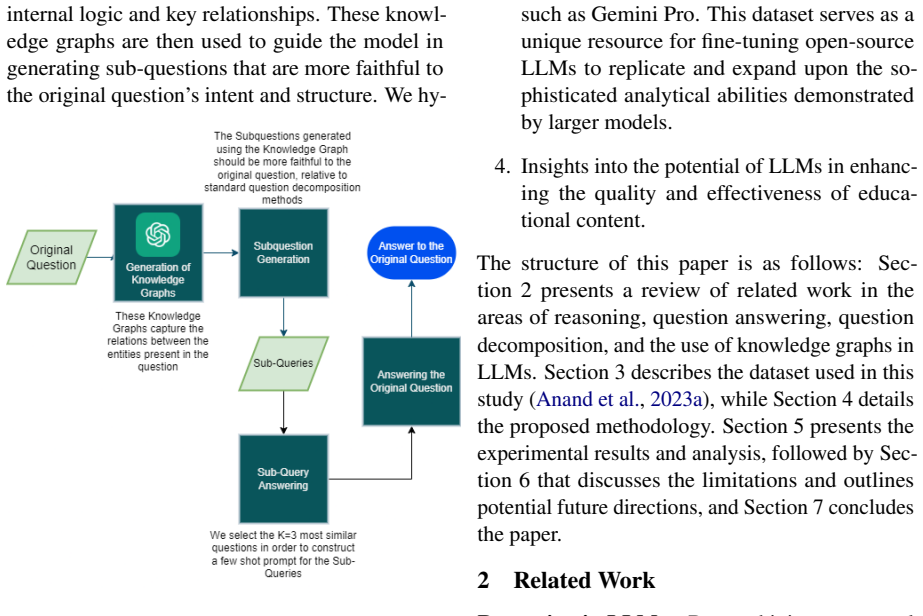
The pipeline's load-bearing object is the knowledge graph constructed by the LLM from the question's text. Nodes capture entities such as objects, materials, and given values; edges capture relationships such as 'has_bulk_modulus'. This graph is then used to prompt the model to generate sub-questions that follow the graph's structure, each sub-question is answered in a few-shot setting, and a synthesis module combines the sub-answers with the original question to produce the final response. The knowledge graph acts as a structural scaffold that keeps decomposition aligned with the question's internal logic, which the authors argue is what standard decomposition lacks.
What would settle it
Conduct the same comparison on a randomly drawn, larger sample of questions (e.g., 500) with multiple blind annotators and pre-registered success criteria; if KG-guided decomposition no longer beats decomposition without a KG by a margin beyond chance, the central claim fails. A simpler check: measure inter-annotator agreement on the original 100 questions; low agreement would show the reported gains are not reliably measurable.
Extended reading notes
Core claim
The central claim is that sub-questions derived from an LLM-generated knowledge graph exhibit significantly improved fidelity to the original question's logic, and that this fidelity translates into higher answer accuracy. The paper argues this by comparing three reasoning methods on GPT-4: standard prompting, decomposition without a knowledge graph, and decomposition guided by a knowledge graph. The measured success rates on a hand-picked set of 54 numerical and 46 conceptual questions were 84.45% and 74.58% respectively for the KG-guided method, beating both baselines. The authors attribute the gain to the knowledge graph anchoring the model to the relevant concepts and entities, preventing it from drifting into wrong formulas or hallucinations, especially on conceptual problems.
Load-bearing premise
The load-bearing premise is that the hand-selected 100-question subset and the human judgments made on it provide a reliable estimate of the pipeline's effect, since the paper gives no random sampling, inter-annotator agreement, confidence intervals, or significance tests.
Editorial extensions
If this is right
- The method can be applied to any LLM without fine-tuning, since it relies only on prompt construction around a generated knowledge graph.
- Improvements are larger for numerical than conceptual questions, suggesting the graph helps most when the solution path follows distinct entities and formulas.
- The released dataset of 8,000 physics questions with knowledge graphs and sub-queries enables fine-tuning of open-source models to emulate the decomposition behavior of larger models like GPT-4 and Gemini Pro.
- The approach may transfer to other structured disciplines such as mathematics, where questions also decompose into named entities and relations.
- Student survey ratings (4.4-4.8 out of 5 for KG-guided sub-questions) suggest the method also improves perceived clarity and helpfulness for learners, albeit on a very small sample.
Reading between the lines
- The reported gains could partly reflect the extra prompt structure itself rather than the knowledge graph per se; an ablation that uses an equivalent structured scaffold (e.g., a generic entity-relation list) would isolate the graph's specific contribution.
- Because the knowledge graph is generated by the same model that later answers, errors in graph construction may propagate; testing with a fixed, human-verified graph versus an LLM-generated one would separate graph quality from decomposition quality.
- The approach is a natural fit for retrieval-augmented educational tools: a KG-guided decomposition could name missing quantities or concepts and trigger targeted retrieval for conceptual sub-questions, where the paper reports the smallest gains.
- If the effect replicates on larger and randomly sampled benchmarks, KG-guided decomposition could become a standard pre-processing step in LLM-based tutoring systems, since it requires no architectural changes.
Editorial analysis
A structured set of objections, weighed in public.
Referee Report
Summary. The paper proposes a pipeline for high-school physics question answering in which an LLM first constructs a knowledge graph from a question, uses that graph to generate sub-questions, answers the sub-questions, and synthesizes a final answer. The authors evaluate the approach against standard prompting and against decomposition without a knowledge graph on 100 hand-selected questions from an 8,000-question bank, using GPT-4 and human grading, and they supplement the results with a five-student preference survey. They report higher success rates for KG-guided decomposition (84.45% vs 77.62% for numerical questions; 74.58% vs 68.53% for conceptual questions) and claim that the generated sub-questions exhibit "significantly improved fidelity" to the original question's logic. The paper also contributes the augmented dataset of knowledge graphs and subqueries.
Significance. If the reported effect were real, KG-guided decomposition would be a cheap and prompt-level improvement for high-school physics QA, and the dataset of knowledge graphs and subqueries could be a useful resource for fine-tuning open-source models. The pipeline is clearly described, the control condition (decomposition without KG) is appropriate, and the worked example illustrates the intended behavior. However, the central quantitative claim is not statistically established: the evaluation is small, the selection and grading procedures are under-specified, and the claim about sub-question fidelity is not directly measured by the reported experiments. The paper's own limitations section explicitly concedes the absence of a well-framed quantitative evaluation, which is in tension with the abstract's claim of significant improvement.
major comments (4)
- [§5.1, Table 1] Table 1 reports improvements of 6.8 and 6.0 percentage points on 54 numerical and 46 conceptual questions, but no confidence intervals, significance tests, or per-question outcomes are reported. With paired binomial data at these sample sizes, the standard error of the difference is on the order of 5–8 percentage points; the observed gains are therefore not distinguishable from chance without a McNemar test, which is not provided. The word "significantly" in the Abstract, Section 8, and Section 9 is thus unsupported by the quantitative evidence as presented.
- [§5.1 vs. Abstract] The headline claim concerns "fidelity to the original question's logic" of the generated sub-questions, but the human evaluation in Section 5.1 measures only whether the final numerical or conceptual answer is judged correct; no rubric or score for sub-question fidelity is described. The student survey in Section 6 rates clarity, consistency, and helpfulness, which is a preference measure rather than a fidelity measure. The principal claim is therefore not directly evaluated by the reported quantitative results.
- [§7] Section 7 states that "Quantitatively evaluating such a pipeline is quite different in the absence of large amounts of pre-existing data" and that only "significant qualitative improvements" were noticed. This statement directly contradicts the quantitative significance asserted in the Abstract, Table 1, and Section 8. The authors should either supply the missing statistical analysis or present the finding as qualitative and exploratory.
- [§5.1 and §6] The human evaluation is described as a "manual qualitative evaluation" without a rubric, blinding, multiple annotators, or inter-annotator agreement, and the student survey uses only five students with no statistical treatment. These design features make it impossible to assess measurement reliability or to rule out experimenter bias. At minimum, the authors should provide annotation instructions, the number and background of annotators, agreement statistics, and a predefined success criterion.
minor comments (5)
- [§3.1 vs. §3.2] The question bank size is described as "approximately 8,000" in Section 3.1 and as "8000" in Section 3.2; please make these numbers consistent.
- [References] Several references are incomplete or misattributed (for example, "Michael Petrochuk et al. 2022. n/a" and a Dasgupta et al. entry whose title does not match the cited arXiv paper); these entries should be corrected before publication.
- [§3.2 vs. §5.1] Please clarify whether the knowledge graph is generated by Gemini Pro (as in the dataset construction in Section 3.2) or by GPT-4 (as in the human evaluation in Section 5.1), since the two models could produce graphs of different quality and this affects reproducibility.
- [§6] The student survey reports average ratings without standard deviations, per-question breakdowns, or any indication of how the surveyed questions were selected; with n=5, the averages are highly sensitive to individual responses and should be presented as anecdotal.
- [Figure 3] Figure 3 is not referenced in the main text; please add a citation where the survey results are discussed.
Circularity Check
No circularity found: the KG-decomposition claim is empirically evaluated by human raters rather than being defined into existence; self-citations are not load-bearing.
full rationale
The paper's central claim, that knowledge-graph-guided decomposition yields sub-questions with better fidelity to the original question's logic, is supported by human evaluation in Section 5.1 and a student survey in Section 6. It is not supported by construction or by a fitted parameter. The knowledge graph is generated from the question and the sub-questions are generated from the graph, but fidelity is judged by human raters against the original question's logic; there is no equation in which the output is algebraically identical to the input. No parameter is fitted to a subset of data and then 'predicted' on a closely related quantity. The heavy use of self-citations, such as Anand et al. 2023a for the question bank, is contextual and is not load-bearing for the improvement claim: the cited dataset provides the source questions, while the augmented KG/sub-query dataset and the reported improvement are produced and evaluated in this paper. The absence of statistical significance tests, acknowledged in Section 7 ('Quantitatively evaluating such a pipeline is quite different in the absence of large amounts of pre-existing data'), is a robustness and validity limitation, not circularity. No specific reduction of the form 'Eq. X = Eq. Y by construction' or 'fitted parameter renamed as prediction' can be exhibited from the manuscript, so the appropriate circularity score is 0.
Assumptions & free parameters
free parameters (2)
- Human-eval question subset =
100 questions (54 numerical, 46 conceptual)
- Student survey sample =
5 students
assumptions (4)
- domain assumption LLM-generated knowledge graphs faithfully capture the internal logic and relationships of the question.
- domain assumption Human evaluation success and fidelity ratings are valid measures of answer and subquestion quality.
- ad hoc to paper The hand-selected 100-question subset is representative of the full 8,000-question bank.
- standard math The physics formulas in the worked example are standard.
Cite this review
Pith. "Pith review of Knowledge Graphs are all you need: Leveraging KGs in Physics Question Answering." pith.science (2026). https://pith.science/paper/OMZ6G44T
@misc{pith2026241205453,
  author       = {Pith},
  title        = {Pith review of: Knowledge Graphs are all you need: Leveraging KGs in Physics Question Answering},
  year         = {2026},
  howpublished = {\url{https://pith.science/paper/OMZ6G44T}},
  note         = {Machine review of arXiv:2412.05453}
}
read the original abstract
This study explores the effectiveness of using knowledge graphs generated by large language models to decompose high school-level physics questions into sub-questions. We introduce a pipeline aimed at enhancing model response quality for Question Answering tasks. By employing LLMs to construct knowledge graphs that capture the internal logic of the questions, these graphs then guide the generation of subquestions. We hypothesize that this method yields sub-questions that are more logically consistent with the original questions compared to traditional decomposition techniques. Our results show that sub-questions derived from knowledge graphs exhibit significantly improved fidelity to the original question's logic. This approach not only enhances the learning experience by providing clearer and more contextually appropriate sub-questions but also highlights the potential of LLMs to transform educational methodologies. The findings indicate a promising direction for applying AI to improve the quality and effectiveness of educational content.
Figures


Reference graph
Works this paper leans on
-
[1]
Avinash Anand, Krishnasai Addala, Kabir Baghel, Arnav Goel, Medha Hira, Rushali Gupta, and Rajiv Ratn Shah. 2023 a . Revolutionizing high school physics education: A novel dataset. In International Conference on Big Data Analytics, pages 64--79. Springer
work page 2023
-
[2]
Avinash Anand, Arnav Goel, Medha Hira, Snehal Buldeo, Jatin Kumar, Astha Verma, Rushali Gupta, and Rajiv Ratn Shah. 2023 b . Sciphyrag-retrieval augmentation to improve llms on physics q &a. In International Conference on Big Data Analytics, pages 50--63. Springer
work page 2023
-
[3]
Avinash Anand, Mohit Gupta, Kritarth Prasad, Ujjwal Goel, Naman Lal, Astha Verma, and Rajiv Ratn Shah. 2023 c . Kg-ctg: Citation generation through knowledge graph-guided large language models. In International Conference on Big Data Analytics, pages 37--49. Springer
work page 2023
-
[4]
Avinash Anand, Mohit Gupta, Kritarth Prasad, Navya Singla, Sanjana Sanjeev, Jatin Kumar, Adarsh Raj Shivam, and Rajiv Ratn Shah. 2024 a . Mathify: Evaluating large language models on mathematical problem solving tasks. arXiv preprint arXiv:2404.13099
arXiv 2024
-
[5]
Avinash Anand, Raj Jaiswal, Abhishek Dharmadhikari, Atharva Marathe, Harsh Popat, Harshil Mital, Ashwin R Nair, Kritarth Prasad, Sidharth Kumar, Astha Verma, et al. 2024 b . Geovqa: A comprehensive multimodal geometry dataset for secondary education. In 2024 IEEE 7th International Conference on Multimedia Information Processing and Retrieval (MIPR), pages...
work page 2024
-
[6]
Avinash Anand, Janak Kapuriya, Apoorv Singh, Jay Saraf, Naman Lal, Astha Verma, Rushali Gupta, and Rajiv Shah. 2024 c . Mm-phyqa: Multimodal physics question-answering with multi-image cot prompting. arXiv preprint arXiv:2404.08704
arXiv 2024
-
[7]
Kaiyan Chang, Songcheng Xu, Chenglong Wang, Yingfeng Luo, Tong Xiao, and Jingbo Zhu. 2022. Efficient prompting methods for large language models: A survey. arXiv preprint arXiv:2404.01077
arXiv 2022
-
[8]
Ishita Dasgupta, Prithwish Sen, Michael Muller, Samyobku Ndiaye, Sohini Upadhyay, and Devi Parikh. 2022. Language models can see: Exploring the potential for language models to perform visual reasoning. arXiv preprint arXiv:2205.14349
work page Pith review arXiv 2022
Show all 26 references
-
[9]
Tianyu Gao, Adam Fisch, and Danqi Chen. 2021. https://doi.org/10.18653/v1/2021.acl-long.295 Making pre-trained language models better few-shot learners . In Proceedings of the 59th Annual Meeting of the Association for Computational Linguistics and the 11th International Joint...
2021 doi
-
[10]
Ying-Hong Jiang, Shao-Chuan Chen, Regina Barzilay, and Diarmuid \'O S \'e aghdha. 2019. https://doi.org/10.18653/v1/D19-1568 Self-supervised learning for contextual overstability . In Proceedings of the 2019 Conference on Empirical Methods in Natural Language Processing and th...
2019 doi
-
[11]
Daniel Khashabi, Tushar Khot, Ashish Sabharwal, Peter Clark, Oren Etzioni, and Dan Roth. 2018. Question answering via integer programming over semi-structured knowledge. In Proceedings of the 27th International Joint Conference on Artificial Intelligence (IJCAI'18), pages 1801...
2018
-
[12]
Tushar Khot, Aman Madaan, Peter Clark, and Ashish Sabharwal. 2022. Language models as instruction followers: A review and outlook. arXiv preprint arXiv:2205.10996
2022 arXiv
-
[13]
Patrick Lewis et al. 2020. Retrieval-augmented generation for knowledge-intensive nlp tasks. Proceedings of NeurIPS
2020
-
[14]
Chin-Yew Lin and Hsin-Hsi Chen. 2021. Truthfulqa: Measuring how models mimic human falsehoods. arXiv preprint arXiv:2112.04598
2021 arXiv
-
[15]
Xi Victoria Lin, Richard Socher, and Caiming Xiong. 2021. Keytext augmented language model for instilling knowledge base in generation model. In Proceedings of the Web Conference 2021, pages 3708--3718. ACM
2021
-
[16]
Ethan Perez, Siddharth Karamcheti, Rob Fergus, Jason Weston, Douwe Kiela, and Kyunghyun Cho. 2020. Finding generalizable evidence by learning to consecutively generate hypotheses and tests. In Advances in Neural Information Processing Systems, volume 33, pages 16237--16249. Cu...
2020
-
[17]
Michael Petrochuk et al. 2022. n/a. Journal Name
2022
-
[18]
Yubo Wang et al. 2022. Kpal: Knowledge-powered active learning for weakly supervised out-of-domain detection. Proceedings of the 2022 Conference on Empirical Methods in Natural Language Processing
2022
-
[19]
Jason Wei, Xuezhi Wang, Dale Schuurmans, Maarten Bosma, Quoc Le, Ed Chi, and Denny Zhou. 2022. Chain of thought prompting elicits reasoning in large language models. arXiv preprint arXiv:2201.11903
2022 arXiv
-
[20]
Wenhan Xu, Jie Liu, Xuancheng Ren, Zeqiu Wu, and Xu Sun. 2022. https://doi.org/10.18653/v1/2022.acl-long.375 Decomprc: Decomposing complex questions into simple ones for compositional reading comprehension . In Proceedings of the 60th Annual Meeting of the Association for Comp...
2022 doi
-
[21]
Xianjun Yang et al. 2022. Beyond the known: Investigating llms performance on out-of-domain intent detection. arXiv preprint arXiv:2402.17256
2022 arXiv
-
[22]
Ningyu Zhang, Luoqiu Li, Xiang Chen, Shumin Deng, Chuanqi Tan, Fei Huang, Huajun Chen, and Zhou Zhao. 2022 a . Faithful representation of rationality in language models. In Proceedings of the 60th Annual Meeting of the Association for Computational Linguistics (Volume 1: Long ...
2022
-
[23]
Yuyu Zhang, Xinyu Feng, Shigeki Kawarabayashi, Ziniu Hu, and Haizhou Li. 2022 b . https://doi.org/10.18653/v1/2022.naacl-main.263 Embedding knowledge graphs into transformer based language models . In Proceedings of the 2022 Conference of the North American Chapter of the Asso...
2022 doi
-
[24]
Yi Zhu et al. 2022. Exhibiting knowledge and reasoning in transformer models. Proceedings of the AAAI Conference on Artificial Intelligence
2022
-
[25]
online" 'onlinestring :=
ENTRY address archivePrefix author booktitle chapter edition editor eid eprint eprinttype howpublished institution journal key month note number organization pages publisher school series title type volume year doi pubmed url lastchecked label extra.label sort.label short.list...
-
[26]
write newline
" write newline "" before.all 'output.state := FUNCTION n.dashify 't := "" t empty not t #1 #1 substring "-" = t #1 #2 substring "--" = not "--" * t #2 global.max substring 't := t #1 #1 substring "-" = "-" * t #2 global.max substring 't := while if t #1 #1 substring * t #2 gl...
Reviewed August 11, 2026 · model on record in the stance chip above.
Discussion (0). Continue with ORCID to comment.