Odd-parity electronic order near the semiconductor limit
Pith reviewed 2026-06-26 00:46 UTC · model grok-4.3
The pith
Dilute hole carriers stabilize odd-parity electronic order in LnCd3P3 semiconductors.
A machine-rendered reading of the paper's core claim, the machinery that carries it, and where it could break.
Core claim
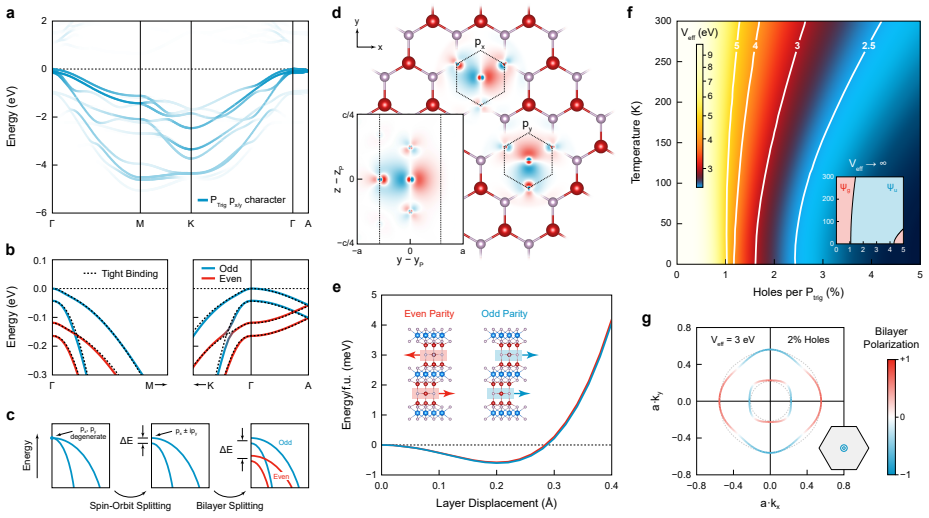
In lightly self-hole-doped LnCd3P3, modest interactions among dilute carriers stabilize an odd-parity phase that features a spontaneous Fermi surface distortion together with a momentum-dependent bilayer polarization breaking inversion symmetry.
What carries the argument
Four-band model of the valence states in which modest interactions produce odd-parity order via Fermi surface distortion and bilayer polarization.
If this is right
- Lightly doped compounds exhibit the ordered phase while the insulator does not.
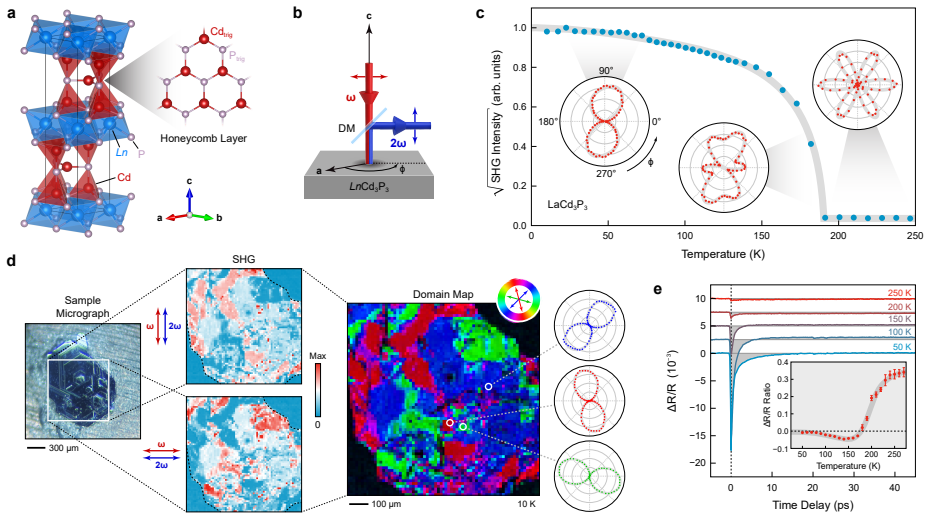
- Second harmonic microscopy shows three domain variants related by 120 degree rotations.
- Ultrafast reflectivity measurements show pronounced electronic reconstruction across the transition.
- The mechanism provides a route to interaction-driven parity breaking in dilute-carrier semiconductors.
Where Pith is reading between the lines
- The same carrier-driven mechanism could appear in other weakly screened semiconductor families.
- Further doping studies might map the boundary between ordered and disordered regimes.
- Similar bilayer systems could be engineered to enhance the odd-parity effects.
Load-bearing premise
The symmetry breaking detected by second harmonic generation is caused by bulk electronic order from the dilute carriers rather than by any accompanying structural change.
What would settle it
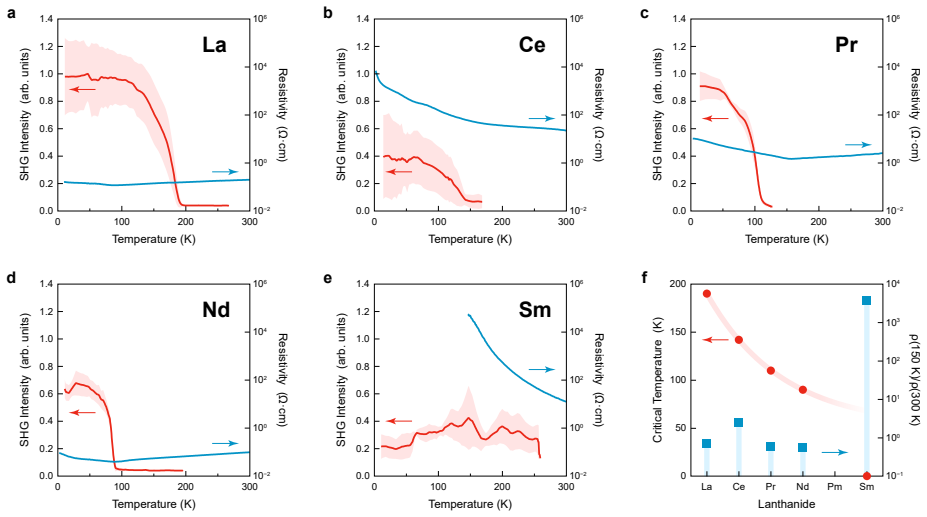
Finding the same ordered phase in insulating SmCd3P3 would show that carriers are not required.
Figures
read the original abstract
Identifying materials platforms in which dilute carriers experience strong Coulomb interactions is a central challenge in the search for interaction-driven quantum phases. In such systems, weak carrier screening can promote a variety of collective instabilities beyond the conventional Fermi liquid paradigm, including superconductivity, Wigner crystallization, and odd-parity electronic order. Experimental realizations of such dilute, strongly interacting electronic systems remain rare in crystalline materials. Here we report a spontaneous odd-parity phase transition in the phosphide semiconductor family $\textit{Ln}$Cd$_3$P$_3$ ($\textit{Ln}$ = La, Ce, Pr, Nd). Using optical second harmonic generation, we observe the onset of bulk inversion and rotational symmetry breaking accompanied by the emergence of an in-plane polar axis. Second harmonic microscopy reveals three domain variants related by 120$^\circ$ rotations, while ultrafast transient reflectivity measurements uncover a pronounced electronic reconstruction across the transition. Remarkably, the ordered phase appears only in lightly self-hole-doped compounds and is absent in insulating SmCd$_3$P$_3$, indicating an essential role for itinerant carriers despite their extremely low concentration. Guided by density functional theory, we develop a four-band model of the valence states and show that modest interactions can stabilize odd-parity electronic order. The resulting phase combines a spontaneous Fermi surface distortion with a momentum-dependent bilayer polarization that breaks inversion symmetry. Our results establish a route to interaction-driven parity breaking in dilute-carrier semiconductors and identify honeycomb bilayer systems as a promising platform for odd-parity electronic phases.
Editorial analysis
A structured set of objections, weighed in public.
Referee Report
Summary. The manuscript reports observation of a spontaneous odd-parity electronic order in the lightly self-hole-doped members of the LnCd3P3 (Ln=La,Ce,Pr,Nd) family of phosphide semiconductors. Signatures include bulk inversion and rotational symmetry breaking detected by optical second-harmonic generation (SHG) with an emergent in-plane polar axis and three 120°-related domains via SHG microscopy, plus electronic reconstruction seen in ultrafast transient reflectivity. The phase is absent in the insulating SmCd3P3 compound. Guided by DFT, a four-band model of the valence states is constructed to show that modest interactions can stabilize a phase featuring spontaneous Fermi-surface distortion together with momentum-dependent bilayer polarization that breaks inversion symmetry.
Significance. If substantiated, the result identifies a new materials platform for interaction-driven odd-parity order in the dilute-carrier limit and highlights honeycomb bilayers as a promising setting for such phases. The experimental signatures stand independently of the model; the model itself supplies a concrete, parameter-light demonstration that modest interactions suffice, which strengthens the plausibility argument.
major comments (1)
- [Abstract] Abstract: the claim that 'the ordered phase appears only in lightly self-hole-doped compounds and is absent in insulating SmCd3P3, indicating an essential role for itinerant carriers' is load-bearing for the central interpretation. The manuscript contrasts the doped and insulating members but does not report explicit temperature-dependent structural characterization (lattice parameters, space-group confirmation) across the Ln series at the transition temperature; this leaves open the possibility that the SHG signal and three-fold domains arise from Ln-specific structural distortions or chemistry that track the self-doping level rather than from carrier-driven bulk order.
Simulated Author's Rebuttal
We thank the referee for the positive assessment of our work and for the constructive major comment. We respond to it below.
read point-by-point responses
-
Referee: [Abstract] Abstract: the claim that 'the ordered phase appears only in lightly self-hole-doped compounds and is absent in insulating SmCd3P3, indicating an essential role for itinerant carriers' is load-bearing for the central interpretation. The manuscript contrasts the doped and insulating members but does not report explicit temperature-dependent structural characterization (lattice parameters, space-group confirmation) across the Ln series at the transition temperature; this leaves open the possibility that the SHG signal and three-fold domains arise from Ln-specific structural distortions or chemistry that track the self-doping level rather than from carrier-driven bulk order.
Authors: We agree that the absence of explicit temperature-dependent structural characterization (lattice parameters and space-group confirmation) across the Ln series at the transition temperature is a genuine limitation that leaves open the possibility of an Ln-specific structural origin. All members of the LnCd3P3 family are reported in the literature to share the same room-temperature crystal structure, and our own room-temperature XRD confirms this, with the primary variation being the self-doping level. The SHG onset and domain structure correlate with carrier presence rather than specific Ln identity, and the ultrafast reflectivity data indicate an electronic reconstruction. The four-band model further shows how modest interactions among the valence carriers can produce the observed odd-parity order. Nevertheless, to address the referee's concern directly we will revise the manuscript to (i) add an explicit discussion of the available structural information and its limitations, (ii) note that temperature-dependent structural data across the series are not reported here, and (iii) soften the abstract wording to reflect this nuance while retaining the central interpretation supported by the electronic measurements and model. revision: yes
Circularity Check
No significant circularity; experiments and model demonstration are independent
full rationale
The paper's load-bearing claims are the experimental observations (SHG onset of inversion/rotational symmetry breaking, three-fold domains, electronic reconstruction via transient reflectivity) that appear only in lightly self-hole-doped LnCd3P3 compounds and are absent in insulating SmCd3P3. These stand on their own without reduction to any fitted parameter or self-citation. The four-band model is explicitly described as guided by DFT to demonstrate that modest interactions can stabilize odd-parity order; it is a plausibility argument rather than a prediction that reduces to its inputs by construction. No self-definitional steps, fitted inputs called predictions, self-citation load-bearing arguments, uniqueness theorems, or ansatz smuggling are present. The derivation chain is self-contained.
Axiom & Free-Parameter Ledger
free parameters (1)
- interaction strength =
modest (unspecified numerical value)
axioms (1)
- domain assumption Density functional theory supplies an accurate description of the valence band structure near the semiconductor limit
Reference graph
Works this paper leans on
-
[1]
Shi et al
Y. Shi et al. A ferroelectric-like structural transition in a metal.Nat. Mater.12, 1024 (2013)
2013
-
[2]
L. Fu. Parity-Breaking Phases of Spin-Orbit-Coupled Metals with Gyrotropic, Ferroelectric, and Multipolar Orders.Phys. Rev. Lett.115, 026401 (2015). 19
2015
-
[3]
J. W. Harter, Z. Y. Zhao, J.-Q. Yan, D. G. Mandrus, D. Hsieh. A parity-breaking electronic nematic phase transition in the spin-orbit coupled metal Cd 2Re2O7.Science356, 295 (2017)
2017
-
[4]
Bhowal, N
S. Bhowal, N. A. Spaldin. Polar Metals: Principles and Prospects.Annu. Rev. Mater. Res. 53, 53 (2023)
2023
-
[5]
Nagaosa, Y
N. Nagaosa, Y. Yanase. Nonreciprocal Transport and Optical Phenomena in Quantum Mate- rials.Annu. Rev. Condens. Matter Phys.15, 63 (2024)
2024
-
[6]
Su´ arez-Rodr´ ıguez, F
M. Su´ arez-Rodr´ ıguez, F. de Juan, I. Souza, M. Gobbi, F. Casanova, L. E. Hueso. Nonlinear transport in non-centrosymmetric systems.Nat. Mater.24, 1005 (2025)
2025
-
[7]
S. Li, Z. Yang, X. Wang, K. P. Loh, X. R. Wang. Nonreciprocal electrical transport in emerging noncentrosymmetric systems: from hidden symmetry to functional devices.Rep. Prog. Phys. 89, 066501 (2026)
2026
-
[8]
A. T. Nientiedt, W. Jeitschko. The Series of Rare Earth Zinc PhosphidesRZn 3P3 (R= Y, La-Nd, Sm, Gd-Er) and the Corresponding Cadmium Compound PrCd 3P3.J. Solid State Chem.146, 478 (1999)
1999
-
[9]
Higuchi, Y
S. Higuchi, Y. Noshima, N. Shirakawa, M. Tsubota, J. Kitagawa. Optical, transport and magnetic properties of new compound CdCd 3P3.Mater. Res. Express3, 056101 (2016)
2016
-
[10]
S. Feng, J. Zhao, Y. Yang, X. Cheng, C. Yuan, X. Cheng. Structural, electronic, and optical properties and bond stiffness of ScAl3C3-type LaCd3P3 phases:ab initiocalculations.J. Phys. Chem. Solids134, 115 (2019)
2019
-
[11]
J. R. Chamorro, A. R. Jackson, A. K. Watkins, R. Seshadri, S. D. Wilson. Magnetic order in theS eff = 1/2 triangular-lattice compound NdCd 3P3.Phys. Rev. Mater.7, 094402 (2023)
2023
-
[12]
J. Lee, A. Rabus, N. R. Lee-Hone, D. M. Broun, E. Mun. The two-dimensional metallic triangular lattice antiferromagnet CdCd 3P3.Phys. Rev. B99, 245159 (2019)
2019
-
[13]
J. R. Chamorro et al. Hidden frustration in the triangular-lattice antiferromagneti NdCd 3P3. Phys. Rev. Mater.9, 104414 (2025)
2025
-
[14]
S. J. Gomez Alvarado et al. Interleaved bond frustration in a triangular lattice antiferromagnet. Nat. Mater.25, 65 (2025)
2025
-
[15]
Jang, Y.-S
J. Jang, Y.-S. Seo, J. Lee, E. Mun, J. Hwang. Optical properties ofRCd 3P3 (R: Ce or La) compounds: insulator–metal transition induced by displacement of atoms in the unit cell. NPG Asia Mater.17, 36 (2025). 20
2025
-
[16]
Orenstein, J
J. Orenstein, J. E. Moore, T. Morimoto, D. H. Torchinsky, J. W. Harter, D. Hsieh. Topology and Symmetry of Quantum Materials via Nonlinear Optical Responses.Annu. Rev. Condens. Matter Phys.12, 247 (2021)
2021
-
[17]
Guo et al
J. Guo et al. Interplay of charge carrier and antiferromagnetic order in metallic triangular lattice GdZn3P3.Phys. Rev. B113, 085147 (2026)
2026
-
[18]
I. I. Pomeranchuk. On the Stability of a Fermi Liquid.Sov. Phys. JETP8, 361 (1959)
1959
-
[19]
Van Tuan, M
D. Van Tuan, M. Yang, H. Dery. Coulomb interaction in monolayer transition-metal dichalco- genides.Phys. Rev. B98, 125308 (2018)
2018
-
[20]
Galiautdinov
A. Galiautdinov. Anisotropic Keldysh interaction.Phys. Lett. A383, 3167 (2019)
2019
- [21]
-
[22]
Kresse, J
G. Kresse, J. Hafner.Ab initiomolecular dynamics for liquid metals.Phys. Rev. B47, 558(R) (1993)
1993
-
[23]
Kresse, J
G. Kresse, J. Furthm¨ uller. Efficiency of ab-initio total energy calculations for metals and semiconductors using a plane-wave basis set.Comput. Mat. Sci.6, 15 (1996)
1996
-
[24]
Kresse, J
G. Kresse, J. Furthm¨ uller. Efficient iterative schemes forab initiototal-energy calculations using a plane-wave basis set.Phys. Rev. B54, 11169 (1996)
1996
-
[25]
Kresse, D
G. Kresse, D. Joubert. From ultrasoft pseudopotentials to the projector augmented-wave method.Phys. Rev. B59, 1758 (1999)
1999
-
[26]
J. P. Perdew, K. Burke, M. Ernzerhof. Generalized Gradient Approximation Made Simple. Phys. Rev. Lett.77, 3865 (1996)
1996
-
[27]
Grimme, J
S. Grimme, J. Antony, S. Ehrlich, H. Krieg. A consistent and accurateab initioparameter- ization of density dispersion correction (DFT-D) for the 94 elements H-Pu.J. Chem. Phys. 132, 154104 (2010)
2010
-
[28]
Blaha et al
P. Blaha et al. WIEN2k, An Augmented Plane Wave + Local Orbitals Program for Calculating Crystal Properties (Karlheinz Schwarz, Techn. Universit¨ at Wien, Austria), 2018
2018
-
[29]
Blaha et al
P. Blaha et al. WIEN2k: An APW+lo program for calculating the properties of solids.J. Chem. Phys.152, 074101 (2020)
2020
-
[30]
J. C. Slater, G. F. Koster. Simplified LCAO Method for the Periodic Potential Problem.Phys. Ref.94, 1498 (1954). 21 a b 50 100 150 200 250 Temperature (K) 0.0 0.2 0.4 0.6 Averaged ΔR/R (10 −3 ) −0.2 50 100 150 200 250 Temperature (K) −15 −10 −5 0 Minimum ΔR/R (10 −3 ) −20 Extended Data Fig. 1|Transient reflectivity data for LaCd 3P3. a,Magnitude of the in...
1954
discussion (0)
Sign in with ORCID, Apple, or X to comment. Anyone can read and Pith papers without signing in.