REVIEW 3 major objections 6 minor 34 references
Dynamic Droop Control in Low-inertia Power Systems
T0 review · 3 major / 6 minor · reviewed 2026-08-14 · deepseek-v4-flash
Pith's one-line read The paper shows that a dynamic droop controller can tune low-inertia grids for noise rejection, fast synchronization, and no frequency Nadir without changing the steady-state control burden.
desk verdict Careful and useful theoretical analysis of iDroop; the results are conditional on a restrictive proportionality assumption, and the robustness evidence is thinner than the abstract suggests. read the letter →
The pith
A machine-rendered reading of the paper's core claim, the machinery that carries it, and where it could break.
The reading
What carries the argument
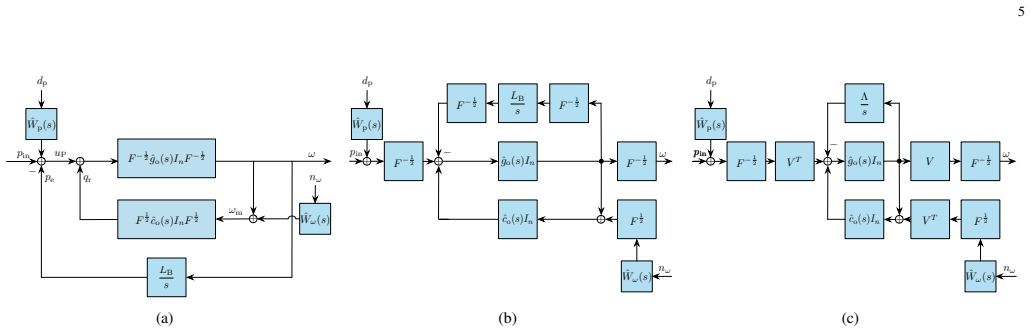
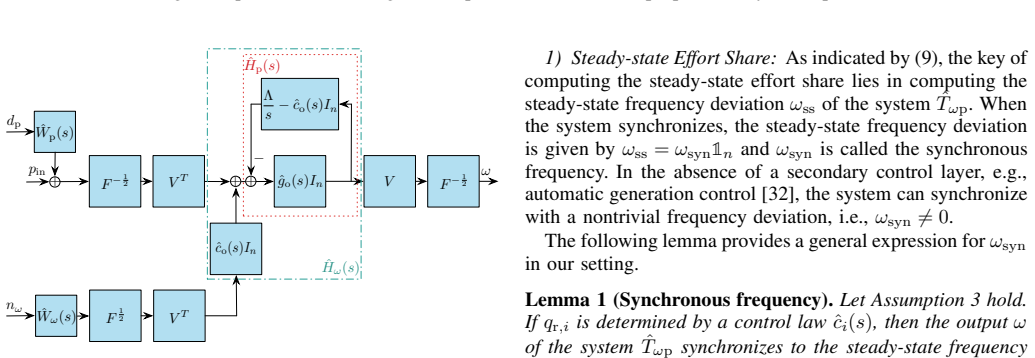
The enabling object is the iDroop transfer function, $\hat c_i(s) = -(\nu_i s + \delta_i r_{r,i}^{-1})/(s+\delta_i)$, a lead/lag compensator whose dc gain is fixed at $-r_{r,i}^{-1}$ while its high-frequency gain is $\nu_i$. The analysis runs through a modal decomposition: under the proportionality assumption $\hat G(s)=\hat g_o(s)F^{-1}$ and $\hat C(s)=\hat c_o(s)F$, the network dynamics diagonalize via the scaled Laplacian $L_F=F^{-1/2}L_B F^{-1/2}$, reducing every performance metric to sums of scalar transfer-function norms. The key cancellation is Theorem 9: with $\delta=\tau^{-1}$ and $\nu=r_r^{-1}+r_t^{-1}$, the representative loop gain becomes first-order, $\hat h_{p,1,T,\mathrm{iDroop}}(s)=1/(ms+\check d+r_t^{-1})$, so the step response has no overshoot and the Nadir vanishes. Theorem 7 and Theorem 8 use the same diagonalized formulas to tune noise rejection and zero synchronization cost.
What would settle it
Pick a network whose generators have strongly heterogeneous turbine time constants, violating the proportionality assumption, and apply the Theorem 9 tuning $\delta_i=\tau_i^{-1}$, $\nu_i=r_{r,i}^{-1}+r_{t,i}^{-1}$ at every bus. Simulate a step disturbance: if the system frequency retains a measurable Nadir (for instance, deeper than 5% of the droop-only Nadir), or if iDroop's H2 norm exceeds droop control's in a noise-dominated simulation, the central claim would be contradicted.
Extended reading notes
Core claim
The paper's central claim is that a first-order dynamic droop controller, iDroop, can outperform both droop control and virtual inertia on dynamic performance metrics without changing the inverters' steady-state effort share. Under a proportionality assumption that diagonalizes the network, the paper derives closed-form expressions for the H2 norm, synchronization cost, and Nadir, and shows: choosing ν near the minimizer ν* = −d + $\sqrt$($d^{2}$ + (κ_p/κ_ω)^2) with δ small makes iDroop strictly better than droop control at rejecting power fluctuations and measurement noise; taking δ → 0 and ν → ∞ drives the synchronization cost to zero; and setting δ = $τ^{{-1}}$ and ν = $r_r^{{-1}}$ + $r_t^{{-1}}$ cancels the turbine lag, making the system frequency respond as a first-order system so the Nadir disappears. The same steady-state effort share as droop and virtual inertia is preserved throughout, because iDroop's dc gain is still −$r_r^{{-1}}$. The paper also proves that droop control cannot eliminate Nadir in low-inertia systems and that virtual inertia generically has infinite H2 norm, and it validates the iDroop tunings on a realistic non-proportional network.
Load-bearing premise
The closed-form guarantees all rely on the assumption that every bus's generator and inverter dynamics are proportional copies of one representative pair, so the whole network can be diagonalized by a single scaling matrix; if real machines differ strongly in time constants and ratings, the tuning formulas may not deliver the promised behavior.
Editorial extensions
If this is right
- In a proportional network, iDroop can be tuned so that its H2 norm is strictly smaller than droop control's whenever $(\kappa_p/\kappa_\omega)^2 \neq 2r_r^{-1}d + r_r^{-2}$, with the best performance approached as $\delta\to 0$ and $\nu\to\nu^*$.
- iDroop can drive the synchronization cost to zero by taking $\delta\to 0$ and $\nu\to\infty$, a capability the paper shows droop control and virtual inertia cannot match without changing the steady-state effort share.
- Setting $\delta=\tau^{-1}$ and $\nu=r_r^{-1}+r_t^{-1}$ eliminates the frequency Nadir, and in the realistic regime $\kappa_p\gg\kappa_\omega$ this same tuning also improves frequency variance relative to droop control.
- The steady-state effort share and synchronous frequency under iDroop are identical to those under droop and virtual inertia, so the dynamic improvements do not shift the regulation burden.
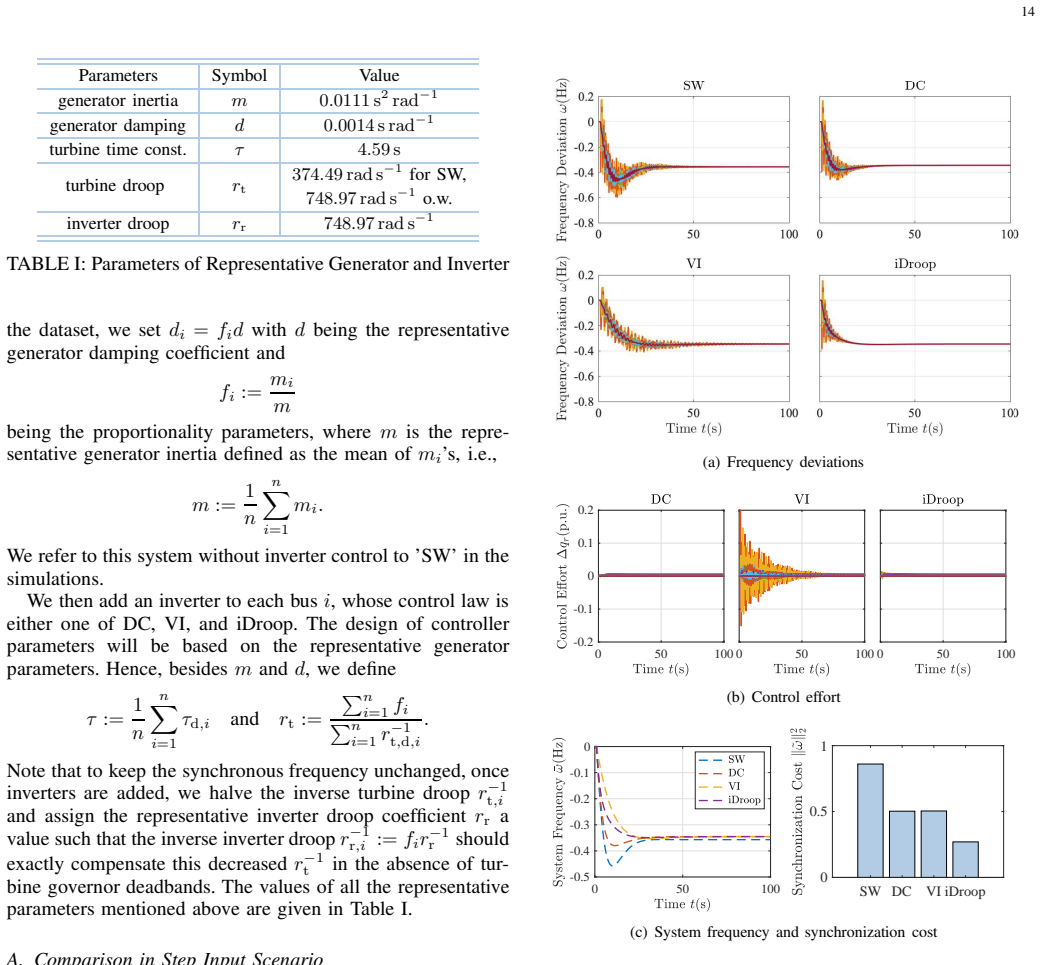
- Simulations on the Icelandic grid suggest these tunings remain useful when the proportionality assumption is violated, including in scenarios with combined step and stochastic disturbances.
Reading between the lines
- A testable extension the authors do not pursue is to treat the $\delta=0$ limit as a pure high-frequency gain with DC regulation preserved; this suggests iDroop's single pole-zero pair is close to the minimal dynamic structure needed to separate transient shaping from steady-state power sharing.
- For deployment, one could compute $\delta$ and $\nu$ from fleet-averaged turbine time constants and droop coefficients, as the paper's numerical setup does, and then monitor how per-bus heterogeneity degrades the H2 guarantee; the paper shows the Nadir tuning works on one non-proportional network but does not quantify a general robustness margin.
- The noise result points to a fairer benchmark for virtual synchronous machines: comparing iDroop against virtual inertia with an explicit measurement low-pass filter, since the paper's unbounded-variance result applies to the unfiltered VI law and a filtered version could close some of the gap.
- Because the Nadir-eliminating choice $\nu=r_r^{-1}+r_t^{-1}$ always lies between $r_r^{-1}$ and $\nu^*$ when $\kappa_p\gg\kappa_\omega$, the same tuning that removes the Nadir should also reduce frequency variance; the paper observes this in simulation but leaves the analytical trade-off curve between the two objectives implicit.
Signed reviews
Editorial analysis
A structured set of objections, weighed in public.
Referee Report
Summary. The paper studies inverter-based frequency control in low-inertia power systems. Under a proportionality assumption (Assumption 1) that makes the generator and inverter transfer-function matrices share a common diagonal factor F, the authors diagonalize the network and derive closed-form expressions for the steady-state effort share, the H2 frequency variance, bounds on the synchronization cost, and Nadir-elimination conditions. They use these expressions to show that conventional droop control cannot decouple dynamic performance from steady-state control effort, and that virtual inertia produces an unbounded H2 norm from white measurement noise. They then propose a dynamic droop (iDroop) controller and prove three tuning results: a variance-optimal tuning (Theorem 7), a zero-synchronization-cost limit (Theorem 8), and a Nadir-eliminating tuning (Theorem 9). The numerical section applies the Nadir-eliminating tuning to a Kron-reduced Icelandic network with heterogeneous parameters.
Significance. If the claims hold, the paper provides a genuinely useful control-theoretic contribution: explicit, parameter-free tuning formulas for iDroop that decouple steady-state effort share from dynamic performance, and a systematic comparison of droop, virtual inertia, and the proposed controller. The derivations are careful: the H2 formulas follow from a proved Lyapunov-based lemma (Lemma 2), and the key theorems (Theorems 7-9) come with proofs. The tuning rules are falsifiable and directly implementable from a small set of aggregate parameters. The main limitation is that the closed-form theory is proved only under Assumption 1, and the evidence that the tuning works when that assumption fails is much thinner than the abstract claims. A secondary limitation is that the zero-synchronization-cost result is an asymptotic limit rather than a finite tuning. The paper is significant for the control community even with these caveats, but the advertised generality needs to be reined in or supported by additional evidence.
major comments (3)
- [Abstract and Section VI] The abstract states that 'extensive numerical experimentation shows that the proposed tuning is effective even when our proportionality assumptions are not valid,' but Section VI contains only one network (the Icelandic Kron-reduced 35-bus system), one disturbance pattern, and a parameter choice that retains partial proportionality: the manuscript sets d_i = f_i d with f_i = m_i/m, so damping is exactly proportional while inertia, turbine time constants, and turbine droop are taken from the dataset. This is a single heuristic test, not a sensitivity analysis, and it does not establish robustness as Assumption 1 is violated in a controlled or systematic way. Since all closed-form tuning formulas in Theorems 7-9 are derived under Assumption 1, the general decoupling claim outside that assumption is currently unsupported; the authors should either soften the abstract/conclusion claims or provide a systematic sensitivity study (e.g., random perturbations to F, independent variations of d_i, multiple test networks).
- [Theorem 8 and Section V.C] The advertised feature of 'fast system-wide synchronization' is not established by Theorem 8. The zero-synchronization-cost result is obtained only in the double limit delta -> 0 and nu -> infinity, and the authors themselves note that delta near zero may lead to slow response and that nu -> infinity may hinder robustness. The theorem therefore provides an asymptotic idealization, not a finite parameter tuning, and it does not imply that the response is fast. Since the abstract and introduction list 'fast system-wide synchronization' as one of the three tunable iDroop properties, this is a load-bearing overstatement. The authors should state clearly that Theorem 8 only shows a limiting flexibility, and either provide finite-parameter bounds or withdraw the word 'fast' from the claims.
- [Corollary 3 and Section IV.B] The claim that virtual inertia leads to unbounded frequency variance is a direct consequence of the white-noise measurement model: h_omega,k,VI(s) has a nonzero high-frequency gain, so ||T_omega dn,VI||_H2 = infinity under the stated H2 definition. This is internally consistent, but the paper should explicitly warn that the 'unbounded variance' conclusion is a white-noise-model phenomenon; with band-limited measurement noise the variance would be finite. As written, the abstract and Section IV.B present the unboundedness as a universal property of VI, which may mislead readers who do not work with ideal white-noise models.
minor comments (6)
- [Equation (7)] The displayed formula for L_B,ij appears to have a typesetting error: the partial derivative with respect to theta_j is written as '∂θj' without a fraction or clear differentiation operator. Please correct this.
- [Section VI, first paragraph] There is a typo in the phrase 'simultation results'; it should read 'simulation results'.
- [Table I] The abbreviation 'o.w.' in the turbine droop row is undefined; please spell out 'otherwise' or define the abbreviation in the table caption.
- [Theorem 7 statement] The interval notation in (51) is slightly ambiguous when nu* equals r_r^{-1}; the equality case is already excluded by the stated condition, but the phrase 'for any delta > 0 and nu such that nu in [nu*, r_r^{-1}) or nu in (r_r^{-1}, nu*]' would be clearer if the two cases were separated according to whether nu* < r_r^{-1} or nu* > r_r^{-1}.
- [Section VI.C] The simulation in the combined step-and-noise scenario does not state whether the noise weighting matrices W_p(s) and W_omega(s) are chosen according to Assumption 2 (i.e., proportional to F^{1/2} and F^{-1/2}). Please state this explicitly, since the H2 comparisons depend on it.
- [Lemma 3] Lemma 3 is stated as a 'direct extension' of [15, Proposition 2] without a proof. Since the synchronization-cost analysis in Corollaries 5-6 and Theorem 8 relies on it, a proof or a precise statement of the extension conditions would improve the paper's self-containedness.
Circularity Check
No significant circularity: iDroop's H2, synchronization, and Nadir results are explicit algebraic consequences of the stated model, not fits or self-citation loops.
full rationale
The derivation chain is self-contained. Theorem 2 decomposes the H2 norm by modal diagonalization under Assumption 1; Corollary 9 and Theorem 7 evaluate that norm for iDroop using Lemma 2, an analytic Lyapunov/H2 formula proved in Section III-B2. Theorem 9's Nadir elimination follows by substituting delta = tau^{-1} and nu = r_r^{-1} + r_t^{-1} into (46) and (19), producing a first-order scalar response; no parameter is fitted to the simulation output. Theorem 8's zero-synchronization-cost result is a limit of H2 norms of scalar modes, combined with the cost bounds in Theorem 3. The only prior-work overlap is Lemma 3, which invokes a direct extension of [15, Proposition 2] for the synchronization-cost expression, and the common-mode factorization cited to [17] in the proof of Theorem 9; both are general mathematical identities that do not assume the iDroop tuning and are not equivalent to the results derived here. The numerical section is a single validation on the Icelandic grid with damping kept proportional (d_i = f_i d), so it is weak evidence for robustness outside Assumption 1, and the footnote reassigns some turbine droops to create a deeper Nadir; these are generalization and scenario-selection concerns, not circularity. No prediction in the paper reduces by construction to a fitted input or to an author-imported uniqueness claim.
Assumptions & free parameters
free parameters (3)
- Representative generator damping d =
0.0014 s/rad
- Virtual inertia mv in the step-input comparison =
0.022 s^2/rad
- Noise weighting constants kappa_p and kappa_omega =
kappa_p = 1e-4, kappa_omega = 1e-5 (simulation)
assumptions (6)
- domain assumption Assumption 1 (Proportionality): there exists F := diag(f_i) >= 0 such that G(s) = g_o(s) F^{-1} and C(s) = c_o(s) F
- domain assumption Assumption 2 (Proportional weighting scenario): Wp(s) = kappa_p F^{1/2}, Womega(s) = kappa_omega F^{-1/2}, and |omega_i(t)| < omega_epsilon for all i
- domain assumption Assumption 3 (Step input scenario): step power injection, dp = 0, n_omega = 0, and omega_epsilon = 0 so turbines are constantly triggered
- domain assumption Internal stability of the feedback interconnection (Remark 2)
- domain assumption Standard transmission-network model assumptions (Remark 1): lossless lines, constant voltage magnitudes, no reactive-power coupling, small equilibrium angle differences
- standard math Standard linear algebra and control facts: Laplacian diagonalization, interlacing theorem, Rayleigh quotient, Lyapunov equation, Routh-Hurwitz
Cite this review
Pith. "Pith review of Dynamic Droop Control in Low-inertia Power Systems." pith.science (2026). https://pith.science/paper/OO3URMBO
@misc{pith2026190810983,
  author       = {Pith},
  title        = {Pith review of: Dynamic Droop Control in Low-inertia Power Systems},
  year         = {2026},
  howpublished = {\url{https://pith.science/paper/OO3URMBO}},
  note         = {Machine review of arXiv:1908.10983}
}
abstract
A widely embraced approach to mitigate the dynamic degradation in low-inertia power systems is to mimic generation response using grid-connected inverters to restore the grid's stiffness. In this paper, we seek to challenge this approach and advocate for a principled design based on a systematic analysis of the performance trade-offs of inverter-based frequency control. With this aim, we perform a qualitative and quantitative study comparing the effect of conventional control strategies --droop control (DC) and virtual inertia (VI)-- on several performance metrics induced by $\mathcal L_2$ and $\mathcal L_\infty$ signal norms. By extending a recently proposed modal decomposition method, we capture the effect of step and stochastic power disturbances, and frequency measurement noise, on the overall transient and steady-state behavior of the system. Our analysis unveils several limitations of these solutions, such as the inability of DC to improve dynamic frequency response without increasing steady-state control effort, or the large frequency variance that VI introduces in the presence of measurement noise. We further propose a novel dynam-i-c Droop controller (iDroop) that overcomes the limitations of DC and VI. More precisely, we show that iDroop can be tuned to achieve high noise rejection, fast system-wide synchronization, or frequency overshoot (Nadir) elimination without affecting the steady-state control effort share, and propose a tuning recommendation that strikes a balance among these objectives. Extensive numerical experimentation shows that the proposed tuning is effective even when our proportionality assumptions are not valid, and that the particular tuning used for Nadir elimination strikes a good trade-off among various performance metrics.
Figures

Figures from the paper (2 more)

Reference graph
Works this paper leans on
-
[1]
iDroop: A dynamic droop controller to decou ple power grid’s steady-state and dynamic performance,
E. Mallada, “iDroop: A dynamic droop controller to decou ple power grid’s steady-state and dynamic performance,” in Proc. of IEEE Confer- ence on Decision and Control , Dec. 2016, pp. 4957–4964
work page 2016
-
[2]
Y . Jiang, R. Pates, and E. Mallada, “Performance tradeof fs of dynami- cally controlled grid-connected inverters in low inertia p ower systems,” in Proc. of IEEE Conference on Decision and Control , Dec. 2017, pp. 5098–5105. 16
work page 2017
-
[3]
B. Kroposki, B. Johnson, Y . Zhang, V . Gevorgian, P . Denho lm, B. Hodge, and B. Hannegan, “Achieving a 100% renewable grid: Operating electric power systems with extremely high level s of variable renewable energy,” IEEE Power and Energy Magazine , vol. 15, no. 2, pp. 61–73, Mar. 2017
work page 2017
-
[4]
Foundations and challenges of low-inertia systems (invited paper),
F. Milano, F. D¨ orfler, G. Hug, D. J. Hill, and G. V erbiˇ c, “ Foundations and challenges of low-inertia systems (invited paper),” in Proc. of Power Systems Computation Conference , June 2018, pp. 1–25
work page 2018
-
[5]
Paving the way: A future without inertia is close r than you think,
T. Ackermann, T. Prevost, V . Vittal, A. J. Roscoe, J. Mate vosyan, and N. Miller, “Paving the way: A future without inertia is close r than you think,” IEEE Power and Energy Magazine , vol. 15, no. 6, pp. 61–69, Nov. 2017
work page 2017
-
[6]
Impact of low r otational inertia on power system stability and operation,
A. Ulbig, T. S. Borsche, and G. Andersson, “Impact of low r otational inertia on power system stability and operation,” in Proc. of IF AC W orld Congress, Aug. 2014, pp. 7290–7297
work page 2014
-
[7]
A framework for assessing renewable integration limits with respect to frequency performance,
A. S. Ahmadyar, S. Riaz, G. V erbiˇ c, A. Chapman, and D. J. H ill, “A framework for assessing renewable integration limits with respect to frequency performance,” IEEE Transactions on Power Systems , vol. 33, no. 4, pp. 4444–4453, July 2018
work page 2018
-
[8]
J. O’Sullivan, A. Rogers, D. Flynn, P . Smith, A. Mullane, and M. O’Malley, “Studying the maximum instantaneous non-sync hronous generation in an island system—Frequency stability challe nges in Ire- land,” IEEE Transactions on Power Systems , vol. 29, no. 6, pp. 2943– 2951, Nov. 2014
work page 2014
Show all 34 references
-
[9]
Global energy scenario and impact of power el ectronics in 21st century,
B. K. Bose, “Global energy scenario and impact of power el ectronics in 21st century,” IEEE Transactions on Industrial Electronics , vol. 60, no. 7, pp. 2638–2651, July 2013
2013
-
[10]
Droop vs. virtual inertia: Comparison from the perspective of converter oper ation mode,
R. Ofir, U. Markovic, P . Aristidou, and G. Hug, “Droop vs. virtual inertia: Comparison from the perspective of converter oper ation mode,” in Proc. of IEEE International Energy Conference , June 2018, pp. 1–6
2018
-
[11]
Placement and imp lementation of grid-forming and grid-following virtual inertia and fas t frequency response,
B. K. Poolla, D. Groß, and F. D¨ orfler, “Placement and imp lementation of grid-forming and grid-following virtual inertia and fas t frequency response,” IEEE Transactions on Power Systems , vol. 34, no. 4, pp. 3035–3046, July 2019
2019
-
[12]
Optimizing DER participation in inertial and primary -frequency response,
S. S. Guggilam, C. Zhao, E. Dall’Anese, Y . C. Chen, and S. V . Dho- ple, “Optimizing DER participation in inertial and primary -frequency response,” IEEE Transactions on Power Systems , vol. 33, no. 5, pp. 5194–5205, Sept. 2018
2018
-
[13]
LQR-base d adaptive virtual synchronous machine for power systems with high inv erter penetration,
U. Markovic, Z. Chu, P . Aristidou, and G. Hug, “LQR-base d adaptive virtual synchronous machine for power systems with high inv erter penetration,” IEEE Transactions on Sustainable Energy , vol. 10, no. 3, pp. 1501–1512, July 2019
2019
-
[14]
Graph laplacian spectrum and primary frequency regulation,
L. Guo, C. Zhao, and S. H. Low, “Graph laplacian spectrum and primary frequency regulation,” in Proc. of IEEE Conference on Decision and Control, Dec. 2018, pp. 158–165
2018
-
[15]
Global analysis of synchro nization per- formance for power systems: bridging the theory-practice g ap,
F. Paganini and E. Mallada, “Global analysis of synchro nization per- formance for power systems: bridging the theory-practice g ap,” arXiv preprint:1905.06948, May 2019
1905 arXiv
-
[16]
Optimal placement of inerti a and pri- mary control: A matrix perturbation theory approach,
L. Pagnier and P . Jacquod, “Optimal placement of inerti a and pri- mary control: A matrix perturbation theory approach,” arXiv preprint: 1906.06922, June 2019
1906 arXiv
-
[17]
Global performance metric s for synchro- nization of heterogeneously rated power systems: The role o f machine models and inertia,
F. Paganini and E. Mallada, “Global performance metric s for synchro- nization of heterogeneously rated power systems: The role o f machine models and inertia,” in Proc. of Allerton Conference on Communication, Control, and Computing , Oct. 2017, pp. 324–331
2017
-
[18]
A voltage and frequency droop control metho d for parallel inverters,
K. D. Brabandere, B. Bolsens, J. V . den Keybus, A. Woyte, J. Driesen, and R. Belmans, “A voltage and frequency droop control metho d for parallel inverters,” IEEE Transactions on Power Electronics , vol. 22, no. 4, pp. 1107–1115, July 2007
2007
-
[19]
Virtual synchronous machine,
H. Beck and R. Hesse, “Virtual synchronous machine,” in Proc. of International Conference on Electrical Power Quality and U tilisation, Oct. 2007, pp. 1–6
2007
-
[20]
The price of sync hrony: Evaluating the resistive losses in synchronizing power net works,
E. Tegling, B. Bamieh, and D. F. Gayme, “The price of sync hrony: Evaluating the resistive losses in synchronizing power net works,” IEEE Transactions on Control of Network Systems , vol. 2, no. 3, pp. 254–266, Sept. 2015
2015
-
[21]
Usefulness of DC power flow for active power flow analysis,
K. Purchala, L. Meeus, D. V an Dommelen, and R. Belmans, “ Usefulness of DC power flow for active power flow analysis,” in Proc. of IEEE Power Engineering Society General Meeting , June 2005, pp. 454–459
2005
-
[22]
Kundur, Power System Stability and Control
P . Kundur, Power System Stability and Control . McGraw-Hill, 1994
1994
-
[23]
Power system dy- namics as primal-dual algorithm for optimal load control,
C. Zhao, U. Topcu, N. Li, and S. H. Low, “Power system dy- namics as primal-dual algorithm for optimal load control,” arXiv preprint:1305.0585, May 2013
2013 arXiv
-
[24]
Design and stabilit y of load- side primary frequency control in power systems,
C. Zhao, U. Topcu, N. Li, and S. Low, “Design and stabilit y of load- side primary frequency control in power systems,” IEEE Transactions on Automatic Control , vol. 59, no. 5, pp. 1177–1189, May 2014
2014
-
[25]
Connecting automatic gener ation control and economic dispatch from an optimization view,
N. Li, C. Zhao, and L. Chen, “Connecting automatic gener ation control and economic dispatch from an optimization view,” IEEE Transactions on Control of Network Systems , vol. 3, no. 3, pp. 254–264, Sept. 2016
2016
-
[26]
Optimal load-side cont rol for frequency regulation in smart grids,
E. Mallada, C. Zhao, and S. Low, “Optimal load-side cont rol for frequency regulation in smart grids,” IEEE Transactions on Automatic Control, vol. 62, no. 12, pp. 6294–6309, Dec. 2017
2017
-
[27]
H. K. Khalil, Nonlinear Systems , 3rd ed. Prentice Hall, 2002
2002
-
[28]
Robust scale free synthesis fo r frequency regulation in power systems,
R. Pates and E. Mallada, “Robust scale free synthesis fo r frequency regulation in power systems,” IEEE Transactions on Control of Network Systems, 2019
2019
-
[29]
Developing generic dynamic models for the 2030 eastern interconnection grid,
G. Kou, S. W. Hadley, P . Markham, and Y . Liu, “Developing generic dynamic models for the 2030 eastern interconnection grid,” Oak Ridge National Laboratory, Tech. Rep., Dec. 2013. [Online] . Available: http://www.osti.gov/scitech/
2013
-
[30]
R. A. Horn and C. R. Johnson, Matrix Analysis , 2nd ed. Cambridge University Press, 2012
2012
-
[31]
Analysis of timin g jitter in CMOS ring oscillators,
T. C. Weigandt, B. Kim, and P . R. Gray, “Analysis of timin g jitter in CMOS ring oscillators,” in Proc. of IEEE International Symposium on Circuits and Systems , May 1994, pp. 27–30
1994
-
[32]
Automatic generation control part II—Digital control techniques,
F. P . deMello, R. J. Mills, and W. F. B’Rells, “Automatic generation control part II—Digital control techniques,” IEEE Transactions on Power Apparatus and Systems , vol. PAS-92, no. 2, pp. 716–724, Mar. 1973
1973
-
[33]
of Edinburgh
U. of Edinburgh. Power systems test case archive. [Onli ne]. Available: https://www.maths.ed.ac.uk/optenergy/NetworkData/icelandDyn/
-
[34]
Kron reduction of graphs with a pplications to electrical networks,
F. D¨ orfler and F. Bullo, “Kron reduction of graphs with a pplications to electrical networks,” IEEE Transactions on Circuits and Systems I: Regular Papers, vol. 60, no. 1, pp. 150–163, Jan. 2013
2013
Reviewed August 14, 2026 · model on record in the stance chip above.
Discussion (0). Continue with ORCID to comment.