Entanglement Structure Across mathbb{Z}_n Phase Transitions in 1D Rydberg Atom Arrays
Pith reviewed 2026-07-01 05:36 UTC · model grok-4.3
The pith
Fourier analysis of pairwise concurrence across a Rydberg chain detects Z_n phase transitions by revealing periodic entanglement patterns.
A machine-rendered reading of the paper's core claim, the machinery that carries it, and where it could break.
Core claim
The entanglement-structure factor, constructed from the Fourier transform of total site concurrence, exhibits distinct features that mark the emergence and transitions of Z_n-ordered phases in the Rydberg chain, providing an alternative characterization to the conventional local-density (magnetization) order parameter.
What carries the argument
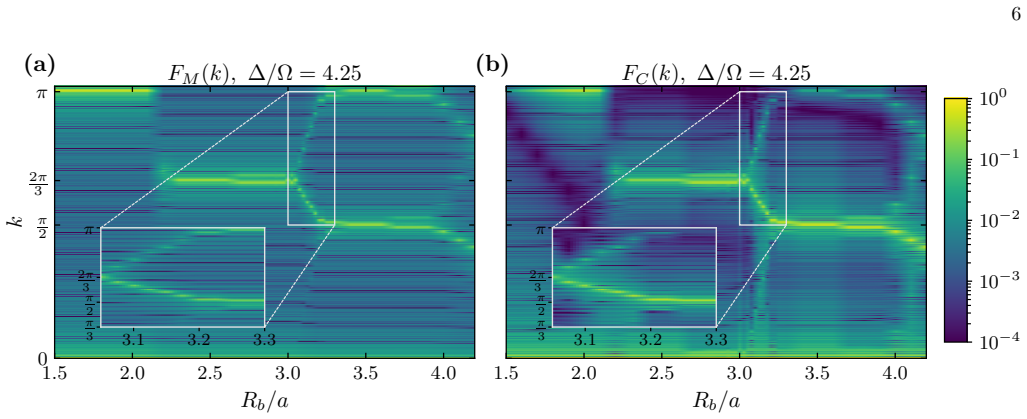
entanglement-structure factor: the Fourier transform of the total concurrence (summed over all other sites) evaluated at each site, whose peaks or periodicity directly reflect the Z_n symmetry breaking.
If this is right
- The same concurrence-based factor can be measured directly in analog Rydberg arrays using site-selective erasure and parametrized pulses.
- Entanglement patterns supply an independent diagnostic for symmetry-breaking transitions that does not rely on single-site density.
- Multipartite entanglement can be probed through its pairwise reductions in a manner that tracks phase structure across the chain.
- The approach extends the utility of two-qubit concurrence beyond bipartite settings to global phase identification.
Where Pith is reading between the lines
- The method may generalize to other lattice models where conventional order parameters are hard to access experimentally.
- Comparing the factor's scaling with system size could quantify how entanglement length scales with the interaction range.
- If the factor remains robust under weak disorder, it could serve as a diagnostic in imperfect experimental arrays.
- Extension to two-dimensional Rydberg lattices would test whether the Fourier approach captures higher-dimensional symmetry breaking.
Load-bearing premise
The Fourier transform of total site concurrence produces clear, interpretable signatures of Z_n order that are at least as informative as the local-density order parameter, without needing extra tuning of analysis windows or interaction ranges.
What would settle it
Numerical or experimental data in which the entanglement-structure factor remains featureless across a known Z_n transition point while the local-density order parameter shows a clear jump or peak.
Figures
read the original abstract
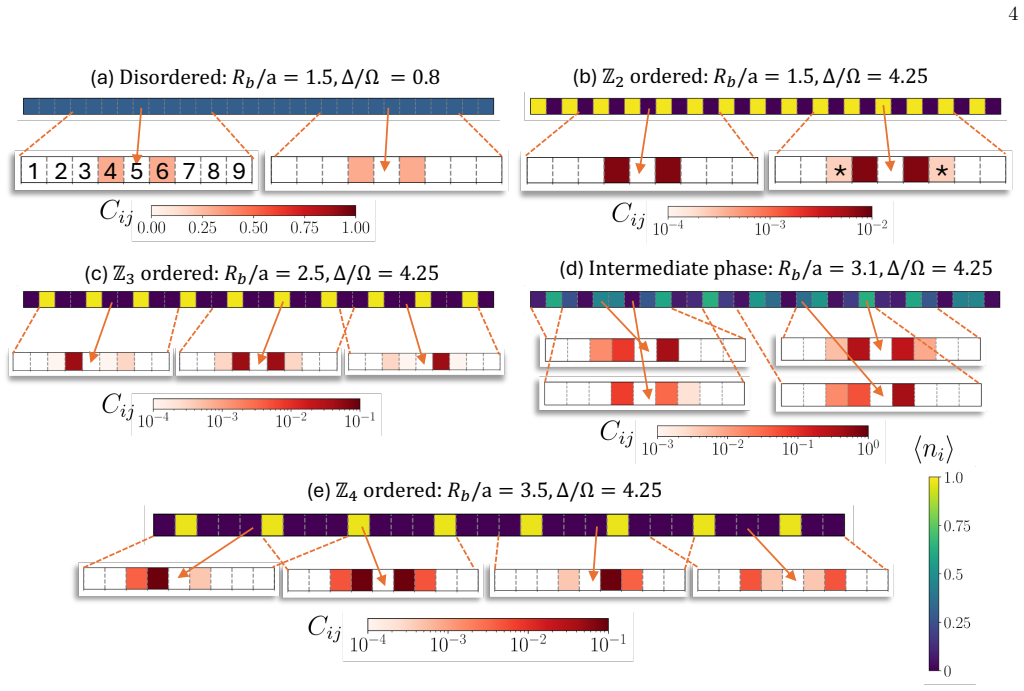
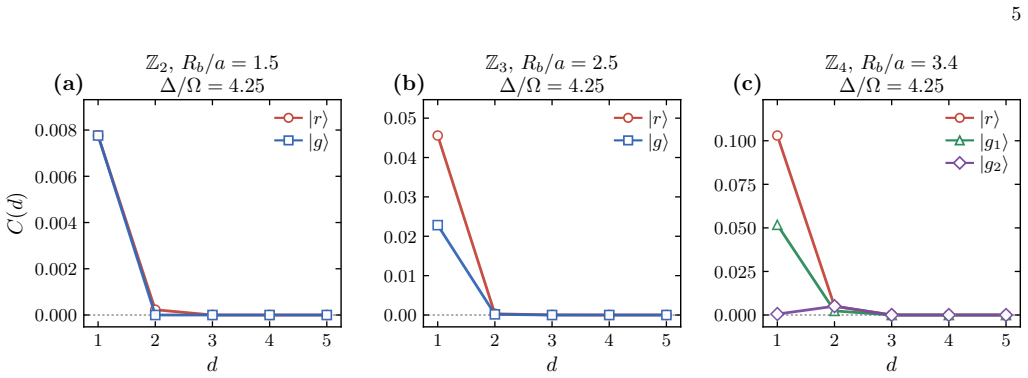
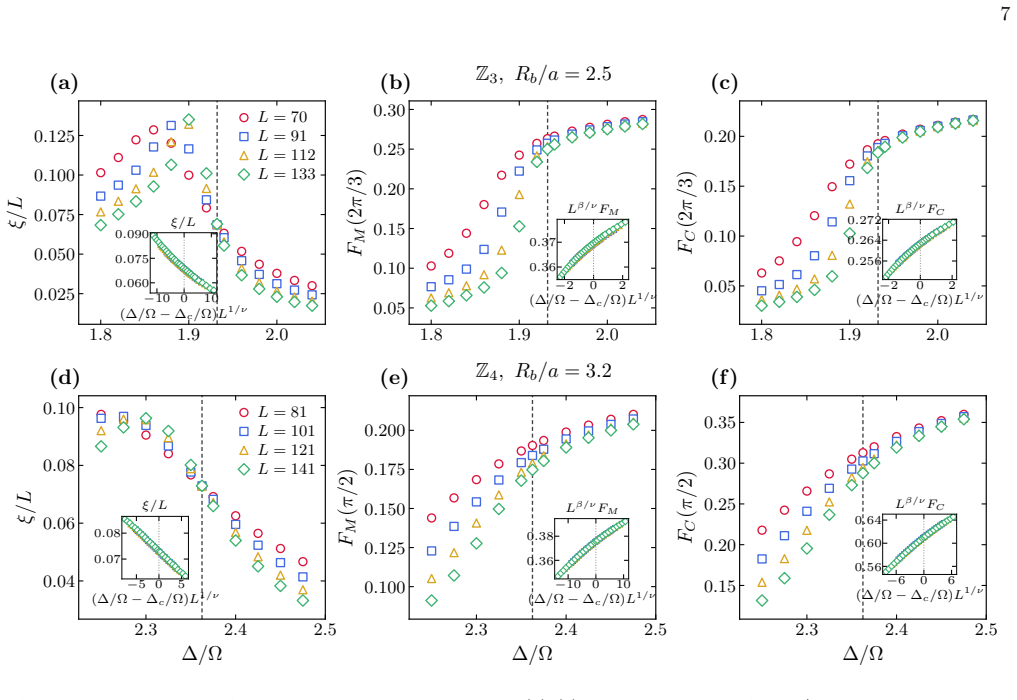
Multipartite quantum entanglement plays a crucial role in the emergence of different quantum phases and their transitions in quantum many-body systems. It is of general interest to know what sort of analysis on quantum entanglement can bring us a profound insight to understand the rich dynamics of quantum many-body systems. In this work we study the characteristics of quantum entanglement in relation to $\mathbb{Z}_n$-ordered phases emerging under a varied strength of 1-dim Rydberg interaction. We propose an approach based on the structure of pair-wise entanglement across the Rydberg chain using two-qubit concurrence as an entanglement measure. We define an entanglement-structure factor via Fourier analysis of total concurrence at each site and address $\mathbb{Z}_n$ phase transitions in comparison with the conventional order-parameter based on local density, i.e. magnetization. We also discuss how the required two-qubit concurrence can be measured in analog Rydberg atom arrays using site-selective erasure and parametrized laser pulses. Our investigation suggests that an entanglement-structure-based approach can provide a powerful tool in analyzing symmetry-breaking in quantum phase transitions.
Editorial analysis
A structured set of objections, weighed in public.
Referee Report
Summary. The manuscript studies multipartite entanglement in 1D Rydberg atom arrays across Z_n-ordered phases that arise as the Rydberg interaction strength is varied. It introduces an entanglement-structure factor constructed from the Fourier transform of the total site concurrence (with two-qubit concurrence as the entanglement measure) and compares its ability to detect the phase transitions against the conventional local-density (magnetization) order parameter. The work also outlines an experimental protocol for extracting the required concurrences via site-selective erasure and parametrized laser pulses in analog Rydberg simulators. The central claim is that an entanglement-structure-based approach can serve as a powerful tool for analyzing symmetry-breaking quantum phase transitions.
Significance. If the proposed factor indeed yields clear Z_n signatures that are at least as informative as the local-density order parameter, the work would supply a new diagnostic that directly probes entanglement structure rather than local observables. The experimental measurement proposal adds immediate relevance for current Rydberg-array platforms. The modest phrasing of the conclusion is appropriate and avoids overstating the results.
minor comments (2)
- [Abstract] The abstract refers to 'total concurrence at each site' without specifying whether this is a sum over all pairs involving the site or a different aggregation; a one-sentence clarification in the main text would remove ambiguity.
- Figure captions (or the methods section) should explicitly state the system sizes, interaction ranges, and Fourier-window choices used in the illustrative comparisons so that readers can assess whether post-hoc tuning was required.
Simulated Author's Rebuttal
We thank the referee for the careful summary of our manuscript and for the positive assessment of its significance. The recommendation of minor revision is noted. No major comments appear in the report, so we have no specific points requiring point-by-point rebuttal or revision at this stage.
Circularity Check
No significant circularity
full rationale
The manuscript defines an entanglement-structure factor as the Fourier transform of site-resolved total concurrence and compares its signatures of Z_n order to the conventional local-density (magnetization) order parameter. No equations, fitted parameters, or self-citations are shown that would make any claimed prediction or result equivalent to its inputs by construction. The central claim is framed as a proposal for an analysis tool rather than a derivation that reduces to prior fitted quantities or author-specific uniqueness theorems. The derivation chain is therefore self-contained against external benchmarks.
Axiom & Free-Parameter Ledger
axioms (2)
- standard math Two-qubit concurrence is a valid entanglement monotone for the Rydberg system.
- domain assumption Fourier analysis of site-resolved concurrence will produce peaks at wave-vectors corresponding to Z_n order.
invented entities (1)
-
entanglement-structure factor
no independent evidence
Reference graph
Works this paper leans on
-
[1]
The basic components of Ry- dberg Hamiltonian are two internal energy levels, ground state|g⟩and Rydberg state|r⟩
and scalability [17, 38]. The basic components of Ry- dberg Hamiltonian are two internal energy levels, ground state|g⟩and Rydberg state|r⟩. The Rydberg state is a highly excited state of an atom which strongly interacts with other atoms in Rydberg states onµm length-scale. A Rydberg system withNatoms is expressed as H= NX i=1 Ω 2 (|gi⟩ ⟨ri|+|ri⟩ ⟨gi|)−∆ˆ...
2025
-
[2]
S. L. Sondhi, S. Girvin, J. Carini, and D. Shahar, Reviews of modern physics69, 315 (1997)
1997
-
[3]
Sachdev, Physics world12, 33 (1999)
S. Sachdev, Physics world12, 33 (1999)
1999
-
[4]
Sachdev,Quantum Phase Transitions(Cambridge University Press, 2011)
S. Sachdev,Quantum Phase Transitions(Cambridge University Press, 2011)
2011
-
[5]
Kitaev and J
A. Kitaev and J. Preskill, Physical review letters96, 110404 (2006)
2006
-
[6]
Wen, Reviews of Modern Physics89, 041004 (2017)
X.-G. Wen, Reviews of Modern Physics89, 041004 (2017)
2017
-
[7]
T. J. Osborne and M. A. Nielsen, Quantum Information Processing1, 45 (2002)
2002
-
[8]
T. J. Osborne and M. A. Nielsen, Physical Review A66, 032110 (2002)
2002
-
[9]
Osterloh, L
A. Osterloh, L. Amico, G. Falci, and R. Fazio, Nature 416, 608 (2002)
2002
-
[10]
Eisert, M
J. Eisert, M. Cramer, and M. B. Plenio, Reviews of mod- ern physics82, 277 (2010)
2010
-
[11]
Bianchi, L
E. Bianchi, L. Hackl, M. Kieburg, M. Rigol, and L. Vid- mar, PRX Quantum3, 030201 (2022)
2022
-
[12]
O. F. Sylju˚ asen, Physical Review A68, 060301 (2003)
2003
-
[13]
Osterloh, G
A. Osterloh, G. Palacios, and S. Montangero, Physical review letters97, 257201 (2006)
2006
-
[14]
T. R. de Oliveira, G. Rigolin, M. C. de Oliveira, and E. Miranda, Physical Review A—Atomic, Molecular, and Optical Physics77, 032325 (2008)
2008
-
[15]
Saffman, T
M. Saffman, T. G. Walker, and K. Mølmer, Reviews of modern physics82, 2313 (2010)
2010
-
[16]
Bernien, S
H. Bernien, S. Schwartz, A. Keesling, H. Levine, A. Om- ran, H. Pichler, S. Choi, A. S. Zibrov, M. Endres, M. Greiner, et al., Nature551, 579 (2017)
2017
-
[17]
Semeghini, H
G. Semeghini, H. Levine, A. Keesling, S. Ebadi, T. T. Wang, D. Bluvstein, R. Verresen, H. Pichler, M. Kali- nowski, R. Samajdar, et al., Science374, 1242 (2021)
2021
-
[18]
Ebadi, T
S. Ebadi, T. T. Wang, H. Levine, A. Keesling, G. Se- meghini, A. Omran, D. Bluvstein, R. Samajdar, H. Pich- ler, W. W. Ho, et al., Nature595, 227 (2021)
2021
-
[19]
Scholl, M
P. Scholl, M. Schuler, H. J. Williams, A. A. Eberharter, D. Barredo, K.-N. Schymik, V. Lienhard, L.-P. Henry, T. C. Lang, T. Lahaye, et al., Nature595, 233 (2021)
2021
-
[20]
Zhang, S
J. Zhang, S. H. Cant´ u, F. Liu, A. Bylinskii, B. Braver- man, F. Huber, J. Amato-Grill, A. Lukin, N. Gemelke, A. Keesling, et al., Nature Communications16, 712 (2025)
2025
-
[21]
Bluvstein, H
D. Bluvstein, H. Levine, G. Semeghini, T. T. Wang, S. Ebadi, M. Kalinowski, A. Keesling, N. Maskara, H. Pichler, M. Greiner, et al., Nature604, 451 (2022)
2022
-
[22]
Bluvstein, S
D. Bluvstein, S. J. Evered, A. A. Geim, S. H. Li, H. Zhou, T. Manovitz, S. Ebadi, M. Cain, M. Kalinowski, D. Hangleiter, et al., Nature626, 58 (2024)
2024
-
[23]
B. W. Reichardt, A. Paetznick, D. Aasen, I. Basov, J. M. Bello-Rivas, P. Bonderson, R. Chao, W. van Dam, M. B. Hastings, A. Paz, et al., arXiv preprint arXiv:2411.11822 (2024)
work page internal anchor Pith review Pith/arXiv arXiv 2024
-
[24]
Fendley, K
P. Fendley, K. Sengupta, and S. Sachdev, Physical Re- view B69, 075106 (2004)
2004
-
[25]
Samajdar, W
R. Samajdar, W. W. Ho, H. Pichler, M. D. Lukin, and S. Sachdev, Physical Review Letters124, 103601 (2020)
2020
-
[26]
Chepiga and F
N. Chepiga and F. Mila, Nature Communications12, 414 (2021)
2021
-
[27]
M. J. O’Rourke and G. K.-L. Chan, Nature Communica- tions14, 5397 (2023)
2023
-
[28]
Reini´ c, D
N. Reini´ c, D. Jaschke, D. Wanisch, P. Silvi, and S. Mon- tangero, Physical Review Research6, 033322 (2024)
2024
-
[29]
Samajdar, S
R. Samajdar, S. Choi, H. Pichler, M. D. Lukin, and S. Sachdev, Physical Review A98, 023614 (2018)
2018
-
[30]
Chepiga and F
N. Chepiga and F. Mila, Physical review letters122, 017205 (2019)
2019
-
[31]
M. Rader and A. M. L¨ auchli, arXiv preprint arXiv:1908.02068 (2019)
-
[32]
X.-J. Yu, S. Yang, J.-B. Xu, and L. Xu, Physical Review B106, 165124 (2022)
2022
-
[33]
S.-A. Liao, J. Zhang, and L.-P. Yang, Physical Review B 111, 165154 (2025)
2025
-
[34]
Soto-Garcia and N
J. Soto-Garcia and N. Chepiga, Physical Review Re- search7, 013215 (2025)
2025
-
[35]
Verresen, M
R. Verresen, M. D. Lukin, and A. Vishwanath, Physical Review X11, 031005 (2021)
2021
-
[36]
Samajdar, D
R. Samajdar, D. G. Joshi, Y. Teng, and S. Sachdev, Physical Review Letters130, 043601 (2023)
2023
-
[37]
Yan, Y.-C
Z. Yan, Y.-C. Wang, R. Samajdar, S. Sachdev, and Z. Y. Meng, Physical Review Letters130, 206501 (2023)
2023
-
[38]
Giudici, M
G. Giudici, M. D. Lukin, and H. Pichler, Physical Review Letters129, 090401 (2022)
2022
-
[39]
H. J. Manetsch, G. Nomura, E. Bataille, X. Lv, K. H. Leung, and M. Endres, Nature647, 60 (2025)
2025
-
[40]
Levine, A
H. Levine, A. Keesling, G. Semeghini, A. Omran, T. T. Wang, S. Ebadi, H. Bernien, M. Greiner, V. Vuleti´ c, H. Pichler, et al., Physical review letters123, 170503 (2019)
2019
-
[41]
Amico, R
L. Amico, R. Fazio, A. Osterloh, and V. Vedral, Reviews of modern physics80, 517 (2008)
2008
-
[42]
M. B. Hastings, Journal of statistical mechanics: theory and experiment2007, P08024 (2007)
2007
-
[43]
Schollw¨ ock, Annals of physics326, 96 (2011)
U. Schollw¨ ock, Annals of physics326, 96 (2011)
2011
-
[44]
Or´ us, Nature Reviews Physics1, 538 (2019)
R. Or´ us, Nature Reviews Physics1, 538 (2019)
2019
-
[45]
G¨ uhne and G
O. G¨ uhne and G. T´ oth, Physics Reports474, 1 (2009), ISSN 0370-1573
2009
-
[46]
W. K. Wootters, Physical Review Letters80, 2245 (1998)
1998
-
[47]
Vidal and R
G. Vidal and R. F. Werner, Physical Review A65, 032314 (2002)
2002
-
[48]
S. R. White, Physical review letters69, 2863 (1992)
1992
-
[49]
Verstraete, V
F. Verstraete, V. Murg, and J. I. Cirac, Advances in physics57, 143 (2008)
2008
-
[50]
Fishman, S
M. Fishman, S. White, and E. M. Stoudenmire, SciPost Physics Codebases p. 004 (2022)
2022
-
[51]
Quantum Optimization for Maximum Independent Set Using Rydberg Atom Arrays
H. Pichler, S.-T. Wang, L. Zhou, S. Choi, and M. D. Lukin, arXiv preprint arXiv:1808.10816 (2018)
work page internal anchor Pith review Pith/arXiv arXiv 2018
-
[52]
Ebadi, A
S. Ebadi, A. Keesling, M. Cain, T. T. Wang, H. Levine, D. Bluvstein, G. Semeghini, A. Omran, J.-G. Liu, R. Samajdar, et al., Science376, 1209 (2022)
2022
-
[53]
Keesling, A
A. Keesling, A. Omran, H. Levine, H. Bernien, H. Pich- ler, S. Choi, R. Samajdar, S. Schwartz, P. Silvi, S. Sachdev, et al., Nature568, 207 (2019)
2019
-
[54]
Bak, Reports on Progress in Physics45, 587 (1982)
P. Bak, Reports on Progress in Physics45, 587 (1982)
1982
-
[55]
Ostlund, Physical Review B24, 398 (1981)
S. Ostlund, Physical Review B24, 398 (1981)
1981
-
[56]
I. A. Maceira, N. Chepiga, and F. Mila, Physical Review Research4, 043102 (2022)
2022
-
[57]
A. W. Sandvik, inAIP Conference Proceedings(AIP, 2010), vol. 1297, pp. 135–338
2010
-
[58]
M. E. Fisher and M. N. Barber, Physical Review Letters 28, 1516 (1972). 18
1972
-
[59]
Binder, Zeitschrift f¨ ur Physik B Condensed Matter 43, 119 (1981)
K. Binder, Zeitschrift f¨ ur Physik B Condensed Matter 43, 119 (1981)
1981
-
[60]
Nohadani, S
O. Nohadani, S. Wessel, and S. Haas, Physical Review B—Condensed Matter and Materials Physics72, 024440 (2005)
2005
-
[61]
Wierschem and P
K. Wierschem and P. Sengupta, Modern Physics Letters B28, 1430017 (2014)
2014
-
[62]
Bhandari and V
P. Bhandari and V. Malik, Journal of Physics: Confer- ence Series814, 012005 (2017)
2017
-
[63]
Calabrese and J
P. Calabrese and J. Cardy, Journal of statistical mechan- ics: theory and experiment2004, P06002 (2004)
2004
-
[64]
Calabrese and J
P. Calabrese and J. Cardy, Journal of physics a: mathe- matical and theoretical42, 504005 (2009)
2009
-
[65]
Cesa and H
F. Cesa and H. Pichler, Physical Review Letters131, 170601 (2023)
2023
-
[66]
Votto, J
M. Votto, J. Zeiher, and B. Vermersch, Quantum8, 1513 (2024)
2024
-
[67]
Chevallier, J
C. Chevallier, J. Vovrosh, J. de Hond, M. Dagrada, A. Dauphin, and V. E. Elfving, Physical Review A109, 062604 (2024)
2024
-
[68]
Anand, C
S. Anand, C. E. Bradley, R. White, V. Ramesh, K. Singh, and H. Bernien, Nature Physics20, 1744 (2024)
2024
-
[69]
A. P. Burgers, S. Ma, S. Saskin, J. Wilson, M. A. Alarc´ on, C. H. Greene, and J. D. Thompson, PRX Quantum3, 020326 (2022)
2022
- [70]
discussion (0)
Sign in with ORCID, Apple, or X to comment. Anyone can read and Pith papers without signing in.