Ultracold Collisions of Polyatomic Molecules: CaOH
Pith reviewed 2026-05-25 17:29 UTC · model grok-4.3
The pith
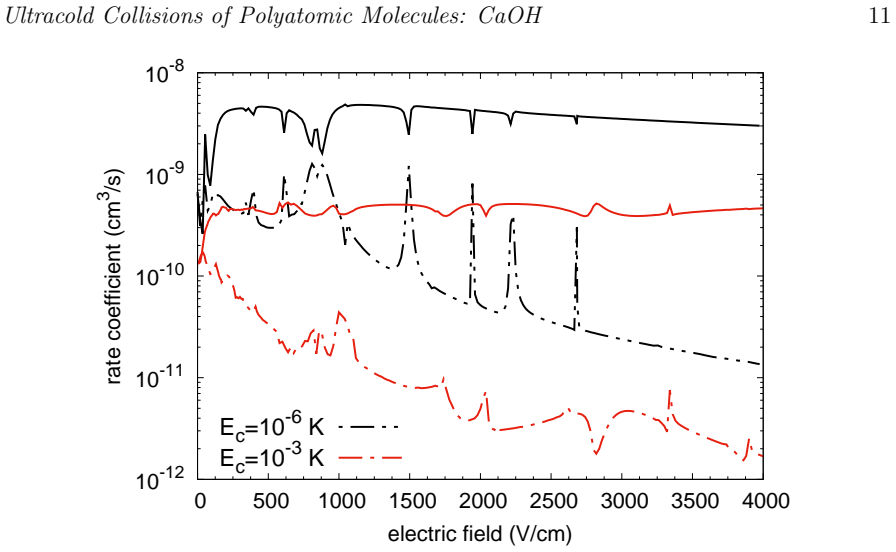
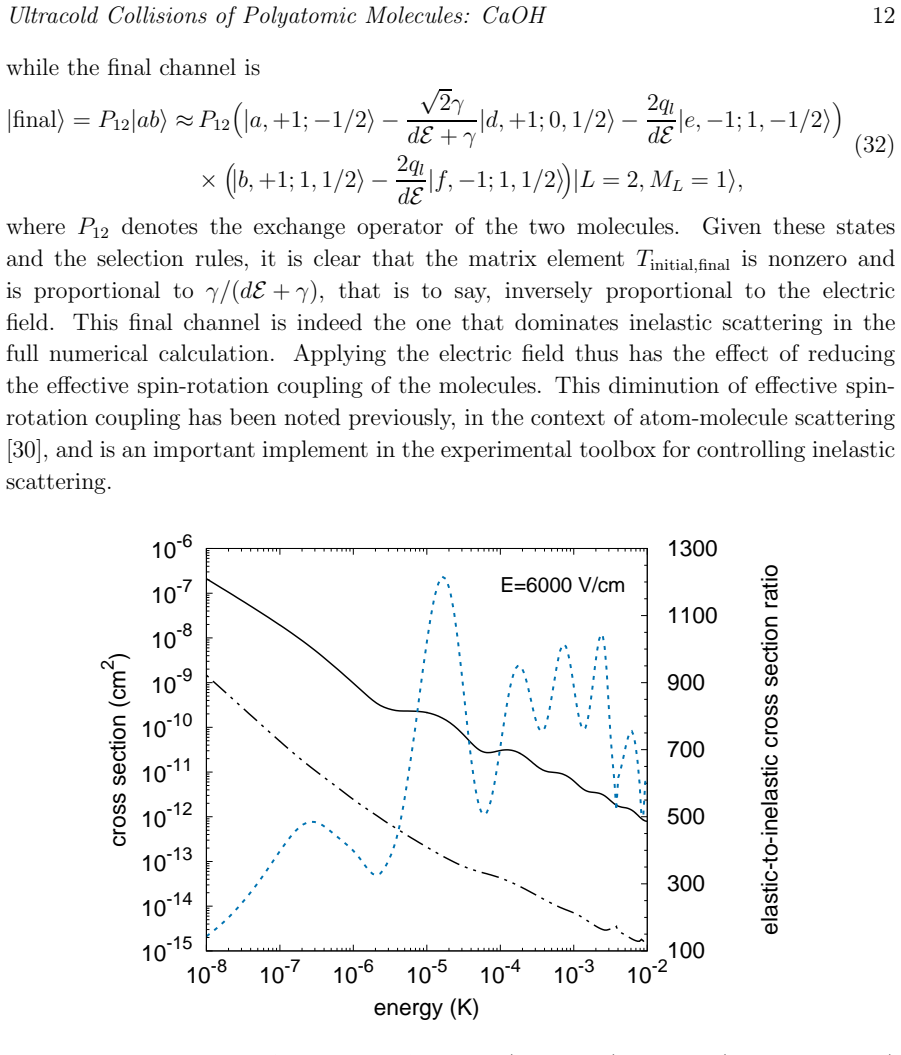
Computations show evaporative cooling of ultracold CaOH becomes more efficient at higher electric fields.
A machine-rendered reading of the paper's core claim, the machinery that carries it, and where it could break.
Core claim
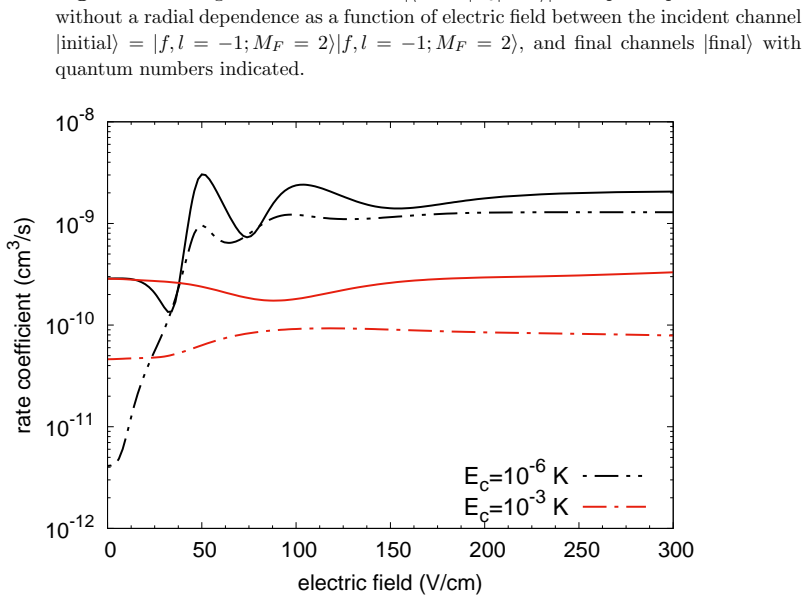
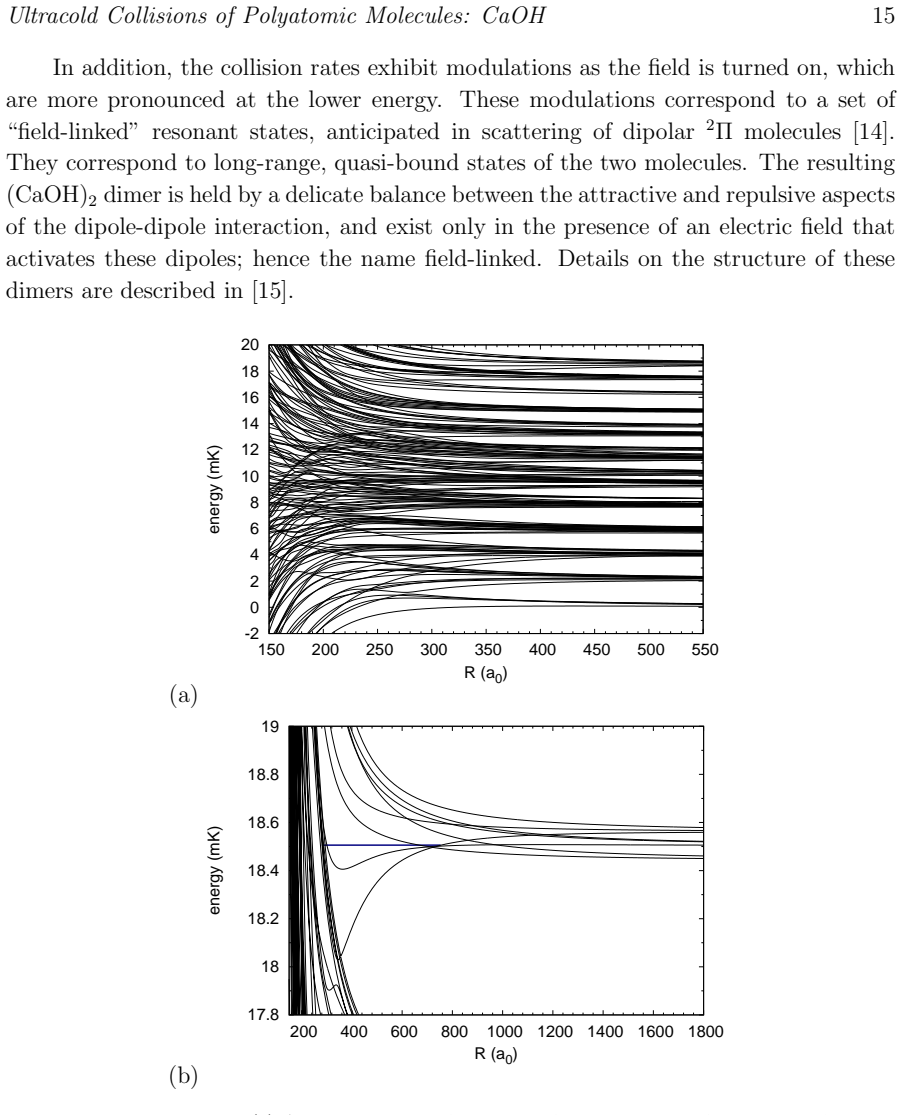
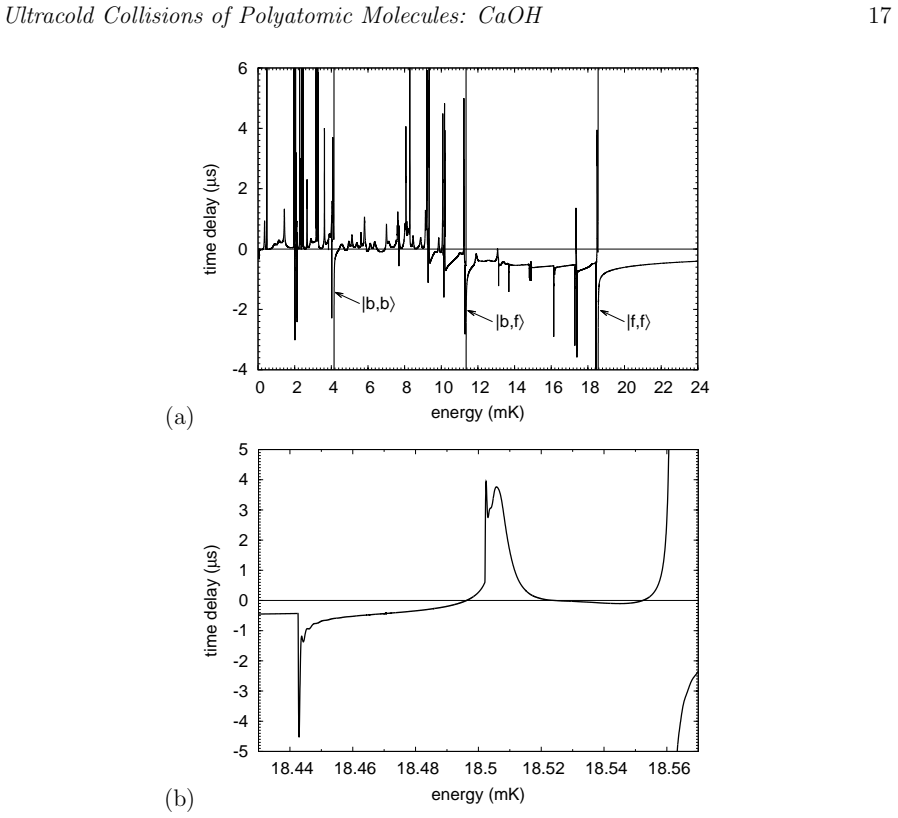
In internal states where collisions are governed by long-range dipole-dipole interactions, the computed rate constants for CaOH support efficient evaporative cooling at laser-cooling temperatures, with the rates becoming still more favorable as electric field strength rises; the same interactions produce long-range dimer states (CaOH)*₂ whose lifetimes reach microseconds.
What carries the argument
Electric-field-dependent rate constants obtained from long-range dipole-dipole potentials between CaOH molecules.
If this is right
- Evaporative cooling can proceed from temperatures already achieved by laser cooling of CaOH.
- Increasing the electric field improves the ratio of elastic to inelastic rates, aiding trap-loss suppression.
- Long-range dimer states exist and live long enough to be detected or used in further experiments.
Where Pith is reading between the lines
- Similar dipole-dominated regimes may exist for other laser-coolable polar polyatomics, allowing the same cooling strategy.
- The predicted dimers could serve as an intermediate for studying few-body physics at long range.
- Field tuning of rates offers a control knob that might be combined with magnetic or optical fields in future traps.
Load-bearing premise
Collisions of CaOH in the internal states considered are dominated by long-range dipole-dipole interactions.
What would settle it
Measured collision rates at ultracold temperatures that deviate substantially from the dipole-dipole predictions, or direct spectroscopy showing no long-range dimer resonances with microsecond lifetimes.
Figures
read the original abstract
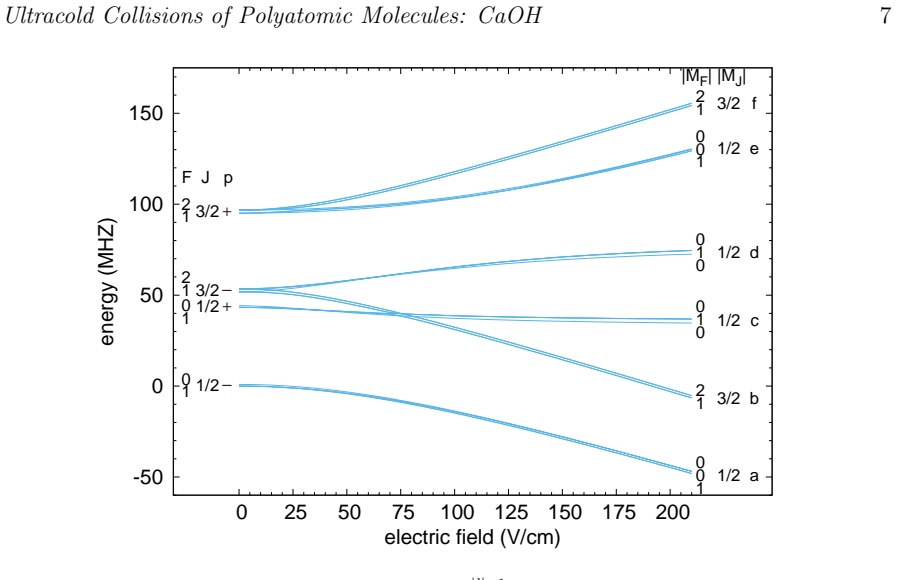
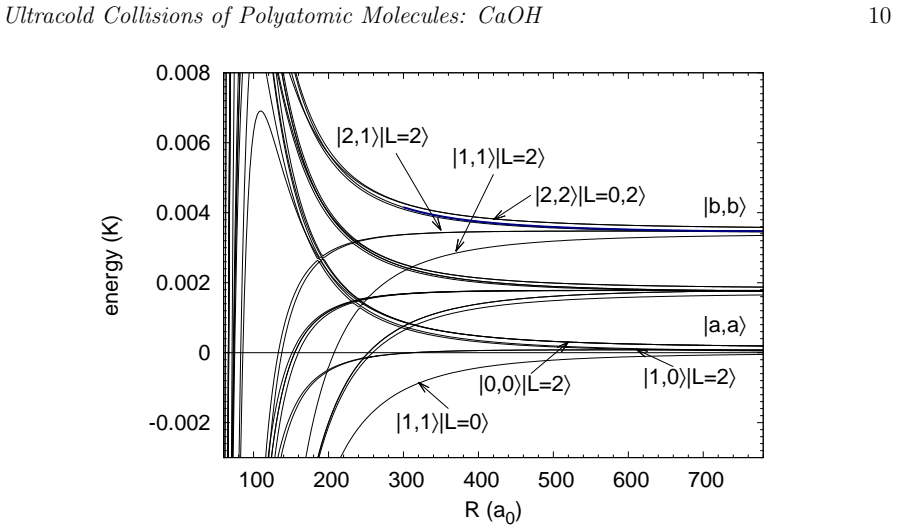
Ultracold collisions of the polyatomic species CaOH are considered, in internal states where the collisions should be dominated by long-range dipole-dipole interactions. The computed rate constants suggest that evaporative cooling can be quite efficient for these species, provided they start at temperatures achievable by laser cooling. The rate constants are shown to become more favorable for evaporative cooling as the electric field increases. Moreover, long-range dimer states (CaOH)$^*_2$ are predicated to occur, having lifetimes on the order of microseconds.
Editorial analysis
A structured set of objections, weighed in public.
Referee Report
Summary. The manuscript computes ultracold collision rate constants for CaOH molecules in internal states dominated by long-range dipole-dipole interactions. It reports that the resulting elastic and inelastic rates indicate evaporative cooling can be efficient at temperatures reachable by laser cooling, that these rates improve with increasing electric field, and that long-range dimer states (CaOH)*₂ with microsecond lifetimes are predicted.
Significance. If the long-range approximation is valid, the work supplies concrete, parameter-free predictions that evaporative cooling of a polyatomic species is feasible and that field-tunable dimer states exist. Such results would directly support experimental efforts in ultracold polyatomic chemistry and would constitute a clear advance over prior diatomic-only treatments.
major comments (1)
- [Abstract and methods (regime statement)] The central claim that collisions occur in the long-range dipole-dipole regime (and therefore that the reported elastic/inelastic ratios and dimer lifetimes are reliable) is not accompanied by a quantitative check. No comparison of long-range versus full-potential phase shifts, no WKB validity range, and no assessment of higher-multipole or short-range contributions at the relevant collision energies and partial waves is supplied. This verification is load-bearing for all numerical conclusions.
minor comments (1)
- [Abstract] Abstract: 'predicated' should read 'predicted'.
Simulated Author's Rebuttal
We thank the referee for the careful reading of the manuscript and the constructive comment on the justification of the long-range regime. We address the major comment below and will revise the manuscript accordingly.
read point-by-point responses
-
Referee: [Abstract and methods (regime statement)] The central claim that collisions occur in the long-range dipole-dipole regime (and therefore that the reported elastic/inelastic ratios and dimer lifetimes are reliable) is not accompanied by a quantitative check. No comparison of long-range versus full-potential phase shifts, no WKB validity range, and no assessment of higher-multipole or short-range contributions at the relevant collision energies and partial waves is supplied. This verification is load-bearing for all numerical conclusions.
Authors: We agree that an explicit quantitative verification of the long-range dipole-dipole regime strengthens the central claims. In the revised manuscript we will add a dedicated subsection in the methods that (i) compares s-wave phase shifts obtained from the pure long-range dipole-dipole potential against those estimated when short-range and higher-multipole terms are included via a model potential, (ii) reports the WKB validity range for the relevant collision energies (down to 1 μK) and partial waves (l ≤ 4), and (iii) quantifies the fractional contribution of higher-order electrostatic terms at the characteristic length scales set by the dipole length. These additions will confirm that the reported elastic-to-inelastic ratios and dimer lifetimes remain reliable within the stated temperature and field ranges. revision: yes
Circularity Check
No significant circularity; forward computation from stated long-range potentials
full rationale
The paper performs quantum scattering calculations on long-range dipole-dipole potentials for CaOH collisions in specified internal states. Rate constants and dimer lifetimes are outputs of this forward computation, not parameters fitted to the target observables and then relabeled as predictions. The long-range dominance is an explicit input assumption (not derived from the results), and no self-citation chain or self-definitional step reduces the central claims to the inputs by construction. This matches the default expectation of a non-circular computational study.
Axiom & Free-Parameter Ledger
Reference graph
Works this paper leans on
-
[2]
Williams H J, Caldwell L, Fitch N J, Truppe S, Rodewald J, Hinds E A, Sau er B E and Tarbutt M R 2018 Phys. Rev. Lett. 120(16) 163201
work page 2018
-
[3]
McCarron D J, Steinecker M H, Zhu Y and DeMille D 2018 Phys. Rev. Lett. 121(1) 013202
work page 2018
-
[4]
Anderegg L, Augenbraun B L, Bao Y, Burchesky S, Cheuk L W, Ke tterle W and Doyle J M 2018 Nature Physics 14 890–893 ISSN 1745-2481
work page 2018
-
[5]
Cheuk L W, Anderegg L, Augenbraun B L, Bao Y, Burchesky S, Ke tterle W and Doyle J M 2018 Phys. Rev. Lett. 121(8) 083201
work page 2018
-
[6]
Krems R V 2019 Molecules in Electromagnetic Fields (Hoboken, NJ: John Wiley and Sons)
work page 2019
-
[7]
Kozyryev I, Baum L, Matsuda K and Doyle J M 2016 Chem. Phys. Chem 17 3641–3648
work page 2016
-
[8]
Kozyryev I, Baum L, Matsuda K, Augenbraun B L, Anderegg L, S edlack A P and Doyle J M 2017 Phys. Rev. Lett. 118(17) 173201
work page 2017
- [9]
-
[10]
Kozyryev I, Baum L, Aldridge L, Yu P, Eyler E E and Doyle J M 2018 Phys. Rev. Lett. 120(6) 063205
work page 2018
-
[11]
Kozyryev I, Steimle T C, Yu P, Nguyen D T and Doyle J M 2019 New J. Phys. 21 052002
work page 2019
-
[12]
Kozyryev I, Baum L, Matsuda K, Olson P, Hemmerling B and Doyle J M 2015 New J. Phys. 17 045003
work page 2015
-
[13]
Morita M, K/suppress los J, Buchachenko A A and Tscherbul T V 2017Phys. Rev. A 95(6) 063421
-
[14]
Avdeenkov A V and Bohn J L 2003 Phys. Rev. Lett. 90(4) 043006
work page 2003
-
[15]
Avdeenkov A V, Bortolotti D C E and Bohn J L 2004 Phys. Rev. A 69(1) 012710
work page 2004
-
[16]
Townes C and Schawlow A 1975 Microwave spectroscopy Dover B ooks on Physics (Dover Publications) chap 2
work page 1975
-
[17]
Fletcher D A, Anderson M A, Barclay W L and Ziurys L M 1995 J. Chem. Phys. 102 4334–4339
work page 1995
-
[18]
Kopp I and Hougen J T 1967 Can. J. Phys. 45 2581–2596
work page 1967
-
[19]
Scurlock C, Fletcher D and Steimle T 1993 J. Mol. Spectrosc. 159 350 – 356
work page 1993
-
[20]
Brink D and Satchler G 1993 Angular Momentum Oxford science publications (Oxford: Clarendon Press)
work page 1993
-
[21]
Ticknor C and Bohn J L 2005 Phys. Rev. A 71(2) 022709
work page 2005
-
[22]
Steimle T C, Fletcher D A, Jung K Y and Scurlock C T 1992 J. Chem. Phys. 96 2556–2564
work page 1992
-
[23]
Augustoviˇ cov´ a L D and Bohn J L 2018 Phys. Rev. A 97(6) 062703
work page 2018
-
[24]
Johnson B R 1973 Journal of Computational Physics 13 445 – 449
work page 1973
-
[25]
Avdeenkov A V, Kajita M and Bohn J L 2006 Phys. Rev. A 73(2) 022707
work page 2006
-
[26]
Wang G and Qu´ em´ ener G 2015New J. Phys. 17 035015
-
[27]
Qu´ em´ ener G and Bohn J L 2016Phys. Rev. A 93(1) 012704
-
[28]
Gonz´ alez-Mart ´ ınez M L, Bohn J L and Qu´ em´ ener G 2017Phys. Rev. A 96(3) 032718
-
[29]
Augustoviˇ cov´ a L D and Bohn J L 2017 Phys. Rev. A 96(4) 042712
work page 2017
-
[30]
Tscherbul T V and Krems R V 2006 J. Chem. Phys. 125 194311
work page 2006
-
[31]
Smith F T 1960 Phys. Rev. 118(1) 349–356
work page 1960
discussion (0)
Sign in with ORCID, Apple, or X to comment. Anyone can read and Pith papers without signing in.