REVIEW 5 major objections 6 minor 1 cited by
Uncertainty-aware Knowledge Tracing
T0 review · 5 major / 6 minor · reviewed 2026-08-10 · deepseek-v4-flash
Pith's one-line read Modeling student knowledge as a Gaussian beats deep KT baselines
desk verdict UKT is a solid empirical package with fixable equation errors, but the epistemic/aleatory separation claim is unmeasured and the 'first in KT' phrasing ignores BKT. read the letter →
The pith
A machine-rendered reading of the paper's core claim, the machinery that carries it, and where it could break.
The reading
What carries the argument
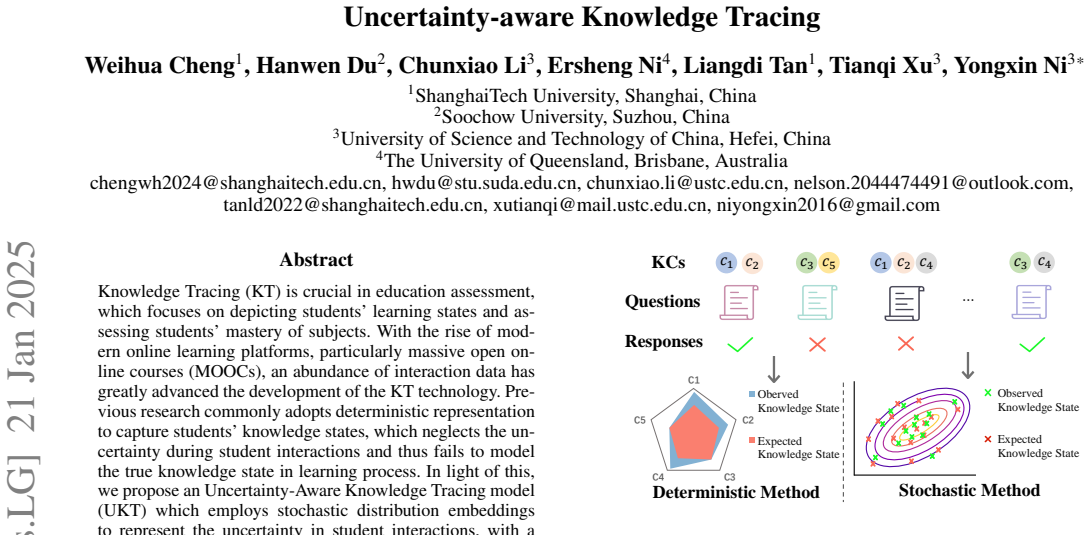
The central machinery is the Gaussian state representation paired with Wasserstein-based self-attention. A mean embedding and a covariance embedding define each interaction and knowledge component as a multidimensional Gaussian, with the covariance kept positive definite by applying ELU plus one to the diagonal. The attention score between two states is the negative 2-Wasserstein distance $W_2$, so the model retrieves historical knowledge states that overlap with the current state distributionally rather than only by pointwise embedding similarity. The contrastive loss completes the mechanism: flipped-response sequences serve as negative anchors in an InfoNCE-style objective expressed through Wasserstein distances between encoded distributions, and the final loss is a weighted sum of the prediction loss and this contrastive loss. This machinery is what turns uncertainty from a modeling byproduct into an explicit, trainable quantity.
What would settle it
A concrete test: take a dataset in which some responses are annotated as careless mistakes or guesses, then flip only those annotated responses to build negative samples and compare with flipping the same number of random responses. If the annotated flips change predictions no more than random flips, or if covariance magnitudes do not differ between students with known different mastery levels, the claimed separation between epistemic and aleatory uncertainty is not doing the work the paper assigns to it.
Extended reading notes
Core claim
UKT's core discovery is that stochastic distribution embeddings can be learned for knowledge tracing end to end. Each interaction and each knowledge concept is mapped to a mean embedding and a covariance embedding that together define a multivariate Gaussian; the mean represents the student's mastery and the covariance represents the uncertainty of that assessment. A self-attention layer compares these Gaussian states with the 2-Wasserstein distance, which accounts for both mean difference and covariance overlap, and retrieves historical states accordingly. The aleatory-uncertainty-aware contrastive loss flips all correct responses in sequences ending in a correct response and flips all incorrect responses in sequences ending in an incorrect response, creating negative samples that mimic lucky guesses and careless mistakes; treating those flips as negatives is what makes the model resilient to aleatory noise while preserving epistemic uncertainty. Because every component contributes in the ablations and because the model outperforms DKT, SAKT, SAINT, ATKT, AKT, and SimpleKT on most of the six benchmarks, the paper argues that the uncertainty-aware representation itself is the reason for the gains.
Load-bearing premise
The load-bearing premise is that a Gaussian mean-and-covariance representation, together with response-flipping negatives, separates epistemic uncertainty, the genuine differences in what students know, from aleatory uncertainty, careless mistakes and lucky guesses, well enough that training against the negatives improves prediction without throwing away useful learning signal.
Editorial extensions
If this is right
- If UKT's reported results hold, uncertainty-aware Gaussian embeddings become a viable replacement for deterministic embeddings in deep knowledge tracing, since the model wins or ties on AUC across all six datasets.
- The covariance embeddings give educators a per-student, per-concept uncertainty signal in addition to a mastery score, so a correct answer accompanied by high covariance can be interpreted differently from a confident correct answer.
- The contrastive negative-sampling strategy offers a way to make knowledge tracing models resist careless mistakes and lucky guesses without requiring labels for which interactions are noisy.
- The ablations imply that each of the three components, the stochastic embeddings, the Wasserstein distance, and the contrastive loss, adds predictive value, so a simpler deterministic model would not reproduce the result.
- The reported single-GPU training time suggests the uncertainty-aware architecture is practical for large-scale online learning platforms, not just small benchmarks.
Reading between the lines
- Beyond the paper: the Wasserstein self-attention could transfer to adaptive quiz selection, where a content item's difficulty profile and a student's Gaussian knowledge state naturally call for a distributional overlap score.
- Beyond the paper: if datasets with explicit annotations of careless mistakes or guesses exist, the response-flipping negative sampling could be validated directly by checking whether those annotated interactions behave like the constructed negatives.
- Beyond the paper: the heatmap evidence that within-student covariance stays fairly stable over time suggests the learned covariance could be used as a student trait signal, for instance to flag students who rush or guess, though the paper does not test this against external labels.
Signed reviews
Editorial analysis
A structured set of objections, weighed in public.
Referee Report
Summary. Summary: The paper proposes UKT, a knowledge tracing model that represents each student's knowledge state as a Gaussian distribution with learned mean and covariance embeddings, uses a Wasserstein-based self-attention mechanism to update these distributions, and adds an aleatory uncertainty-aware contrastive loss. The contrastive negatives are constructed by flipping previous correct or incorrect responses depending on the last response. The paper reports AUC and accuracy on six datasets, ablations, sensitivity to the contrastive weight, and covariance heatmaps, and claims that UKT outperforms existing deep KT baselines and better handles aleatory uncertainty.
Significance. If the central claims were established, UKT would be a useful contribution to knowledge tracing: stochastic state representations with calibrated uncertainty could support more reliable mastery assessment, and a training scheme that downweights careless mistakes and lucky guesses would be practically valuable. The paper has concrete strengths: it evaluates on six benchmark datasets, compares with six recent baselines, reports ablations for each architectural component, and provides a public code repository. Against that, the uncertainty-decomposition story is currently asserted rather than measured, the contrastive loss in Eq. (7) has an apparent sign inconsistency, and the 'consistently outperforms' claim is contradicted by the ASSIST2015 row of Table 1.
major comments (5)
- [Methodology, Eq. (4)] Eq. (4) is not a well-defined 2-Wasserstein distance as printed. The trace term `M^sigma + E^sigma - 2 ((M^sigma)^{1/2} M^sigma (E^sigma)^{1/2})^{1/2}` mixes the matrices and their square roots without indicating the intended square root of a product; the standard closed forms are `trace(M^sigma + E^sigma - 2 (M^sigma E^sigma)^{1/2})` for commuting matrices or the Bures form `trace(M^sigma + E^sigma - 2 (M^sigma^{1/2} E^sigma M^sigma^{1/2})^{1/2})`. In addition, `R_t` in `W2(M_t, R_t)` is never defined. The attention mechanism cannot be implemented from the paper as written.
- [Aleatory Uncertainty-Aware Contrastive Learning, Eq. (7)] The contrastive objective in Eq. (7) is internally inconsistent. Because W2 is a distance, the positive-pair term should use `exp(-W2(h_i, h_i^-))` if the flipped sequence is the positive view; as written, minimizing `L_CL` maximizes `W2(h_i, h_i^-)`, pushing the two views apart. Moreover, qs_i^- is called a negative sample, but it appears in the numerator as the positive anchor, and the denominator uses in-batch sequences as negatives. The paper must clarify whether the flipped sequence is a positive or negative view and must correct the sign convention; the current formulation does not express the stated goal of robustness to aleatory uncertainty.
- [Aleatory Uncertainty-Aware Contrastive Learning (negative construction)] The construction of qs_i^- is not a controlled manipulation of aleatory uncertainty. When the last answer is correct, the rule flips all previous correct responses; when the last is incorrect, it flips all previous incorrect responses. This changes the student's entire learning history, so the resulting sequence does not isolate a careless mistake or a lucky guess. No experiment validates the claimed epistemic/aleatory separation against labeled, simulated, or otherwise known uncertainty events; Figures 5-6 only display averaged covariance values, and Table 3 reports aggregate accuracy differences. The load-bearing claim that UKT retains epistemic uncertainty while suppressing aleatory uncertainty is therefore not supported by the evidence presented.
- [Experiments, RQ1 (Table 1)] The summary of RQ1 contains a direct contradiction. The text says 'UKT consistently outperforms the other baselines in AUC scores across all datasets,' but Table 1 shows UKT (0.7267 +/- 0.0007) below AKT (0.7282 +/- 0.0004) and DKT (0.7271 +/- 0.0005) on ASSIST2015; the same paragraph later acknowledges that UKT 'only slightly underperforms baselines on the ASSIST2015 dataset.' The benchmark claim should be corrected to 'best on five of six datasets,' and in view of the 0.001 to 0.009 AUC margins on the other datasets, the paper should include paired significance tests (per-student bootstrap or repeated cross-validation paired tests) to support the word 'significantly.'
- [Uncertainty Analysis (RQ3), Table 3] Table 3 is the only quantitative evidence for the robustness advantage, but it is not convincing. The table shows that adding AU reduces simpleKT by 1.14%, AKT by 1.33%, and UKT by 0.83%, yet it reports no confidence intervals or significance tests; with differences at the 0.01-AUC scale, the conclusion that UKT is 'less affected' is fragile. The table also does not define precisely what 'with AU' changes in the data or training, and the UKT values in Table 3 (0.8501/0.8430) differ from the UKT value in Table 1 (0.8563), so the protocol underlying Table 3 must be clarified before the robustness claim can be evaluated.
minor comments (6)
- [Methodology, Eq. (1)] The notation in Eq. (1) is under-specified: `W1_c` and `W2_c` are used but never defined, and it is unclear how `e^sigma_qj` and `e^mu_qj` relate to the one-hot response vector `e_qj` introduced in the text.
- [Methodology, Eq. (5)] The description of WassersteinSelfAttention never states how the score in Eq. (4) is converted into attention weights (e.g., softmax over keys), so the attention mechanism is not fully specified.
- [Uncertainty Analysis, Figures 5-6] The captions and text say the 'mean of the covariance matrix' is plotted, but it is not stated whether the average is over sequence positions, students, or batch elements, and the heatmap axes are not labeled.
- [Table 3] The column headers 'w/o AU' and 'with AU' are ambiguous; the text should specify what the AU manipulation consists of and reconcile the UKT AUC with Table 1.
- [Table 4] The abbreviations 'Stocemb' and 'W.dist' are not defined; they should be expanded to stochastic embedding and Wasserstein distance, and the ablation rows need significance tests or confidence intervals to support component contributions.
- [Datasets] The POJ dataset URL in footnote 5 contains a space and is not clickable; please provide a corrected link and cite the original source for POJ.
Circularity Check
AUC benchmark is externally validated and not circular; the epistemic-uncertainty validation is self-referential, giving a low partial circularity score.
-
self definitional
[Methodology ('Stochastic Embedding Layers') and Experiments ('Uncertainty Analysis (RQ3)')]
"The mean indicates the student's baseline knowledge, while the covariance captures the uncertainty in the learning process, including both epistemic and aleatory uncertainties. ... Given that covariance embedding can quantify this uncertainty, we employ the following approach: we extract covariance embeddings processed through a Feed-Forward Network from a series of data and calculated the average covariance matrix for each sample to reflect the level of epistemic uncertainty across the entire sequence."
The paper defines the covariance embedding as the quantity that captures uncertainty, then uses that same covariance embedding as the evidence that UKT captures epistemic uncertainty. No independently labeled epistemic or aleatory uncertainty is used, so the heatmap 'confirmation' is a restatement of the definitional choice rather than an independent check. This does not affect the external AUC benchmark, so it is a minor, localized circularity.
full rationale
The central quantitative result (Tables 1-2) compares UKT's AUC and accuracy against external baselines on six public datasets; this is a standard benchmark and not a fitted value renamed as a prediction. The model's components (stochastic embeddings, Wasserstein attention, contrastive loss) are architectural choices, not derived from the target result. The only load-bearing step that approaches circularity is the uncertainty analysis: covariance is introduced as 'captures the uncertainty' and then the same covariance embeddings are used as the evidence that UKT captures epistemic uncertainty, with no external label of epistemic or aleatory uncertainty. This makes the interpretability claim self-referential but does not invalidate the prediction benchmark. Self-citations (Ni et al. 2023; Li et al. 2024) appear only in a future-work sentence and are not load-bearing. The contrastive-loss negative sampling is an unverified operationalization of aleatory uncertainty, but the paper does not state that Table 3's perturbation is generated by the same flipping mechanism, so a formal circularity cannot be established from the text. Overall score 2.
Assumptions & free parameters
free parameters (2)
- lambda (contrastive loss weight) =
chosen per dataset from [0.01, 0.02, 0.05, 0.07, 0.1, 0.5, 1]
- Architecture hyperparameters (embedding dimension, attention heads, blocks, dropout) =
searched over embedding dim [64,128,256,512], heads [4,8], blocks [1,2,4], dropout [0.05,0.1,0.3,0.5]
assumptions (3)
- domain assumption Student knowledge state can be represented by an elliptical Gaussian distribution, with the mean as mastery and the covariance as uncertainty.
- domain assumption The negative 2-Wasserstein distance between distributions is a suitable attention score for tracking knowledge-state transitions.
- ad hoc to paper Flipping previous correct answers when the last answer is correct, or previous incorrect answers when the last answer is incorrect, produces sequences that embody aleatory uncertainty.
Cite this review
Pith. "Pith review of Uncertainty-aware Knowledge Tracing." pith.science (2026). https://pith.science/paper/OOKI2R3B
@misc{pith2026250105415,
  author       = {Pith},
  title        = {Pith review of: Uncertainty-aware Knowledge Tracing},
  year         = {2026},
  howpublished = {\url{https://pith.science/paper/OOKI2R3B}},
  note         = {Machine review of arXiv:2501.05415}
}
read the original abstract
Knowledge Tracing (KT) is crucial in education assessment, which focuses on depicting students' learning states and assessing students' mastery of subjects. With the rise of modern online learning platforms, particularly massive open online courses (MOOCs), an abundance of interaction data has greatly advanced the development of the KT technology. Previous research commonly adopts deterministic representation to capture students' knowledge states, which neglects the uncertainty during student interactions and thus fails to model the true knowledge state in learning process. In light of this, we propose an Uncertainty-Aware Knowledge Tracing model (UKT) which employs stochastic distribution embeddings to represent the uncertainty in student interactions, with a Wasserstein self-attention mechanism designed to capture the transition of state distribution in student learning behaviors. Additionally, we introduce the aleatory uncertainty-aware contrastive learning loss, which strengthens the model's robustness towards different types of uncertainties. Extensive experiments on six real-world datasets demonstrate that UKT not only significantly surpasses existing deep learning-based models in KT prediction, but also shows unique advantages in handling the uncertainty of student interactions.
Figures


Figures from the paper (3 more)


Forward citations
Cited by 1 Pith paper
-
UNVaMP: Neural Knowledge Tracing with Variational Regularization of Latent Knowledge Dynamics
A neural knowledge tracing model with a KL penalty on latent dynamics matches or beats strong baselines on most datasets and provides interpretable skill-level proficiency estimates.
Reference graph
Works this paper leans on
-
[1]
, " * write output.state after.block = add.period write newline
ENTRY address archivePrefix author booktitle chapter edition editor eid eprint howpublished institution isbn journal key month note number organization pages publisher school series title type volume year label extra.label sort.label short.list INTEGERS output.state before.all mid.sentence after.sentence after.block FUNCTION init.state.consts #0 'before.a...
-
[2]
write newline
" write newline "" before.all 'output.state := FUNCTION n.dashify 't := "" t empty not t #1 #1 substring "-" = t #1 #2 substring "--" = not "--" * t #2 global.max substring 't := t #1 #1 substring "-" = "-" * t #2 global.max substring 't := while if t #1 #1 substring * t #2 global.max substring 't := if while FUNCTION word.in bbl.in capitalize " " * FUNCT...
-
[3]
Abdar, M.; Pourpanah, F.; Hussain, S.; Rezazadegan, D.; Liu, L.; Ghavamzadeh, M.; Fieguth, P.; Cao, X.; Khosravi, A.; Acharya, U. R.; et al. 2021. A review of uncertainty quantification in deep learning: Techniques, applications and challenges. Information fusion, 76: 243--297
work page 2021
-
[4]
Chen, Y.-C.; and Qiao, X. 2020. Using students' epistemic uncertainty as a pedagogical resource to develop knowledge in argumentation. International Journal of Science Education, 42(11): 1813349
work page 2020
-
[5]
Choi, Y.; Lee, Y.; Cho, J.; Baek, J.; Kim, B.; Cha, Y.; Shin, D.; Bae, C.; and Heo, J. 2020. Towards an appropriate query, key, and value computation for knowledge tracing. In Proceedings of the seventh ACM conference on learning@ scale, 341--344
2020
-
[6]
Clement, P.; and Desch, W. 2008. An elementary proof of the triangle inequality for the Wasserstein metric. Proceedings of the American Mathematical Society, 136(1): 333--339
work page 2008
-
[7]
Fan, Z.; Liu, Z.; Peng, H.; and Yu, P. S. 2023. Mutual wasserstein discrepancy minimization for sequential recommendation. In Proceedings of the ACM Web Conference 2023, 1375--1385
work page 2023
-
[8]
Fan, Z.; Liu, Z.; Wang, Y.; Wang, A.; Nazari, Z.; Zheng, L.; Peng, H.; and Yu, P. S. 2022. Sequential recommendation via stochastic self-attention. In Proceedings of the ACM web conference 2022, 2036--2047
work page 2022
Show all 37 references
-
[9]
Fu, J.; Ge, X.; Xin, X.; Karatzoglou, A.; Arapakis, I.; Wang, J.; and Jose, J. M. 2024. IISAN: Efficiently adapting multimodal representation for sequential recommendation with decoupled PEFT. In Proceedings of the 47th International ACM SIGIR Conference on Research and Develo...
2024
-
[10]
Gal, Y.; et al. 2016. Uncertainty in deep learning. PhD thesis, University of Cambridge
2016
-
[11]
Gao, T.; Yao, X.; and Chen, D. 2021. Simcse: Simple contrastive learning of sentence embeddings. arXiv preprint arXiv:2104.08821
2021 arXiv
-
[12]
Ghosh, A.; Heffernan, N.; and Lan, A. S. 2020. Context-aware attentive knowledge tracing. In Proceedings of the 26th ACM SIGKDD international conference on knowledge discovery & data mining, 2330--2339
2020
-
[13]
Guo, X.; Huang, Z.; Gao, J.; Shang, M.; Shu, M.; and Sun, J. 2021. Enhancing knowledge tracing via adversarial training. In Proceedings of the 29th ACM International Conference on Multimedia, 367--375
2021
-
[14]
C.; Johnson, J
Helton, J. C.; Johnson, J. D.; Oberkampf, W. L.; and Sallaberry, C. J. 2008. Representation of Analysis Results Involving Aleatory and Epistemic Uncertainty. Technical Report SAND2008-4379, Sandia National Laboratories, Albuquerque, New Mexico and Livermore, California, USA
2008
-
[15]
H \"u llermeier, E.; and Waegeman, W. 2021. Aleatoric and epistemic uncertainty in machine learning: An introduction to concepts and methods. Machine learning, 110(3): 457--506
2021
-
[16]
Kim, H.; Papamakarios, G.; and Mnih, A. 2021. The lipschitz constant of self-attention. In International Conference on Machine Learning, 5562--5571. PMLR
2021
-
[17]
P.; and Ba, J
Kingma, D. P.; and Ba, J. 2014. Adam: A method for stochastic optimization. arXiv preprint arXiv:1412.6980
2014 arXiv
-
[18]
Lee, J.; and Yeung, D.-Y. 2019. Knowledge query network for knowledge tracing: How knowledge interacts with skills. In Proceedings of the 9th international conference on learning analytics & knowledge, 491--500
2019
-
[19]
Li, Y.; Du, H.; Ni, Y.; Zhao, P.; Guo, Q.; Yuan, F.; and Zhou, X. 2024. Multi-modality is all you need for transferable recommender systems. In 2024 IEEE 40th International Conference on Data Engineering (ICDE), 5008--5021. IEEE
2024
-
[20]
Liu, Q.; Huang, Z.; Yin, Y.; Chen, E.; Xiong, H.; Su, Y.; and Hu, G. 2019. Ekt: Exercise-aware knowledge tracing for student performance prediction. IEEE Transactions on Knowledge and Data Engineering, 33(1): 100--115
2019
-
[21]
Liu, Y.; Yang, Y.; Chen, X.; Shen, J.; Zhang, H.; and Yu, Y. 2020. Improving knowledge tracing via pre-training question embeddings. arXiv preprint arXiv:2012.05031
2020 arXiv
-
[22]
Liu, Z.; Liu, Q.; Chen, J.; Huang, S.; and Luo, W. 2023. simpleKT: a simple but tough-to-beat baseline for knowledge tracing. arXiv preprint arXiv:2302.06881
2023 arXiv
-
[23]
Liu, Z.; Liu, Q.; Chen, J.; Huang, S.; Tang, J.; and Luo, W. 2022. pyKT: a python library to benchmark deep learning based knowledge tracing models. Advances in Neural Information Processing Systems, 35: 18542--18555
2022
-
[24]
Nagatani, K.; Zhang, Q.; Sato, M.; Chen, Y.-Y.; Chen, F.; and Ohkuma, T. 2019. Augmenting knowledge tracing by considering forgetting behavior. In The world wide web conference, 3101--3107
2019
-
[25]
Ni, Y.; Cheng, Y.; Liu, X.; Fu, J.; Li, Y.; He, X.; Zhang, Y.; and Yuan, F. 2023. A content-driven micro-video recommendation dataset at scale. arXiv preprint arXiv:2309.15379
2023 arXiv
-
[26]
Oord, A. v. d.; Li, Y.; and Vinyals, O. 2018. Representation learning with contrastive predictive coding. arXiv preprint arXiv:1807.03748
2018 arXiv
-
[27]
Ozair, S.; Lynch, C.; Bengio, Y.; Van den Oord, A.; Levine, S.; and Sermanet, P. 2019. Wasserstein dependency measure for representation learning. Advances in Neural Information Processing Systems, 32
2019
-
[28]
Pandey, S.; and Karypis, G. 2019. A Self-Attentive Model for Knowledge Tracing. International Educational Data Mining Society
2019
-
[29]
Pandey, S.; and Srivastava, J. 2020. RKT: relation-aware self-attention for knowledge tracing. In Proceedings of the 29th ACM international conference on information & knowledge management, 1205--1214
2020
-
[30]
J.; and Sohl-Dickstein, J
Piech, C.; Bassen, J.; Huang, J.; Ganguli, S.; Sahami, M.; Guibas, L. J.; and Sohl-Dickstein, J. 2015. Deep knowledge tracing. Advances in neural information processing systems, 28
2015
-
[31]
R \"u schendorf, L. 1985. The Wasserstein distance and approximation theorems. Probability Theory and Related Fields, 70(1): 117--129
1985
-
[32]
Sanchez, T.; Caramiaux, B.; Thiel, P.; and Mackay, W. E. 2022. Deep Learning Uncertainty in Machine Teaching. In Proceedings of the 27th Annual ACM Symposium on User Interface Software and Technology (IUI), 26 pages. Helsinki / Virtual, Finland: ACM
2022
-
[33]
Shen, S.; Huang, Z.; Liu, Q.; Su, Y.; Wang, S.; and Chen, E. 2022. Assessing student's dynamic knowledge state by exploring the question difficulty effect. In Proceedings of the 45th international ACM SIGIR conference on research and development in information retrieval, 427--437
2022
-
[34]
Wimmer, L.; Sale, Y.; Hofman, P.; Bischl, B.; and H \"u llermeier, E. 2023. Quantifying aleatoric and epistemic uncertainty in machine learning: Are conditional entropy and mutual information appropriate measures? In Uncertainty in Artificial Intelligence, 2282--2292. PMLR
2023
-
[35]
Yang, Y.; Shen, J.; Qu, Y.; Liu, Y.; Wang, K.; Zhu, Y.; Zhang, W.; and Yu, Y. 2021. GIKT: a graph-based interaction model for knowledge tracing. In Machine learning and knowledge discovery in databases: European conference, ECML PKDD 2020, Ghent, Belgium, September 14--18, 202...
2021
-
[36]
Zhang, J.; Shi, X.; King, I.; and Yeung, D.-Y. 2017. Dynamic key-value memory networks for knowledge tracing. In Proceedings of the 26th international conference on World Wide Web, 765--774
2017
-
[37]
Zhang, M.; Zhu, X.; Zhang, C.; Ji, Y.; Pan, F.; and Yin, C. 2021. Multi-factors aware dual-attentional knowledge tracing. In Proceedings of the 30th ACM International Conference on Information & Knowledge Management, 2588--2597
2021
Reviewed August 10, 2026 · model on record in the stance chip above.
Discussion (0). Continue with ORCID to comment.