Multidimensional Resilience for Electrical Power Systems: Systematic Review, Integrated Index, and Validation under Real-World Cyber-Physical Attack Scenarios
Pith reviewed 2026-06-27 19:36 UTC · model grok-4.3
The pith
Simultaneous failures across power system dimensions cause eight times the degradation of isolated stresses, with exogenous factors adding a further sixfold amplification for a total 46-fold resilience loss.
A machine-rendered reading of the paper's core claim, the machinery that carries it, and where it could break.
Core claim
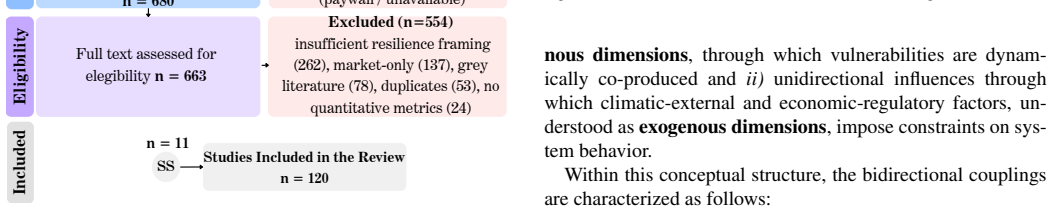
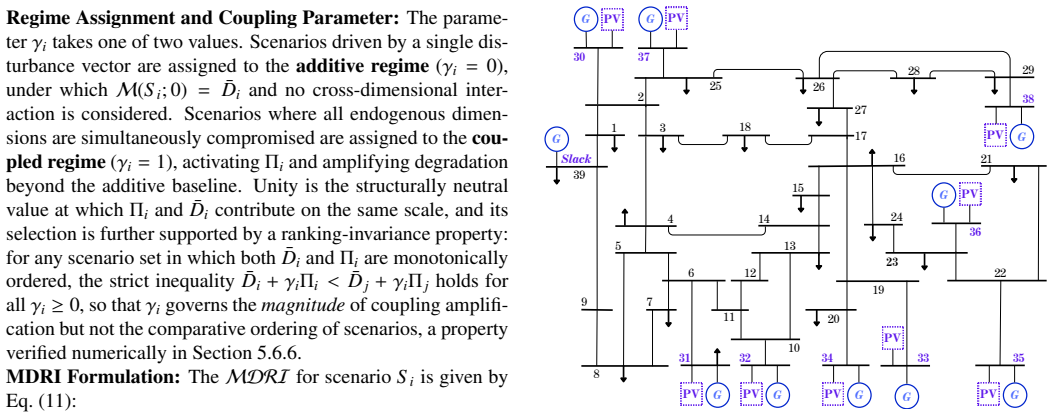
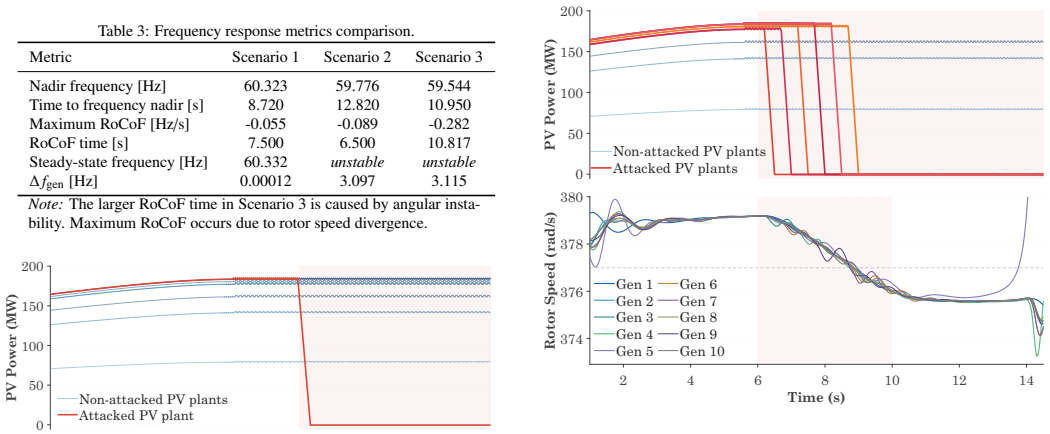
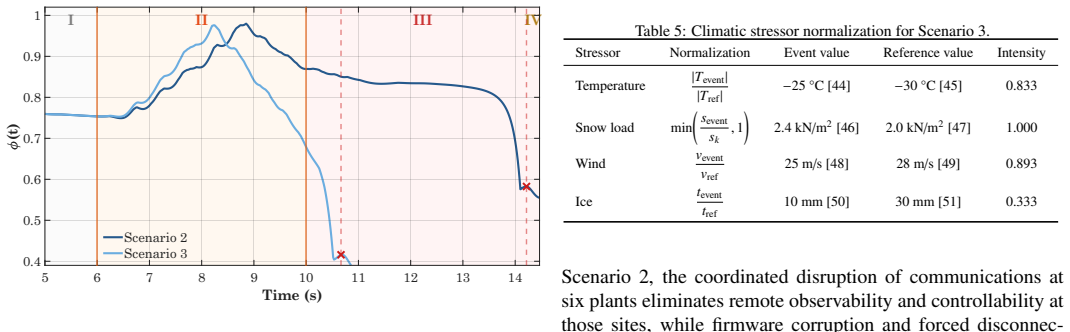
The Multidimensional Resilience Index captures endogenous couplings across physical, operational, digital-cyber, climatic-external, and economic-regulatory dimensions plus exogenous amplification effects. When applied to escalating cyber-physical attack scenarios, degradation under cascading and simultaneous failures is nearly eight times greater than under isolated stress, exogenous conditions amplify degradation by an additional factor approaching six with 72 percent of this amplification driven by exogenous stressors, and combined these mechanisms produce a 46-fold increase in resilience loss compared to a single-vector reference.
What carries the argument
The Multidimensional Resilience Index (MDRI), which integrates five resilience dimensions to quantify endogenous couplings and exogenous amplification.
If this is right
- Assessments limited to one or two dimensions substantially underestimate total resilience loss under joint failures.
- Exogenous climatic and economic-regulatory stressors account for the majority of the additional amplification in attack scenarios.
- Integrated indices rather than isolated metrics are required to model nonlinear effects of simultaneous physical and cyber failures.
- Planning for decarbonized power systems must incorporate cross-dimensional interactions to avoid severe underestimation of infrastructure risks.
Where Pith is reading between the lines
- Resilience planning tools used by grid operators would need replacement of additive models with coupling-aware indices if the MDRI approach is adopted.
- The same multidimensional amplification logic could be tested on historical blackout datasets to check consistency with observed outcomes.
- Comparable cross-dimensional effects are likely present in other critical infrastructures facing combined physical and digital threats.
Load-bearing premise
The MDRI model correctly quantifies the nonlinear amplification and exogenous effects identified by the PRISMA review when applied to the escalating cyber-physical attack scenarios.
What would settle it
Direct measurement of resilience loss during the December 2025 Polish energy infrastructure attack or equivalent documented events; if the observed loss is substantially less than 46 times the single-vector reference, the quantified amplification claim does not hold.
Figures
read the original abstract
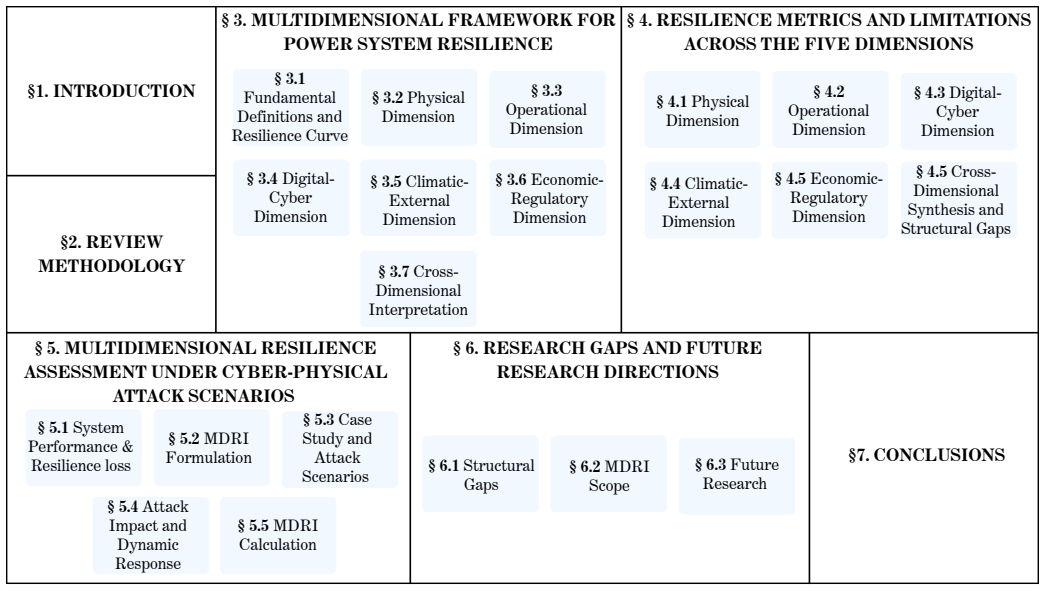
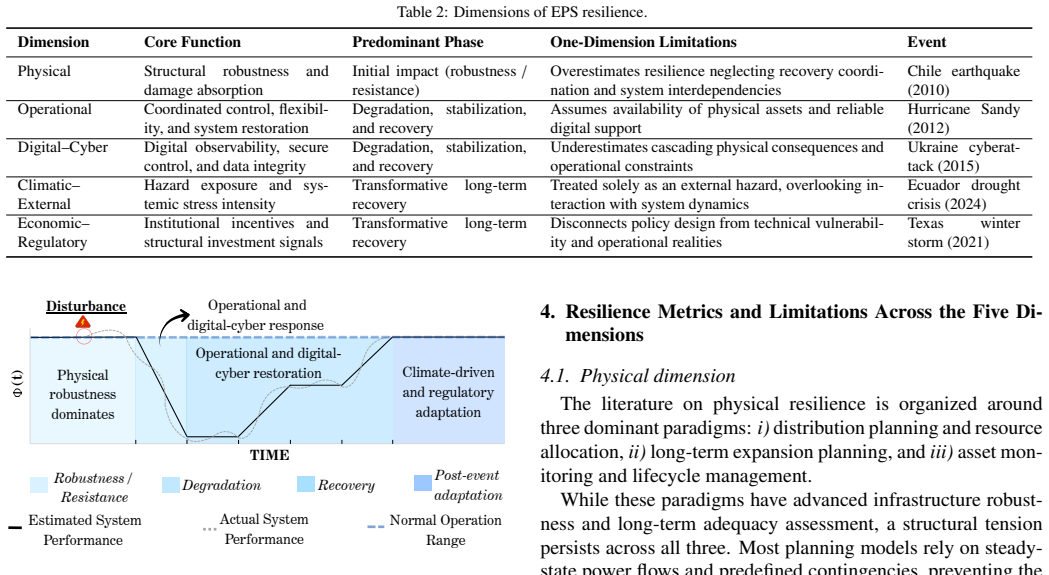
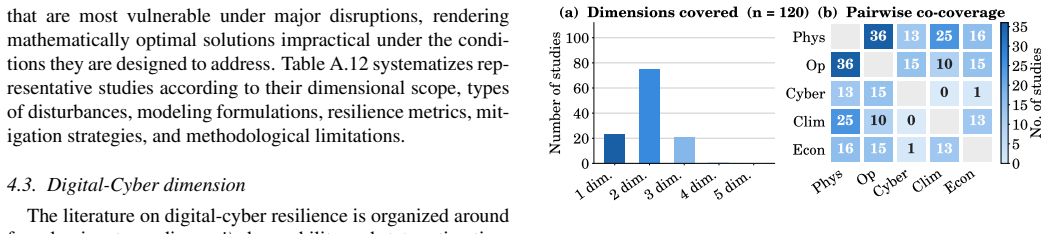
The accelerating decarbonization of energy systems has transformed electrical power systems into complex infrastructures exposed to threats whose interactions generate systemic vulnerabilities that conventional resilience approaches fail to capture. Although resilience assessment has expanded across multiple dimensions, existing studies largely examine them in isolation or adjacent pairs, leaving cross-dimensional couplings insufficiently explored. This study demonstrates i) that single-dimension assessments fail to capture the degradation produced by simultaneous cross-dimensional failures, ii) the nonlinear amplification emerging when physical, operational, and digital-cyber dimensions are jointly compromised, and iii) the intensification imposed by climatic and economic-regulatory stressors. To this end, we leverage a hybrid quantitative methodology. A PRISMA 2020 review with backward and forward snowballing identifies methodological gaps and unresolved dependencies across five resilience dimensions: physical, operational, digital-cyber, climatic-external, and economic-regulatory. Following this analysis, a Multidimensional Resilience Index (MDRI) is developed to capture endogenous couplings and exogenous amplification effects and is validated under escalating cyber-physical attack scenarios inspired by the December 2025 attack on Polish energy infrastructure. Results show that degradation under cascading and simultaneous failures is nearly eight times greater than under isolated stress, while exogenous conditions amplify degradation by an additional factor approaching six, with 72% of this amplification driven by exogenous stressors. Combined, these mechanisms produce a 46-fold increase in resilience loss compared to a single-vector reference.
Editorial analysis
A structured set of objections, weighed in public.
Referee Report
Summary. The manuscript conducts a PRISMA 2020 systematic review (with snowballing) of resilience assessment across five dimensions (physical, operational, digital-cyber, climatic-external, economic-regulatory) in electrical power systems, identifies gaps in cross-dimensional couplings, develops a Multidimensional Resilience Index (MDRI) to quantify endogenous couplings and exogenous amplification, and validates the index on escalating cyber-physical attack scenarios inspired by the December 2025 Polish energy infrastructure incident. It reports that cascading/simultaneous failures produce nearly 8× greater degradation than isolated stress, exogenous conditions add a further ~6× factor (72% exogenous-driven), and the combined mechanisms yield a 46-fold increase in resilience loss relative to a single-vector reference.
Significance. If the MDRI equations and scenario parameterization prove robust, the work would usefully demonstrate that single- or pairwise-dimension resilience metrics systematically understate systemic risk under decarbonization-driven complexity. The hybrid review-plus-modeling approach and explicit quantification of nonlinear amplification are strengths that could inform integrated planning tools, provided the multipliers are shown to be reproducible rather than scenario artifacts.
major comments (2)
- [Abstract, §4] Abstract and §4 (validation): the headline multipliers (nearly 8× from cascading failures, approaching 6× from exogenous stressors, 72% exogenous-driven, and 46-fold combined) are stated without the underlying MDRI equations, the explicit mapping from PRISMA-identified couplings to endogenous/exogenous terms, or any sensitivity analysis on scenario parameterization; this leaves open whether the 46-fold result is an independent output or is shaped by the choice of 'inspired by' attack parameters.
- [§3, §4] §3 (MDRI construction) and §4: the scenarios are described only as 'inspired by' the December 2025 Polish attack rather than calibrated or validated against measured post-event data; without an explicit comparison to observed loss metrics or a falsification test against an independent incident, the nonlinear amplification claim cannot be distinguished from parameterization effects.
minor comments (1)
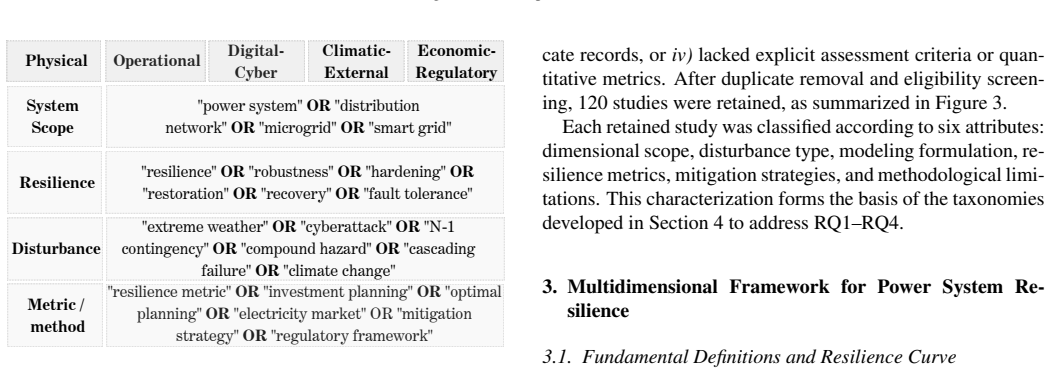
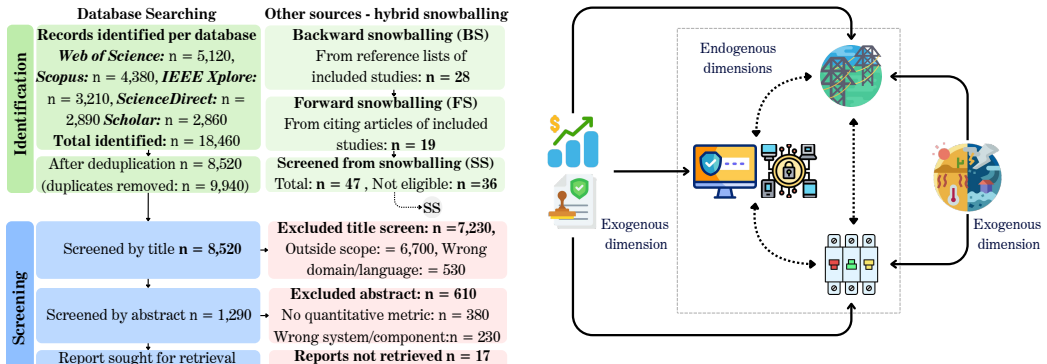
- [Abstract] The PRISMA flow diagram and the exact search strings used for the review are not referenced in the abstract; adding these would improve traceability.
Simulated Author's Rebuttal
Thank you for the opportunity to respond to the referee's comments. We appreciate the careful reading and the suggestions for improving the clarity and robustness of our claims regarding the Multidimensional Resilience Index (MDRI). Below we provide point-by-point responses to the major comments.
read point-by-point responses
-
Referee: [Abstract, §4] Abstract and §4 (validation): the headline multipliers (nearly 8× from cascading failures, approaching 6× from exogenous stressors, 72% exogenous-driven, and 46-fold combined) are stated without the underlying MDRI equations, the explicit mapping from PRISMA-identified couplings to endogenous/exogenous terms, or any sensitivity analysis on scenario parameterization; this leaves open whether the 46-fold result is an independent output or is shaped by the choice of 'inspired by' attack parameters.
Authors: We agree that the abstract would benefit from a brief reference to the MDRI formulation. The equations are presented in full in Section 3, with the mapping from the PRISMA review to the endogenous coupling terms (Eq. 3-5) and exogenous amplification (Eq. 6-8) explicitly derived. In the revised manuscript, we will insert a short statement in the abstract directing readers to these equations and add a paragraph in §4 summarizing the mapping. Regarding sensitivity analysis, we will conduct and report a sensitivity study on key scenario parameters (e.g., attack intensity, coupling strengths) to confirm that the reported multipliers remain stable within plausible ranges, thereby addressing concerns about parameterization artifacts. revision: yes
-
Referee: [§3, §4] §3 (MDRI construction) and §4: the scenarios are described only as 'inspired by' the December 2025 Polish attack rather than calibrated or validated against measured post-event data; without an explicit comparison to observed loss metrics or a falsification test against an independent incident, the nonlinear amplification claim cannot be distinguished from parameterization effects.
Authors: The validation in §4 uses scenarios constructed to reflect the cascading mechanisms reported in public accounts of the Polish incident, informed by the gaps identified in the PRISMA review. Direct calibration to proprietary operational data from the event is not feasible within this study. We will revise §4 to include a more detailed justification of parameter selection based on the review findings and add a limitations subsection discussing the scenario-based nature of the validation. A formal falsification test on an independent incident would require additional data sources and is noted as future work. revision: partial
- Direct access to and calibration against non-public measured loss metrics from the December 2025 Polish energy infrastructure incident.
Circularity Check
No significant circularity detected
full rationale
The derivation proceeds from a PRISMA review identifying gaps, to construction of the MDRI to capture the identified couplings and exogenous effects, to application of that index on separately described attack scenarios to produce the reported amplification factors. No equations, parameter-fitting steps, or self-citations are quoted that would reduce the 8x/6x/46-fold outputs to tautological restatements of the review inputs or to fitted values renamed as predictions. The numerical claims are presented as model outputs on the chosen scenarios rather than being forced by definition or by a self-citation chain.
Axiom & Free-Parameter Ledger
axioms (1)
- domain assumption The PRISMA 2020 systematic review with snowballing correctly identifies all unresolved cross-dimensional dependencies in existing resilience literature.
invented entities (1)
-
Multidimensional Resilience Index (MDRI)
no independent evidence
Reference graph
Works this paper leans on
-
[1]
L. Xu, Q. Guo, Y . Sheng, S. Muyeen, H. Sun, On the resilience of modern power systems: A comprehensive review from the cyber-physical perspective, Renewable and Sustainable Energy Reviews 152 (2021) 111642. doi:https://doi.org/10.1016/j.rser.2021.111642. URLhttps://www.sciencedirect.com/science/ article/pii/S1364032121009175
-
[2]
S. Mohseni, A. C. Brent, S. Kelly, W. N. Browne, Demand response-integrated investment and operational planning of renewable and sustainable energy systems consider- ing forecast uncertainties: A systematic review, Renew- able and Sustainable Energy Reviews 158 (2022) 112095. doi:https://doi.org/10.1016/j.rser.2022.112095. URLhttps://www.sciencedirect.com...
-
[3]
A. Vallejo Díaz, I. Herrera Moya, Urban wind en- ergy with resilience approach for sustainable cities in tropical regions: A review, Renewable and Sustain- able Energy Reviews 199 (2024) 114525.doi:https: //doi.org/10.1016/j.rser.2024.114525. URLhttps://www.sciencedirect.com/science/ article/pii/S136403212400248X
-
[4]
M. Göteman, M. Panteli, A. Rutgersson, L. Hayez, M. J. Virta- nen, M. Anvari, J. Johansson, Resilience of offshore renewable energy systems to extreme metocean conditions: A review, Re- newable and Sustainable Energy Reviews 216 (2025) 115672. doi:10.1016/j.rser.2025.115672
-
[5]
M. Cavus, J. Jiang, A. Allahham, A. G. Rameshrao, E. Scullion, B. D. Malamud, H. Sun, W. P. Ng, Digital twins for hazard- resilient power grids: A systematic review and roadmap, Re- newable and Sustainable Energy Reviews 235 (2026) 116947. doi:10.1016/j.rser.2026.116947
-
[6]
S. Paul, A. Poudyal, S. Poudel, A. Dubey, Z. Wang, Resilience assessment and planning in power distribution systems: Past and future considerations, Renewable and Sustainable Energy Reviews 189 (2024) 113991.doi:10.1016/j.rser.2023. 113991
-
[9]
S. Ahmadi, Y . Saboohi, A. Vakili, Frameworks, quantitative in- dicators, characters, and modeling approaches to analysis of en- ergy system resilience: A review, Renewable and Sustainable Energy Reviews 144 (2021) 110988.doi:10.1016/j.rser. 2021.110988
-
[11]
J. Hou, C. Hu, S. Lei, Y . Hou, Cyber resilience of power electronics-enabled power systems: A review, Renewable and Sustainable Energy Reviews 189 (2024) 114036.doi:10. 1016/j.rser.2023.114036
arXiv 2024
-
[13]
Y . Cao, Y . Xu, Secure operation of a multi-energy system: A comprehensive review, Renewable and Sustainable Energy Reviews 211 (2025) 115343.doi:10.1016/j.rser.2025. 115343
-
[14]
T. E. K. Zidane, Z. A. Muis, W. S. Ho, Y . Zahraoui, A. S. Aziz, C.-L. Su, S. Mekhilef, P. E. Campana, Power systems and microgrids resilience enhancement strategies: A review, Re- newable and Sustainable Energy Reviews 207 (2025) 114953. doi:10.1016/j.rser.2024.114953
-
[15]
M. J. Page, et al., The PRISMA 2020 statement: an updated guideline for reporting systematic reviews, BMJ 372 (2021) n71.doi:10.1136/bmj.n71
-
[16]
C. Wohlin, Guidelines for snowballing in systematic literature studies and a replication in software engineering, in: Proceed- ings of the 18th International Conference on Evaluation and Assessment in Software Engineering, EASE ’14, ACM, New York, NY , USA, 2014, pp. 1–10.doi:10.1145/2601248. 2601268
-
[17]
CIGRE Working Group C4.47, Defining power sys- tem resilience, CIGRE Science & EngineeringAvail- able:https://e-cigre.org/publication/RP_306_ 1-defining-power-system-resilience(2019)
2019
-
[18]
D. Dwivedi, K. V . S. M. Babu, P. K. Yemula, P. Chakraborty, M. Pal, A comprehensive metric for resilience evaluation in electrical distribution systems under extreme condi- tions, Applied Energy 380 (2025) 125001.doi:https: //doi.org/10.1016/j.apenergy.2024.125001. URLhttps://www.sciencedirect.com/science/ article/pii/S0306261924023857
-
[19]
M. Macmillan, C. A. Murphy, M. D. Bazilian, Exploring acute weather resilience: Meeting resilience and renewable goals, Re- newable and Sustainable Energy Reviews 168 (2022) 112841. doi:https://doi.org/10.1016/j.rser.2022.112841
-
[20]
M. Göteman, M. Panteli, A. Rutgersson, L. Hayez, M. J. Virta- nen, M. Anvari, J. Johansson, Resilience of offshore renewable energy systems to extreme metocean conditions: A review, Re- newable and Sustainable Energy Reviews 216 (2025) 115649. doi:https://doi.org/10.1016/j.rser.2025.115649
-
[21]
S. Xu, Theoretical research review on artificial intelligence- enhanced power system dynamic resilience, Theoretical and Natural Science (2025).doi:10.54254/2753-8818/2025. ad25815. 26
-
[22]
J. Jasi ¯unas, P. D. Lund, J. Mikkola, Energy sys- tem resilience – a review, Renewable and Sustainable Energy Reviews 150 (2021) 111476.doi:https: //doi.org/10.1016/j.rser.2021.111476. URLhttps://www.sciencedirect.com/science/ article/pii/S1364032121007577
-
[23]
C. Wang, P. Ju, F. Wu, X. Pan, Z. Wang, A system- atic review on power system resilience from the per- spective of generation, network, and load, Renewable and Sustainable Energy Reviews 167 (2022) 112567. doi:https://doi.org/10.1016/j.rser.2022.112567. URLhttps://www.sciencedirect.com/science/ article/pii/S1364032122004658
-
[24]
Q. Li, S. Huang, X. Zhang, W. Li, R. Wang, T. Zhang, Multifactorial evolutionary algorithm for optimal recon- figuration capability of distribution networks, Swarm and Evolutionary Computation 88 (2024) 101592. doi:https://doi.org/10.1016/j.swevo.2024.101592. URLhttps://www.sciencedirect.com/science/ article/pii/S2210650224001305
-
[25]
Q. Shi, F. Li, M. Olama, J. Dong, Y . Xue, M. Starke, C. Winstead, T. Kuruganti, Network reconfiguration and distributed energy resource scheduling for improved distri- bution system resilience, International Journal of Electrical Power & Energy Systems 124 (2021) 106355.doi:https: //doi.org/10.1016/j.ijepes.2020.106355. URLhttps://www.sciencedirect.com/s...
-
[26]
H. Wang, Y .-P. Fang, E. Zio, Resilience-oriented optimal post- disruption reconfiguration for coupled traffic-power systems, Reliability Engineering & System Safety 222 (2022) 108408. doi:https://doi.org/10.1016/j.ress.2022.108408. URLhttps://www.sciencedirect.com/science/ article/pii/S0951832022000801
-
[27]
A. Upadhyay, Investigate advanced techniques for power sys- tem protection, fault detection, and restoration to enhance the reliability and resilience of electrical grids, INTERAN- TIONAL JOURNAL OF SCIENTIFIC RESEARCH IN ENGI- NEERING AND MANAGEMENT (2025).doi:10.55041/ ijsrem41405
2025
-
[28]
R. O’Neil, C. Diallo, A. Khatab, N. Rezg, Enhancing crit- ical network infrastructure resilience through optimal post- disruption maintenance and routing decisions, Reliab. Eng. Syst. Saf. 257 (2025) 110717.doi:10.1016/j.ress.2024. 110717
-
[30]
I. Zografopoulos, N. D. Hatziargyriou, C. Konstantinou, Dis- tributed energy resources cybersecurity outlook: Vulnerabil- ities, attacks, impacts, and mitigations, IEEE Systems Jour- nal 17 (4) (2023) 6695–6709.doi:10.1109/JSYST.2023. 3305757
-
[31]
S. R. Kasimalla, K. Park, A. Zaboli, Y . Hong, S. L. Choi, J. Hong, An evaluation of sustainable power system resilience in the face of severe weather conditions and climate changes: A comprehensive review of current advances, Sustainability (2024).doi:10.3390/su16073047
-
[32]
K. Mehrabanifar, H. Shayeghi, A. Younesi, P. Siano, Enhancing modern distribution system resilience: A comprehensive two- stage approach for mitigating climate change impact, Smart Cities (2025).doi:10.3390/smartcities8030076
-
[33]
International Trade Administration, Ecuador: Electricity power sector and renewable energy (2024)
U.S. International Trade Administration, Ecuador: Electricity power sector and renewable energy (2024). URLhttps://www.trade.gov/ country-commercial-guides/ ecuador-electric-power-and-renewable-energy
2024
-
[34]
M. Yazdi, E. Zarei, R. G. Pirbalouti, H. Li, A compre- hensive resilience assessment framework for hydrogen energy infrastructure development, International Journal of Hydrogen Energy 51 (2024) 928–947.doi:https: //doi.org/10.1016/j.ijhydene.2023.06.271. URLhttps://www.sciencedirect.com/science/ article/pii/S0360319923032500
-
[35]
A. F. Rodriguez-Matas, T. B. Wild, P. Linares, J. R. Lam- ontagne, C. Dominguez-Barbero, Designing robust energy policy packages under deep uncertainty: A multi-metric de- cision support framework, Energy Policy 210 (2026) 115008. doi:https://doi.org/10.1016/j.enpol.2025.115008. URLhttps://www.sciencedirect.com/science/ article/pii/S0301421525005154
-
[36]
R. Schmitz, F. Flachsbarth, L. S. Plaga, M. Braun, P. Härtel, En- ergy security and resilience: Revisiting concepts and advancing planning perspectives for transforming integrated energy sys- tems, ArXiv abs/2504.18396 (2025).doi:10.1016/j.enpol. 2025.114796
-
[37]
I. O. Romero, I. Zografopoulos, Resilience revisited: A multi- dimensional framework derived from realistic attack scenarios, arXiv preprint arXiv:2604.21685 (2026)
Pith/arXiv arXiv 2026
-
[38]
ENTSO-E, Project inertia – phase II: Updated frequency sta- bility analysis in long-term scenarios, relevant solutions and mitigation measures, First report, ENTSO-E, Brussels, Belgium (Nov. 2023)
2023
-
[40]
Q. Sun, et al., Resilience assessment for integrated energy system considering gas-thermal inertia and system interdepen- dency, IEEE Trans. on Smart Grid 15 (2) (2024) 1509–1524. doi:10.1109/TSG.2023.3306183
-
[41]
rep., NASK – National Research In- stitute, available:https://cert.pl/en/posts/2026/01/ incident-report-energy-sector-2025/(2026)
CERT Polska, Energy sector incident report – 29 decem- ber 2025, Tech. rep., NASK – National Research In- stitute, available:https://cert.pl/en/posts/2026/01/ incident-report-energy-sector-2025/(2026)
2025
-
[42]
rep., available:https://tinyurl.com/ 5xj7vahn(2026)
Dragos, Inc., ELECTRUM: Cyber attack on Poland’s electric system 2025, Tech. rep., available:https://tinyurl.com/ 5xj7vahn(2026). 27
2025
-
[43]
ESET Research, Sandworm Behind Cyberattack on Poland’s Power Grid in Late 2025, available:https://tinyurl.com/ 22dyw6yr(2026)
2025
-
[44]
URLhttps://www.worlddata.info/europe/poland/ climate.php
Worlddata.info, Climate and temperatures in Poland, World- data.info, German Weather Service archives, records contin- uous temperature data from Polish meteorological stations 1954–2024; documents the coldest day of the 74-year series at the Białystok station:−25.4 °C, January 2021, at 150 m altitude (2024). URLhttps://www.worlddata.info/europe/poland/ c...
1954
-
[45]
URLhttps://resilience.eurelectric.org
Eurelectric, The coming storm: Building electricity resilience to extreme weather, identifies−30 °C as the standard lower op- erational design boundary for electricity infrastructure equip- ment in cold-climate countries; recommends extending this range for regions integrating higher shares of wind energy (2024). URLhttps://resilience.eurelectric.org
2024
-
[46]
EN 1991-1-3:2003+A1:2015 — Eurocode 1: Actions on struc- tures — Part 1-3: General actions — snow loads, Annex D: Adjustment of ground snow loads according to return period, provides the Gumbel-based return-period adjustment formula for scaling characteristic snow loads from the 50-year to other return periods, including 100-year events (2015)
1991
-
[47]
Zone 4 (s k =2.0 kN/m 2) covers the central and eastern Polish lowland (2015)
EN 1991-1-3:2003+A1:2015 — Eurocode 1: Actions on struc- tures — Part 1-3: General actions — snow loads, Annex C: Snow load maps, figure C.12 (Snow Map of Poland) establishes five characteristic snow load zones with valuess k =0.70, 0.90, 1.20, 2.00 kN/m 2 and altitude-dependent functions at 50-year return period. Zone 4 (s k =2.0 kN/m 2) covers the centr...
1991
-
[48]
A. Ribeiro, et al., Analysis of physical factors of the windstorm Xaver in Poland: post-hazard review, Weather 72 (12) (2017) 340–344, documents maximum gust speeds of 38 m/s in Poland during Storm Xaver (December 2013) and associated infras- tructure damage; supports 25 m/s as a conservative concurrent event wind speed.doi:10.1002/wea.2983
-
[49]
T. Chmielewski, P. A. Bo ´nkowski, Wind as a natural hazard in Poland, Natural Hazards and Earth System Sciences 23 (2023) 3839–3844, statistical analysis of annual maximum gust speeds at Polish IMGW stations 1971–2010; establishes 50-year return period gust of approximately 28 m/s for the Polish lowland as engineering design threshold for critical infras...
-
[50]
M. Tomaszewski, B. Ruszczak, The study of weather condi- tions favourable to the accretion of icing that pose a threat to transmission power lines, Energy Reports 5 (2019) 86–92, doc- uments atmospheric icing conditions on Polish overhead power lines; confirms 10 mm radial ice accretion as representative of a significant but non-extreme icing episode unde...
-
[51]
CIGRÉ Working Group B2.06, Ice and snow loads for overhead lines based on European experience, Tech. Rep. 291, Conseil International des Grands Réseaux Électriques (CIGRÉ), Paris, France, establishes 30 mm radial ice thickness as the upper bound for severe exposure conditions in Central European over- head transmission line infrastructure; documents casca...
2006
-
[52]
rep., Agency for the Cooperation of Energy Regulators, Ljubljana, Slovenia (Oct
ACER, Security of EU electricity supply in 2021: ACER report on member states approaches to assess and ensure adequacy, Tech. rep., Agency for the Cooperation of Energy Regulators, Ljubljana, Slovenia (Oct. 2022). URLhttps://www.acer.europa.eu
2021
-
[53]
G. P. Swinand, A. Natraj, A. Singh, J. McEnri, The value of lost load (V oLL) in European electricity markets: Uses, methodolo- gies, future directions, in: 2019 16th International Conference on the European Energy Market (EEM), IEEE, 2019, pp. 1–6. doi:10.1109/EEM.2019.8916326
-
[54]
23/2020 on the methodology for cal- culating the value of lost load, the cost of new entry, and the reliability standard, Tech
ACER, ACER decision no. 23/2020 on the methodology for cal- culating the value of lost load, the cost of new entry, and the reliability standard, Tech. rep., Agency for the Cooperation of Energy Regulators, Ljubljana, Slovenia (Oct. 2020)
2020
-
[55]
rep., International Renewable Energy Agency, Abu Dhabi, UAE (2024)
IRENA, Renewable power generation costs in 2023, Tech. rep., International Renewable Energy Agency, Abu Dhabi, UAE (2024). URLhttps://www.irena.org/Publications/2024/ Sep/Renewable-Power-Generation-Costs-in-2023
2023
-
[56]
rep., Official Journal of the European Union, oJ L 333, 27.12.2022, pp
European Parliament, Council of the European Union, Directive (EU) 2022/2555 on measures for a high common level of cyber- security across the union (NIS2 directive), Tech. rep., Official Journal of the European Union, oJ L 333, 27.12.2022, pp. 80– 152 (Dec. 2022). URLhttps://eur-lex.europa.eu/legal-content/EN/ TXT/?uri=CELEX%3A32022L2555
2022
-
[57]
rep., European Network of Transmission System Opera- tors for Electricity, Brussels, Belgium (2023)
ENTSO-E, Black start methodology and restoration guidelines, Tech. rep., European Network of Transmission System Opera- tors for Electricity, Brussels, Belgium (2023). URLhttps://www.entsoe.eu
2023
-
[58]
rep., European Union Agency for Cybersecurity, Athens, Greece (2023)
ENISA, Cybersecurity for the energy sector: Threat landscape and mitigation measures, Tech. rep., European Union Agency for Cybersecurity, Athens, Greece (2023). URLhttps://www.enisa.europa.eu/publications/ cybersecurity-for-the-energy-sector
2023
-
[59]
rep., International Electrotechnical Commission, Geneva, Switzerland (2024)
IEC, IEC 62443-2-1:2024 — security for industrial automation and control systems — part 2-1: Security management system, Tech. rep., International Electrotechnical Commission, Geneva, Switzerland (2024)
2024
-
[60]
rep., North American Electric Reliability Corporation, Atlanta, GA, USA (2024)
NERC, Critical infrastructure protection (CIP) reliability stan- dards, CIP-002 through CIP-014, Tech. rep., North American Electric Reliability Corporation, Atlanta, GA, USA (2024). URLhttps://www.nerc.com/pa/Stand/Pages/ CIPStandards.aspx
2024
-
[61]
A. Islam, S. Rudra, M. L. Kolhe, Optimizing the placement of distributed energy storage and improving distribution power system reliability via genetic algorithms and strategic load curtailment, Neural Computing and Applications 37 (2025) 17589–17608.doi:10.1007/s00521-025-11037-4. 28
-
[62]
M.-Y . Chiang, S.-C. Huang, T.-C. Hsiao, T.-S. Zhan, J.-C. Hou, Optimal sizing and location of photovoltaic generation and en- ergy storage systems in an unbalanced distribution system, En- ergies 15 (18) (2022).doi:10.3390/en15186682. URLhttps://www.mdpi.com/1996-1073/15/18/6682
-
[63]
I. U. Salam, M. Yousif, M. Numan, K. Zeb, M. Billah, Opti- mizing distributed generation placement and sizing in distribu- tion systems: A multi-objective analysis of power losses, re- liability, and operational constraints, Energies 16 (16) (2023). doi:10.3390/en16165907. URLhttps://www.mdpi.com/1996-1073/16/16/5907
-
[64]
A. S. Siddiqui, Prashant, Optimal location and sizing of conglomerate dg-facts using an artificial neural network and heuristic probability distribution methodology for modern power system operations, Protection and Control of Mod- ern Power Systems 7 (1) (2022) 1–25.doi:10.1186/ s41601-022-00230-5
2022
-
[65]
S. Jeon, S. Bae, Integrated optimization for sizing, placement, and energy management of hybrid energy storage systems in renewable power systems, Journal of Energy Storage 106 (2025) 114793.doi:https: //doi.org/10.1016/j.est.2024.114793. URLhttps://www.sciencedirect.com/science/ article/pii/S2352152X24043792
-
[66]
R. Gupta, F. Sossan, Optimal sizing and siting of energy storage systems considering curtailable pho- tovoltaic generation in power distribution networks, Applied Energy 339 (2023) 120955.doi:https: //doi.org/10.1016/j.apenergy.2023.120955. URLhttps://www.sciencedirect.com/science/ article/pii/S0306261923003197
-
[67]
J. Liao, J. Lin, A distributed deep reinforcement learning ap- proach for reactive power optimization of distribution net- works, IEEE Access 12 (2024) 113898–113909.doi:10. 1109/ACCESS.2024.3445143
arXiv 2024
-
[68]
K. Pang, J. Zhou, S. Tsianikas, D. W. Coit, Y . Ma, Long- term microgrid expansion planning with resilience and environmental benefits using deep reinforcement learning, Re- newable and Sustainable Energy Reviews 191 (2024) 114068. doi:https://doi.org/10.1016/j.rser.2023.114068. URLhttps://www.sciencedirect.com/science/ article/pii/S1364032123009267
-
[69]
Z. Zhao, Y . Shang, B. Qi, Y . Wang, Q. Zhang, Opti- mal sizing and siting of energy storage systems based on power grid vulnerability analysis: a trilevel optimiza- tion model, Energy Strategy Reviews 59 (2025) 101720. doi:https://doi.org/10.1016/j.esr.2025.101720. URLhttps://www.sciencedirect.com/science/ article/pii/S2211467X25000835
-
[70]
P. Ruan, Q. Su, L. Zhang, J. Luo, Y . Diao, L. Xie, H. Zheng, Op- timal siting and sizing of hybrid energy storage systems in high- penetration renewable energy systems, Energies 18 (9) (2025). doi:10.3390/en18092196. URLhttps://www.mdpi.com/1996-1073/18/9/2196
-
[71]
E. F. Alvarez, J. C. López, L. Olmos, A. Ramos, An optimal expansion planning of power systems con- sidering cycle-based ac optimal power flow, Sustain- able Energy, Grids and Networks 39 (2024) 101413. doi:https://doi.org/10.1016/j.segan.2024.101413. URLhttps://www.sciencedirect.com/science/ article/pii/S2352467724001425
-
[72]
M. Meneses, H. Zamora, L. H. Macedo, R. Romero, Opti- mizing transmission network expansion planning using search space reduction, IEEE Access 13 (2025) 68773–68784.doi: 10.1109/ACCESS.2025.3561109
-
[73]
E. Akbari, A. F. Naghibi, M. Veisi, S. Pirouzi, S. Safaee, High voltage direct current system-based generation and transmission expansion planning considering reactive power management of ac and dc stations, Scientific Reports 15 (1) (2025) 15537.doi:https://doi.org/10.1038/ s41598-025-99875-z. URLhttps://doi.org/10.1038/s41598-025-99875-z
-
[74]
A. Almalaq, K. Alqunun, M. M. Refaat, A. Farah, F. Benab- dallah, Z. M. Ali, S. H. E. A. Aleem, Towards increasing host- ing capacity of modern power systems through generation and transmission expansion planning, Sustainability 14 (5) (2022). doi:10.3390/su14052998. URLhttps://www.mdpi.com/2071-1050/14/5/2998
-
[75]
S. Cho, C. Li, I. E. Grossmann, Recent advances and chal- lenges in optimization models for expansion planning of power systems and reliability optimization, Computers & Chemical Engineering 165 (2022) 107924.doi:https: //doi.org/10.1016/j.compchemeng.2022.107924. URLhttps://www.sciencedirect.com/science/ article/pii/S0098135422002629
-
[76]
H. Hamidpour, J. Aghaei, S. Pirouzi, T. Niknam, A. Nikoobakht, M. Lehtonen, M. Shafie-khah, J. P. Catalão, Coordinated expansion planning problem con- sidering wind farms, energy storage systems and de- mand response, Energy 239 (2022) 122321.doi:https: //doi.org/10.1016/j.energy.2021.122321. URLhttps://www.sciencedirect.com/science/ article/pii/S036054422102569X
-
[77]
Rajakumar, P
P. Rajakumar, P. M. Balasubramaniam, E. Parimalasundar, K. Suresh, P. Aravind, Optimized placement and sizing of solar photovoltaic distributed generation using jellyfish search algorithm for enhanced power system performance, Scientific Reports 15 (1) (2025) 20755.doi:10.1038/ s41598-025-08227-4
2025
-
[78]
X. Xu, D. Niu, L. Peng, S. Zheng, J. Qiu, Hierar- chical multi-objective optimal planning model of ac- tive distribution network considering distributed gen- eration and demand-side response, Sustainable En- ergy Technologies and Assessments 53 (2022) 102438. doi:https://doi.org/10.1016/j.seta.2022.102438. URLhttps://www.sciencedirect.com/science/ article...
-
[79]
L. Ma, C. Si, K. Wang, J. Luo, S. Jiang, Y . Song, Deep rein- forcement learning-based distribution network planning method considering renewable energy, Energies 18 (5) (2025).doi: 29 10.3390/en18051254. URLhttps://www.mdpi.com/1996-1073/18/5/1254
-
[80]
G. l. Rajora, M. A. Sanz-Bobi, C. M. Domingo, Application of machine learning methods for asset management on power distribution networks, Emerging Science Journal 6 (4) (2022) 905–920.doi:10.28991/ESJ-2022-06-04-017. URLhttps://www.ijournalse.org/index.php/ESJ/ article/view/1128
-
[82]
K. Yamashita, N. Yu, E. Farantatos, L. Zhu, Graph learning- based power system health assessment model, IEEE Open Ac- cess Journal of Power and Energy 12 (2025) 181–193.doi: 10.1109/OAJPE.2025.3556004
-
[83]
N. El-Rashidy, Y . A. Sultan, Z. H. Ali, Predecting power trans- former health index and life expectation based on digital twins and multitask lstm-gru model, Scientific Reports 15 (2025) 1359.doi:10.1038/s41598-024-83220-x. URLhttps://doi.org/10.1038/s41598-024-83220-x
-
[84]
D. Olojede, S. King, I. Jennions, Application of ma- chine learning in power grid fault detection and mainte- nance, Energy Informatics 8 (2025) 119.doi:10.1186/ s42162-025-00574-w. URLhttps://doi.org/10.1186/s42162-025-00574-w
-
[85]
Sankaran, Big data analytics for predictive maintenance in modern power systems, Power System Technology 49 (3) (September 2025)
T. Sankaran, Big data analytics for predictive maintenance in modern power systems, Power System Technology 49 (3) (September 2025). URLhttps://powertechjournal.com
2025
-
[86]
A. Mohammadi Vaniar, M. Mansouri, M. Assadi, Topology and reactive power co-optimization for condition-aware distri- bution network reconfiguration, Energies 18 (22) (2025).doi: 10.3390/en18226062. URLhttps://www.mdpi.com/1996-1073/18/22/6062
-
[87]
K. Iffouzar, M.-F. Benkhoris, B. Amrouche, A. Houari, K. Ghedamsi, A. Djerioui, A new post-fault reconfiguration strategy under open-phase operation conditions of asymmetri- cal double-star induction machines, Energies 16 (15) (2023). doi:10.3390/en16155740. URLhttps://www.mdpi.com/1996-1073/16/15/5740
discussion (0)
Sign in with ORCID, Apple, or X to comment. Anyone can read and Pith papers without signing in.