REVIEW 2 major objections 4 minor 25 references
Equilibrium and stability of two-dimensional pinned drops
T0 review · 2 major / 4 minor · reviewed 2026-08-14 · deepseek-v4-flash
Pith's one-line read The stability of two-dimensional drops pinned on sharp edges is controlled by the Bond number, with critical pinning angles given by extrema of the pressure and area curves.
desk verdict A solid stability map for 2D pinned drops, with the main caveat that the turning-point theorem is invoked rather than verified. read the letter →
The pith
A machine-rendered reading of the paper's core claim, the machinery that carries it, and where it could break.
The reading
What carries the argument
The central object is the pressure eigenvalue $P_0$, the pressure at zero height scaled by $\sigma/W_d$, together with the scaled cross-sectional area $a$; both are functions of the pinning angle $\theta_0$ and the Bond number $Bo$. Stability is read off from the curves $P_0(a)$ and $a(P_0)$: by Maddocks' turning-point theorem, unconstrained extremals change stability at folds of the solution branches, that is, at local extrema of $P_0(a)$, and constant-volume extremals change stability at local extrema of $a(P_0)$. The theorem replaces a direct check of the second variation of the energy functional with a geometric condition on computed equilibrium branches.
What would settle it
For one Bond number, say $Bo=1$, compute the full spectrum of the second variation of the energy along the equilibrium branch and locate the first angle at which an eigenvalue crosses zero; if that angle differs from the extremum of $P_0(a)$ or $a(P_0)$, the turning-point criterion misses an instability. Alternatively, measure depinning angles of pressure-controlled drops pinned on a sharp-edged aperture of known width and compare them with the predicted critical angles.
Extended reading notes
Core claim
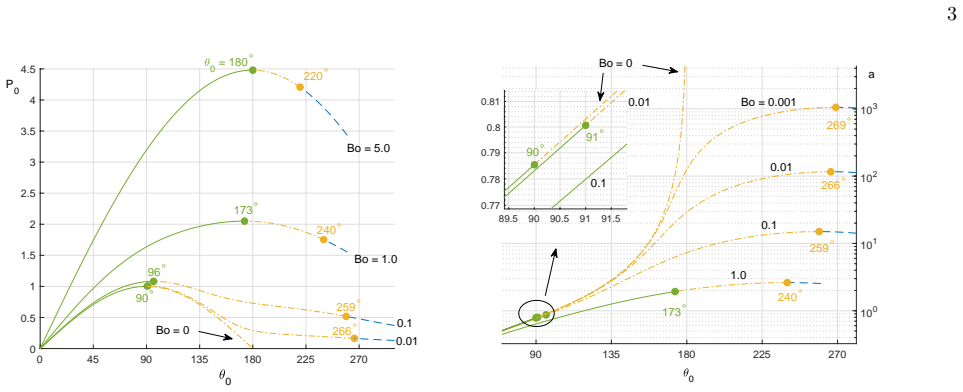
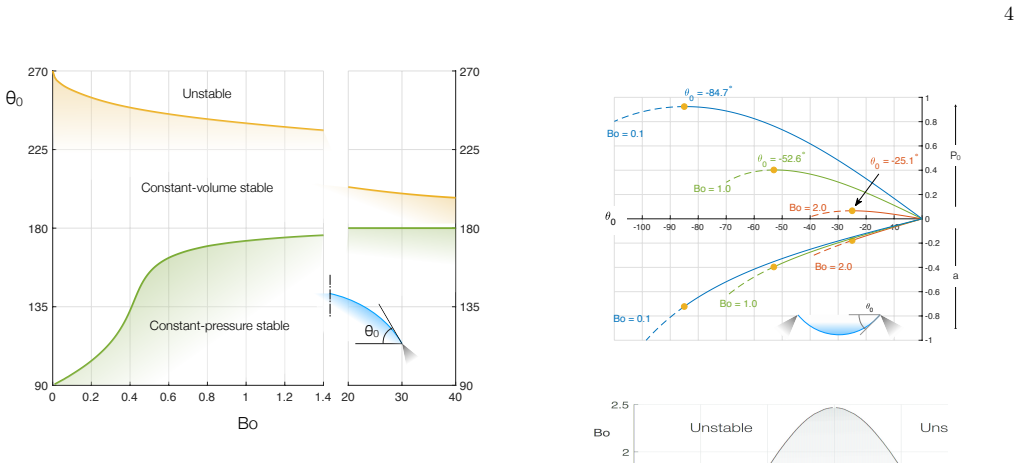
Working in a planar arc-length formulation with the pressure eigenvalue $P_0$ as an unknown, the paper computes equilibrium branches for drops pinned on two sharp edges and locates their stability changes using turning-point arguments. It finds that unconstrained (constant-pressure) drops lose stability at extrema of $P_0$ as a function of area $a$, whereas constant-volume drops lose stability at extrema of $a$ as a function of $P_0$. The resulting stability diagram in the Bond-number--pinning-angle plane has two boundaries: below the constant-pressure limit the drop is stable to both perturbation classes; between the constant-pressure and constant-volume limits it is stable only to volume-preserving perturbations; above both it is unstable. At zero Bond number the two limits meet at $\theta_0 = 90^\circ$, matching earlier theory and experiment, and at large Bond number they approach the common limit $\theta_0 = 180^\circ$, a semi-infinite liquid layer. The same fold criterion applies to inverted (hanging) drops with negative pinning angles.
Load-bearing premise
The central assumption is that a pinned drop loses stability precisely when the pressure-versus-area relation turns over, and no other kind of disturbance, such as a bulge along the third dimension, goes unstable before that point.
Editorial extensions
If this is right
- On a superhydrophobic substrate, the Gibbs pinning condition is necessary but not sufficient: a drop can be in mechanical equilibrium yet unstable, so the attainable non-wetting states are those inside the stability region of the $Bo$--$\theta_0$ map.
- A shrinking closed drop becomes more stable, so an evaporating drop on a micropatterned surface should remain non-wetting until its size approaches the microstructure scale, at which point the interface underneath develops curvature and the drop transitions to a wetted state.
- An open drop fed by a reservoir behaves oppositely: lowering the Bond number narrows the range of stable pinning angles, so pressure-controlled drops destabilize more easily at small scales.
- When the drop and microstructure scales are widely separated, the micro-interface under the drop is nearly flat because its pressure eigenvalue must match that of the macro-interface; this links the two scales and explains why hierarchical micropatterning widens the non-wetting regime.
- For $Bo \to 0$ both stability limits converge to $\theta_0 = 90^\circ$, reproducing prior theoretical and experimental results, and for large $Bo$ they converge to $\theta_0 = 180^\circ$, where constant-pressure and constant-volume perturbations coincide.
Reading between the lines
- A direct extension of the fold criterion is that axisymmetric three-dimensional pinned drops should have stability boundaries set by extrema of $P_0(V)$ and $V(P_0)$, so the qualitative size trends found here would likely carry over to spherical-cap-like drops.
- A testable experimental check would be to measure, at fixed Bond number, the pinning angle at which a pressure-controlled pinned drop depins and compare it with the extremum of $P_0(a)$; a mismatch would signal that a mode excluded by the planar analysis is active.
- Because longitudinal Rayleigh-Plateau modes are excluded, the stability diagram should be read as the boundary for planar pinned perturbations; for drops that are long in the third dimension, three-dimensional bulging modes would set a lower practical stability limit.
- The multiscale pressure-matching argument suggests a design rule: making the microfeature spacing much smaller than the drop radius keeps the underside interface flat and stable, so the robustness of superhydrophobic surfaces should scale with the ratio of the two Bond numbers.
Signed reviews
Editorial analysis
A structured set of objections, weighed in public.
Referee Report
Summary. The paper studies the equilibrium and stability of two-dimensional liquid drops pinned on sharp edges under gravity. The authors introduce a variational formulation with a pressure eigenvalue P0, solve the Euler-Lagrange equations for a range of Bond numbers, and use turning-point theory (Maddocks' theorem) to claim that stability changes occur at extrema of P0(a) for open (constant-pressure) drops and at extrema of a(P0) for fixed-volume drops. They construct a stability map in the Bond-number/pinning-angle plane, apply the results to a multiscale model of superhydrophobic substrates, and draw qualitative conclusions about how drop size affects stability.
Significance. If the stability boundaries are correct, the paper offers an elegant, parameter-free explanation of how drop size (Bond number) controls the stability of pinned interfaces, which is directly relevant to superhydrophobicity and droplet microfluidics. The variational turning-point approach is a standard and powerful tool, and the multiscale discussion makes useful contact with experimentally observed wetting transitions. However, the central stability map rests on assumptions about the second variation that are not verified, and some of the abstract's size-stability claims are not derived explicitly. These issues temper the otherwise significant contribution.
major comments (2)
- [Section II.B, Eq. (2e)] The stability analysis is performed on the half-domain with the symmetry boundary condition ζ_dot(sa)=0, which restricts the admissible perturbations to those symmetric about the vertical axis. Antisymmetric planar perturbations (which would have a nonzero vertical component at the symmetry plane) are not captured by this formulation. The turning-point method identifies stability changes only at folds of the P0-a branch; a symmetry-breaking bifurcation or any other eigenmode crossing zero at a point that is not a fold would not be detected. Since the stability boundaries in Fig. 3 are the central result of the paper, the authors must either verify directly (e.g., by discretizing the second variation and checking positive definiteness) that no eigenmode of the full planar problem becomes unstable before the folds, or explicitly restrict and justify the analysis to symmetric perturbations.
- [Abstract and Section III] The statements "Drops with a fixed volume become more stable as they shrink in size" and "open drops... are less stable as their associated Bond number decreases" are not derived in the manuscript. The stability map in Fig. 3 gives critical angles as functions of Bo, but it does not track drops of fixed physical volume as size changes; the dimensionless area a = A/(2Wd²) varies when Wd changes at fixed A. As presented, the claims appear inconsistent with the monotonic rise of the stability boundaries with Bo seen in Fig. 2 (e.g., the yellow constant-volume limit increases from θ0=90° at Bo=0 to θ0=180° at large Bo). The paper should provide the missing iso-volume analysis or qualify these claims.
minor comments (4)
- [Section I.A] The statement that P0 is "a one-to-one function of the pinning angle" is inaccurate when P0(θ0) has extrema, as in Fig. 2; the authors likely mean "single-valued." Please rephrase.
- [Section II.B] The sentence "the stability can be studied in the preferred plane P0 − (−E_P0)" is confusing; it would be clearer to say "the P0-a plane, where E_P0 = -a."
- [Figures 2 and 4] The paper does not describe the numerical method used to solve the boundary value problem (2) and generate the equilibrium branches; adding a brief description would help reproducibility.
- [References] There are minor typographical and reference issues, including a duplicated journal name in reference [14] and missing apostrophes in "drop's" in a few places.
Circularity Check
No significant circularity: stability limits are computed from direct solution of the governing equations and an external turning-point theorem, not from fitted inputs or self-citation.
full rationale
The paper derives equilibrium shapes by integrating the Euler-Lagrange equations (2) with boundary conditions, treating the pressure eigenvalue P0 and Bond number Bo as independent parameters, and obtains the area a directly from the solution. The stability boundaries are then identified with extrema of P0(a) and a(P0) by invoking Maddocks' turning-point theorem, which is an external mathematical result (Ref. [5]) and not derived from the paper's own data. No parameter is fitted to the stability data, and the central predictions—dependence of the critical pinning angles on Bo, and the contrasting size-stability behavior of constant-volume versus constant-pressure drops—follow from solving the equations across the parameter range, not from any assumed answer. The only possible concern is whether the hypotheses of Maddocks' theorem (e.g., no earlier eigenvalue crossings) are fully verified for this infinite-dimensional free-endpoint problem; the paper explicitly restricts to planar pinned perturbations and does not compute the second variation directly. But that is a correctness/validity risk, not circularity: the argument does not assume the conclusion by definition or by self-citation. There are no author self-citations carrying load, and no fitted input is renamed as a prediction. The paper is self-contained against the governing equations and external stability theory, so the circularity score is 0.
Assumptions & free parameters
assumptions (3)
- domain assumption Stability changes occur at turning points (extrema of P0(a) and a(P0)) per Maddocks' theorem.
- domain assumption Only planar pinned perturbations are considered; longitudinal Rayleigh-Plateau instabilities are excluded.
- domain assumption The sharp-edged pinning is perfect and the contact line does not move during perturbations.
Cite this review
Pith. "Pith review of Equilibrium and stability of two-dimensional pinned drops." pith.science (2026). https://pith.science/paper/OP2UXTME
@misc{pith2026190807971,
  author       = {Pith},
  title        = {Pith review of: Equilibrium and stability of two-dimensional pinned drops},
  year         = {2026},
  howpublished = {\url{https://pith.science/paper/OP2UXTME}},
  note         = {Machine review of arXiv:1908.07971}
}
abstract
Superhydrophobicity relies on the stability of drops's interfaces pinned on sharp edges to sustain non-wetting (Cassie-Baxter) equilibrium states. Gibbs already pointed out that equilibrium is possible as long as the pinning angle at the edge falls between the equilibrium contact angles corresponding to the flanks of the edge. However, the lack of stability can restrict further the realizable equilibrium configurations. To find these limits we analyze here the equilibrium and stability of two-dimensional drops bounded by interfaces pinned on mathematically sharp edges. We are specifically interested on how the drop's stability depends on its size, which is measured with the Bond number $Bo = (\mathcal{W}_d/\ell_c)^2$, defined as the ratio of the drop's characteristic length scale $\mathcal{W}_d$ to the capillary length $\ell_c = \sqrt{\sigma/\rho g}$. Drops with a fixed volume become more stable as they shrink in size. On the contrary, open drops, i.e. capable of exchanging mass with a reservoir, are less stable as their associated Bond number decreases.
Figures

Figures from the paper (2 more)

Reference graph
Works this paper leans on
-
[1]
Consider for instance the case when the scales are widely differentW b≪W d, so Bob≪ Bod as well
=P d 0 (θd 0) √ Bob Bod (3) This is thus the condition that determines each inter- face’s pinning angle θb 0 and θd 0, or more precisely, the relationship between them, in terms of their respective Bond numbers Bob = (Wb/𝓁c)2, Bod = (Wd/𝓁c)2. Consider for instance the case when the scales are widely differentW b≪W d, so Bob≪ Bod as well. Ac- cording to (3)...
-
[2]
an almost flat interface underneath between the microstructure
≈ θb 0 ∼ Wb/Wd, i.e. an almost flat interface underneath between the microstructure. However, when the drop scaleWd decreases to sizes comparable to those of the superhydrophobic microstructure, both interfaces must have comparable curvatures, i.e. θb 0 is not small anymore. This is in fact, the basic mechanism of superhydropho- bicity: the scale of microp...
-
[3]
W. Barthlott, M. Mail, B. Bhushan, and K. Koch, Nano- Micro Letters 9, 23 (2017)
work page 2017
-
[4]
B. Bhushan and Y. C. Jung, Progress in Materials Sci- ence 56, 1 (2011)
work page 2011
- [5]
-
[6]
Poincar´ e, Acta Math.7, 259 (1885)
H. Poincar´ e, Acta Math.7, 259 (1885)
-
[7]
J. H. Maddocks, Archive for Rational Mechanics and Analysis 99, 301 (1987)
work page 1987
- [8]
Show all 25 references
-
[9]
R. L. Speth and E. Lauga, New Journal of Physics 11, 075024 (2009)
2009
-
[10]
H. Gau, S. Herminghaus, P. Lenz, and R. Lipowsky, Science 283, 46 (1999)
1999
-
[11]
J. F. Oliver, C. Huh, and S. G. Mason, Journal of Colloid and Interface Science 59, 568 (1977)
1977
-
[12]
P. Lv, Y. Xue, Y. Shi, H. Lin, and H. Duan, Physical Review Letters 112, 196101 (2014)
2014
-
[13]
Berthier, F
J. Berthier, F. Loe-Mie, V.-M. Tran, S. Schoumacker, F. Mittler, G. Marchand, and N. Sarrut, Journal of Col- loid and Interface Science 338, 296 (2009)
2009
-
[14]
Hensel, A
R. Hensel, A. Finn, R. Helbig, S. Killge, H.-G. Braun, and C. Werner, Langmuir 30, 15162 (2014)
2014
-
[15]
”Leo” Liu and C.-J
T. ”Leo” Liu and C.-J. ”CJ” Kim, Science 346, 1096 (2014)
2014
-
[16]
Haimov, S
B. Haimov, S. Pechook, O. Ternyak, and B. Pokroy, The Journal of Physical Chemistry C, The Journal of Physical Chemistry C 117, 6658 (2013)
2013
-
[17]
C. Hao, J. Li, Y. Liu, X. Zhou, Y. Liu, R. Liu, L. Che, W. Zhou, D. Sun, L. Li, L. Xu, and Z. Wang, Nature Communications 6, 7986 EP (2015)
2015
-
[18]
Josserand and S
C. Josserand and S. Thoroddsen, Annual Review of Fluid Mechanics 48, 365 (2016)
2016
-
[19]
Zhang, Q
B. Zhang, Q. Lei, Z. Wang, and X. Zhang, Langmuir 32, 346 (2016)
2016
-
[20]
Antonini, J
C. Antonini, J. B. Lee, T. Maitra, S. Irvine, D. Derome, M. K. Tiwari, J. Carmeliet, and D. Poulikakos, Nature Scientific Reports 4 : 4055 , 1 (2014)
2014
-
[21]
Langbein, Journal of Fluid Mechanics 213, 251 (1990)
D. Langbein, Journal of Fluid Mechanics 213, 251 (1990)
1990
-
[22]
Herminghaus, M
S. Herminghaus, M. Brinkmann, and R. Seemann, An- nual Review of Materials Research 38, 101 (2008)
2008
-
[23]
I. M. Gelfand and S. Fomin, Calculus of variations (Prentice-Hall Inc, 1963)
1963
-
[24]
Schellenberger, N
F. Schellenberger, N. Encinas, D. Vollmer, and H. J. Butt, Physical Review Letters 116 (2016)
2016
-
[25]
Verho, J
T. Verho, J. T. Korhonen, L. Sainiemi, V. Joki- nen, C. Bower, K. Franze, S. Franssila, P. An- drew, O. Ikkala, and R. H. A. Ras, Proceedings of the National Academy of Sciences 109, 10210 (2012), https://www.pnas.org/content/109/26/10210.full.pdf
2012
Reviewed August 14, 2026 · model on record in the stance chip above.
Discussion (0). Continue with ORCID to comment.