REVIEW 3 major objections 6 minor 87 references
Sparse Coding of Shape Trajectories for Facial Expression and Action Recognition
T0 review · 3 major / 6 minor · reviewed 2026-08-14 · deepseek-v4-flash
Pith's one-line read Sparse coding of shape trajectories in Kendall spaces yields vector-space time-series that are more discriminative than the raw data, the paper argues.
desk verdict Solid extension of the authors' earlier intrinsic SCDL work; the extrinsic 2D facial-expression pipeline is the new part, and the intrinsic formulation has a real but fixable gap. read the letter →
The pith
A machine-rendered reading of the paper's core claim, the machinery that carries it, and where it could break.
The reading
What carries the argument
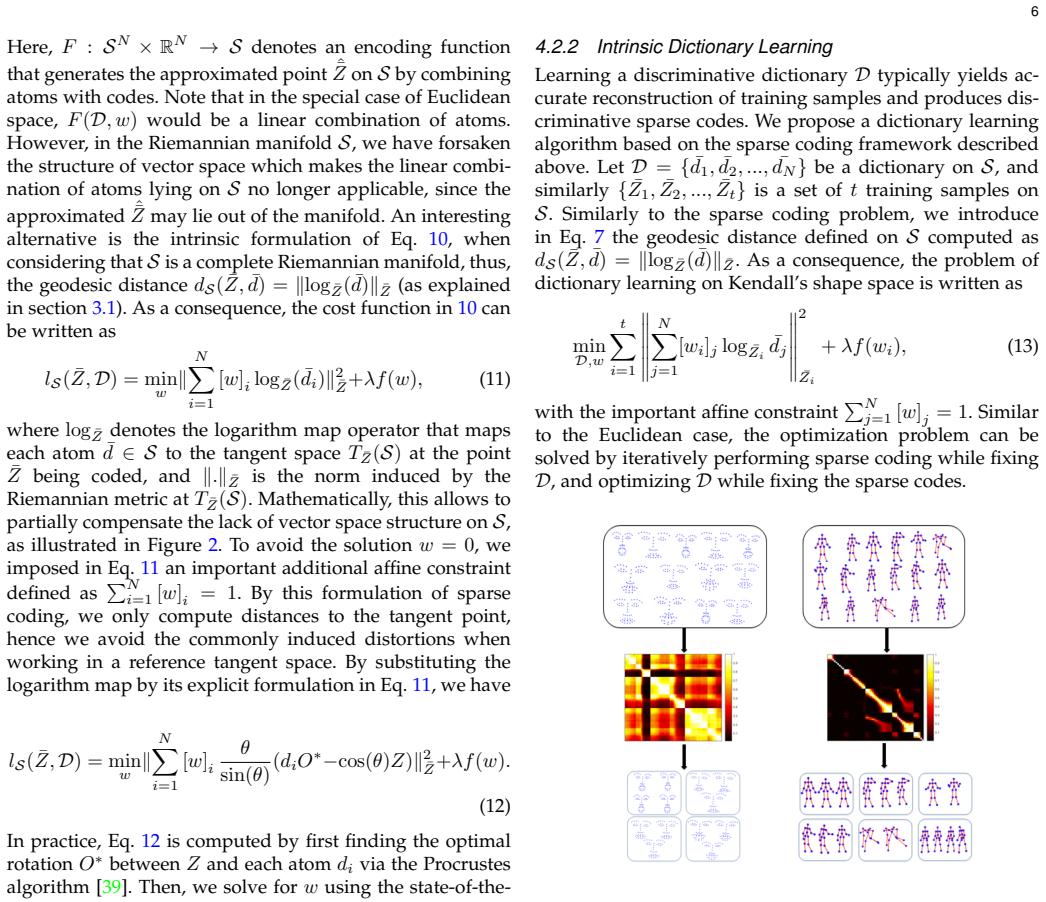
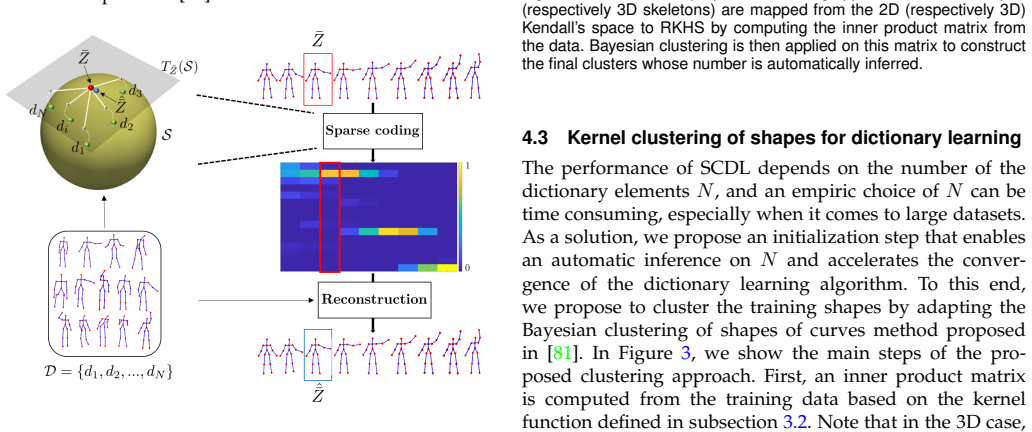
The central object is the Kendall shape space, the manifold formed by landmark configurations modulo translation, rotation, and global scaling, together with the geodesic distance and logarithm/exponential maps induced by the Procrustes metric. On top of this manifold the paper builds Riemannian sparse coding and dictionary learning (SCDL): a dictionary of shapes is learned from training data, and each query shape is represented by a sparse weight vector. In the intrinsic version the weights act on tangent vectors obtained by logarithm-mapping every atom to the query's tangent space, so reconstruction error is measured at the query itself; in the extrinsic version the Procrustes Gaussian kernel embeds the 2D shape space into a Hilbert space where ordinary linear sparse coding applies. This machinery carries the argument because it converts nonlinear manifold-valued trajectories into Euclidean sparse time-series that can be fed to standard temporal classifiers.
What would settle it
Take a query shape and a learned dictionary, compute its intrinsic sparse code with Eq. (11), then reconstruct the shape as the weighted Karcher mean of the selected atoms and measure the geodesic distance between the reconstruction and the query; if that error is systematically large when the query is far from the chosen atoms, the tangent-space objective does not represent the true reconstruction loss the framework relies on.
Extended reading notes
Core claim
The paper's central claim is that Riemannian sparse coding and dictionary learning in Kendall shape spaces turns a shape trajectory into a sequence of sparse coefficient vectors that live in a vector space and are more discriminative than the original landmarks. For 2D facial sequences the coding is extrinsic: shapes are embedded in a reproducing kernel Hilbert space through the Procrustes Gaussian kernel, and sparse codes are computed there. For 3D skeletal sequences the coding is intrinsic: each shape is coded on its own tangent space, where the logarithm map sends dictionary atoms to tangent vectors at the query and the reconstruction cost is the norm of a weighted sum of those vectors. Class-specific dictionaries are learned, with atoms initialized by clustering and principal geodesic analysis, and the resulting sparse time-series are classified either by a DTW-FTP-SVM pipeline or by a bidirectional LSTM. The paper reports that extrinsic coding works better for subtle facial expressions, intrinsic coding works better for 3D actions, and both beat the raw-nonlinear baselines in ablation experiments on the action datasets.
Load-bearing premise
The intrinsic coding rule assumes that combining small local displacements from a shape still measures the true curved distance to the reconstructed shape, an approximation that holds exactly only when dictionary shapes are close to the query.
Editorial extensions
If this is right
- Dynamic shape classification can be moved off the manifold: once trajectories are coded, temporal modeling and classification run in Euclidean space with methods such as DTW, Fourier pyramids, SVMs, and Bi-LSTMs.
- Because coding is done against class-specific Riemannian dictionaries, the concatenated sparse coefficients carry label information, and reported recognition rates on CK+, Oulu-CASIA, CASME II, Florence3D, UTKinect, MSR-Action 3D, and NTU-RGB+D are competitive with state-of-the-art.
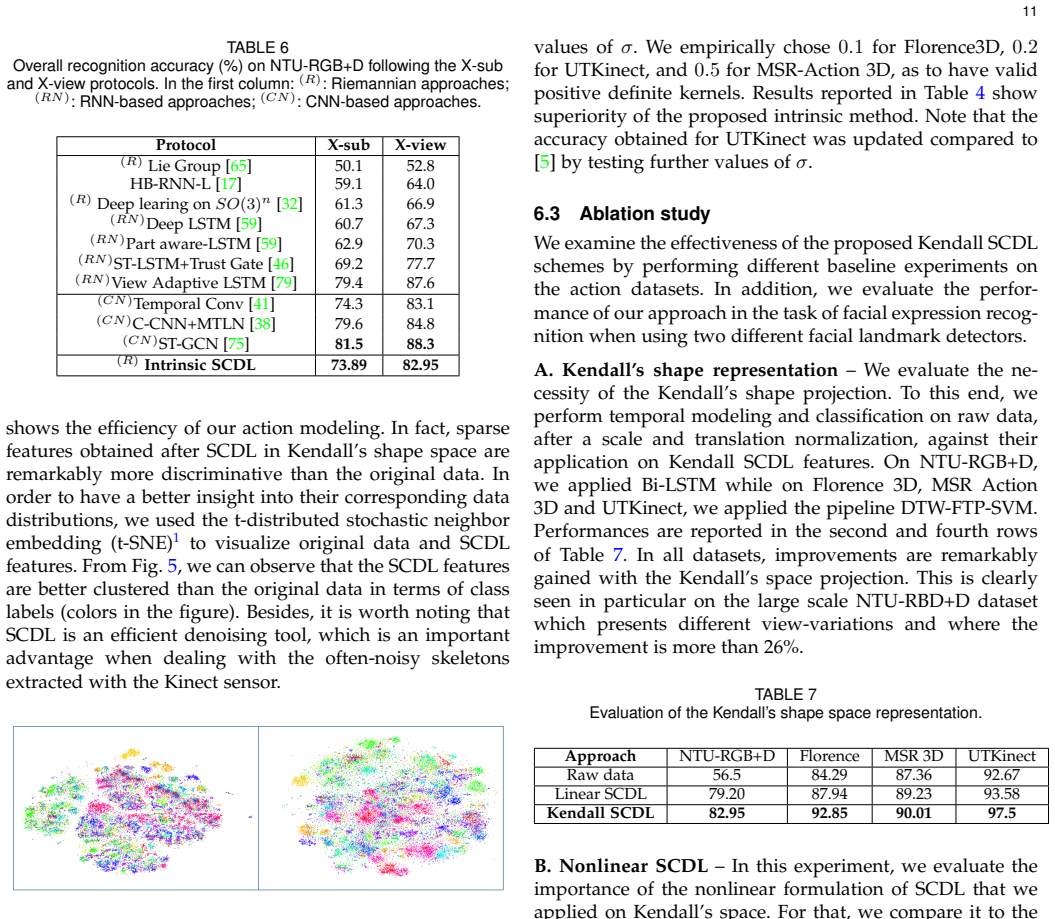
- Ablations show the full Kendall SCDL pipeline beats linear SCDL on the same features and beats raw normalized landmarks, so the nonlinear geometry of the shape space is doing real work.
- On the large-scale NTU-RGB+D dataset the intrinsic SCDL representation improves over other Riemannian trajectory representations by large margins, suggesting the approach scales beyond small benchmarks.
Reading between the lines
- Beyond the paper's own experiments, the extrinsic-versus-intrinsic split suggests a selection rule: use the kernel embedding for subtle, small deformations and per-query tangent coding for large, noisy skeletal datasets, a rule that could be tested by swapping the two coders across the same dataset.
- A testable extension the paper only gestures at is to train a generative model on the Euclidean sparse codes and decode new trajectories through the weighted Karcher mean to synthesize novel actions or expressions.
- Because the intrinsic objective is a first-order tangent approximation, one could audit the claim that codes are more discriminative by measuring exact geodesic reconstruction error between queries far from all dictionary atoms.
Signed reviews
Editorial analysis
A structured set of objections, weighed in public.
Referee Report
Summary. The paper proposes to represent 2D facial-landmark and 3D-skeleton trajectories as trajectories in Kendall shape spaces and to apply sparse coding and dictionary learning (SCDL) to these manifold-valued data. Two formulations are developed: an extrinsic kernelized SCDL using the Procrustes Gaussian kernel (for 2D expressions) and an intrinsic SCDL using the logarithm map on the tangent space at each query shape (for 3D actions). The resulting sparse codes form Euclidean time series that are classified with either DTW+FTP+linear SVM or a Bi-LSTM. Experiments cover CK+, Oulu-CASIA, CASME II, Florence3D, UTKinect, MSR-Action3D, and NTU-RGB+D, and the paper reports competitive or state-of-the-art accuracies together with ablations on the Kendall representation, linear vs. nonlinear SCDL, and landmark detectors.
Significance. If the claims are fully supported, the contribution is practically valuable: it provides a view-invariant, geometry-aware representation of landmark trajectories that moves time-series classification into Euclidean space while retaining discriminative power. The strongest assets are the breadth of the experimental evaluation (seven datasets, two classifiers, ablations), the clear comparison with prior Riemannian approaches, and the attention to the subtle-deformation regime in micro-expression recognition. The Kendall geometry and the extrinsic kernelized SCDL derivation are standard and are built on correctly cited sources. The paper does not provide code or formal proofs, and the intrinsic method relies on an approximation that is not stated precisely; nevertheless, the empirical study is sufficiently extensive that the central idea deserves further scrutiny rather than rejection.
major comments (3)
- [§4.2.1 (Eqs. 10-11)] The encoding function F in Eq. (10) is never defined. If F is the weighted Karcher mean, as suggested by the caption of Figure 2, then the squared norm of the weighted tangent sum in Eq. (11) is not equal to d_S(Z, F(D,w))^2 except in a first-order or small-angle sense; the exponential of the weighted tangent vector is generally not the Karcher mean. If, instead, F is defined implicitly as the exponential map of the tangent sum, then the reconstruction in Eq. (10) depends on the query Z and is not a global objective. In either case, the passage from Eq. (10) to Eq. (11) is not a derivation, and the claim that the resulting codes preserve Kendall geometry is not supported as written. Please define F explicitly, state the approximation being made, and provide a validation (for example, a reconstruction-error experiment on held-out shapes) or a proof of equivalence under stated conditions.
- [§4.2.2 (Eq. 13)] The intrinsic dictionary-learning problem is presented only as an objective; no update rule for the atoms D on the manifold is given beyond the phrase "optimizing D while fixing the sparse codes." This is load-bearing because all reported intrinsic coding results depend on the learned dictionary, and an atom update in Kendall shape space requires either a geodesic gradient step or an explicit Procrustean re-estimation procedure. Please specify the exact update, state how the affine constraint on the codes is enforced during learning, and explain the convergence criterion used in the experiments.
- [§6 (Experimental Settings and Parameters)] The values of the kernel parameter σ, the sparsity parameter λ, the dictionary size N, and the Bi-LSTM hidden sizes are described only as "chosen empirically" and are not reported for any dataset. The selection procedure is also not described, so the reader cannot tell whether these hyperparameters were tuned on dedicated validation folds or on the test data. Since the comparisons in Tables 1, 3, 4, and 6 are the main evidence for the paper's claims, please report the chosen values per dataset and describe the validation protocol used for selection.
minor comments (6)
- [§4.1.1 (Eq. 9)] The expansion of the reconstruction term appears to have a typographical error: the first line after the norm should read φ(z)^Tφ(z) - 2Σ_i [w]_i φ(d_i)^T φ(z) + ..., rather than having an extra equals sign before the negative term; please correct and re-check the algebra.
- [§4.1.2] In the dictionary-update derivation, the expression contains "IM−VA" where "A" is likely meant to be "W"; please correct this and clarify why V = W^dagger follows, including the required invertibility assumptions.
- [§4.2.1 (Eq. 12)] The notation "diO*" should be written as d_i O^* to make explicit that the optimal rotation is computed between the query Z and each atom d_i, and the angle in the formula is atom-dependent.
- [§3.1 (Eq. 3)] The exponential map formula is singular at θ = 0; please state the limiting behavior or define exp_Z(0) = Z explicitly.
- [Table 4] The MSR-Action 3D row for Intrinsic SCDL (Bi-LSTM) reports 86.18 for both the Half-Half and the 3-Subsets protocols; please verify whether this duplication is correct or a rounding/typing artifact.
- [§6.1.2] The comparison in Table 3 says the result is state-of-the-art "with the exception of [30]", but the table lists two methods from [30] (STCLQP and DiSTLBP-IIP); please make the comparison statement precise.
Circularity Check
No significant circularity: the central claims are evaluated on external benchmarks and the derivation chain does not reduce to fitted inputs or load-bearing self-citations.
full rationale
The paper's central quantities—classification accuracies on CK+, Oulu-CASIA, CASME II, MSR-Action3D, Florence3D, UTKinect, and NTU-RGB+D—are measured against external labels under held-out protocols (10-fold cross-validation, leave-one-subject-out, cross-subject), not against quantities constructed from fitted parameters. The intrinsic objective in Eq. (11) is a tangent-space relaxation of the generic Eq. (10), and the encoding function F is left unspecified; this is a derivation-gap and correctness concern, not circularity, because Eq. (11) does not derive its output from its input by definition. Similarly, Fig. 2's reference to reconstruction with the weighted Karcher mean is not generally equivalent to the exponential of the weighted tangent sum minimized in Eq. (11), but this again is an approximation issue rather than a circular reduction. The preliminary version [5] is self-cited only as prior work and as the source of a UTKinect result that the paper explicitly updated by testing further values of sigma; no load-bearing claim rests on that citation. The 3D Procrustes kernel's positive definiteness is checked empirically and sigma is dataset-dependent, but this is hyperparameter selection on benchmarks, not a fitted input renamed as a prediction. Consequently, no circular step is identified and the paper is scored 0.
Assumptions & free parameters
free parameters (4)
- Sparsity regularization lambda =
Not reported
- Kernel parameter sigma =
0.1, 0.2, 0.5 on Florence3D, UTKinect, MSR-Action 3D; 2D values not reported
- Bi-LSTM hidden size and layer count =
Not reported
- Dictionary size N =
Inferred by Bayesian clustering; final N values not reported
assumptions (5)
- standard math Kendall shape spaces carry the geodesic, logarithm, and exponential structure used in Eqs. 1 through 3.
- domain assumption The Procrustes Gaussian kernel on the 2D Kendall shape space is positive definite for all sigma.
- domain assumption The adapted Procrustes Gaussian kernel on the 3D Kendall shape space is positive definite for the selected sigma values.
- domain assumption Chehra landmark detections are accurate enough to capture facial expression geometry.
- domain assumption The benchmark datasets provide correct labels and reliable train/test splits.
Cite this review
Pith. "Pith review of Sparse Coding of Shape Trajectories for Facial Expression and Action Recognition." pith.science (2026). https://pith.science/paper/OP2WEOUN
@misc{pith2026190803231,
  author       = {Pith},
  title        = {Pith review of: Sparse Coding of Shape Trajectories for Facial Expression and Action Recognition},
  year         = {2026},
  howpublished = {\url{https://pith.science/paper/OP2WEOUN}},
  note         = {Machine review of arXiv:1908.03231}
}
read the original abstract
The detection and tracking of human landmarks in video streams has gained in reliability partly due to the availability of affordable RGB-D sensors. The analysis of such time-varying geometric data is playing an important role in the automatic human behavior understanding. However, suitable shape representations as well as their temporal evolution, termed trajectories, often lie to nonlinear manifolds. This puts an additional constraint (i.e., nonlinearity) in using conventional Machine Learning techniques. As a solution, this paper accommodates the well-known Sparse Coding and Dictionary Learning approach to study time-varying shapes on the Kendall shape spaces of 2D and 3D landmarks. We illustrate effective coding of 3D skeletal sequences for action recognition and 2D facial landmark sequences for macro- and micro-expression recognition. To overcome the inherent nonlinearity of the shape spaces, intrinsic and extrinsic solutions were explored. As main results, shape trajectories give rise to more discriminative time-series with suitable computational properties, including sparsity and vector space structure. Extensive experiments conducted on commonly-used datasets demonstrate the competitiveness of the proposed approaches with respect to state-of-the-art.
Figures

Figures from the paper (2 more)

Reference graph
Works this paper leans on
-
[26]
M. Harandi and M. Salzmann. Riemannian coding and dictionary learning: Kernels to the rescue. In 2015 IEEE Conference on Com- puter Vision and Pattern Recognition (CVPR), pages 3926–3935, June 2015
work page 2015
-
[1]
Anirudh, P
R. Anirudh, P . Turaga, J. Su, and A. Srivastava. Elastic functional coding of human actions: From vector-fields to latent variables. In Proceedings of the IEEE Conference on Computer Vision and Pattern Recognition, pages 3147–3155, 2015
2015
-
[2]
Asthana, S
A. Asthana, S. Zafeiriou, S. Cheng, and M. Pantic. Incremental face alignment in the wild. In 2014 IEEE Conference on Computer Vision and Pattern Recognition, pages 1859–1866, June 2014
2014
-
[3]
Baltrusaitis, A
T. Baltrusaitis, A. Zadeh, Y. C. Lim, and L.-P . Morency. Openface 2.0: Facial behavior analysis toolkit. In 2018 13th IEEE International Conference on Automatic Face & Gesture Recognition (FG 2018), pages 59–66. IEEE, 2018
2018
-
[4]
Ben Amor, J
B. Ben Amor, J. Su, and A. Srivastava. Action recognition using rate-invariant analysis of skeletal shape trajectories. IEEE Trans. Pattern Anal. Mach. Intell., 38(1):1–13, 2016
2016
-
[5]
Ben Tanfous, H
A. Ben Tanfous, H. Drira, and B. Ben Amor. Coding kendall’s shape trajectories for 3d action recognition. In Proceedings of the IEEE Conference on Computer Vision and Pattern Recognition , pages 2840–2849, 2018
2018
-
[6]
R. Breuer and R. Kimmel. A deep learning perspective on the origin of facial expressions. arXiv preprint arXiv:1705.01842, 2017
arXiv 2017
-
[7]
Bryner, E
D. Bryner, E. Klassen, H. Le, and A. Srivastava. 2d affine and projective shape analysis. IEEE transactions on pattern analysis and machine intelligence, 36(5):998–1011, 2014
2014
Show all 87 references
-
[8]
Z. Cao, T. Simon, S.-E. Wei, and Y. Sheikh. Realtime multi-person 2d pose estimation using part affinity fields. In Proceedings of the IEEE Conference on Computer Vision and Pattern Recognition , pages 7291–7299, 2017
2017
-
[9]
H. E. C ¸ eting ¨ul and R. Vidal. Intrinsic mean shift for clustering on stiefel and grassmann manifolds. In 2009 IEEE Computer Society Conference on Computer Vision and Pattern Recognition (CVPR 2009), 20-25 June 2009, Miami, Florida, USA, pages 1896–1902. IEEE Computer Society, 2009
2009
-
[10]
H. E. Ceting ¨ul and R. Vidal. Sparse riemannian manifold clus- tering for hardi segmentation. In Biomedical Imaging: From Nano to Macro, 2011 IEEE International Symposium on , pages 1750–1753. IEEE, 2011
2011
-
[11]
Chaudhry, F
R. Chaudhry, F. Ofli, G. Kurillo, R. Bajcsy, and R. Vidal. Bio- inspired dynamic 3d discriminative skeletal features for human action recognition. In Proceedings of the IEEE Conference on Com- puter Vision and Pattern Recognition Workshops, pages 471–478, 2013
2013
-
[12]
Cherian and S
A. Cherian and S. Sra. Riemannian dictionary learning and sparse coding for positive definite matrices. IEEE Transactions on Neural Networks and Learning Systems, PP(99):1–13, 2017
2017
-
[13]
D. Y. Choi, D. H. Kim, and B. C. Song. Recognizing fine facial micro-expressions using two-dimensional landmark feature. In 2018 25th IEEE International Conference on Image Processing (ICIP) , pages 1962–1966. IEEE, 2018
2018
-
[14]
Diamond and S
S. Diamond and S. Boyd. CVXPY: A Python-embedded modeling language for convex optimization. Journal of Machine Learning Research, 17(83):1–5, 2016. 13
2016
-
[15]
Dryden and K
I. Dryden and K. Mardia. Statistical shape analysis. Wiley, 1998
1998
-
[16]
I. L. Dryden and K. V . Mardia. Statistical Shape Analysis: With Applications in R. John Wiley & Sons, 2016
2016
-
[17]
Y. Du, W. Wang, and L. Wang. Hierarchical recurrent neural network for skeleton based action recognition. In Proceedings of the IEEE conference on computer vision and pattern recognition , pages 1110–1118, 2015
2015
-
[18]
Ebrahimi Kahou, V
S. Ebrahimi Kahou, V . Michalski, K. Konda, R. Memisevic, and C. Pal. Recurrent neural networks for emotion recognition in video. In Proceedings of the 2015 ACM on International Conference on Multimodal Interaction, pages 467–474. ACM, 2015
2015
-
[19]
Elaiwat, M
S. Elaiwat, M. Bennamoun, and F. Boussaid. A spatio-temporal rbm-based model for facial expression recognition. Pattern Recog- nition, 49:152 – 161, 2016
2016
-
[20]
P . T. Fletcher, C. Lu, S. M. Pizer, and S. Joshi. Principal geodesic analysis for the study of nonlinear statistics of shape. IEEE transactions on medical imaging, 23(8):995–1005, 2004
2004
-
[21]
Garcia-Hernando and T.-K
G. Garcia-Hernando and T.-K. Kim. Transition forests: Learning discriminative temporal transitions for action recognition and detection. In IEEE Conference on Computer Vision and Pattern Recognition (CVPR), pages 432–440, 2017
2017
-
[22]
Graves and J
A. Graves and J. Schmidhuber. Framewise phoneme classification with bidirectional lstm and other neural network architectures. Neural Networks, 18(5):602–610, 2005
2005
-
[23]
Guha and R
T. Guha and R. K. Ward. Learning sparse representations for human action recognition. IEEE Transactions on Pattern Analysis and Machine Intelligence, 34(8):1576–1588, 2012
2012
-
[24]
K. Guo, P . Ishwar, and J. Konrad. Action recognition from video using feature covariance matrices. IEEE Transactions on Image Processing, 22(6):2479–2494, June 2013
2013
-
[25]
Harandi, R
M. Harandi, R. Hartley, C. Shen, B. Lovell, and C. Sanderson. Ex- trinsic methods for coding and dictionary learning on grassmann manifolds. International Journal of Computer Vision , 114(2-3):113– 136, 2015
2015
-
[27]
M. T. Harandi, R. Hartley, B. Lovell, and C. Sanderson. Sparse coding on symmetric positive definite manifolds using bregman divergences. IEEE transactions on neural networks and learning systems, 27(6):1294–1306, 2016
2016
-
[28]
M. T. Harandi, C. Sanderson, R. Hartley, and B. C. Lovell. Sparse coding and dictionary learning for symmetric positive definite matrices: A kernel approach. In Proceedings, Part II, of the 12th European Conference on Computer Vision — ECCV 2012 - Volume 7573, pages 216–229, Be...
2012
-
[29]
J. Ho, Y. Xie, and B. Vemuri. On a nonlinear generalization of sparse coding and dictionary learning. In International conference on machine learning, pages 1480–1488, 2013
2013
-
[30]
Huang, G
X. Huang, G. Zhao, X. Hong, W. Zheng, and M. Pietik ¨ainen. Spontaneous facial micro-expression analysis using spatiotempo- ral completed local quantized patterns. Neurocomputing, 175:564– 578, 2016
2016
-
[32]
Huang, C
Z. Huang, C. Wan, T. Probst, and L. Van Gool. Deep learning on lie groups for skeleton-based action recognition. In Proceedings of the IEEE conference on computer vision and pattern recognition , pages 6099–6108, 2017
2017
-
[33]
S. Jain, C. Hu, and J. K. Aggarwal. Facial expression recognition with temporal modeling of shapes. In 2011 IEEE International Conference on Computer Vision Workshops (ICCV Workshops) , pages 1642–1649, nov 2011
2011
-
[34]
Jayasumana, M
S. Jayasumana, M. Salzmann, H. Li, and M. Harandi. A framework for shape analysis via hilbert space embedding. In IEEE ICCV , pages 1249–1256, 2013
2013
-
[35]
H. Jung, S. Lee, J. Yim, S. Park, and J. Kim. Joint fine-tuning in deep neural networks for facial expression recognition. In 2015 IEEE International Conference on Computer Vision (ICCV) , pages 2983– 2991, Dec 2015
2015
-
[36]
Kacem, M
A. Kacem, M. Daoudi, B. B. Amor, S. Berretti, and J. C. Alvarez- Paiva. A novel geometric framework on gram matrix trajectories for human behavior understanding. IEEE transactions on pattern analysis and machine intelligence, 2018
2018
-
[37]
Kacem, M
A. Kacem, M. Daoudi, B. Ben Amor, and J. Carlos Alvarez-Paiva. A novel space-time representation on the positive semidefinite cone for facial expression recognition. In The IEEE International Conference on Computer Vision (ICCV), Oct 2017
2017
-
[38]
Q. Ke, M. Bennamoun, S. An, F. Sohel, and F. Boussaid. A new representation of skeleton sequences for 3d action recognition. In Computer Vision and Pattern Recognition (CVPR), 2017 IEEE Conference on, pages 4570–4579. IEEE, 2017
2017
-
[39]
D. G. Kendall. Shape manifolds, Procrustean metrics, and complex projective spaces. Bulletin of the London Mathematical Society , 16(2):81–121, 1984
1984
-
[40]
D. H. Kim, W. J. Baddar, and Y. M. Ro. Micro-expression recog- nition with expression-state constrained spatio-temporal feature representations. In Proceedings of the 2016 ACM on Multimedia Conference, pages 382–386. ACM, 2016
2016
-
[41]
T. S. Kim and A. Reiter. Interpretable 3d human action analysis with temporal convolutional networks. In 2017 IEEE Conference on Computer Vision and Pattern Recognition Workshops (CVPRW), pages 1623–1631. IEEE, 2017
2017
-
[42]
Koniusz, A
P . Koniusz, A. Cherian, and F. Porikli. Tensor representations via kernel linearization for action recognition from 3d skeletons. In European Conference on Computer Vision , pages 37–53. Springer, 2016
2016
-
[43]
P . Li, Q. Wang, W. Zuo, and L. Zhang. Log-euclidean kernels for sparse representation and dictionary learning. In 2013 IEEE International Conference on Computer Vision , pages 1601–1608, Dec 2013
2013
-
[44]
W. Li, Z. Zhang, and Z. Liu. Action recognition based on a bag of 3D points. In IEEE Inter. Workshop on CVPR for Human Communicative Behavior Analysis (CVPR4HB), page 914, 2010
2010
-
[45]
Liong, J
S.-T. Liong, J. See, R. C.-W. Phan, Y.-H. Oh, A. C. Le Ngo, K. Wong, and S.-W. Tan. Spontaneous subtle expression detection and recognition based on facial strain. Signal Processing: Image Communication, 47:170–182, 2016
2016
-
[46]
J. Liu, A. Shahroudy, D. Xu, and G. Wang. Spatio-temporal lstm with trust gates for 3d human action recognition. In European Conference on Computer Vision, pages 816–833. Springer, 2016
2016
-
[47]
M. Liu, S. Li, S. Shan, R. Wang, and X. Chen. Deeply learning deformable facial action parts model for dynamic expression analysis. In Asian conference on computer vision , pages 143–157. Springer, 2014
2014
-
[48]
M. Liu, S. Shan, R. Wang, and X. Chen. Learning expression- lets on spatio-temporal manifold for dynamic facial expression recognition. In The IEEE Conference on Computer Vision and Pattern Recognition (CVPR), June 2014
2014
-
[49]
M. Liu, S. Shan, R. Wang, and X. Chen. Learning expressionlets on spatio-temporal manifold for dynamic facial expression recog- nition. In 2014 IEEE Conference on Computer Vision and Pattern Recognition, pages 1749–1756, June 2014
2014
-
[50]
Lo Presti and M
L. Lo Presti and M. La Cascia. 3d skeleton-based human action classification. Pattern Recogn., 53(C):130–147, May 2016
2016
-
[51]
Lucey, J
P . Lucey, J. F. Cohn, T. Kanade, J. Saragih, Z. Ambadar, and I. Matthews. The extended cohn-kanade dataset (ck+): A complete dataset for action unit and emotion-specified expression. In 2010 IEEE Computer Society Conference on Computer Vision and Pattern Recognition - Workshop...
2010
-
[52]
Y. M. Lui. Advances in matrix manifolds for computer vision. Image Vision Comput., 30(6-7):380–388, June 2012
2012
-
[53]
F. Ofli, R. Chaudhry, G. Kurillo, R. Vidal, and R. Bajcsy. Sequence of the most informative joints (smij): A new representation for human skeletal action recognition. Journal of Visual Communication and Image Representation, 25(1):24–38, 2014
2014
-
[54]
Y.-H. Oh, J. See, A. C. Le Ngo, R. C.-W. Phan, and V . M. Baskaran. A survey of automatic facial micro-expression analysis: Databases, methods and challenges. Frontiers in psychology, 9:1128, 2018
2018
-
[55]
Sch ¨olkopf, R
B. Sch ¨olkopf, R. Herbrich, and A. J. Smola. A generalized repre- senter theorem. In COLT/EuroCOLT, 2001
2001
-
[56]
Sch ¨olkopf and A
B. Sch ¨olkopf and A. Smola. Learning with Kernels: Support Vector Machines, Regularization, Optimization, and Beyond. Adaptive Com- putation and Machine Learning. MIT Press, Cambridge, MA, USA, Dec. 2002
2002
-
[57]
Scovanner, S
P . Scovanner, S. Ali, and M. Shah. A 3-dimensional sift descriptor and its application to action recognition. In Proceedings of the 15th ACM international conference on Multimedia , pages 357–360. ACM, 2007
2007
-
[58]
Seidenari, V
L. Seidenari, V . Varano, S. Berretti, A. D. Bimbo, and P . Pala. Recognizing actions from depth cameras as weakly aligned multi- 14 part bag-of-poses. In IEEE Conference on Computer Vision and Pattern Recognition, CVPR Workshops 2013, Portland, OR, USA, June 23-28, 2013, page...
2013
-
[59]
Shahroudy, J
A. Shahroudy, J. Liu, T.-T. Ng, and G. Wang. Ntu rgb+ d: A large scale dataset for 3d human activity analysis. In Proceedings of the IEEE conference on computer vision and pattern recognition , pages 1010–1019, 2016
2016
-
[60]
Shahroudy, J
A. Shahroudy, J. Liu, T.-T. Ng, and G. Wang. Ntu rgb+d: A large scale dataset for 3d human activity analysis. InThe IEEE Conference on Computer Vision and Pattern Recognition (CVPR), June 2016
2016
-
[61]
Shotton, A
J. Shotton, A. Fitzgibbon, M. Cook, T. Sharp, M. Finocchio, R. Moore, A. Kipman, and A. Blake. Real-time human pose recognition in parts from single depth images. In Proceedings of the 2011 IEEE Conference on Computer Vision and Pattern Recognition , pages 1297–1304, 2011
2011
-
[62]
J. Su, S. Kurtek, E. Klassen, and A. Srivastava. Statistical analysis of trajectories on riemannian manifolds: Bird migration, hurricane tracking, and video surveillance. Annals of Applied Statistics, 2013
2013
-
[63]
Taheri, P
S. Taheri, P . Turaga, and R. Chellappa. Towards view-invariant expression analysis using analytic shape manifolds. In Automatic Face & Gesture Recognition and Workshops (FG 2011), 2011 IEEE International Conference on, pages 306–313. IEEE, 2011
2011
-
[64]
Valstar and M
M. Valstar and M. Pantic. Induced disgust, happiness and sur- prise: an addition to the mmi facial expression database. In Proc. 3rd Intern. Workshop on EMOTION (satellite of LREC): Corpora for Research on Emotion and Affect, page 65, 2010
2010
-
[65]
Veeriah, N
V . Veeriah, N. Zhuang, and G.-J. Qi. Differential recurrent neural networks for action recognition. In Proceedings of the IEEE interna- tional conference on computer vision, pages 4041–4049, 2015
2015
-
[66]
Vemulapalli, F
R. Vemulapalli, F. Arrate, and R. Chellappa. Human action recognition by representing 3d skeletons as points in a lie group. In Proceedings of the 2014 IEEE Conference on Computer Vision and Pattern Recognition, CVPR ’14, 2014
2014
-
[67]
Vemulapalli and R
R. Vemulapalli and R. Chellapa. Rolling rotations for recognizing human actions from 3d skeletal data. In Proceedings of the IEEE Conference on Computer Vision and Pattern Recognition , pages 4471– 4479, 2016
2016
-
[68]
C. Wang, Y. Wang, and A. L. Yuille. Mining 3d key-pose-motifs for action recognition. In Proceedings of the IEEE Conference on Computer Vision and Pattern Recognition, pages 2639–2647, 2016
2016
-
[69]
J. Wang, Z. Liu, J. Chorowski, Z. Chen, and Y. Wu. Robust 3D action recognition with random occupancy patterns. InProceedings of the 12th European Conference on Computer Vision - Volume Part II , pages 872–885, 2012
2012
-
[70]
J. Wang, Z. Liu, Y. Wu, and J. Yuan. Mining actionlet ensemble for action recognition with depth cameras. In Conference on Computer Vision and Pattern Recognition (CVPR), pages 1290–1297, 2012
2012
-
[71]
P . Wang, C. Yuan, W. Hu, B. Li, and Y. Zhang. Graph based skeleton motion representation and similarity measurement for action recognition. In European conference on computer vision, pages 370–385. Springer, 2016
2016
-
[72]
Z. Wang, S. Wang, and Q. Ji. Capturing complex spatio-temporal relations among facial muscles for facial expression recognition. In Proceedings of the IEEE Conference on Computer Vision and Pattern Recognition, pages 3422–3429, 2013
2013
-
[73]
Xia, C.-C
L. Xia, C.-C. Chen, and J. K. Aggarwal. View invariant human action recognition using histograms of 3d joints. InComputer vision and pattern recognition workshops (CVPRW), 2012 IEEE computer society conference on, pages 20–27. IEEE, 2012
2012
-
[74]
Xiong and F
X. Xiong and F. De la Torre. Supervised descent method and its applications to face alignment. In Proceedings of the IEEE conference on computer vision and pattern recognition , pages 532–539, 2013
2013
-
[75]
S. Yan, Y. Xiong, and D. Lin. Spatial temporal graph convolutional networks for skeleton-based action recognition. In Thirty-Second AAAI Conference on Artificial Intelligence , 2018
2018
-
[76]
W.-J. Yan, X. Li, S.-J. Wang, G. Zhao, Y.-J. Liu, Y.-H. Chen, and X. Fu. Casme ii: An improved spontaneous micro-expression database and the baseline evaluation. PloS one, 9(1):e86041, 2014
2014
-
[77]
C. Yuan, W. Hu, X. Li, S. Maybank, and G. Luo. Human Action Recognition under Log-Euclidean Riemannian Metric , pages 343–353. Springer Berlin Heidelberg, Berlin, Heidelberg, 2010
2010
-
[78]
Zanfir, M
M. Zanfir, M. Leordeanu, and C. Sminchisescu. The moving pose: An efficient 3d kinematics descriptor for low-latency action recognition and detection. In Proceedings of the IEEE international conference on computer vision, pages 2752–2759, 2013
2013
-
[79]
Zhang, C
P . Zhang, C. Lan, J. Xing, W. Zeng, J. Xue, and N. Zheng. View adaptive recurrent neural networks for high performance human action recognition from skeleton data. In Proceedings of the IEEE International Conference on Computer Vision, pages 2117–2126, 2017
2017
-
[80]
Zhang, X
S. Zhang, X. Liu, and J. Xiao. On geometric features for skeleton- based action recognition using multilayer lstm networks. In 2017 IEEE Winter Conference on Applications of Computer Vision (WACV) , pages 148–157, March 2017
2017
-
[81]
Zhang, D
Z. Zhang, D. Pati, and A. Srivastava. Bayesian clustering of shapes of curves. Journal of Statistical Planning and Inference, 166:171 – 186,
-
[82]
Zhao and M
G. Zhao and M. Pietikainen. Dynamic texture recognition using lo- cal binary patterns with an application to facial expressions. IEEE transactions on pattern analysis and machine intelligence , 29(6):915– 928, 2007
2007
-
[83]
Zheng, X
H. Zheng, X. Geng, and Z. Yang. A relaxed k-svd algorithm for spontaneous micro-expression recognition. In Pacific Rim Interna- tional Conference on Artificial Intelligence , pages 692–699. Springer, 2016
2016
-
[84]
Zhong, Q
L. Zhong, Q. Liu, P . Yang, B. Liu, J. Huang, and D. N. Metaxas. Learning active facial patches for expression analysis. In 2012 IEEE Conference on Computer Vision and Pattern Recognition , pages 2562–2569, June 2012
2012
-
[85]
W. Zhu, C. Lan, J. Xing, W. Zeng, Y. Li, L. Shen, X. Xie, et al. Co- occurrence feature learning for skeleton based action recognition using regularized deep lstm networks. In AAAI, volume 2, page 6, 2016
2016
-
[86]
H. E. etingl, M. J. Wright, P . M. Thompson, and R. Vidal. Seg- mentation of high angular resolution diffusion mri using sparse riemannian manifold clustering. IEEE Transactions on Medical Imaging, 33(2):301–317, Feb 2014. Amor Ben Tanfous received the engineering degree from ...
2014
-
[2006]
He is recipient of the prestigious Research Fulbright scholarship (2016-2017)
He joined the Inception Institute of Artifi- cial Intelligence (IIAI) in U.A.E as senior scientist, from his full professor position with the Mines- Telecom Institute (IMT) Lille Douai, in France. He is recipient of the prestigious Research Fulbright scholarship (2016-2017). Hi...
2016
-
[2015]
Special Issue on Bayesian Nonparametrics
Reviewed August 14, 2026 · model on record in the stance chip above.
Discussion (0). Continue with ORCID to comment.