REVIEW 4 major objections 5 minor 22 references
This paper claims that adding three generic operations to the CoVer contract language—`alloc`, `free`, and `param`—lets a single correctness checker catch invalid-parameter and allocation errors in parallel MPI programs across C and Fortran
Reviewed by Pith at T0; open to challenge. T0 means a machine referee read the full paper against a public rubric. the ladder, T0–T4 →
T0 review · deepseek-v4-flash
2026-08-03 09:36 UTC pith:OPBFNWY4
load-bearing objection Solid incremental extension of CoVer adding parameter and allocation checks with a real accuracy jump and a reproducible artifact; main caveat is the static Fortran value-extraction heuristics, validated anecdotally. the 4 major comments →
Allocation Tracking and Parameter Checking for Parallel Programming Models using Contracts
The pith
A machine-rendered reading of the paper's core claim, the machinery that carries it, and where it could break.
Core claim
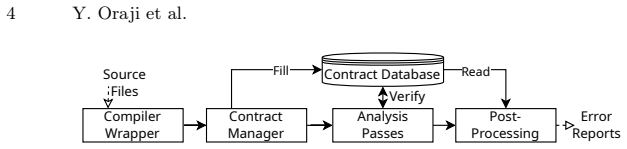
The central claim is that two previously unsupported classes of parallel-programming errors can be captured purely by extending the contract language rather than the hard-coded tool logic. A contract may now require that an argument be allocated (`alloc`), mark a function as freeing memory (`free`), or impose restrictions on an argument value (`param`), comparing against integers, named constants, or sibling arguments. Because allocator and deallocator behavior is itself declared through contracts, the tool's allocation model is data-driven: the static analysis builds a directed tree of allocation state, tracking copies and indirections, while the dynamic analysis replaces function calls wit
What carries the argument
The extension of the contract language itself: three new operations—`alloc` (a pointer must be allocated at that point), `free` (a function deallocates memory), and `param` (restrictions on argument values, with equality, inequality, or ordering comparisons against integers, named constants, or sibling arguments)—plus `CONTRACT_VALUE_PAIR`/`Declare_Value` declarations that map names like `MPI_ANY_SOURCE` to implementation-specific values, and the except-equal comparator that short-circuits checks when a parameter equals an explicitly permitted value. These are carried by two analyses: a static worklist data-flow analysis that models allocation state as a rooted tree of copies and indirection
Load-bearing premise
The argument depends on the heuristic extraction of parameter values from compiler intermediate representation continuing to work on real Fortran and MPI programs beyond the tested benchmark suite; if those heuristics encounter an unseen code pattern, the reported parameter and allocation errors would become unreliable.
What would settle it
Take a corpus of production Fortran MPI programs using allocatable and pointer buffers; run the static and dynamic checks; inspect every reported and missed allocation and parameter error. A single valid program in which a buffer is wrapped in a derived type, passed through a procedure interface, or created by a non-`allocate` intrinsic, and CoVer either reports a false use-of-unallocated error or misses a genuine use-after-free, would settle the generality claim negatively.
If this is right
- Invalid-parameter mistakes, such as using `MPI_ANY_SOURCE` where a concrete rank is required, become expressible and checkable both statically and dynamically.
- Use-after-free and unallocated-buffer errors become detectable in C and Fortran from the same contract database, since allocator and deallocator functions are marked by contracts.
- The contract database can be extended by users to new APIs or programming models, such as OpenSHMEM, without recompiling the checker or adding tool-specific code.
- A library-dependent pitfall is surfaced: the same test can count as detected on one MPI implementation and missed on another because magic constants differ for the same named value.
- Dynamic overhead rises mainly from stack-allocation tracking; disabling that tracking yields a cheaper path when stack buffers are not used in MPI calls.
Where Pith is reading between the lines
- The same contract operations could likely express higher-level memory-model rules, such as OpenSHMEM's symmetric-memory requirement, more directly than the paper demonstrates; the intrinsic mechanism already points in that direction.
- The implementation-dependence of the results suggests a natural extension: bind contract values per implementation or use symbolic rather than concrete constants, so accuracy no longer varies with the MPI library.
- If the value-extraction heuristics prove fragile beyond the benchmark suite, a fallback design would be to expose parameter values at a higher-level IR or to add explicit value-access intrinsics, reducing the need for backtracking.
- The reworked inlined-callback mechanism could be reused for other post-call conditions beyond allocation, such as checking handle state or status values set by the called function.
Editorial analysis
A structured set of objections, weighed in public.
Referee Report
Summary. The paper extends CoVer, a contract-based correctness checker for parallel programming models, with two new contract-language operations: parameter checking ("param") and allocation tracking ("alloc"/"free"). The authors implement these extensions in both static (LLVM IR data-flow) and dynamic (libffi-based inlined callbacks) analyses, and add CoVer intrinsics to handle stack, global, and Fortran allocations. Evaluation on MPI-BugBench Level 1 shows accuracy 0.96 for CoVer-Dynamic and 0.95 for CoVer-Static on the 75 tests belonging to supported error classes, compared with 0.67 for the old CoVer; they also report runtime overhead on three proxy applications.
Significance. The contribution is valuable: it extends a generic, contract-based approach rather than hardcoding new error checks, preserves language generality, and provides an artifact with a DOI. The systematic comparison against the previous CoVer and against MUST on an external benchmark, together with identical C and Fortran accuracy and the absence of false positives, make the empirical claims credible within the selected error classes. However, the evaluation is restricted to a self-selected subset of the benchmark and the static Fortran IR heuristics are validated only anecdotally, which limits the strength of the cross-language and general-applicability claims.
major comments (4)
- [Section 4.1, Table 1] Accuracy is reported on 75 of the 222 MPI-BugBench tests (TP+TN+FN=75). The paper states that the tests were restricted to 'supported error classes ... as described in [17]' plus the new parameter/allocation classes, and that all 222 tests were run only to detect false positives. The headline figures 0.96/0.95 are therefore accuracy on a self-selected subset, not on the complete benchmark. The abstract's 'significant accuracy improvement' is correspondingly qualified. Please report full-benchmark results (e.g., a per-error-class table, or at least the number of unsupported tests and how they would be treated) or explicitly reframe the claims as applying only to supported error classes. As written, the reader cannot assess how many of the 147 excluded tests would be missed.
- [Section 3.2] The static parameter analysis relies on 'a significant amount of heuristics' for extracting parameter values from LLVM IR, with the only stability evidence being that 'the heuristics have not yet failed in any code tested.' The identical C/Fortran accuracy in Table 1 is produced by these heuristics, including the Fortran metadata backtracking example in Figure 6. This is an anecdotal validation of a load-bearing component for the paper's central claim of cross-language generality. Please provide a systematic robustness evaluation (e.g., across MPI implementations, compiler versions, optimization levels, and a broader Fortran corpus) or precisely delimit the supported IR patterns and known limitations. Without this, the claim that the approach generalizes beyond the benchmark is not fully supported.
- [Section 3.2, Allocation Tracking] The static allocation-tracking data-flow analysis is described only informally; the formal definitions of the analysis domain and transfer functions are omitted 'for brevity.' The worklist algorithm, tree pruning, intersection-based merging at control-flow joins, and the 'trivially allocated' check are central to the claimed absence of false negatives. Please provide these definitions in an appendix or technical report, or state clearly that the static analysis is intended to be heuristic rather than formally verified. This is needed to let reviewers assess the soundness of the static mode.
- [Section 4.2] The sentence 'While the static analysis reports many spurious FPs on all proxy apps' is not supported by any data presented in this paper and is not referenced to the prior CoVer publications. If this observation is from earlier work, cite it; otherwise remove it or provide the supporting measurements, since it is used to argue for the dynamic analysis in the overhead section.
minor comments (5)
- [Figure 9] The figure legend/caption appears to omit the 'New' version of CoVer-Dynamic. The text refers to CoVer-Dynamic (Old) and CoVer-Dynamic (New), but the legend lists 'Baseline CoVer-Dynamic (Old) CoVer-Dynamic MUST.' Please clarify which bars correspond to the new version.
- [Section 4.1] The comparison with MUST on Fortran is not apples-to-apples: CoVer runs on OpenMPI, while MUST runs on MPICH because of the mpi_f08 module, and RMA data race checking is disabled for MUST on Fortran. The paper explains this, but the discussion should state explicitly that the MUST accuracy numbers are therefore not directly comparable across languages.
- [Section 6] Typo: 'dependant' should be 'dependent'. Also in Section 5, 'There already many correctness checkers' is missing 'are'.
- [Section 3.2] 'The analysis itself is deceptively simple' is a clichéd phrase; consider 'The analysis itself is simple in structure' or similar.
- [References] Several references are preprints or 'to be published' items ([15], [17], [18]). Please update these to their published versions if available, and add a note where DOI links are not yet active.
Circularity Check
No circularity: the evaluation is anchored to an external benchmark with ground-truth labels, and the contracts are MPI/OpenSHMEM specifications rather than fitted predictions.
full rationale
The paper's derivation chain is: extend the CoVer contract language with alloc/free/param operations, implement static and dynamic analyses, and evaluate on the external MPI-BugBench suites (C and Fortran) against both the authors' previous CoVer version and the independent MUST tool. The contracts themselves are not derived from the benchmark labels; they encode standard API requirements (e.g., MPI_Send's destination must not be MPI_ANY_SOURCE, MPI_Recv's buffer must be allocated). Accuracy is computed against fixed ground-truth labels in MPI-BugBench, and the comparison includes an independent tool (MUST), so the reported 0.95-0.96 accuracy is not a quantity that is equivalent to an input by construction. The paper cites prior same-author work for the CoVer framework, the dynamic callback system, and the Fortran port, but these citations supply the baseline implementation rather than a conclusion forced by a self-citation chain; there is no imported uniqueness theorem and no ansatz smuggled in via citation. The main weakness is external validity: the Fortran value-extraction heuristics in Section 3.2 are validated only anecdotally on the tested code, and the evaluation filters to error classes CoVer supports. That is a generalizability concern, not circularity: no parameter is fitted to the reported results in a way that makes the accuracy an artifact of the contracts, and no prediction reduces to its own input.
Axiom & Free-Parameter Ledger
axioms (5)
- domain assumption MPI-BugBench Level 1 test labels are correct ground truth for the error classes being measured.
- domain assumption The allocation-state data-flow model (directed graph with pessimistic intersection at joins) correctly captures all allocation, aliasing, and lifetime behavior of the analyzed program.
- domain assumption Delaying optimization preserves enough LLVM IR information for the value-extraction heuristics to recover parameter values and Fortran metadata.
- domain assumption libffi-based inlined callbacks are semantically transparent, preserving all arguments, return values, and control flow of the replaced API calls.
- domain assumption All relevant allocation and deallocation sites are known, either through user-supplied contracts on allocators or through inserted CoVer intrinsics.
invented entities (1)
-
CoVer intrinsics (CoVer_AllocStack, CoVer_FreeStack, CoVer_RegisterGlobal, CoVer_FAllocate, CoVer_FDeallocate)
no independent evidence
read the original abstract
Correctness checking tools for High-Performance Computing programs are typically limited to specific parallel programming models such as MPI or OpenSHMEM. The CoVer framework previously addressed this by introducing a generic, contract-based approach that decoupled API requirements from the core tool. However, CoVer's effectiveness remains bounded by the expressiveness of its underlying contract language, restricting the types of errors it can verify. This paper presents an extension to the CoVer contract language designed to capture and check a broader range of error classes. Our extensions introduce generic parameter checking and allocation tracking, while keeping generality across both programming model and language. We evaluate these extensions and demonstrate that analysis accuracy remains consistent across multiple languages, reinforcing the framework's general applicability. While the additional runtime analyses naturally incur a performance overhead, these improvements greatly enhance CoVer's utility with a significant accuracy improvement.
Figures




Reference graph
Works this paper leans on
-
[1]
The LLVM Compiler Infrastructure Project,https://llvm.org/
-
[2]
Open MPI: Open Source High Performance Computing,https://www.open-mpi. org/
-
[3]
In: Blaas- Schenner, C., Niethammer, C., Haas, T
Burak, S., Ivanov, I.R., Domke, J., Müller, M.: SPMD IR: Unifying SPMD and Multi-value IR Showcased for Static Verification of Collectives. In: Blaas- Schenner, C., Niethammer, C., Haas, T. (eds.) Recent Advances in the Mes- sage Passing Interface. pp. 3–20. Springer Nature Switzerland, Cham (2025). https://doi.org/10.1007/978-3-031-73370-3_1
-
[4]
In: Pro- ceedings of the Second Workshop on the LLVM Compiler Infrastructure in HPC
Droste, A., Kuhn, M., Ludwig, T.: MPI-checker: Static analysis for MPI. In: Pro- ceedings of the Second Workshop on the LLVM Compiler Infrastructure in HPC. pp. 1–10. LLVM ’15, Association for Computing Machinery, New York, NY, USA (Nov 2015).https://doi.org/10.1145/2833157.2833159
arXiv 2015
-
[5]
In: Müller, M.S., Resch, M.M., Schulz, A., Nagel, W.E
Hilbrich, T., Schulz, M., de Supinski, B.R., Müller, M.S.: MUST: A Scalable Ap- proach to Runtime Error Detection in MPI Programs. In: Müller, M.S., Resch, M.M., Schulz, A., Nagel, W.E. (eds.) Tools for High Performance Computing
-
[6]
Hück, A., Lehr, J.P., Kreutzer, S., Protze, J., Terboven, C., Bischof, C., Müller, M.S.: Compiler-aided Type Tracking for Correctness Checking of MPI Applica- tions. In: 2018 IEEE/ACM 2nd International Workshop on Software Correctness for HPC Applications (Correctness). pp. 51–58 (Nov 2018).https://doi.org/10. 1109/Correctness.2018.00011
arXiv 2018
-
[7]
(eds.) Recent Advances in the Mes- sage Passing Interface
Jammer, T., Saillard, E., Schwitanski, S., Jenke, J., Vinayagame, R., Hück, A., Bischof,C.:MPI-BugBench:AFrameworkforAssessingMPICorrectnessTools.In: Blaas-Schenner, C., Niethammer, C., Haas, T. (eds.) Recent Advances in the Mes- sage Passing Interface. pp. 121–137. Springer Nature Switzerland, Cham (2025). https://doi.org/10.1007/978-3-031-73370-3_8
-
[8]
Karlin, I., Keasler, J., Neely, J.: LULESH 2.0 Updates and Changes. Tech. Rep. LLNL-TR-641973, 1090032 (Jul 2013).https://doi.org/10.2172/1090032
doi:10.2172/1090032 2013
-
[9]
libffi Developers: Libffi,https://sourceware.org/libffi/
-
[10]
Message Passing Interface Forum: MPI: A Message-Passing Interface Standard Version 5.0 (2025),https://www.mpi-forum.org/docs/mpi-5.0/mpi50-report.pdf
2025
-
[11]
SIGPLAN Not.42(6), 89–100 (Jun 2007).https://doi.org/10
Nethercote, N., Seward, J.: Valgrind: A framework for heavyweight dynamic binary instrumentation. SIGPLAN Not.42(6), 89–100 (Jun 2007).https://doi.org/10. 1145/1273442.1250746
arXiv 2007
-
[12]
Norman,M.R.:miniWeather.OakRidgeNationalLaboratory(ORNL),OakRidge, TN (United States) (Mar 2020).https://doi.org/10.11578/dc.20201001.88
-
[13]
OpenSHMEM Committee: OpenSHMEM: Application Programming Inter- face Version 1.5 (2020),http://openshmem.org/site/sites/default/site_files/ OpenSHMEM-1.5.pdf
2020
-
[14]
Oraji, Y.M.: Artifact for ’Allocation Tracking and Parameter Checking for Paral- lel Programming Models using Contracts’ (Apr 2026).https://doi.org/10.5281/ zenodo.19662915
2026
-
[15]
Oraji,Y.M.,Bischof,C.:ExtendingContractVerificationforParallelProgramming Models to Fortran - Preprint, to be published in ISC C3PO Workshop 2026 (Apr 2026).https://doi.org/10.48550/arXiv.2604.20410
work page internal anchor Pith review Pith/arXiv arXiv doi:10.48550/arxiv.2604.20410 2026
-
[16]
Oraji, Y.M., Hück, A., Bischof, C.: Extending MPI Correctness Benchmarking to theFortranLanguage.In:ProceedingsoftheSC’25WorkshopsoftheInternational Allocation Tracking and Parameter Checking using Contracts 17 Conference for High Performance Computing, Networking, Storage and Analysis. pp. 244–248. SC Workshops ’25, Association for Computing Machinery, N...
arXiv 2025
-
[17]
Oraji, Y.M., Hück, A., Bischof, C.: Dynamic Contract Analysis for Parallel Pro- gramming Models - Preprint, to be published in IPDPS HIPS Workshop 2026 (Mar 2026).https://doi.org/10.48550/arXiv.2603.03023
-
[18]
In: Schuchart, J., Bouteiller, A., Hunold, S., Jaeger, J., Niethammer, C., Smith, B
Oraji, Y.M., Schwitanski, S., Hück, A., Jenke, J., Kreutzer, S., Bischof, C.: Verify- ing MPI API Usage Requirements with Contracts. In: Schuchart, J., Bouteiller, A., Hunold, S., Jaeger, J., Niethammer, C., Smith, B. (eds.) Recent Advances in the Message Passing Interface. pp. 54–72. Springer Nature Switzerland, Cham (2026). https://doi.org/10.1007/978-3...
-
[19]
The International Jour- nal of High Performance Computing Applications28(4), 425–434 (Nov 2014)
Saillard, E., Carribault, P., Barthou, D.: PARCOACH: Combining static and dynamic validation of MPI collective communications. The International Jour- nal of High Performance Computing Applications28(4), 425–434 (Nov 2014). https://doi.org/10.1177/1094342014552204
-
[20]
In: Proceedings of the 53rd International Conference on Par- allel Processing
Schwitanski, S., Oraji, Y.M., Pätzold, C., Jenke, J., Tomski, F., Müller, M.S.: RMASanitizer: Generalized Runtime Detection of Data Races in Remote Memory Access Applications. In: Proceedings of the 53rd International Conference on Par- allel Processing. pp. 833–844. ICPP ’24, Association for Computing Machinery, New York, NY, USA (Aug 2024).https://doi.o...
arXiv 2024
-
[21]
In: 2014 IEEE High Performance Extreme Computing Conference (HPEC)
Van der Wijngaart, R.F., Mattson, T.G.: The Parallel Research Kernels. In: 2014 IEEE High Performance Extreme Computing Conference (HPEC). pp. 1–6 (Sep 2014).https://doi.org/10.1109/HPEC.2014.7040972
arXiv 2014
-
[2009]
pp. 53–66. Springer, Berlin, Heidelberg (2010).https://doi.org/10.1007/ 978-3-642-11261-4_5
2010
discussion (0)
Sign in with ORCID, Apple, or X to comment. Anyone can read and Pith papers without signing in.