REVIEW 5 major objections 5 minor 40 references
LLaPipe: LLM-Guided Reinforcement Learning for Automated Data Preparation Pipeline Construction
T0 review · 5 major / 5 minor · reviewed 2026-08-06 · deepseek-v4-flash
Pith's one-line read LLaPipe uses a large language model as an occasional advisor to a reinforcement learning agent, claiming up to 22.4% higher downstream accuracy than the state-of-the-art RL baseline on 18 benchmark datasets, with about 2.3x faster…
desk verdict A real framework with a clean ablation, but the headline 22.4% gain over CtxPipe is confounded by an unacknowledged search-space expansion. read the letter →
The pith
A machine-rendered reading of the paper's core claim, the machinery that carries it, and where it could break.
The reading
What carries the argument
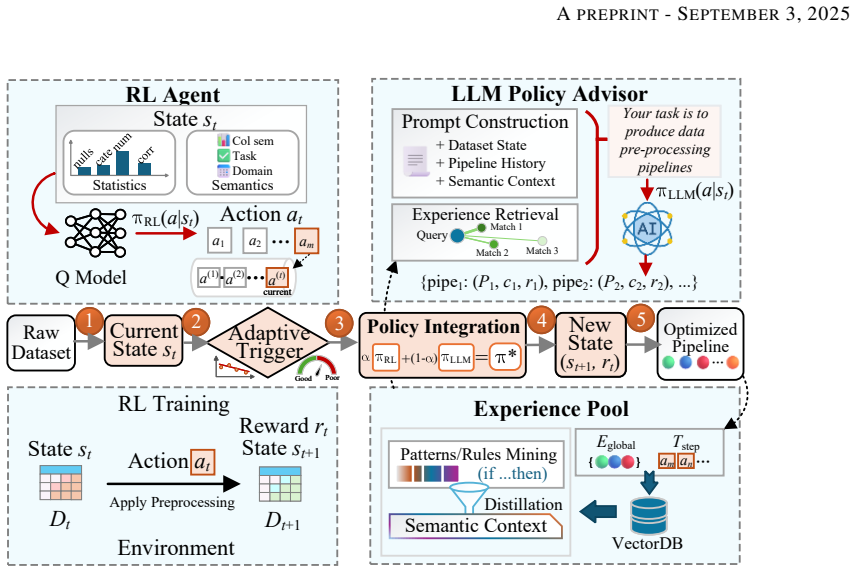
The load-bearing object is the hybrid policy $\pi_{\text{combined}}(a|s) = \alpha\,\pi_{\text{LLM}}(a|s) + (1-\alpha)\,\pi_{\text{RL}}(a|s)$, where the LLM's distribution comes from its ranked suggestions and $\alpha$ is decided by the adaptive trigger. The trigger keeps a sliding window of the last ten episode accuracies, fits a linear regression slope $\beta$, and invokes the advisor when $\beta$ falls below the threshold $\theta_{\text{slope}} = 0.01$, with a five-episode cooldown; the paper justifies this as an optimal stopping policy and the first-improvement evaluation of LLM suggestions as a cost-optimal strategy. The experience pool stores both whole-pipeline summaries and step-wise trajectories in a vector database, and offline mining extracts frequent operator sequences and conditional rules that enrich later prompts.
What would settle it
Take the state-of-the-art RL baseline, remove its no-repeated-operator-type restriction, and compare it against LLaPipe with the LLM advisor switched off; if the unconstrained RL agent matches or beats LLaPipe on the same datasets and budget, then the claimed gains are explained by the enlarged search space rather than by LLM guidance. A complementary run constrains LLaPipe to the original restriction and checks whether its accuracy advantage persists.
Extended reading notes
Core claim
On its own terms, the paper establishes that an LLM can serve as a strategic advisor rather than a one-shot pipeline generator. The LLaPipe agent builds a state from dataset statistics, column semantics, and pipeline history; the advisor uses retrieval-augmented prompting over an experience pool to propose ranked candidate actions with confidence scores; and the final action policy is a weighted combination of the LLM's suggestions and the Q-learning agent's softmax policy. The experimental claim is that this hybrid reaches the best average accuracy (0.833) and best average rank (2.67) over 18 datasets, beats the state-of-the-art RL method on 12 of 18 datasets with up to 22.4% improvement, and that the adaptive Advisor+ variant keeps most of the gain (0.820, rank 2.81) while cutting LLM calls from 25 to 9 over 50 episodes.
Load-bearing premise
The comparison against the state of the art is presented as happening in the same search space, but LLaPipe removes the baseline's restriction that a pipeline cannot contain two operators of the same type; if the gains come from that enlarged action space instead of from LLM guidance, the measured improvements would shrink or vanish when the restriction is reinstated.
Editorial extensions
If this is right
- Selective advisor triggering keeps LLM usage at about 19% of exploration steps on average while preserving most of the quality gain (average accuracy 0.820 for Advisor+ versus 0.833 for the always-consulting Advisor).
- The adaptive trigger's slope policy shrinks LLM calls from 25 to 9 over 50 episodes in the reported run, so plateau-only intervention dominates constant-frequency guidance on cost.
- Removing experience distillation drops average accuracy from 0.833 to 0.810 for Advisor and from 0.820 to 0.802 for Advisor+, so the mined past successes are a measurable part of the gain.
- The generated pipelines are shorter (average length 1.89 to 2.83) than the fixed-length six-operator pipelines of the RL baseline, meaning the guidance finds more parsimonious solutions.
- Adding the advisor to a plain Q-learning agent lifts average accuracy from 0.791 to 0.833 and visibly accelerates early convergence, per the learning-curve comparison.
Reading between the lines
- A controlled way to separate the LLM's contribution from the enlarged action space is to constrain LLaPipe to the baseline's no-repeated-operator-type rule; the paper reports only the unconstrained version, so the purely semantic effect size remains an open question.
- The slope-triggering design suggests a general rule for expensive advisory oracles in RL: ask for help only when the agent's own progress stalls, a principle that could apply to human expert calls or costly simulators, not just LLMs.
- If the semantic priors are doing the work, the approach could transfer to other combinatorial search problems such as hyperparameter tuning, query rewriting, or circuit synthesis, where an LLM proposes structured candidates and a cheap evaluator scores them.
- The reported 19% LLM usage is an average across datasets; the per-dataset variance is not given, and a dataset where the trigger fires constantly would erode much of the efficiency claim.
Editorial analysis
A structured set of objections, weighed in public.
Referee Report
Summary. The paper proposes LLaPipe, a framework that augments a tabular Q-learning agent with an LLM policy advisor, an experience pool with retrieval and distillation, and an adaptive triggering mechanism (Advisor+) that limits LLM invocations. The authors claim up to 22.4% improvement in pipeline quality and 2.3x faster convergence over state-of-the-art RL methods (CtxPipe) across 18 datasets, while invoking the LLM in only about 19% of exploration steps. Experiments compare LLaPipe variants against CtxPipe, DQN, Q-learning, TPOT, DeepLine, SAGA, DiffPrep baselines, and include ablations of experience distillation and of the LLM advisor.
Significance. The LLM-as-advisor idea is well motivated for automated data preparation, and the adaptive triggering strategy targets a real computational bottleneck. The paper makes a genuine attempt to isolate the LLM contribution through an internal ablation (Table 3: QLearning 0.791 vs Advisor 0.833 average accuracy) and a DQN-with-Advisor+ comparison (Table 6), and the appendix pseudocode is detailed enough to reproduce the method. However, the headline comparison to CtxPipe is not controlled, the theoretical justification of the triggering policy is largely heuristic, and the abstract's quantitative claims are not all supported by the reported experiments. If the controlled comparison were fixed and the claims appropriately qualified, the contribution could be a useful step for the community; as it stands, the significance rests on confounded evidence.
major comments (5)
- [§5.1, §5.2, Tables 2 and 9] The statement in Section 5.2 that accuracy gains over CtxPipe are obtained 'under the same component search space' is contradicted by Section 5.1, which says CtxPipe's implementation forbids multiple operators of the same type while LLaPipe imposes no such structural priors. The pipelines in Table 9 for avila ([10,23,18,15]) and wall-robot-nav ([10,9,15]) contain same-type operator combinations (three Feature Engineering operators in the first case, two Feature Preprocessing operators in the second) that CtxPipe cannot reach. The headline 22.4% avila improvement (0.929 vs 0.759 in Table 2) therefore conflates the LLM advisor with an enlarged action space and a different RL backbone (tabular Q-learning vs DQN). To support the abstract's primary quantitative claim, the comparison must be controlled: either run CtxPipe under the same unconstrained action space or constrain LLaPipe to CtxPipe's operator-type rule, and report results for all 18 datasets. The small CtxPipe+Advisor+ control in Table 7 (improvements of 0.003-0.026 on only 6 datasets, excluding avila) does not rescue the 22.4% claim.
- [Abstract and §5.2/Figure 5] The abstract claims '2.3× faster convergence,' but the experimental section never defines or measures a convergence-speed metric. Figure 5 shows learning curves only qualitatively, with a caption that describes improvement over different episode ranges. Please define convergence (e.g., episodes to reach a target accuracy or a fixed fraction of the final performance), report it per dataset for LLaPipe and for the RL baselines, and include variance across runs. Without this, the convergence claim is unverifiable.
- [§4.4, Appendix A.7-A.8, Algorithm 1] Theorem 2's 'optimal' slope threshold θslope is derived from assumed values for the expected LLM accuracy gain and for costs; the proof then asserts that 'typical cost structures' yield θslope ≈ 0.01, and Algorithm 1 hard-codes θslope = 0.01. This makes the threshold a free parameter rather than a parameter-free optimality result, so the main text's characterization of the triggering policy as 'theoretically grounded' (Section 4.4) is overstated. Theorem 3's appeal to the secretary problem is by analogy and does not verify the required model assumptions (e.g., random arrival order, no recall). Please state explicit, checkable assumptions, derive the threshold from them, and include a sensitivity analysis over θslope and the cooldown period; otherwise, present the triggering strategy as a heuristic with empirical justification.
- [Tables 2, 3, 6, 7, and Figure 5] No error bars, multiple seeds, or significance tests are reported anywhere in the paper. Since both RL training and LLM sampling are stochastic, single-run numbers cannot establish that differences such as Table 3's 0.791 vs 0.833 for QLearning vs Advisor, or Table 6's 0.753 vs 0.767 for DQN vs DQN+Adv+, are reliable. Report means and standard deviations over at least five independent runs and, where feasible, paired significance tests across the 18 datasets.
- [Abstract and Figure 4] The abstract's '19.0% of total exploration steps' is not clearly defined. Figure 4 reports LLM calls per 50 episodes (Advisor+ makes 9 calls, i.e., 18% of episodes), but the abstract refers to 'exploration steps.' Clarify the denominator (episodes vs operator-level steps) and report the ratio consistently for all experiments.
minor comments (5)
- [Abstract and title page] The placeholder 'The codes and datasets are available at (xxx)' must be replaced with a working URL before the paper can be considered for publication.
- [Throughout] Several typos remain: the title is rendered as 'LL APIPE', Figure 4's caption has 'bewteen', and Section 4.2.1 contains 'further promot details can be found in Appendix A.4A.4'.
- [§1] The statement that 'with just 5 component types and 4 candidates each, the space exceeds 100,000 configurations' is inconsistent with Table 4, which lists more than four candidates for several types; please clarify the arithmetic or the operator set used for the estimate.
- [Algorithm 2 and Eq. (3)] The symbol α is used both for the Q-learning update in Algorithm 2 (line 7) and for the policy-integration weight in Eq. (3); rename one of them to avoid ambiguity.
- [Main text Theorems 1-4] The main text states Theorems 1-4 without stating their assumptions or giving proof sketches, while full proofs appear only in the appendix; consider moving formal statements to the appendix and including brief intuitive explanations in the main text.
Circularity Check
The accuracy claims are empirically grounded and not circular; the one load-bearing reduction is the slope-trigger threshold in Theorem 2, which is defined as the break-even point of assumed cost/gain values and then declared optimal.
-
self definitional
[Section 4.4.2 / Appendix A.8 (Proof of Theorem 2); Algorithm 1, line 11]
"The optimal policy is to trigger the LLM if VLLM > Vcontinue. For a one-step horizon ( ∆e = 1), this simplifies to triggering if E[∆accLLM ] − CLLM > β− CRL. This defines a threshold θslope = E[∆accLLM ] − CLLM + CRL. For typical cost structures where CLLM ≫ CRL and the expected gain is a small positive constant (e.g., 0.05), this leads to a small positive slope threshold (e.g., θslope ≈ 0.01)."
Theorem 2 claims to prove the optimality of slope-based triggering, but the threshold θslope is defined as the exact value of β at which the assumed one-step comparison VLLM > Vcontinue breaks even. The existence of a threshold is therefore a tautology, and the numerical value 0.01 used in Algorithm 1 is obtained by substituting an assumed expected gain of 0.05 and an assumed cost structure, not by fitting, measurement, or independent derivation. The rule 'invoke if β < θslope' is true by construction of the definition, so the theorem adds no independent evidence that 0.01 is the right threshold for LLaPipe.
full rationale
The paper's central quality claim — that LLM-guided exploration improves pipeline accuracy — is supported by an internal ablation (Q-Learning 0.791 vs. Advisor 0.833 average accuracy) and by comparisons against external baselines, so it is not circular. The 22.4% headline improvement over CtxPipe is an empirical measurement, and the concern that LLaPipe benefits from removing CtxPipe's same-type-operator constraint (Section 5.1) while Section 5.2 claims 'same component search space' is a validity/confound issue, not a derivation-chain circularity. No load-bearing self-citations were found. The main circular step is in the Adaptive Advisor Triggering justification: Theorem 2 defines θslope as the break-even point of assumed expected gain and cost values, then the paper treats the resulting threshold as theoretically grounded. This affects the Advisor+ efficiency contribution, but not the core accuracy result, which has independent experimental content.
Assumptions & free parameters
free parameters (4)
- theta_slope (LLM trigger threshold) =
0.01
- alpha (policy integration weight) =
not specified
- num retrieved examples k =
3
- cooldown period =
5 episodes
assumptions (4)
- domain assumption The state represented by the last executed operator is sufficient and Markovian for pipeline construction.
- ad hoc to paper The learning curve can be locally approximated by a linear function (Theorem 1).
- ad hoc to paper The expected immediate accuracy gain from an LLM intervention is a small positive constant around 0.05 and costs have typical values (Theorem 2).
- ad hoc to paper First-improvement sampling is optimal by analogy with the secretary problem (Theorem 3).
Cite this review
Pith. "Pith review of LLaPipe: LLM-Guided Reinforcement Learning for Automated Data Preparation Pipeline Construction." pith.science (2026). https://pith.science/paper/OPBQXYSG
@misc{pith2026250713712,
  author       = {Pith},
  title        = {Pith review of: LLaPipe: LLM-Guided Reinforcement Learning for Automated Data Preparation Pipeline Construction},
  year         = {2026},
  howpublished = {\url{https://pith.science/paper/OPBQXYSG}},
  note         = {Machine review of arXiv:2507.13712}
}
abstract
Automated data preparation is crucial for democratizing machine learning, yet existing reinforcement learning (RL) based approaches suffer from inefficient exploration in the vast space of possible preprocessing pipelines. We present LLaPipe, a novel framework that addresses this exploration bottleneck by integrating Large Language Models (LLMs) as intelligent policy advisors. Unlike traditional methods that rely solely on statistical features and blind trial-and-error, LLaPipe leverages the semantic understanding capabilities of LLMs to provide contextually relevant exploration guidance. Our framework introduces three key innovations: (1) an LLM Policy Advisor that analyzes dataset semantics and pipeline history to suggest promising preprocessing operations, (2) an Experience Distillation mechanism that mines successful patterns from past pipelines and transfers this knowledge to guide future exploration, and (3) an Adaptive Advisor Triggering strategy (Advisor\textsuperscript{+}) that dynamically determines when LLM intervention is most beneficial, balancing exploration effectiveness with computational cost. Through extensive experiments on 18 diverse datasets spanning multiple domains, we demonstrate that LLaPipe achieves up to 22.4\% improvement in pipeline quality and 2.3$\times$ faster convergence compared to state-of-the-art RL-based methods, while maintaining computational efficiency through selective LLM usage (averaging only 19.0\% of total exploration steps).
Figures


Figures from the paper (4 more)


Reference graph
Works this paper leans on
-
[1]
Data preparation for machine learning
Pecan. Data preparation for machine learning. https://www.pecan.ai/blog/ data-preparation-for-machine-learning/ , 2024. Accessed: 2025-06-25
work page 2024
-
[2]
Automated image data preprocessing with deep reinforcement learning
Tran Ngoc Minh, Mathieu Sinn, Hoang Thanh Lam, and Martin Wistuba. Automated image data preprocessing with deep reinforcement learning. arXiv preprint arXiv:1806.05886, 2018
arXiv 2018
-
[3]
Agile data preparation & exploration for cloud machine learning
John Morrell. Agile data preparation & exploration for cloud machine learning. https://www.datameer.com/ blog/agile-data-preparation-exploration-for-cloud-machine-learning// , 2024. Accessed: 2025-06-25
work page 2024
-
[4]
Evaluation of a tree-based pipeline optimization tool for automating data science
Randal S Olson, Nathan Bartley, Ryan J Urbanowicz, and Jason H Moore. Evaluation of a tree-based pipeline optimization tool for automating data science. In Proceedings of the genetic and evolutionary computation conference 2016, pages 485–492, 2016
work page 2016
-
[5]
Saga: a scalable framework for optimizing data cleaning pipelines for machine learning applications
Shafaq Siddiqi, Roman Kern, and Matthias Boehm. Saga: a scalable framework for optimizing data cleaning pipelines for machine learning applications. Proceedings of the ACM on Management of Data, 1(3):1–26, 2023
work page 2023
-
[6]
Efficient and robust automated machine learning
Matthias Feurer, Aaron Klein, Katharina Eggensperger, Jost Springenberg, Manuel Blum, and Frank Hutter. Efficient and robust automated machine learning. Advances in neural information processing systems, 28, 2015
2015
-
[7]
Democratizing data science through interactive curation of ml pipelines
Zeyuan Shang, Emanuel Zgraggen, Benedetto Buratti, Ferdinand Kossmann, Philipp Eichmann, Yeounoh Chung, Carsten Binnig, Eli Upfal, and Tim Kraska. Democratizing data science through interactive curation of ml pipelines. In Proceedings of the 2019 international conference on management of data, pages 1171–1188, 2019
work page 2019
-
[8]
Auto-weka: Combined selection and hyperparameter optimization of classification algorithms
Chris Thornton, Frank Hutter, Holger H Hoos, and Kevin Leyton-Brown. Auto-weka: Combined selection and hyperparameter optimization of classification algorithms. In Proceedings of the 19th ACM SIGKDD international conference on Knowledge discovery and data mining, pages 847–855, 2013
work page 2013
Show all 40 references
-
[9]
Diffml: End-to-end differentiable ml pipelines
Benjamin Hilprecht, Christian Hammacher, Eduardo S Reis, Mohamed Abdelaal, and Carsten Binnig. Diffml: End-to-end differentiable ml pipelines. In Proceedings of the Seventh Workshop on Data Management for End-to-End Machine Learning, pages 1–7, 2023
2023
-
[10]
Diffprep: Differentiable data preprocessing pipeline search for learning over tabular data
Peng Li, Zhiyi Chen, Xu Chu, and Kexin Rong. Diffprep: Differentiable data preprocessing pipeline search for learning over tabular data. Proceedings of the ACM on Management of Data, 1(2):1–26, 2023
2023
-
[11]
Windtunnel: towards differentiable ml pipelines beyond a single model
Gyeong-In Yu, Saeed Amizadeh, Sehoon Kim, Artidoro Pagnoni, Ce Zhang, Byung-Gon Chun, Markus Weimer, and Matteo Interlandi. Windtunnel: towards differentiable ml pipelines beyond a single model. Proceedings of the VLDB Endowment, 15(1):11–20, 2021
2021
-
[12]
Learn2clean: Optimizing the sequence of tasks for web data preparation
Laure Berti-Equille. Learn2clean: Optimizing the sequence of tasks for web data preparation. In The world wide web conference, pages 2580–2586, 2019
2019
-
[13]
Haipipe: Combining human-generated and machine-generated pipelines for data preparation
Sibei Chen, Nan Tang, Ju Fan, Xuemi Yan, Chengliang Chai, Guoliang Li, and Xiaoyong Du. Haipipe: Combining human-generated and machine-generated pipelines for data preparation. Proceedings of the ACM on Management of Data, 1(1):1–26, 2023
2023
-
[14]
Deepline: Automl tool for pipelines generation using deep reinforcement learning and hierarchical actions filtering
Yuval Heffetz, Roman Vainshtein, Gilad Katz, and Lior Rokach. Deepline: Automl tool for pipelines generation using deep reinforcement learning and hierarchical actions filtering. In Proceedings of the 26th ACM SIGKDD international conference on knowledge discovery & data minin...
2020
-
[15]
Auto-pipeline: synthesizing complex data pipelines by-target using reinforcement learning and search
Junwen Yang, Yeye He, and Surajit Chaudhuri. Auto-pipeline: synthesizing complex data pipelines by-target using reinforcement learning and search. arXiv preprint arXiv:2106.13861, 2021
2021 arXiv
-
[16]
Ctxpipe: Context-aware data preparation pipeline construction for machine learning
Haotian Gao, Shaofeng Cai, Tien Tuan Anh Dinh, Zhiyong Huang, and Beng Chin Ooi. Ctxpipe: Context-aware data preparation pipeline construction for machine learning. Proceedings of the ACM on Management of Data, 2(6):1–27, 2024
2024
-
[17]
Cleansurvival: Automated data preprocessing for time-to-event models using reinforcement learning
Yousef Koka, David Selby, Gerrit Großmann, and Sebastian V ollmer. Cleansurvival: Automated data preprocessing for time-to-event models using reinforcement learning. arXiv preprint arXiv:2502.03946, 2025. 11 A PREPRINT - SEPTEMBER 3, 2025
2025 arXiv
-
[18]
Advancing multimodal reasoning: From optimized cold start to staged reinforcement learning
Shuang Chen, Yue Guo, Zhaochen Su, Yafu Li, Yulun Wu, Jiacheng Chen, Jiayu Chen, Weijie Wang, Xiaoye Qu, and Yu Cheng. Advancing multimodal reasoning: From optimized cold start to staged reinforcement learning. arXiv preprint arXiv:2506.04207, 2025
2025
-
[19]
A survey on deep reinforcement learning for data processing and analytics
Qingpeng Cai, Can Cui, Yiyuan Xiong, Wei Wang, Zhongle Xie, and Meihui Zhang. A survey on deep reinforcement learning for data processing and analytics. IEEE Transactions on Knowledge and Data Engineering, PP:1–1, 01 2022
2022
-
[20]
Udayan Khurana, Horst Samulowitz, and Deepak S. Turaga. Feature engineering for predictive modeling using reinforcement learning. CoRR, abs/1709.07150, 2017
2017 arXiv
-
[21]
Learning shaping strategies in human-in-the-loop interactive reinforcement learning
Chao Yu, Tianpei Yang, Wenxuan Zhu, Guangliang Li, et al. Learning shaping strategies in human-in-the-loop interactive reinforcement learning. arXiv preprint arXiv:1811.04272, 2018
2018 arXiv
-
[22]
Feature engineering for predictive modeling using reinforcement learning
Udayan Khurana, Horst Samulowitz, and Deepak Turaga. Feature engineering for predictive modeling using reinforcement learning. In Proceedings of the AAAI Conference on Artificial Intelligence, volume 32, 2018
2018
-
[23]
Towards sample efficient reinforcement learning
Yang Yu. Towards sample efficient reinforcement learning. In IJCAI, pages 5739–5743, 2018
2018
-
[24]
Causalcomrl: Context-based offline meta- reinforcement learning with causal representation
Zhengzhe Zhang, Wenjia Meng, Haoliang Sun, and Gang Pan. Causalcomrl: Context-based offline meta- reinforcement learning with causal representation. arXiv preprint arXiv:2502.00983, 2025
2025 arXiv
-
[25]
Can foundation models wrangle your data? arXiv preprint arXiv:2205.09911, 2022
Avanika Narayan, Ines Chami, Laurel Orr, Simran Arora, and Christopher Ré. Can foundation models wrangle your data? arXiv preprint arXiv:2205.09911, 2022
2022 arXiv
-
[26]
Watch every step! llm agent learning via iterative step-level process refinement
Weimin Xiong, Yifan Song, Xiutian Zhao, Wenhao Wu, Xun Wang, Ke Wang, Cheng Li, Wei Peng, and Sujian Li. Watch every step! llm agent learning via iterative step-level process refinement. arXiv preprint arXiv:2406.11176, 2024
2024 arXiv
-
[27]
Tabllm: Few-shot classification of tabular data with large language models
Stefan Hegselmann, Alejandro Buendia, Hunter Lang, Monica Agrawal, Xiaoyi Jiang, and David Sontag. Tabllm: Few-shot classification of tabular data with large language models. In International Conference on Artificial Intelligence and Statistics, pages 5549–5581. PMLR, 2023
2023
-
[28]
Guiding reinforcement learning using uncertainty-aware large language models
Maryam Shoaeinaeini and Brent Harrison. Guiding reinforcement learning using uncertainty-aware large language models. arXiv preprint arXiv:2411.14457, 2024
2024 arXiv
-
[29]
Deep neural networks and tabular data: A survey
Vadim Borisov, Tobias Leemann, Kathrin Seßler, Johannes Haug, Martin Pawelczyk, and Gjergji Kasneci. Deep neural networks and tabular data: A survey. IEEE transactions on neural networks and learning systems, 2022
2022
-
[30]
Retrieval-augmented generation for large language models: A survey
Yunfan Gao, Yun Xiong, Xinyu Gao, Kangxiang Jia, Jinliu Pan, Yuxi Bi, Yixin Dai, Jiawei Sun, Haofen Wang, and Haofen Wang. Retrieval-augmented generation for large language models: A survey. arXiv preprint arXiv:2312.10997, 2(1), 2023
2023 arXiv
-
[31]
Retrieval-augmented generation for knowledge- intensive nlp tasks
Patrick Lewis, Ethan Perez, Aleksandra Piktus, Fabio Petroni, Vladimir Karpukhin, Naman Goyal, Heinrich Küttler, Mike Lewis, Wen-tau Yih, Tim Rocktäschel, et al. Retrieval-augmented generation for knowledge- intensive nlp tasks. Advances in neural information processing system...
2020
-
[32]
Vector database management techniques and systems
James Jie Pan, Jianguo Wang, and Guoliang Li. Vector database management techniques and systems. In Companion of the 2024 International Conference on Management of Data, pages 597–604, 2024
2024
-
[33]
A comprehensive survey on vector database: Storage and retrieval technique, challenge
Yikun Han, Chunjiang Liu, and Pengfei Wang. A comprehensive survey on vector database: Storage and retrieval technique, challenge. arXiv preprint arXiv:2310.11703, 2023
2023
-
[34]
When large language models meet vector databases: A survey
Zhi Jing, Yongye Su, and Yikun Han. When large language models meet vector databases: A survey. In 2025 Conference on Artificial Intelligence x Multimedia (AIxMM), pages 7–13. IEEE, 2025
2025
-
[35]
Openml: networked science in machine learning
Joaquin Vanschoren, Jan N Van Rijn, Bernd Bischl, and Luis Torgo. Openml: networked science in machine learning. ACM SIGKDD Explorations Newsletter, 15(2):49–60, 2014
2014
-
[36]
Cleanml: A study for evaluating the impact of data cleaning on ml classification tasks
Peng Li, Xi Rao, Jennifer Blase, Yue Zhang, Xu Chu, and Ce Zhang. Cleanml: A study for evaluating the impact of data cleaning on ml classification tasks. In 2021 IEEE 37th International Conference on Data Engineering (ICDE), pages 13–24. IEEE, 2021
2021
-
[37]
H2o automl: Scalable automatic machine learning
Erin LeDell and Sebastien Poirier. H2o automl: Scalable automatic machine learning. In Proceedings of the AutoML Workshop at ICML, volume 2020, page 24, 2020
2020
-
[38]
Llamafactory: Unified efficient fine-tuning of 100+ language models
Yaowei Zheng, Richong Zhang, Junhao Zhang, Yanhan Ye, Zheyan Luo, Zhangchi Feng, and Yongqiang Ma. Llamafactory: Unified efficient fine-tuning of 100+ language models. arXiv preprint arXiv:2403.13372, 2024
2024 arXiv
-
[39]
Qwen3 technical report
An Yang, Anfeng Li, Baosong Yang, Beichen Zhang, Binyuan Hui, Bo Zheng, Bowen Yu, Chang Gao, Chengen Huang, Chenxu Lv, et al. Qwen3 technical report. arXiv preprint arXiv:2505.09388, 2025
2025 arXiv
-
[40]
first-improvement
Christopher JCH Watkins and Peter Dayan. Q-learning. Machine learning, 8:279–292, 1992. 12 A PREPRINT - SEPTEMBER 3, 2025 A Appendix A.1 Implementation Details Hardware and OS. We run our experiments on a server with 128 AMD EPYC 7543 CPUs, each with 32 cores, and 256GB memory...
1992
Reviewed August 6, 2026 · model on record in the stance chip above.
Discussion (0). Sign in to comment.