REVIEW 4 major objections 5 minor 1 cited by
A Large Language Model-Enabled Control Architecture for Dynamic Resource Capability Exploration in Multi-Agent Manufacturing Systems
T0 review · 4 major / 5 minor · reviewed 2026-08-07 · deepseek-v4-flash
Pith's one-line read LLM-enabled controller lets manufacturing agents explore new capabilities after robot breakdowns, lifting throughput from 15 to 23 parts in a simulated wafer fab.
desk verdict Useful architecture with a real simulated gain, but the experiment doesn't isolate the LLM's contribution. read the letter →
The pith
A machine-rendered reading of the paper's core claim, the machinery that carries it, and where it could break.
The reading
What carries the argument
The central object is the Central Controller Agent (CCA), a supervisory agent that wraps an LLM-based decision maker around the existing Product Agent/Resource Agent framework. The decision maker computes a weighted score $S_i = \sum_j \omega_j f_j(x_{ij})$ for each candidate resource agent, where the weights are assigned by the LLM and the $f_j$ normalize raw performance indicators such as throughput, utilization, breakdown rate, and proximity. The selected output $O = (RA_e, C_e)$ names an exploration agent and a set of explored capabilities, which are checked by a validation loop (Algorithm 1) against operational bounds $B_i$ and safety limits $S_i$ before being written into the resource's capability model $M = (X, E, Tr, Pr_{pp}, x_i, X_m)$ as new events and state transitions.
What would settle it
Run the same wafer fab scenario but add a check to Algorithm 1 that rejects any explored capability whose transition function $Tr(x_i, e_l)$ does not map to a state in $X_m$; if throughput drops back toward the baseline 15 parts, the reported improvement depends on unverified transitions rather than on the LLM's capability selection alone.
Extended reading notes
Core claim
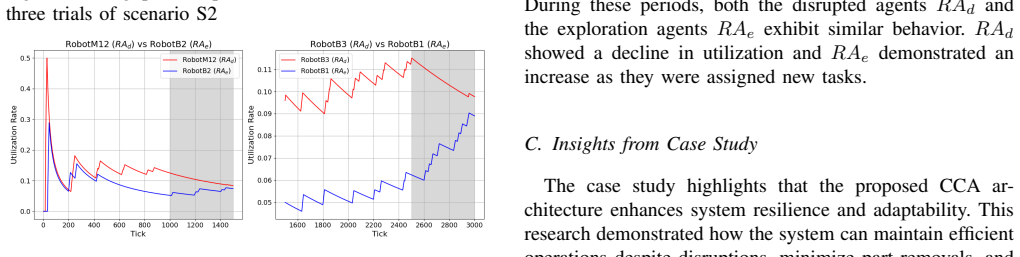
The authors discover that an LLM-enabled central controller agent can restore throughput in a multi-agent manufacturing system after robot breakdowns by authorizing an exploration agent to take over the disrupted agent's tasks with newly explored capabilities. The architecture collects real-time status and performance data from resource agents, uses a structured chain-of-thought prompt to have GPT-4o score candidate agents via a weighted utility function, validates the selected agent and capabilities against operational boundaries and safety limits, and then merges the new capabilities into the exploration agent's finite-state-machine model. The case study shows that the explored-capability system completes substantially more parts than the baseline, and that during breakdowns the exploration agent's utilization rises while the disrupted agent's utilization falls, evidence that task reassignment is actually happening.
Load-bearing premise
The architecture assumes that any capability the LLM proposes, after passing the syntax, agent-existence, and bound checks, will always produce legal transitions that move the part through to a completion state, but the validation loop never actually checks that each proposed transition lands in a marked state.
Editorial extensions
If this is right
- If the architecture works as claimed, a manufacturing system can sustain near-full throughput during sequential robot failures without a human expert manually reconfiguring each resource.
- The result implies that capability exploration need not be limited to the initially configured boundaries of a resource, since the exploration agent can adopt events and transitions from a disrupted neighbor.
- The utilization pattern observed during breakdowns indicates that the CCA's task reassignment actually shifts workload onto the exploration agent, reducing idle time otherwise caused by the failure.
- The residual part removals in the case study show that even with exploration, parts already stuck inside a broken robot or on an invalidated pre-planned route cannot always be saved, so the mechanism improves but does not eliminate losses.
- The architecture's reliance on LLM-determined weights and prompts suggests that decision quality is tied to prompt design, which the authors flag as a direction for future improvement.
Reading between the lines
- A direct testable extension would be to modify Algorithm 1 to verify the formal condition $\forall x_i \in X_e, \forall e_l \in E_e,\ Tr(x_i, e_l) = x_j \wedge x_j \in X_m$ before accepting an explored capability; if the current throughput advantage shrinks or vanishes when that check is added, the reported gains rest on unvalidated transition legality rather than on the LLM's choices alone.
- Because the case study assumes zero communication delay from the LLM (assumption A.1), the architecture's real-world value depends on whether LLM inference time stays short enough for real-time control; a sensitivity study varying prompt latency could reveal an operating envelope.
- The observation that the LLM occasionally assigned inconsistent weights to performance metrics suggests replacing free-form weight elicitation with a fixed, prompt-independent weighting rule or a learned scoring function could improve reproducibility while retaining the LLM's role in candidate selection.
- The capability-merging step (Equation 4) could be reused outside disruption handling, for instance to deliberately broaden a resource's skills during changeover or product-mix shifts, which the paper does not explicitly explore.
Editorial analysis
A structured set of objections, weighed in public.
Referee Report
Summary. The paper proposes a central controller agent (CCA) architecture for multi-agent manufacturing systems, in which a large language model (GPT-4o) dynamically selects exploration agents and extends their capabilities after robot breakdowns. The architecture comprises a knowledge base, an LLM-driven decision maker using a weighted scoring function, a validation algorithm, and a communication manager to update resource capability models. The authors evaluate the architecture in a Repast Symphony simulation of a wafer fab with 25 parts and four robot breakdowns, comparing their prior MAS framework (S1) with the new CCA framework (S2) across three trials. They report that S1 completes 15 parts, while S2 completes 23, 23, and 21 parts, and that exploration-agent utilization rises during breakdowns. The paper claims improved throughput, resilience, and flexibility relative to existing approaches.
Significance. If the central claim is supported, the paper would provide a useful demonstration of LLM-based runtime reconfiguration in multi-agent manufacturing, addressing a real gap in adaptive control. The architecture is described clearly, with a formal problem statement, a concrete validation algorithm, and an explicit set of simulation assumptions. The use of a public simulation platform (RepastS) and the reporting of three repeated trials are strengths. However, the experimental design does not currently isolate the effect of the LLM from the effect of the central controller, and the statistical basis for the claimed improvement is thin. The paper also acknowledges limitations that bear directly on reproducibility, such as inconsistent LLM-assigned weights. These issues are fixable within the scope of a revision, so the result is promising but not yet established.
major comments (4)
- [Section V.B / Section IV.B.2] The central attribution claim is confounded by the experimental design. Scenario S1 is the authors' prior MAS framework without a central controller, while S2 introduces both a CCA and an LLM-based decision maker. There is no control condition in which the same CCA framework runs with a non-LLM decision-maker (e.g., the weighted scoring function of Eq. (3) with fixed weights, or a deterministic nearest-available-robot rule). Consequently, the observed throughput improvement (15 vs. 21–23 parts) cannot be attributed specifically to the LLM; it could be due entirely to the central reallocation mechanism. Section IV.B.2 contrasts LLM-based with rule-based methods but does not benchmark them, and Section VI lists comparison with rule-based adaptation as future work. Please add an ablation that separates the LLM from the CCA, or revise the claims to attribute the improvement only to the combined architecture.
- [Section V.B / Figure 7] The throughput comparison is reported without any statistical support. The three S2 trials yield counts of 23, 23, and 21, but the paper provides no mean, standard deviation, error bars, or significance test, and S1 is a single run. With n=3 and no variance characterization, it is not possible to assess whether the improvement is stable or within simulation noise. Please report summary statistics across multiple random seeds, and ideally perform a significance test (or at least show the distribution of outcomes) before describing the result as a 'significant improvement'.
- [Section III.B / Algorithm 1] The formal guarantee in Eq. (2) is not enforced by the validation procedure. Section III.B states that Eq. (1) 'guarantees' the exploration agent can meet the process plan, with Eq. (2) requiring that every transition T r(xi, el) reaches a marked state xj in Xm. However, Algorithm 1 in Section IV.B.3 checks only output syntax, agent existence, and that explored capabilities lie within operational bounds Bi and safety limits Si. It does not verify that the new capabilities produce only valid transitions to marked states. If a proposed capability creates an invalid transition, the exploration agent may fail to complete the process. Please either add a transition-validity check to Algorithm 1 or reformulate the guarantee as a best-effort property that is verified by simulation rather than by construction.
- [Section V.C / Eq. (3)] The paper acknowledges that the LLM-assigned weights in Eq. (3) are unstable and not always justified, but it does not report the weights used in each of the three trials or analyze how sensitive the throughput result is to that variation. Because Eq. (3) is the core selection mechanism, this variability is load-bearing for reproducibility. Please provide the actual weights or prompts used across trials, and include a sensitivity analysis over reasonable weight assignments to show that the qualitative conclusion (S2 outperforms S1) does not depend on a particular LLM output.
minor comments (5)
- [Section III.A.1] The notation P rpp : X → Pp is introduced before Pp and Pnp are defined; those sets are only defined later in Section III.A.2 under Product Agents. Please move or forward-reference the definitions.
- [Section IV.B.2, Eq. (3)] The equation appears with a malformed summation symbol in the manuscript text; please ensure the proper Σ notation is used and define the normalization function f j explicitly.
- [Algorithm 1, line 15] The validation condition mixes operational bounds b_min_ij and safety limits s_min_ik in a single expression; please clarify which bound applies to which capability dimension, and whether a capability must satisfy both bounds simultaneously.
- [Section V.B] Please define the throughput metric precisely: clarify whether 'completed parts' counts only parts that exit the system, and explicitly state whether failed parts are removed from the simulation or counted as incomplete at the end of the run.
- [Figure 8] The caption says 'during breakdown in S2-3' but the figure covers two robots (M12 and B3); please specify which breakdown interval corresponds to each robot or restructure the caption to avoid ambiguity.
Circularity Check
No significant circularity: the throughput comparison is an empirical simulation result, not a derivation that assumes its own conclusion.
full rationale
The paper's central claim is an empirical throughput comparison between a prior baseline (S1, from [29]) and the proposed CCA architecture (S2) in a Repast simulation. The S2 results (23, 23, and 21 completed parts vs 15) are observed simulation outcomes, not quantities derived from the architecture's own definitions. Eq. (3)'s weighted scoring formula is the LLM's decision rule, not a parameter fitted to the throughput data; no fitted value is later renamed as a prediction. The formal guarantee in Eq. (1)/(2) is a modeling requirement on the updated transition function, and Section IV.C constructs the updated T r to map into the marked set Xm; however, this definitional consistency is not what generates the throughput result, which comes from running the actual multi-agent simulation with breakdowns. The main self-referential elements are bibliographic: the CCA concept, MAS models, and baseline come from the authors' prior work [6], [13], [29], but they provide the framework and comparison point, not the evidence for the improvement. The reader-identified gap (Algorithm 1 does not verify Eq. (2)) is a validation weakness rather than circularity, since an invalid transition would degrade throughput rather than force the claimed result. The skeptical concern that S2 adds both a central controller and an LLM with no non-LLM CCA ablation is an attribution and confound threat, not a circular derivation. Thus no step reduces the paper's conclusion to its inputs by construction.
Assumptions & free parameters
free parameters (1)
- omega_j (LLM-assigned weights in the scoring function) =
not fixed; assigned per query by GPT-4o
assumptions (4)
- domain assumption The FSM capability model M and the Product Agent/Resource Agent interaction models from [13], [14] accurately represent the physical manufacturing system.
- domain assumption Case study assumptions A.1-A.3 hold: no LLM communication delay, no simultaneous breakdowns, and robots revert to original capabilities after repair.
- ad hoc to paper GPT-4o produces valid, consistent scores and capability proposals that pass validation.
- domain assumption Operational boundaries Bi and safety constraints Si are known and static a priori.
Cite this review
Pith. "Pith review of A Large Language Model-Enabled Control Architecture for Dynamic Resource Capability Exploration in Multi-Agent Manufacturing Systems." pith.science (2026). https://pith.science/paper/OPI536EA
@misc{pith2026250522814,
  author       = {Pith},
  title        = {Pith review of: A Large Language Model-Enabled Control Architecture for Dynamic Resource Capability Exploration in Multi-Agent Manufacturing Systems},
  year         = {2026},
  howpublished = {\url{https://pith.science/paper/OPI536EA}},
  note         = {Machine review of arXiv:2505.22814}
}
read the original abstract
Manufacturing environments are becoming more complex and unpredictable due to factors such as demand variations and shorter product lifespans. This complexity requires real-time decision-making and adaptation to disruptions. Traditional control approaches highlight the need for advanced control strategies capable of overcoming unforeseen challenges, as they demonstrate limitations in responsiveness within dynamic industrial settings. Multi-agent systems address these challenges through decentralization of decision-making, enabling systems to respond dynamically to operational changes. However, current multi-agent systems encounter challenges related to real-time adaptation, context-aware decision-making, and the dynamic exploration of resource capabilities. Large language models provide the possibility to overcome these limitations through context-aware decision-making capabilities. This paper introduces a large language model-enabled control architecture for multi-agent manufacturing systems to dynamically explore resource capabilities in response to real-time disruptions. A simulation-based case study demonstrates that the proposed architecture improves system resilience and flexibility. The case study findings show improved throughput and efficient resource utilization compared to existing approaches.
Figures


Figures from the paper (5 more)


Forward citations
Cited by 1 Pith paper
-
Towards an Intention Abstraction Layer for Autonomous Industrial Systems
A runtime middleware records autonomous agents' goals as structured, ontology-linked intentions and flags conflicts between them before execution, demonstrated on a two-agent production/energy scenario.
Reference graph
Works this paper leans on
-
[1]
Reconfigurable Manufacturing Sys- tems: Principles, Design, and Future Trends,
Y . Koren, X. Gu, and W. Guo, “Reconfigurable Manufacturing Sys- tems: Principles, Design, and Future Trends,” Frontiers of Mechanical Engineering, vol. 13, pp. 121–136, 2018
work page 2018
-
[2]
Industry 4.0: State of the Art and Future Trends,
L. D. Xu, E. L. Xu, and L. Li, “Industry 4.0: State of the Art and Future Trends,” International Journal of Production Research, vol. 56, no. 8, pp. 2941–2962, 2018
work page 2018
-
[3]
Agent-based Distributed Manufacturing Control: A State- of-the-art Survey,
P. Leitão, “Agent-based Distributed Manufacturing Control: A State- of-the-art Survey,” Engineering applications of artificial intelligence , vol. 22, no. 7, pp. 979–991, 2009
2009
-
[4]
Past, Present, and Future of Industrial Agent Applications,
P. Leitão, V . Ma ˇrík, and P. Vrba, “Past, Present, and Future of Industrial Agent Applications,” IEEE Transactions on Industrial In- formatics, vol. 9, no. 4, pp. 2360–2372, 2012
2012
-
[5]
Agent-Based Manufactur- ing—Review and Expert Evaluation,
T. Pulikottil, L. A. Estrada-Jimenez, H. Ur Rehman, F. Mo, S. Nikghadam-Hojjati, and J. Barata, “Agent-Based Manufactur- ing—Review and Expert Evaluation,” The International Journal of Advanced Manufacturing Technology, vol. 127, no. 5, pp. 2151–2180, 2023
work page 2023
-
[6]
Toward an Automated Learning Control Architecture for Cyber-Physical Man- ufacturing Systems,
I. Kovalenko, J. Moyne, M. Bi, E. C. Balta, W. Ma, Y . Qamsane, X. Zhu, Z. M. Mao, D. M. Tilbury, and K. Barton, “Toward an Automated Learning Control Architecture for Cyber-Physical Man- ufacturing Systems,” IEEE Access, vol. 10, pp. 38 755–38 773, 2022
2022
-
[7]
A. Hurst, A. Lerer, A. P. Goucher, A. Perelman, A. Ramesh, A. Clark, A. Ostrow, A. Welihinda, A. Hayes, A. Radford et al. , “GPT-4o System Card,” arXiv preprint arXiv:2410.21276 , 2024
arXiv 2024
-
[8]
Llama: Open and Efficient Foundation Language Models,
H. Touvron, T. Lavril, G. Izacard, X. Martinet, M.-A. Lachaux, T. Lacroix, B. Rozière, N. Goyal, E. Hambro, F. Azhar et al., “Llama: Open and Efficient Foundation Language Models,” arXiv preprint arXiv:2302.13971, 2023
arXiv 2023
Show all 31 references
-
[9]
Large Language Model- Enabled Multi-Agent Manufacturing Systems,
J. Lim, B. V ogel-Heuser, and I. Kovalenko, “Large Language Model- Enabled Multi-Agent Manufacturing Systems,” 2024 IEEE 20th Inter- national Conference on Automation Science and Engineering (CASE) , pp. 3940–3946, 2024
2024
-
[10]
Enhancing Human-Robot Collaborative Assembly in Manufacturing Systems Using Large Language Models,
J. Lim, S. Patel, A. Evans, J. Pimley, Y . Li, and I. Kovalenko, “Enhancing Human-Robot Collaborative Assembly in Manufacturing Systems Using Large Language Models,” 2024 IEEE 20th Interna- tional Conference on Automation Science and Engineering (CASE) , pp. 2581–2587, 2024
2024
-
[11]
A Software-Defined Framework for the Integrated Management of Smart Manufacturing Systems,
F. Lopez, Y . Shao, Z. M. Mao, J. Moyne, K. Barton, and D. Tilbury, “A Software-Defined Framework for the Integrated Management of Smart Manufacturing Systems,” Manufacturing Letters , vol. 15, pp. 18–21, 2018
2018
-
[12]
Dy- namic Rerouting of Cyber-Physical Production Systems in Response to Disruptions Based on SDC Framework,
Y . Qamsane, E. C. Balta, J. Moyne, D. Tilbury, and K. Barton, “Dy- namic Rerouting of Cyber-Physical Production Systems in Response to Disruptions Based on SDC Framework,” 2019 American Control Conference (ACC), pp. 3650–3657, 2019
2019
-
[13]
The Model-based Product Agent: A Control Oriented Architecture for Intelligent Products in Multi-agent Manufacturing Systems,
I. Kovalenko, D. Tilbury, and K. Barton, “The Model-based Product Agent: A Control Oriented Architecture for Intelligent Products in Multi-agent Manufacturing Systems,” Control Engineering Practice , vol. 86, pp. 105–117, 2019
2019
-
[14]
Dynamic Resource Task Negotiation to Enable Product Agent Exploration in Multi-Agent Manufacturing Systems,
I. Kovalenko, D. Ryashentseva, B. V ogel-Heuser, D. Tilbury, and K. Barton, “Dynamic Resource Task Negotiation to Enable Product Agent Exploration in Multi-Agent Manufacturing Systems,” IEEE Robotics and Automation Letters , vol. 4, no. 3, pp. 2854–2861, 2019
2019
-
[15]
Dynamic Distributed Decision-Making for Resilient Resource Reallocation in Disrupted Manufacturing Systems,
M. Bi, I. Kovalenko, D. M. Tilbury, and K. Barton, “Dynamic Distributed Decision-Making for Resilient Resource Reallocation in Disrupted Manufacturing Systems,” International Journal of Produc- tion Research, vol. 62, no. 5, pp. 1737–1757, 2024
2024
-
[16]
How Can Large Language Models Help Humans in Design and Manufacturing?
L. Makatura, M. Foshey, B. Wang, F. HähnLein, P. Ma, B. Deng, M. Tjandrasuwita, A. Spielberg, C. E. Owens, P. Y . Chen, A. Zhao, A. Zhu, W. J. Norton, E. Gu, J. Jacob, Y . Li, A. Schulz, and W. Matusik, “How Can Large Language Models Help Humans in Design and Manufacturing?” a...
2023 arXiv
-
[17]
Large Language Models for Manufacturing,
Y . Li, H. Zhao, H. Jiang, Y . Pan, Z. Liu, Z. Wu, P. Shu, J. Tian, T. Yang, S. Xu et al. , “Large Language Models for Manufacturing,” arXiv preprint arXiv:2410.21418 , 2024
2024 arXiv
-
[18]
Leveraging Error- Assisted Fine-Tuning Large Language Models for Manufacturing Ex- cellence,
L. Xia, C. Li, C. Zhang, S. Liu, and P. Zheng, “Leveraging Error- Assisted Fine-Tuning Large Language Models for Manufacturing Ex- cellence,” Robotics and Computer-Integrated Manufacturing , vol. 88, p. 102728, 2024
2024
-
[19]
Knowledge Sharing in Manufacturing Using LLM-Powered Tools: User Study and Model Benchmarking,
S. Kernan Freire, C. Wang, M. Foosherian, S. Wellsandt, S. Ruiz- Arenas, and E. Niforatos, “Knowledge Sharing in Manufacturing Using LLM-Powered Tools: User Study and Model Benchmarking,” Frontiers in Artificial intelligence , vol. 7, p. 1293084, 2024
2024
-
[20]
Framework for LLM Applications in Manufacturing,
C. I. Garcia, M. A. DiBattista, T. A. Letelier, H. D. Halloran, and J. A. Camelio, “Framework for LLM Applications in Manufacturing,” Manufacturing Letters, vol. 41, p. 253–263, Oct. 2024
2024
-
[21]
Embodied Intelligence in Manufacturing: Leveraging Large Language Models for Autonomous Industrial Robotics,
H. Fan, X. Liu, J. Y . H. Fuh, W. F. Lu, and B. Li, “Embodied Intelligence in Manufacturing: Leveraging Large Language Models for Autonomous Industrial Robotics,” Journal of Intelligent Manufac- turing, vol. 36, no. 2, p. 1141–1157, Feb. 2025
2025
-
[22]
A Large Language Model-Based Manufacturing Process Planning Approach Under Indus- try 5.0,
M. Ni, T. Wang, J. Leng, C. Chen, and L. Cheng, “A Large Language Model-Based Manufacturing Process Planning Approach Under Indus- try 5.0,” p. 1–20, Feb. 2025
2025
-
[23]
Towards Reasoning in Large Language Models: A Survey,
J. Huang and K. C.-C. Chang, “Towards Reasoning in Large Language Models: A Survey,” arXiv preprint arXiv:2212.10403 , 2022
2022 arXiv
-
[24]
Bounding the Capabilities of Large Language Models in Open Text Generation with Prompt Constraints,
A. Lu, H. Zhang, Y . Zhang, X. Wang, and D. Yang, “Bounding the Capabilities of Large Language Models in Open Text Generation with Prompt Constraints,” arXiv preprint arXiv:2302.09185 , 2023
2023 arXiv
-
[25]
Chain-of-Thought Prompting Elicits Reasoning in Large Language Models,
J. Wei, X. Wang, D. Schuurmans, M. Bosma, F. Xia, E. Chi, Q. V . Le, D. Zhou et al., “Chain-of-Thought Prompting Elicits Reasoning in Large Language Models,” Advances in Neural Information Processing Systems, vol. 35, pp. 24 824–24 837, 2022
2022
-
[26]
From Generation to Judgment: Opportunities and Challenges of LLM-as-a-Judge,
D. Li, B. Jiang, L. Huang, A. Beigi, C. Zhao, Z. Tan, A. Bhattacharjee, Y . Jiang, C. Chen, T. Wu et al. , “From Generation to Judgment: Opportunities and Challenges of LLM-as-a-Judge,” arXiv preprint arXiv:2411.16594, 2024
2024
-
[27]
Self-Refine: Itera- tive Refinement with Self-Feedback,
A. Madaan, N. Tandon, P. Gupta, S. Hallinan, L. Gao, S. Wiegreffe, U. Alon, N. Dziri, S. Prabhumoye, Y . Yang et al., “Self-Refine: Itera- tive Refinement with Self-Feedback,” Advances in Neural Information Processing Systems, vol. 36, pp. 46 534–46 594, 2023
2023
-
[28]
Complex Adaptive Systems Mmodeling with Repast Simphony,
M. J. North, N. T. Collier, J. Ozik, E. R. Tatara, C. M. Macal, M. Bragen, and P. Sydelko, “Complex Adaptive Systems Mmodeling with Repast Simphony,” Complex Adaptive Systems Modeling , vol. 1, pp. 1–26, 2013
2013
-
[29]
Cooperative Product Agents to Improve Manufacturing System Flexibility: A Model-based Decision Framework,
I. Kovalenko, E. C. Balta, D. M. Tilbury, and K. Barton, “Cooperative Product Agents to Improve Manufacturing System Flexibility: A Model-based Decision Framework,” IEEE Transactions on Automation Science and Engineering , vol. 20, no. 1, pp. 440–457, 2022
2022
-
[30]
Ontology-Based Feedback to Improve Runtime Control for Multi- Agent Manufacturing Systems,
J. Lim, L. Pfeiffer, F. Ocker, B. V ogel-Heuser, and I. Kovalenko, “Ontology-Based Feedback to Improve Runtime Control for Multi- Agent Manufacturing Systems,” pp. 1–7, 2023
2023
-
[31]
An Advanced Retrieval-Augmented Generation System for Manufacturing Quality Control,
J. A. H. Álvaro and J. G. Barreda, “An Advanced Retrieval-Augmented Generation System for Manufacturing Quality Control,” Advanced Engineering Informatics, vol. 64, p. 103007, 2025
2025
Reviewed August 7, 2026 · model on record in the stance chip above.
Discussion (0). Sign in to comment.