REVIEW 3 major objections 5 minor 111 references
Characterization of Linear Measurements in Cavity Optomechanics: Examples and Applications
T0 review · 3 major / 5 minor · reviewed 2026-08-05 · deepseek-v4-flash
Pith's one-line read This paper establishes a two-number phase diagram that classifies linear optomechanical measurements and identifies when they are truly quantum nondemolition, including a concrete route for levitated nanoparticles.
desk verdict A solid, useful formalism for comparing linear optomechanical measurements, with a genuinely new CQNC off-resonance result, but the levitodynamics QND proposal leans on an unquantified node-positioning idealization that should be fixed before publication. read the letter →
The pith
A machine-rendered reading of the paper's core claim, the machinery that carries it, and where it could break.
The reading
What carries the argument
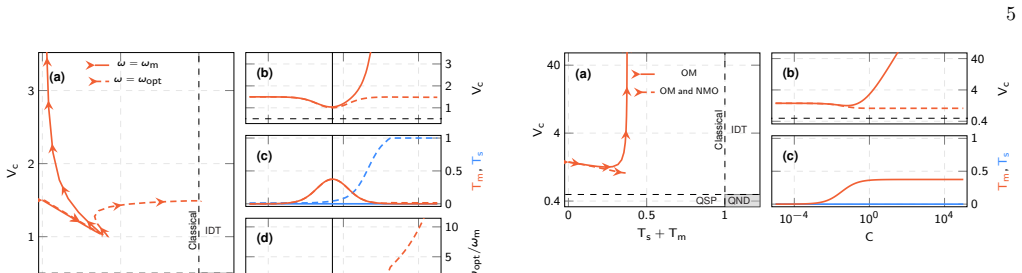
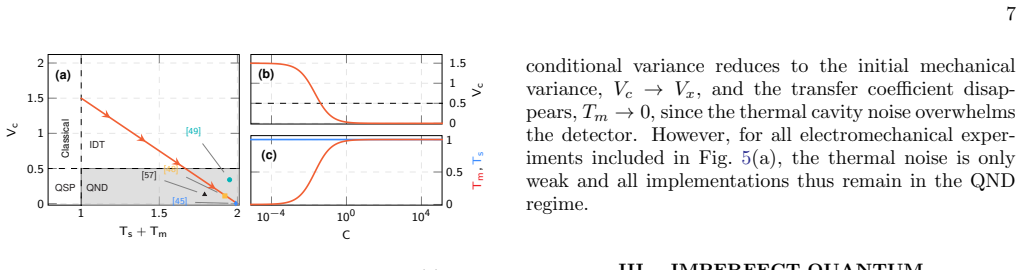
The carrying object is the T V diagram: conditional mechanical variance Vc plotted against the sum of signal and meter transfer coefficients Ts+Tm, with thresholds Vc=1/2 and Ts+Tm=1 partitioning the measurement into classical, state-preparation, information-damage trade-off, and QND regimes. In the levitodynamics proposal, the load-bearing identity is the modulation-frequency condition Ω=ωm(16+7α²)/(16+8α²), chosen so the quadratic momentum term p² drops out of the effective Hamiltonian, leaving HQND=[α²ωm/(8(2+α²))]x²−(αg/2)Xx, whose backaction accumulates only in the unmeasured quadrature.
What would settle it
Scan the nanoparticle's position across the cavity standing wave in a coherent-scattering QND setup with the modulation detuned per Eq. (38), and measure the conditional variance Vc at high cooperativity: if moving the particle even a small fraction of the standing-wave period away from the node pushes Vc above 1/2 or drives Ts+Tm below 1, the neglected radiation-pressure term is the limiting backaction and the QND claim fails for finite-size particles.
Extended reading notes
Core claim
The paper's central claim is that every linear optomechanical measurement can be scored by two numbers—the conditional variance Vc, which says how well the measurement projects the mechanical resonator into a squeezed state, and the signal-transfer sum Ts+Tm, which says how much of the original signal reaches the outputs. Plotting Vc against Ts+Tm, with thresholds Vc=1/2 and Ts+Tm=1, separates measurements into classical, quantum-state-preparation, information-damage trade-off, and QND regions. On this diagram the paper shows that ordinary displacement detection is classical, with an optimum at the standard quantum limit; coherent quantum noise cancellation is also classical on mechanical re
Load-bearing premise
The levitated-nanoparticle proposal assumes the particle sits at a node of the cavity standing wave so that radiation-pressure coupling is zero and coherent scattering is the only optomechanical interaction; any residual radiation pressure reintroduces backaction into the measured quadrature.
Editorial extensions
If this is right
- Displacement detection never leaves the classical quadrant of the T V diagram; its best operating point is at the standard quantum limit.
- Coherent quantum noise cancellation is classical when detection is on mechanical resonance, but optimized off-resonant detection can move it into the QND regime for sufficiently large optomechanical cooperativity.
- For ideal single-quadrature QND readout, the cooperativity condition C>(2Vx−1)/(32Vx) gives a simple, experimentally accessible threshold for sub-shot-noise conditional variance.
- Cavity detuning, mechanical free oscillation, mechanical squeezing, and counter-rotating terms can be compensated against one another—for instance, intentional detuning can cancel squeezing—so near-ideal QND measurements remain possible at moderate sideband ratios.
- In levitodynamics, a modulated tweezer with the detuning set by Eq. (38) gives a true QND measurement of a levitated nanoparticle's motion, and both continuous dual-tweezer and pulsed protocols can reach the QND regime with state-of-the-art coherent-scattering couplings.
Reading between the lines
- The same two-number T V diagram could serve as a common benchmark for comparing electromechanical, membrane, and levitated measurement platforms, since it reduces each setup to the same pair of experimentally meaningful numbers.
- The compensation principle—detuning can cancel unwanted parametric squeezing—likely extends beyond levitodynamics to any two-tone or Floquet optomechanical QND scheme where mechanical squeezing is unintentionally generated.
- If the levitated QND readout works as predicted, it would allow continuous measurement of a nanoparticle's position without the usual backaction, a resource for proposals seeking continuous monitoring in collapse-model or gravitational-sensing tests; the paper does not pursue these applications.
- The paper leaves open whether Vc and Ts+Tm can be extracted from noise spectra without full system tomography; a practical estimator would turn the T V diagram from a theoretical classifier into a routine experimental diagnostic.
Editorial analysis
A structured set of objections, weighed in public.
Referee Report
Summary. The paper develops a unified formalism for characterizing linear optomechanical measurements using the conditional variance Vc and the transfer coefficients Ts and Tm, borrowing the T-V diagram from quantum-optics QND characterization. It applies this formalism to three standard measurement schemes: displacement detection, coherent quantum noise cancellation (CQNC), and ideal single-quadrature QND readout, deriving explicit conditions such as C > (2Vx−1)/(32Vx) for reaching the QND regime. The paper then studies imperfections (cavity detuning, bilinear mechanical terms, counter-rotating terms) and uses the resulting insight to propose QND readout of levitated nanoparticles via a modulated tweezer with coherent scattering, considering both dual-tweezer continuous and pulsed sequential protocols. Detailed scattering-matrix derivations and Floquet calculations are provided in the appendices.
Significance. If the results hold, the paper provides a useful unifying framework for comparing optomechanical measurement strategies and gives analytic, parameter-free conditions for QND operation, including a generalized SQL for imperfect readout. The systematic treatment of imperfections and the concrete levitodynamics proposals are timely and likely to be of interest to the cavity-optomechanics and levitodynamics communities. The derivations are largely explicit and internally consistent, and the paper does not fit free parameters; it uses established external QND benchmarks as thresholds. The main weaknesses are two unquantified idealizations in the levitodynamics proposal and in the Floquet truncation claim, as detailed below.
major comments (3)
- [Section IV.A / Appendix F / Eq. (39)] The 'true QND' claim for the levitated-nanoparticle proposal rests on the exact cancellation of the radiation-pressure term E_cav^2. Appendix F states that this term 'disappears for a nanoparticle positioned at a node of the cavity mode' and is therefore neglected, but no error budget is provided. A real nanoparticle has finite radius and its center will have a fluctuating offset from the node; for small offset δ the residual linear coupling scales as g_rp ∝ 2kδ g_rp,max, with an additional (kR)^2 contribution from finite size. This residual coupling generates corrections of order g_rp^2/Ω in the effective Hamiltonian and will degrade Vc and Ts+Tm. Since Eq. (39) is the basis for the central levitodynamics conclusion, the authors should provide a quantitative tolerance on δ/λ, R/λ, and the resulting g_rp/(αg), or explicitly restrict the claim to the idealized point-particle, zero-offset
- [Section III.D / Appendix E / Fig. 9] The claim that the QND-regime result for sideband ratios κ/ωm ≤ 1 'does not rely on the truncation of the Floquet basis to n ∈ {−1,0,1}' is not substantiated. The scattering matrix and the analytic expressions (E13) are derived with exactly this truncation, and no convergence check (e.g., including n = ±2 or an error estimate) is given. Since the counter-rotating terms grow with κ/ωm, this is a load-bearing point for the statement that QND readout is achievable over the broad parameter range claimed in Figs. 8 and 9. A quantitative convergence test or an explicit bound on the truncation error is needed.
- [Section IV.B / Eqs. (42)-(44)] The dual-tweezer analysis defines the transfer coefficients with respect to a 'compound signal' that includes the primary optical input noise Y1,in, not the bare mechanical quadrature. As a result, Ts = 1 in Eq. (44b) and the statement that Ts+Tm > 1 everywhere in Fig. 10(d) certify the QND regime for the compound degree of freedom, not directly for the nanoparticle motion. If the goal is QND measurement of the mechanical quadrature, the primary optical noise should be treated as an imperfection in Ts and Tm, or the relation between the compound-signal characterization and the bare mechanical characterization should be quantified. Otherwise the dual-tweezer QND claim is stronger than what the derivation supports.
minor comments (5)
- [Appendix A] Typo: 'scatterig matrix' should be 'scattering matrix'.
- [Section II.C / Eq. (14)] The conditional variance for conditioning on both the optical output and the negative-mass oscillator is written as Eq. (14), but Appendix B (Eq. B6) gives a fuller expression including V25 cross-correlations and then argues that these are negligible. Please make this reduction explicit in the main text or add a sentence pointing to the numerical check in Appendix B.
- [Section II.C / Fig. 4] The discontinuity in the transfer coefficients around C ∼ 10^6 is noted but not explained. A brief discussion of the branch selection and its physical origin would help the reader assess the off-resonant CQNC claim.
- [Section IV.A / Appendix F] The modulation-frequency condition (38) is derived for ϕ = 0; the arbitrary-quadrature case is mentioned in the text and Appendix F but the general ϕ-dependent condition is not written out. Please state it explicitly or point to the corresponding equation in Appendix F.
- [Throughout] There are several small spacing/formatting issues in the figure captions (e.g., 'T Vdiagram') and in displayed equations. These should be corrected in the final version.
Circularity Check
No significant circularity: the TV-diagram formalism, QND conditions, and levitodynamics proposal are derived from the model with external quantum-optics benchmarks, not from fitted inputs.
full rationale
The paper's central derivations are self-contained and do not reduce to their inputs by construction. The QND criteria Vc < 1/2 and Ts + Tm > 1 are imported from quantum optics (Refs. [74,75]) as external benchmarks, and the conditional variance and transfer coefficients are computed from the scattering matrix derived from the Hamiltonian. The ideal-QND cooperativity condition, C > (2Vx-1)/(32Vx), follows algebraically from Eq. (16a), not from a fitted parameter. The CQNC off-resonant result is obtained by numerically optimizing the detection frequency in the derived scattering matrix, which is a legitimate optimization, not a fit masquerading as a prediction. The levitodynamics proposal derives the modulated-tweezer Hamiltonian from the coherent-scattering interaction in Appendix F; the squeezing term that motivates detuning is re-derived there rather than merely imported from the authors' prior work [80]. The modulation frequency in Eq. (38) is obtained by setting the p^2 coefficient in Eq. (37) to zero, an explicit design condition from the derived Hamiltonian rather than a claimed empirical prediction. The only self-citation, Ref. [80], is used for context and for the modulated-tweezer Hamiltonian, but the relevant terms are independently derived in Appendices F and G, so it is not load-bearing. The assumption of nanoparticle positioning at a cavity node to neglect radiation pressure is an idealization and a possible correctness risk, but it is not a circular step: it is a stated physical assumption, not a reduction of the conclusion to the premise.
Assumptions & free parameters
assumptions (6)
- domain assumption Linearization of the optomechanical interaction around a strong coherent pump field
- domain assumption Markovian white-noise input correlations for optical and mechanical baths
- domain assumption The quantum-optics QND criteria (Vc < 1/2 and Ts + Tm > 1) define the measurement regimes
- domain assumption Rotating wave approximation for the modulated tweezer in levitodynamics
- domain assumption Neglect of radiation pressure by placing the nanoparticle at a cavity node
- domain assumption Truncation of the Floquet basis to n in {-1,0,1} for counterrotating terms
Cite this review
Pith. "Pith review of Characterization of Linear Measurements in Cavity Optomechanics: Examples and Applications." pith.science (2026). https://pith.science/paper/OPW5MM3K
@misc{pith2026250821419,
  author       = {Pith},
  title        = {Pith review of: Characterization of Linear Measurements in Cavity Optomechanics: Examples and Applications},
  year         = {2026},
  howpublished = {\url{https://pith.science/paper/OPW5MM3K}},
  note         = {Machine review of arXiv:2508.21419}
}
read the original abstract
Detailed understanding of physical measurements is essential for devising efficient metrological strategies and measurement-feedback schemes, as well as finding fundamental limitations on measurement sensitivity. In the quantum regime, measurements modify the state of the system of interest through measurement backaction as a direct consequence of the Heisenberg principle. In cavity optomechanics and electromechanics, a plethora of strategies exist for measuring the mechanical motion using electromagnetic fields, each leading to different competition between measurement imprecision and backaction. While this range of techniques allows broad applications of optomechanical and electromechanical devices, it makes direct comparison of different measurement methods difficult. We develop a formalism for quantifying the performance of optomechanical measurements using a few relevant figures of merit. Our approach is inspired by similar characterizations in quantum optics and quantifies the main properties of quantum measurements -- the ability to distinguish different quantum states and preservation of signal in the presence of measurement noise. We demonstrate our concept on the most common optomechanical measurements -- displacement detection, coherent quantum noise cancellation, and quantum nondemolition measurements -- and perform detailed analysis of errors in optomechanical nondemolition measurements. This newly acquired knowledge allows us to propose a strategy for quantum nondemolition measurements in levitodynamics using coherent scattering. Our results complement existing knowledge of linear optomechanical interactions and open the way to new understanding of optomechanical measurements, thus allowing also novel applications of optomechanical devices in fundamental physics and quantum technologies.
Figures


Figures from the paper (8 more)


Reference graph
Works this paper leans on
-
[1]
(45) As shown in Fig
+ 1 2Vx − C1α2 1 3 − α2 1 − 1 16α2 2 h 2Vx + C1(2 − α2 1)2 i > 0 . (45) As shown in Fig. 11, we encounter a fundamental trade-off between quantum state preparation and mea- surement precision when keeping the sum of the tweezer intensities fixed. Typically, one would expect a weaker in- tensity for readout to avoid perturbing the quantum state prepared by...
-
[2]
We also introduced g = G/√2mωm and set ϕ = 0 without loss of generality. To achieve QND readout without unwanted backaction in the position quadrature x, we set the mod- ulation frequency as Ω = ωm 16 + 7α2 16 + 8α2 (38) which allows us to eliminate the momentum degree of freedom from Eq. (37) and get the final Hamiltonian for QND measurement in levitodyn...
-
[3]
Cavity detuning For the QND Hamiltonian with free cavity oscillation, Eq. (21), we obtain the scattering matrix S(ω) = ˜K ˜∆ − uc ˜χaχb 0 − ˜∆ ˜K −sµaχb 0 0 0 Γ 0 −sµaχb −uc ˜χaχb tc ˜χaχ2 b Γ , (D1) where ˜χa(ω) = [(κ − 2iω)2 + 4δ2 c ]−1, (D2a) ˜K(ω) = κ2 + 4ω2 − 4δ2 c (κ − 2iω)2 + 4δ2c , (D2b) ˜∆(ω) = 4κδc (κ − 2iω)2 + 4δ2c , (D2c) Γ(ω) = γ ...
-
[4]
Mechanical dynamics For the Hamiltonian with the quadratic momentum term, H = νp2 + 2gXx, (D4) a straightforward calculation gives the scattering matrix S(ω) = K(ω) 0 0 0 tνχ2 bχ2 a K(ω) −sχbχa −uνχ2 bχa −uνχ2 bχa 0 Γ( ω) 8 γνχ 2 b −4sχbχa 0 0 Γ( ω) (D5) where tν =32Cγκ 2ν (D6a) uν =16 √ Cγκν (D6b) Moreover, we obtain the conditional variance Vc...
-
[5]
This is a direct con- sequence of the equation of motion (25), which mixes both mechanical quadratures, making them both visible in the optical and mechanical outputs Yout, xout
Clearly, the conditional variance and transfer coef- ficients depend not only on the initial position variance, Vx = nm + Re m + 1 2 , but also on the initial momen- tum variance, Vp = nm − Re msq + 1 2 and the correlations between the two, Vxp = Im msq. This is a direct con- sequence of the equation of motion (25), which mixes both mechanical quadratures...
-
[6]
x2 − 1 2 α2g2Xx. (H2) We can now express the equations of motion in the matrix form with the drift matrix A = − κ 2 0 0 0 0 − κ 2 1 2 α2g2 0 0 0 − γ 2 0 1 2 α2g2 0 ν − γ 2 , (H3) where ν = α2 2ωm/8(2 + α2 2). The solution of the equations of motion is given by formal integration, u(t) = M(t)u(0) + tZ 0 dsM(t − s)Huin(s) , (H4) where M(t) = exp...
-
[7]
Aspelmeyer, T
M. Aspelmeyer, T. J. Kippenberg, and F. Marquardt, Cavity optomechanics, Reviews of Modern Physics 86, 1391 (2014)
2014
-
[8]
Barzanjeh, A
S. Barzanjeh, A. Xuereb, S. Gr¨ oblacher, M. Paternostro, C. A. Regal, and E. Weig, Optomechanics for quantum technologies, Nature Physics 18, 15 (2022)
2022
Show all 111 references
-
[9]
Fabre, M
C. Fabre, M. Pinard, S. Bourzeix, A. Heidmann, E. Gia- cobino, and S. Reynaud, Quantum-noise reduction using a cavity with a movable mirror, Physical Review A 49, 1337 (1994)
1994
-
[10]
P. F. Cohadon, A. Heidmann, and M. Pinard, Cooling of a mirror by radiation pressure, Physical Review Letters 83, 3174 (1999)
1999
-
[11]
Pirkkalainen, E
J.-M. Pirkkalainen, E. Damsk¨ agg, M. Brandt, F. Mas- sel, and M. A. Sillanp¨ a¨ a, Squeezing of Quantum Noise of Motion in a Micromechanical Resonator, Physical Re- view Letters 115, 243601 (2015)
2015
-
[12]
E. E. Wollman, C. U. Lei, A. J. Weinstein, J. Suh, A. Kronwald, F. Marquardt, A. A. Clerk, and K. C. Schwab, Quantum squeezing of motion in a mechanical 25 resonator, Science 349, 952 (2015)
2015
-
[13]
C. F. Ockeloen-Korppi, E. Damsk¨ agg, G. S. Paraoanu, F. Massel, and M. A. Sillanp¨ a¨ a, Revealing hidden quan- tum correlations in an electromechanical measurement, Physical Review Letters 121, 243601 (2018)
2018
-
[14]
D. Lee, M. Underwood, D. Mason, A. B. Shkarin, S. W. Hoch, and J. G. E. Harris, Multimode optomechani- cal dynamics in a cavity with avoided crossings, Nature Communications 6, 6232 (2015)
2015
-
[15]
H. Xu, D. Mason, L. Jiang, and J. G. E. Harris, Topolog- ical energy transfer in an optomechanical system with exceptional points, Nature 537, 80 (2016)
2016
-
[16]
W. H. P. Nielsen, Y. Tsaturyan, C. B. Møller, E. S. Polzik, and A. Schliesser, Multimode optomechanical system in the quantum regime, Proceedings of the Na- tional Academy of Sciences 114, 62 (2017)
2017
-
[17]
J. C. Sankey, C. Yang, B. M. Zwickl, A. M. Jayich, and J. G. E. Harris, Strong and tunable nonlinear optome- chanical coupling in a low-loss system, Nature Physics 6, 707 (2010)
2010
-
[18]
G. A. Brawley, M. R. Vanner, P. E. Larsen, S. Schmid, A. Boisen, and W. P. Bowen, Nonlinear optomechanical measurement of mechanical motion, Nature Communi- cations 7, 10988 (2016)
2016
-
[19]
Navarro-Urrios, N
D. Navarro-Urrios, N. E. Capuj, M. F. Colombano, P. D. Garc ´ ıa, M. Sledzinska, F. Alzina, A. Griol, A. Mart ´ ınez, and C. M. Sotomayor-Torres, Nonlinear dynamics and chaos in an optomechanical beam, Nature Communica- tions 8, 14965 (2017)
2017
-
[20]
Midolo, A
L. Midolo, A. Schliesser, and A. Fiore, Nano-opto- electro-mechanical systems, Nature Nanotechnology 13, 11 (2018)
2018
-
[21]
Chu and S
Y. Chu and S. Gr¨ oblacher, A perspective on hybrid quantum opto- and electromechanical systems, Applied Physics Letters 117, 150503 (2020)
2020
-
[22]
A. A. Clerk, K. W. Lehnert, P. Bertet, J. R. Petta, and Y. Nakamura, Hybrid quantum systems with cir- cuit quantum electrodynamics, Nature Physics 16, 257 (2020)
2020
-
[23]
A. J. Heinrich, W. D. Oliver, L. M. K. Vander- sypen, A. Ardavan, R. Sessoli, D. Loss, A. B. Jayich, J. Fernandez-Rossier, A. Laucht, and A. Morello, Quantum-coherent nanoscience, Nature Nanotechnol- ogy 16, 1318 (2021)
2021
-
[24]
J. Chan, T. P. M. Alegre, A. H. Safavi-Naeini, J. T. Hill, A. Krause, S. Gr¨ oblacher, M. Aspelmeyer, and O. Painter, Laser cooling of a nanomechanical oscillator into its quantum ground state, Nature 478, 89 (2011)
2011
-
[25]
J. D. Teufel, T. Donner, D. Li, J. W. Harlow, M. S. Allman, K. Cicak, A. J. Sirois, J. D. Whittaker, K. W. Lehnert, and R. W. Simmonds, Sideband cooling of mi- cromechanical motion to the quantum ground state, Na- ture 475, 359 (2011)
2011
-
[26]
R. W. Peterson, T. P. Purdy, N. S. Kampel, R. W. Andrews, P. L. Yu, K. W. Lehnert, and C. A. Regal, Laser cooling of a micromechanical membrane to the quantum backaction limit, Physical Review Letters116, 063601 (2016)
2016
-
[27]
T. A. Palomaki, J. W. Harlow, J. D. Teufel, R. W. Simmonds, and K. W. Lehnert, Coherent state trans- fer between itinerant microwave fields and a mechanical oscillator, Nature 495, 210 (2013)
2013
-
[28]
A. P. Reed, K. H. Mayer, J. D. Teufel, L. D. Burkhart, W. Pfaff, M. Reagor, L. Sletten, X. Ma, R. J. Schoelkopf, E. Knill, and K. W. Lehnert, Faithful con- version of propagating quantum information to mechan- ical motion, Nature Physics 13, 1163 (2017)
2017
-
[29]
Lecocq, J
F. Lecocq, J. B. Clark, R. W. Simmonds, J. Aumentado, and J. D. Teufel, Mechanically Mediated Microwave Fre- quency Conversion in the Quantum Regime, Physical Review Letters 116, 043601 (2016)
2016
-
[30]
Forsch, R
M. Forsch, R. Stockill, A. Wallucks, I. Marinkovic, C. G¨ artner, R. A. Norte, F. van Otten, A. Fiore, K. Srinivasan, and S. Gr¨ oblacher, Microwave-to-optics conversion using a mechanical oscillator in its quantum groundstate, Nature Physics 16, 69 (2020)
2020
-
[31]
Mirhosseini, A
M. Mirhosseini, A. Sipahigil, M. Kalaee, and O. Painter, Superconducting qubit to optical photon transduction, Nature 588, 599 (2020)
2020
-
[32]
B. M. Brubaker, J. M. Kindem, M. D. Urmey, S. Mit- tal, R. D. Delaney, P. S. Burns, M. R. Vissers, K. W. Lehnert, and C. A. Regal, Optomechanical ground-state cooling in a continuous and efficient electro-optic trans- ducer, Physical Review X 12, 021062 (2022)
2022
-
[33]
R. D. Delaney, M. D. Urmey, S. Mittal, B. M. Brubaker, J. M. Kindem, P. S. Burns, C. A. Regal, and K. W. Lehnert, Superconducting-qubit readout via low- backaction electro-optic transduction, Nature 606, 489 (2022)
2022
-
[34]
Elste, S
F. Elste, S. M. Girvin, and A. A. Clerk, Quantum noise interference and backaction cooling in cavity nanome- chanics, Physical Review Letters 102, 207209 (2009)
2009
-
[35]
J¨ ockel, A
A. J¨ ockel, A. Faber, T. Kampschulte, M. Korppi, M. T. Rakher, and P. Treutlein, Sympathetic cooling of a membrane oscillator in a hybrid mechanical-atomic sys- tem, Nature Nanotechnology 10, 55 (2015)
2015
-
[36]
Sawadsky, H
A. Sawadsky, H. Kaufer, R. M. Nia, S. P. Tarabrin, F. Y. Khalili, K. Hammerer, and R. Schnabel, Observation of generalized optomechanical coupling and cooling on cavity resonance, Physical Review Letters 114, 043601 (2015)
2015
-
[37]
J. B. Clark, F. Lecocq, R. W. Simmonds, J. Aumen- tado, and J. D. Teufel, Sideband Cooling Beyond the Quantum Limit with Squeezed Light, Nature 541, 191 (2017)
2017
-
[38]
Rossi, N
M. Rossi, N. Kralj, S. Zippilli, R. Natali, A. Borrielli, G. Pandraud, E. Serra, G. Di Giuseppe, and D. Vi- tali, Enhancing sideband cooling by feedback-controlled light, Physical Review Letters 119, 123603 (2017)
2017
-
[39]
ˇCernot ´ ık, A
O. ˇCernot ´ ık, A. Dantan, and C. Genes, Cavity quan- tum electrodynamics with frequency-dependent reflec- tors, Physical Review Letters 122, 243601 (2019)
2019
-
[40]
Lau and A
H.-K. Lau and A. A. Clerk, Ground-state cooling and high-fidelity quantum transduction via parametrically driven bad-cavity optomechanics, Physical Review Let- ters 124, 103602 (2020)
2020
-
[41]
C. F. Ockeloen-Korppi, E. Damsk¨ agg, J.-M. Pirkkalainen, T. T. Heikkil¨ a, F. Massel, and M. A. Sillanp¨ a¨ a, Low-Noise Amplification and Frequency Con- version with a Multiport Microwave Optomechanical Device, Physical Review X 6, 041024 (2016)
2016
-
[42]
L. D. T´ oth, N. R. Bernier, A. Nunnenkamp, E. Glushkov, A. K. Feofanov, and T. J. Kippenberg, En- gineered dissipative reservoir for microwave light using circuit optomechanics, Nature Physics 13, 787 (2017)
2017
-
[43]
Shen, Y.-L
Z. Shen, Y.-L. Zhang, Y. Chen, F.-W. Sun, X.-B. Zou, G.-C. Guo, C.-L. Zou, and C.-H. Dong, Reconfigurable optomechanical circulator and directional amplifier, Na- 26 ture Communications 9, 1797 (2018)
2018
-
[44]
Mercier de L´ epinay, E
L. Mercier de L´ epinay, E. Damsk¨ agg, C. F. Ockeloen- Korppi, and M. A. Sillanp¨ a¨ a, Realization of directional amplification in a microwave optomechanical device, Physical Review Applied 11, 034027 (2019)
2019
-
[45]
T. A. Palomaki, J. D. Teufel, R. W. Simmonds, and K. W. Lehnert, Entangling Mechanical Motion with Mi- crowave Fields, Science 342, 710 (2013)
2013
-
[46]
Riedinger, A
R. Riedinger, A. Wallucks, I. Marinkovic, C. L¨ oschnauer, M. Aspelmeyer, S. Hong, and S. Gr¨ oblacher, Remote quantum entanglement be- tween two micromechanical oscillators, Nature 556, 473 (2018)
2018
-
[47]
Riedinger, S
R. Riedinger, S. Hong, R. A. Norte, J. A. Slater, J. Shang, A. G. Krause, V. Anant, M. Aspelmeyer, and S. Gr¨ oblacher, Non-classical correlations between sin- gle photons and phonons from a mechanical oscillator, Nature 530, 313 (2016)
2016
-
[48]
S. Hong, R. Riedinger, I. Marinkovic, A. Wallucks, S. G. Hofer, R. A. Norte, M. Aspelmeyer, and S. Gr¨ oblacher, Hanbury brown and twiss interferometry of single phonons from an optomechanical resonator, Science 358, 203 (2017)
2017
-
[49]
C. A. Regal, J. D. Teufel, and K. W. Lehnert, Mea- suring nanomechanical motion with a microwave cavity interferometer, Nature Physics 4, 555 (2008)
2008
-
[50]
Anetsberger, O
G. Anetsberger, O. Arcizet, Q. P. Unterreithmeier, R. Rivi` ere, A. Schliesser, E. M. Weig, J. P. Kotthaus, and T. J. Kippenberg, Near-field cavity optomechanics with nanomechanical oscillators, Nature Physics 5, 909 (2009)
2009
-
[51]
J. B. Clark, F. Lecocq, R. W. Simmonds, J. Aumen- tado, and J. D. Teufel, Observation of strong radiation pressure forces from squeezed light on a mechanical os- cillator, Nature Physics 12, 683 (2016)
2016
-
[52]
A. A. Clerk, F. Marquardt, and K. Jacobs, Back-action evasion and squeezing of a mechanical resonator using a cavity detector, New Journal of Physics 10, 095010 (2008)
2008
-
[53]
J. B. Hertzberg, T. Rocheleau, T. Ndukum, M. Savva, A. A. Clerk, and K. C. Schwab, Back-action- evading measurements of nanomechanical motion, Na- ture Physics 6, 213 (2009)
2009
-
[54]
J. Suh, A. J. Weinstein, C. U. Lei, E. E. Wollman, S. K. Steinke, P. Meystre, A. A. Clerk, and K. C. Schwab, Mechanically detecting and avoiding the quantum fluc- tuations of a microwave field, Science 344, 1262 (2014)
2014
-
[55]
Shomroni, L
I. Shomroni, L. Qiu, D. Malz, A. Nunnenkamp, and T. J. Kippenberg, Optical backaction-evading measure- ment of a mechanical oscillator, Nature Communica- tions 10, 2086 (2019)
-
[56]
Tsang and C
M. Tsang and C. M. Caves, Coherent quantum-noise cancellation for optomechanical sensors, Physical Re- view Letters 105, 123601 (2010)
2010
-
[57]
M. H. Wimmer, D. Steinmeyer, K. Hammerer, and M. Heurs, Coherent cancellation of backaction noise in optomechanical force measurements, Physical Review A 89, 053836 (2014)
2014
-
[58]
L. F. Buchmann, S. Schreppler, J. Kohler, N. Speth- mann, and D. M. Stamper-Kurn, Complex squeezing and force measurement beyond the standard quantum limit, Physical Review Letters 117, 030801 (2016)
2016
-
[59]
N. S. Kampel, R. W. Peterson, R. Fischer, P.-L. Yu, K. Cicak, R. W. Simmonds, K. W. Lehnert, and C. A. Regal, Improving broadband displacement detec- tion with quantum correlations, Physical Review X 7, 021008 (2017)
2017
-
[60]
Mason, J
D. Mason, J. Chen, M. Rossi, Y. Tsaturyan, and A. Schliesser, Continuous force and displacement mea- surement below the standard quantum limit, Nature Physics 15, 745 (2019)
2019
-
[61]
Tsang and C
M. Tsang and C. M. Caves, Evading quantum mechan- ics: Engineering a classical subsystem within a quantum environment, Physical Review X 2, 031016 (2012)
2012
-
[62]
Mercier de L´ epinay, C
L. Mercier de L´ epinay, C. F. Ockeloen-Korppi, M. J. Woolley, and M. A. Sillanp¨ a¨ a, Quantum-mechanics free subsystem with mechanical oscillators, Science 372, 625 (2021)
2021
-
[63]
Lecocq, J
F. Lecocq, J. B. Clark, R. W. Simmonds, J. Aumentado, and J. D. Teufel, Quantum nondemolition measurement of a nonclassical state of a massive object, Physical Re- view X 5, 041037 (2015)
2015
-
[64]
C. Lei, A. Weinstein, J. Suh, E. Wollman, A. Kronwald, F. Marquardt, A. Clerk, and K. Schwab, Quantum non- demolition measurement of a quantum squeezed state beyond the 3 dB limit, Physical Review Letters 117 (2016)
2016
-
[65]
C. F. Ockeloen-Korppi, E. Damsk¨ agg, J.-M. Pirkkalainen, A. A. Clerk, M. J. Woolley, and M. A. Sillanp¨ a¨ a, Quantum Backaction Evading Measurement of Collective Mechanical Modes, Physical Review Letters 117, 140401 (2016)
2016
-
[66]
M. D. Levenson, R. M. Shelby, M. Reid, and D. F. Walls, Quantum nondemolition detection of optical quadrature amplitudes, Physical Review Letters 57, 2473 (1986)
1986
-
[67]
A. L. Porta, R. E. Slusher, and B. Yurke, Back-action evading measurements of an optical field using para- metric down conversion, Physical Review Letters 62, 28 (1989)
1989
-
[68]
Kuzmich, L
A. Kuzmich, L. Mandel, and N. P. Bigelow, Generation of spin squeezing via continuous quantum nondemoli- tion measurement, Physical Review Letters 85, 1594 (2000)
2000
-
[69]
Appel, P
J. Appel, P. J. Windpassinger, D. Oblak, U. B. Hoff, N. Kjaergaard, and E. S. Polzik, Mesoscopic atomic entanglement for precision measurements beyond the standard quantum limit, Proceedings of the National Academy of Sciences 106, 10960 (2009)
2009
-
[70]
R. J. Sewell, M. Napolitano, N. Behbood, G. Colangelo, and M. W. Mitchell, Certified quantum non-demolition measurement of a macroscopic material system, Nature Photonics 7, 517 (2013)
2013
-
[71]
C. B. Møller, R. A. Thomas, G. Vasilakis, E. Zeuthen, Y. Tsaturyan, M. Balabas, K. Jensen, A. Schliesser, K. Hammerer, and E. S. Polzik, Quantum back-action- evading measurement of motion in a negative mass ref- erence frame, Nature 547, 191 (2017)
2017
-
[72]
Huang, E
X. Huang, E. Zeuthen, D. V. Vasilyev, Q. He, K. Ham- merer, and E. S. Polzik, Unconditional steady-state en- tanglement in macroscopic hybrid systems by coherent noise cancellation, Physical Review Letters 121, 103602 (2018)
2018
-
[73]
R. A. Thomas, M. Parniak, C. Østfeldt, C. B. Møller, C. Bærentsen, Y. Tsaturyan, A. Schliesser, J. Appel, E. Zeuthen, and E. S. Polzik, Entanglement between distant macroscopic mechanical and spin systems, Na- ture Physics 17, 228 (2021)
2021
-
[74]
M. G. Genoni, J. Zhang, J. Millen, P. F. Barker, and 27 A. Serafini, Quantum cooling and squeezing of a lev- itating nanosphere via time-continuous measurements, New Journal of Physics 17, 073019 (2015)
2015
-
[75]
C. Gut, K. Winkler, J. Hoelscher-Obermaier, S. G. Hofer, R. M. Nia, N. Walk, A. Steffens, J. Eis- ert, W. Wieczorek, J. A. Slater, M. Aspelmeyer, and K. Hammerer, Stationary optomechanical entanglement between a mechanical oscillator and its measurement apparatus, Physical Rev...
2020
-
[76]
Schreppler, N
S. Schreppler, N. Spethmann, N. Brahms, T. Botter, M. Barrios, and D. M. Stamper-Kurn, Optically mea- suring force near the standard quantum limit, Science 344, 1486 (2014)
2014
-
[77]
Wilson, V
D. Wilson, V. Sudhir, N. Piro, R. Schilling, A. Ghadimi, and T. J. Kippenberg, Measurement-based control of a mechanical oscillator at its thermal decoherence rate, Nature 524, 325 (2015)
2015
-
[78]
Sch¨ afermeier, H
C. Sch¨ afermeier, H. Kerdoncuff, U. B. Hoff, H. Fu, A. Huck, J. Bilek, G. I. Harris, W. P. Bowen, T. Gehring, and U. L. Andersen, Quantum enhanced feedback cooling of a mechanical oscillator using non- classical light, Nature Communications 7, 1 (2016)
2016
-
[79]
Rossi, D
M. Rossi, D. Mason, J. Chen, Y. Tsaturyan, and A. Schliesser, Measurement-based quantum control of mechanical motion, Nature 563, 53 (2018)
2018
-
[80]
J. F. Roch, G. Roger, P. Grangier, J.-M. Courty, and S. Reynaud, Quantum non-demolition measurements in optics: a review and some recent experimental results, Applied Physics B 55, 291 (1992)
1992
-
[81]
Grangier, J
P. Grangier, J. A. Levenson, and J.-P. Poizat, Quantum non-demolition measurements in optics, Nature 396, 537 (1998)
1998
-
[82]
Bruckmeier, H
R. Bruckmeier, H. Hansen, S. Schiller, and J. Mlynek, Realization of a paradigm for quantum measurements: The squeezed light beam splitter, Physical Review Let- ters 79, 43 (1997)
1997
-
[83]
W. P. Bowen, N. Treps, B. C. Buchler, R. Schnabel, T. C. Ralph, H.-A. Bachor, T. Symul, and P. K. Lam, Experimental investigation of continuous-variable quantum teleportation, Physical Review A 67, 032302 (2003)
2003
-
[84]
H´ etet, A
G. H´ etet, A. Peng, M. T. Johnsson, J. J. Hope, and P. K. Lam, Characterization of electromagnetically-induced- transparency-based continuous-variable quantum mem- ories, Physical Review A 77, 012323 (2008)
2008
-
[85]
Gonzalez-Ballestero, P
C. Gonzalez-Ballestero, P. Maurer, D. Windey, L. Novotny, R. Reimann, and O. Romero-Isart, Theory for cavity cooling of levitated nanoparticles via coherent scattering: Master equation approach, Physical Review A 100, 013805 (2019)
2019
-
[86]
ˇCernot ´ ık and R
O. ˇCernot ´ ık and R. Filip, Strong Mechanical Squeezing for a Levitated Particle by Coherent Scattering, Physi- cal Review Research 2, 013052 (2020)
2020
-
[87]
D. C. Moore and A. A. Geraci, Searching for new physics using optically levitated sensors, Quantum Science and Technology 6, 014008 (2021)
2021
-
[88]
Gonzalez-Ballestero, M
C. Gonzalez-Ballestero, M. Aspelmeyer, L. Novotny, R. Quidant, and O. Romero-Isart, Levitodynamics: Levitation and control of microscopic objects in vac- uum, Science 374, 168 (2021)
2021
-
[89]
H. M. Wiseman and G. J. Milburn, Quantum Measure- ment and Control (Cambridge University Press, Cam- bridge, 2010)
2010
-
[90]
Setter, J
A. Setter, J. Vovrosh, and H. Ulbricht, Characteriza- tion of non-linearities through mechanical squeezing in levitated optomechanics, Applied Physics Letters 115, 153106 (2019)
2019
-
[91]
Huber, G
J. Huber, G. Rastelli, M. Seitner, J. K¨ olbl, W. Belzig, M. Dykman, and E. Weig, Spectral evidence of squeez- ing of a weakly damped driven nanomechanical mode, Physical Review X 10, 021066 (2020)
2020
-
[92]
Malz and A
D. Malz and A. Nunnenkamp, Floquet approach to bichromatically driven cavity-optomechanical systems, Physical Review A 94, 023803 (2016)
2016
-
[93]
Malz and A
D. Malz and A. Nunnenkamp, Optomechanical dual- beam backaction-evading measurement beyond the rotating-wave approximation, Physical Review A 94, 053820 (2016)
2016
-
[94]
Millen, T
J. Millen, T. S. Monteiro, R. Pettit, and A. N. Vami- vakas, Optomechanics with levitated particles, Reports on Progress in Physics 83, 026401 (2020)
2020
-
[95]
Kiesel, F
N. Kiesel, F. Blaser, U. Delic, D. Grass, R. Kaltenbaek, and M. Aspelmeyer, Cavity cooling of an optically lev- itated submicron particle, Proceedings of the National Academy of Sciences 110, 14180 (2013)
2013
-
[96]
V. Jain, J. Gieseler, C. Moritz, C. Dellago, R. Quidant, and L. Novotny, Direct measurement of photon recoil from a levitated nanoparticle, Physical Review Letters 116, 243601 (2016)
2016
-
[97]
Deli´ c, D
U. Deli´ c, D. Grass, M. Reisenbauer, T. Damm, M. Weitz, N. Kiesel, and M. Aspelmeyer, Levitated cav- ity optomechanics in high vacuum, Quantum Science and Technology 5, 025006 (2020)
2020
-
[98]
Deli´ c, M
U. Deli´ c, M. Reisenbauer, D. Grass, N. Kiesel, V. Vuleti´ c, and M. Aspelmeyer, Cavity cooling of a lev- itated nanosphere by coherent scattering, Physical Re- view Letters 122, 123602 (2019)
2019
-
[99]
Windey, C
D. Windey, C. Gonzalez-Ballestero, P. Maurer, L. Novotny, O. Romero-Isart, and R. Reimann, Cavity- based 3d cooling of a levitated nanoparticle via coherent scattering, Physical Review Letters 122, 123601 (2019)
2019
-
[100]
Deli´ c, M
U. Deli´ c, M. Reisenbauer, K. Dare, D. Grass, V. Vuleti´ c, N. Kiesel, and M. Aspelmeyer, Cooling of a levitated nanoparticle to the motional quantum ground state, Sci- ence 367, 892 (2020)
2020
-
[101]
Pontin, H
A. Pontin, H. Fu, M. Toroˇ s, T. S. Monteiro, and P. F. Barker, Simultaneous cavity cooling of all six degrees of freedom of a levitated nanoparticle, Nature Physics 19, 1003 (2023)
2023
-
[102]
A. K. Chauhan, O. ˇCernot ´ ık, and R. Filip, Stationary gaussian entanglement between levitated nanoparticles, New Journal of Physics 22, 123021 (2020)
2020
-
[103]
Rudolph, K
H. Rudolph, K. Hornberger, and B. A. Stickler, En- tangling levitated nanoparticles by coherent scattering, Physical Review A 101, 011804 (2020)
2020
-
[104]
Brand˜ ao, D
I. Brand˜ ao, D. Tandeitnik, and T. Guerreiro, Co- herent scattering-mediated correlations between levi- tated nanospheres, Quantum Science and Technology 6, 045013 (2021)
2021
-
[105]
A. K. Chauhan, O. ˇCernot ´ ık, and R. Filip, Tuneable gaussian entanglement in levitated nanoparticle arrays, npj Quantum Information 8, 151 (2022)
2022
-
[106]
de los R ´ ıos Sommer, N
A. de los R ´ ıos Sommer, N. Meyer, and R. Quidant, Strong optomechanical coupling at room temperature by coherent scattering, Nature Communication 12, 1 (2021)
2021
-
[107]
Ranfagni, P
A. Ranfagni, P. Vezio, M. Calamai, A. Chowdhury, F. Marino, and F. Marin, Vectorial polaritons in the 28 quantum motion of a levitated nanosphere, Nature Physics 17, 1120 (2021)
2021
-
[108]
Kustura, C
K. Kustura, C. Gonzalez-Ballestero, A. d. l. R. Sommer, N. Meyer, R. Quidant, and O. Romero-Isart, Mechan- ical squeezing via unstable dynamics in a microcavity, Physical Review Letters 128, 143601 (2022)
2022
-
[109]
K. Dare, J. J. Hansen, I. Coroli, A. Johnson, M. As- pelmeyer, and U. Deli´ c, Linear ultrastrong optomechan- ical interaction, (2023), arXiv:2305.16226
2023 arXiv
-
[110]
E. S. Polzik and K. Hammerer, Trajectories without quantum uncertainties, Annalen der Physik 527, A15 (2015)
2015
-
[111]
A. A. Rakhubovsky, D. W. Moore, and R. Filip, Non- classical states of levitated macroscopic objects beyond the ground state, Quantum Science and Technology 4, 024006 (2019)
2019
Reviewed August 5, 2026 · model on record in the stance chip above.
Discussion (0). Sign in to comment.