Quantum Circuit Complexity as a Measure of Particle Creation in Bouncing Cosmologies
Pith reviewed 2026-06-28 05:37 UTC · model grok-4.3
The pith
Post-bounce growth of circuit complexity tracks the number of particles created in bouncing cosmologies.
A machine-rendered reading of the paper's core claim, the machinery that carries it, and where it could break.
Core claim
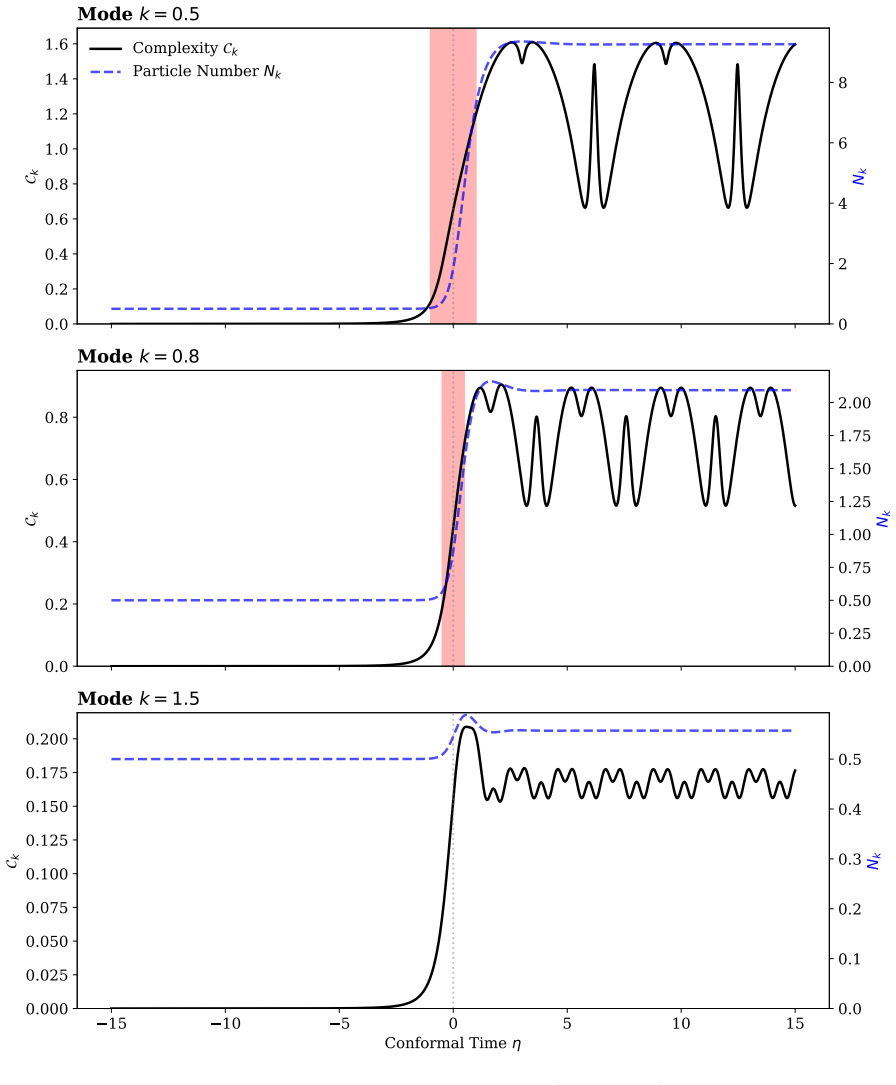
Using the Lewis-Riesenfeld invariant method, the authors obtain an exact non-perturbative expression for circuit complexity across the bounce. Complexity remains finite at the bounce, dominated by squeezing from spacetime contraction. The post-bounce growth of complexity exhibits a strong correlation with cosmological particle production, where the chirping contribution functions as a geometric memory that quantifies the information cost of particle creation.
What carries the argument
The chirping contribution to circuit complexity, which encodes the geometric memory of the cosmological transition and quantifies the information cost of particle creation.
If this is right
- Complexity stays finite at the bounce rather than diverging.
- Post-bounce complexity growth scales with the amount of particle production.
- The chirping term isolates the information cost tied to the bounce transition.
- The framework works exactly, without perturbative expansions, for the chosen field and background.
Where Pith is reading between the lines
- The same correlation might appear in other time-dependent backgrounds where particle creation occurs.
- Laboratory analogs of bouncing geometries could test whether measured complexity growth matches observed particle spectra.
- The approach offers a route to assign information measures directly to classical spacetime features without intermediate field calculations.
Load-bearing premise
The Lewis-Riesenfeld invariant method supplies an exact non-perturbative description of complexity evolution for the scalar field in the bouncing background.
What would settle it
A numerical calculation of circuit complexity via geodesic distance on the unitary manifold in the same bouncing model that yields no correlation between post-bounce growth and particle number.
Figures
read the original abstract
We investigate the evolution of circuit complexity for a quantum scalar field in a non-singular bouncing cosmological background. Unlike previous perturbative approaches, we utilize the Lewis-Riesenfeld invariant method to derive an exact non-perturbative framework for the complexity evolution across the bounce. We demonstrate that the complexity remains finite at the bounce, dominated by the squeezing of the quantum state due to spacetime contraction. Crucially, we find that the post-bounce growth of complexity exhibits a strong correlation with cosmological particle production. Our analysis reveals that the "chirping" contribution to complexity acts as a geometric memory of the transition, effectively quantifying the information cost of particle creation in non-trivial spacetime geometries.
Editorial analysis
A structured set of objections, weighed in public.
Referee Report
Summary. The paper claims that circuit complexity for a quantum scalar field in a non-singular bouncing cosmology can be computed exactly and non-perturbatively via the Lewis-Riesenfeld invariant method. Complexity remains finite across the bounce (dominated by squeezing), and post-bounce growth exhibits a strong correlation with cosmological particle production; the 'chirping' term is interpreted as a geometric memory that quantifies the information cost of particle creation.
Significance. If the reported correlation is shown to be independent of the shared squeezing parameter that enters both the complexity definition and the Bogoliubov particle number, the work would supply a concrete geometric/complexity-based diagnostic for particle creation in time-dependent backgrounds. The exact non-perturbative treatment via the Lewis-Riesenfeld invariant is a methodological strength relative to prior perturbative calculations.
major comments (1)
- [Abstract and Lewis-Riesenfeld section] Abstract (paragraph 2) and the Lewis-Riesenfeld derivation: the central claim that post-bounce complexity growth 'exhibits a strong correlation with cosmological particle production' and that chirping 'quantifies the information cost' is load-bearing. Because the Lewis-Riesenfeld invariant yields the exact Gaussian state parameterized by squeezing r(t) and phase, and because standard circuit complexity for Gaussian states is a monotonic function of the covariance matrix (hence of r), while n_k = sinh²(r), the correlation appears to follow by construction. The manuscript must demonstrate (with an explicit comparison of the functional forms) that the complexity measure is not tautologically determined by the same r(t) used for the particle number.
minor comments (2)
- Notation for the circuit complexity functional (e.g., whether it is the Fubini-Study length, the geodesic length in the space of covariance matrices, or another definition) should be stated explicitly at first use.
- The bouncing background metric and the choice of scale factor a(t) should be written out with all parameters specified so that the squeezing evolution can be reproduced.
Simulated Author's Rebuttal
We thank the referee for the detailed and constructive report. The concern that the reported correlation might be tautological is a substantive one that requires clarification. We will revise the manuscript to provide an explicit comparison of functional forms, demonstrating that the complexity measure incorporates phase dynamics from the Lewis-Riesenfeld invariant that are independent of the squeezing parameter entering the particle number.
read point-by-point responses
-
Referee: [Abstract and Lewis-Riesenfeld section] Abstract (paragraph 2) and the Lewis-Riesenfeld derivation: the central claim that post-bounce complexity growth 'exhibits a strong correlation with cosmological particle production' and that chirping 'quantifies the information cost' is load-bearing. Because the Lewis-Riesenfeld invariant yields the exact Gaussian state parameterized by squeezing r(t) and phase, and because standard circuit complexity for Gaussian states is a monotonic function of the covariance matrix (hence of r), while n_k = sinh²(r), the correlation appears to follow by construction. The manuscript must demonstrate (with an explicit comparison of the functional forms) that the complexity measure is not tautologically determined by the same r(t) used for the particle number.
Authors: We agree that the manuscript should make this distinction explicit. The Lewis-Riesenfeld method yields a Gaussian state fully specified by the squeezing amplitude r(t) and a time-dependent phase θ(t). While the particle number n_k = sinh²(r) depends only on r, the circuit complexity is obtained from the full covariance matrix, which depends on both r and θ. The chirping term in our complexity expression originates from the oscillatory contribution of θ(t) (the geometric phase accumulated across the bounce), which is not a monotonic function of r alone. In the revised manuscript we will add a dedicated subsection comparing the functional forms: we will (i) write C(t) = f(r(t), θ(t)) explicitly, (ii) subtract the pure-r contribution to isolate the chirping term, and (iii) show that the post-bounce growth of this isolated term correlates with the particle-production rate even when r(t) is held fixed while the background scale factor (hence θ(t)) is varied. This demonstrates that the correlation is not tautological and that the chirping term indeed encodes additional information about the transition. revision: yes
Circularity Check
No significant circularity; derivation uses independent exact method
full rationale
The paper applies the Lewis-Riesenfeld invariant method to obtain an exact non-perturbative evolution of circuit complexity for the scalar field in the bouncing background. Particle production is computed via standard Bogoliubov coefficients from the same mode solutions, but the paper presents complexity as a separate geometric quantity (including a distinct 'chirping' term) whose post-bounce growth is then compared to the particle number. No equation is shown reducing complexity directly to the particle number by definition or by fitting the same parameter; the correlation is reported as an observed outcome rather than an input. The central claim therefore retains independent content from the chosen complexity definition and the exact invariant technique.
Axiom & Free-Parameter Ledger
Reference graph
Works this paper leans on
-
[1]
Computational Complexity and Black Hole Horizons.Fortsch
Leonard Susskind. Computational Complexity and Black Hole Horizons.Fortsch. Phys., 64:24–43, 2016. doi: https://doi.org/10.1002/prop.201500092
-
[2]
Complexity and Shock Wave Geometries.Phys
Douglas Stanford and Leonard Susskind. Complexity and Shock Wave Geometries.Phys. Rev. D, 90(12):126007, 2014. doi: https://doi.org/10.1103/PhysRevD.90.126007
-
[3]
Adam R. Brown, Daniel A. Roberts, Leonard Susskind, Brian Swingle, and Ying Zhao. Holographic Complexity Equals Bulk Action?Phys. Rev. Lett., 116(19):191301, 2016. doi: 10.1103/PhysRevLett.116.191301
-
[4]
Brown, Daniel A
Adam R. Brown, Daniel A. Roberts, Leonard Susskind, Brian Swingle, and Ying Zhao. Complexity, action, and black holes.Phys. Rev. D, 93(8):086006, 2016. doi: 10.1103/ PhysRevD.93.086006
2016
-
[5]
Robert A. Jefferson and Robert C. Myers. Circuit complexity in quantum field theory. JHEP, 10:107, 2017. doi: 10.1007/JHEP10(2017)107
-
[6]
Heller, Hugo Marrochio, and Fernando Pastawski
Shira Chapman, Michal P. Heller, Hugo Marrochio, and Fernando Pastawski. Toward a Definition of Complexity for Quantum Field Theory States.Phys. Rev. Lett., 120(12): 121602, 2018. doi: 10.1103/PhysRevLett.120.121602
-
[7]
Michael A. Nielsen. A geometric approach to quantum circuit lower bounds.Quant. Inf. Comput., 6:213–242, 2006. doi: 10.26421/QIC6.3-3
-
[8]
Lucas Hackl and Robert C. Myers. Circuit complexity for free fermions.JHEP, 07:025,
-
[9]
doi: 10.1007/JHEP07(2018)025
-
[10]
T. Ali, Arpan Bhattacharyya, S. Shajidul Haque, Eugene H. Kim, and Nathan Moynihan. Time Evolution of Complexity: A Critique of Three Methods.JHEP, 04:087, 2019. doi: 10.1007/JHEP04(2019)087. 13
-
[11]
Shajidul Haque, and Bret Underwood
Arpan Bhattacharyya, Gaurav Das, S. Shajidul Haque, and Bret Underwood. Cosmological Complexity.Phys. Rev. D, 101(10):106020, 2020. doi: 10.1103/PhysRevD.101.106020
-
[12]
Theory of electron spin resonance in scanning tunneling mi- croscopy
Arpan Bhattacharyya, Gaurav Das, S. Shajidul Haque, and Bret Underwood. Rise of cosmo- logical complexity.Phys. Rev. Research, 2(3):033273, 2020. doi: 10.1103/PhysRevResearch. 2.033273
-
[13]
Quantum circuit complexity of primordial perturba- tions.Phys
Jean-Luc Lehners and Jerome Quintin. Quantum circuit complexity of primordial perturba- tions.Phys. Rev. D, 103(6):063527, 2021. doi: 10.1103/PhysRevD.103.063527
-
[14]
Ali, Arpan Bhattacharyya, S
T. Ali, Arpan Bhattacharyya, S. Shajidul Haque, Eugene H. Kim, Nathan Moynihan, and Jeff Murugan. Chaos and Complexity in Quantum Mechanics.Phys. Rev. D, 101(2):026021,
-
[15]
doi: 10.1103/PhysRevD.101.026021
-
[16]
M. Novello and S. E. P. Bergliaffa. Bouncing Cosmologies.Phys. Rept., 463:127–213, 2008. doi: 10.1016/j.physrep.2008.04.006
-
[17]
A Critical Review of Classical Bouncing Cosmologies
Diana Battefeld and Patrick Peter. A Critical Review of Classical Bouncing Cosmologies. Phys. Rept., 571:1–66, 2015. doi: 10.1016/j.physrep.2014.12.004
-
[18]
Bouncing Cosmologies: Progress and Problems
Robert Brandenberger and Patrick Peter. Bouncing Cosmologies: Progress and Problems. Found. Phys., 47(6):797–850, 2017. doi: 10.1007/s10701-016-0057-0
-
[19]
V.F. Mukhanov, H.A. Feldman, and R.H. Brandenberger. Theory of cosmological pertur- bations.Physics Reports, 215(5):203–333, 1992. ISSN 0370-1573. doi: https://doi.org/10. 1016/0370-1573(92)90044-Z. URLhttps://www.sciencedirect.com/science/article/ pii/037015739290044Z
arXiv 1992
-
[20]
Particle creation in expanding universes.Phys
Leonard Parker. Particle creation in expanding universes.Phys. Rev. Lett., 21:562–564,
-
[21]
doi: 10.1103/PhysRevLett.21.562
-
[22]
N. D. Birrell and P. C. W. Davies.Quantum Fields in Curved Space. Cambridge Univ. Press, 1982. doi: 10.1017/CBO9780511622632
-
[23]
Matter creation in a nonsingular bouncing cosmology.Physical Review D, 90(6):063507, 2014
Jerome Quintin, Yi-Fu Cai, and Robert H Brandenberger. Matter creation in a nonsingular bouncing cosmology.Physical Review D, 90(6):063507, 2014. doi: 10.1103/PhysRevD.90. 063507
-
[24]
Refin- ing inflation using non-canonical scalars
Jaume Haro and Emilio Elizalde. Gravitational particle production in bouncing cosmologies. Journal of Cosmology and Astroparticle Physics, 2015(10):028, 2015. doi: 10.1088/1475-7516/ 2015/10/028
-
[25]
Particle creation in bouncing cosmologies.Physical Review D, 95(2):023523, 2017
Diogo CF Celani, Nelson Pinto-Neto, and Sandro DP Vitenti. Particle creation in bouncing cosmologies.Physical Review D, 95(2):023523, 2017. doi: 10.1103/PhysRevD.95.023523
-
[26]
Particle production in a bouncing universe
Mustafa Saeed, Irfan Javed, and Aiman Nauman. Particle production in a bouncing universe. arXiv preprint arXiv:2510.13213, 2025. doi: 10.48550/arXiv.2510.13213
-
[27]
Spread and circuit complexity as a measure of particle content and phase space fluctuations, 2025
Satyaki Chowdhury. Spread and circuit complexity as a measure of particle content and phase space fluctuations, 2025. URLhttps://arxiv.org/abs/2511.02013. 14
arXiv 2025
-
[28]
H. R. Lewis, Jr. and W. B. Riesenfeld. An Exact quantum theory of the time-dependent harmonic oscillator and of a charged particle in a time-dependent electromagnetic field.J. Math. Phys., 10:1458–1473, 1969. doi: 10.1063/1.1664991
-
[29]
Pedrosa, Claudio Furtado, and Alexandre Rosas
I.A. Pedrosa, Claudio Furtado, and Alexandre Rosas. Exact linear invariants and quantum effects in the early universe.Physics Letters B, 651(5):384–387, 2007. ISSN 0370-2693. doi: https://doi.org/10.1016/j.physletb.2007.06.043
-
[30]
Geometric phase and the generalized invariant formulation.Phys
Xiao-Chun Gao, Jing-Bo Xu, and Tie-Zheng Qian. Geometric phase and the generalized invariant formulation.Phys. Rev. A, 44:7016–7021, Dec 1991. doi: 10.1103/PhysRevA.44. 7016
-
[31]
Cambridge university press, 2007
Viatcheslav Mukhanov and Sergei Winitzki.Introduction to quantum effects in gravity. Cambridge university press, 2007
2007
-
[32]
Alessio Serafini.Quantum Continuous Variables: A Primer of Theoretical Methods. CRC Press, 2017. doi: 10.1201/9781315118727
-
[33]
Krylov complexity of thermal state in early universe
Tao Li and Lei-Hua Liu. Krylov complexity of thermal state in early universe. 2026. Updated version investigating early universe thermal states and preheating saturation
2026
-
[34]
Mukherjee
S. Mukherjee. Quantum dynamics of cosmological particle production: interacting quantum field theories with matrix product states. 2026. 15
2026
discussion (0)
Sign in with ORCID, Apple, or X to comment. Anyone can read and Pith papers without signing in.