REVIEW 3 major objections 4 minor 45 references
The learnability scaling of quantum states: restricted Boltzmann machines
T0 review · 3 major / 4 minor · reviewed 2026-08-14 · deepseek-v4-flash
Pith's one-line read A restricted Boltzmann machine learning the critical transverse-field Ising ground state needs a number of weights that grows quadratically with the qubit count, while the required training data grows only linearly.
desk verdict First systematic empirical scaling study for RBM-based quantum state reconstruction, giving useful O(N^2) parameter and O(N) sample benchmarks, but the DMRG data fidelity and missing error bars keep the central scalings conditional. read the letter →
The pith
A machine-rendered reading of the paper's core claim, the machinery that carries it, and where it could break.
The reading
What carries the argument
The load-bearing object is the restricted Boltzmann machine, a bipartite graphical model with energy $E_\lambda(v,h)=-\sum_{ij} W_{ij}v_i h_j - \sum_i b_i v_i - \sum_j c_j h_j$ over visible spin configurations $v$ and hidden units $h$, whose marginal $p_\lambda(v)$ is matched to the measurement distribution; for the positive-real TFIM ground state the wavefunction is $\psi_\lambda(v)=\sqrt{p_\lambda(v)}$ by the Perron-Frobenius theorem. The criterion that makes the scaling measurable is the relative observable error (ROE) $\epsilon$ defined on the energy estimator, including the 99% confidence interval. Counting parameters in the $N\times N_h$ weight matrix turns the observed linear hidden-unit growth $\mathcal{O}(N)$ into the quadratic parameter scaling $\mathcal{O}(N^2)$, and the pruning protocol (set small $|W_{ij}|$ to zero, fine-tune, repeat) is the tool that reveals over-parameterization.
What would settle it
Compare RBM training on the DMRG-generated data with training on data from a genuinely symmetric ground state, for example exact diagonalization up to $N=20$ or a DMRG run with bond dimension large enough that the spin-flip symmetry is restored to machine precision. If the hidden-unit count at $h/J\approx0.8$ drops and the parameter peak moves to $h/J=1$, the reported quadratic scaling describes learning an artifact of the corrupted training data; if the same $\mathcal{O}(N^2)$ scaling survives on faithful data, the claim stands.
Extended reading notes
Core claim
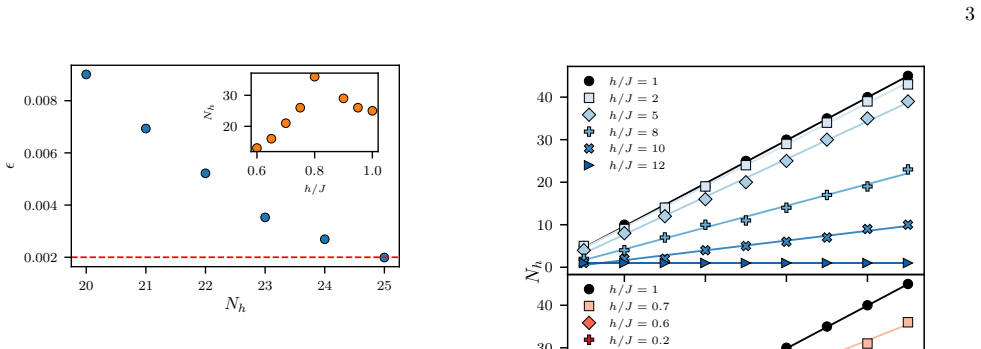
Under a fixed learning criterion—relative energy error below $\epsilon=0.002$ with 99% confidence on the RBM's own Monte Carlo samples—the minimal RBM needed to represent the positive-real transverse-field Ising model ground state has, near the quantum critical point $h/J=1$, a hidden layer of size $N_h \approx N/2$, so the weight matrix contains $\mathcal{O}(N^2)$ parameters; deep in the ferromagnetic or paramagnetic phases the same criterion is met with $\mathcal{O}(1)$ hidden units. With the hidden fraction fixed near $\alpha = N_h/N = 1/2$, the minimum number of independent projective measurements needed to train these weights grows linearly with $N$. After convergence, zeroing the smallest weights followed by brief fine-tuning cuts the required nonzero weights sharply (for $N=40$, from 760 to 119 at criticality), which the authors take as evidence that the RBM's over-parameterization exists to ease the contrastive-divergence optimization rather than to represent the state.
Load-bearing premise
That the simulated measurement data generated with a maximum tensor-network bond dimension of 2000 faithfully represents the true ground state at every system size and field strength studied, even where the expected spin-flip symmetry is absent from the data.
Editorial extensions
If this is right
- At the critical field $h/J=1$, an RBM with $N_h \approx N/2$ hidden units—hence $\mathcal{O}(N^2)$ weights—is needed to reach the energy-error threshold, so the practical cost of reconstructing the state grows quadratically with qubit count.
- The sample complexity at criticality grows only linearly with $N$, matching the PAC-learning scaling for predicting measurement outcomes; full tomography's exponential cost is not needed for this energy-estimation task.
- Deep inside the ferromagnetic and paramagnetic phases the required hidden-unit count stays $\mathcal{O}(1)$, so only states near criticality drive the quadratic resource demand.
- Many trained weights are redundant: pruning plus brief fine-tuning cuts the required nonzero weights sharply (e.g., from 760 to 119 at $N=40$), so over-parameterization serves the optimization procedure rather than the representational capacity of the state.
Reading between the lines
- If the DMRG bond-dimension limitation is the cause of the anomalous peak at $h/J \approx 0.8$, then increasing the bond dimension until the expected Z2 symmetry is restored should shift the hardest-to-learn region to the critical point $h/J=1$; this is my inference, not a claim of the paper.
- The paper's energy-based criterion likely undercounts resources needed for stronger notions of accuracy: requiring fidelity or correlation-function convergence would plausibly push the required hidden-unit count above $N/2$; the paper itself lists this caveat.
- Because pruning reduces the active weights substantially, an alternative parameterization with fewer explicit weights (e.g., an autoregressive architecture) may achieve the same energy accuracy with sub-quadratic parameters at criticality; the current data do not settle that.
- The over-parameterization finding suggests RBM training difficulty, not state complexity, sets the observed $\mathcal{O}(N^2)$ scaling; a direct test would be to vary the optimizer or initialization and see whether the minimal hidden-unit count moves, which the paper does not do.
Signed reviews
Editorial analysis
A structured set of objections, weighed in public.
Referee Report
Summary. The paper studies how the resources required to reconstruct a positive-real quantum wavefunction with a restricted Boltzmann machine (RBM) scale with system size. Training data are projective measurements in the sigma_z basis sampled from DMRG-MPS simulations of the one-dimensional transverse-field Ising model, and the learning criterion is a fixed upper bound on the relative error of the RBM energy estimator. The authors report that, near the quantum critical point, the minimum number of hidden units grows linearly in the number of qubits N, implying an O(N^2) growth in the number of RBM weights, while the sample complexity grows linearly in N. They also show that pruning small weights after training can substantially reduce the number of parameters while retaining the same energy accuracy, which they interpret as evidence that over-parameterization aids stochastic optimization.
Significance. If the reported scaling laws are correct, they provide concrete guidance for practical quantum-state reconstruction with RBMs on near-term devices: the energy can be learned with O(N^2) parameters and O(N) samples at criticality, a much gentler resource growth than full tomography. The paper is commendably explicit in defining a learning criterion and in benchmarking against DMRG-computed energies rather than against the RBM's own training objective, and the pruning results are a useful empirical observation about the role of over-parameterization. The consistency with Aaronson's PAC-learning picture is suggestive, although the authors are appropriately careful in framing it as consistency rather than a proof. The main weaknesses are that the fidelity of the DMRG training data itself is not independently established, and the asymptotic scaling claims rest on fits whose statistical quality is not reported.
major comments (3)
- [Section III A and Appendix] The training target is a DMRG-MPS distribution with bond dimension 2000, but the paper does not establish that this distribution faithfully represents the true TFIM ground state for all N and h studied. This concern is raised by the authors themselves: the required hidden-unit count peaks at h/J about 0.8 rather than at h/J=1, and the Appendix states that the expected Z2 symmetry is not realized for large N at low transverse field, with both effects attributed to the DMRG data. Because the scaling fits in Fig. 2 include h/J=0.6 and 0.7, at least part of the claimed linear growth in Nh(N) may be the cost of fitting a symmetry-broken, truncated MPS distribution rather than the physics of the TFIM. The authors should add explicit bond-dimension convergence checks (for example, repeating the dataset generation with chi=500, 1000, and 2000 and comparing energies, magnetizations, and sampled sigma_z statistics), and either restrict the scaling analysis to parameter regions where the DMRG target is demonstrably converged or show that the scaling conclusions are insensitive to the truncation.
- [Section III A, Fig. 2] The central O(N^2) parameter-scaling claim is an extrapolation from fits over N up to about 100, yet the fit parameters, confidence intervals, and residuals are not reported, and the Nh values are shown without error bars. Without these details the reader cannot assess whether the apparent linear growth in Nh persists asymptotically or is contaminated by finite-size curvature. Please report the fitted slope and intercept with uncertainties for each h/J value, the exact range of N used in each fit, and a stability check as the maximum system size is varied.
- [Section III B, Fig. 4] The sample-complexity claim M ~ N is based on increasing M in steps of 2500 until the ROE criterion is met and then averaging over initial conditions, but the number of trials, the spread across initializations, and the fit to M(N) are not reported. The central linear-scaling result needs at least error bars and, ideally, the fits for each fixed alpha = Nh/N, so the reader can gauge the significance of the linear dependence and the role of the alpha = 1/2 choice.
minor comments (4)
- [Section II B, Eq. (5)] The definition of the ROE involves a Gaussian confidence interval, but the number of RBM samples n used in the estimator is never specified in the text; please state the value of n and check that the 99% confidence statement is robust to the choice.
- [Section III A, Fig. 2] The upper and lower panels both include h/J = 1, which makes the figure slightly redundant and may confuse readers; consider plotting all field values in one panel or clearly labeling the duplicated curve.
- [Section III C, Table I] The pruning results are reported only for N up to 40, and the text notes that rare pruning events can seriously alter the ROE; please state how many independent training runs were used and quote a range or standard deviation for the pruned weight counts.
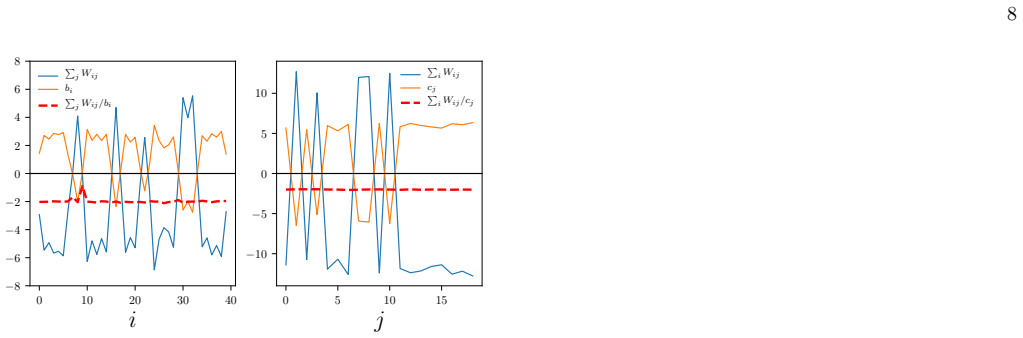
- [Appendix] The derivation of the bias-to-weight ratios in Eqs. (7) and (8) assumes that the RBM actually realizes the Z2-symmetric parameterization, but Fig. 5 shows only approximate agreement near -2; a sentence quantifying the observed deviations would be helpful.
Circularity Check
No significant circularity: the scaling laws are empirical measurements against an external DMRG benchmark, not outputs of a fit or a self-citation chain.
full rationale
The paper's central scaling claims are empirical observations. The RBM is trained by minimizing KL divergence via contrastive divergence, and the hidden-unit count at which the energy ROE falls below epsilon = 0.002 is measured against external DMRG energies. This is not a self-definitional loop because the energy is not a training target; it is evaluated post hoc on the trained model. The sample-complexity scaling is likewise measured by increasing M until the same external energy criterion is met. The paper explicitly compares its linear sample complexity to Aaronson's independent PAC-learning theorem, and the DMRG data come from ITensor, an external library. The only self-references are the use of the authors' own QuCumber package and prior RBM-state-reconstruction papers (e.g., Ref. [2]), but these are implementation/tooling citations and are not load-bearing for the scaling conclusions. The acknowledged limitation that DMRG bond dimension 2000 may break Z2 symmetry below certain fields is a data-fidelity or correctness caveat, not a circularity: it concerns whether the learned distribution is the true ground state, not whether the derivation reduces to its inputs. No equation in the paper is shown to be equivalent by construction to a fitted parameter, and no uniqueness theorem or ansatz is imported from the authors' prior work to force the observed scalings.
Assumptions & free parameters
free parameters (2)
- Relative observable error threshold epsilon =
0.002
- Pruning schedule fractions =
40% of nonzero weights in the first iteration, then 5% per iteration
assumptions (3)
- standard math Perron-Frobenius theorem guarantees the TFIM ground state has a positive-real wavefunction in the computational basis, enabling a direct mapping to a probability distribution.
- domain assumption DMRG simulations with maximum bond dimension 2000 produce training data and exact energies that faithfully represent the true ground state for all N and h studied.
- domain assumption Training samples are drawn independently from the target measurement distribution, matching the setting of Aaronson's PAC-learning theorem.
Cite this review
Pith. "Pith review of The learnability scaling of quantum states: restricted Boltzmann machines." pith.science (2026). https://pith.science/paper/OQ4JXTEU
@misc{pith2026190807532,
  author       = {Pith},
  title        = {Pith review of: The learnability scaling of quantum states: restricted Boltzmann machines},
  year         = {2026},
  howpublished = {\url{https://pith.science/paper/OQ4JXTEU}},
  note         = {Machine review of arXiv:1908.07532}
}
read the original abstract
Generative modeling with machine learning has provided a new perspective on the data-driven task of reconstructing quantum states from a set of qubit measurements. As increasingly large experimental quantum devices are built in laboratories, the question of how these machine learning techniques scale with the number of qubits is becoming crucial. We empirically study the scaling of restricted Boltzmann machines (RBMs) applied to reconstruct ground-state wavefunctions of the one-dimensional transverse-field Ising model from projective measurement data. We define a learning criterion via a threshold on the relative error in the energy estimator of the machine. With this criterion, we observe that the number of RBM weight parameters required for accurate representation of the ground state in the worst case - near criticality - scales quadratically with the number of qubits. By pruning small parameters of the trained model, we find that the number of weights can be significantly reduced while still retaining an accurate reconstruction. This provides evidence that over-parametrization of the RBM is required to facilitate the learning process.
Figures


Figures from the paper (1 more)
Reference graph
Works this paper leans on
-
[1]
3, with Nh = 1 2N for h/J = 1)
Start from the original, converged trained model (e.g., Fig. 3, with Nh = 1 2N for h/J = 1)
-
[2]
If a given|Wij| < δ, set Wij = 0, and freeze it for the following steps
Set a threshold δ for the weight magnitudes. If a given|Wij| < δ, set Wij = 0, and freeze it for the following steps
-
[3]
Fine-tune the pruned model by running several more training iterations until the desired accuracy (as defined by the ROE learning criterion) is re- stored
-
[4]
Repeat steps 2-4, pruning additional weights until the model fails to fulfill the learning criterion. We choose the pruning threshold such that 40% of the non-zero weights are pruned in the first iteration, and 5% of the non-zero weights in each following iteration. Note also that in this procedure we do not prune biases (see the Appendix for further commen...
- [5]
- [6]
-
[7]
J. Carrasquilla, G. Torlai, R. G. Melko, and L. Aolita, Nature Machine Intelligence 1, 155 (2019)
work page 2019
-
[8]
J. Chen, S. Cheng, H. Xie, L. Wang, and T. Xiang, Phys. Rev. B 97, 085104 (2018)
work page 2018
Show all 45 references
- [9]
-
[10]
Carleo, Y
G. Carleo, Y. Nomura, and M. Imada, Nature Commu- nications 9, 5322 (2018)
2018
-
[11]
Carleo and M
G. Carleo and M. Troyer, Science 355, 602 (2017)
2017
-
[12]
Torlai, B
G. Torlai, B. Timar, E. P. van Nieuwenburg, H. Levine, A. Omran, A. Keesling, H. Bernien, M. Greiner, V. Vuleti, M. D. Lukin, R. G. Melko, and M. Endres, (2019), arXiv:1904.08441
2019 arXiv
- [13]
-
[14]
R. G. Melko, G. Carleo, J. Carrasquilla, and J. I. Cirac, Nature Physics (2019)
2019
-
[15]
Carleo, I
G. Carleo, I. Cirac, K. Cranmer, L. Daudet, M. Schuld, N. Tishby, L. Vogt-Maranto, and L. Zdeborova, (2019), arXiv:1903.10563
2019 arXiv
-
[16]
Czischek, J
S. Czischek, J. M. Pawlowski, T. Gasenzer, and M. Gart- tner, (2019), arXiv:1907.12844
2019 arXiv
-
[17]
Paris and J
M. Paris and J. Rehacek, eds., Quantum State Estima- tion, Lecture Notes in Physics, Vol. 649 (Springer-Verlag Berlin Heidelberg, 2004)
2004
-
[18]
A. W. Sandvik, Phys. Rev. E 68, 056701 (2003)
2003
-
[19]
E. M. Inack, G. Giudici, T. Parolini, G. Santoro, and S. Pilati, Phys. Rev. A 97, 032307 (2018)
2018
-
[20]
Vidal, Phys
G. Vidal, Phys. Rev. Lett. 99, 220405 (2007)
2007
-
[21]
W. W. Ho and T. H. Hsieh, SciPost Phys. 6, 29 (2019). 7
2019
-
[22]
W. W. Ho, C. Jonay, and T. H. Hsieh, Phys. Rev. A 99, 052332 (2019)
2019
-
[23]
M. J. S. Beach, R. G. Melko, T. Grover, and T. H. Hsieh, (2019), arXiv:1904.00019
2019 arXiv
-
[24]
A. J. Ferris and G. Vidal, Phys. Rev. B 85, 165146 (2012)
2012
-
[25]
ITensor Library (version 2.0.11) http://itensor.org
-
[26]
D. H. Ackley, G. E. Hinton, and T. J. Sejnowski, Cog- nitive Science 9, 147 (1985)
1985
-
[27]
G. E. Hinton, Neural Computation 14, 1771 (2002), https://doi.org/10.1162/089976602760128018
2002 doi
-
[28]
M. J. S. Beach, I. D. Vlugt, A. Golubeva, P. Huembeli, B. Kulchytskyy, X. Luo, R. G. Melko, E. Merali, and G. Torlai, SciPost Phys. 7, 9 (2019)
2019
-
[29]
Aaronson, Proc
S. Aaronson, Proc. R. Soc. A 463 (2007)
2007
-
[30]
Livni, S
R. Livni, S. Shalev-Shwartz, and O. Shamir, CoRR abs/1410.1141 (2014), arXiv:1410.1141
2014 arXiv
- [31]
- [32]
-
[33]
K. A. Sankararaman, S. De, Z. Xu, W. R. Huang, and T. Goldstein, (2019), arXiv:1904.06963
2019 arXiv
-
[34]
Easing non-convex opti- mization with neural networks,
D. Lopez-Paz and L. Sagun, “Easing non-convex opti- mization with neural networks,” (2018)
2018
-
[35]
S. Han, J. Pool, J. Tran, and W. Dally, in Advances in Neural Information Processing Systems 28 , edited by C. Cortes, N. D. Lawrence, D. D. Lee, M. Sugiyama, and R. Garnett (Curran Associates, Inc., 2015) pp. 1135– 1143
2015
-
[36]
D. C. Mocanu, E. Mocanu, P. H. Nguyen, M. Gibescu, and A. Liotta, Machine Learning 104, 243 (2016)
2016
-
[37]
Gao and L.-M
X. Gao and L.-M. Duan, Nature Communications 8, 662 (2017)
2017
-
[38]
Glasser, N
I. Glasser, N. Pancotti, M. August, I. D. Rodriguez, and J. I. Cirac, Phys. Rev. X 8, 011006 (2018)
2018
- [39]
-
[40]
H. Zhou, J. Lan, R. Liu, and J. Yosinski, (2019), arXiv:1905.01067
2019 arXiv
-
[41]
N. Lee, T. Ajanthan, and P. H. S. Torr, (2018), arXiv:1810.02340
2018 arXiv
-
[42]
Mazurenko, C
A. Mazurenko, C. S. Chiu, G. Ji, M. F. Parsons, M. Kan´ asz-Nagy, R. Schmidt, F. Grusdt, E. Demler, D. Greif, and M. Greiner, Nature 545, 462 EP (2017)
2017
-
[43]
B. P. Lanyon, C. Maier, M. Holz¨ apfel, T. Baumgratz, C. Hempel, P. Jurcevic, I. Dhand, A. S. Buyskikh, A. J. Daley, M. Cramer, M. B. Plenio, R. Blatt, and C. F. Roos, Nature Physics 13, 1158 (2017)
2017
-
[44]
Keesling, A
A. Keesling, A. Omran, H. Levine, H. Bernien, H. Pich- ler, S. Choi, R. Samajdar, S. Schwartz, P. Silvi, S. Sachdev, P. Zoller, M. Endres, M. Greiner, V. Vuletic, and M. D. Lukin, (2018), arXiv:1809.05540
2018 arXiv
-
[45]
occupation
A. Kandala, A. Mezzacapo, K. Temme, M. Takita, M. Brink, J. M. Chow, and J. M. Gambetta, Nature 549, 242 EP (2017). A. Appendix Projective measurement data in the σz basis for the TFIM will generally obey Z2 symmetry in the absence of symmetry breaking, which may occur due to ...
2017
Reviewed August 14, 2026 · model on record in the stance chip above.
Discussion (0). Continue with ORCID to comment.