REVIEW 4 major objections 5 minor 70 references
On the Mechanistic Interpretability of Neural Networks for Causality in Bio-statistics
T0 review · 4 major / 5 minor · reviewed 2026-08-16 · deepseek-v4-flash
Pith's one-line read Mechanistic interpretability tools—probing, ablation, and causal tracing—can open up the neural networks used inside TMLE causal estimators, showing whether a network encodes known confounders and which input pathways drive its estimates.
desk verdict Reproducible probe/ablation proof of concept undermined by an unsupported treatment-pathway claim. read the letter →
The pith
A machine-rendered reading of the paper's core claim, the machinery that carries it, and where it could break.
The reading
What carries the argument
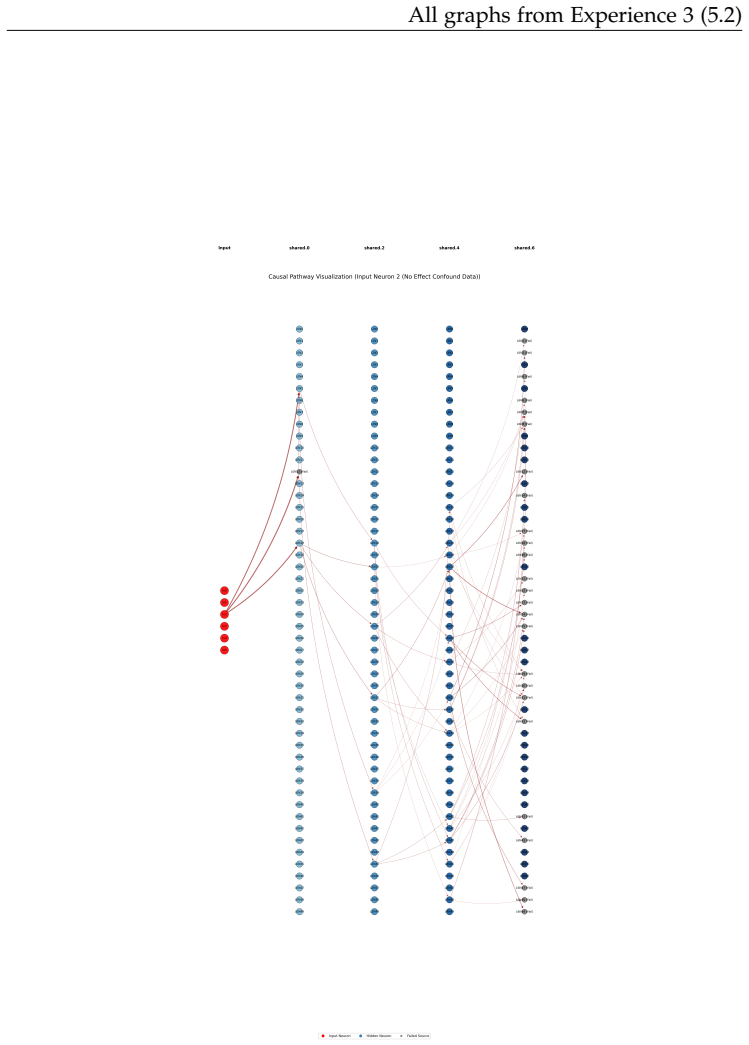
Three interacting tools carry the argument. Linear probing: train a simple regression on activations at each shared layer to predict the known confounder $W_1$, then rank neurons by the magnitude of the probe weights; high probe $R^2$ is evidence the confounder is represented. Neuron ablation: zero the output of the probe-identified neurons during a forward pass and measure how much the $Q$- and $g$-head losses and the TMLE ATE estimate move; larger movement for top-importance neurons is evidence the representation is causally used. Causal tracing: patch the activation of one input neuron, then successively patch downstream neurons whose activation change exceeds a cutoff, building a directed graph of 'impacted' nodes; sparsity, success, and Jaccard-overlap scores turn these graphs into comparable pathway summaries.
What would settle it
Re-run the causal-tracing procedure of Section 5.2 on the same trained networks while sweeping the activation-change cutoff across a plausible range (e.g., from a small fixed value to a high percentile of the null distribution of activation differences induced by patching). If the reported treatment-versus-confounder pathway separation, the success scores, and the Jaccard-overlap structure change qualitatively across cutoffs, the discovered pathways are threshold artifacts. A second check: train the same architecture on a version of DS1 in which the confounder $W_1$ is permuted to break its link to treatment and outcome; if probes still report high $R^2$ for $W_1$ or ablating probe-important neurons still moves the TMLE ATE, the representation-and-ablation claims fail.
Extended reading notes
Core claim
The central claim is that MI techniques—linear probing, neuron ablation, and causal tracing—can be applied to neural networks that estimate nuisance functions in TMLE, and that they reveal something true about how those networks compute. Concretely, the paper shows that a linear probe trained on shared-layer activations recovers the critical confounder $W_1$ with high $R^2$ at every layer; that ablating the neurons most important to that probe shifts the resulting TMLE estimate of the average treatment effect more than ablating random or least-important neurons; and that causal traces started from individual input neurons produce pathway graphs with measurable overlap structure, which the author interprets as evidence that the network processes confounder and treatment information through partly distinct internal routes. The ground truth for these experiments comes from synthetic datasets with known true ATEs (2.0 in the strong-confounder design, 0 in the no-effect design).
Load-bearing premise
The load-bearing premise is that the causal-tracing pathway graphs are not artifacts of an unstated activation-change cutoff: Section 5.2.1 marks downstream neurons as 'failed' whenever their activation change does not exceed a threshold, but the threshold is never specified, so the existence of distinct confounder and treatment pathways depends on an untested tuning choice.
Editorial extensions
If this is right
- Linear probing can serve as a validation check: a TMLE nuisance network that linearly encodes a known confounder passes a minimal test that it has learned the right input structure.
- Ablation of probe-important neurons changes the final ATE estimate, so the internal representation is not a correlation artifact—it is load-bearing for the causal estimate.
- Causal tracing provides a visual and quantitative map of how individual input covariates propagate; treatment and confounder inputs can be compared by pathway overlap rather than by inspecting weights.
- Because the same tools work on any network with shared layers, the approach extends to other nuisance estimators and to longitudinal variants of TMLE.
- If MI validation becomes standard for network-based nuisance estimation, black-box concerns in high-stakes biostatistics shift from 'can we trust it' to 'which confounders are demonstrably used and how'.
Reading between the lines
- A testable next step is to turn the pathway-overlap matrix into a formal diagnostic: under a null model with randomized weights or shuffled inputs, the null distribution of Jaccard overlap between treatment and confounder traces could be estimated, so a reported separation can be tested rather than read off a graph.
- If linear decodability and ablation-sensitivity generalize to real electronic health record data, the same protocol could be used as a pre-deployment audit for any neural nuisance model, flagging networks that encode confounders they should not or fail to encode confounders they must adjust for.
- The probe-importance ranking also suggests a pruning or regularization strategy: neurons that are important for a confounder could be penalized or removed when the goal is to estimate effects invariant to that confounder, though this is a design choice the paper does not explore.
- The author's framing implies a broader claim: MI is not only for frontier models but can serve as a general science-of-models toolkit for statistics, where ground truth about causal structure is often known from the study design.
Signed reviews
Editorial analysis
A structured set of objections, weighed in public.
Referee Report
Summary. This manuscript, a master's thesis, proposes applying mechanistic interpretability (MI) tools to neural networks used for causal inference in biostatistics, specifically multi-task networks that estimate nuisance functions within TMLE. In Experiment 1, linear probes are trained on shared-layer activations to predict a known strong confounder W1, and ablation of the probe-selected neurons is shown to shift the resulting TMLE ATE estimate relative to random and bottom-neuron ablations. Experiments 2 and 3 apply causal tracing from input neurons to generate pathway graphs and Jaccard-overlap matrices, which the paper interprets as revealing distinct computational pathways for confounders versus treatments. The paper concludes that MI can validate nuisance function estimators and reveal how different input covariates are processed, and it claims a third contribution of providing methods to compare mechanisms across statistical, ML, and NN models.
Significance. The work is a useful proof-of-concept that linear probing and ablation can provide external validation of nuisance networks: the experiments use synthetic data with a known true ATE, compare against random and bottom-neuron ablation baselines, and the code is publicly referenced. If the causal-tracing claims were fully supported, the paper would make a modest but real contribution to the emerging practice of auditing black-box causal estimators. The primary experimental evidence for claim (1) is credible; the evidence for claim (2) is not, because treatment information is never patched, and claim (3) is not experimentally addressed.
major comments (4)
- [§5.2.1, §5.3.1, Chapter 6] The causal-tracing experiments patch only input neurons corresponding to covariates W, never the treatment input A; because in fQ,g the treatment A enters only the Q-head (fQ(h_shared,A)) while the shared layers process W, the traced pathways describe how covariates propagate and cannot support the conclusion that the network has distinct 'treatment vs. confounder' pathways. The claim in Chapter 6 that tracing revealed 'how information from different input covariates, such as confounders versus treatment variables, is processed' overreaches the collected data; a treatment-input patch or an explicit head-level intervention would be needed.
- [§5.2.1] The method marks nodes as 'failed' when activation changes do not exceed a threshold, but the threshold is never specified and no sensitivity analysis is reported; because the success score, the edge set in Figures 5.7-5.9, and all overlap computations depend on this threshold, the pathway graphs are not reproducible or interpretable without reporting it.
- [Abstract and §5.1-5.3] The abstract's third claimed contribution—providing methodologies for comparing learned mechanisms across statistical, ML, and NN models—is not realized anywhere in the experiments; Sections 5.1-5.3 study only the NN fQ,g, with no cross-model comparison, and Chapter 6 does not present such a method.
- [§5.1.1 and Appendix 'Experiment 1'] The architecture description is internally inconsistent: §5.1.1 and Table 5.1 refer to shared layers h1 through h8 plus h_shared, while the architecture section states 5 shared layers with 100 units, and the training section reports that 'HIDDEN LAYER = 10 and HIDDEN SIZE = 30' gave the best results; the actual network used in Experiments 1 and 3 is therefore ambiguous, preventing reproducibility.
minor comments (5)
- [Chapter 5 opening] Chapter 5 opens with 'this chapter presents experiments1 applying MI techniques' and refers to 'the previous chapter ??'; fix the broken cross-reference.
- [§5.2.2 and §5.3.2] Figure 5.6 is described in §5.2.2 as the no-effect model and in §5.3.2 as the strong-confounder model; the caption and text should state which dataset the figure corresponds to.
- [Appendix 'All graphs from Experience 3 (5.2)'] The appendix heading 'All graphs from Experience 3 (5.2)' is mislabeled; the figures it contains appear to belong to the Section 5.2 causal-tracing experiments.
- [§5.2.1] Section 5.2.1 contains the typo 'follwi metrics,' and the Success Score definition depends on the unspecified threshold noted in the major comments.
- [§5.1.1 and Appendix 'Training'] The combined loss in Section 5.1.1 uses weights wq and wg, while the appendix reports a single alpha = 0.5; specify the relationship between these quantities.
Circularity Check
No significant circularity: the experiments are benchmarked against synthetic ground truth and controlled ablations, and the main overreach is a scope gap rather than a derivation from inputs.
full rationale
The paper's central derivation chain is externally anchored. In Experiment 1, the TMLE nuisance network is trained on synthetic DS1 with a known true ATE of 2.0, and the ablated-network ATE estimates are compared against this ground truth; this is an external benchmark, not a fitted parameter renamed as a prediction. The probe selects neurons by their linear predictiveness of the confounder W1, but the subsequent ablation is an independent intervention, and the paper includes Bottom-10% and Random-10% ablation controls that reduce the risk that the result is forced by the selection procedure. In Experiments 2 and 3, causal tracing produces pathway visualizations defined by activation-patch impact; these are descriptive outputs of an interventional method, and no quantitative claim is made that reduces to the method's own threshold by construction. The unspecified activation-change threshold is a reproducibility and robustness concern, not circularity. The conclusion that the network has distinct 'treatment vs. confounder pathways' is not actually supported because the treatment input A enters only at the Q-head and is never patched as an input neuron, but that is an overclaim about experimental scope, not a circular derivation. Citations to van der Laan and TMLE are background methodology, not a load-bearing self-citation chain or an imported uniqueness theorem. Therefore no circular step meets the evidentiary bar of the review rules.
Assumptions & free parameters
free parameters (3)
- Combined loss weight alpha =
0.5
- Model architecture (number and size of hidden layers) =
contradictory: 5 layers of 100 units vs 10 layers of 30 units
- Causal-tracing activation-change threshold
assumptions (4)
- domain assumption Linear probe accuracy is a valid measure of how strongly a concept is represented in a layer.
- domain assumption Ablating probe-important neurons and observing output changes identifies causal reliance on the probed concept.
- domain assumption Thresholded causal-tracing graphs faithfully represent the network's computational pathways.
- domain assumption Synthetic data with known ATE is an adequate benchmark for validating NN nuisance estimators in TMLE.
Cite this review
Pith. "Pith review of On the Mechanistic Interpretability of Neural Networks for Causality in Bio-statistics." pith.science (2026). https://pith.science/paper/OQDKP4VR
@misc{pith2026250500555,
  author       = {Pith},
  title        = {Pith review of: On the Mechanistic Interpretability of Neural Networks for Causality in Bio-statistics},
  year         = {2026},
  howpublished = {\url{https://pith.science/paper/OQDKP4VR}},
  note         = {Machine review of arXiv:2505.00555}
}
read the original abstract
Interpretable insights from predictive models remain critical in bio-statistics, particularly when assessing causality, where classical statistical and machine learning methods often provide inherent clarity. While Neural Networks (NNs) offer powerful capabilities for modeling complex biological data, their traditional "black-box" nature presents challenges for validation and trust in high-stakes health applications. Recent advances in Mechanistic Interpretability (MI) aim to decipher the internal computations learned by these networks. This work investigates the application of MI techniques to NNs within the context of causal inference for bio-statistics. We demonstrate that MI tools can be leveraged to: (1) probe and validate the internal representations learned by NNs, such as those estimating nuisance functions in frameworks like Targeted Minimum Loss-based Estimation (TMLE); (2) discover and visualize the distinct computational pathways employed by the network to process different types of inputs, potentially revealing how confounders and treatments are handled; and (3) provide methodologies for comparing the learned mechanisms and extracted insights across statistical, machine learning, and NN models, fostering a deeper understanding of their respective strengths and weaknesses for causal bio-statistical analysis.
Figures


Figures from the paper (19 more)




Reference graph
Works this paper leans on
-
[1]
Angelopoulos Anastasiadiou, Stephen Bates, Michael I. Jordan, and Tijana Zrnic. Prediction-powered inference. 2023. URL https://arxiv.org/abs/2301.09633
arXiv 2023
-
[2]
Martin Arjovsky, L \'e on Bottou, Ishaan Gulrajani, and David Lopez-Paz. Invariant risk minimization. arXiv preprint arXiv:1907.02893, 2019. URL https://arxiv.org/abs/1907.02893
arXiv 1907
-
[3]
Jimmy Lei Ba, Jamie Ryan Kiros, and Geoffrey E. Hinton. Layer normalization. https://arxiv.org/abs/1607.06450, 2016
arXiv 2016
-
[4]
Bang and J
H. Bang and J. M. Robins. Doubly robust estimation in missing data and causal inference models. Biometrics, 61 0 (4): 0 962--973, 2005
2005
-
[5]
Biopharmaceutical industry-sponsored clinical trials: Impact on state economies, 2015
Battelle Memorial Institute . Biopharmaceutical industry-sponsored clinical trials: Impact on state economies, 2015. https://orclinicalresearch.com/wp-content/uploads/2018/12/battelle-2015-study.pdf
work page 2015
-
[6]
Probing classifiers: Promises, shortcomings, and advances
Yonatan Belinkov. Probing classifiers: Promises, shortcomings, and advances. Computational Linguistics, 48 0 (1): 0 207--219, 2022
2022
-
[7]
Random forests
Leo Breiman. Random forests. Machine Learning, 45: 0 5--32, 2001
2001
-
[8]
Trenton Bricken, Collin Templeton, Nicholas Durk, Logan H. Chan, Adam Jermyn, J. D. Chen, Tom Barez, Samuel R. Clayton, Will Gurnee, Cameron Hume, Najib Salim, Tom Henighan, Clark Olsson, Daniel M. Cummings, Brian Hubinger, Cem Anil, Jason Hawkins, Amanda Askell, Nelson Callahan, Robert Huben, Nelson Elhage, and Chris Olah. Sparse autoencoders find highly...
arXiv 2023
Show all 70 references
-
[9]
Brown, Benjamin Mann, Nick Ryder, Melanie Subbiah, Jared Kaplan, Prafulla Dhariwal, Arvind Neelakantan, Pranav Shyam, Girish Sastry, Amanda Askell, et al
Tom B. Brown, Benjamin Mann, Nick Ryder, Melanie Subbiah, Jared Kaplan, Prafulla Dhariwal, Arvind Neelakantan, Pranav Shyam, Girish Sastry, Amanda Askell, et al. Language models are few-shot learners. Advances in Neural Information Processing Systems, 33, 2020
2020
-
[10]
Causal scrubbing: a method for rigorously testing interpretability hypotheses
Lawrence Chan, Adrià Garriga-Alonso, Nicholas Goldowsky-Dill, Ryan Greenblatt, Jenny Nitishinskaya, Ansh Radhakrishnan, Buck Shlegeris, and Nate Thomas. Causal scrubbing: a method for rigorously testing interpretability hypotheses. AI Alignment Forum, 2022
2022
-
[11]
D. R. Cox. Regression models and life-tables. Journal of the Royal Statistical Society. Series B (Methodological), 34 0 (2): 0 187--220, 1972
1972
-
[12]
George V. Cybenko. Approximation by superpositions of a sigmoidal function. Mathematics of Control, Signals and Systems, 2: 0 303--314, 1989
1989
-
[13]
Transcoders find interpretable llm feature circuits
Jacob Dunefsky, Philippe Chlenski, and Neel Nanda. Transcoders find interpretable llm feature circuits. Advances in Neural Information Processing Systems 37 (NeurIPS 2024), 2024
2024
-
[14]
A mathematical framework for transformer circuits
Nelson Elhage, Neel Nanda, Catherine Olsson, Tom Henighan, Nicholas Joseph, Ben Mann, Amanda Askell, Yuntao Bai, Anna Chen, Tom Conerly, Nova DasSarma, Dawn Drain, Deep Ganguli, Zac Hatfield-Dodds, Danny Hernandez, Andy Jones, Jackson Kernion, Liane Lovitt, Kamal Ndousse, Dari...
2021
-
[15]
Data on notable ai models, 2024
Epoch AI . Data on notable ai models, 2024. URL https://epoch.ai/data/notable-ai-models. Accessed: 2025-03-19
2024
-
[16]
Modern robust statistical methods: an easy way to maximize the accuracy and power of your research
David M Erceg-Hurn and V Mark Mirosevich. Modern robust statistical methods: an easy way to maximize the accuracy and power of your research. Behavior Research Methods, 40 0 (4): 0 898--917, 2008. doi:10.3758/BRM.40.4.898. URL https://pubmed.ncbi.nlm.nih.gov/18855490/
2008
-
[17]
Balance regularized neural network models for causal effect estimation
Mehrdad Farajtabar, Andrew Lee, Yuanjian Feng, Vishal Gupta, Peter Dolan, and Harish. Balance regularized neural network models for causal effect estimation. arXiv preprint arXiv:2011.11199, 2020. URL https://arxiv.org/abs/2011.11199
2011 arXiv
-
[18]
Schapire
Yoav Freund and Robert E. Schapire. A decision-theoretic generalization of on-line learning and an application to boosting. Journal of Computer and System Sciences, 55 0 (1): 0 119--139, August 1997
1997
-
[19]
Friedman
Jerome H. Friedman. Greedy function approximation: a gradient boosting machine. Annals of Statistics, pages 1189--1232, 2001
2001
-
[20]
Scaling and evaluating sparse autoencoders
Leo Gao, Tom Dupr \'e la Tour, Henk Tillman, Gabriel Goh, Rajan Troll, Alec Radford, Ilya Sutskever, Jan Leike, and Jeffrey Wu. Scaling and evaluating sparse autoencoders. arXiv preprint arXiv:2406.04093, 2024. URL https://arxiv.org/abs/2406.04093. Work from OpenAI
2024 arXiv
-
[21]
Causal abstractions of neural networks
Atticus Geiger, Zhengxuan Wu, Christopher Potts, Thomas Icard, and Noah D Goodman. Causal abstractions of neural networks. In Advances in Neural Information Processing Systems ( NeurIPS ) , volume 34, pages 10145--10158, 2021. URL https://proceedings.neurips.cc/paper_files/pap...
2021
-
[22]
Inducing causal structure for interpretable neural networks
Atticus Geiger, Thomas Icard, Christopher Potts, and Noah D Goodman. Inducing causal structure for interpretable neural networks. In Advances in Neural Information Processing Systems ( NeurIPS ) , 2022
2022
-
[23]
Deep Learning
Ian Goodfellow, Yoshua Bengio, and Aaron Courville. Deep Learning. MIT Press, Cambridge, MA, 2016
2016
-
[24]
Natural and Political Observations Mentioned in a Following Index, and Made Upon the Bills of Mortality
John Graunt. Natural and Political Observations Mentioned in a Following Index, and Made Upon the Bills of Mortality. Printed by Tho. Roycroft for John Martin, James Allestry, and Tho. Dicas, London, 1662. The first edition was published between January 25 and February 5, 1662
-
[25]
Deep residual learning for image recognition
Kaiming He, Xiangyu Zhang, Shaoqing Ren, and Jian Sun. Deep residual learning for image recognition. arXiv preprint arXiv:1512.03385, 2015
2015 arXiv
-
[26]
Burgess, Xavier Glorot, Matthew M
Irina Higgins, Lo \"i c Matthey, Arka Pal, Christopher P. Burgess, Xavier Glorot, Matthew M. Botvinick, Shakir Mohamed, and Alexander Lerchner. beta-vae: Learning basic visual concepts with a constrained variational framework. In International Conference on Learning Representa...
2017
-
[27]
Denoising diffusion probabilistic models
Jonathan Ho, Ajay Jain, and Pieter Abbeel. Denoising diffusion probabilistic models. In H. Larochelle, M. Ranzato, R. Hadsell, M.F. Balcan, and H. Lin, editors, Advances in Neural Information Processing Systems, volume 33, pages 6840--6851. Curran Associates, Inc., 2020. URL h...
2020
-
[28]
Long short-term memory
Sepp Hochreiter and Jürgen Schmidhuber. Long short-term memory. Neural Computation, 9 0 (8): 0 1735--1780, 1997. doi:10.1162/neco.1997.9.8.1735
1997 doi
-
[29]
An artificial neural network for spatio-temporal bipolar patterns: application to phoneme classification
Toshiteru Homma, Les E Atlas, and Robert J Marks II. An artificial neural network for spatio-temporal bipolar patterns: application to phoneme classification. In Neural information processing systems, pages 31--40, 1987
1987
-
[30]
Multilayer feedforward networks are universal approximators
Kurt Hornik, Maxwell Stinchcombe, and Halbert White. Multilayer feedforward networks are universal approximators. Neural Networks, 2 0 (5): 0 359--366, 1989. ISSN 0893-6080. doi:https://doi.org/10.1016/0893-6080(89)90020-8. URL https://www.sciencedirect.com/science/article/pii...
1989
-
[31]
Maximum mean discrepancy for class ratio estimation
Harish Iyer et al. Maximum mean discrepancy for class ratio estimation. In Proceedings of the 31st International Conference on Machine Learning, volume 32 of PMLR, pages 530--538, 2014. URL https://proceedings.mlr.press/v32/iyer14.html
2014
-
[32]
Johansson, Uri Shalit, and David Sontag
Fredrik D. Johansson, Uri Shalit, and David Sontag. Learning representations for counterfactual inference. In Proceedings of The 33rd International Conference on Machine Learning, volume 48 of Proceedings of Machine Learning Research, pages 3020--3029, 2016. URL http://proceed...
2016
-
[33]
Highly accurate protein structure prediction with AlphaFold
John Jumper, Richard Evans, Alexander Pritzel, Tim Green, Michael Figurnov, Olaf Ronneberger, Kathryn Tunyasuvunakool, Russ Bates, Augustin Z \' dek, Anna Potapenko, Alex Bridgland, Clemens Meyer, Simon A A Kohl, Andrew J Ballard, Andrew Cowie, Bernardino Romera-Paredes, Stani...
2021
-
[34]
Linear representations of political perspective emerge in large language models
Junsol Kim, James Evans, and Aaron Schein. Linear representations of political perspective emerge in large language models. arXiv preprint arXiv:2503.02080, 2025. URL https://arxiv.org/abs/2503.02080
2025 arXiv
-
[35]
Kingma and Max Welling
Diederik P. Kingma and Max Welling. Auto-encoding variational bayes. CoRR, abs/1312.6114, 2013
2013 arXiv
-
[36]
Using multiple imputation to deal with missing data and attrition in longitudinal studies with patient-reported outcomes
Mette Madsen, Bjarne Christensen, Mette T H ybye, Flemming Olesen, and Bodil Nielsen. Using multiple imputation to deal with missing data and attrition in longitudinal studies with patient-reported outcomes. Patient Related Outcome Measures, 6: 0 15--25, 2015. doi:10.2147/PROM...
2015 doi
-
[37]
Auditing language models for hidden objectives, 2025
Samuel Marks, Johannes Treutlein, Trenton Bricken, Jack Lindsey, Jonathan Marcus, Siddharth Mishra-Sharma, Daniel Ziegler, Emmanuel Ameisen, Joshua Batson, Tim Belonax, Shan Carter, Brian Chen, Hoagy Cunningham, Carson Denison, Florien Dietz, Satvik Golechha, Akbir Khan, Jan K...
2025
-
[38]
Locating and editing factual associations in GPT
Kevin Meng, David Bau, Alex Andonian, and Yonatan Belinkov. Locating and editing factual associations in GPT . In Advances in Neural Information Processing Systems ( NeurIPS ) , 2022. URL https://arxiv.org/abs/2202.05262
2022 arXiv
-
[39]
Meyes, M
R. Meyes, M. Lu, C. Waubert de Puiseau, and T. Meisen. Ablation studies in artificial neural networks. 2019
2019
-
[40]
Perceptrons: An Introduction to Computational Geometry
Marvin Minsky and Seymour Papert. Perceptrons: An Introduction to Computational Geometry. MIT Press, 1969
1969
-
[41]
Attribution patching: Activation patching at industrial scale
Neel Nanda. Attribution patching: Activation patching at industrial scale. https://www.neelnanda.io/mechanistic-interpretability/attribution-patching, Mar 2023. Accessed [Insert Date Accessed]
2023
-
[42]
Niven and H.-Y
T. Niven and H.-Y. Kao. Probing neural network comprehension of natural language arguments. In Proceedings of the 57th Annual Meeting of the Association for Computational Linguistics, pages 4658--4664, 2019
2019
-
[43]
Sparse autoencoders trained on the same data learn different features
Gonçalo Paulo and Nora Belrose. Sparse autoencoders trained on the same data learn different features. arXiv preprint arXiv:2501.16615, 2025. URL https://arxiv.org/abs/2501.16615
2025 arXiv
-
[44]
Causality: Models, Reasoning, and Inference
Judea Pearl. Causality: Models, Reasoning, and Inference. Cambridge University Press, New York, 2nd edition, 2009. ISBN 978-0521895606
2009
-
[45]
Prinja, N
S. Prinja, N. Gupta, and R. Varma. Censoring in clinical trials: Review of survival analysis techniques. Indian Journal of Community Medicine, 35 0 (2): 0 217--221, 2010
2010
-
[46]
Jumping ahead: Improving reconstruction fidelity with jumprelu sparse autoencoders
Senthooran Rajamanoharan, Tom Lieberum, Nicolas Sonnerat, Arthur Conmy, Vikrant Varma, Janos Kramar, and Neel Nanda. Jumping ahead: Improving reconstruction fidelity with jumprelu sparse autoencoders. arXiv preprint arXiv:2407.14435, 2024. URL https://arxiv.org/abs/2407.14435
2024 arXiv
-
[47]
Stochastic backpropagation and approximate inference in deep generative models
Danilo Jimenez Rezende, Shakir Mohamed, and Daan Wierstra. Stochastic backpropagation and approximate inference in deep generative models. In Proceedings of the International Conference on Machine Learning, 2014
2014
-
[48]
The perceptron: A probabilistic model for information storage and organization in the brain
Frank Rosenblatt. The perceptron: A probabilistic model for information storage and organization in the brain. Psychological Review, 65 0 (6): 0 386--408, 1958. doi:10.1037/h0042519
1958 doi
-
[49]
D. E. Rumelhart, G. E. Hinton, and R. J. Williams. Learning internal representations by error propagation. Technical Report ICS 8504, Institute for Cognitive Science, University of California, San Diego, 1985
1985
-
[50]
Polysemanticity and capacity in neural networks
Adam Scherlis, Kshitij Mueller, János András Dang, Nelson Elhage, and Chris Olah. Polysemanticity and capacity in neural networks. arXiv preprint arXiv:2210.01892, 2022. URL https://arxiv.org/abs/2210.01892
2022 arXiv
-
[51]
Toward causal representation learning
Bernhard Sch \"o lkopf, Francesco Locatello, Stefan Bauer, Nan Rosemary Ke, Nal Kalchbrenner, Anirudh Goyal, and Yoshua Bengio. Toward causal representation learning. Proceedings of the IEEE, 109: 0 612--634, 2021
2021
-
[52]
Adjustment for confounding using pre-trained representations
Rickmer Schulte, David R \"u gamer, and Thomas Nagler. Adjustment for confounding using pre-trained representations. In ICLR 2025 Workshop FM-Wild, March 2025. Submission Number: 98
2025
-
[53]
271 the neyman— rubin model of causal inference and estimation via matching methods
Jasjeet Sekhon. 271 the neyman— rubin model of causal inference and estimation via matching methods. In The Oxford Handbook of Political Methodology. Oxford University Press, 08 2008. ISBN 9780199286546. doi:10.1093/oxfordhb/9780199286546.003.0011. URL https://doi.org/10.1093/...
2008
-
[54]
Johansson, and David Sontag
Uri Shalit, Fredrik D. Johansson, and David Sontag. Estimating individual treatment effect: generalization bounds and algorithms. Proceedings of the 34th International Conference on Machine Learning, 70: 0 3073--3082, 2017
2017
-
[55]
Shi, Victor Veitch, and David M
C. Shi, Victor Veitch, and David M. Blei. Invariant representation learning for treatment effect estimation. In Proceedings of the Thirty-Seventh Conference on Uncertainty in Artificial Intelligence, volume 161 of Proceedings of Machine Learning Research, pages 1546--1555. PMLR, 2021
2021
-
[56]
Blei, and Victor Veitch
Claudia Shi, David M. Blei, and Victor Veitch. Adapting neural networks for the estimation of treatment effects. arXiv preprint, 2019 a . URL https://www.cs.columbia.edu/ blei/papers/ShiBleiVeitch2019.pdf
2019
-
[57]
Blei, and Victor Veitch
Claudia Shi, David M. Blei, and Victor Veitch. Adapting neural networks for the estimation of treatment effects. In Advances in Neural Information Processing Systems 32 (NeurIPS 2019), Vancouver, Canada, December 2019 b
2019
-
[58]
Longitudinal targeted minimum loss-based estimation with temporal-difference heterogeneous transformer
Toru Shirakawa, Yi Li, Yulun Wu, Sky Qiu, Yuxuan Li, Mingduo Zhao, Hiroyasu Iso, and Mark van der Laan. Longitudinal targeted minimum loss-based estimation with temporal-difference heterogeneous transformer. International Conference of Machine Learning, 2024
2024
-
[59]
To explain or to predict? Statistical Science, 25 0 (3): 0 289--310, 2010
Galit Shmueli. To explain or to predict? Statistical Science, 25 0 (3): 0 289--310, 2010. doi:10.1214/10-STS330
2010 doi
-
[60]
Regression shrinkage and selection via the Lasso
Robert Tibshirani. Regression shrinkage and selection via the Lasso . Journal of the Royal Statistical Society. Series B (Methodological), 58 0 (1): 0 267--288, 1996
1996
-
[61]
van der Laan and James M
Mark J. van der Laan and James M. Robins. Unified methods for censored longitudinal data and causality. Springer, 2003
2003
-
[62]
van der Laan and Sherri Rose
Mark J. van der Laan and Sherri Rose. Targeted Learning: Causal Inference for Observational and Experimental Data. Springer New York, 2013. ISBN 9781461429111
2013
-
[64]
van der Laan and Daniel Rubin
Mark J. van der Laan and Daniel Rubin. Targeted maximum likelihood learning. U.C. Berkeley Division of Biostatistics Working Paper Series, 2006
2006
-
[65]
van der Laan, Eric C
Mark J. van der Laan, Eric C. Polley, and Alan E. Hubbard. Super learner. Statistical Applications in Genetics and Molecular Biology, 6 0 (1), 2007. doi:10.2202/1544-6115.1309
2007
-
[66]
van der Laan, Maya L
Mark J. van der Laan, Maya L. Petersen, and Alan E. Hubbard. Conducting strategic and scientific research using observational data. Journal of the National Cancer Institute, 100 0 (5): 0 332--335, 2008. doi:10.1093/jnci/djn032
2008 doi
-
[68]
Gomez, Lukasz Kaiser, and Illia Polosukhin
Ashish Vaswani, Noam Shazeer, Niki Parmar, Jakob Uszkoreit, Llion Jones, Aidan N. Gomez, Lukasz Kaiser, and Illia Polosukhin. Attention is all you need. In Advances in Neural Information Processing Systems 30: Annual Conference on Neural Information Processing Systems 2017, pa...
2017
-
[69]
Deep learning-based propensity scores for confounding control in comparative effectiveness research: A large-scale, real-world data study
Janick Weberpals, Tim Becker, Jessica Davies, Fabian Schmich, Dominik R \"u ttinger, Fabian J Theis, and Anna Bauer-Mehren. Deep learning-based propensity scores for confounding control in comparative effectiveness research: A large-scale, real-world data study. Epidemiology, ...
2021 doi
-
[70]
Causal proxy models for concept-based model explanations
Zhengxuan Wu, Karel D'Oosterlinck, Atticus Geiger, Amir Zur, and Christopher Potts. Causal proxy models for concept-based model explanations. arXiv preprint arXiv:2209.14279, September 2022
2022 arXiv
-
[71]
van der Laan
Wenjing Zheng and Mark J. van der Laan. Mediation Analysis with Time-Varying Mediators and Exposures, pages 277--299. Springer International Publishing, Cham, 2018. ISBN 978-3-319-65304-4. doi:10.1007/978-3-319-65304-4_10. URL https://doi.org/10.1007/978-3-319-65304-4_10
2018 doi
-
[72]
Ensemble Methods: Foundations and Algorithms
Zhi-Hua Zhou. Ensemble Methods: Foundations and Algorithms. CRC Press, Boca Raton, FL, 2012. ISBN 9781439830031
2012
Reviewed August 16, 2026 · model on record in the stance chip above.
Discussion (0). Continue with ORCID to comment.