REVIEW 3 major objections 5 minor 70 references
Constraining the Formation of the Four Terrestrial Planets in the Solar System
T0 review · 3 major / 5 minor · reviewed 2026-08-14 · deepseek-v4-flash
Pith's one-line read Truncated Grand Tack-style disks cannot explain how Mercury and Mars formed.
desk verdict A careful, useful simulation survey with a system-level classification scheme; the negative result on Grand Tack disks is suggestive but the 'cannot explain' claim overreaches because the giant planets are frozen. read the letter →
The pith
A machine-rendered reading of the paper's core claim, the machinery that carries it, and where it could break.
The reading
What carries the argument
The load-bearing tool is a system-level classification algorithm that, for each simulated final system, first identifies the most plausible Venus–Earth pair by mass and mass-weighted distance, then defines the Mercury and Mars regions relative to that pair and disqualifies analogs when interloping planets sit nearby. This matters because it converts a batch of planet-like objects into whole analog systems, making it possible to see correlated failures—for example, that Mercury analogs in truncated disks are all too massive and too close to Venus—that are invisible in mixed-population plots. The simulations themselves vary four disk models (fiducial, truncated, depleted, and peaked), the embryo-to-planetesimal mass ratio r, core-region size, inner and outer components, and several giant-planet orbital architectures.
What would settle it
Run the same truncated-disk initial conditions with Jupiter and Saturn allowed to migrate or undergo an instability, and include collisional fragmentation; if such runs routinely yield a Mercury analog near 0.4 au with mass below about 0.11 Earth masses, a Mars analog no more than about 1.25 Mars masses on a moderately excited orbit, and an Earth analog whose last giant impact falls at 20–140 Myr with late veneer below 2%, the paper's dismissal of truncated disks would be overturned.
Extended reading notes
Core claim
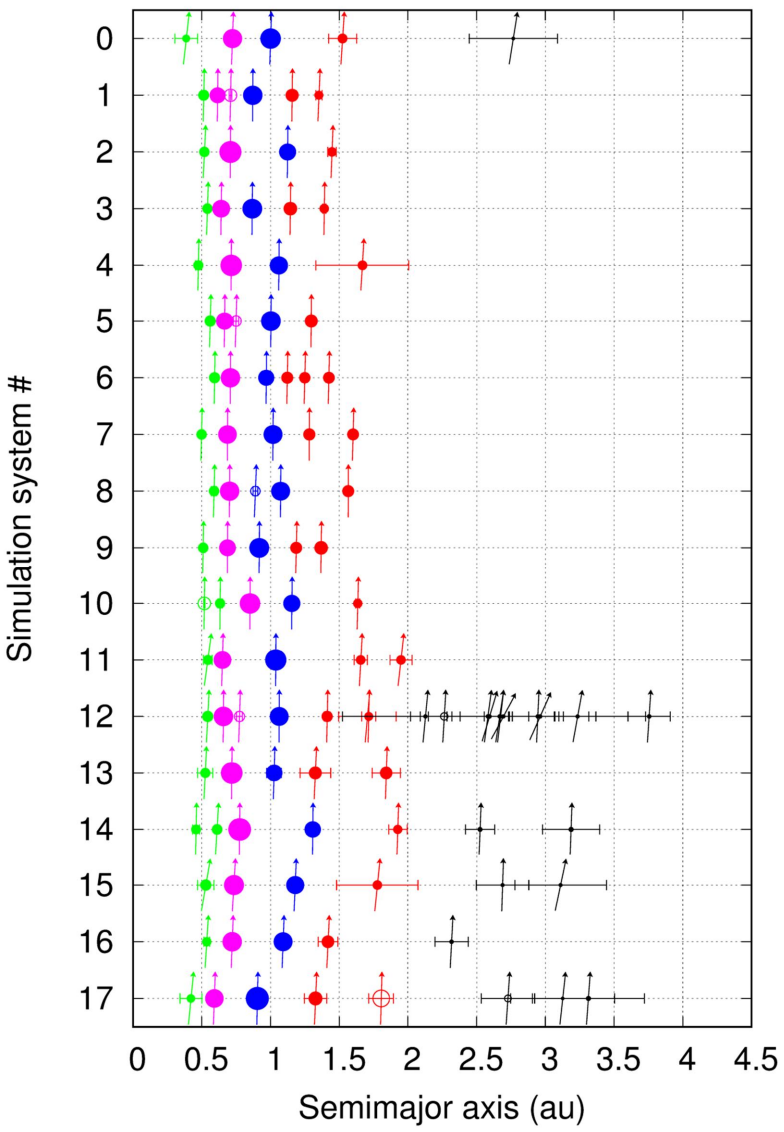
The paper's central claim is that analog systems—not individual planet look-alikes drawn from mixed populations—are the right test of terrestrial planet formation, and that by that test the standard truncated disks fail. Out of 540 runs, 194 systems produced at least three analogs, but only 17 produced all four; in the truncated-disk subset, Mercury analogs were all too massive, Mercury and Mars analogs were dynamically colder than the real planets and formed too close to the Venus/Earth pair, and the Earth analogs' last giant impacts occurred before 20 Myr with late veneer masses 2–10 times the allowed upper limit. The paper concludes that disks with mass concentrated in narrow core regions between about 0.7–0.9 and 1.0–1.2 au, an inner region starting at about 0.3–0.4 au, a less massive outer component starting at about 1.0–1.2 au, an embryo-dominated mass distribution, and eccentric Jupiter–Saturn orbits are required to reproduce the four terrestrial planets.
Load-bearing premise
Jupiter and Saturn are fixed on their starting orbits for the full 400 million years, with no gas-driven migration and no giant-planet instability; if the real giant planets stirred the inner disk, the systematic failures blamed on truncated disks might disappear.
Editorial extensions
If this is right
- The Grand Tack's characteristic truncated disk, and the often-used 0.7–1.0 au disk of the Empty Asteroid Belt model, are strongly disfavored as initial conditions for the inner solar system.
- Mercury formation requires a mass-depleted inner region starting near 0.3–0.4 au; the only Mercury analogs that matched both orbit and mass appeared in disks with such inner components.
- Earth's water budget, the Moon-forming impact timing, and the late veneer cannot be satisfied simultaneously by narrow dry disks; an outer component or water-rich planetesimals is needed, though wetting Venus and Mars too much then becomes a danger.
- Models such as Early Instability and Pebble Accretion become more attractive competitors if they can deliver embryo-dominated, steeply depleted disks with eccentric giant planets.
- Embryo-dominated disks (large r) produce more four-planet systems and better Mars analogs, implying that dynamical friction from planetesimals must be weak during the late stages of terrestrial accretion.
Reading between the lines
- If the fixed-orbit restriction is relaxed, the paper's strongest conclusion—that truncated disks are ruled out—could weaken, because a late giant-planet instability might stir Mercury and Mars analogs onto the right excited orbits while keeping their masses low; the authors themselves flag giant-planet evolution as the next step.
- The same system-level classification logic could be exported to exoplanetary systems, where requiring Venus–Earth–like pairs plus small outer planets in one system may be a sharper test of formation models than matching individual planet masses and orbits.
- The requirement of an inner region plus giant impacts for Mercury predicts that Mercury's high core mass fraction was set by collisions rather than by gentle in-situ accretion, a prediction that can be sharpened with further geophysical data from Mercury.
- A direct testable extension is to run the authors' favored disk shapes with migrating giant planets and collisional fragmentation; if Mercury and Mars analogs improve, the disk-shape constraints may be less unique than the paper suggests.
Signed reviews
Editorial analysis
A structured set of objections, weighed in public.
Referee Report
Summary. The manuscript reports 540 N-body simulations of terrestrial planet formation with four disk models (fiducial, truncated, depleted, peaked), several static giant-planet orbital architectures, and a classification algorithm that identifies Mercury, Venus, Earth, and Mars analogs within each simulated system. The authors find 194 systems with at least three analogs and 17 systems with four analogs. They conclude that truncated disks representative of typical Grand Tack outcomes cannot explain the formation of the terrestrial planets: Mercury and Mars analogs are too dynamically cold, too close to the Venus/Earth analogs, and too massive; Earth analogs experience Moon-forming giant impacts too early and accrete too much late veneer; and Earth analogs are too dry. They propose that forming the terrestrial planets requires disks with mass concentrated in narrow core regions, an inner component starting near 0.3-0.4 au, a low-mass outer component, embryo-dominated mass, and eccentric Jupiter-Saturn orbits.
Significance. If the negative claim held, this would be an important constraint on the Grand Tack and Empty Asteroid Belt models of terrestrial planet formation. The study is strong in scale and documentation: 540 runs, a transparent system-level classification algorithm, small time steps for the Mercury region, and simultaneous application of orbital, mass, timing, late-veneer, and water constraints. The analog-system framework is a useful contribution to the field. However, the headline conclusion is broader than the simulations support, primarily because the giant planets are held on fixed orbits and because the decisive four-planet sample consists of only 17 systems without confidence intervals.
major comments (3)
- [Section 2 and Section 1.1] The central claim that truncated disks 'cannot explain' the terrestrial planets rests on simulations in which Jupiter and Saturn are held on fixed orbits for the full 400 Myr (Section 2: 'the giant planets do not migrate'), with only four static giant-planet architectures. Several of the systematic failures that drive the conclusion—dynamically too-cold Mercury and Mars analogs, overly early Moon-forming impacts, excessive late veneer, and too-compact systems—are precisely the quantities most sensitive to the degree of dynamical excitation imposed by the giant planets. The paper itself finds that more eccentric giant-planet configurations improve Mars analogs (Section 3.2.2) and acknowledges in Section 1.1 that planetesimal-driven migration and giant-planet instabilities 'may strongly perturb the planets and other bodies in the inner solar system.' A concrete test would be to rerun the truncated-disk scenarios with an early giant-planet instability or planetesimal-driven migration and check whether Mercury/Mars excitation, the Moon-forming impact timing, and the late veneer move into the observed ranges. As written, the simulations exclude static-giant-planet truncated disks, not all plausible Grand Tack realizations; the negative conclusion should be scoped accordingly or supported by additional simulations.
- [Section 3.4 and Table 3] The impossibility claim is based on only 17 four-planet analog systems, 11 of which come from truncated disks, with no confidence intervals or cross-tabulation of simultaneous constraint satisfaction. Table 3 shows several non-negligible success rates for truncated disks: C5 (Moon-forming impact timing) is satisfied by 21% of analog systems and C6 (late veneer) by 10%, while C7 (water) is never satisfied. With these small numbers, the absence of a single system satisfying all constraints simultaneously could be a small-sample effect rather than a physical exclusion. The text should report binomial confidence intervals for the key success rates and state the negative conclusion as 'no system in our sample satisfied all constraints' rather than as a general impossibility.
- [Section 1.1 (constraint G) and Section 4 (item G)] The water-delivery failure is not robust enough to support the global 'cannot explain' conclusion because the water mass fractions are assigned through an assumed radial profile whose parameters are explicitly uncertain. The paper notes that if outer-disk objects carried 10% water by weight (O'Brien et al. 2014), Earth analogs in truncated disks would reach WMF ~2E-3, within the observed range, while Venus and Mars analogs would become too wet. This is a model-dependent trade-off, not a robust exclusion. The water constraint should be presented as a conditional result of the adopted water model rather than as an independent disproof of truncated disks.
minor comments (5)
- [Section 2.1] The classification algorithm is described entirely in prose; a pseudocode block or structured list would substantially improve reproducibility and make the disqualification rules easier to audit.
- [Section 1.1, constraint F] There is a typo in 'Mars’ss formation timescale'; it should read 'Mars’s formation timescale.'
- [Section 5 and Abstract] The abstract and summary state the negative conclusion in absolute terms, whereas Sections 1.1 and 2 carry important caveats about giant-planet migration and instabilities. The wording should be harmonized so that the abstract reflects the scope of the simulations actually performed.
- [Table 3] The symbol Mpf is defined in the notes, but the name 'Mars analog production factor' is somewhat opaque; consider renaming it to something like 'Mars analogs per Mars-bearing system' for clarity.
- [Section 2] The initial conditions for all 540 simulations are summarized only in aggregate tables; depositing the full initial-condition files and final outputs in a public repository would aid reproducibility and follow-up studies.
Circularity Check
No significant circularity: the simulation outcomes are judged against externally given solar system constraints, and the central conclusions do not reduce to the initial conditions or to self-citations.
full rationale
The paper's derivation chain is self-contained in the relevant sense: 540 N-body simulations with varied protoplanetary disk initial conditions are compared against externally given constraints on the inner solar system (orbits, masses, Moon-forming impact timing, late veneer, water content, asteroid belt structure). The disk initial conditions are not fitted to those constraints; in fact, most runs fail the constraints, and truncated disks are rejected because they systematically violate them. The classification algorithm in Section 2.1 defines Mercury, Venus, Earth, and Mars analogs using thresholds based on the real planets (e.g., mass ranges 0.03–0.17, 0.4–2.0, and 0.05–0.32 Earth masses), which determines what counts as an analog without forcing success. The negative claim about Grand Tack-style truncated disks follows from direct comparison of simulation outputs with these externally fixed criteria, not from any equation that equates input disk profiles with output analogs. The favorable disk properties listed in Section 5 are inferred by identifying which explored initial conditions produced the most analog systems satisfying the constraints; this is standard parameter inference from a simulation survey rather than a prediction equivalent to the inputs by construction. There is minor reliance on the authors' own prior work, notably Lykawka & Ito (2017), for the linear inner-region surface-density profile and for supporting Mercury water/volatile findings, but this is not load-bearing: the central result that truncated disks cannot explain the terrestrial planets is generated by the new simulation suite and does not reduce to those citations. The static giant-planet assumption (Section 2: 'the giant planets do not migrate') is a genuine modeling limitation that could affect external validity, but it is an assumption about the model setup, not a circular step in the derivation. No step was found in which a predicted quantity is identical by construction to a fitted input or in which a self-citation is invoked as the sole justification for a forbidden alternative.
Assumptions & free parameters
free parameters (6)
- Core region mass and boundaries =
2.0-2.1 M_Earth in 0.7-1.0 or 0.7-1.2 au
- Inner and outer region disk components =
Inner 0.3-0.9 au with 0.5-1.3 M_Earth; outer 1.0-4.3 au with 0.2-0.7 M_Earth
- Embryo-to-planetesimal mass ratio r =
1, 4, 8 for truncated/depleted; about 6 and 19 for peaked
- Giant planet orbital architectures =
JS23, JS23me, JS12he, NC
- Success constraint thresholds =
Moon-forming impact timing 20-140 Myr; late veneer 0.1-2%; water mass fraction 2.5e-4 to 1e-2
- Water mass fraction radial profile =
0.001% inward of 1.5 au; 0.01% at 1.5-2 au; 0.1% at 2-2.5 au; 5% at 2.5-3 au; 10% beyond 3 au
assumptions (5)
- domain assumption The modified MERCURY N-body integrator with timesteps 2.43-4.57 days resolves orbital evolution down to Mercury's orbit reliably.
- domain assumption Gas disk mass is negligible after 5-10 Myr, so gas dynamics can be ignored.
- ad hoc to paper Jupiter and Saturn do not migrate during the 400 Myr simulations.
- domain assumption Collisional fragmentation is not crucial for the conclusions.
- domain assumption The truncated disk setup with 0.7-1.0 or 0.7-1.2 au core and S/C planetesimal split represents typical Grand Tack outcomes.
invented entities (1)
-
Ice belts (I-belts)
Cite this review
Pith. "Pith review of Constraining the Formation of the Four Terrestrial Planets in the Solar System." pith.science (2026). https://pith.science/paper/OQJFSPUI
@misc{pith2026190804934,
  author       = {Pith},
  title        = {Pith review of: Constraining the Formation of the Four Terrestrial Planets in the Solar System},
  year         = {2026},
  howpublished = {\url{https://pith.science/paper/OQJFSPUI}},
  note         = {Machine review of arXiv:1908.04934}
}
read the original abstract
To reproduce the orbits and masses of the terrestrial planets (analogs) of the solar system, most studies scrutinize simulations for success as a batch. However, there is insufficient discussion in the literature on the likelihood of forming planet analogs simultaneously in the same system (analog system). To address this issue, we performed 540 N-body simulations of protoplanetary disks representative of typical models in the literature. We identified a total of 194 analog systems containing at least three analogs, but only 17 systems simultaneously contained analogs of the four terrestrial planets. From an analysis of our analog systems, we found that, compared to the real planets, truncated disks based on typical outcomes of the Grand Tack model produced analogs of Mercury and Mars that were too dynamically cold and located too close to the Venus and Earth analogs. Additionally, all the Mercury analogs were too massive, while most of the Mars analogs were more massive than Mars. Furthermore, the timing of the Moon-forming impact was too early in these systems, and the amount of additional mass accreted after the event was too great. Therefore, such truncated disks cannot explain the formation of the terrestrial planets. Our results suggest that forming the four terrestrial planets requires disks with the following properties: 1) Mass concentrated in narrow core regions between ~0.7-0.9 and ~1.0-1.2 au; 2) an inner region component starting at ~0.3-0.4 au; 3) a less massive component beginning at ~1.0-1.2 au; 4) embryos rather than planetesimals carrying most of the disk mass; and 5) Jupiter and Saturn placed on eccentric orbits.
Figures
Reference graph
Works this paper leans on
- [1]
-
[3]
O” indicates that a system satisfied a specific constraint among C1–C8, whereas “X
“O” indicates that a system satisfied a specific constraint among C1–C8, whereas “X” indicates that it did not. a Systems with planet-like objects. b Systems with asteroid belts similar in orbital structure compared to that observed in the inner solar system. c Similar to O’Brien et al. (2014), if we assume that all objects in the disk outer region in tru...
work page 2014
-
[4]
a The WMF of Venus is an approximate estimation (see footnote 4 in the main text). If the absence of satellites around Venus were caused by fortuitous giant impacts, that would suggest that nGI should be at least equal to 2 (Alemi & Stevenson 2006). However, the lack of an internally generated magnetic dynamo may be better explained if V enus did not expe...
work page 2014
-
[15]
Kokubo, E., Genda, H. 2010, ApJ, 714, L21. Kulikov, Y u. N., Lammer, H., Lichtenegger, H. I. M., Terada, N., Ribas, I., Kolb, C., Langmayr, D., 29 Lundin, R., Guinan, E. F., Barabash, S., Biernat, H. K. 2006, Planetary and Space Science, 54,
work page 2010
-
[27]
Min, M., Dullemond, C. P ., Kama, M., Dominik, C. 2011, Icarus, 212,
work page 2011
- [28]
- [38]
-
[39]
O’Brien, D. P., Morbidelli, A., Bottke, W . F. 2007, Icarus, 191,
work page 2007
Show all 70 references
-
[41]
Lunine, J. I. 2006, in Meteorites ad the Early Solar System II, ed. D. S. Lauretta, H. Y . McSween Jr. (Tucson: Univ. Arizona Press),
2006
-
[43]
Chambers, J. E. 2016, ApJ, 825,
2016
-
[47]
K., Morbidelli, A
Ogihara, M., Kokubo, E., Suzuki, T. K., Morbidelli, A. 2018, A&A, 612, L5. Peplowski, P. N., Evans, L. G., Hauck, S. A., McCoy, T. J.; Boynton, W. V .; Gillis-Davis, J. J.; Ebel, D. S.; Goldsten, J. O.; Hamara, D. K.; Lawrence, D. J.; McNutt, R. L.; Nittler, L. R.; Solomon, S....
2018
-
[49]
A., Rubie, D
Jacobson, S. A., Rubie, D. C., Hernlund, J., Morbidelli, A., Nakajima, M. 2017, Earth and Planetary Science Letters, 474,
2017
-
[50]
E., Carry, B
DeMeo, F. E., Carry, B. 2014, Nature, 505,
2014
-
[56]
2013, Space Sci
Mezger, K., Debaille, V ., Kleine, T. 2013, Space Sci. Rev. 174,
2013
-
[63]
2018, ApJ, 865, id.35
Chau, A., Reinhardt, C., Helled, R., Stadel, J. 2018, ApJ, 865, id.35. Ciesla, F. J., Mulders, G. D., Pascucci, I., Apai, D. 2015, ApJ, 804, id.9. Clement, M. S., Kaib, N. A., Raymond, S. N., Walsh, K. J. 2018, Icarus, 311,
2018
-
[65]
S-type planetesimals
See Section 2 for more details about the disk models. a The disk outer edge was determined by the condition aJ(1 í eJ) – 3 rH,J, where rH,J is the Hill radius, aJ is the semimajor axis, and eJ is the eccentricity of Jupiter at the start of the simulations. b We placed 20 embry...
2000
-
[66]
(2014), if we assume that all objects in the disk outer region carried 10% of water by weight, the WMF of the Mercury analogs would increase to 3Â10í3 in truncated disks
b Similar to O’Brien et al. (2014), if we assume that all objects in the disk outer region carried 10% of water by weight, the WMF of the Mercury analogs would increase to 3Â10í3 in truncated disks. 5 Table
2014
-
[68]
W ., Stewart, G
Wetherill, G. W ., Stewart, G. R. 1989, Icarus, 106,
1989
-
[69]
The formation of the Moon after a giant collision suggests that Earth suffered at least one such an impact, whose timing should be within the 20–140 Myr time interval
a One ocean of water sets Earth’s minimum WMF. The formation of the Moon after a giant collision suggests that Earth suffered at least one such an impact, whose timing should be within the 20–140 Myr time interval. b Similar to O’Brien et al. (2014), if we assume that all obje...
2014
-
[70]
The formation of the Martian surface dichotomy suggests that the planet may have suffered one giant impact (Marinova et al
a The WMF of Mars is an approximate estimation (Section 1.1). The formation of the Martian surface dichotomy suggests that the planet may have suffered one giant impact (Marinova et al. 2008). b Similar to O’Brien et al. (2014), if we assume that all objects in the disk outer ...
2014
-
[74]
P ., Izidoro, A., Jacobson, S
O’Brien, D. P ., Izidoro, A., Jacobson, S. A., Raymond, S. N., Rubie, D. C. 2018, Space Sci Rev, 214, id
2018
-
[85]
C., Kenyon, S
Bromley, B. C., Kenyon, S. J. 2017, AJ, 153,
2017
-
[92]
Haghighipour, N., Winter, O. C. 2016, CMDA, 124,
2016
-
[125]
P ., Karato, S., Vander Kaaden, K
Greenwood, J. P ., Karato, S., Vander Kaaden, K. E., Pahlevan, K., Usui, T. 2018, Space Sci Rev, 214,
2018
-
[152]
F., Kretke, K
Levison, H. F., Kretke, K. A., W alsh, K. J., Bottke, W . F. 2015, PNAS, 112, 14180. Lunine, J. I., Chambers, J., Morbidelli, A., Leshin, L. A. 2003, Icarus, 165,
2015
-
[174]
A., Walsh, K
Jacobson, S. A., Walsh, K. J. 2015, in Geophysical Monograph Series, V ol. 212, ed. J. Badro and M. Walter (Hoboken: John Wiley & Sons),
2015
-
[189]
Brasser, R., Morbidelli, A., Gomes, R., Tsiganis, K., Levison, H. F. 2009, A&A, 507,
2009
-
[190]
2010, ApJ, 719,
Zhang, H., Zhou, J.-L. 2010, ApJ, 719,
2010
-
[205]
Chambers, J. E. 2007, Icarus, 189,
2007
-
[206]
Walsh, K., Levison, H. F. 2016, AJ, 152,
2016
-
[216]
E., Wetherill, G
Chambers, J. E., Wetherill, G. W . 1998, Icarus, 136,
1998
-
[235]
M., Malhotra, R
Hahn, J. M., Malhotra, R. 2005, AJ, 130,
2005
-
[251]
2010, Icarus, 207,
Morishima, R., Stadel, J., Moore, B. 2010, Icarus, 207,
2010
-
[304]
Chambers, J. E. 1999, MNRAS, 304,
1999
-
[336]
2002, MNRAS, 336,
Ito, T., Tanikawa, K. 2002, MNRAS, 336,
2002
-
[375]
Kaib, N., Chambers, J. E. 2016, MNRAS, 455,
2016
-
[386]
Chambers, J. E. 2013, Icarus, 224,
2013
-
[407]
A., Ciesla, F
Fischer, R. A., Ciesla, F. J. 2014, Earth and Planetary Sci. Lett., 392,
2014
-
[416]
I., Petit, J
Morbidelli, A., Chambers, J., Lunine, J. I., Petit, J. M., Robert, F., V alsecchi, G. B., Cyr, K. E. 2000, Meteoritics & Planetary Science, 35,
2000
-
[434]
P ., Walsh, K
O’Brien, D. P ., Walsh, K. J., Morbidelli, A., Raymond, S. N., Mandell, A. M. 2014, Icarus, 239,
2014
-
[483]
C., Tsuchida, M
Izidoro, A., Haghighipour, N., Winter, O. C., Tsuchida, M. 2014, ApJ, 782, id.31. Izidoro, A., Raymond, S. N., Morbidelli, A., Winter, O. C. 2015, MNRAS, 453,
2014
-
[489]
S., Nesvorny, D., Raymond, S
Deienno, R., Izidoro, A., Morbidelli, A., Gomes, R. S., Nesvorny, D., Raymond, S. N. 2018, ApJ, 864,
2018
-
[497]
2016, Space Science Reviews, 205,
Gorti, U., Liseau, R., Sandor, Z., Clarke, C. 2016, Space Science Reviews, 205,
2016
-
[517]
P ., Morbidelli, A., Levison, H
O’Brien, D. P ., Morbidelli, A., Levison, H. F. 2006, Icarus, 184,
2006
-
[558]
I., O’Brien, D
Morbidelli, A., Lunine, J. I., O’Brien, D. P ., Raymond, S. N., Walsh, K. J. 2012, Annu. Rev. Earth Planet. Sci., 40,
2012
-
[564]
Benz, W ., Anic, A., Horner, J., Whitby , J. A. 2007, SSRv, 132,
2007
-
[595]
N., Izidoro, A., Bitsch, B., Jacobson, S
Raymond, S. N., Izidoro, A., Bitsch, B., Jacobson, S. A., 2016, MNRAS, 458,
2016
-
[629]
E., Willacy, K., Bodenheimer, P ., Turner, N
Dodson-Robinson, S. E., Willacy, K., Bodenheimer, P ., Turner, N. J., Beichman, C. A. 2009, Icarus, 200,
2009
-
[644]
N., Kokubo, E., Morbidelli, A., Morishima, R., Walsh, K
Raymond, S. N., Kokubo, E., Morbidelli, A., Morishima, R., Walsh, K. J. 2014, in Protostars and Planets VI Compendium, ed. H. Beuther, R. Klessen, C. Dullemond, Th. Henning. (Tucson: Univ. Arizona Press),
2014
-
[778]
S., Raymond, S
Clement, M. S., Raymond, S. N., Kaib, N. A. 2019b, AJ, 157, id.38. 28 Clement, M. S., Kaib, N. A., Chambers, J. E. 2019c, AJ, 157, id.208. D’Angelo, G., Marzari, F. 2012, ApJ, 757, id.50. Dauphas, N., Pourmand, A. 2011, Nature, 473,
2012
-
[793]
Chambers, J. E. 2001, Icarus, 152,
2001
-
[1053]
J., Nesvorny, D
Brasser, R., Walsh, K. J., Nesvorny, D. 2013, MNRAS, 433,
2013
-
[1131]
L., Roos-Serote, M., Sugita, S., Gilmore, M
Hashimoto, G. L., Roos-Serote, M., Sugita, S., Gilmore, M. S., Kamp, L. W., Carlson, R. W., Baines, K. H. 2008, Journal of Geophysical Research, 113, E00B24. Ito, T., Tanikawa, K. 1999, Icarus, 139,
2008
-
[1141]
2015, ApJL, 806, id.L26
V olk, K., Gladman, B. 2015, ApJL, 806, id.L26. Walsh, K. J., Morbidelli, A. 2011, A&A, 526, A126. Walsh, K. J., Morbidelli, A., Raymond, S. N., O’Brien, D. P., Mandell, A. M. 2011, Nature, 475,
2015
-
[1216]
Marty. B. 2012, Earth Planet. Sci. Lett., 313,
2012
-
[1227]
2006, American Astronomical Society, DPS meeting #38, id.07.03; Bulletin of the American Astronomical Society, V ol
Alemi, A., Stevenson, D. 2006, American Astronomical Society, DPS meeting #38, id.07.03; Bulletin of the American Astronomical Society, V ol. 38, p.491. Asphaug, E., Reufer, A. 2014, Nature Geoscience 7,
2006
-
[1309]
F., Gomes, R
Morbidelli, A., Tsiganis, K., Crida, A., Levison, H. F., Gomes, R. 2007, AJ, 134,
2007
-
[1425]
2008, Icarus, 196,
Laskar, J. 2008, Icarus, 196,
2008
-
[1790]
F., Nesvorny, D., Levison, H
Morbidelli, A., Bottke, W . F., Nesvorny, D., Levison, H. F. 2009, Icarus, 204,
2009
-
[1850]
Pierens, A., Raymond, S. N. 2011, A&A, 533, id.A131. Pierens, A., Raymond, S. N., Nesvorny, D., Morbidelli, A
2011
-
[2014]
Raymond, S
ApJL, 795, L11. Raymond, S. N., O’Brien, D. P ., Morbidelli, A., Kaib, N. A. 2009, Icarus, 203,
2009
-
[2016]
A&A, 594, A105. Eke, V. R., Lawrence, D. J., Teodoro, L. F. A. 2017, Icarus, 284,
2017
-
[2017]
Marinova, M
ApJ, 838, id.106. Marinova, M. M., Aharonson, O., Asphaug, E. 2008, Nature, 453,
2008
-
[2392]
Haisch, K. E. Jr., Lada, E. A., & Lada, C. J. 2001, ApJ, 553, L153. Hansen, B. M. S. 2009, ApJ, 703,
2001
-
[2692]
F., Morbidelli, A., Tsiganis, K., Nesvorny, D., Gomes, R
Levison, H. F., Morbidelli, A., Tsiganis, K., Nesvorny, D., Gomes, R. 2011, AJ, 142,
2011
-
[2924]
A., Morbidelli, A
Jacobson, S. A., Morbidelli, A. 2014, Philosophical Transactions of the Royal Society A, 372,
2014
-
[2962]
N, Izidoro, A
Raymond, S. N, Izidoro, A. 2017, Science Advances, 3, e1701138. 30 Raymond, S. N., Izidoro, A., Morbidelli, A. 2018, in Planetary Astrobiology (Editors: Victoria Meadows, Giada Arney, David Des Marais, and Britney Schmidt), in press. Rubie, D. C., Laurenz, V., Jacobson, S. A.,...
2017
-
[3561]
B., Yin, Q.-Z., Halliday, A
Kleine, T., Touboul, M., Bourdon, B., Nimmo, F., Mezger, K., Palme, H., Jacobsen, S. B., Yin, Q.-Z., Halliday, A. N. 2009, Geochimica et Cosmochimica Acta, 73,
2009
-
[3619]
N., Pierens, A., Morbidelli, A., Winter, O
Izidoro, A., Raymond, S. N., Pierens, A., Morbidelli, A., Winter, O. C., Nesvorny, D. 2016, ApJ, 833, id.40. Hosono, N., Karato, S., Makino, J., Saitoh, T. R. 2019, Nature Geoscience, 12, 418-423. Jackson, A. P., Gabriel, T. S. J., Asphaug, E. I. 2018, MNRAS, 474,
2016
-
[5150]
2000, Icarus, 143,
Kokubo, E., Ida, S. 2000, Icarus, 143,
2000
Reviewed August 14, 2026 · model on record in the stance chip above.
Discussion (0). Continue with ORCID to comment.