A Standard Processing Pipeline for High-accuracy Measurement of Few-shot Regression on Laser Induced Breakdown Spectroscopy
Pith reviewed 2026-06-26 12:03 UTC · model grok-4.3
The pith
A pipeline of diffusion denoising, attention autoencoder, group shuffling and OLS regression reaches mean RMAE of 0.2847 on few-shot LIBS data.
A machine-rendered reading of the paper's core claim, the machinery that carries it, and where it could break.
Core claim
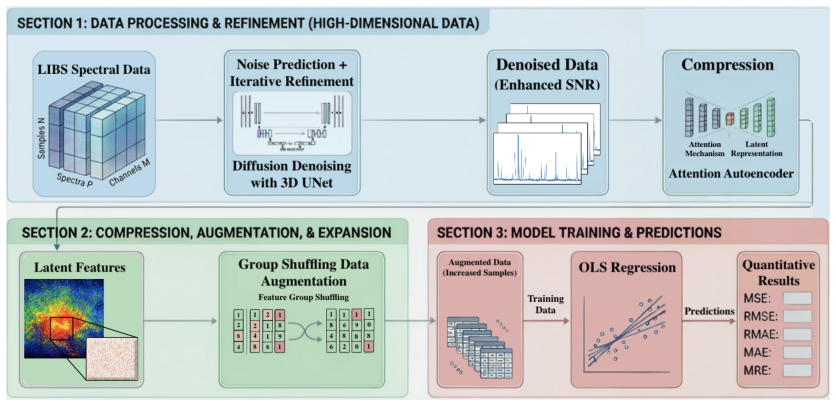
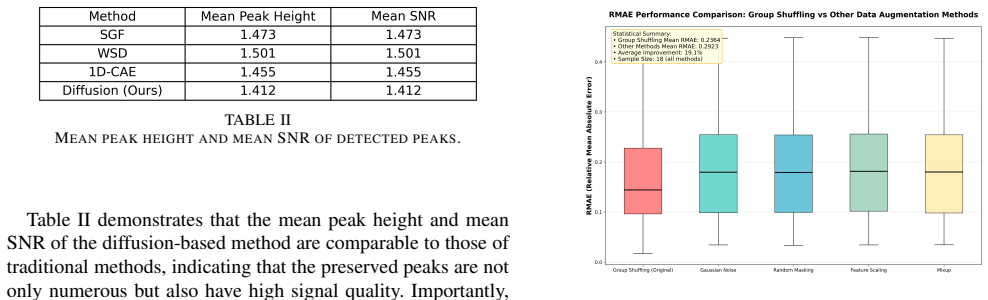
The Diffusion-DA-AE pipeline, which integrates diffusion denoising with a 3D UNet to remove spectral noise while preserving essential emission features, an attention-based autoencoder to capture nonlinear spectral correlations in compact latent representations, group shuffling data augmentation to enhance robustness through feature permutation, and ordinary least squares regression, achieves a mean RMAE of 0.2847 on few-shot LIBS regression for multiple elemental concentrations, delivering 37.7 percent and 37.6 percent improvements over baseline autoencoder and traditional PCA-PLS methods respectively.
What carries the argument
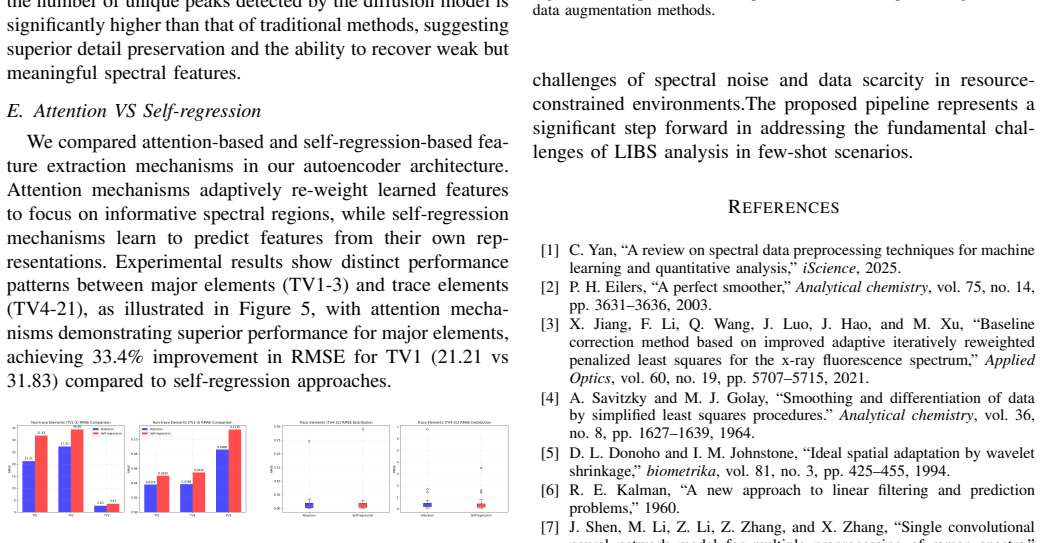
The Diffusion-DA-AE pipeline that chains diffusion-based denoising with 3D UNet, attention autoencoder for dimensionality reduction, group shuffling augmentation, and ordinary least squares regression.
If this is right
- The diffusion module removes spectral noise without losing essential emission features.
- The attention autoencoder captures nonlinear spectral correlations in reduced latent space.
- Group shuffling augmentation improves robustness by generating synthetic samples via feature permutation.
- The full pipeline generalizes across multiple elemental concentrations in the tested datasets.
- The approach sets a new benchmark for few-shot quantitative LIBS regression.
Where Pith is reading between the lines
- The same denoising-plus-attention structure could be applied to other spectroscopy modalities that also face noise and scarce labels.
- The attention weights might be inspected post-training to surface which emission lines drive the concentration predictions.
- Testing the pipeline on LIBS spectra collected from different instruments or under varying ambient conditions would check whether the reported gains hold outside the original collection setup.
Load-bearing premise
The diffusion denoising and attention autoencoder preserve subtle spectral features better than traditional methods and the group shuffling produces useful synthetic samples so that performance gains can be attributed to the pipeline rather than dataset-specific effects.
What would settle it
Re-running the same elemental concentration experiments after replacing the diffusion module and attention autoencoder with standard denoising and PCA, then observing no meaningful RMAE improvement over the reported baselines, would show the gains are not due to the proposed components.
Figures
read the original abstract
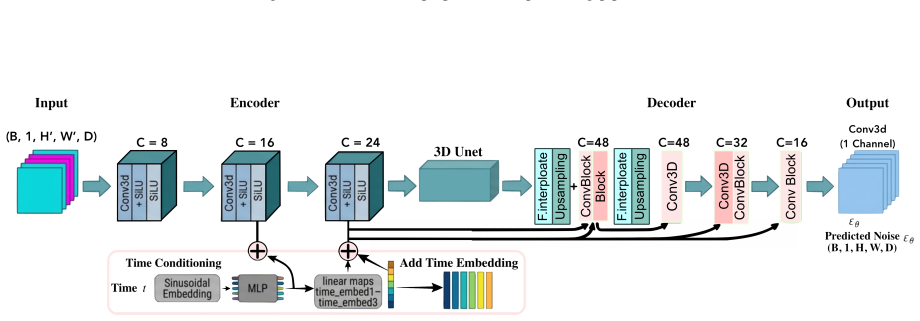
Laser-induced breakdown spectroscopy (LIBS) faces challenges in high-accuracy quantitative measurement under few-shot scenarios due to spectral noise and data scarcity. Traditional preprocessing methods often fail to preserve subtle spectral features or capture nonlinear correlations. This work proposes a standardized processing pipeline integrating diffusion-based denoising, attention-based autoencoder for dimensionality reduction, group shuffling data augmentation, and ordinary least squares regression. The diffusion module employs a 3D UNet architecture to remove spectral noise while preserving essential emission features. The attention-autoencoder captures nonlinear spectral correlations, effectively reducing high-dimensional spectral data to compact latent representations. Group shuffling data augmentation enhances model robustness by creating synthetic samples through feature group permutation. Experimental results on multiple elemental concentrations demonstrate that our Diffusion-DA-AE pipeline achieves superior performance with a mean RMAE of 0.2847, representing 37.7\% and 37.6\% improvements over baseline autoencoder and traditional PCA-PLS regression, respectively. The framework's effectiveness validates its generalizability and establishes a new benchmark for few-shot LIBS regression.
Editorial analysis
A structured set of objections, weighed in public.
Referee Report
Summary. The paper proposes a standardized Diffusion-DA-AE pipeline for few-shot quantitative regression on LIBS spectra. The pipeline combines 3D-UNet diffusion denoising, an attention autoencoder for nonlinear dimensionality reduction, group-shuffling augmentation, and OLS regression. It reports a mean RMAE of 0.2847 across multiple elemental concentrations, corresponding to 37.7% and 37.6% relative improvement over a baseline autoencoder and PCA-PLS, respectively, and positions the pipeline as a new benchmark for the task.
Significance. If the reported gains can be shown to arise specifically from the added modules rather than from data-split artifacts or the final regressor, the work would supply a concrete, modular preprocessing recipe that could be adopted as a reference pipeline in few-shot LIBS and related spectroscopic regression settings. The combination of diffusion denoising with attention-based compression is a plausible direction for preserving weak emission lines under data scarcity.
major comments (3)
- [Experimental results] Experimental results section: the headline claim of a mean RMAE of 0.2847 with 37.7%/37.6% improvements is presented without error bars, without any description of the few-shot train/test splits, without statistical significance tests, and without any table or figure that isolates the contribution of the diffusion module, the attention mechanism, or the group-shuffling augmentation. Consequently the attribution of the observed delta to the proposed pipeline cannot be verified from the reported evidence.
- [Method / Experimental results] Method and Experimental results sections: no ablation table or set of controlled experiments is described that removes one component at a time (e.g., diffusion off, attention off, group shuffle off) while keeping the regression head, data splits, and evaluation protocol fixed. Without such controls the performance delta could equally be explained by favorable random splits or by the OLS step alone.
- [Abstract / Experimental results] Abstract and Experimental results: the manuscript supplies neither code nor data, nor any statement on reproducibility, making independent verification of the numerical claims impossible at present.
minor comments (2)
- [Abstract] The abstract would be clearer if it stated the number of elements, the total number of spectra, and the precise few-shot regime (e.g., shots per concentration) used in the reported experiments.
- [Abstract] Notation for RMAE should be defined explicitly (is it relative mean absolute error, and relative to what baseline value?) at first use.
Simulated Author's Rebuttal
We thank the referee for the constructive comments. We address each major comment below and will revise the manuscript to incorporate the requested clarifications and additional experiments.
read point-by-point responses
-
Referee: [Experimental results] Experimental results section: the headline claim of a mean RMAE of 0.2847 with 37.7%/37.6% improvements is presented without error bars, without any description of the few-shot train/test splits, without statistical significance tests, and without any table or figure that isolates the contribution of the diffusion module, the attention mechanism, or the group-shuffling augmentation. Consequently the attribution of the observed delta to the proposed pipeline cannot be verified from the reported evidence.
Authors: We agree that the current presentation of results lacks error bars, explicit descriptions of the few-shot train/test splits, statistical significance tests, and isolation of module contributions. These elements are necessary for verifying the source of the reported improvements. In the revision we will add error bars computed over multiple random seeds, describe the splitting protocol in detail, report appropriate significance tests, and include a table or figure showing incremental performance when each module is added. revision: yes
-
Referee: [Method / Experimental results] Method and Experimental results sections: no ablation table or set of controlled experiments is described that removes one component at a time (e.g., diffusion off, attention off, group shuffle off) while keeping the regression head, data splits, and evaluation protocol fixed. Without such controls the performance delta could equally be explained by favorable random splits or by the OLS step alone.
Authors: The manuscript does not presently contain a systematic ablation study with one-component-at-a-time removals under fixed splits and regressor. We recognize that without such controls alternative explanations cannot be excluded. We will run the required controlled ablations and add a dedicated ablation table to the revised Experimental results section. revision: yes
-
Referee: [Abstract / Experimental results] Abstract and Experimental results: the manuscript supplies neither code nor data, nor any statement on reproducibility, making independent verification of the numerical claims impossible at present.
Authors: The current manuscript version does not include code, data, or a reproducibility statement. We will add an explicit reproducibility section and make the implementation code publicly available. Data access details will be provided subject to the originating data policies. revision: yes
Circularity Check
No circularity: empirical pipeline evaluated on external data
full rationale
The manuscript describes a processing pipeline (diffusion denoising + attention AE + group-shuffle augmentation + OLS) and reports measured RMAE values on LIBS spectra. No equations, fitted parameters, or self-citations are shown that reduce the reported performance metric to an input quantity by construction. The result is an external measurement, not a renaming or self-definition. Absence of ablations affects attribution strength but does not create circularity under the defined criteria.
Axiom & Free-Parameter Ledger
Reference graph
Works this paper leans on
-
[1]
A review on spectral data preprocessing techniques for machine learning and quantitative analysis,
C. Yan, “A review on spectral data preprocessing techniques for machine learning and quantitative analysis,”iScience, 2025
2025
-
[2]
A perfect smoother,
P. H. Eilers, “A perfect smoother,”Analytical chemistry, vol. 75, no. 14, pp. 3631–3636, 2003
2003
-
[3]
Baseline correction method based on improved adaptive iteratively reweighted penalized least squares for the x-ray fluorescence spectrum,
X. Jiang, F. Li, Q. Wang, J. Luo, J. Hao, and M. Xu, “Baseline correction method based on improved adaptive iteratively reweighted penalized least squares for the x-ray fluorescence spectrum,”Applied Optics, vol. 60, no. 19, pp. 5707–5715, 2021
2021
-
[4]
Smoothing and differentiation of data by simplified least squares procedures
A. Savitzky and M. J. Golay, “Smoothing and differentiation of data by simplified least squares procedures.”Analytical chemistry, vol. 36, no. 8, pp. 1627–1639, 1964
1964
-
[5]
Ideal spatial adaptation by wavelet shrinkage,
D. L. Donoho and I. M. Johnstone, “Ideal spatial adaptation by wavelet shrinkage,”biometrika, vol. 81, no. 3, pp. 425–455, 1994
1994
-
[6]
A new approach to linear filtering and prediction problems,
R. E. Kalman, “A new approach to linear filtering and prediction problems,” 1960
1960
-
[7]
Single convolutional neural network model for multiple preprocessing of raman spectra,
J. Shen, M. Li, Z. Li, Z. Zhang, and X. Zhang, “Single convolutional neural network model for multiple preprocessing of raman spectra,” Vibrational Spectroscopy, vol. 121, p. 103391, 2022
2022
-
[8]
Automatic kalman-filter-based wavelet shrink- age denoising of 1d stellar spectra,
S. Gilda and Z. Slepian, “Automatic kalman-filter-based wavelet shrink- age denoising of 1d stellar spectra,”Monthly Notices of the Royal Astronomical Society, vol. 490, no. 4, pp. 5249–5269, 2019
2019
-
[9]
Cascaded deep convolutional neural networks as improved methods of preprocessing raman spectroscopy data,
M. Kazemzadeh, M. Martinez-Calderon, W. Xu, L. W. Chamley, C. L. Hisey, and N. G. Broderick, “Cascaded deep convolutional neural networks as improved methods of preprocessing raman spectroscopy data,”Analytical Chemistry, vol. 94, no. 37, pp. 12 907–12 918, 2022
2022
-
[10]
A three-stage deep learning-based training frame for spectra baseline correction,
Q. Jiao, B. Cai, M. Liu, L. Dong, M. Hei, L. Kong, and Y . Zhao, “A three-stage deep learning-based training frame for spectra baseline correction,”Analytical Methods, vol. 16, no. 10, pp. 1496–1507, 2024
2024
-
[11]
Learning to decide with just enough: Information-theoretic context summarization for cmdps,
P. Liu, J. Lin, S. Wang, Y . Xu, H. Li, X. Xie, S. Wu, and H. Li, “Learning to decide with just enough: Information-theoretic context summarization for cmdps,”arXiv preprint arXiv:2510.01620, 2025
arXiv 2025
-
[12]
Latency-aware batch task offloading for vehicular cloud: Maximizing submodular bandit,
H. Li, H. Huang, and Z. Qian, “Latency-aware batch task offloading for vehicular cloud: Maximizing submodular bandit,” in2021 IEEE 14th International Conference on Cloud Computing (CLOUD). IEEE, 2021, pp. 584–593
2021
-
[13]
A reliable resource scheduling for network function virtualization,
D. Xu, Y . Li, M. Yin, X. Li, H. Li, and Z. Qian, “A reliable resource scheduling for network function virtualization,” inInternational Confer- ence on Security, Privacy and Anonymity in Computation, Communica- tion and Storage. Springer, 2017, pp. 251–260
2017
-
[14]
A new technique for baseline calibration of soil x-ray fluorescence spectra based on enhanced generative adversarial networks combined with transfer learning,
X. He, Y . Zhao, and F. Li, “A new technique for baseline calibration of soil x-ray fluorescence spectra based on enhanced generative adversarial networks combined with transfer learning,”Journal of Analytical Atomic Spectrometry, vol. 38, no. 11, pp. 2486–2498, 2023
2023
-
[15]
Study on breast cancerization and isolated diagnosis in situ by hof- atr-mir spectroscopy with deep learning,
H. Shang, Q. Wu, J. Wu, S. Zhou, Z. Wang, H. Wang, and J. Yin, “Study on breast cancerization and isolated diagnosis in situ by hof- atr-mir spectroscopy with deep learning,”Spectrochimica Acta Part A: Molecular and Biomolecular Spectroscopy, vol. 319, p. 124546, 2024
2024
-
[16]
Tdiffde: A truncated diffusion model for remote sensing hyperspectral image denoising,
J. He, Y . Li, Q. Yuanet al., “Tdiffde: A truncated diffusion model for remote sensing hyperspectral image denoising,”arXiv preprint arXiv:2311.13622, 2023
arXiv 2023
-
[17]
Dds2m: Self-supervised de- noising diffusion spatio-spectral model for hyperspectral image restora- tion,
Y . Miao, L. Zhang, L. Zhang, and D. Tao, “Dds2m: Self-supervised de- noising diffusion spatio-spectral model for hyperspectral image restora- tion,” inProceedings of the IEEE/CVF International Conference on Computer Vision, 2023, pp. 12 086–12 096
2023
-
[18]
Restricted boltzmann machine method for dimensionality reduction of large spectroscopic data,
J. Vr ´abel, P. Po ˇr´ızka, and J. Kaiser, “Restricted boltzmann machine method for dimensionality reduction of large spectroscopic data,”Spec- trochimica Acta Part B: Atomic Spectroscopy, vol. 167, p. 105849, 2020
2020
-
[19]
Rapid classification of steel via a modified support vector machine algorithm based on portable fiber-optic laser-induced breakdown spectroscopy,
M. Yuan, Q. Zeng, J. Wang, W. Li, G. Chen, Z. Li, Y . Liu, L. Guo, X. Li, and H. Yu, “Rapid classification of steel via a modified support vector machine algorithm based on portable fiber-optic laser-induced breakdown spectroscopy,”Optical Engineering, vol. 60, no. 12, pp. 124 114–124 114, 2021
2021
-
[20]
A step-by-step classification method of coal and miscellaneous materials by laser-induced breakdown spectroscopy,
W. Ma, Z. Yu, Z. Lu, Q. Ma, and S. Yao, “A step-by-step classification method of coal and miscellaneous materials by laser-induced breakdown spectroscopy,”At. Spectrosc, vol. 44, no. 3, pp. 160–168, 2023
2023
-
[21]
Protein-protein interface hot spots prediction based on a hybrid feature selection strategy,
Y . Qiao, Y . Xiong, H. Gao, X. Zhu, and P. Chen, “Protein-protein interface hot spots prediction based on a hybrid feature selection strategy,”BMC bioinformatics, vol. 19, no. 1, p. 14, 2018
2018
-
[22]
Golden rpg: Confidence-adaptive region-aware noise for com- positional text-to-image generation,
H. Li, “Golden rpg: Confidence-adaptive region-aware noise for com- positional text-to-image generation,”arXiv preprint arXiv:2604.25314, 2026
Pith/arXiv arXiv 2026
-
[23]
H. Li and M. F. Zhuo, “Revisiting the scale loss function and gaussian- shape convolution for infrared small target detection,”arXiv preprint arXiv:2604.09991, 2026
Pith/arXiv arXiv 2026
-
[24]
R3d: Regional-guided residual radar diffu- sion,
H. Li, X. Liu, and Y . Jin, “R3d: Regional-guided residual radar diffu- sion,”arXiv preprint arXiv:2601.06465, 2026
arXiv 2026
-
[25]
A hybrid feature selection algorithm based on in- formation gain and sequential forward floating search,
J. Ding and L. Fu, “A hybrid feature selection algorithm based on in- formation gain and sequential forward floating search,”J Intell Comput, vol. 9, no. 3, p. 93, 2018
2018
-
[26]
Varia- tions in variational autoencoders-a comparative evaluation,
R. Wei, C. Garcia, A. El-Sayed, V . Peterson, and A. Mahmood, “Varia- tions in variational autoencoders-a comparative evaluation,”Ieee Access, vol. 8, pp. 153 651–153 670, 2020
2020
-
[27]
Performing sequential forward selection and variational autoencoder techniques in soil classification based on laser- induced breakdown spectroscopy,
E. Harefa and W. Zhou, “Performing sequential forward selection and variational autoencoder techniques in soil classification based on laser- induced breakdown spectroscopy,”Analytical Methods, vol. 13, no. 41, pp. 4926–4933, 2021
2021
-
[28]
High-accuracy measurement of the heat of deto- nation with good robustness by laser-induced breakdown spectroscopy of energetic materials,
A. Li, X. Zhang, Y . Yin, X. Wang, Y . He, Y . Shan, Y . Zhang, X. Liu, L. Zhong, and R. Liu, “High-accuracy measurement of the heat of deto- nation with good robustness by laser-induced breakdown spectroscopy of energetic materials,”Journal of Analytical Atomic Spectrometry, vol. 38, no. 4, pp. 810–817, 2023
2023
-
[29]
Real time and high-precision online determination of main components in iron ore using spectral refinement algorithm based libs,
A. Li, X. Zhang, X. Liu, Y . He, Y . Shan, H. Sun, W. Yi, and R. Liu, “Real time and high-precision online determination of main components in iron ore using spectral refinement algorithm based libs,”Optics Express, vol. 31, no. 23, pp. 38 728–38 743, 2023
2023
-
[30]
H. Li and M. F. Zhuo, “Multi-adapter ppo: A cross-attention enhanced wavelength selection framework for libs quantitative analysis,”arXiv preprint arXiv:2606.17476, 2026
Pith/arXiv arXiv 2026
-
[31]
Determination of propellant products by time resolved and spatial distribution lips combined with high-speed schlieren imaging,
X. Zhang, A. Li, Y . Zhang, Y . Yin, X. Wang, Y . He, J. Lyv, Y . Shan, X. Liu, W. Yiet al., “Determination of propellant products by time resolved and spatial distribution lips combined with high-speed schlieren imaging,”Journal of Analytical Atomic Spectrometry, vol. 39, no. 3, pp. 974–981, 2024
2024
-
[32]
Deep learning regression for quantitative libs analysis,
S. Van den Eynde, D. J. Diaz-Romero, I. Zaplana, and J. Peeters, “Deep learning regression for quantitative libs analysis,”Spectrochimica Acta Part B: Atomic Spectroscopy, vol. 202, p. 106634, 2023
2023
-
[33]
Character- ization of coal fly ash components by laser-induced breakdown spec- troscopy,
T. Ctvrtnickova, M.-P. Mateo, A. Yanez, and G. Nicolas, “Character- ization of coal fly ash components by laser-induced breakdown spec- troscopy,”Spectrochimica Acta Part B: Atomic Spectroscopy, vol. 64, no. 10, pp. 1093–1097, 2009
2009
-
[34]
A study of machine learning regression methods for major elemental analysis of rocks using laser-induced breakdown spectroscopy,
T. F. Boucher, M. V . Ozanne, M. L. Carmosino, M. D. Dyar, S. Mahade- van, E. A. Breves, K. H. Lepore, and S. M. Clegg, “A study of machine learning regression methods for major elemental analysis of rocks using laser-induced breakdown spectroscopy,”Spectrochimica Acta Part B: Atomic Spectroscopy, vol. 107, pp. 1–10, 2015
2015
-
[35]
Machine learning- based intelligent prediction of elastic modulus of rocks at thar coalfield,
N. M. Shahani, X. Zheng, X. Guo, and X. Wei, “Machine learning- based intelligent prediction of elastic modulus of rocks at thar coalfield,” Sustainability, vol. 14, no. 6, p. 3689, 2022
2022
discussion (0)
Sign in with ORCID, Apple, or X to comment. Anyone can read and Pith papers without signing in.