REVIEW 3 major objections 5 minor 25 references
For the Vlasov–Poisson system, the unsplit Active Flux method is slightly more accurate on coarse grids and cheaper in two dimensions, while the split-step version is more accurate on fine grids and easier to extend to higher dimensions.
Reviewed by Pith at T0; open to challenge. T0 means a machine referee read the full paper against a public rubric. the ladder, T0–T4 →
T0 review · deepseek-v4-flash
2026-08-01 03:28 UTC pith:OQOEMJB7
load-bearing objection A clean, honest benchmark of two Active Flux variants for Vlasov-Poisson; the quantitative ranking is provisional until the reference solution is shown converged. the 3 major comments →
A Comparison of Active Flux Methods for the Vlasov-Poisson System
The pith
A machine-rendered reading of the paper's core claim, the machinery that carries it, and where it could break.
Core claim
The paper's central finding is that the two Active Flux formulations for the one-dimensional 1D1V Vlasov–Poisson system have opposite strengths. The unsplit method is fully discrete: it solves the characteristic ODEs backwards in time, approximates the electric field within the step via a Taylor expansion using moment equations, and performs a single Poisson solve per step. The split-step method instead alternates x- and v-advection sub-steps, repeating Poisson solves and reconstruction evaluations. On coarse grids the unsplit method has slightly lower error against a high-resolution reference and lower cost; on fine grids the split-step method with an optimised fourth-order splitting is sli
What carries the argument
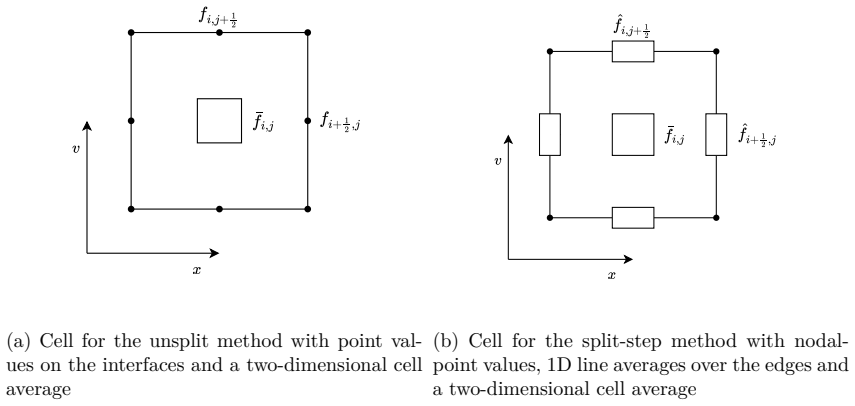
The Active Flux reconstruction: a compact, globally continuous finite-volume representation carrying cell averages plus shared point values on cell interfaces. Instead of Riemann solvers, the point values are advanced by characteristic tracing—backward ODEs for the unsplit method, successive one-dimensional advection updates for the split-step method. This reconstruction lets numerical fluxes be evaluated directly from the continuous representation, giving third-order accuracy with low dissipation on coarse grids.
Load-bearing premise
The comparison treats one finely resolved run as the exact answer; if that reference is not converged, the reported error ranking between the two methods could be an artifact of comparing to a slightly wrong solution.
What would settle it
Run the two-stream instability with both methods against an independent, converged reference—for example, two references at different resolutions with Richardson extrapolation, or a manufactured solution—and compare the relative error at t>40 on 64x64 and 128x128 grids. If the unsplit method no longer shows lower error than the split-step method on coarse grids, the paper's central ranking would be refuted.
If this is right
- Both Active Flux variants provide third-order accurate, low-dissipation Vlasov–Poisson solutions that track a high-resolution reference through the linear and early nonlinear phase.
- The unsplit method is cheaper in the two-dimensional case: one Poisson solve per step and fewer polynomial term evaluations than a nine-stage fourth-order splitting.
- The split-step method extends naturally to higher dimensions and to Vlasov–Maxwell, while the unsplit method lacks an obvious generalisation of its electric-field time expansion beyond one-dimensional problems.
- By the paper's term-evaluation count, the split method becomes the more cost-effective choice in four or more dimensions.
- Using a splitting scheme with more stages improves split-step accuracy but also raises its cost, so the crossover dimension depends on the splitting chosen.
Where Pith is reading between the lines
- The coarse-grid ranking rests on a single high-resolution reference; an independent convergence study could plausibly reverse the 'unsplit slightly better on coarse grids' conclusion.
- The cost metric counts reconstruction term evaluations only; a full hardware comparison including Poisson solves and memory traffic might move the crossover dimension.
- If the unsplit method is to reach Vlasov–Maxwell, it will need a different way to represent the field in time than the one-dimensional moment identities used here; the split method already has a demonstrated path.
- For practitioners, a practical default could be: use the unsplit method for two-dimensional electrostatic runs on coarse grids, and the split-step method for high-resolution or four-dimensional-and-above simulations.
Editorial analysis
A structured set of objections, weighed in public.
Referee Report
Summary. The paper compares two recently proposed Active Flux methods for the 1D1V Vlasov–Poisson system: an unsplit, fully discrete method from [17] and a split-step method from [16] using Strang, Yoshida, or Blanes–Moan operator splitting. After reviewing the two discretizations, it develops a theoretical cost model based on term evaluations in §2.4 and presents numerical comparisons for the two-stream instability and strong Landau damping in §3, using a high-resolution split-step PFC solution (N=512, CFL=1/(5π)) as reference. The main conclusion is that the unsplit method is slightly more accurate on coarser grids and cheaper in two dimensions, while the split-step method is slightly more accurate on finer grids and more readily extensible to higher dimensions.
Significance. If the numerical ranking is robust, the paper provides useful practical guidance for choosing between two Active Flux formulations. It assembles two methods from the same family, evaluates them on standard benchmarks against an independent reference method (PFC, [5]), and makes the theoretical cost model explicit. The algorithmic descriptions are consistent with the cited sources and I found no internal inconsistency in the derivations as presented. However, the central quantitative claims currently rest on an unvalidated reference solution and on a term-count cost proxy rather than measured runtime; both are fixable and should be addressed before publication.
major comments (3)
- [Section 3, Eq. (13)] The error metric is computed against a single PFC reference run at N=512 with CFL=1/(5π). No self-convergence study, Richardson estimate, or independent second reference is provided. In strong Landau damping the Active Flux curves depart from the reference after t≈50 even at 128×128 (Fig. 4b), and in the two-stream case the error grows rapidly after t≈40 (Fig. 2). If the PFC reference is not converged in these regimes, the relative ordering 'unsplit slightly better on coarse grids' could be an artifact of reference dissipation/dispersion rather than a property of the Active Flux schemes. Because the conclusion's numerical claim is explicitly 'in our comparisons to the reference,' the reference must be validated (e.g., a finer PFC run with a Richardson estimate or a second independent method).
- [Section 2.4 and Conclusion] The statement that the unsplit method 'is also cheaper for the two-dimensional case considered here' is based on the term-count proxy 9 vs 27 evaluations per point value, not on measured runtime, memory traffic, or total work including Poisson solves. The proxy omits the cost of the ODE solves for point values in the unsplit method and the multiple Poisson solves in the higher-order split-step variants. Please either report measured wall-clock times for the 2D experiments or qualify the conclusion as a theoretical term-count estimate rather than a measured cost comparison.
- [Section 3, Figs. 2 and 4] The central claims that the unsplit method is 'slightly better' on coarse grids and the split-step/BM method 'slightly better' on finer grids are supported only by curves; no numerical error values, error tables, or observed convergence rates are given. This makes it hard to verify the relative ordering or judge whether the differences are meaningful. Please include a table of ϵVP at representative times/resolutions and, if possible, estimated convergence rates.
minor comments (5)
- [Section 2.2, after Eq. (4)] 'and for H_{i+1/2,j} respectively' should be reworded to indicate that the H flux is approximated analogously; as written it is incomplete.
- [Section 2.4] The sentence 'Applying second-order Strang splitting reduces the number of Poisson solves required per time step to one' should explicitly state that this applies to the split-step method and only for Strang splitting, not for Yoshida or Blanes–Moan.
- [Section 3.2] Please define the discrete electric field energy in the text; the expression 1/2 Δx ∑ E_i^2 appears only in the narrative and is not labeled as an equation.
- [References] References [3] and [21] are the same paper (Rossmanith and Seal, J. Comput. Phys. 230, 2011). Duplicate references should be merged.
- [Section 2.4] The d≥4 break-even statement is explicitly qualified as 'according to this metric,' but the conclusion drops this qualifier when saying the unsplit method is 'cheaper' in 2D. Align the wording.
Circularity Check
No significant circularity: the comparison is measured against an external reference method and no prediction is fitted from the data.
full rationale
The paper's central activity is a numerical comparison of two previously published Active Flux methods for the 1D1V Vlasov-Poisson system. The methods are formulated from the governing equations and Active Flux reconstruction principles (Sections 2.2-2.3), and the reported ranking is obtained by evaluating the relative-error measure (Eq. 13) on standard two-stream instability and strong Landau damping benchmarks against a high-resolution PFC reference solution from [5]. No parameter is fitted to the compared data and then renamed as a prediction; the cost comparison in Section 2.4 is an analytic operation-count estimate, not an empirical fit. The cited works [16] and [17] are the sources of the two methods being compared, and citing them for the method formulations is expected rather than load-bearing for the numerical conclusions. Concerns about whether the PFC reference solution is sufficiently converged in the long-time regime are legitimate numerical validation risks, but they are not circularity: the reference is an external, independently developed solver, and the paper does not derive its conclusion from the Active Flux methods' own outputs. Thus no self-definitional, fitted-input, or self-citation-circular step is present.
Axiom & Free-Parameter Ledger
axioms (7)
- standard math Divergence theorem and Simpson quadrature for flux integrals (Eqs. 2–4)
- standard math Taylor expansion of electric field in time (Eq. 6) with derivatives from moments (Eqs. 7–8) to third order
- standard math Characteristics of the Vlasov equation solved backward in time (Eq. 5)
- domain assumption The Vlasov–Poisson model in 1D1V with periodic boundaries and neutralizing ion background (Eq. 1)
- ad hoc to paper The high-resolution PFC solution (N=512, CFL=1/(5π)) is an accurate reference
- standard math Operator splitting schemes (Strang, Yoshida, Blanes–Moan) achieve the stated orders
- domain assumption During the v-direction split step the electric field is constant (charge density is velocity-independent)
read the original abstract
Active Flux is a third-order accurate, fairly novel finite volume method for hyperbolic conservation laws that is becoming increasingly popular. It evolves additional nodal degrees of freedom (DOF) located on cell interfaces and shared by neighboring cells. The numerical fluxes are then computed from these DOFs. A crucial component of Active Flux methods is the evolution operator of the point values, which enables the natural use of semi-Lagrangian ideas and makes Active Flux an attractive candidate for a grid-based approach to the Vlasov equation. Here, we compare two recently proposed Active Flux methods for the 1D1V Vlasov-Poisson system: a split-step method and an unsplit method.
Figures


Reference graph
Works this paper leans on
-
[1]
An energy con- serving Vlasov solver that tolerates coarse velocity space resolutions: simulation of MMS reconnection events
Florian Allmann-Rahn, Simon Lautenbach, and Rainer Grauer. “An energy con- serving Vlasov solver that tolerates coarse velocity space resolutions: simulation of MMS reconnection events”. In:Journal of Geophysical Research: Space Physics127.2 (2022), e2021JA029976
2022
-
[2]
GEMPIC:geometricelectromagneticparticle-in-cellmethods
Michael Kraus, Katharina Kormann, Philip J. Morrison, and Eric Sonnendrücker. “GEMPIC:geometricelectromagneticparticle-in-cellmethods”.In:Journal of Plasma Physics83.4 (2017), p. 905830401.doi:10.1017/S002237781700040X. 9
-
[3]
James A. Rossmanith and David C. Seal. “A positivity-preserving high-order semi- Lagrangian discontinuous Galerkin scheme for the Vlasov–Poisson equations”. In: Journal of Computational Physics230.16 (2011), pp. 6203–6232.issn: 0021-9991. doi:10.1016/j.jcp.2011.04.018
-
[4]
A new class of nonlinear finite-volume meth- ods for Vlasov simulation
J.W. Banks and J.A.F. Hittinger. “A new class of nonlinear finite-volume meth- ods for Vlasov simulation”. In:IEEE Transactions on Plasma Science38.9 (2010), pp. 2198–2207
2010
-
[5]
Conservative numerical schemes for the Vlasov equation
F. Filbet, E. Sonnendrücker, and P. Bertrand. “Conservative numerical schemes for the Vlasov equation”. In:J. Comput. Phys.172.1 (2001), pp. 166–187
2001
-
[7]
The integration of the Vlasov equation in configuration space
Chio-Zong Cheng and Georg Knorr. “The integration of the Vlasov equation in configuration space”. In:Journal of Computational Physics22.3 (1976), pp. 330– 351
1976
-
[8]
Construction of higher order symplectic integrators
Haruo Yoshida. “Construction of higher order symplectic integrators”. In:Physics Letters A150.5 (1990), pp. 262–268.issn: 0375-9601.doi:10.1016/0375-9601(90) 90092-3
-
[9]
Energy-conserving dis- continuous Galerkin methods for the Vlasov–Maxwell system
Yingda Cheng, Andrew J. Christlieb, and Xinghui Zhong. “Energy-conserving dis- continuous Galerkin methods for the Vlasov–Maxwell system”. In:Journal of Com- putational Physics279 (2014), pp. 145–173.issn: 0021-9991.doi:10.1016/j.jcp. 2014.08.041
doi:10.1016/j.jcp 2014
-
[10]
Practical symplectic partitioned Runge– Kutta and Runge–Kutta–Nyström methods
Sergio Blanes and Per Christian Moan. “Practical symplectic partitioned Runge– Kutta and Runge–Kutta–Nyström methods”. In:Journal of computational and ap- plied mathematics142.2 (2002), pp. 313–330
2002
-
[11]
Tuning symplectic integrators is easy and worthwhile
Robert I McLachlan. “Tuning symplectic integrators is easy and worthwhile”. In: arXiv preprint arXiv:2104.10269(2021)
Pith/arXiv arXiv 2021
-
[12]
Active flux schemes
Timothy Eymann and Philip Roe. “Active flux schemes”. In:49th AIAA Aerospace Sciences Meeting including the New Horizons Forum and Aerospace Exposition.2011, p. 382
2011
-
[13]
Investigationsofanewschemeforwavepropagation
DoreenFanandPhilipLRoe.“Investigationsofanewschemeforwavepropagation”. In:22nd AIAA computational fluid dynamics conference. 2015, p. 2449
2015
-
[14]
Comparingactivefluxanddiscon- tinuous Galerkin methods for compressble flow
PhilipLRoe,JungyeoulMaeng,andDoreenFan.“Comparingactivefluxanddiscon- tinuous Galerkin methods for compressble flow”. In:2018 AIAA aerospace sciences meeting. 2018, p. 0836
2018
-
[15]
Erik Chudzik, Christiane Helzel, and Amelie Porfetye.A Fully Discrete Truly Multi- dimensional Active Flux Method For The Two-Dimensional Euler Equations. 2025. arXiv:2508.06273 [math.NA].url:https://arxiv.org/abs/2508.06273
Pith/arXiv arXiv 2025
-
[16]
A split-step Active Flux method for the Vlasov-Poisson system
L. Hensel, G. Grünwald, K. Kormann, and R. Grauer. “A split-step Active Flux method for the Vlasov-Poisson system”. In:Journal of Computational Physics540 (2025), p. 114294.issn: 0021-9991.doi:10.1016/j.jcp.2025.114294
arXiv 2025
-
[17]
A positivity-preserving Active Flux method for the Vlasov-Poisson system
Yanick Kiechle, Erik Chudzik, and Christiane Helzel. “A positivity-preserving Active Flux method for the Vlasov-Poisson system”. In:Journal of Computational Physics 524 (2025), p. 113693.issn: 0021-9991.doi:https://doi.org/10.1016/j.jcp. 2024.113693. 10
arXiv 2025
-
[18]
AnActiveFluxMethod for the Vlasov-Poisson System
Yanick-FlorianKiechle,ErikChudzik,andChristianeHelzel.“AnActiveFluxMethod for the Vlasov-Poisson System”. In:Finite Volumes for Complex Applications X— Volume 2, Hyperbolic and Related Problems. Ed. by Emmanuel Franck, Jürgen Fuhrmann, Victor Michel-Dansac, and Laurent Navoret. Springer Nature Switzer- land, 2023, pp. 93–101
2023
-
[19]
Solving the six-dimensional Vlasov-Maxwell System with Active Flux and Splitting Methods
G Grünwald, L Hensel, M Deisenhofer, S Lautenbach, K Kormann, and R Grauer. “Solving the six-dimensional Vlasov-Maxwell System with Active Flux and Splitting Methods”. In:arXiv preprint arXiv:2511.22440(2025)
arXiv 2025
-
[20]
Musings of a Computational Philosopher
Philip Roe. “Musings of a Computational Philosopher”. In:Proceedings of the Cam- bridge Unsteady Flow Symposium 2024. Ed. by James C. Tyacke and Nagabhushana Rao Vadlamani. Cham: Springer Nature Switzerland, 2025, pp. 1–35.isbn: 978-3- 031-69035-8
2024
-
[21]
A positivity-preserving high-order semi-Lagrangian discontinuous Galerkin scheme for the Vlasov-Poisson equations
J.A. Rossmanith and D.C. Seal. “A positivity-preserving high-order semi-Lagrangian discontinuous Galerkin scheme for the Vlasov-Poisson equations”. In:J. Comput. Phys.230 (2011), pp. 6203–6232
2011
-
[22]
ActiveFluxSchemesforSystems
T.A.EymannandP.L.Roe.“ActiveFluxSchemesforSystems”.In:AIAA2011-3840 (2011)
2011
-
[23]
On the advective component of active flux schemes for nonlinear hyperbolic conservation laws
Jungyeoul Brad Maeng. “On the advective component of active flux schemes for nonlinear hyperbolic conservation laws”. In:Ph. D. Thesis(2017)
2017
-
[24]
The serendipity family of finite elements
Douglas N Arnold and Gerard Awanou. “The serendipity family of finite elements”. In:Foundations of computational mathematics11.3 (2011), pp. 337–344
2011
-
[25]
The muphyII code: Multiphysics plasma simulation on large HPC systems
FlorianAllmann-Rahn,SimonLautenbach,MagnusDeisenhofer,andRainerGrauer. “The muphyII code: Multiphysics plasma simulation on large HPC systems”. In: Computer Physics Communications296 (2024), p. 109064
2024
-
[26]
Comparison of semi-Lagrangian dis- continuous Galerkin schemes for linear and nonlinear transport simulations
Xiaofeng Cai, Wei Guo, and Jing-Mei Qiu. “Comparison of semi-Lagrangian dis- continuous Galerkin schemes for linear and nonlinear transport simulations”. In: Communications on Applied Mathematics and Computation4.1 (2022), pp. 3–33. 11
2022
discussion (0)
Sign in with ORCID, Apple, or X to comment. Anyone can read and Pith papers without signing in.