REVIEW 3 major objections 5 minor 70 references
Time-frequency structure in the post-merger binary black hole gravitational wave signal
T0 review · 3 major / 5 minor · reviewed 2026-08-07 · deepseek-v4-flash
Pith's one-line read Spin shapes the post-merger gravitational-wave signal of black hole mergers: strong aligned spin adds extra post-merger chirps, mild precession breaks the sky symmetry of emitted power, and the pattern points to horizon geometry.
desk verdict A transparent morphology study that plausibly extends the double-chirp story to spins, but every spin claim leans on one unvalidated approximant and a hand-picked merger-time convention. read the letter →
The pith
A machine-rendered reading of the paper's core claim, the machinery that carries it, and where it could break.
The reading
What carries the argument
The carrying objects are the two post-merger power metrics $\kappa_1$ and $\kappa_2$, defined from a continuous wavelet transform with a Morlet-Gabor basis at quality factor $Q=5$. $\kappa_1$ is the fraction of total time-frequency power in a fixed post-merger window starting at the peak total amplitude and spanning $\kappa_w=500$ samples (about 0.03 s at 16384 Hz); $\kappa_2$ is that window's average power per pixel. A grid search over observer orientations $\iota,\phi$ locates $(\iota_\kappa,\phi_\kappa)$, the orientation with the strongest double-chirp pattern, and the same metrics evaluated at 40,000 sky directions with the merger time $t_c$ held fixed build the celestial-sky maps whose symmetry properties carry the spin claims. The Newman-Penrose scalar $\Psi_4$ is used inside the orbital plane to verify that the detected spectral peaks are features of the radiation rather than artifacts of the wavelet transform.
What would settle it
Run the same sky-map and peak-count analysis on a numerical-relativity simulation with aligned spin $\xi\approx0.75$ and with precessing spin $\chi_p\approx0.25$, setting $t_c$ by the common-horizon formation time instead of the amplitude peak; if the extra post-merger peaks or the broken equatorial symmetry fail to appear, the central claim is refuted.
Extended reading notes
Core claim
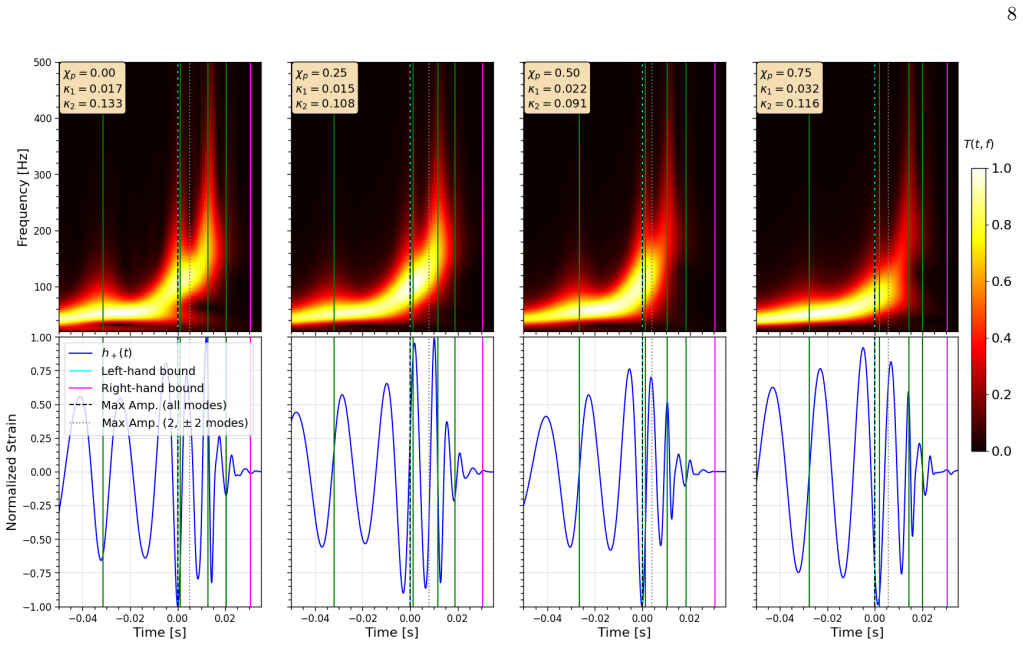
On the paper's own terms, the post-merger signal of an asymmetric binary black hole is not a featureless damped ring: its time-frequency map contains spectral peaks whose number, spacing, and sky distribution respond to spin. Using a publicly available higher-mode waveform model at mass ratio $q=4$, the authors find that increasing the effective aligned spin $\xi$ reduces the spacing between spectral peaks and, at $\xi=0.75$, adds a distinct extra post-merger peak; anti-aligned spin suppresses the peaks until they nearly vanish at $\xi=-0.75$. Precessing spin, tracked by $\chi_p$, complicates the morphology at the best orientation, and the full-sky map of post-merger power breaks its equatorial symmetry already at $\chi_p=0.25$, with the change becoming noticeable near $\chi_p=0.05$. Since the zero-spin distribution is symmetric about the edge-on equator, this broken symmetry is the paper's direct evidence that precession changes how the final black hole broadcasts its post-merger radiation. The authors present the results as support for the earlier proposal that post-merger spectral peaks correspond to sharp curvature features on the common horizon passing across the observer's line of sight, while explicitly noting that waveform analysis alone cannot establish causation.
Load-bearing premise
The whole sky-pattern analysis stands on one timing choice: the merger time is set by the amplitude peak of the best-viewed orientation and then treated as fixed for all directions, with no independent check against the actual moment the two horizons merge; the spinning waveform model's post-merger behavior is also taken on trust.
Editorial extensions
If this is right
- Post-merger peak counting becomes a spin probe: at fixed post-merger duration the $\xi=0.75$ system shows roughly twice as many spectral peaks as the $\xi=0$ system.
- The equator-symmetric sky map of zero-spin systems and its breaking for $\chi_p\ge0.25$ give a precession signature that is present even when the best-orientation morphology is ambiguous.
- Mode content through $l=4$ is enough to lock in the double-chirp structure, so current higher-mode waveform models are adequate for searches, while dominant-mode-only analyses miss the effect.
- If the peaks trace horizon curvature, this motivates building surrogate models that connect horizon-geometry data to waveform features, aiming toward statistical inference of horizon geometry from detected events.
Reading between the lines
- A natural extension the paper leaves implicit is to map the two hot and cold spot pairs of the precessing-sky figures as a function of spin orientation; that would predict how the symmetry axis rotates with the precession phase and could be checked against numerical relativity.
- If the horizon-correlation picture is right, the extra peaks at $\xi=0.75$ imply aligned spin prolongs the deformation of the final horizon, which would make high-spin, high-mass mergers the best targets for horizon imaging.
- The weakest link is the fixed merger-time convention, so an independent test would recompute the sky maps with $t_c$ defined from the $(2,2)$-mode peak; if the claimed symmetry breaking disappears under that convention, the precession result is an artifact of the timing choice rather than a physical pattern.
Editorial analysis
A structured set of objections, weighed in public.
Referee Report
Summary. The paper extends the zero-spin numerical-relativity finding of a post-merger 'double-chirp' in asymmetric binary black hole signals to spinning systems, using the SEOBNRv4PHM waveform model and the NR waveform GT0568. The authors define two time-frequency metrics κ1 and κ2 that measure post-merger CWT power in a fixed window, scan the observer orientation (ι, φ) to find the orientation maximizing the double-chirp, and then study how the morphology varies with mass ratio q, effective aligned spin ξ, and precessing spin χp. They report that strong aligned spin (ξ=0.75) produces additional post-merger spectral peaks, while mild precessing spin (χp=0.25) breaks the equatorial symmetry of the post-merger power distribution across the final black hole sky. They also compare spectral-peak locations with the |Ψ4| distribution and interpret the results as supporting the horizon-geometry correlation conjecture of [24].
Significance. If the claimed spin dependence is real, the double-chirp pattern would become a promising, purely waveform-based probe of binary spin and possibly of final-black-hole horizon dynamics, with clear motivation for future NR horizon-data studies. The paper is careful in several places: it openly flags the tc assumption as 'crucial' (Sec. IV A), it provides an internal cross-check that CWT spectral peaks track the |Ψ4| distribution (Sec. III A), and it recommends a minimum modal content of l=4 for this analysis (Sec. II E). The κ metrics are descriptive summaries rather than fits to a target, so there is no circularity in their definition. However, the significance is currently conditional: every spin-specific claim is generated by a single approximant, SEOBNRv4PHM, whose post-merger higher-mode time-frequency morphology is not independently validated against numerical relativity, and the sky-symmetry result depends on a merger-time convention that is not yet tested for robustness.
major comments (3)
- [Secs. II C, II D, III B] All spin results—the additional ξ=0.75 post-merger peaks, the anti-aligned spin behavior, and the χp=0.25 sky-symmetry break—are obtained exclusively from SEOBNRv4PHM. The paper correctly cites the model's calibration range (q≤4, |χ|≤0.9), but calibration to total waveforms and dominant modes does not guarantee that the post-merger higher-mode amplitudes and phases driving the double-chirp are NR-faithful. The only NR comparison (GT0568, q=10, zero spin) is outside the calibrated range and does not test spin. Because Sec. II E shows that the double-chirp arises from higher modes, the spin-dependent morphology must be checked against at least one NR simulation with aligned spin (e.g., q=4, ξ=0.75) and one with precessing spin (e.g., q=4, χp=0.25). Without such a check, the headline claims could reflect model artifacts rather than physics.
- [Secs. III B, IV A] The sky maps in Fig. 10 and the κ values in Table I are computed with tc fixed as the time of maximum total waveform amplitude at the optimal orientation (ικ, φκ). The paper explicitly calls this 'a crucial assumption' in Sec. IV A, but does not quantify its effect. A different tc convention (e.g., the peak of the (2,±2) mode amplitude, the peak of |Ψ4|, or the NR horizon-formation time) would shift the post-merger window for every orientation and could change both the number of detected post-merger peaks and the apparent equatorial symmetry breaking. The authors should repeat the key analyses of Figs. 4, 8, and 10 under at least two alternative tc definitions and show that the spin conclusions are stable, or explain why the chosen convention is physically preferred.
- [Sec. II A, App. A, Table I] The detection of 'additional post-merger spectral peaks' at ξ=0.75 in Fig. 4 relies on peak-finding thresholds that are adjusted case-by-case, with different settings in the inspiral (A=5, height=0.1, prominence=0.6) and post-merger (A=10, height=0.1, prominence=0.05). The paper does not report how the number of peaks or the values of κ1 and κ2 change when these thresholds, the window width κw, the CWT quality factor Q, or the frequency count nf are varied. Because the appearance of additional peaks is a load-bearing claim in the abstract, a stability analysis over these analysis parameters is needed; otherwise a reader cannot distinguish a robust morphological change from a threshold-dependent artifact.
minor comments (5)
- [Sec. II C] The text states that Figs. 4 and 5 span 'ξ = [0.0, 0.25, 0.50, 0.75] and ξ = [0.0, 0.25, 0.50, 0.75], respectively'; the second list should evidently be the negative values [-0.75, -0.50, -0.25, 0.0] shown in Fig. 5.
- [Sec. I] The introduction contains a typo: 'ack the type of horizon geometry data' should read 'lack the type of horizon geometry data'.
- [Sec. II A / Fig. 2] The main text specifies a Morlet-Gabor CWT with Q=5.0, while the caption of Fig. 2 describes a 'chirplet basis at d=0.2'; the relation between these two analysis choices should be clarified.
- [Sec. III / Figs. 9-10] The text says the orientation scan covers '0 ≤ ϕ ≤ π/2', but Figs. 9 and 10 and the associated grid of 40,000 points are described as covering ϕ ∈ {0, 2π}; one of these statements is a typo.
- [Table I] The first row lists model 'GT0446' while the text and Fig. 3 refer to 'GT0466'; the labels should be made consistent.
Circularity Check
No significant circularity: κ metrics are descriptive, spin results come from an external model, and the tc convention is an acknowledged limitation rather than a self-fulfilling definition.
full rationale
The paper's derivation chain is descriptive rather than inferential, and no claimed result reduces to its own inputs. The κ1 and κ2 metrics (Eqs. 3–4) are explicit sums over the waveform's own continuous-wavelet-transform coefficient map; they are not fitted to any target quantity, and the trends in mass ratio, aligned spin, and precession (Figs. 3–6, Table I) are summary statistics of those same maps. The central spin findings — the additional post-merger spectral peaks at ξ=0.75 and the χp=0.25 sky-symmetry break — are generated by applying a fixed CWT/peak-finding pipeline to SEOBNRv4PHM, an external approximant from Ossokine et al. (2020). No parameter is adjusted to force the claimed extra peak or asymmetry; the paper explicitly reports the per-case peak-finding thresholds in Appendix A rather than hiding a fit. The sky maps in Sec. III B are conditional on the stated global-tc convention, which the paper explicitly labels 'a crucial assumption' (Sec. IV A) and contrasts with the conventional (l,m)=(2,±2) peak-time choice; this is an acknowledged, convention-dependent limitation, not a circular definition of the result. The internal Ψ4 cross-check in Sec. III A compares two transforms of the same waveform and is presented as a consistency check, not as independent confirmation. The only notable self-citation is ref. [37] for the CWT/chirplet methodology; it is not load-bearing for the physical conclusions, and the horizon-geometry interpretation is imported from the different group of ref. [24]. Whether SEOBNRv4PHM faithfully reproduces the post-merger higher-mode time-frequency morphology of spinning numerical-relativity waveforms is a legitimate validation concern, but it is a correctness risk rather than a circularity.
Assumptions & free parameters
free parameters (6)
- κw (post-merger window width) =
500 samples (~0.03 s)
- CWT quality factor Q =
5.0
- CWT frequency count nf =
400
- flow (low-frequency cutoff) =
20 Hz (SEOBNRv4PHM) / 30 Hz (NR) / 40 Hz (GT0601)
- Peak-finding thresholds (A, height, prominence, distance) =
case-by-case; e.g., A = 5 to 10, height = 0.1, prominence = 0.05 to 0.6
- Waveform scaling (M, dL, fref) =
M = 80 solar masses, dL = 500 Mpc, fref = 20 Hz
assumptions (5)
- domain assumption SEOBNRv4PHM reproduces the physical post-merger time-frequency structure at edge-on orientations, including higher modes (2,±1), (3,±3), (4,±4), (5,±5).
- domain assumption The correlation between post-merger spectral peaks and sharp-curvature features on the apparent horizon of the final black hole, established in [24].
- ad hoc to paper The 'continued trajectory' paradigm: after common-horizon formation, the original singularity trajectories continue to inspiral within the horizon, and their curvature is the common source of horizon shape and outgoing radiation.
- domain assumption tc is a global parameter equal to the time of maximum total waveform amplitude at the optimal orientation (ικ, ϕκ), chosen over the conventional (2,±2) peak time.
- standard math Standard time-frequency analysis machinery: the Morlet-Gabor CWT resolves the spectral peaks, and Ψ4 = d²h*/dt² represents outgoing radiation intensity.
invented entities (2)
-
κ1 and κ2 post-merger power metrics
-
(ικ, ϕκ) optimal orientation
Cite this review
Pith. "Pith review of Time-frequency structure in the post-merger binary black hole gravitational wave signal." pith.science (2026). https://pith.science/paper/OQQPAG7Z
@misc{pith2026250517743,
  author       = {Pith},
  title        = {Pith review of: Time-frequency structure in the post-merger binary black hole gravitational wave signal},
  year         = {2026},
  howpublished = {\url{https://pith.science/paper/OQQPAG7Z}},
  note         = {Machine review of arXiv:2505.17743}
}
abstract
Gravitational wave signals from asymmetric binary black hole systems have been shown to exhibit additional chirps beyond the primary merger chirp in the post-merger region of the time-frequency domain. These secondary post-merger chirps correlate to the evolving geometry of the common horizon that forms as the binary merges and were previously studied through numerical relativity simulation in a zero-spin regime. In this work, we investigate the post-merger time-frequency structure in systems with both aligned and precessing spin using widely available waveform models. We find that the inclusion of strong aligned spin $\left(\xi = 0.75\right)$ induces further post-merger time-frequency peaks. Additionally we show that even mild precessing spin $\left(\chi_p = 0.25\right)$ strongly affects the distribution of post-merger radiative power across the celestial sky of the final black hole. Our results support the theory of a correlation between the post-merger signal and horizon geometry.
Figures


Figures from the paper (7 more)




Reference graph
Works this paper leans on
-
[24]
into the time-frequency structure of GW signals from highly-inclined asymmetric BBH systems. We have demonstrated for the first time how the double-chirp pat- tern may be analyzed with a pure waveform approach. By parameterizing the post-merger power (see Sec.(II A), we have developed a method to determine the observer orientation (ικ, ϕκ) for which the d...
-
[1]
B. P. Abbott et al. (LIGO Scientific, Virgo), Phys. Rev. X 9, 031040 (2019), arXiv:1811.12907 [astro-ph.HE]
arXiv 2019
-
[2]
R. Abbott et al. (LIGO Scientific, Virgo), Phys. Rev. X 11, 021053 (2021), arXiv:2010.14527 [gr-qc]
arXiv 2021
-
[3]
R. Abbott et al. (LIGO Scientific, VIRGO), Phys. Rev. D 109, 022001 (2024), arXiv:2108.01045 [gr-qc]
arXiv 2024
-
[4]
R. Abbott et al. (KAGRA, VIRGO, LIGO Scientific), Phys. Rev. X 13, 041039 (2023), arXiv:2111.03606 [gr- qc]
arXiv 2023
-
[5]
B. P. Abbott et al. (LIGO Scientific, Virgo), Phys. Rev. Lett. 119, 161101 (2017), arXiv:1710.05832 [gr-qc]
arXiv 2017
-
[6]
B. P. Abbott et al. (LIGO Scientific, Virgo), Astrophys. J. Lett. 892, L3 (2020), arXiv:2001.01761 [astro-ph.HE]
arXiv 2020
-
[7]
R. Abbott et al. (LIGO Scientific, Virgo), Astrophys. J. Lett. 896, L44 (2020), arXiv:2006.12611 [astro-ph.HE]
arXiv 2020
Show all 70 references
-
[8]
Abbott et al.(LIGO Scientific, KAGRA, VIRGO), As- trophys
R. Abbott et al.(LIGO Scientific, KAGRA, VIRGO), As- trophys. J. Lett. 915, L5 (2021), arXiv:2106.15163 [astro- ph.HE]
2021 arXiv
-
[9]
A. G. Abac et al. (LIGO Scientific, KAGRA, VIRGO), Astrophys. J. Lett. 970, L34 (2024), arXiv:2404.04248 [astro-ph.HE]
2024 arXiv
-
[10]
C. W. Lincoln and C. M. Will, Physical Review D 42, 1123 (1990)
1990
-
[11]
L. E. Kidder, Phys. Rev. D 52, 821 (1995)
1995
-
[13]
J. S. Read et al. , Physical Review D - Particles, Fields, Gravitation and Cosmology 79, 1 (2009), arXiv:0901.3258
2009 arXiv
-
[14]
Blanchet, Living Reviews in Relativity 17, 10.12942/lrr-2014-2 (2014), arXiv:1310.1528
L. Blanchet, Living Reviews in Relativity 17, 10.12942/lrr-2014-2 (2014), arXiv:1310.1528
2014 arXiv
-
[15]
J. A. Clark, A. Bauswein, N. Stergioulas, and D. Shoemaker, Classical and Quantum Grav- ity 33, 10.1088/0264-9381/33/8/085003 (2016), arXiv:1509.08522
2016 arXiv
-
[16]
Bauswein, N
A. Bauswein, N. Stergioulas, and H. T. Janka, Euro- pean Physical Journal A 52, 10.1140/epja/i2016-16056-7 (2016), arXiv:1508.05493
2016 arXiv
-
[17]
Schmidt, F
P. Schmidt, F. Ohme, and M. Hannam, Physical Review D 91, 10.1103/physrevd.91.024043 (2015)
2015 doi
-
[19]
Henshaw, R
C. Henshaw, R. O’Shaughnessy, and L. Cadonati, Classical and Quantum Gravity 39, 125003 (2022), arXiv:2201.05220
2022 arXiv
-
[20]
Gerosa et al., Phys
D. Gerosa et al., Phys. Rev. D 108, 024042 (2023)
2023
-
[21]
Antonini and M
F. Antonini and M. Gieles, Physical Review D 102, 10.1103/physrevd.102.123016 (2020)
2020 doi
-
[22]
A. A. Trani et al., Monthly Notices of the Royal Astro- nomical Society 504, 910–919 (2021)
2021
-
[23]
Belczynski et al., Astronomy & Astrophysics 636, A104 (2020)
K. Belczynski et al., Astronomy & Astrophysics 636, A104 (2020)
2020
-
[25]
Harry, J
I. Harry, J. C. Bustillo, and A. Nitz, Physical Review D 97, 23004 (2018), arXiv:1709.09181
2018 arXiv
-
[26]
Calderon Bustillo et al., Communications Physics 3, 1 (2020), arXiv:1906.01153
J. Calderon Bustillo et al., Communications Physics 3, 1 (2020), arXiv:1906.01153
2020 arXiv
- [27]
-
[28]
Chandra, J
K. Chandra, J. Calder´ on Bustillo, A. Pai, and I. W. Harry, Phys. Rev. D 106, 123003 (2022), arXiv:2207.01654 [gr-qc]
2022 arXiv
-
[29]
The geometry of these apparent hori- zons, which are distinct from the globally defined event horizons [30], correlates with the double-chirp pattern
for a review. The geometry of these apparent hori- zons, which are distinct from the globally defined event horizons [30], correlates with the double-chirp pattern. Current simulation template banks [31–34], however, ack the type of horizon geometry data used in [24], making t...
2025 arXiv
-
[30]
Penrose, Physical Review Letters 14, 57 (1965)
R. Penrose, Physical Review Letters 14, 57 (1965)
1965
-
[31]
Ashtekar and B
A. Ashtekar and B. Krishnan, Living Reviews in Relativ- ity 7, 10.12942/lrr-2004-10 (2004), arXiv:0407042 [gr-qc]
2004 doi
-
[32]
Booth, Canadian Journal of Physics 83, 1073 (2005), arXiv:0508107 [gr-qc]
I. Booth, Canadian Journal of Physics 83, 1073 (2005), arXiv:0508107 [gr-qc]
2005
-
[33]
Boyle et al., Classical and Quantum Gravity 36, 10.1088/1361-6382/ab34e2 (2019), arXiv:1904.04831
M. Boyle et al., Classical and Quantum Gravity 36, 10.1088/1361-6382/ab34e2 (2019), arXiv:1904.04831
2019 arXiv
-
[34]
Jani et al., Classical and Quantum Gravity 33, 1 (2016), arXiv:1605.03204
K. Jani et al., Classical and Quantum Gravity 33, 1 (2016), arXiv:1605.03204
2016 arXiv
- [35]
-
[36]
Healy and C
J. Healy and C. O. Lousto, Physical Review D 105, 10.1103/PhysRevD.105.124010 (2022), arXiv:2202.00018
2022 arXiv
-
[37]
Nitz et al., gwastro/pycbc: v2.1.0 release of pycbc (2023)
A. Nitz et al., gwastro/pycbc: v2.1.0 release of pycbc (2023)
2023
-
[38]
Ossokine et al., Phys
S. Ossokine et al., Phys. Rev. D 102, 044055 (2020)
2020
-
[39]
Henshaw, M
C. Henshaw, M. Arogeti, A. Heranval, and L. Cadonati, arXiv:2402.16533 [gr-qc] (2024)
2024 arXiv
-
[40]
A. K. Mehta, C. K. Mishra, V. Varma, and P. Ajith, 17 Physical Review D 96, 1 (2017), arXiv:1708.03501
2017 arXiv
-
[41]
Varma, D
V. Varma, D. Gerosa, L. C. Stein, F. H´ ebert, and H. Zhang, Physical Review Letters 122, 1 (2019), arXiv:1809.09125
2019 arXiv
-
[42]
Newman and R
E. Newman and R. Penrose, Journal of Mathematical Physics 3, 566 (1962)
1962
-
[43]
Pook-kolb, R
D. Pook-kolb, R. A. Hennigar, and I. Booth, Physical Review Letters 127, 181101 (2021)
2021
-
[44]
Pook-Kolb, I
D. Pook-Kolb, I. Booth, and R. A. Hennigar, Physical Review D 104, 84084 (2021), arXiv:2104.11344
2021 arXiv
-
[45]
Evans et al., Classical and Quantum Gravity 37, 10.1088/1361-6382/ab9c6b (2020)
C. Evans et al., Classical and Quantum Gravity 37, 10.1088/1361-6382/ab9c6b (2020)
2020 doi
-
[46]
Booth, R
I. Booth, R. A. Hennigar, and S. Mondal, Physical Re- view D 102, 44031 (2020)
2020
-
[47]
Schmidt, M
P. Schmidt, M. Hannam, and S. Husa, Physical Review D - Particles, Fields, Gravitation and Cosmology 86, 1 (2012), arXiv:1207.3088
2012 arXiv
-
[48]
H. Y. Chen et al., Classical and Quantum Gravity 38, 10.1088/1361-6382/abd594 (2020), arXiv:1709.08079
2020 arXiv
-
[49]
Capote et al., Physical Review D 111, 62002 (2024), arXiv:2411.14607
E. Capote et al., Physical Review D 111, 62002 (2024), arXiv:2411.14607
2024 arXiv
-
[50]
Acernese et al., Living Reviews in Relativity 21 (2018)
F. Acernese et al., Living Reviews in Relativity 21 (2018)
2018
- [51]
-
[52]
Branchesi et al., Journal of Cosmology and Astropar- ticle Physics 2023 (7), arXiv:2303.15923
M. Branchesi et al., Journal of Cosmology and Astropar- ticle Physics 2023 (7), arXiv:2303.15923
2023 arXiv
-
[53]
Thornburg, Classical and Quantum Gravity 21, 743 (2004), arXiv:0306056 [gr-qc]
J. Thornburg, Classical and Quantum Gravity 21, 743 (2004), arXiv:0306056 [gr-qc]
2004
-
[54]
Blackman et al., Physical Review D 96, 1 (2017), arXiv:1705.07089
J. Blackman et al., Physical Review D 96, 1 (2017), arXiv:1705.07089
2017 arXiv
-
[55]
Rezzolla, R
L. Rezzolla, R. P. MacEdo, and J. L. Jaramillo, Physical Review Letters 104, 4 (2010), arXiv:1003.0873
2010 arXiv
-
[56]
Owen et al., Physical Review Letters 106, 4 (2011), arXiv:1012.4869
R. Owen et al., Physical Review Letters 106, 4 (2011), arXiv:1012.4869
2011 arXiv
-
[57]
D. A. Nichols et al. , Physical Review D - Parti- cles, Fields, Gravitation and Cosmology 84, 1 (2011), arXiv:1108.5486
2011 arXiv
-
[58]
Zhang et al
F. Zhang et al. , Physical Review D - Particles, Fields, Gravitation and Cosmology 86, 1 (2012), arXiv:1208.3034
2012 arXiv
-
[59]
D. A. Nichols et al. , Physical Review D - Parti- cles, Fields, Gravitation and Cosmology 86, 1 (2012), arXiv:1208.3038
2012 arXiv
-
[60]
J. L. Jaramillo, R. P. Macedo, P. Moesta, and L. Rezzolla, AIP Conference Proceedings 1458, 158 (2012)
2012
-
[61]
J. L. Jaramillo, R. P. MacEdo, P. Moesta, and L. Rez- zolla, Physical Review D - Particles, Fields, Gravitation and Cosmology 85, 1 (2012), arXiv:1108.0060
2012 arXiv
-
[62]
J. L. Jaramillo, R. P. MacEdo, P. Moesta, and L. Rez- zolla, Physical Review D - Particles, Fields, Gravitation and Cosmology 85, 1 (2012), arXiv:1108.0061
2012 arXiv
-
[63]
Gupta, B
A. Gupta, B. Krishnan, A. B. Nielsen, and E. Schnetter, Physical Review D 97, 84028 (2018), arXiv:1801.07048
2018 arXiv
-
[64]
Prasad et al., Physical Review Letters 125, 121101 (2020), arXiv:2003.06215
V. Prasad et al., Physical Review Letters 125, 121101 (2020), arXiv:2003.06215
2020 arXiv
-
[65]
Mourier, X
P. Mourier, X. Jim´ enez Forteza, D. Pook-Kolb, B. Krish- nan, and E. Schnetter, Physical Review D 103, 1 (2021), arXiv:2010.15186
2021 arXiv
-
[66]
Prasad, A
V. Prasad, A. Gupta, S. Bose, and B. Krishnan, Physical Review D 105, 44019 (2022), arXiv:2106.02595
2022 arXiv
-
[67]
Khera et al., Physical Review Letters 131, 1 (2023), arXiv:2306.11142
N. Khera et al., Physical Review Letters 131, 1 (2023), arXiv:2306.11142
2023 arXiv
-
[68]
Prasad, Physical Review D 111, 84070 (2023), arXiv:2312.01136
V. Prasad, Physical Review D 111, 84070 (2023), arXiv:2312.01136
2023 arXiv
- [69]
-
[70]
Ashton et al., The Astrophysical Journal Supplement Series 241, 27 (2019)
G. Ashton et al., The Astrophysical Journal Supplement Series 241, 27 (2019)
2019
-
[71]
Veitch et al., Physical Review D 91, 10.1103/phys- revd.91.042003 (2015)
J. Veitch et al., Physical Review D 91, 10.1103/phys- revd.91.042003 (2015)
2015 doi
-
[72]
Virtanen et al., Nature Methods 17, 261 (2020)
P. Virtanen et al., Nature Methods 17, 261 (2020)
2020
Reviewed August 7, 2026 · model on record in the stance chip above.
Discussion (0). Sign in to comment.