REVIEW 5 major objections 4 minor 51 references
IntrinsicReal: Adapting IntrinsicAnything from Synthetic to Real Objects
T0 review · 5 major / 4 minor · reviewed 2026-08-05 · deepseek-v4-flash
Pith's one-line read This paper proposes IntrinsicReal, a two-phase domain adaptation framework that fine-tunes a synthetic-trained diffusion model for albedo estimation on unlabeled real-world images, using dual pseudo-labels from classifier confidence thresho
desk verdict Good idea, thin evidence: the dual pseudo-labeling + DPO adaptation loop is a genuine contribution, but the SOTA claim rests on a 20-object benchmark with no error bars and a near-chance initial classifier. read the letter →
The pith
A machine-rendered reading of the paper's core claim, the machinery that carries it, and where it could break.
The reading
What carries the argument
The central mechanism is dual pseudo-labeling. First, an absolute threshold on classifier confidence selects high-quality albedo outputs for supervised fine-tuning; second, relative preference rankings from the same classifier, applied to outputs of different iterations for the same input, are converted into win/lose pairs for Diffusion-DPO. The two are combined in an iterative joint-updating loop where classifier, model, and positive/negative sets are alternately refined. The classifier is a ResNet101 trained to distinguish albedo from diffuse RGB, and the model is a Stable-Diffusion-based conditional generator initialized from IntrinsicAnything.
What would settle it
Take a held-out set of real-world albedo predictions, have humans rank pairs from different iterations, and compare those rankings with the classifier's preference scores. If classifier and human rankings disagree on sub-optimal pairs, or if fine-tuning with human-ranked pairs outperforms fine-tuning with classifier-ranked pairs, the classifier's preference signal is not carrying the reported gain.
Extended reading notes
Core claim
IntrinsicReal claims that a synthetic-trained diffusion model for albedo estimation—IntrinsicAnything—can be adapted to unlabeled real-world photos by constructing a training signal from its own outputs. The paper introduces a two-phase pipeline. In Phase 1, a ResNet101 classifier trained to tell albedo from diffuse RGB is fine-tuned with a small manually labeled set of good and bad albedo predictions, then assigns absolute-confidence pseudo-labels (thresholds 0.99 positive, 0.3 negative) to albedos the model generates on MVImgNet; the high-confidence positives fine-tune the diffusion model, and the positive/negative sets are rectified each iteration. In Phase 2, the classifier's relative pr
Load-bearing premise
The load-bearing premise is that a classifier trained mostly on synthetic renders and a small set of hand-picked examples can reliably tell good albedo estimates from bad ones on real photos, and that its relative preferences are a trustworthy reward signal for fine-tuning. If the classifier's idea of 'good' is wrong, the iterative loop trains the model toward that wrong idea rather than toward true surface reflectance.
Editorial extensions
If this is right
- Albedo estimation for real-world object photos can be improved without needing any paired real-world albedo ground truth.
- A synthetic-trained diffusion model can be moved to a new visual domain using its own high-confidence outputs, breaking the usual reliance on large labeled target datasets.
- Relative preference labels can substitute for absolute quality scores when sub-optimal outputs are hard to score, extending direct-preference fine-tuning to perception tasks.
- The method retains or improves synthetic-domain performance while adapting, so it does not trade synthetic accuracy for real-world generalization.
- The resulting albedo maps support downstream relighting and editing of in-the-wild images.
Reading between the lines
- The absolute-vs-relative labeling insight is transferable: any generation task where humans can rank outputs but cannot score them absolutely could use a similar two-phase classifier/DPO loop, such as surface normal or material estimation. This is an extension, not a claim in the paper.
- Because the paper reports the initial classifier accuracy at 0.52 on the validation set, much of Phase 1's early gain may come from the manually labeled positive/negative sets rather than from the iterative loop; a stripped-down control that fixes the classifier would reveal how much the joint updating adds.
- If classifier preference is even slightly biased, DPO can amplify that bias; a practical safeguard would be periodic human verification of win/lose pairs, which the paper does not evaluate.
- The high-confidence positive pseudo-labels could be used as a large-scale training set for other architectures or for scaling studies, which the paper names as future work.
Editorial analysis
A structured set of objections, weighed in public.
Referee Report
Summary. The paper proposes IntrinsicReal, a synthetic-to-real domain adaptation framework for single-image intrinsic decomposition. Starting from IntrinsicAnything, which is trained on synthetic Objaverse data, the method fine-tunes the model on unlabeled real-world RGB images from MVImgNet using a dual pseudo-labeling strategy. Phase 1 iteratively updates a quality classifier (IR-Classifier) and the albedo generation model (IR-Model) using absolute confidence thresholds (0.99 and 0.3) to select positive and negative pseudo-labels. Phase 2 constructs relative preference pairs between outputs of different iterations and fine-tunes the model with Diffusion-DPO, using the same classifier's scores as the reward. The method is evaluated on the 20-object MIT intrinsic benchmark and on MVImgNet with a user study, reporting improvements in PSNR/SSIM/MSE over IntrinsicAnything and RGB-X.
Significance. If its claims are validated, IntrinsicReal would provide a practical recipe for adapting synthetic-trained intrinsic decomposition models to real objects using only unlabeled real images plus a small expert-labeled set, which is a relevant contribution for inverse rendering and material editing. The paper has several genuine strengths: it includes an external quantitative anchor (MIT ground truth) rather than relying solely on qualitative results; the iterative classifier/model co-training is ablated; and the expert-annotated MVImgNet validation set provides a human-labeled check on classifier improvements. However, the central empirical claim of 'significantly outperforming existing methods on both synthetic and real-world datasets' is currently supported by a single 20-image benchmark with no error bars, by qualitative synthetic comparisons, and by a user study whose protocol is under-specified. The self-training loop also raises a reward-hacking risk that is acknowledged only implicitly. These issues are substantive but addressable, so the paper could become acceptable after a major revision that strengthens the evaluation and analyzes the sensitivity of the key hyperparameters.
major comments (5)
- [§4.4, Table 1] The central quantitative claim rests on the MIT Intrinsic dataset with only 20 objects, and Table 1 reports only averaged PSNR/SSIM/MSE. There are no per-object scores, no variance estimates, and no significance test. The word 'significantly outperforms' in the Abstract and §4.4 is therefore not statistically supported. The authors should report per-object metrics, paired tests or bootstrap confidence intervals, and ideally evaluate on a held-out subset of objects not used for any model selection or early stopping.
- [§3.2.2 and §3.3] The training loop is largely self-referential: IR-Classifier selects pseudo-labels for IR-Model fine-tuning, and in Phase 2 the same classifier provides the preference reward for Diffusion-DPO. The initial classifier accuracy on the expert-validated MVImgNet set is only 0.52 (Table 2), near chance. Although the MIT ground-truth evaluation provides an external anchor, it is small, and the loop could in principle improve classifier agreement and MIT PSNR while drifting from true albedo on unseen objects. The authors should quantify this risk, e.g., by checking whether classifier score improvements correlate with MIT PSNR improvements per object, by training with inverted preferences as a sanity check, or by evaluating with an independent albedo-quality measure. A short discussion of this potential bias and its mitigation is needed.
- [§3.2.2, Pseudo-labeling] The positive and negative thresholds (0.99 and 0.3) are introduced without justification and without any sensitivity analysis. These thresholds directly control the pseudo-label sets and therefore the entire fine-tuning signal. The paper should include experiments varying both thresholds (e.g., 0.95/0.4, 0.99/0.3, 0.999/0.2) and report the resulting MIT metrics to show the method is not brittle to these hand-chosen values.
- [Abstract and §B.4] The Abstract claims state-of-the-art albedo estimation on 'both synthetic and real-world datasets,' but the synthetic claim is not quantitatively supported anywhere. §B.4 points only to Fig. 15, which is a qualitative comparison on Objaverse. No PSNR/SSIM or other metrics are reported on a synthetic test set. The authors should either provide quantitative synthetic evaluation on a suitable benchmark (e.g., a held-out subset of Objaverse renderings or an existing synthetic intrinsic dataset) or temper the claim to real-world datasets only.
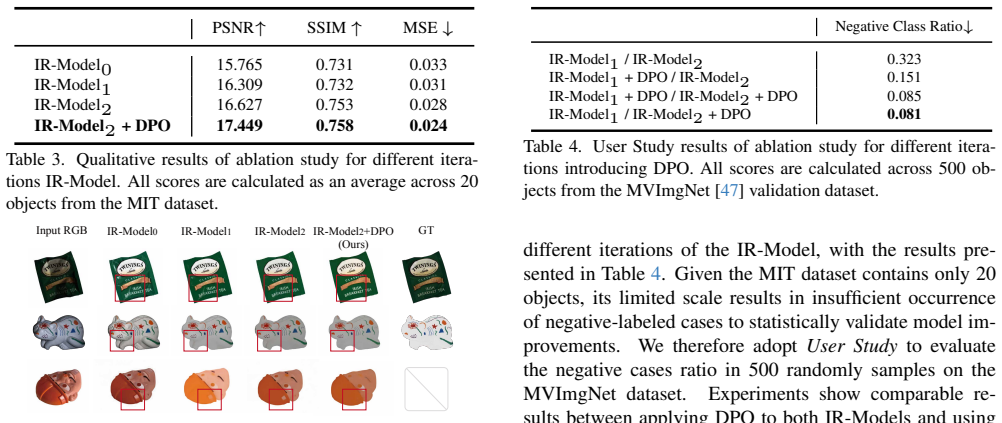
- [§4.3 and Table 4] The user study is under-specified. Table 4 reports 'Negative Class Ratio' but the definition is unclear: what exactly is being voted on, what instructions were given to the 18 participants, how the 500 objects were sampled, and what the inter-rater agreement was. Without these details the user study cannot support the claim that DPO reduces negative cases. Please provide the full protocol, including sample images, voting interface, and summary statistics of rater agreement.
minor comments (4)
- [Throughout] Typos: 'Pesudo-labeling' (Fig. 3), 'Adapation' (Sec. 3.2 heading), 'IntrinsicRreal' (Fig. 3 caption), 'downtown tasks' should be 'downstream tasks' (§4.4).
- [Table 3 caption] Table 3 is labeled 'Qualitative results' but reports numerical metrics; it should be 'Quantitative results'.
- [§B.7] The text in §B.7 ('Results of Comparison on Different Iterations of IR-Model') repeats the description of IR-Classifier improvements from §B.6. The text should describe the IR-Model results shown in the corresponding figures.
- [Eq. (3)] The Diffusion-DPO loss notation is dense; the roles of xw0 and xl0 as albedo latents from different iterations should be stated more explicitly, and the dependence on the conditioning image I should be clarified in the expectation notation.
Circularity Check
No significant circularity: external benchmarks validate the training loop.
full rationale
The paper's central claim—state-of-the-art albedo estimation—is tested against held-out external benchmarks (MIT Intrinsic dataset with ground truth in Table 1; expert-annotated MVImgNet validation in Table 2; user study with 18 professionals in Table 4), not against the model's own pseudo-labels or classifier scores. The pseudo-labeling loop (Sec. 3.2.2) and DPO preferences (Sec. 3.3) are indeed self-referential in that the classifier selects training data and defines win/lose pairs, but the classifier is initialized on synthetic ground-truth albedo (Eq. 1) and a small manually labeled set, so the notion of 'quality' has external roots. The final model is fine-tuned on MVImgNet pseudo-labels and evaluated on a different dataset (MIT), so the reported PSNR/SSIM/MSE improvements are not forced by the pseudo-label definition. The synthetic SOTA claim lacks quantitative evidence (only Fig. 15), which is a reporting gap, not circularity. The acknowledged limitation in Sec. 4.6 that some objects degrade is an empirical risk of self-training, not a logical tautology.
Assumptions & free parameters
free parameters (7)
- positive pseudo-label threshold =
0.99
- negative pseudo-label threshold =
0.3
- Phase 1 iterations =
2
- classifier learning rate =
5e-4
- model fine-tuning learning rate =
1e-5
- DPO training iterations =
10000
- manual label set size =
not reported
assumptions (5)
- domain assumption Lambertian assumption: I_diff = A ⊙ S
- domain assumption The synthetic-data-trained classifier generalizes to real data
- domain assumption IntrinsicAnything's synthetic pretraining is a good starting point
- standard math Diffusion-DPO improves alignment to classifier preferences
- ad hoc to paper Classifier preferences are a valid proxy for albedo quality
Cite this review
Pith. "Pith review of IntrinsicReal: Adapting IntrinsicAnything from Synthetic to Real Objects." pith.science (2026). https://pith.science/paper/OQYEW7XA
@misc{pith2026250900777,
  author       = {Pith},
  title        = {Pith review of: IntrinsicReal: Adapting IntrinsicAnything from Synthetic to Real Objects},
  year         = {2026},
  howpublished = {\url{https://pith.science/paper/OQYEW7XA}},
  note         = {Machine review of arXiv:2509.00777}
}
read the original abstract
Estimating albedo (a.k.a., intrinsic image decomposition) from single RGB images captured in real-world environments (e.g., the MVImgNet dataset) presents a significant challenge due to the absence of paired images and their ground truth albedos. Therefore, while recent methods (e.g., IntrinsicAnything) have achieved breakthroughs by harnessing powerful diffusion priors, they remain predominantly trained on large-scale synthetic datasets (e.g., Objaverse) and applied directly to real-world RGB images, which ignores the large domain gap between synthetic and real-world data and leads to suboptimal generalization performance. In this work, we address this gap by proposing IntrinsicReal, a novel domain adaptation framework that bridges the above-mentioned domain gap for real-world intrinsic image decomposition. Specifically, our IntrinsicReal adapts IntrinsicAnything to the real domain by fine-tuning it using its high-quality output albedos selected by a novel dual pseudo-labeling strategy: i) pseudo-labeling with an absolute confidence threshold on classifier predictions, and ii) pseudo-labeling using the relative preference ranking of classifier predictions for individual input objects. This strategy is inspired by human evaluation, where identifying the highest-quality outputs is straightforward, but absolute scores become less reliable for sub-optimal cases. In these situations, relative comparisons of outputs become more accurate. To implement this, we propose a novel two-phase pipeline that sequentially applies these pseudo-labeling techniques to effectively adapt IntrinsicAnything to the real domain. Experimental results show that our IntrinsicReal significantly outperforms existing methods, achieving state-of-the-art results for albedo estimation on both synthetic and real-world datasets.
Figures


Figures from the paper (20 more)




Reference graph
Works this paper leans on
-
[1]
Enhanced transfer learning for autonomous driving with systematic ac- cident simulation
Shivam Akhauri, Laura Y Zheng, and Ming C Lin. Enhanced transfer learning for autonomous driving with systematic ac- cident simulation. In 2020 IEEE/RSJ International Confer- ence on Intelligent Robots and Systems (IROS), pages 5986–
work page 2020
-
[2]
An end-to-end curriculum learning approach for autonomous driving scenarios
Luca Anzalone, Paola Barra, Silvio Barra, Aniello Cas- tiglione, and Michele Nappi. An end-to-end curriculum learning approach for autonomous driving scenarios. IEEE Transactions on Intelligent Transportation Systems, 23(10): 19817–19826, 2022. 3
work page 2022
-
[3]
ZoDi: Zero-Shot Domain Adaptation with Diffusion-Based Image Transfer
Hiroki Azuma, Yusuke Matsui, and Atsuto Maki. Zodi: Zero-shot domain adaptation with diffusion-based image transfer. arXiv preprint arXiv:2403.13652, 2024. 3
work page Pith review arXiv 2024
-
[4]
Curriculum learning for vehicle lateral stability estimations
Jihwan Bae, Taekyung Kim, Wonsuk Lee, and Inwook Shim. Curriculum learning for vehicle lateral stability estimations. IEEE Access, 9:89249–89262, 2021. 3
work page 2021
-
[5]
Cnn based learning using reflection and retinex models for intrin- sic image decomposition
Anil S Baslamisli, Hoang-An Le, and Theo Gevers. Cnn based learning using reflection and retinex models for intrin- sic image decomposition. In Proceedings of the IEEE con- ference on computer vision and pattern recognition , pages 6674–6683, 2018. 3
work page 2018
-
[6]
Sean Bell, Kavita Bala, and Noah Snavely. Intrinsic images in the wild. ACM Transactions on Graphics (TOG) , 33(4): 1–12, 2014. 2
work page 2014
-
[7]
An l 1 image trans- form for edge-preserving smoothing and scene-level intrinsic decomposition
Sai Bi, Xiaoguang Han, and Yizhou Yu. An l 1 image trans- form for edge-preserving smoothing and scene-level intrinsic decomposition. ACM Transactions on Graphics (TOG) , 34 (4):1–12, 2015. 3
work page 2015
-
[8]
Deep cg2real: Synthetic-to-real translation via image disentanglement
Sai Bi, Kalyan Sunkavalli, Federico Perazzi, Eli Shechtman, Vladimir G Kim, and Ravi Ramamoorthi. Deep cg2real: Synthetic-to-real translation via image disentanglement. In Proceedings of the IEEE/CVF International Conference on Computer Vision, pages 2730–2739, 2019. 3
work page 2019
Show all 51 references
-
[9]
Unsupervised pixel- level domain adaptation with generative adversarial net- works
Konstantinos Bousmalis, Nathan Silberman, David Dohan, Dumitru Erhan, and Dilip Krishnan. Unsupervised pixel- level domain adaptation with generative adversarial net- works. In Proceedings of the IEEE conference on computer vision and pattern recognition, pages 3722–3731, 2017. 3
2017
-
[10]
A naturalistic open source movie for opti- cal flow evaluation
Daniel J Butler, Jonas Wulff, Garrett B Stanley, and Michael J Black. A naturalistic open source movie for opti- cal flow evaluation. In Computer Vision–ECCV 2012: 12th European Conference on Computer Vision, Florence, Italy, October 7-13, 2012, Proceedings, Part VI 12 , pages 611–
2012
-
[11]
Emerg- ing properties in self-supervised vision transformers
Mathilde Caron, Hugo Touvron, Ishan Misra, Herv ´e J´egou, Julien Mairal, Piotr Bojanowski, and Armand Joulin. Emerg- ing properties in self-supervised vision transformers. In Pro- ceedings of the IEEE/CVF international conference on com- puter vision, pages 9650–9660, 2021. 5
2021
-
[12]
Shapenet: An information-rich 3d model repository
Angel X Chang, Thomas Funkhouser, Leonidas Guibas, Pat Hanrahan, Qixing Huang, Zimo Li, Silvio Savarese, Manolis Savva, Shuran Song, Hao Su, et al. Shapenet: An information-rich 3d model repository. arXiv preprint arXiv:1512.03012, 2015. 3
2015 arXiv
-
[13]
Intrinsicanything: Learning diffusion priors for inverse rendering under unknown illumi- nation
Xi Chen, Sida Peng, Dongchen Yang, Yuan Liu, Bowen Pan, Chengfei Lv, and Xiaowei Zhou. Intrinsicanything: Learning diffusion priors for inverse rendering under unknown illumi- nation. arXiv preprint arXiv:2404.11593, 2024. 2, 3, 5, 7, 8, 12, 13, 14, 15, 16, 17, 18
2024 arXiv
-
[14]
Non-local intrinsic decomposition with near-infrared priors
Ziang Cheng, Yinqiang Zheng, Shaodi You, and Imari Sato. Non-local intrinsic decomposition with near-infrared priors. In Proceedings of the IEEE/CVF international conference on computer vision, pages 2521–2530, 2019. 3
2019
-
[15]
Cross-domain transfer learning with corte: Consistent and reliable transfer from black-box to lightweight segmentation model
Claudia Cuttano, Antonio Tavera, Fabio Cermelli, Giuseppe Averta, and Barbara Caputo. Cross-domain transfer learning with corte: Consistent and reliable transfer from black-box to lightweight segmentation model. In Proceedings of the IEEE/CVF International Conference on Comput...
2023
-
[16]
Obja- verse: A universe of annotated 3d objects
Matt Deitke, Dustin Schwenk, Jordi Salvador, Luca Weihs, Oscar Michel, Eli VanderBilt, Ludwig Schmidt, Kiana Ehsani, Aniruddha Kembhavi, and Ali Farhadi. Obja- verse: A universe of annotated 3d objects. arXiv preprint arXiv:2212.08051, 2022. 2, 5, 6, 18, 22
2022 arXiv
-
[17]
Imagenet: A large-scale hierarchical image database
Jia Deng, Wei Dong, Richard Socher, Li-Jia Li, Kai Li, and Li Fei-Fei. Imagenet: A large-scale hierarchical image database. In 2009 IEEE conference on computer vision and pattern recognition, pages 248–255. Ieee, 2009. 5, 7
2009
-
[18]
Ground truth dataset and baseline eval- uations for intrinsic image algorithms
Roger Grosse, Micah K Johnson, Edward H Adelson, and William T Freeman. Ground truth dataset and baseline eval- uations for intrinsic image algorithms. In 2009 IEEE 12th International Conference on Computer Vision, pages 2335–
2009
-
[19]
Deep residual learning for image recognition
Kaiming He, Xiangyu Zhang, Shaoqing Ren, and Jian Sun. Deep residual learning for image recognition. In Proceed- ings of the IEEE conference on computer vision and pattern recognition, pages 770–778, 2016. 5, 7, 12
2016
-
[20]
Distilling the knowledge in a neural net- work
Geoffrey Hinton. Distilling the knowledge in a neural net- work. arXiv preprint arXiv:1503.02531, 2015. 3
2015 arXiv
-
[21]
Cycada: Cycle-consistent adversarial domain adaptation
Judy Hoffman, Eric Tzeng, Taesung Park, Jun-Yan Zhu, Phillip Isola, Kate Saenko, Alexei Efros, and Trevor Darrell. Cycada: Cycle-consistent adversarial domain adaptation. In International conference on machine learning, pages 1989–
1989
-
[22]
Synthetic-to-real domain adaptation using contrastive un- paired translation
Benedikt T Imbusch, Max Schwarz, and Sven Behnke. Synthetic-to-real domain adaptation using contrastive un- paired translation. In 2022 IEEE 18th International Confer- ence on Automation Science and Engineering (CASE), pages 595–602. IEEE, 2022. 3
2022
-
[23]
End-to-end ego lane esti- mation based on sequential transfer learning for self-driving cars
Jiman Kim and Chanjong Park. End-to-end ego lane esti- mation based on sequential transfer learning for self-driving cars. In Proceedings of the IEEE conference on computer vi- sion and pattern recognition workshops, pages 30–38, 2017. 3
2017
-
[24]
Adam: A method for stochastic opti- mization
Diederik P Kingma. Adam: A method for stochastic opti- mization. arXiv preprint arXiv:1412.6980, 2014. 7
2014 arXiv
-
[25]
In- trinsic image diffusion for single-view material estimation
Peter Kocsis, Vincent Sitzmann, and Matthias Nießner. In- trinsic image diffusion for single-view material estimation. arXiv preprint arXiv:2312.12274, 2023. 3
2023 arXiv
-
[26]
Shading annotations in the wild
Balazs Kovacs, Sean Bell, Noah Snavely, and Kavita Bala. Shading annotations in the wild. In Proceedings of the IEEE conference on computer vision and pattern recogni- tion, pages 6998–7007, 2017. 3
2017
-
[27]
Self-paced learning for latent variable models
M Kumar, Benjamin Packer, and Daphne Koller. Self-paced learning for latent variable models. Advances in neural in- formation processing systems, 23, 2010. 3
2010
-
[28]
Camera-driven repre- sentation learning for unsupervised domain adaptive person re-identification
Geon Lee, Sanghoon Lee, Dohyung Kim, Younghoon Shin, Yongsang Yoon, and Bumsub Ham. Camera-driven repre- sentation learning for unsupervised domain adaptive person re-identification. In Proceedings of the IEEE/CVF Interna- tional Conference on Computer Vision, pages 11453–11462,
-
[29]
Self-distillation for ro- bust lidar semantic segmentation in autonomous driving
Jiale Li, Hang Dai, and Yong Ding. Self-distillation for ro- bust lidar semantic segmentation in autonomous driving. In European conference on computer vision , pages 659–676. Springer, 2022. 3
2022
-
[30]
Single image layer separation using relative smoothness
Yu Li and Michael S Brown. Single image layer separation using relative smoothness. In Proceedings of the IEEE con- ference on computer vision and pattern recognition , pages 2752–2759, 2014. 3
2014
-
[31]
Aldm-grasping: Diffusion-aided zero-shot sim-to-real transfer for robot grasping
Yiwei Li, Zihao Wu, Huaqin Zhao, Tianze Yang, Zhengliang Liu, Peng Shu, Jin Sun, Ramviyas Parasuraman, and Tianming Liu. Aldm-grasping: Diffusion-aided zero-shot sim-to-real transfer for robot grasping. arXiv preprint arXiv:2403.11459, 2024. 3
2024 arXiv
-
[32]
Cgintrinsics: Better intrinsic image decomposition through physically-based rendering
Zhengqi Li and Noah Snavely. Cgintrinsics: Better intrinsic image decomposition through physically-based rendering. In Proceedings of the European conference on computer vision (ECCV), pages 371–387, 2018. 3
2018
-
[33]
Materialfusion: Enhancing inverse rendering with material diffusion priors
Yehonathan Litman, Or Patashnik, Kangle Deng, Aviral Agrawal, Rushikesh Zawar, Fernando De la Torre, and Shubham Tulsiani. Materialfusion: Enhancing inverse rendering with material diffusion priors. arXiv preprint arXiv:2409.15273, 2024. 3
2024 arXiv
-
[34]
Guid- ing pseudo-labels with uncertainty estimation for source- free unsupervised domain adaptation
Mattia Litrico, Alessio Del Bue, and Pietro Morerio. Guid- ing pseudo-labels with uncertainty estimation for source- free unsupervised domain adaptation. In Proceedings of the IEEE/CVF Conference on Computer Vision and Pattern Recognition, pages 7640–7650, 2023. 3
2023
-
[35]
Lime: Live intrinsic material esti- mation
Abhimitra Meka, Maxim Maximov, Michael Zollhoefer, Avishek Chatterjee, Hans-Peter Seidel, Christian Richardt, and Christian Theobalt. Lime: Live intrinsic material esti- mation. In Proceedings of the IEEE conference on computer vision and pattern recognition, pages 6315–6324, 2018. 3
2018
-
[36]
Nerf: Representing scenes as neural radiance fields for view syn- thesis
Ben Mildenhall, Pratul P Srinivasan, Matthew Tancik, Jonathan T Barron, Ravi Ramamoorthi, and Ren Ng. Nerf: Representing scenes as neural radiance fields for view syn- thesis. Communications of the ACM , 65(1):99–106, 2021. 2
2021
-
[37]
Ganerated hands for real-time 3d hand tracking from monocular rgb
Franziska Mueller, Florian Bernard, Oleksandr Sotny- chenko, Dushyant Mehta, Srinath Sridhar, Dan Casas, and Christian Theobalt. Ganerated hands for real-time 3d hand tracking from monocular rgb. In Proceedings of the IEEE conference on computer vision and pattern recognition ...
2018
-
[38]
Image to image transla- tion for domain adaptation
Zak Murez, Soheil Kolouri, David Kriegman, Ravi Ra- mamoorthi, and Kyungnam Kim. Image to image transla- tion for domain adaptation. In Proceedings of the IEEE con- ference on computer vision and pattern recognition , pages 4500–4509, 2018. 3
2018
-
[39]
Automatically gen- erated curriculum based reinforcement learning for au- tonomous vehicles in urban environment
Zhiqian Qiao, Katharina Muelling, John M Dolan, Praveen Palanisamy, and Priyantha Mudalige. Automatically gen- erated curriculum based reinforcement learning for au- tonomous vehicles in urban environment. In 2018 IEEE In- telligent Vehicles Symposium (IV), pages 1233–1238. IEEE,
2018
-
[40]
Learning transferable visual models from natural language supervi- sion
Alec Radford, Jong Wook Kim, Chris Hallacy, Aditya Ramesh, Gabriel Goh, Sandhini Agarwal, Girish Sastry, Amanda Askell, Pamela Mishkin, Jack Clark, et al. Learning transferable visual models from natural language supervi- sion. In International conference on machine learning, ...
2021
-
[41]
High-resolution image synthesis with latent diffusion models
Robin Rombach, Andreas Blattmann, Dominik Lorenz, Patrick Esser, and Bj ¨orn Ommer. High-resolution image synthesis with latent diffusion models. In Proceedings of the IEEE/CVF conference on computer vision and pattern recognition, pages 10684–10695, 2022. 7
2022
-
[42]
Image-to-lidar self-supervised distillation for autonomous driving data
Corentin Sautier, Gilles Puy, Spyros Gidaris, Alexandre Boulch, Andrei Bursuc, and Renaud Marlet. Image-to-lidar self-supervised distillation for autonomous driving data. In Proceedings of the IEEE/CVF Conference on Computer Vi- sion and Pattern Recognition, pages 9891–9901, 2022. 3
2022
-
[43]
Learning non- lambertian object intrinsics across shapenet categories
Jian Shi, Yue Dong, Hao Su, and Stella X Yu. Learning non- lambertian object intrinsics across shapenet categories. In Proceedings of the IEEE conference on computer vision and pattern recognition, pages 1685–1694, 2017. 3
2017
-
[44]
Autonomous overtaking in gran turismo sport using curriculum reinforcement learning
Yunlong Song, HaoChih Lin, Elia Kaufmann, Peter D ¨urr, and Davide Scaramuzza. Autonomous overtaking in gran turismo sport using curriculum reinforcement learning. In 2021 IEEE international conference on robotics and au- tomation (ICRA), pages 9403–9409. IEEE, 2021. 3
2021
-
[45]
Curriculum self-paced learning for cross-domain ob- ject detection
Petru Soviany, Radu Tudor Ionescu, Paolo Rota, and Nicu Sebe. Curriculum self-paced learning for cross-domain ob- ject detection. Computer Vision and Image Understanding, 204:103166, 2021. 3
2021
-
[46]
Diffusion model align- ment using direct preference optimization
Bram Wallace, Meihua Dang, Rafael Rafailov, Linqi Zhou, Aaron Lou, Senthil Purushwalkam, Stefano Ermon, Caiming Xiong, Shafiq Joty, and Nikhil Naik. Diffusion model align- ment using direct preference optimization. In Proceedings of the IEEE/CVF Conference on Computer Vision a...
2024
-
[47]
Mvimgnet: A large-scale dataset of multi-view images
Xianggang Yu, Mutian Xu, Yidan Zhang, Haolin Liu, Chongjie Ye, Yushuang Wu, Zizheng Yan, Tianyou Liang, Guanying Chen, Shuguang Cui, and Xiaoguang Han. Mvimgnet: A large-scale dataset of multi-view images. In CVPR, 2023. 3, 6, 7, 8, 13, 15, 16, 17, 22
2023
-
[48]
Rgbx: Image decomposition and synthesis us- ing material-and lighting-aware diffusion models
Zheng Zeng, Valentin Deschaintre, Iliyan Georgiev, Yannick Hold-Geoffroy, Yiwei Hu, Fujun Luan, Ling-Qi Yan, and Miloˇs Haˇsan. Rgbx: Image decomposition and synthesis us- ing material-and lighting-aware diffusion models. In ACM SIGGRAPH 2024 Conference Papers, pages 1–11, 202...
2024
-
[49]
Pointdistiller: structured knowledge distillation to- wards efficient and compact 3d detection
Linfeng Zhang, Runpei Dong, Hung-Shuo Tai, and Kaisheng Ma. Pointdistiller: structured knowledge distillation to- wards efficient and compact 3d detection. In Proceedings of the IEEE/CVF conference on computer vision and pattern recognition, pages 21791–21801, 2023. 3
2023
-
[50]
T2net: Synthetic-to-realistic translation for solving single-image depth estimation tasks
Chuanxia Zheng, Tat-Jen Cham, and Jianfei Cai. T2net: Synthetic-to-realistic translation for solving single-image depth estimation tasks. In Proceedings of the European con- ference on computer vision (ECCV) , pages 767–783, 2018. 3 Supplementary Materials A. Details of Method...
2018
-
[2342]
3, 6, 7, 8, 14
IEEE, 2009. 3, 6, 7, 8, 14
2009
Reviewed August 5, 2026 · model on record in the stance chip above.
Discussion (0). Sign in to comment.