A Novel Approach to Temporal QoS Estimation via Extended Kalman Filter-Incorporated Latent Feature Analysis
Pith reviewed 2026-06-26 08:39 UTC · model grok-4.3
The pith
The EKL model integrates Extended Kalman Filter with latent feature analysis to achieve superior accuracy and efficiency in temporal QoS prediction.
A machine-rendered reading of the paper's core claim, the machinery that carries it, and where it could break.
Core claim
The central claim is that the EKL model, through bidirectional model-data-driven learning, provides efficient and accurate temporal QoS prediction. It uses a model-driven feature producer following Extended Kalman Filter principles to obtain temporal latent features capturing intricate temporal patterns, a data-driven feature producer based on alternating least squares for time-invariant features, and a density-oriented parallel strategy for workload balancing. Theoretical analysis proves convergence, and evaluations on real-world temporal QoS datasets show it surpasses state-of-the-art models in computational efficiency and prediction accuracy.
What carries the argument
The EKL model, which merges an Extended Kalman Filter-based model-driven feature producer for temporal latent features with an alternating least squares-based data-driven feature producer for intrinsic characteristics, supported by a density-oriented parallel strategy.
If this is right
- Accurate prediction of fluctuating temporal QoS data enables optimized network services and rationalized resource allocation in cloud computing.
- Computational efficiency gains from the parallel strategy allow handling larger datasets in service-oriented systems.
- The convergence proof guarantees that the iterative learning process stabilizes.
- Bidirectional learning mitigates accuracy degradation in non-stationary scenarios.
Where Pith is reading between the lines
- If the model reliably captures non-stationary patterns, it would lead to more stable QoS estimates over time in dynamic cloud environments.
- The density-oriented sorting strategy may improve scalability in other matrix completion problems with uneven data distribution.
Load-bearing premise
Incorporating Extended Kalman Filter principles into a latent feature model will reliably capture non-stationary temporal patterns where purely data-driven methods fail.
What would settle it
Running the EKL model on a temporal QoS dataset exhibiting strong non-stationary fluctuations and finding no improvement in prediction accuracy compared to existing models would falsify the central claim.
Figures
read the original abstract
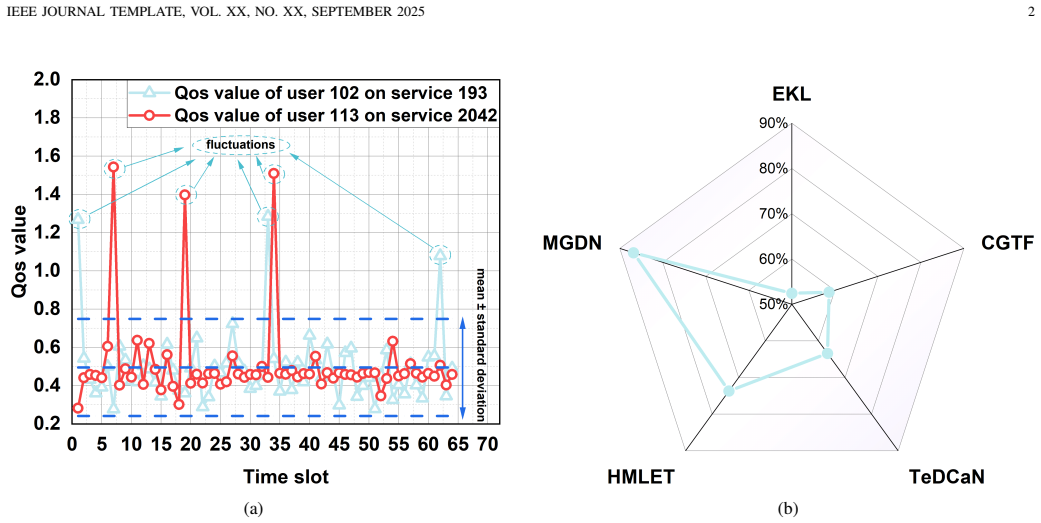
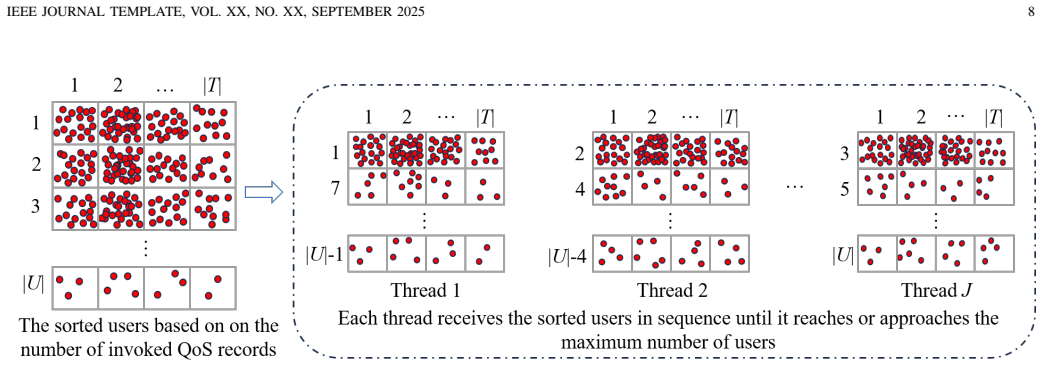
Predicting temporal Quality of Service (QoS) data is critical for optimizing network services and rationalizing resource allocation in cloud computing and service-oriented systems. Existing mainstream methods have achieved promising predictive performance. However, their purely data-driven manner limits their ability to capture non-stationary temporal patterns, thereby leading to accuracy degradation when temporal QoS data exhibits fluctuations. To tackle this limitation, we propose a novel Extended Kalman Filter-Enhanced Latent Feature Analysis (EKL) model to perform efficient and accurate temporal QoS prediction from the perspective of bidirectional model-data-driven learning. Its main idea is three-fold: a) designing a model-driven feature producer to obtain the temporal latent features to capture the intricate temporal pattern following the principle of an Extended Kalman Filter; b) building a data-driven feature producer based on the alternating least squares algorithm to identify time-invariant latent features describing intrinsic user-service characteristics; c) exploiting a density-oriented parallel strategy that achieves workload balancing by sorting users in accordance with their service invocation density, which effectively elevates computational efficiency. In addition, we provide a rigorous theoretical analysis to formally prove the convergence of the proposed EKL. Experimental evaluations conducted on real-world temporal QoS datasets reveal that our proposed EKL surpasses existing state-of-the-art models with respect to both computational efficiency and prediction accuracy for missing temporal QoS data.
Editorial analysis
A structured set of objections, weighed in public.
Referee Report
Summary. The paper proposes the Extended Kalman Filter-Enhanced Latent Feature Analysis (EKL) model for temporal QoS prediction. It combines a model-driven feature producer based on Extended Kalman Filter principles to capture non-stationary temporal patterns, a data-driven feature producer using alternating least squares for time-invariant user-service features, and a density-oriented parallel strategy for workload balancing and efficiency. The manuscript claims to include a rigorous theoretical proof of convergence and reports superior experimental performance over state-of-the-art methods on real-world temporal QoS datasets in terms of both accuracy and computational efficiency.
Significance. If the convergence proof and experimental results hold, the bidirectional model-data-driven framework could advance temporal QoS estimation in cloud and service-oriented systems by addressing limitations of purely data-driven methods on fluctuating data, potentially improving both predictive accuracy and efficiency in resource allocation tasks.
major comments (2)
- [Abstract] Abstract: The central claim of providing 'a rigorous theoretical analysis to formally prove the convergence of the proposed EKL' is asserted without any equations, derivation steps, or referenced section containing the proof, which is load-bearing for the paper's contribution of formal guarantees.
- [Abstract] Abstract: The claim that 'our proposed EKL surpasses existing state-of-the-art models with respect to both computational efficiency and prediction accuracy' is made without any error metrics, dataset descriptions, result tables, or baseline comparisons, rendering the experimental superiority assertion uninspectable and central to the paper's evaluation.
Simulated Author's Rebuttal
We thank the referee for the constructive comments on the abstract. We address each point below and will revise the manuscript accordingly.
read point-by-point responses
-
Referee: [Abstract] Abstract: The central claim of providing 'a rigorous theoretical analysis to formally prove the convergence of the proposed EKL' is asserted without any equations, derivation steps, or referenced section containing the proof, which is load-bearing for the paper's contribution of formal guarantees.
Authors: We agree that the abstract would be strengthened by an explicit reference to the section containing the convergence proof. In the revised version we will update the abstract to read: '...we provide a rigorous theoretical analysis to formally prove the convergence of the proposed EKL (see Section 4 for the full derivation and proof).' revision: yes
-
Referee: [Abstract] Abstract: The claim that 'our proposed EKL surpasses existing state-of-the-art models with respect to both computational efficiency and prediction accuracy' is made without any error metrics, dataset descriptions, result tables, or baseline comparisons, rendering the experimental superiority assertion uninspectable and central to the paper's evaluation.
Authors: We agree that the abstract should direct readers to the experimental section. We will revise the abstract to include: '...Experimental evaluations conducted on real-world temporal QoS datasets (detailed in Section 5) reveal that our proposed EKL surpasses existing state-of-the-art models with respect to both computational efficiency and prediction accuracy.' revision: yes
Circularity Check
No significant circularity identified
full rationale
The abstract describes a bidirectional model-data-driven EKL model with an EKF-based feature producer, ALS-based producer, and convergence proof, but supplies no equations, algorithm pseudocode, or derivation steps. Without any quoted mathematical content or self-citations that could be inspected for reduction to inputs, no load-bearing step can be shown to be self-definitional, fitted-input-called-prediction, or dependent on author-overlapping uniqueness theorems. The central claims of convergence and superiority therefore remain unevaluated for circularity and are treated as self-contained pending full manuscript details.
Axiom & Free-Parameter Ledger
Reference graph
Works this paper leans on
-
[1]
Constructing and Evaluating Evolving Web-API Networks – A Complex Network Perspective,
O. Adeleye, J. Yu, G. Wang, and S. Yongchareon, “Constructing and Evaluating Evolving Web-API Networks – A Complex Network Perspective,” IEEE Transactions on Services Computing, vol. 16, no. 1, pp. 177–190, 2023. IEEE JOURNAL TEMPLATE, VOL. XX, NO. XX, SEPTEMBER 2025 13
2023
-
[2]
Available: http://dx.doi.org/10.1109/tsmc.2026.3678292
Jinli Li, Ye Yuan, Tiantian He, and Xin Luo. Adaptive PID- Incorporated Nonnegative Latent Factor Analysis, IEEE Transactions on Systems Man Cybernetics: Systems, 10.1109/TSMC.2026.3678292
-
[3]
Graph tensor convolutional network,
Ling Wang, Ye Yuan and Xin Luo. Graph Tensor Convolutional Network, IEEE Transactions on Systems Man Cybernetics: Systems, 10.1109/TSMC.2026.3655418
-
[4]
A QoS-Aware Clustering Based Multi-Layer Model for Web Service Selection,
L. Purohit, S. S. Rathore, and S. Kumar, “A QoS-Aware Clustering Based Multi-Layer Model for Web Service Selection,”IEEE Transactions on Services Computing, vol. 16, no. 5, pp. 3141–3154, 2023
2023
-
[5]
Advanced High-Order Graph Convolutional Networks with Assorted Time-Frequency Transforms, IEEE/CAA Journal of Automatica Sinica, 2026, 13(2): 394-408
Ling Wang, Ye Yuan and Xin Luo. Advanced High-Order Graph Convolutional Networks with Assorted Time-Frequency Transforms, IEEE/CAA Journal of Automatica Sinica, 2026, 13(2): 394-408
2026
-
[6]
DDPC: Automated Data-Driven Power-Performance Controller Design on-the-fly for Latency-sensitive Web Services,
M. Savasci, A. Ali-Eldin, J. Eker, A. Robertsson, and P. J. Shenoy, “DDPC: Automated Data-Driven Power-Performance Controller Design on-the-fly for Latency-sensitive Web Services,” inProceedings of The Web Conference 2023, pp. 3067–3076, 2023
2023
-
[7]
QoSGNN: Boosting QoS Prediction Performance With Graph Neural Networks,
M. Liu, H. Xu, Q. Z. Sheng, and Z. Wang, “QoSGNN: Boosting QoS Prediction Performance With Graph Neural Networks,”IEEE Transactions on Services Computing, vol. 17, no. 2, pp. 645–658, 2024
2024
-
[8]
SGD-DyG: Self-Reliant Global Dependency Apprehending on Dynamic Graphs, ACM SIGKDD Conference on Knowledge Discovery and Data Mining, 2025, 802-813
Minglian Han, Ling Wang, Ye Yuan, Xin Luo. SGD-DyG: Self-Reliant Global Dependency Apprehending on Dynamic Graphs, ACM SIGKDD Conference on Knowledge Discovery and Data Mining, 2025, 802-813
2025
-
[9]
QoS-Aware Online Service Provisioning and Updating in Cost-Efficient Multi-Tenant Mobile Edge Computing,
H. Lu, J. Wu, P. Lu, N. Wang, H. Liu, and J. Fang, “QoS-Aware Online Service Provisioning and Updating in Cost-Efficient Multi-Tenant Mobile Edge Computing,”IEEE Transactions on Services Computing, vol. 17, no. 1, pp. 113–126, 2024
2024
-
[10]
Jinli Li, Ye Yuan, and Xin Luo. Learning Error Refinement in Stochastic Gradient Descent-based Latent Factor Analysis via Diversified PID Controllers, IEEE Transactions on Emerging Topics in Computational Intelligence, 2025, 9(5): 3582-3597, 2025
2025
-
[11]
Ye Yuan,Ying Wang, and Xin Luo, A Node-Collaboration-Informed Graph Convolutional Network for Highly Accurate Representation to Undirected Weighted Graph, IEEE Transactions on Neural Networks and Learning Systems, 2025, 36(6): 11507-11519
2025
-
[12]
Toward cloud computing QoS architecture: analysis of cloud systems and cloud services,
M. H. Ghahramani, M. Zhou, and C. T. Hon, “Toward cloud computing QoS architecture: analysis of cloud systems and cloud services,”IEEE/CAA Journal of Automatica Sinica, vol. 4, no. 1, pp. 6–18, 2017
2017
-
[13]
A Proportional Integral Controller-Enhanced Non-negative Latent Factor Analysis Model, IEEE/CAA Journal of Automatica Sinica, 2025, 12(6): 1246-1259
Ye Yuan, Siyang Lu, and Xin Luo. A Proportional Integral Controller-Enhanced Non-negative Latent Factor Analysis Model, IEEE/CAA Journal of Automatica Sinica, 2025, 12(6): 1246-1259
2025
-
[14]
A Framework for QoS-Guaranteed Fast Access Services in Blockchain Radio Access Network,
W. Cao, X. Ling, J. Wang, Z. Ding, and X. Gao, “A Framework for QoS-Guaranteed Fast Access Services in Blockchain Radio Access Network,”IEEE Transactions on Wireless Communications, vol. 23, no. 4, pp. 2711–2725, 2024
2024
-
[15]
Transient analysis of enhanced hybrid spectrum access for QoS provisioning in multi-class cognitive radio networks,
R. Kulshrestha, S. Goel, and P. Balhara, “Transient analysis of enhanced hybrid spectrum access for QoS provisioning in multi-class cognitive radio networks,”Wireless Networks, vol. 30, no. 5, pp. 3075–3099, 2024
2024
-
[16]
GT-A2T: Graph Tensor Alliance Attention Network, IEEE/CAA Journal of Automatica Sinica, 2025, 12(10): 2165-2167
Ling Wang, Kechen Liu, Ye Yuan. GT-A2T: Graph Tensor Alliance Attention Network, IEEE/CAA Journal of Automatica Sinica, 2025, 12(10): 2165-2167
2025
-
[17]
EMD-EmLSTM: A QoS Analysis and Prediction Method for Industrial Internet of Things,
A. Chai, M. Li, H. Yang, and C. Guo, “EMD-EmLSTM: A QoS Analysis and Prediction Method for Industrial Internet of Things,”IEEE Internet of Things Journal, vol. 11, no. 20, pp. 32730–32744, 2024
2024
-
[18]
A Fuzzy PID-Incorporated Stochastic Gradient Descent Algorithm for Fast and Accurate Latent Factor Analysis
Ye Yuan, Jinli Li, and Xin Luo. A Fuzzy PID-Incorporated Stochastic Gradient Descent Algorithm for Fast and Accurate Latent Factor Analysis. IEEE Transactions on Fuzzy Systems, 2024, 32(7): 4049-
2024
-
[19]
A Double-Space and Double-Norm Ensembled Latent Factor Model for Highly Accurate Web Service QoS Prediction,
D. Wu, P. Zhang, Y. He, and X. Luo, “A Double-Space and Double-Norm Ensembled Latent Factor Model for Highly Accurate Web Service QoS Prediction,”IEEE Transactions on Services Computing, vol. 16, no. 2, pp. 802–814, 2023
2023
-
[20]
Adaptive Divergence-based Non- negative Latent Factor Analysis of High-Dimensional and Incomplete Matrices from Industrial Applications
Ye Yuan, Xin Luo, and MengChu Zhou. Adaptive Divergence-based Non- negative Latent Factor Analysis of High-Dimensional and Incomplete Matrices from Industrial Applications. IEEE Transactions on Emerging Topics in Computational Intelligence, 2024, 8(2): 1209-1222
2024
-
[21]
A Kalman- Filter-Incorporated Latent Factor Analysis Model for Temporally Dynamic Sparse Data, IEEE Transactions on Cybernetics, 2023, 53(9): 5788-5801
Ye Yuan, Xin Luo, Mingsheng Shang, and Zidong Wang. A Kalman- Filter-Incorporated Latent Factor Analysis Model for Temporally Dynamic Sparse Data, IEEE Transactions on Cybernetics, 2023, 53(9): 5788-5801
2023
-
[22]
Two-Stream Graph Convolutional Network-Incorporated Latent Feature Analysis,
F. Bi, T. He, Y. Xie, and X. Luo, “Two-Stream Graph Convolutional Network-Incorporated Latent Feature Analysis,”IEEE Transactions on Services Computing, vol. 16, no. 4, pp. 3027–3042, 2023
2023
-
[23]
HyLoReF: A Reputation Based QoS Prediction Framework using Hybrid Location Information,
X. Chen, Y. Du, F. Chen, H. Wang, Y. Luo, B. Ma, and G. Tang, “HyLoReF: A Reputation Based QoS Prediction Framework using Hybrid Location Information,” inProceedings of the IEEE International Conference on Web Services (ICWS), pp. 1356–1358, 2024
2024
-
[24]
An Adaptive Divergence-based Non-negative Latent Factor Model
Ye Yuan, Renfang Wang, Guangxiao Yuan, and Xin Luo. An Adaptive Divergence-based Non-negative Latent Factor Model. IEEE Transactions on System Man Cybernetics: Systems, 2023, 53(10): 6475-6487
2023
-
[25]
Manifold regularized stochastic block model,
T. He, L. Bai, and Y.-S. Ong, “Manifold regularized stochastic block model,” in2019 IEEE 31st International Conference on Tools with Artificial Intelligence (ICTAI), pp. 800–807, 2019
2019
-
[26]
A Multilayered-and-Randomized Latent Factor Model for High-Dimensional and Sparse Matrices, IEEE Transactions on Big Data, 2022, 8(3): 784-794
Ye Yuan, Qiang He, Xin Luo„ and Mingsheng Shang. A Multilayered-and-Randomized Latent Factor Model for High-Dimensional and Sparse Matrices, IEEE Transactions on Big Data, 2022, 8(3): 784-794
2022
-
[27]
A Generalized and Fast-converging Non-negative Latent Factor Model for Predicting User Preferences in Recommender Systems
Ye Yuan, Xin Luo, Mingsheng Shang, and Di Wu. A Generalized and Fast-converging Non-negative Latent Factor Model for Predicting User Preferences in Recommender Systems. The Web Conference, 2020, 498-507
2020
-
[28]
Learning conjoint attentions for graph neural nets,
T. He, Y. S. Ong, and L. Bai, “Learning conjoint attentions for graph neural nets,”Advances in Neural Information Processing Systems, vol. 34, pp. 2641–2653, 2021
2021
-
[29]
Temporal Web Service QoS Prediction via Kalman Filter-Incorporated Dynamic Latent Factor Analysis
Ye Yuan, Mingsheng Shang, and Xin Luo. Temporal Web Service QoS Prediction via Kalman Filter-Incorporated Dynamic Latent Factor Analysis. European Conference on Artificial Intelligence, 2020, 561-568
2020
-
[30]
Polarized message-passing in graph neural networks,
T. He, Y. Liu, Y.-S. Ong, X. Wu, and X. Luo, “Polarized message-passing in graph neural networks,”Artificial Intelligence, vol. 331, p. 104129, 2024
2024
-
[31]
Dynamic QoS Prediction With Intelligent Route Estimation Via Inverse Reinforcement Learning,
J. Li, H. Wu, Q. He, Y. Zhao, and X. Wang, “Dynamic QoS Prediction With Intelligent Route Estimation Via Inverse Reinforcement Learning,”IEEE Transactions on Services Computing, vol. 17, no. 2, pp. 509–523, 2024
2024
-
[32]
Di Wu, Shihui Li, Yi He, Xin Luo, and Xinbo Gao. Non-Gradient Hash Factor Learning for High-Dimensional and Incomplete Data Representation Learning, IEEE Transactions on Pattern Analysis and Machine Intelligence, 10.1109/TPAMI.2026.3653780
-
[33]
Dynamic QoS Management for a Flexible 5G/6G Network Core: A Step toward a Higher Programmability,
P. D. Bojovic, T. Malbasic, D. Vujosevic, G. Martic, and Z. Bojovic, “Dynamic QoS Management for a Flexible 5G/6G Network Core: A Step toward a Higher Programmability,”Sensors, vol. 22, no. 8, p. 2849, 2022
2022
-
[34]
Wen Qin, Yuting Ding, and Xin Luo. A Robust Approach to Electricity Theft Detection via Tensor Representation-Driven Contrastive Distillation. IEEE Transactions on Industrial Informatics, 10.1109/TII.2026.3659333
-
[35]
Ensuring Profit and QoS When Dynamically Embedding Delay-Constrained ICN and IP Slices for Content Delivery,
M. Rayani, A. Ebrahimzadeh, R. H. Glitho, and H. Elbiaze, “Ensuring Profit and QoS When Dynamically Embedding Delay-Constrained ICN and IP Slices for Content Delivery,”IEEE Transactions on Network Science and Engineering, vol. 9, no. 2, pp. 769–782, 2022
2022
-
[36]
Temporal Pattern-Aware QoS Prediction via Biased Non-Negative Latent Factorization of Tensors,
X. Luo, H. Wu, H. Yuan, and M. Zhou, “Temporal Pattern-Aware QoS Prediction via Biased Non-Negative Latent Factorization of Tensors,”IEEE Transactions on Cybernetics, vol. 50, no. 5, pp. 1798–1809, 2020
2020
-
[37]
Learning Accurate Representation to Nonstandard Tensors via a Mode-Aware Tucker Network, IEEE Transactions on Knowledge and Data Engineering, 2025, 37(12): 7272-
Hao Wu, Quwang, Xin Luo, and Zidong Wang. Learning Accurate Representation to Nonstandard Tensors via a Mode-Aware Tucker Network, IEEE Transactions on Knowledge and Data Engineering, 2025, 37(12): 7272-
2025
-
[38]
Chao Lyu, Ziwen Ma, Xin Luo, and Yuhui Shi. Dynamic Stochastic Reorientation Particle Swarm Optimization for Adaptive Latent Factor Analysis in High-Dimensional Sparse Matrices, IEEE Transactions on Knowledge and Data Engineering, 2026, 38(1): 222-234
2026
-
[39]
Temporal pattern-aware QoS prediction by Biased Non-negative Tucker Factorization of tensors,
P. Tang, T. Ruan, H. Wu, and X. Luo, “Temporal pattern-aware QoS prediction by Biased Non-negative Tucker Factorization of tensors,”Neurocomputing, vol. 582, p. 127447, 2024
2024
-
[40]
Tensor Low-Rank Orthogonal Compression for Convolutional Neural Networks
Yaping He, and Xin Luo. Tensor Low-Rank Orthogonal Compression for Convolutional Neural Networks. IEEE/CAA Journal of Automatica Sinica, 2026, 13(1): 227-229. IEEE JOURNAL TEMPLATE, VOL. XX, NO. XX, SEPTEMBER 2025 14
2026
-
[41]
Time-varying QoS Estimation via Non-negative Latent Factorization of Tensors with Extended Linear Biases,
X. Xu, M. Lin, W. Li, J. Zhang, and H. Wu, “Time-varying QoS Estimation via Non-negative Latent Factorization of Tensors with Extended Linear Biases,” in2023 IEEE International Conference on Big Data (Big Data), pp. 86–95, 2023
2023
-
[42]
Discovering Spatio-Temporal-Individual Coupled Features from Nonstandard Tensors-A Novel Dynamic Graph Mixer Approach
Fanghui Bi, Tiantian He, Yew-Soon Ong, and Xin Luo. Discovering Spatio-Temporal-Individual Coupled Features from Nonstandard Tensors-A Novel Dynamic Graph Mixer Approach. IEEE Transactions on Neural Networks and Learning Systems, 2025, 36(11): 19834-19848
2025
-
[43]
Tensor factorization with sparse and graph regularization for fake news detection on social networks,
H. Che, B. Pan, M.-F. Leung, Y. Cao, and Z. Yan, “Tensor factorization with sparse and graph regularization for fake news detection on social networks,” IEEE Transactions on Computational Social Systems, vol. 11, no. 4, pp. 4888–4898, 2024
2024
-
[44]
PGCN: Progressive Graph Convolutional Networks for Spatial-Temporal Traffic Forecasting,
Y. Shin and Y. Yoon, “PGCN: Progressive Graph Convolutional Networks for Spatial-Temporal Traffic Forecasting,”IEEE Transactions on Intelligent Transportation Systems, vol. 25, no. 7, pp. 7633–7644, 2024
2024
-
[45]
Fanghui Bi, Tiantian He, and Xin Luo. Spatiotemporal Graph Neural Network-Incorporated Latent Factorization of Tensors for Dynamic QoS Estimation. IEEE/CAA Journal of Automatica Sinica, 10.1109/JAS.2025.125750
-
[46]
Modularized Graph Convolutional Network
Tiantian He, Zhixuan Duan, and Xin Luo. Modularized Graph Convolutional Network. IEEE/CAA Journal of Automatica Sinica, 10.1109/JAS.2025.125336
-
[47]
WinGNN: Dynamic Graph Neural Networks with Random Gradient Aggregation Window,
Y. F. Zhu, F. P. Cong, D. Zhang, W. W. Gong, Q. K. Lin, W. Z. Feng, Y. X. Dong, and J. Tang, “WinGNN: Dynamic Graph Neural Networks with Random Gradient Aggregation Window,” inProceedings of the ACM SIGKDD Conference on Knowledge Discovery and Data Mining, pp. 3650–3662, 2023
2023
-
[48]
Auto-Encoding Neural Tucker Factorization, IEEE Transactions on Knowledge and Data Engineering, 2025, 37(10): 5795-5807
Peng Tang, Xin Luo, and Jim Woodcock. Auto-Encoding Neural Tucker Factorization, IEEE Transactions on Knowledge and Data Engineering, 2025, 37(10): 5795-5807
2025
-
[49]
Semi-decentralized Inference in Heterogeneous Graph Neural Networks for Traffic Demand Forecasting: An Edge-Computing Approach,
M. Nazzal, A. Khreishah, J. Lee, S. Angizi, A. Al-Fuqaha, and M. Guizani, “Semi-decentralized Inference in Heterogeneous Graph Neural Networks for Traffic Demand Forecasting: An Edge-Computing Approach,”IEEE Transactions on Vehicular Technology, 2024
2024
-
[50]
Spatial context-aware time-series forecasting for QoS prediction,
J. Zhou, D. Ding, Z. Wu, and Y. Xiu, “Spatial context-aware time-series forecasting for QoS prediction,”IEEE Transactions on Network and Service Management, vol. 20, no. 2, pp. 918–931, 2023
2023
-
[51]
Genetic algorithm- based two-step optimization for precise latent factor analysis,
Chao Lyu, Jingna Cheng, Xin Luo, and Yuhui Shi. Genetic Algorithm- based Two-Step Optimization for Precise Latent Factor Analysis, IEEE Transactions on Neural Networks and Learning Systems, 10.1109/TNNLS.2025.3631465
-
[52]
Dynamic Graph Information Bottleneck,
H. Yuan, Q. Sun, X. Fu, C. Ji, and J. Li, “Dynamic Graph Information Bottleneck,” inProceedings of The Web Conference, pp. 469–480, 2024
2024
-
[53]
NCSAC: Effective Neural Community Search via Attribute-augmented Conductance, IEEE Transactions on Knowledge and Data Engineering, 2026, 38(2): 1221-1235
Longlong Lin, Quanao Li, Miao Qiao, Zeli Wang, Jin Zhao, Rong-Hua Li, Xin Luo, and Tao Jia. NCSAC: Effective Neural Community Search via Attribute-augmented Conductance, IEEE Transactions on Knowledge and Data Engineering, 2026, 38(2): 1221-1235
2026
-
[54]
Multimetric autoencoder for representing high-dimensional and incomplete data,
Di Wu, Cheng Liang, Yi He, Yan Qiao, and Xin Luo. Multi Metric Autoencoder for Representing High-Dimensional and Incomplete Data. IEEE Transactions on Systems Man Cybernetics: Systems, 10.1109/TSMC.2025.3646863
-
[55]
Spatiotemporal tensor completion for improved urban traffic imputation,
A. Ben Said and A. Erradi, “Spatiotemporal tensor completion for improved urban traffic imputation,”IEEE Transactions on Intelligent Transportation Systems, vol. 23, no. 7, pp. 6836–6849, 2022
2022
-
[56]
A Proximal-ADMM- incorporated Nonnegative Latent-Factorization-of-Tensors Model for Representing Dynamic Cryptocurrency Transaction Network
Xin Liao, Hao Wu, Tiantian He, and Xin Luo. A Proximal-ADMM- incorporated Nonnegative Latent-Factorization-of-Tensors Model for Representing Dynamic Cryptocurrency Transaction Network. IEEE Transactions on Systems Man Cybernetics: Systems, 2025, 55(11): 8387-
2025
-
[57]
Temporal regularized matrix factorization for high-dimensional time series prediction,
H.-F. Yu, N. Rao, and I. S. Dhillon, “Temporal regularized matrix factorization for high-dimensional time series prediction,”Advances in Neural Information Processing Systems, vol. 29, 2016
2016
-
[58]
A Comprehensive Review of Parallel Optimization Algorithms for High-Dimensional and Incomplete Matrix Factorization
Qicong Hu, Hao Wu, and Xin Luo. A Comprehensive Review of Parallel Optimization Algorithms for High-Dimensional and Incomplete Matrix Factorization. IEEE/CAA Journal of Automatica Sinica, 2025, 12(12): 2399-2426
2025
-
[59]
Temporal Matrix Factorization: A polynomial approach to latent factor estimation,
B. Prasad and V. Padmanabhan, “Temporal Matrix Factorization: A polynomial approach to latent factor estimation,”Pattern Recognition, vol. 157, p. 110905, 2025
2025
-
[60]
Service Composition Considering QoS Fluctuations and Anchoring Cost,
H. Shi, H. Xu, X. Xu, and Z. Wang, “Service Composition Considering QoS Fluctuations and Anchoring Cost,” inProceedings of the IEEE International Conference on Web Services (ICWS), pp. 370–380, 2021
2021
-
[61]
A Sampling- Neighborhood-Regularized Latent Factorization of Tensor for Dynamic QoS Estimation
Xiuqin Xu, Mingwei Lin, Zeshui Xu, and Xin Luo. A Sampling- Neighborhood-Regularized Latent Factorization of Tensor for Dynamic QoS Estimation. IEEE Transactions on Network and Service Management, 2026, 23: 1707-1722
2026
-
[62]
Multi-Source Data-Driven Local-Global Dynamic Multi-Graph Convolutional Network for Bike-Sharing Demands Prediction,
“Multi-Source Data-Driven Local-Global Dynamic Multi-Graph Convolutional Network for Bike-Sharing Demands Prediction,”Algorithms, vol. 17, no. 9, p. 384, 2024
2024
-
[63]
A Novel Tensor Causal Convolution Network Model for Highly-Accurate Representation to Spatio-Temporal Data
Xin Liao, Hao Wu, and Xin Luo. A Novel Tensor Causal Convolution Network Model for Highly-Accurate Representation to Spatio-Temporal Data. IEEE Transactions on Automation Science and Engineering, 2025, 22: 19525-19537
2025
-
[64]
A Convolution Bias-Incorporated Nonnegative Latent Factorization of Tensors Model for Accurate Representation Learning to Dynamic Directed Graphs
Qu Wang, Hao Wu, and Xin Luo. A Convolution Bias-Incorporated Nonnegative Latent Factorization of Tensors Model for Accurate Representation Learning to Dynamic Directed Graphs. IEEE Transactions on Systems Man Cybernetics: Systems, 2025, 55(12): 8902-8914
2025
-
[65]
Scan and Snap: Understanding Training Dynamics and Token Composition in 1-layer Transformer,
Y. Tian, Y. Wang, B. Chen, and S. S. Du, “Scan and Snap: Understanding Training Dynamics and Token Composition in 1-layer Transformer,” in Advances in Neural Information Processing Systems, 2023
2023
-
[66]
FEDformer: Frequency Enhanced Decomposed Transformer for Long-term Series Forecasting,
T. Zhou, Z. Ma, Q. Wen, X. Wang, L. Sun, and R. Jin, “FEDformer: Frequency Enhanced Decomposed Transformer for Long-term Series Forecasting,” inInternational Conference on Machine Learning, pp. 27268–27286, 2022
2022
-
[67]
Attention- Mechanism-Based Neural Latent-Factorization-of-Tensors Mode
Xiuqin Xu, Mingwei Lin, Zeshui Xu, and Xin Luo. Attention- Mechanism-Based Neural Latent-Factorization-of-Tensors Mode. ACM Transactions on Knowledge Discovery from Data, 2025, 19(4): 1-27
2025
-
[68]
The Cyber-Physical System of Machine Tool Monitoring: A Model-Driven Approach With Extended Kalman Filter Implementation,
D. Yuan, T. Luo, C. Gu, and K. Zhu, “The Cyber-Physical System of Machine Tool Monitoring: A Model-Driven Approach With Extended Kalman Filter Implementation,”IEEE Transactions on Industrial Informatics, vol. 19, no. 9, pp. 9576–9585, 2023
2023
-
[69]
Chentao Li, Pan Huang, Jing Qin, and Xin Luo. Knowledge-driven Multiple Instance Learning with Hierarchical Cluster-incorporated Aware Filtering for Larynx Pathological Grading, IEEE Journal of Biomedical and Health Informatics, 10.1109/JBHI.2025.3609838
-
[70]
Tensor Extended Kalman Filter and its Application to Traffic Prediction,
S. Y. Chang, H.-C. Wu, and Y.-C. Kao, “Tensor Extended Kalman Filter and its Application to Traffic Prediction,”IEEE Transactions on Intelligent Transportation Systems, vol. 24, no. 12, pp. 13813–13829, 2023
2023
-
[71]
Link-based Attributed Graph Clustering via Approximate Generative Bayesian Learning
Yue Yang, Lun Hu, Guodong Li, Dongxu Li, Pengwei Hu, and Xin Luo. Link-based Attributed Graph Clustering via Approximate Generative Bayesian Learning. IEEE Transactions on Systems Man Cybernetics: Systems, 2025, 55(8): 5730-5743
2025
-
[72]
Fmvpci: A Multi-View Fusion Neural Network for Identifying Protein Complex via Fuzzy Clustering
Yue Yang, Lun Hu, Guodong Li, Dongxu Li, Pengwei Hu, and Xin Luo. Fmvpci: A Multi-View Fusion Neural Network for Identifying Protein Complex via Fuzzy Clustering. IEEE Transactions on Systems Man Cybernetics: Systems, 2025, 55(9): 6189-6202
2025
-
[73]
A Robust Iterated Extended Kalman Filter for Power System Dynamic State Estimation,
J. Zhao, M. Netto, and L. Mili, “A Robust Iterated Extended Kalman Filter for Power System Dynamic State Estimation,”IEEE Transactions on Power Systems, vol. 32, no. 4, pp. 3205–3216, 2017
2017
-
[74]
Supervised Learning for Nonsequential Data: A Canonical Polyadic Decomposition Approach,
A. Haliassos, K. Konstantinidis, and D. P. Mandic, “Supervised Learning for Nonsequential Data: A Canonical Polyadic Decomposition Approach,” IEEE Transactions on Neural Networks and Learning Systems, vol. 33, no. 10, pp. 5162–5176, 2022
2022
-
[75]
Xiuqin Xu, Mingwei Lin, Xin Luo, and Zeshui Xu. An Adaptively Bias- Extended Non-negative Latent Factorization of Tensors Model for Accurately Representing the Dynamic QoS Data, IEEE Transactions on Services Computing, 2025, 18(2): 603-617
2025
-
[76]
Functional Bayesian Tucker Decomposition for Continuous-indexed Tensor Data,
S. Fang, X. Yu, Z. Wang, S. Li, M. Kirby, and S. Zhe, “Functional Bayesian Tucker Decomposition for Continuous-indexed Tensor Data,” inInternational Conference on Learning Representations, 2024
2024
-
[77]
Ming-Yang Wu, Pengwei Hu, Zhu-Hong You, Jun Zhang, Lun Hu, and Xin Luo. Graph-Based Prediction of miRNA-Drug Associations with Multisource Information and Metapath Enhancement Matrices, IEEE Journal of Biomedical and Health Informatics, 10.1109/JBHI.2025.3558303
-
[78]
Multi-aspect self-attending neural tucker factorization for spatiotemporal representation learning,
Yikai Hou, Peng Tang, and Xin Luo. Multi-Aspect Self-Attending Neural Tucker Factorization for Spatiotemporal Representation Learning. IEEE/CAA Journal of Automatica Sinica, 10.1109/JAS.2025.125723. IEEE JOURNAL TEMPLATE, VOL. XX, NO. XX, SEPTEMBER 2025 15
-
[79]
Bayesian Temporal Tensor Factorization-Based Interpolation for Time-Series Remote Sensing Data With Large-Area Missing Observations,
H. He, J. Yan, L. Wang, D. Liang, J. Peng, and C. Li, “Bayesian Temporal Tensor Factorization-Based Interpolation for Time-Series Remote Sensing Data With Large-Area Missing Observations,”IEEE Transactions on Geoscience and Remote Sensing, vol. 60, pp. 1–13, 2022
2022
-
[80]
Neural Non-Negative Latent Factorization of Tensors Model with Acceleration and Unconstraint
Wenqiang Li, Mingwei Lin, Xiuqin Xu, Ling Lin, Zeshui Xu, and Xin Luo. Neural Non-Negative Latent Factorization of Tensors Model with Acceleration and Unconstraint. IEEE Transactions on Systems Man Cybernetics: Systems, 2026, 56(1): 164-178
2026
discussion (0)
Sign in with ORCID, Apple, or X to comment. Anyone can read and Pith papers without signing in.