REVIEW 3 major objections 6 minor 1 cited by
Dark Neutrino interactions phase out the Hubble tension
T0 review · 3 major / 6 minor · reviewed 2026-08-14 · deepseek-v4-flash
Pith's one-line read Dark neutrino scattering cancels the neutrino-induced phase shift and reduces the Hubble tension to 2.1σ.
desk verdict The phase-shift mechanism is real, but the 2.1σ headline relies on the least aggressive data cut and a non-Gaussian posterior; the robust improvement is closer to 2.9σ. read the letter →
The pith
A machine-rendered reading of the paper's core claim, the machinery that carries it, and where it could break.
The reading
What carries the argument
The load-bearing mechanism is the scale-dependent acoustic phase shift $\varphi$. In $\Lambda$CDM, free-streaming neutrinos add a positive phase to the photon transfer function $\cos(kr_*+\varphi)$; DNI removes most of that phase by keeping neutrinos coupled to a subdominant dark-matter component $\chi$ through elastic scattering up to recombination. The interaction is written as an electroweak-invariant effective operator involving the Higgs and lepton doublets with a messenger $\psi$, and the controlling parameter is $fu$, the product of the interacting-dark-matter fraction and a Thomson-normalized cross-section per unit mass. Near-degeneracy of the messenger and $\chi$ masses makes the cross-section independent of neutrino temperature, which is what lets even a modest coupling postpone decoupling to late times; at $fu\sim 0.02$ the negative phase shift grows with multipole almost exactly as required to offset a larger $H_0$.
What would settle it
Measure the neutrino--dark-matter scattering cross-section as a function of neutrino temperature over the MeV-to-eV range: if it falls with temperature rather than staying constant, the DNI phase shift is erased before recombination. On the observational side, a galaxy survey reaching roughly one-percent precision in the matter power spectrum should detect the predicted few-percent enhancement and BAO phase shift at $k \simeq 0.1\,h\,\mathrm{Mpc}^{-1}$; the absence of that signal at that precision would rule out $fu\gtrsim 0.01$.
Extended reading notes
Core claim
The central claim is that the Hubble tension can be solved by undoing the phase shift that free-streaming neutrinos imprint on the CMB acoustic peaks. In $\Lambda$CDM the photon transfer function is approximately $\cos(kr_*+\varphi)$ with $\varphi>0$ from neutrinos, and raising $H_0$ while holding physical densities fixed reduces the angular diameter distance; DNI supplies a scale-dependent negative phase shift, larger at higher multipoles, that almost exactly compensates. The model uses two-component dark matter so that only a small fraction $f$ interacts with neutrinos, leaving the dark-matter power spectrum nearly unchanged, and its only cosmological effect is the removal of neutrino free-streaming. Fitting the model to CMB data plus the full-shape galaxy power spectrum up to $k=0.12\,h\,\mathrm{Mpc}^{-1}$ reduces the tension to $2.1\sigma$ with a non-Gaussian measure, with best-fit $H_0\approx 70$ km s$^{-1}$ Mpc$^{-1}$ and an acoustic scale $\theta_*$ about $15\sigma$ away from its $\Lambda$CDM value. The paper therefore concludes that nonzero neutrino--dark-matter interactions are already preferred by the data.
Load-bearing premise
The whole mechanism rests on the neutrino--dark-matter scattering cross-section being independent of neutrino temperature all the way down to recombination, which the model obtains only by assuming the messenger and the interacting dark-matter component are nearly degenerate in mass; if a complete ultraviolet realization does not enforce that degeneracy, the late-time coupling disappears and the compensating phase shift does not happen.
Editorial extensions
If this is right
- With the CMB and galaxy data restricted to $k\le 0.12\,h\,\mathrm{Mpc}^{-1}$, the tension falls from about $3.8\sigma$ in $\Lambda$CDM to $2.1\sigma$; cutting the galaxy data at larger $k$ still keeps it below $3\sigma$.
- A larger $H_0$ is achieved without changing the number of relativistic species, so the model does not rely on extra radiation or modified early-time expansion.
- Once the local distance-ladder value is included, zero neutrino interaction ($fu=0$) is excluded at more than $3\sigma$, making the Hubble tension evidence for new neutrino interactions.
- The model predicts a modified CMB B-mode spectrum that future polarization experiments could detect if the tensor-to-scalar ratio is near current limits.
- The matter power spectrum receives a few-percent scale-dependent enhancement plus a BAO phase shift, which future surveys at roughly one-percent precision could observe.
Reading between the lines
- The phase-shift mechanism is more general than the specific operator: any subdominant dark-matter component with temperature-independent elastic scattering off neutrinos should produce a similar scale-dependent peak shift, making DNI a template for a broader model class.
- Because standard BAO likelihoods assume the $\Lambda$CDM phase shift, they cannot be applied to this class of models; re-analyzing existing BAO data with the phase shift left free could strengthen or weaken the preference for $fu>0$.
- The reported $2.1\sigma$ uses a non-Gaussian tension measure, so direct comparisons with Gaussian $|H_0^{\rm CMB}-H_0^{\rm local}|/\sigma$ numbers require converting between conventions.
- The near-degenerate mass condition ties the cosmology to a narrow parameter region that laboratory searches for sub-MeV dark matter or low-energy neutrino scattering could in principle probe.
Editorial analysis
A structured set of objections, weighed in public.
Referee Report
Summary. The paper proposes a new mechanism, Dark Neutrino Interactions (DNI), to alleviate the Hubble tension. A small fraction of dark matter interacts with standard left-handed neutrinos through a nearly degenerate mediator, making the scattering cross-section temperature-independent so that neutrinos remain coupled until recombination. This suppresses the standard free-streaming phase shift in the CMB acoustic peaks, and the authors show that this phase shift has the scale dependence needed to compensate for a larger H0. They implement the model in CLASS, run MCMC analyses with Planck 2015 and WiggleZ power-spectrum data (using three k-cuts W1, W2, W3), and report that the Hubble tension is reduced to about 2.1σ for the W1 cut, with no-interaction (fu=0) disfavoured at more than 3σ when SH0ES data are included. They also predict modifications to CMB B-modes and the matter power spectrum observable by future experiments.
Significance. If the headline result were robust, this would be a valuable contribution: it introduces a qualitatively new way to address the Hubble tension by altering the acoustic phase shift rather than only the sound horizon or late-time expansion, and it makes concrete, testable predictions for B-modes and large-scale structure. The analysis is competently performed with public codes (CLASS, Monte Python), the modified CLASS code is made publicly available, and the physical mechanism is clearly explained and internally consistent. The main weakness is statistical: the central quantitative claim of a ~2.1σ tension reduction is not robust to the choice of WiggleZ k-cut and depends on a non-Gaussian secondary peak in the H0 posterior, as the authors themselves state. The paper needs to present a more conservative and dataset-robust measure of the tension reduction.
major comments (3)
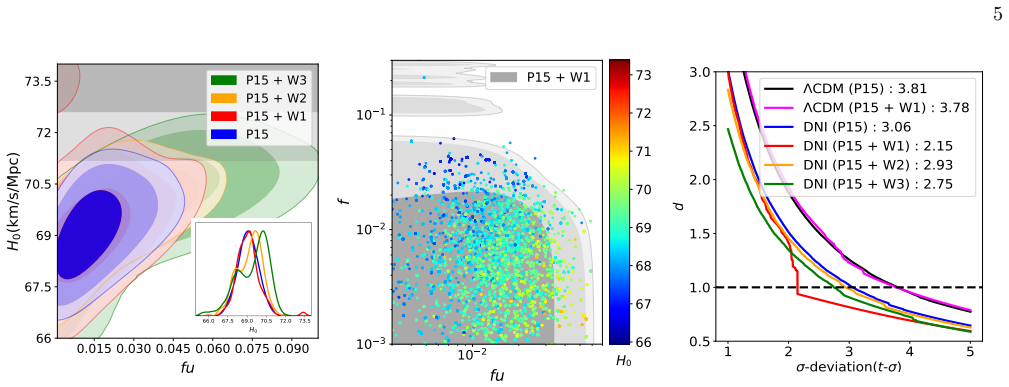
- [Section IV, Fig. 4 (right) and text after the definition of d] The central claim that the Hubble tension reduces to approximately 2.1σ is not robust. The text states that the small secondary peak in the P15+W1 posterior causes a jump in d, reducing the tension to 2.1σ, while the same chains with W2 and W3 give 2.93σ and 2.75σ, respectively. A simple Gaussian estimate from Table I (H0 = 69.39 ± 0.68 for P15+W1 versus SH0ES = 74.03 ± 1.42) gives about 2.9σ, consistent with the W2/W3 values. Since the abstract and conclusions highlight the 2.1σ number as the main result, the paper overstates the model's performance. The authors should either report the more conservative ~2.9σ value as the headline tension reduction, use a properly Gaussianized or likelihood-based tension statistic, or explicitly and prominently qualify that 2.1σ is an artifact of the W1 k-cut and a non-Gaussian secondary peak.
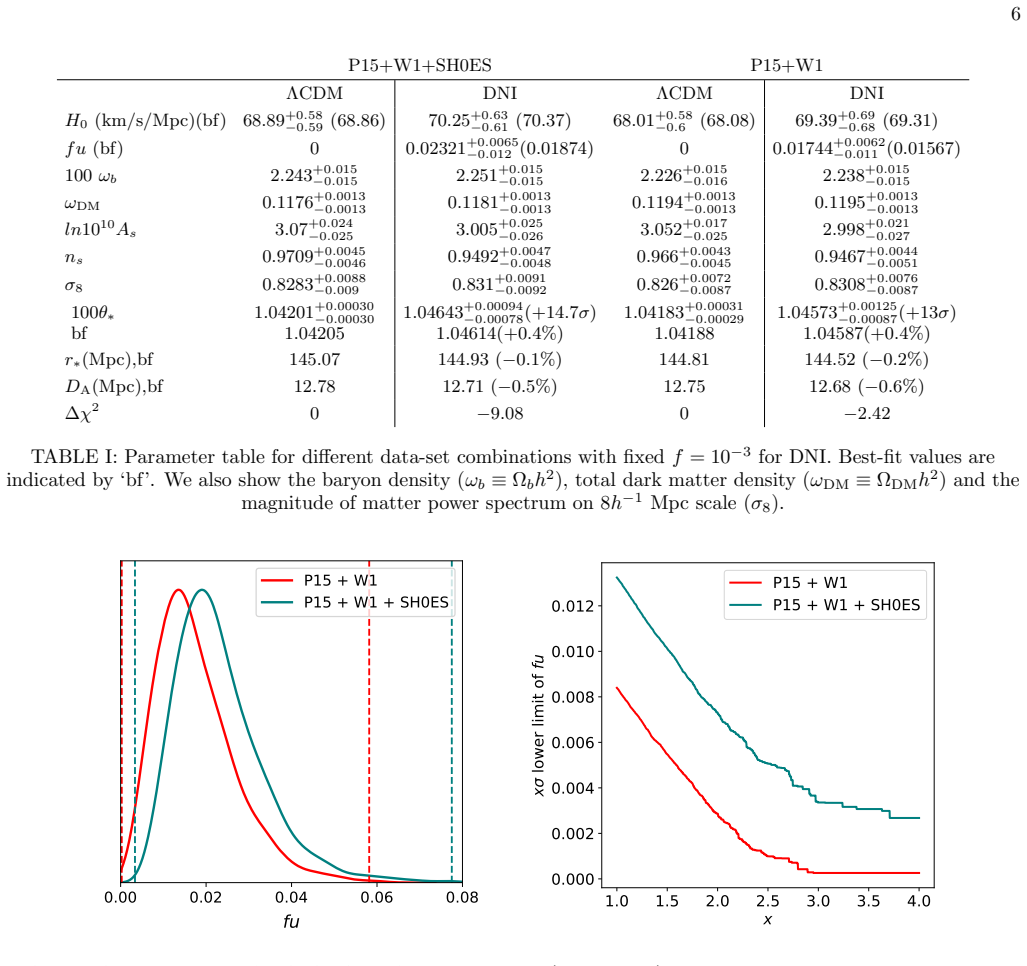
- [Section V, Conclusions and Fig. 5] The claim that fu=0 is disfavoured at more than 3σ is based solely on the P15+W1+SH0ES posterior for fu. The paper does not show whether this exclusion persists for the W2 and W3 k-cuts, which are the same cuts that give the more stable 2.9σ tension values. Given that the fu posterior is highly non-Gaussian and that the W1 cut is the one producing the anomalous secondary peak, the >3σ exclusion for no-interaction should be checked against the other data cuts and ideally with a profile-likelihood or Bayesian evidence calculation. Without this, the conclusion that 'we might have found evidence of new interactions of neutrinos' is not supported by a robust statistical analysis.
- [Section III, Eq. (6) and text following] The entire mechanism relies on the temperature independence of the neutrino–dark matter cross-section, which is achieved by assuming the messenger ψ and dark matter χ are nearly degenerate in mass. If this degeneracy is not realized in a UV completion, the cross-section will inherit a temperature dependence, the late-time coupling will disappear, and the scale-dependent phase shift that compensates the Hubble tension will not occur. The paper cites Ref. [80] for a possible UV completion, but the present manuscript presents this as a proof-of-principle. This is a model-building caveat rather than an internal inconsistency, but it should be stated more prominently as a key assumption that must be satisfied for the proposed solution to work.
minor comments (6)
- [Author line] The author line contains a duplicated word: 'Rishi Khatri, 1,† and and Tuhin S. Roy' should read '... and Tuhin S. Roy'.
- [Section IV, definition of tension statistic] The definition of d using t-dependent credible-interval widths is nonstandard and the paper should clarify that a Gaussianized comparison from the same chains gives a different answer; the text should note this explicitly when the 2.1σ value is discussed.
- [Section V, Conclusions] The phrase 'We therefore might have found evidence of new interactions of neutrinos in the Hubble tension' is stronger than the statistical analysis supports; it should be qualified in light of the W2/W3 and Gaussianized results.
- [Figure 4, left panel] The left panel appears to lack axis labels in the description; it would be clearer to label the horizontal axis as fu and the vertical axis as H0 (km/s/Mpc).
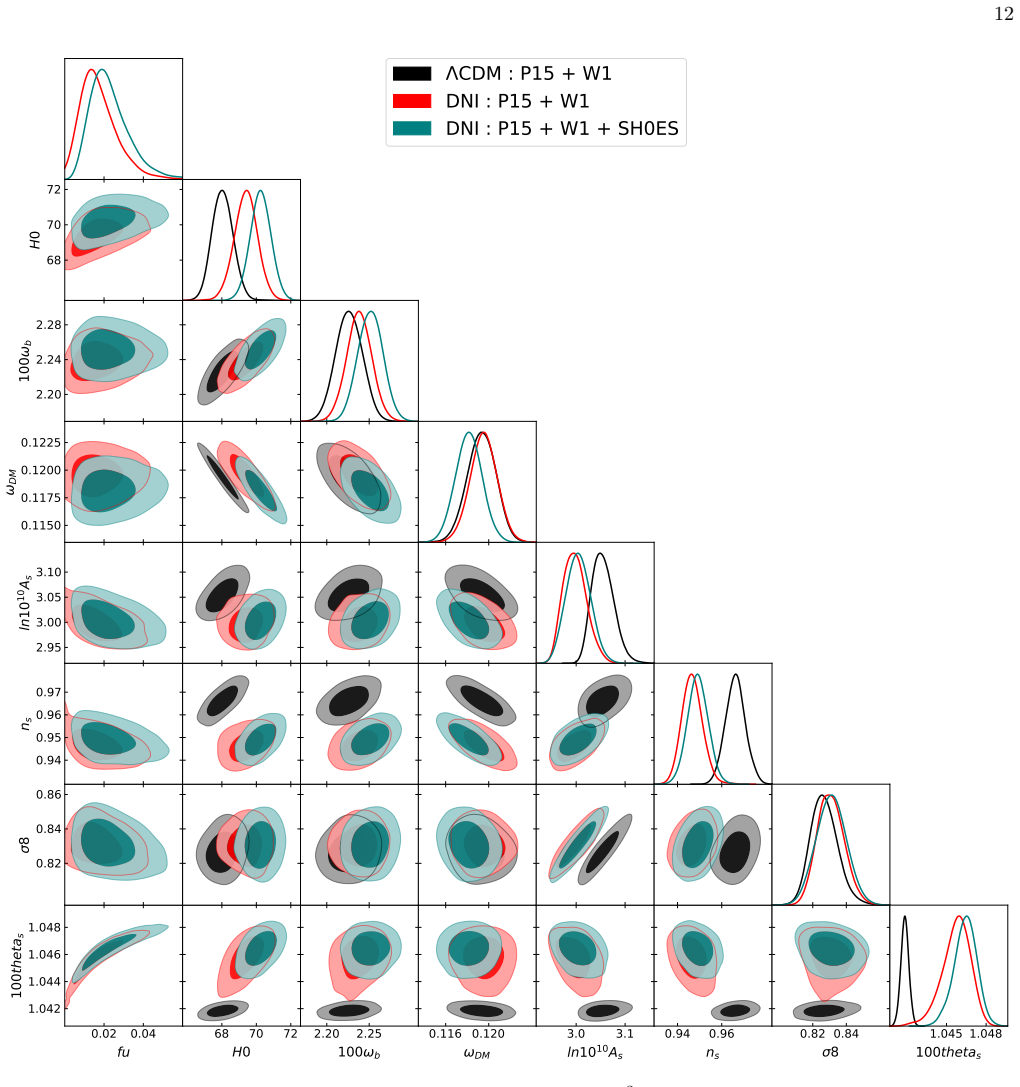
- [Appendix A, Fig. 7] The axis label '100thetas' should be formatted as '100θ∗' for consistency with the table.
- [References] The paper uses Planck 2015 data; given that Planck 2018 results are cited in Ref. [2], the analysis should either be updated to Planck 2018 or the choice of Planck 2015 should be justified.
Circularity Check
No significant circularity: the DNI phase-shift mechanism is derived from standard acoustic physics and tested against external data; the main caveats are model assumptions and a fragile tension statistic, not circular reasoning.
full rationale
The paper's central derivation is not circular. The phase-shift relation in Eq. (1) and the required shift in Eq. (2) follow from standard acoustic oscillation theory, and the DNI effect on CMB peak positions is computed with a modified CLASS code rather than imposed to match the data. The parameters f and u are fitted with flat priors and then used to infer H0, which is standard parameter inference rather than a 'prediction' that reduces to its inputs. The 2.1σ tension reduction is obtained from a non-Gaussian posterior and an explicitly defined t-dependent statistic, and the paper transparently reports that W2 and W3 cuts give 2.93σ and 2.75σ and that a secondary peak causes the jump in d; this is a statistical robustness concern, not circularity. The only notable self-citation is Ref. [80], used to justify the temperature-independent neutrino-DM cross-section that requires nearly degenerate mediator and DM masses. This is a model-building assumption supported by a prior calculation by the same authors, and it does not simply restate the Hubble-tension result; it is a microphysical input with stated assumptions. Under the stated rules, this is independent support rather than load-bearing circularity, so the score is low despite the model-dependence of the headline significance claim.
Assumptions & free parameters
free parameters (1)
- fu (effective interaction strength) =
best-fit 0.0187 (P15+W1) and 0.0232 (P15+W1+SH0ES) for fixed f = 10^-3; varied freely in other runs
assumptions (6)
- domain assumption Flat ΛCDM background with physical densities fixed when varying H0
- domain assumption Neutrinos are massless and all three flavors interact with equal strength
- ad hoc to paper Mediator ψ and dark matter χ are nearly degenerate in mass, making the cross-section temperature-independent
- domain assumption Small f approximation: modifications to total DM transfer functions are O(f^2) and negligible
- domain assumption Halofit nonlinear correction is valid for DNI cosmology
- standard math CMB peak positions follow cos(kr* + φ) with a neutrino-induced phase shift φ
invented entities (2)
-
χ, interacting dark matter component
independent evidence
-
ψ, messenger (flavor triplet)
independent evidence
Cite this review
Pith. "Pith review of Dark Neutrino interactions phase out the Hubble tension." pith.science (2026). https://pith.science/paper/OREPC4UN
@misc{pith2026190809843,
  author       = {Pith},
  title        = {Pith review of: Dark Neutrino interactions phase out the Hubble tension},
  year         = {2026},
  howpublished = {\url{https://pith.science/paper/OREPC4UN}},
  note         = {Machine review of arXiv:1908.09843}
}
abstract
New interactions of neutrinos can stop them from free streaming even after the weak interaction freeze-out. This results in a phase shift in the cosmic microwave background (CMB) acoustic peaks which can alleviate the Hubble tension. In addition, the perturbations in neutrinos do not decay away on horizon entry and contribute to metric perturbation enhancing the matter power spectrum. We demonstrate that this acoustic phase shift can be achieved using new interactions of standard left-handed neutrinos with dark matter without changing the number of effective relativistic degrees of freedom. Using Planck CMB and the WiggleZ galaxy survey $ (k\le 0.12 h \ {\rm Mpc}^{-1} ) $ data, we demonstrate that in this model the Hubble tension reduces to approximately $ 2.1 \sigma$. Our model predicts potentially observable modifications of the CMB B-modes and the matter power spectrum that can be observed in future data sets.
Figures


Figures from the paper (4 more)

Forward citations
Cited by 1 Pith paper
-
New Constraints on Neutrino-Dark Matter Interactions: A Comprehensive Analysis
Most benchmark neutrino-dark matter couplings adopted in previous studies are excluded when laboratory meson and Z decay bounds are combined with cosmological and astrophysical constraints, leaving only special galact...
Reference graph
Works this paper leans on
-
[80]
The Neutrino Puzzle: Anomalies, Interactions, and Cosmological Tensions,
Christina D. Kreisch, Francis-Yan Cyr-Racine, and Olivier Dor´ e, “The Neutrino Puzzle: Anomalies, Interactions, and Cosmological Tensions,” (2019), arXiv:1902.00534 [astro-ph.CO]
arXiv 2019
-
[1]
differential optical depth
> 0) decreases DA (δDA < 0). If δDA is to be compensated mostly from the shift in φ so that 𝓁peak remains unaltered, we get from Eq. (1) δDA DA − δφm mπ−φ = 0 ⇒ δφm ≈ mπδDA DA , (2) 1 We note that including a curvature term, Ω K(1 + z)2, will re- sult in a redshift-dependent change in the Hubble parameter and therefore cannot compensate for a constant shi...
-
[2]
Planck 2018 results. VI. Cosmological parameters,
N. Aghanim et al. (Planck), “Planck 2018 results. VI. Cosmological parameters,” (2018), arXiv:1807.06209 [astro-ph.CO]
arXiv 2018
-
[3]
Planck 2015 results. XIII. Cosmological parameters,
P. A. R. Ade et al. (Planck), “Planck 2015 results. XIII. Cosmological parameters,” Astron. Astrophys. 594, A13 (2016), arXiv:1502.01589 [astro-ph.CO]
arXiv 2016
-
[4]
[11] of H0 = 74.03± 1.42 km s−1 Mpc−1 is shown in gray horizontal bands
The local measurement from Ref. [11] of H0 = 74.03± 1.42 km s−1 Mpc−1 is shown in gray horizontal bands. There is a clear degeneracy between the neutrino stopping power (∝ fu) and H0 which reduces the Hub- ble tension. We see from the MCMC samples plotted in Fig. 4 (centre) that stronger neutrino interaction favours higher H0. The 2D contours clearly indi...
2015
-
[5]
The 6dF Galaxy Survey: Baryon Acoustic Oscilla- tions and the Local Hubble Constant,
Florian Beutler, Chris Blake, Matthew Colless, D. Heath Jones, Lister Staveley-Smith, Lachlan Camp- bell, Quentin Parker, Will Saunders, and Fred Wat- son, “The 6dF Galaxy Survey: Baryon Acoustic Oscilla- tions and the Local Hubble Constant,” Mon. Not. Roy. Astron. Soc. 416, 3017–3032 (2011), arXiv:1106.3366 [astro-ph.CO]
arXiv 2011
-
[6]
Quasar-Lyman α Forest Cross-Correlation from BOSS DR11 : Baryon Acoustic Oscillations,
Andreu Font-Ribera et al. (BOSS), “Quasar-Lyman α Forest Cross-Correlation from BOSS DR11 : Baryon Acoustic Oscillations,” JCAP 1405, 027 (2014), 8 arXiv:1311.1767 [astro-ph.CO]
arXiv 2014
-
[7]
Baryon acoustic os- cillations in the Ly α forest of BOSS DR11 quasars,
Timoth´ ee Delubacet al. (BOSS), “Baryon acoustic os- cillations in the Ly α forest of BOSS DR11 quasars,” Astron. Astrophys. 574, A59 (2015), arXiv:1404.1801 [astro-ph.CO]
arXiv 2015
Show all 108 references
-
[8]
The clus- tering of the SDSS DR7 main Galaxy sample – I. A 4 per cent distance measure atz = 0.15,
Ashley J. Ross, Lado Samushia, Cullan Howlett, Will J. Percival, Angela Burden, and Marc Manera, “The clus- tering of the SDSS DR7 main Galaxy sample – I. A 4 per cent distance measure atz = 0.15,” Mon. Not. Roy. As- tron. Soc. 449, 835–847 (2015), arXiv:1409.3242 [astro- ph.CO]
2015 arXiv
-
[9]
Elucidating ΛCDM: Impact of Baryon Acoustic Oscillation Measurements on the Hubble Constant Discrepancy,
G. E. Addison, D. J. Watts, C. L. Bennett, M. Halpern, G. Hinshaw, and J. L. Weiland, “Elucidating ΛCDM: Impact of Baryon Acoustic Oscillation Measurements on the Hubble Constant Discrepancy,” Astrophys. J. 853, 119 (2018), arXiv:1707.06547 [astro-ph.CO]
2018 arXiv
-
[10]
The clustering of galaxies in the completed SDSS-III Baryon Oscillation Spectro- scopic Survey: cosmological analysis of the DR12 galaxy sample,
Shadab Alam et al. (BOSS), “The clustering of galaxies in the completed SDSS-III Baryon Oscillation Spectro- scopic Survey: cosmological analysis of the DR12 galaxy sample,” Mon. Not. Roy. Astron. Soc. 470, 2617–2652 (2017), arXiv:1607.03155 [astro-ph.CO]
2017 arXiv
-
[11]
A 2.4% Determination of the Local Value of the Hubble Constant,
Adam G. Riess, Lucas M. Macri, Samantha L. Hoff- mann, Dan Scolnic, Stefano Casertano, Alexei V. Filip- penko, Brad E. Tucker, Mark J. Reid, David O. Jones, and Jeffrey M. Silverman, “A 2.4% Determination of the Local Value of the Hubble Constant,” ApJ 826, 56 (2016), arXiv:1604...
2016 arXiv
-
[12]
Milky Way Cepheid Standards for Measuring Cosmic Distances and Application to Gaia DR2: Implications for the Hubble Constant,
Adam G. Riess et al. , “Milky Way Cepheid Standards for Measuring Cosmic Distances and Application to Gaia DR2: Implications for the Hubble Constant,” As- trophys. J. 861, 126 (2018), arXiv:1804.10655 [astro- ph.CO]
2018 arXiv
-
[13]
Large Magellanic Cloud Cepheid Standards Provide a 1% Foundation for the Determination of the Hubble Constant and Stronger Evidence for Physics Beyond LambdaCDM,
Adam G. Riess, Stefano Casertano, Wenlong Yuan, Lu- cas M. Macri, and Dan Scolnic, “Large Magellanic Cloud Cepheid Standards Provide a 1% Foundation for the Determination of the Hubble Constant and Stronger Evidence for Physics Beyond LambdaCDM,” (2019), arXiv:1903.07603 [astro-ph.CO]
2019 arXiv
-
[14]
H0LiCOW – V. New COSMOGRAIL time delays of HE 0435-1223: H0 to 3.8 per cent pre- cision from strong lensing in a flat ΛCDM model,
V. Bonvin et al., “H0LiCOW – V. New COSMOGRAIL time delays of HE 0435-1223: H0 to 3.8 per cent pre- cision from strong lensing in a flat ΛCDM model,” Mon. Not. Roy. Astron. Soc. 465, 4914–4930 (2017), arXiv:1607.01790 [astro-ph.CO]
2017 arXiv
-
[15]
H0LiCOW - IX. Cosmographic analysis of the doubly imaged quasar SDSS 1206 + 4332 and a new measurement of the Hubble constant,
S. Birrer et al., “H0LiCOW - IX. Cosmographic analysis of the doubly imaged quasar SDSS 1206 + 4332 and a new measurement of the Hubble constant,” Mon. Not. Roy. Astron. Soc. 484, 4726 (2019), arXiv:1809.01274 [astro-ph.CO]
2019 arXiv
-
[16]
The Carnegie-Chicago Hub- ble Program. VIII. An Independent Determination of the Hubble Constant Based on the Tip of the Red Gi- ant Branch,
Wendy L. Freedman et al., “The Carnegie-Chicago Hub- ble Program. VIII. An Independent Determination of the Hubble Constant Based on the Tip of the Red Gi- ant Branch,” (2019), arXiv:1907.05922 [astro-ph.CO]
2019 arXiv
-
[17]
Riess, Lucas M
Wenlong Yuan, Adam G. Riess, Lucas M. Macri, Ste- fano Casertano, and Dan Scolnic, “Consistent Cali- bration of the Tip of the Red Giant Branch in the Large Magellanic Cloud on the Hubble Space Tele- scope Photometric System and Implications for the De- termination of the Hubb...
2019 arXiv
-
[18]
Calibra- tion of the Tip of the Red Giant Branch (TRGB),
Wendy L. Freedman, Barry F. Madore, Taylor Hoyt, In Sung Jang, Rachael Beaton, Myung Gyoon Lee, An- drew Monson, Jill Neeley, and Jeffrey Rich, “Calibra- tion of the Tip of the Red Giant Branch (TRGB),” (2020), 10.3847/1538-4357/ab7339, arXiv:2002.01550 [astro-ph.GA]
2020 arXiv
-
[19]
The observational status of Galileon gravity after Planck,
Alexandre Barreira, Baojiu Li, Carlton M. Baugh, and Silvia Pascoli, “The observational status of Galileon gravity after Planck,” JCAP2014, 059 (2014), arXiv:1406.0485 [astro-ph.CO]
2014 arXiv
-
[20]
CMB and BAO constraints for an induced gravity dark energy model with a quartic potential,
C. Umilt` a, M. Ballardini, F. Finelli, and D. Paoletti, “CMB and BAO constraints for an induced gravity dark energy model with a quartic potential,” JCAP 2015, 017 (2015), arXiv:1507.00718 [astro-ph.CO]
2015 arXiv
-
[21]
Evidence for dark matter interac- tions in cosmological precision data?
Julien Lesgourgues, Gustavo Marques-Tavares, and Martin Schmaltz, “Evidence for dark matter interac- tions in cosmological precision data?” JCAP 1602, 037 (2016), arXiv:1507.04351 [astro-ph.CO]
2016 arXiv
-
[22]
Con- straining the Cosmology of the Phantom Brane using Distance Measures,
Ujjaini Alam, Satadru Bag, and Varun Sahni, “Con- straining the Cosmology of the Phantom Brane using Distance Measures,” Phys. Rev. D95, 023524 (2017), arXiv:1605.04707 [astro-ph.CO]
2017 arXiv
-
[23]
Reconciling Planck with the local value ofH0 in extended parameter space,
Eleonora Di Valentino, Alessandro Melchiorri, and Joseph Silk, “Reconciling Planck with the local value ofH0 in extended parameter space,” Phys. Lett. B761, 242–246 (2016), arXiv:1606.00634 [astro-ph.CO]
2016 arXiv
-
[24]
How the dark en- ergy can reconcile Planck with local determination of the Hubble constant,
Qing-Guo Huang and Ke Wang, “How the dark en- ergy can reconcile Planck with local determination of the Hubble constant,” Eur. Phys. J. C76, 506 (2016), arXiv:1606.05965 [astro-ph.CO]
2016 arXiv
-
[25]
Light dark photon and fermionic dark radiation for the Hubble constant and the struc- ture formation,
P. Ko and Yong Tang, “Light dark photon and fermionic dark radiation for the Hubble constant and the struc- ture formation,” Phys. Lett. B762, 462–466 (2016), arXiv:1608.01083 [hep-ph]
2016 arXiv
-
[26]
Dark en- ergy at early times, the Hubble parameter, and the string axiverse,
Tanvi Karwal and Marc Kamionkowski, “Dark en- ergy at early times, the Hubble parameter, and the string axiverse,” Phys. Rev. D94, 103523 (2016), arXiv:1608.01309 [astro-ph.CO]
2016 arXiv
-
[27]
Probing the in- teraction between dark matter and dark energy in the presence of massive neutrinos,
Suresh Kumar and Rafael C. Nunes, “Probing the in- teraction between dark matter and dark energy in the presence of massive neutrinos,” Phys. Rev.D94, 123511 (2016), arXiv:1608.02454 [astro-ph.CO]
2016 arXiv
-
[28]
Galileon gravity in light of ISW, CMB, BAO and H 0 data,
Janina Renk, Miguel Zumalac´ arregui, Francesco Mon- tanari, and Alexandre Barreira, “Galileon gravity in light of ISW, CMB, BAO and H 0 data,” JCAP 2017, 020 (2017), arXiv:1707.02263 [astro-ph.CO]
2017 arXiv
-
[29]
Constraining Dark Energy Dynamics in Extended Parameter Space,
Eleonora Di Valentino, Alessandro Melchiorri, Eric V. Linder, and Joseph Silk, “Constraining Dark Energy Dynamics in Extended Parameter Space,” Phys. Rev. D96, 023523 (2017), arXiv:1704.00762 [astro-ph.CO]
2017 arXiv
-
[30]
Can interacting dark energy solve the H0 tension?
Eleonora Di Valentino, Alessandro Melchiorri, and Olga Mena, “Can interacting dark energy solve the H0 tension?” Phys. Rev. D96, 043503 (2017), arXiv:1704.08342 [astro-ph.CO]
2017 arXiv
-
[31]
Reducing theH0 andσ8 tensions with Dark Matter-neutrino interactions,
Eleonora Di Valentino, C´ eline Bøehm, Eric Hivon, and Fran¸ cois R. Bouchet, “Reducing theH0 andσ8 tensions with Dark Matter-neutrino interactions,” Phys. Rev. D97, 043513 (2018), arXiv:1710.02559 [astro-ph.CO]
2018 arXiv
-
[32]
Emerging spatial curvature can resolve the tension between high-redshift CMB and low-redshift distance ladder measurements of the Hubble constant,
Krzysztof Bolejko, “Emerging spatial curvature can resolve the tension between high-redshift CMB and low-redshift distance ladder measurements of the Hubble constant,” Phys. Rev. D97, 103529 (2018), arXiv:1712.02967 [astro-ph.CO]
2018 arXiv
-
[33]
Vacuum phase transition solves theH0 ten- sion,
Eleonora Di Valentino, Eric V. Linder, and Alessandro Melchiorri, “Vacuum phase transition solves theH0 ten- sion,” Phys. Rev.D97, 043528 (2018), arXiv:1710.02153 [astro-ph.CO]. 9
2018 arXiv
-
[34]
A tale of two modes: Neutrino free-streaming in the early universe,
Lachlan Lancaster, Francis-Yan Cyr-Racine, Lloyd Knox, and Zhen Pan, “A tale of two modes: Neutrino free-streaming in the early universe,” JCAP 1707, 033 (2017), arXiv:1704.06657 [astro-ph.CO]
2017 arXiv
-
[35]
H0 tension as a hint for a tran- sition in gravitational theory,
Nima Khosravi, Shant Baghram, Niayesh Afshordi, and Natacha Altamirano, “H0 tension as a hint for a tran- sition in gravitational theory,” Phys. Rev. D99, 103526 (2019), arXiv:1710.09366 [astro-ph.CO]
2019 arXiv
-
[36]
Interacting Dark Sector and Precision Cosmology,
Manuel A. Buen-Abad, Martin Schmaltz, Julien Les- gourgues, and Thejs Brinckmann, “Interacting Dark Sector and Precision Cosmology,” JCAP 1801, 008 (2018), arXiv:1708.09406 [astro-ph.CO]
2018 arXiv
-
[37]
Hot Axions and theH0 tension,
Francesco D’Eramo, Ricardo Z. Ferreira, Alessio Notari, and Jos´ e Luis Bernal, “Hot Axions and theH0 tension,” JCAP 1811, 014 (2018), arXiv:1808.07430 [hep-ph]
2018 arXiv
-
[38]
Beyond ΛCDM with Low and High Redshift Data: Implications for Dark Energy,
Koushik Dutta, Ruchika, Anirban Roy, Anjan A. Sen, and M. M. Sheikh-Jabbari, “Beyond ΛCDM with Low and High Redshift Data: Implications for Dark Energy,” (2018), arXiv:1808.06623 [astro-ph.CO]
2018 arXiv
-
[39]
Ginzburg-Landau Theory of Dark Energy: A Framework to Study Both Temporal and Spatial Cos- mological Tensions Simultaneously,
Abdolali Banihashemi, Nima Khosravi, and Amir H. Shirazi, “Ginzburg-Landau Theory of Dark Energy: A Framework to Study Both Temporal and Spatial Cos- mological Tensions Simultaneously,” Phys. Rev. D99, 083509 (2019), arXiv:1810.11007 [astro-ph.CO]
2019 arXiv
-
[40]
Nonlocal gravity. Conceptual aspects and cosmological predictions,
Enis Belgacem, Yves Dirian, Stefano Foffa, and Michele Maggiore, “Nonlocal gravity. Conceptual aspects and cosmological predictions,” JCAP 2018, 002 (2018), arXiv:1712.07066 [hep-th]
2018 arXiv
-
[41]
Alleviating the H0 and σ8 anomalies with a decaying dark matter model,
Kanhaiya L. Pandey, Tanvi Karwal, and Subinoy Das, “Alleviating the H0 and σ8 anomalies with a decaying dark matter model,” (2019), arXiv:1902.10636 [astro- ph.CO]
2019 arXiv
-
[42]
Rock ’n’ Roll Solutions to the Hubble Tension,
Prateek Agrawal, Francis-Yan Cyr-Racine, David Pin- ner, and Lisa Randall, “Rock ’n’ Roll Solutions to the Hubble Tension,” (2019), arXiv:1904.01016 [astro- ph.CO]
2019 arXiv
-
[43]
H0 Tension, Swampland Conjectures and the Epoch of Fading Dark Matter,
Prateek Agrawal, Georges Obied, and Cumrun Vafa, “H0 Tension, Swampland Conjectures and the Epoch of Fading Dark Matter,” (2019), arXiv:1906.08261 [astro- ph.CO]
2019 arXiv
-
[44]
Late time transitions in the quintessence field and the H0 tension,
Eleonora Di Valentino, Ricardo Z. Ferreira, Luca Visinelli, and Ulf Danielsson, “Late time transitions in the quintessence field and the H0 tension,” (2019), arXiv:1906.11255 [astro-ph.CO]
2019 arXiv
-
[45]
A local resolution of the Hubble tension: The impact of screened fifth forces on the cosmic distance ladder,
Harry Desmond, Bhuvnesh Jain, and Jeremy Sakstein, “A local resolution of the Hubble tension: The impact of screened fifth forces on the cosmic distance ladder,” (2019), arXiv:1907.03778 [astro-ph.CO]
2019 arXiv
-
[46]
Recon- ciling H0 tension in a six parameter space?
Supriya Pan, Weiqiang Yang, Eleonora Di Valentino, Arman Shafieloo, and Subenoy Chakraborty, “Recon- ciling H0 tension in a six parameter space?” (2019), arXiv:1907.12551 [astro-ph.CO]
2019 arXiv
-
[47]
Dark matter decaying in the late Universe can relieve the H0 tension,
Kyriakos Vattis, Savvas M. Koushiappas, and Abraham Loeb, “Dark matter decaying in the late Universe can relieve the H0 tension,” Phys. Rev.D99, 121302 (2019), arXiv:1903.06220 [astro-ph.CO]
2019 arXiv
-
[48]
Early Dark Energy Can Resolve The Hubble Tension,
Vivian Poulin, Tristan L. Smith, Tanvi Karwal, and Marc Kamionkowski, “Early Dark Energy Can Resolve The Hubble Tension,” Phys. Rev. Lett. 122, 221301 (2019), arXiv:1811.04083 [astro-ph.CO]
2019 arXiv
-
[49]
Phe- nomenology of modified gravity at recombination,
Meng-Xiang Lin, Marco Raveri, and Wayne Hu, “Phe- nomenology of modified gravity at recombination,” Phys. Rev. D 99, 043514 (2019), arXiv:1810.02333 [astro-ph.CO]
2019 arXiv
-
[50]
Revisiting Metastable Dark En- ergy and Tensions in the Estimation of Cosmological Parameters,
Xiao-Lei Li, Arman Shafieloo, Varun Sahni, and Alexei A. Starobinsky, “Revisiting Metastable Dark En- ergy and Tensions in the Estimation of Cosmological Parameters,” (2019), arXiv:1904.03790 [astro-ph.CO]
2019 arXiv
-
[51]
Axion- Dilaton Destabilization and the Hubble Ten- sion,
Stephon Alexander and Evan McDonough, “Axion- Dilaton Destabilization and the Hubble Ten- sion,” (2019), 10.1016/j.physletb.2019.134830, arXiv:1904.08912 [astro-ph.CO]
2019
-
[52]
Acoustic Dark Energy: Poten- tial Conversion of the Hubble Tension,
Meng-Xiang Lin, Giampaolo Benevento, Wayne Hu, and Marco Raveri, “Acoustic Dark Energy: Poten- tial Conversion of the Hubble Tension,” arXiv e-prints , arXiv:1905.12618 (2019), arXiv:1905.12618 [astro- ph.CO]
2019 arXiv
-
[53]
Interacting dark energy after the latest Planck, DES, andH0 measurements: an excellent solution to theH0 and cosmic shear tensions,
Eleonora Di Valentino, Alessandro Melchiorri, Olga Mena, and Sunny Vagnozzi, “Interacting dark energy after the latest Planck, DES, andH0 measurements: an excellent solution to theH0 and cosmic shear tensions,” (2019), arXiv:1908.04281 [astro-ph.CO]
2019 arXiv
-
[54]
Constraining Dark Matter – Dark Radiation in- teractions with CMB, BAO, and Lyman- α,
Maria Archidiacono, Deanna C. Hooper, Riccardo Mur- gia, Sebastian Bohr, Julien Lesgourgues, and Matteo Viel, “Constraining Dark Matter – Dark Radiation in- teractions with CMB, BAO, and Lyman- α,” (2019), arXiv:1907.01496 [astro-ph.CO]
2019 arXiv
-
[55]
The Hubble Hunter’s Guide,
Lloyd Knox and Marius Millea, “The Hubble Hunter’s Guide,” (2019), arXiv:1908.03663 [astro-ph.CO]
2019 arXiv
-
[56]
Expectations for the difference between local and global measure- ments of the Hubble constant,
Xiang-Dong Shi and Michael S. Turner, “Expectations for the difference between local and global measure- ments of the Hubble constant,” Astrophys. J. 493, 519 (1998), arXiv:astro-ph/9707101 [astro-ph]
1998 arXiv
-
[57]
H 0 revisited,
George Efstathiou, “H 0 revisited,” MNRAS 440, 1138– 1152 (2014), arXiv:1311.3461 [astro-ph.CO]
2014 arXiv
-
[58]
Cosmological implications of baryon acoustic oscillation measurements,
´Eric Aubourg et al. , “Cosmological implications of baryon acoustic oscillation measurements,” Phys. Rev. D92, 123516 (2015), arXiv:1411.1074 [astro-ph.CO]
2015 arXiv
-
[59]
On the local variation of the Hubble constant,
Io Odderskov, Steen Hannestad, and Troels Haugbølle, “On the local variation of the Hubble constant,” JCAP 1410, 028 (2014), arXiv:1407.7364 [astro-ph.CO]
2014 arXiv
-
[60]
First Cosmological Results using Type Ia Supernovae from the Dark Energy Survey: Measurement of the Hubble Constant,
E. Macaulay et al. (DES), “First Cosmological Results using Type Ia Supernovae from the Dark Energy Survey: Measurement of the Hubble Constant,” Mon. Not. Roy. Astron. Soc. 486, 2184–2196 (2019), arXiv:1811.02376 [astro-ph.CO]
2019 arXiv
-
[61]
Sounds Discordant: Classical Distance Ladder & ΛCDM -based Determinations of the Cosmolog- ical Sound Horizon,
Kevin Aylor, MacKenzie Joy, Lloyd Knox, Marius Millea, Srinivasan Raghunathan, and W. L. Kimmy Wu, “Sounds Discordant: Classical Distance Ladder & ΛCDM -based Determinations of the Cosmolog- ical Sound Horizon,” Astrophys. J. 874, 4 (2019), arXiv:1811.00537 [astro-ph.CO]
2019 arXiv
-
[62]
The Hubble Constant determined through an inverse distance ladder including quasar time delays and Type Ia supernovae,
S. Taubenberger, S. H. Suyu, E. Komatsu, I. Jee, S. Bir- rer, V. Bonvin, F. Courbin, C. E. Rusu, A. J. Shajib, and K. C. Wong, “The Hubble Constant determined through an inverse distance ladder including quasar time delays and Type Ia supernovae,” Astron. Astro- phys. 628, L7 ...
2019 arXiv
-
[63]
The Local Perspective on the Hubble Tension: Lo- cal Structure Does Not Impact Measurement of the Hubble Constant,
W. D’Arcy Kenworthy, Dan Scolnic, and Adam Riess, “The Local Perspective on the Hubble Tension: Lo- cal Structure Does Not Impact Measurement of the Hubble Constant,” Astrophys. J. 875, 145 (2019), arXiv:1901.08681 [astro-ph.CO]
2019 arXiv
-
[64]
Is there really a ‘Hubble tension’?
Mohamed Rameez and Subir Sarkar, “Is there really a ‘Hubble tension’?” (2019), arXiv:1911.06456 [astro- ph.CO]. 10
2019 arXiv
-
[65]
Small-Scale Fluc- tuations of Relic Radiation,
R. A. Sunyaev and Y. B. Zeldovich, “Small-Scale Fluc- tuations of Relic Radiation,” Astrophysics and Space Science 7, 3–19 (1970)
1970
-
[66]
Primeval Adiabatic Per- turbation in an Expanding Universe,
P. J. E. Peebles and J. T. Yu, “Primeval Adiabatic Per- turbation in an Expanding Universe,” ApJ 162, 815 (1970)
1970
-
[67]
Neutrino per- turbations in CMB anisotropy and matter cluster- ing,
Sergei Bashinsky and Uros Seljak, “Neutrino per- turbations in CMB anisotropy and matter cluster- ing,” Phys. Rev. D69, 083002 (2004), arXiv:astro- ph/0310198 [astro-ph]
2004
-
[68]
Planck 2015 results. XI. CMB power spectra, likelihoods, and robustness of parameters,
N. Aghanim et al. (Planck), “Planck 2015 results. XI. CMB power spectra, likelihoods, and robustness of parameters,” Astron. Astrophys. 594, A11 (2016), arXiv:1507.02704 [astro-ph.CO]
2016 arXiv
-
[69]
Cosmological signatures of interacting neutri- nos,
Nicole F. Bell, Elena Pierpaoli, and Kris Sigurd- son, “Cosmological signatures of interacting neutri- nos,” Phys. Rev. D73, 063523 (2006), arXiv:astro- ph/0511410 [astro-ph]
2006
-
[70]
Cosmological bounds on dark matter-neutrino inter- actions,
Gianpiero Mangano, Alessandro Melchiorri, Paolo Serra, Asantha Cooray, and Marc Kamionkowski, “Cosmological bounds on dark matter-neutrino inter- actions,” Phys. Rev. D74, 043517 (2006), arXiv:astro- ph/0606190 [astro-ph]
2006
-
[71]
Con- straints on neutrino – dark matter interactions from cosmic microwave background and large scale structure data,
Paolo Serra, Federico Zalamea, Asantha Cooray, Gi- anpiero Mangano, and Alessandro Melchiorri, “Con- straints on neutrino – dark matter interactions from cosmic microwave background and large scale structure data,” Phys. Rev. D81, 043507 (2010), arXiv:0911.4411 [astro-ph.CO]
2010 arXiv
-
[72]
Limits on Neutrino-Neutrino Scattering in the Early Universe,
Francis-Yan Cyr-Racine and Kris Sigurdson, “Limits on Neutrino-Neutrino Scattering in the Early Universe,” Phys. Rev. D90, 123533 (2014), arXiv:1306.1536 [astro- ph.CO]
2014 arXiv
-
[73]
Updated constraints on non-standard neutrino interactions from Planck,
Maria Archidiacono and Steen Hannestad, “Updated constraints on non-standard neutrino interactions from Planck,” JCAP 1407, 046 (2014), arXiv:1311.3873 [astro-ph.CO]
2014 arXiv
-
[74]
Constraining Dark Matter-Neutrino Interac- tions using the CMB and Large-Scale Structure,
Ryan J. Wilkinson, Celine Boehm, and Julien Les- gourgues, “Constraining Dark Matter-Neutrino Interac- tions using the CMB and Large-Scale Structure,” JCAP 1405, 011 (2014), arXiv:1401.7597 [astro-ph.CO]
2014 arXiv
-
[75]
Using the Milky Way satellites to study interactions between cold dark matter and ra- diation,
C. Boehm, J. A. Schewtschenko, R. J. Wilkinson, C. M. Baugh, and S. Pascoli, “Using the Milky Way satellites to study interactions between cold dark matter and ra- diation,” Mon. Not. Roy. Astron. Soc. 445, L31–L35 (2014), arXiv:1404.7012 [astro-ph.CO]
2014 arXiv
-
[76]
Constraints and consequences of reduc- ing small scale structure via large dark matter-neutrino interactions,
Bridget Bertoni, Seyda Ipek, David McKeen, and Ann E. Nelson, “Constraints and consequences of reduc- ing small scale structure via large dark matter-neutrino interactions,” JHEP 04, 170 (2015), arXiv:1412.3113 [hep-ph]
2015 arXiv
-
[77]
Exploring dark matter microphysics with galaxy surveys,
Miguel Escudero, Olga Mena, Aaron C. Vincent, Ryan J. Wilkinson, and C´ eline Bœhm, “Exploring dark matter microphysics with galaxy surveys,” JCAP1509, 034 (2015), arXiv:1505.06735 [astro-ph.CO]
2015 arXiv
-
[78]
Constraints on secret neutrino interactions af- ter Planck,
Francesco Forastieri, Massimiliano Lattanzi, and Paolo Natoli, “Constraints on secret neutrino interactions af- ter Planck,” Journal of Cosmology and Astro-Particle Physics 2015, 014 (2015), arXiv:1504.04999 [astro- ph.CO]
2015 arXiv
-
[79]
Interacting neutrinos in cosmology: exact description and constraints,
Isabel M. Oldengott, Thomas Tram, Cornelius Rampf, and Yvonne Y. Y. Wong, “Interacting neutrinos in cosmology: exact description and constraints,” JCAP 1711, 027 (2017), arXiv:1706.02123 [astro-ph.CO]
2017 arXiv
-
[81]
Cosmologi- cal constraints on neutrino self-interactions with a light mediator,
F. Forastieri, M. Lattanzi, and P. Natoli, “Cosmologi- cal constraints on neutrino self-interactions with a light mediator,” arXiv e-prints , arXiv:1904.07810 (2019), arXiv:1904.07810 [astro-ph.CO]
2019 arXiv
-
[82]
Dark neutrino interactions make gravitational waves blue,
Subhajit Ghosh, Rishi Khatri, and Tuhin S. Roy, “Dark neutrino interactions make gravitational waves blue,” Phys. Rev. D97, 063529 (2018), arXiv:1711.09929 [astro-ph.CO]
2018 arXiv
-
[83]
First Detection of the Acoustic Oscillation Phase Shift Expected from the Cosmic Neutrino Background,
Brent Follin, Lloyd Knox, Marius Millea, and Zhen Pan, “First Detection of the Acoustic Oscillation Phase Shift Expected from the Cosmic Neutrino Background,” Phys. Rev. Lett. 115, 091301 (2015), arXiv:1503.07863 [astro-ph.CO]
2015 arXiv
-
[84]
Phases of New Physics in the CMB,
Daniel Baumann, Daniel Green, Joel Meyers, and Benjamin Wallisch, “Phases of New Physics in the CMB,” JCAP 1601, 007 (2016), arXiv:1508.06342 [astro-ph.CO]
2016 arXiv
-
[85]
Cosmic Microwave Background Acoustic Peak Locations,
Zhen Pan, Lloyd Knox, Brigid Mulroe, and Ali Nari- mani, “Cosmic Microwave Background Acoustic Peak Locations,” Mon. Not. Roy. Astron. Soc. 459, 2513– 2524 (2016), arXiv:1603.03091 [astro-ph.CO]
2016 arXiv
-
[86]
Phases of New Physics in the BAO Spec- trum,
Daniel Baumann, Daniel Green, and Matias Zal- darriaga, “Phases of New Physics in the BAO Spec- trum,” JCAP 1711, 007 (2017), arXiv:1703.00894 [astro-ph.CO]
2017 arXiv
-
[87]
Searching for light relics with large-scale struc- ture,
Daniel Baumann, Daniel Green, and Benjamin Wal- lisch, “Searching for light relics with large-scale struc- ture,” JCAP 1808, 029 (2018), arXiv:1712.08067 [astro- ph.CO]
2018 arXiv
-
[88]
Probing Decoupling in Dark Sectors with the Cosmic Microwave Background,
Gongjun Choi, Chi-Ting Chiang, and Marilena LoVerde, “Probing Decoupling in Dark Sectors with the Cosmic Microwave Background,” JCAP 1806, 044 (2018), arXiv:1804.10180 [astro-ph.CO]
2018 arXiv
-
[89]
First con- straint on the neutrino-induced phase shift in the spec- trum of baryon acoustic oscillations,
Daniel Baumann, Florian Beutler, Raphael Flauger, Daniel Green, Mariana Vargas-Maga˜ na, Anˇ ze Slosar, Benjamin Wallisch, and Christophe Y` eche, “First con- straint on the neutrino-induced phase shift in the spec- trum of baryon acoustic oscillations,” Nature Phys. 15, 465–4...
2019 arXiv
-
[90]
Dark Matter-Neutrino Interaction in Light of Collider and Neutrino Telescope Data,
Reinard Primulando and Patipan Uttayarat, “Dark Matter-Neutrino Interaction in Light of Collider and Neutrino Telescope Data,” JHEP 06, 026 (2018), arXiv:1710.08567 [hep-ph]
2018 arXiv
-
[91]
Cosmologi- cal perturbation theory in the synchronous and confor- mal Newtonian gauges,
Chung-Pei Ma and Edmund Bertschinger, “Cosmologi- cal perturbation theory in the synchronous and confor- mal Newtonian gauges,” Astrophys. J.455, 7–25 (1995), arXiv:astro-ph/9506072 [astro-ph]
1995 arXiv
-
[92]
The Cosmic Linear Anisotropy Solving System (CLASS). Part II: Approximation schemes,
Diego Blas, Julien Lesgourgues, and Thomas Tram, “The Cosmic Linear Anisotropy Solving System (CLASS). Part II: Approximation schemes,” Journal of Cosmology and Astro-Particle Physics 2011, 034 (2011), arXiv:1104.2933 [astro-ph.CO]
2011 arXiv
-
[93]
Conservative Constraints on Early Cosmology: an illustration of the Monte Python cos- mological parameter inference code,
Benjamin Audren, Julien Lesgourgues, Karim Benabed, and Simon Prunet, “Conservative Constraints on Early Cosmology: an illustration of the Monte Python cos- mological parameter inference code,” JCAP 1302, 001 (2013), arXiv:1210.7183 [astro-ph.CO]
2013 arXiv
-
[94]
The WiggleZ Dark Energy Survey: Final data release and cosmological results,
David Parkinson et al. , “The WiggleZ Dark Energy Survey: Final data release and cosmological results,” Phys. Rev. D86, 103518 (2012), arXiv:1210.2130 [astro- 11 ph.CO]
2012 arXiv
-
[95]
Sta- ble clustering, the halo model and nonlinear cosmolog- ical power spectra,
R. E. Smith, J. A. Peacock, A. Jenkins, S. D. M. White, C. S. Frenk, F. R. Pearce, P. A. Thomas, G. Efstathiou, and H. M. P. Couchmann (VIRGO Consortium), “Sta- ble clustering, the halo model and nonlinear cosmolog- ical power spectra,” Mon. Not. Roy. Astron. Soc. 341, 1311 (2...
2003 arXiv
-
[96]
PRISM (Polarized Radiation Imaging and Spectroscopy Mission): An Extended White Paper,
Philippe Andre et al. (PRISM), “PRISM (Polarized Radiation Imaging and Spectroscopy Mission): An Extended White Paper,” JCAP 1402, 006 (2014), arXiv:1310.1554 [astro-ph.CO]
2014 arXiv
-
[97]
BICEP2 / Keck Array V: Measurements of B-mode Polarization at Degree Angular Scales and 150 GHz by the Keck Ar- ray,
P. A. R. Ade et al. (BICEP2, Keck Array), “BICEP2 / Keck Array V: Measurements of B-mode Polarization at Degree Angular Scales and 150 GHz by the Keck Ar- ray,” Astrophys. J. 811, 126 (2015), arXiv:1502.00643 [astro-ph.CO]
2015 arXiv
-
[98]
BICEP2 / Keck Array x: Constraints on Primordial Gravi- tational Waves using Planck, WMAP, and New BI- CEP2/Keck Observations through the 2015 Season,
P. A. R. Ade et al. (BICEP2, Keck Array), “BICEP2 / Keck Array x: Constraints on Primordial Gravi- tational Waves using Planck, WMAP, and New BI- CEP2/Keck Observations through the 2015 Season,” Phys. Rev. Lett. 121, 221301 (2018), arXiv:1810.05216 [astro-ph.CO]
2018 arXiv
-
[99]
Exploring cosmic ori- gins with CORE: Inflation,
Fabio Finelli et al. (CORE), “Exploring cosmic ori- gins with CORE: Inflation,” JCAP 1804, 016 (2018), arXiv:1612.08270 [astro-ph.CO]
2018 arXiv
-
[100]
PICO: Probe of Inflation and Cosmic Origins,
Marcelo Alvarez et al. , “PICO: Probe of Inflation and Cosmic Origins,” (2019), arXiv:1908.07495 [astro- ph.IM]
2019 arXiv
-
[101]
CMB-S4 Sci- ence Book, First Edition,
Kevork N. Abazajian et al. (CMB-S4), “CMB-S4 Sci- ence Book, First Edition,” (2016), arXiv:1610.02743 [astro-ph.CO]
2016 arXiv
-
[102]
LiteBIRD: A Satellite for the Stud- ies of B-Mode Polarization and Inflation from Cosmic Background Radiation Detection,
M. Hazumi et al. , “LiteBIRD: A Satellite for the Stud- ies of B-Mode Polarization and Inflation from Cosmic Background Radiation Detection,” J. Low. Temp. Phys. 194, 443–452 (2019)
2019
-
[103]
The DESI Experiment Part I: Science,Targeting, and Survey Design,
Amir Aghamousa et al. (DESI), “The DESI Experiment Part I: Science,Targeting, and Survey Design,” (2016), arXiv:1611.00036 [astro-ph.IM]
2016 arXiv
-
[104]
Cosmology and fundamental physics with the Euclid satellite,
Luca Amendola et al. , “Cosmology and fundamental physics with the Euclid satellite,” Living Rev. Rel. 21, 2 (2018), arXiv:1606.00180 [astro-ph.CO]
2018 arXiv
-
[105]
LSST: from Science Drivers to Reference Design and Anticipated Data Products,
ˇZeljko Ivezi´ cet al. (LSST), “LSST: from Science Drivers to Reference Design and Anticipated Data Products,” Astrophys. J. 873, 111 (2019), arXiv:0805.2366 [astro- ph]
2019 arXiv
-
[106]
Euclid Definition Study Re- port,
R. Laureijs et al. , “Euclid Definition Study Re- port,” arXiv e-prints , arXiv:1110.3193 (2011), arXiv:1110.3193 [astro-ph.CO]
2011 arXiv
-
[107]
Baryonic features in the matter transfer function,
Daniel J. Eisenstein and Wayne Hu, “Baryonic features in the matter transfer function,” Astrophys. J. 496, 605 (1998), arXiv:astro-ph/9709112
1998 arXiv
-
[108]
Cosmological param- eters from CMB and other data: A Monte Carlo ap- proach,
Antony Lewis and Sarah Bridle, “Cosmological param- eters from CMB and other data: A Monte Carlo ap- proach,” Phys. Rev. D66, 103511 (2002), arXiv:astro- ph/0205436 [astro-ph]. Appendix A: Triangular plot for fixed f DNI In Fig. 7, we show the plots of 1-D and 2-D posteriors of...
2002
Reviewed August 14, 2026 · model on record in the stance chip above.
Discussion (0). Continue with ORCID to comment.