REVIEW 3 major objections 5 minor 51 references
Quantum Neimark-Sacker bifurcation
T0 review · 3 major / 5 minor · reviewed 2026-08-14 · deepseek-v4-flash
Pith's one-line read The paper establishes a quantum analog of the Neimark-Sacker bifurcation in a periodically driven open bosonic dimer.
desk verdict First numerical evidence for a quantum Neimark-Sacker bifurcation in a driven open dimer; the case is coherent but the link to the classical mean-field limit is asserted rather than demonstrated. read the letter →
The pith
A machine-rendered reading of the paper's core claim, the machinery that carries it, and where it could break.
The reading
What carries the argument
The central objects are the stroboscopic Floquet map $P_F=\mathcal{T}\exp[\int_0^T \mathcal{L}\,dt]$, the one-period evolution operator of the Lindblad master equation, and the mean-field Bloch-sphere equations obtained by replacing bosonic operators with expectation values. The Floquet eigenvalues play the role of classical multipliers, with a conjugate pair approaching the unit circle at the bifurcation; the Husimi distribution built from SU(2) coherent states visualizes the attractor shape; and the Monte-Carlo wave-function unraveling supplies individual trajectories whose polar angle in the $(n,e)$ plane defines the rotation number $\omega_m$.
What would settle it
Exact diagonalization of the Floquet map at $N=500$, $U=0.1125$, should show a bagel-shaped Husimi distribution and a conjugate eigenvalue pair with $|\mu_{2,3}|$ close to 1 and phase $\theta_0\approx 2\pi\times 0.58$; if the distribution remains unimodal or no such pair exists at that parameter set, the claimed quantum Neimark-Sacker bifurcation is not present there.
Extended reading notes
Core claim
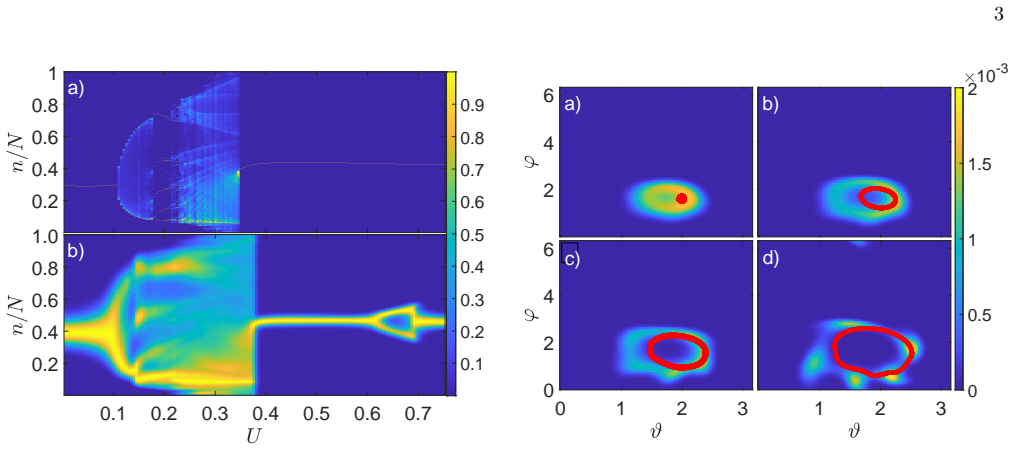
For the open dimer with hopping $J=1$, dissipation $\gamma=0.1$, modulation amplitude $A=3.4$, and period $T=2\pi$, the paper shows that the quantum stroboscopic state reproduces the mean-field Neimark-Sacker scenario: the fixed point of the Poincaré map loses stability and an invariant curve is born, while the quantum Husimi distribution and the stroboscopic distributions of particle number and energy become bagel-shaped. The Floquet map's subleading eigenvalues $\mu_{2,3}$ approach the unit circle with phase $\theta_0\approx 2\pi\omega$, where the rotation number $\omega\approx 0.58$ is measured from the winding of individual quantum trajectories on the attractor. Increasing $U$ leads to frequency locking at $\omega=3/5$ and a period-5 structure on the torus, and increasing $N$ at fixed $U$ converts a unimodal distribution into a bagel, so the bifurcation is controlled both by interaction strength and by system size.
Load-bearing premise
The whole analogy rests on the assumption that the mean-field equations obtained by replacing quantum operators with expectation values are accurate for $N$ between 50 and 500, and the paper does not quantify the error of that semiclassical truncation.
Editorial extensions
If this is right
- At $N=500$ the quantum bifurcation diagram reproduces the classical sequence of torus birth, period-6 cycle, chaos, and crisis, with the quantum transition occurring slightly earlier ($U\approx 0.1$).
- The rotation-number distribution is well localized near $\omega\approx 0.58$ just after the bifurcation, clearly distinct from the period-doubling value $1/2$, and locks to the rational $3/5$ at $U\approx 0.15$.
- The spectral gap $1-|\mu_{2,3}|$ decreases as $N$ grows, so the relaxation time to the asymptotic state, estimated as $t\sim(1-|\mu_{2,3}|)^{-1}$, can become very large near the quantum bifurcation.
- The number of bosons acts as a bifurcation parameter: at $U=0.1125$ the Husimi distribution is unimodal for $N=50$ but develops a bagel by $N=500$.
- The diameter of the quantum bagel grows with $U$ in a way that depends on $N$, so the finite-size scaling near the bifurcation is not universal.
Reading between the lines
- If the finite-$N$ shift of the apparent bifurcation point scales as a power of $1/N$, measuring that shift in the dimer would quantify how much the mean-field reference overestimates or underestimates the true quantum threshold; the paper reports the shift but does not extract this scaling.
- The same stroboscopic rotation-number diagnostic could be applied to other driven-dissipative bosonic systems, such as an open Dicke model, to search for torus bifurcations from time-series data alone.
- The observed relation between the Floquet eigenvalue phase and the trajectory rotation number suggests that rational plateaus of the rotation number could be predicted directly from spectral properties without simulating trajectories.
- Comparing the spread of quantum trajectories on the bagel with the width predicted from the spectral gap would allow a test of whether quantum fluctuations, rather than finite sampling, set the thickness of the quantum torus.
Signed reviews
Editorial analysis
A structured set of objections, weighed in public.
Referee Report
Summary. The paper studies a periodically modulated open bosonic dimer with N bosons subject to Lindblad dissipation, and reports a qualitative transition in the stroboscopic asymptotic state as the interaction strength U increases through U about 0.1: the Husimi distribution and the histograms of observables change from unimodal to bagel-shaped, a conjugate pair of Floquet eigenvalues approaches the unit circle, and trajectory-based rotation numbers become localized near omega about 0.58. The authors identify this transition as the quantum counterpart of the classical Neimark-Sacker bifurcation in the mean-field equations (Eq. 7), and they further show that the transition depends on the particle number N, which can itself serve as a bifurcation parameter.
Significance. If established, this result would extend the catalog of dissipative quantum bifurcations to the Neimark-Sacker (torus-birth) case, in a model that is experimentally relevant for cavity and circuit QED systems. The paper's strengths are its multi-probe numerical evidence: Husimi distributions, observable histograms, Floquet spectra, and rotation-number statistics all point to the same transition, and the quantum results are compared with the mean-field model without parameter fitting. The quantum-trajectory unraveling additionally resolves dynamics on the quantum attractor, which goes beyond earlier static Husimi pictures. The main weakness is that the quantitative link between the finite-N quantum transition and the mean-field bifurcation point is not established by a finite-size scaling analysis.
major comments (3)
- [Section III, Figs. 2 and 6 and the Floquet spectral paragraph] The central claim of a quantum Neimark-Sacker bifurcation requires the finite-N onset to converge to the mean-field bifurcation at U approximately 0.11 as N goes to infinity. The manuscript explicitly reports that at N=500 the bagel is already present at U=0.1 while the mean-field map still has a fixed point, and it states only that the spectral gap 1-|mu_{2,3}| decreases with N, without giving a quantitative scaling law. No finite-size scaling of U*(N), of the bagel diameter D(U), or of the spectral gap is provided, so the observed bagel could be a finite-size crossover rather than a precursor of the classical Neimark-Sacker bifurcation. Please provide estimates of U*(N) for the reported N values (for example, from a threshold in D(U) or in 1-|mu_{2,3}|), an extrapolation to N to infinity, and a comparison with U approximately 0.11, together with the scaling exponent of the spectral gap with N.
- [Section III, Fig. 1(b)] The quantum bifurcation diagram in Fig. 1(b) shows an additional quantum transition within U in [0.6,0.7] that has no counterpart in the mean-field model. Because the mean-field model is the classical reference used to identify the bifurcation, this unexplained feature leaves the claimed correspondence incomplete. The authors should characterize this transition, for instance by testing whether its location and N-dependence indicate a separate finite-size instability or a second quantum Neimark-Sacker bifurcation, and by stating explicitly whether the feature persists as N increases.
- [Section II, Eq. (6)] The mean-field equations are obtained by truncating the cumulant hierarchy at the level of first-order expectation values and neglecting subleading-in-N dissipative terms, but the accuracy of this truncation for N=50..500 is not quantified. Since the mean-field bifurcation point U approximately 0.11 is used as the classical reference to which the quantum data are compared, the validity of this reference is load-bearing. A consistency check should be reported, for example the magnitude of the leading neglected second-order cumulants in the Heisenberg equations or a comparison with a next-order truncation, so that the reader can assess how much the mean-field bifurcation value may shift at finite N.
minor comments (5)
- [Introduction] The word 'qunntum torus' appears in the Introduction; it should be 'quantum torus'.
- [Fig. 1 caption] The phrase 'The maximal element for each value of U is normalized to 1' is ambiguous; please specify the plotted quantity (for example, a density-matrix diagonal element, a histogram count, or a probability) and the binning or normalization procedure used.
- [Fig. 4] Please specify how the average rotation number (solid line) is computed, including whether it is a time average or an ensemble average over trajectories, and provide error bars or a standard deviation to quantify the localization of the omega distribution.
- [Section III, Floquet paragraph] The statement that the largest eigenvalue 'is always unity' should be qualified: for a trace-preserving completely positive stroboscopic map with a unique asymptotic state there is an eigenvalue equal to 1, and numerical diagonalization of the finite-dimensional Floquet map will yield values close to but not exactly equal to 1.
- [References] Reference [17] gives the publisher location as 'Brlin'; this should be 'Berlin'.
Circularity Check
None: the quantum Neimark-Sacker signatures are obtained directly from the Lindblad dynamics and compared, not derived, from the in-paper mean-field reference; no fitted parameter is renamed as a prediction.
full rationale
The paper contains no circular derivation. The mean-field system (Eqs. (6)-(7)) is derived in Section II from the same Lindblad master equation by the standard replacement of spin operators by expectation values and neglect of subleading-in-N dissipative terms; it is then used only as a 'reference role' for bifurcation analysis, not as an input that forces the quantum results. The quantum signatures—bagel-shaped Husimi distributions, stroboscopic observable histograms, the Floquet eigenvalue pair approaching the unit circle, and the rotation number—are computed independently by direct propagation of Eq. (1) and by Monte-Carlo wave-function unraveling of the same master equation, with no parameter fitted to the mean-field curve. The paper even reports quantitative discrepancies (the bagel is already present at U=0.1 for N=500 while the mean-field model still has a fixed point, and an extra quantum bifurcation appears for U in [0.6,0.7]) that would be impossible if the comparison had been constructed to coincide. The self-citations ([24,25,27,50] by the authors) are used for background on earlier quantum bifurcations, for the dissipative jump operator, and for the numerical method; none is invoked as a load-bearing uniqueness theorem or as the source of the Neimark-Sacker interpretation. The lack of a finite-size scaling law connecting U*(N) to the mean-field bifurcation value is a legitimate correctness concern but is not circularity, since the paper does not claim to derive the quantum transition from the mean-field model. Verdict: no significant circularity.
Assumptions & free parameters
free parameters (4)
- Modulation amplitude A =
3.4
- Dissipation strength γ =
0.1
- Tunneling amplitude J =
1
- Modulation period T =
2π
assumptions (3)
- domain assumption Lindblad master equation correctly describes the open dimer's Markovian dynamics.
- domain assumption The mean-field equations are obtained by replacing operators by their expectation values, assuming factorized correlators and neglecting lower-order-in-N dissipative terms.
- domain assumption The system has a unique asymptotic state (periodic trajectory of the stroboscopic map) for the considered parameters.
Cite this review
Pith. "Pith review of Quantum Neimark-Sacker bifurcation." pith.science (2026). https://pith.science/paper/OSDPQV24
@misc{pith2026190808134,
  author       = {Pith},
  title        = {Pith review of: Quantum Neimark-Sacker bifurcation},
  year         = {2026},
  howpublished = {\url{https://pith.science/paper/OSDPQV24}},
  note         = {Machine review of arXiv:1908.08134}
}
read the original abstract
Recently, it has been demonstrated that asymptotic states of open quantum system can undergo qualitative changes resembling pitchfork, saddle-node, and period doubling classical bifurcations. Here, making use of the periodically modulated open quantum dimer model, we report and investigate a quantum Neimark-Sacker bifurcation. Its classical counterpart is the birth of a torus (an invariant curve in the Poincar\'{e} section) due to instability of a limit cycle (fixed point of the Poincar\'{e} map). The quantum system exhibits a transition from unimodal to bagel shaped stroboscopic distributions, as for Husimi representation, as for observables. The spectral properties of Floquet map experience changes reminiscent of the classical case, a pair of complex conjugated eigenvalues approaching a unit circle. Quantum Monte-Carlo wave function unraveling of the Lindblad master equation yields dynamics of single trajectories on "quantum torus" and allows for quantifying it by rotation number. The bifurcation is sensitive to the number of quantum particles that can also be regarded as a control parameter.
Figures


Figures from the paper (1 more)

Reference graph
Works this paper leans on
- [1]
-
[2]
Kuznetsov, Elements of Applied Bifurcation The- ory, Springer, 3rd edition (2004)
Yu.A. Kuznetsov, Elements of Applied Bifurcation The- ory, Springer, 3rd edition (2004)
work page 2004
-
[3]
P. Blanchard, R.L. Devaney, G.R. Hall, Differential Equations, London: Thompson (2006)
work page 2006
- [4]
-
[5]
Gutzwiller, Chaos in Classical and Quantum Mechan- ics (Springer, New York, 1991)
M. Gutzwiller, Chaos in Classical and Quantum Mechan- ics (Springer, New York, 1991)
work page 1991
- [6]
-
[7]
T. Guhr, A. M¨ uller-Groeling, and H. A. Weidenm¨ uller, Phys. Rep. 299, 189 (1998)
work page 1998
-
[8]
A.P. Hines, R.H. McKenzie, and G.J. Milburn, Phys. Rev. A 71, 042303 (2005)
work page 2005
Show all 51 references
-
[9]
Nemes, K
M.C. Nemes, K. Furuya, G.Q. Pellegrino, A.C. Oliveira, M. Reis, and L. Sanz, Phys. Lett. A 354, 60 (2005)
2005
-
[10]
Zibold, E
T. Zibold, E. Nicklas, Ch. Gross, and M. K. Oberthaler, Phys. Rev. Lett. 105, 204101 (2010)
2010
-
[11]
Walther, B.T.H
H. Walther, B.T.H. Varcoe, B.-G. Englert, Th. Becker, Rep. Prog. Phys. 69, 1325 (2006)
2006
-
[12]
Aspelmeyer, T
M. Aspelmeyer, T. J. Kippenberg, F. Marquardt, Rev. Mod. Phys. 86, 1391 (2014)
2014
-
[13]
J. Q. You and F. Nori, Nature 474, 589 (2011)
2011
-
[14]
Feurer, J.C
T. Feurer, J.C. Vaughan, and K.A. Nelson, Science 299, 374 (2003)
2003
-
[15]
Barends, L
R. Barends, L. Lamata, J. Kelly, L. Garc´ ıa-´Alvarez, A.G. Fowler, A. Megrant, E. Jeffrey, T.C. White, D. Sank, J.Y. Mutus, B. Campbell, Yu Chen, Z. Chen, B. Chiaro, A. Dunsworth, I.-C. Hoi, C. Neill, P.J.J. O’Malley, C. Quintana, P. Roushan, A. Vainsencher, J. Wenner, E. Sola...
2015
-
[16]
Roushan, C
P. Roushan, C. Neill, J. Tangpanitanon, V.M. Bastidas, A. Megrant, R. Barends, Y. Chen, Z. Chen, B. Chiaro, A. Dunsworth, A. Fowler, B. Foxen, M. Giustina, E. Jeffrey, J. Kelly, E. Lucero, J. Mutus, M. Neeley, C. Quintana, D. Sank, A. Vainsencher, J. Wenner, T. White, H. Neven,...
2017
-
[17]
Carmichael, An Open Systems Approach to Quantum Optics (Springer, Brlin, 1991)
H. Carmichael, An Open Systems Approach to Quantum Optics (Springer, Brlin, 1991)
1991
-
[18]
Breuer, F
H.-P. Breuer, F. Petruccione, The Theory of Open Quan- tum Systems (Oxford University Press, Oxford, 2002)
2002
-
[19]
Spohn, Rep
H. Spohn, Rep. Math. Phys. 10 198 (1976)
1976
-
[20]
Alicki, R. and K. Lendi, 1987, Quantum Dynamical Semi- groups and Applications , Lecture Notes in Physics, Vol. 286 (Springer, Berlin, 1998)
1987
-
[21]
T. P. Spiller, J. F. Ralph, Phys. Lett. A 194, 235 (1994)
1994
-
[22]
T. A. Brun, I. C. Percival, and R. Schack, J. Phys. A: Math. Gen. 29, 2077 (1996)
1996
-
[23]
Carlo, G
G.G. Carlo, G. Benenti, G. Casati, and D.L. Shepelyan- sky, Phys. Rev. Lett. 94, 164101 (2005)
2005
-
[24]
Hartmann, D
M. Hartmann, D. Poletti, M. Ivanchenko, S. Denisov, P. H¨ anggi, New J. Phys.19, 083011 (2017)
2017
-
[25]
M. V. Ivanchenko, E. A. Kozinov, V. D. Volokitin, A. V. Liniov, I.B. Meyerov, and S. V. Denisov, Ann. Phys. 529, 1600402 (2017)
2017
-
[26]
G. G. Carlo, L. Ermann, A. M. F. Rivas, M. E. Spina, and D. Poletti, Phys. Rev. E 95, 062202 (2017)
2017
-
[27]
Yusipov, O.S
I.I. Yusipov, O.S. Vershinina, S.V. Denisov, S.P. Kuznetsov, M.V. Ivanchenko, Chaos 29, (2019)
2019
-
[28]
Ch. P. Meaney, T. Duty, R. H. McKenzie, and G. J. Milburn, Phys. Rev. A 81, 043805 (2010)
2010
-
[29]
Tomadin, S
A. Tomadin, S. Diehl, and P. Zoller, Phys. Rev. A 83, 013611 (2011)
2011
-
[30]
R. R .W. Wang, B. Xing, G. G. Carlo, and D. Poletti, Phys. Rev. E 97, 020202(R) (2018)
2018
-
[31]
Lindblad , Commun
G. Lindblad , Commun. Math. Phys. 48, 119 (1976)
1976
-
[32]
Gorini , A
V. Gorini , A. Kossakowski , E. C. G. Sudarshan , J. Math. Phys. 17, 821 (1976)
1976
-
[33]
Meiser and M
D. Meiser and M. J. Holland, Phys. Rev. A 81, 063827 (2010)
2010
-
[34]
St¨ ockmann, Quantum Chaos: An Introduction (Cambridge University Press, 2007)
H.-J. St¨ ockmann, Quantum Chaos: An Introduction (Cambridge University Press, 2007)
2007
-
[35]
Dum, A.S
R. Dum, A.S. Parkins, P. Zoller, and C.W. Gardiner, Phys. Rev. A 46, 4382 (1992)
1992
-
[36]
Mølmer, Y
K. Mølmer, Y. Castin, and J. Dalibard, J. Opt. Soc. Am. B 10, 524 (1993)
1993
-
[37]
Plenio and P.L
M.B. Plenio and P.L. Knight, Rev. Mod. Phys. 70, 101 (1998)
1998
-
[38]
Daley, Adv
A.J. Daley, Adv. Phys. 63, 77 (2014)
2014
-
[39]
Vardi, J.R
A. Vardi, J.R. Anglin, Phy. Rev. Lett. 86, 568 (2001)
2001
-
[40]
Trimborn, D
F. Trimborn, D. Witthaut, S. Wimberger, J. Phys. B: At. Mol. Opt. Phys. 41, 171001 (2008)
2008
-
[41]
Poletti, J.-S
D. Poletti, J.-S. Bernier, A. Georges, C. Kollath, Phys. Rev. Lett. 109, 045302 (2012)
2012
-
[42]
Weiss, N
C. Weiss, N. Teichmann, Phys. Rev. Lett. 100, 140408 (2008)
2008
-
[43]
Gross, T
C. Gross, T. Zibold, E. Nicklas, J. Esteve, M.K. Oberthaler, Nature 464, 1165 (2010)
2010
-
[44]
Tomkovi˘ c, W
J. Tomkovi˘ c, W. Muessel, H. Strobel, S. L¨ oock, P. Schlagheck, R. Ketzmerick, M. K. Oberthaler, Phys. Rev. A 95, 011602 (2017)
2017
-
[45]
Diehl, A
S. Diehl, A. Micheli, A. Kantian, B. Kraus, H.P. B¨ uchler, P. Zoller, Nature Phys. 4, 878 (2008)
2008
-
[46]
Kraus, H
B. Kraus, H. P. B¨ uchler, S. Diehl, A. Kantian, A. Micheli, and P. Zoller, Phys. Rev. A 78, 042307 (2008)
2008
-
[47]
Schindler, M
P. Schindler, M. M¨ uller, D. Nigg, J.T. Barreiro, E.A. Martinez, M. Hennrich, T. Monz, S. Diehl, P. Zoller and R. Blatt, Nature Phys. 9, 361 (2013)
2013
-
[48]
Arecchi, E
F.T. Arecchi, E. Courtens, R. Gilmore, H. Thomas, Phys. Rev. A 6, 2211 (1972)
1972
-
[49]
Perelomov, Generalized coherent states and their ap- plications (Springer, Berlin 1986)
A. Perelomov, Generalized coherent states and their ap- plications (Springer, Berlin 1986)
1986
-
[50]
Volokitin, A
V. Volokitin, A. Liniov, I . Meyerov, M. Hartmann, M. Ivanchenko, P. H¨ anggi, and S. Denisov, Phys. Rev. E96, 053313 (2017). 7
2017
-
[51]
Z. Gong, R. Hamazaki, and M. Ueda, Phys. Rev. Lett. 120, 040404 (2018)
2018
Reviewed August 14, 2026 · model on record in the stance chip above.
Discussion (0). Continue with ORCID to comment.