REVIEW 5 major objections 5 minor 27 references
Fourier Neural Operators for Non-Markovian Processes:Approximation Theorems and Experiments
T0 review · 5 major / 5 minor · reviewed 2026-08-06 · deepseek-v4-flash
Pith's one-line read MFNO approximates path-dependent SDE solutions and fractional Brownian motion with proven error bounds.
desk verdict MFNO is a plausible route to learning non-Markovian SDE operators, but the main theorems currently lean on an H^1 approximation claim that Theorem 2.4 does not actually prove. read the letter →
The pith
A machine-rendered reading of the paper's core claim, the machinery that carries it, and where it could break.
The reading
What carries the argument
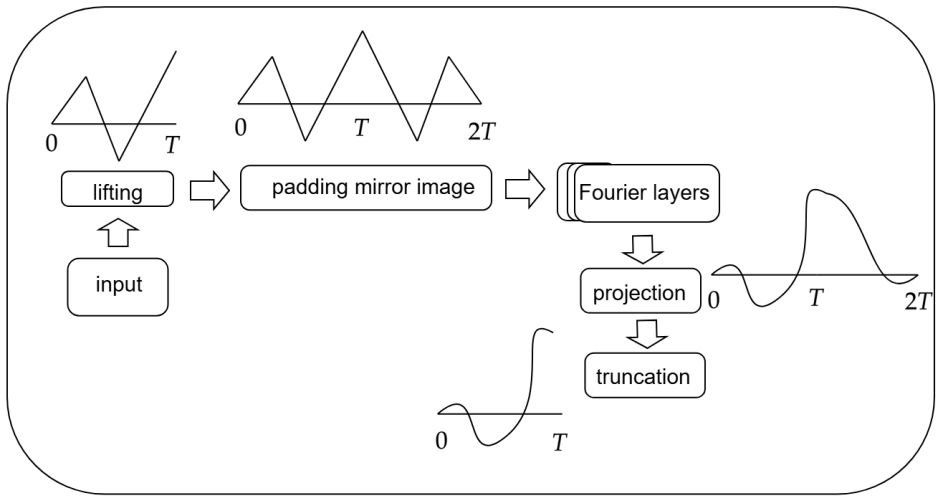
The load-bearing object is the mirror-padding layer M(a)(t) = a(t) for t ≤ T and M(a)(t) = a(2T − t) for T < t ≤ 2T, which reflects a non-periodic path about its midpoint so that the lifted input is continuous and periodic on the doubled interval. This lets the FNO's Fourier layers operate with the periodic-domain guarantee of Theorem 2.2. The other main machinery is the non-adapted piecewise linear interpolation B^n of Brownian motion, whose sample paths lie in $H^1([0,T])$, together with a Wong–Zakai comparison theorem bounding the sup-norm distance between the true solution and the solution driven by B^n. For fractional Brownian motion, the Volterra kernel representation converts Brownian paths into fBM, and the Lipschitz operator is composed with that kernel operator to produce a continuous map on $H^1$.
What would settle it
Find a continuous operator F on a compact subset K of $H^1([0,T])$ whose outputs are uniformly bounded in $H^1$ but whose derivative map is not well approximated by low-frequency Fourier modes, for example F(ω)(t) = φ(ω'(t)) with a smooth nonlinearity φ on a set of paths with bounded second derivatives; compute for such K the best $L^2$ MFNO approximation and check whether the best possible $H^1$ error remains bounded away from zero as the $L^2$ error tends to zero. If such an example exists, the $H^1$ step in Theorems 3.2 and 3.7 fails and the stated sup-norm bounds do not follow.
Extended reading notes
Core claim
The paper claims two approximation theorems for the mirror-padded Fourier neural operator. Theorem 3.2 states that for any tolerances ε, ε' > 0 and any window length M in natural numbers, there is an MFNO and a starting partition index M0 such that, on a set D of probability at least 1 − ε', the conditional root-mean-square supremum-norm error between the true solution X^ξ of a path-dependent SDE and the MFNO output is below ε for every partition n from M0 to M0 + M, where B^n is the piecewise-linear Brownian interpolation. Theorem 3.7 makes the analogous claim for L-Lipschitz transformations G(B^H) of fractional Brownian motion, with the error measured in $L^2$ rather than supremum norm. The proofs chain together Wong–Zakai convergence rates, a compactness argument on $H^1$ paths, and the MFNO universality theorem, with mirror padding supplying the periodic input that the Fourier architecture requires.
Load-bearing premise
The proofs assume an MFNO can match both the path values and their time derivatives uniformly on the compact set of inputs, but the approximation theorem actually invoked only guarantees matching the path values in $L^2$.
Editorial extensions
If this is right
- For any path-dependent SDE satisfying conditions (R1)–(R3), sufficiently fine linearly interpolated Brownian inputs let an MFNO match the true solution path within any prescribed tolerance in conditional squared-sup-norm error.
- The same recipe covers every L-Lipschitz functional of fractional Brownian motion, not only fBM itself, because the theorem is stated for general Lipschitz maps on $L^2$.
- Because the architecture operates on functions rather than fixed grids, a single trained MFNO can be evaluated at finer grids than the training grid; experiments show roughly constant error from 128 to 1024 points for the two path-dependent SDEs.
- Sample path generation scales as O(n log n) with resolution, versus O(n^2) for the Euler scheme, and measured inference is several times faster at resolution 256.
Reading between the lines
- The proof step applying 'the universal approximation theorem for MFNOs' to control the $H^1$ error goes beyond what Theorem 2.4 actually proves, which is $L^2$ approximation; closing that $H^1$ gap is the natural next theorem, and until then the $L^\infty$ conclusions are conditional on it.
- The experiments put MFNO and the simpler zero-padded ZFNO at comparable accuracy on the tested tasks, suggesting mirror padding buys theoretical tractability more than raw error reduction; a sharper ablation varying padding length and directly measuring boundary artifacts would test that reading.
- For rough fBM (H = 0.25), every architecture's error grows with resolution, so the bottleneck appears to be the low regularity of the target paths rather than periodicity; combining MFNO with a wavelet or multiscale representation is a concrete test of that diagnosis.
- The fBM argument only requires a square-integrable Volterra kernel and $L^2$ convergence of the interpolated inputs, so the same strategy should extend to other Gaussian processes with such kernels, such as Ornstein–Uhlenbeck processes or integrated Brownian motion.
Editorial analysis
A structured set of objections, weighed in public.
Referee Report
Summary. The paper introduces the mirror-padded Fourier neural operator (MFNO), an FNO variant that symmetrically extends inputs on [0,T] to a periodic domain, and claims two rigorous approximation theorems: Theorem 3.2 for solutions of path-dependent SDEs (with error measured in conditional L2 norm after conditioning on a high-probability event) and Theorem 3.7 for Lipschitz transformations of fractional Brownian motion (fBM), both with explicit error bounds. If these theorems hold, they would be the first universal approximation guarantees for operator learning of non-Markovian stochastic processes. The paper also reports experiments on two path-dependent SDEs and fBM with H=0.25 and H=0.75, showing resolution generalization and speed advantages relative to several baselines. The proof strategy combines Wong–Zakai-type approximations, fBM approximation results, and known FNO universality, but the central approximation step in Theorem 3.2 relies on an H1-approximation property that the stated MFNO universality theorem does not provide.
Significance. The claimed contributions are significant if correct: the approximation theorems would fill a real gap in operator learning for non-Markovian stochastic processes, and the MFNO architecture with mirror padding is a reasonable and clearly motivated design for handling non-periodic inputs in FNOs. The paper's reliance on external results (Kovachki et al. for FNO universality, Xu and Gong for Wong–Zakai estimates, and Decreusefond–Ustunel for fBM approximation) is appropriate, and the empirical study includes a useful resolution-generalization analysis. However, because the main theoretical claim (Theorem 3.2) depends on an unproven H1 approximation property, the central result is currently not established. The paper is potentially repairable, but the repair requires either a strengthened universality theorem for MFNOs with H1-valued outputs or a substantially different argument.
major comments (5)
- [Proof of Theorem 3.2, Section 3.1] In the proof of Theorem 3.2, the line 'By the universal approximation theorem for MFNOs (Theorem 2.4), there exists an MFNO N ... such that sup_{(x,ω)∈K} ||F(x,ω) - N(x,ω)||_{H^1} < ε/(2√(1/T+T))' is not justified by Theorem 2.4. Theorem 2.4 guarantees approximation only in the L^2([0,T]) norm for continuous operators G: H^s → L^2; it does not provide H^1-norm error control. Moreover, F maps H^1([0,T]) into H^1([0,T]) (Lemma 3.4), while the MFNO as defined in Definition 2.4 maps into L^2([0,T], R^{du}), so the expression ||F - N||_{H^1} is not even well-defined unless N is identified with its smooth restriction to [0,T]. The subsequent L∞ bound on F(ξ,B^n) - N(ξ,B^n), which is essential for the advertised conditional L^2 error, relies entirely on this H^1 closeness via Sobolev embedding. This is a load-bearing gap in the proof of the paper's central theorem.
- [Proof of Theorem 3.7, Section 3.2] The proof of Theorem 3.7 contains the analogous assertion 'By the universal approximation theorem for MFNOs (Theorem 2.4), there exists an MFNO N ... such that sup_{ω∈K} ||G∘G(ω) - N(ω)||_{H^1} < ε/2'. Here G∘G maps H^1([0,T]) to L^2([0,T]) (the kernel-integral operator G maps H^1 to L^2 by Lemma 3.6, and the Lipschitz map G maps L^2 to L^2), so the H^1 norm of the difference is not controlled by Theorem 2.4. However, since the final error in Theorem 3.7 is measured in L^2, this particular invocation can be repaired by replacing 'H^1' with 'L^2' in that sentence: G∘G is indeed a continuous operator from H^1 to L^2, and Theorem 2.4 applies directly. Thus, unlike the gap in Theorem 3.2, this issue is a local fix, but as written the proof is invalid.
- [Theorem 2.4, Section 2.2] Theorem 2.4 is stated for s ≥ 1/2, but its proof invokes Theorem 2.2, which requires s > d/2 = 1/2. The case s = 1/2 is therefore not covered. Additionally, for s = 1/2, the Sobolev embedding H^s([0,T]) ⊂ C([0,T]) fails in one dimension, so the mirror-padding map M in Definition 2.4, which acts on continuous functions, is not even defined on the full space H^{1/2}([0,T]). The statement should require s > 1/2. Since all applications in Section 3 use s = 1, this is not directly load-bearing for the main theorems, but it is a correctness issue in the stated universality result.
- [Proof of Theorem 3.2 (event D) and Theorem 3.7] In the proof of Theorem 3.2, the set D is defined as the intersection over n = M0, ..., M0+M of the events {∥B^n∥_{H^1} ≤ R_{M0+M,ε'}}. Lemma 2.3 gives each individual event probability at least 1 - ε', so the union bound yields P(D) ≥ 1 - (M+1)ε', not P(D) > 1 - ε' as stated. The same error appears in the proof of Theorem 3.7. To achieve the claimed probability, Lemma 2.3 should be applied with ε'/(M+1) (and the constant R adjusted accordingly). This is a fixable probabilistic bound issue, but it affects the theorem statements as written.
- [Abstract and Section 5 vs Table 1] The abstract and conclusion claim that MFNO performs 'comparable or superior' to the baselines. However, Table 1 shows that on the fBM tasks with H=0.25 and H=0.75, MFNO has relative l2 errors of (1.3±0.16)×10^{-2} and (1.4±0.21)×10^{-2}, which are roughly 2.5 and 3.8 times larger than the corresponding vanilla FNO errors (5.3±0.74)×10^{-3} and (3.7±0.39)×10^{-3}. Similar gaps appear against ZFNO and LSTM on these tasks. The claim of superiority is therefore not supported by the reported numbers; at best, MFNO is competitive on the two SDE tasks and worse on the fBM tasks. The authors should reword the summary to reflect that the performance gains are task-dependent.
minor comments (5)
- [Section 2.2] The symbol T is used both for the terminal time and for the torus [0,2T]/∼ in Definition 2.4 and the surrounding text. This overloading is confusing; please use a distinct symbol for the torus.
- [Lemma 3.3] In the displayed inequality, the domain of X and Y is written as H^1([−T, δ], R^m), but the fixed-point map is defined on H^1([0, δ], R^m). This appears to be a typo and should be corrected to H^1([0, δ], R^m).
- [Theorem 3.2 and Definition 2.4] The letter N is used both for the MFNO network and for the order of the pseudo-spectral projection; for example, Theorem 3.2 says 'there exist N, M0 ∈ N ... and a MFNO N ... with order N'. Please use different notation, such as W for the order, to avoid confusion.
- [Related Literature] The citation 'Cont and Lu (2016)' is described as generalizing the Euler scheme to path-dependent SDEs, but the cited paper 'Weak approximation of martingale representations' does not appear to address Euler schemes. Please verify and correct this reference or its description.
- [Proof of Theorem 2.4] The proof asserts the continuity of the extended operator ~G: H^s(T) → L^2(T) without spelling out the argument. For s > 1/2, the restriction to [0,T] and the mirror extension are bounded linear operators, so the continuity is plausible, but the details should be included for completeness.
Circularity Check
No significant circularity: the approximation theorems are derived from external universality, Wong–Zakai, and fBM approximation results, with no fitted input masquerading as a prediction.
full rationale
The paper's central derivations reduce to external results, not to their own conclusions. Theorem 3.2 uses the Wong–Zakai estimate of Xu and Gong (2023), the continuity of the path-dependent solution map F proved in Lemma 3.4, and the MFNO universality theorem, which itself is derived from the FNO universality theorem of Kovachki et al. (2021). Theorem 3.7 uses the fBM approximation result of Decreusefond and Ustunel (1999) together with Lipschitzness of G. No parameter is fitted to the target process and then renamed as a prediction; the theoretical claims are parameter-free approximation statements, and the empirical section evaluates on held-out test sets. The only self-citation, Lee et al. (2022), appears in the related-literature paragraph on option pricing and is not load-bearing. The reviewer-identified gap in the proof of Theorems 3.2 and 3.7—invoking Theorem 2.4 to obtain H1-close approximation when Theorem 2.4 is stated only for L2 outputs—is a correctness risk or missing theorem, not a circular reduction: it does not assume the conclusion being proved, and it remains an unproven intermediate strengthening rather than an input-output identity. There is also a minor union-bound issue in the definition of D and a smoothness-parameter mismatch in Theorem 2.4, both of which are fixable gaps rather than circular steps. Accordingly, the derivation chain is not circular, and the score is 0.
Assumptions & free parameters
assumptions (6)
- standard math FNO universal approximation on the torus (Kovachki et al., Theorems 2.1-2.2)
- standard math Wong-Zakai convergence of piecewise-linear interpolated Brownian motion for path-dependent SDEs (Xu-Gong, Theorem 3.1)
- standard math Volterra representation W^n = integral K_H dBn converges to fBM (Decreusefond-Ustunel, Proposition 3.1)
- domain assumption Coefficients b, sigma satisfy (R1)-(R3) and initial condition xi is bounded
- domain assumption Inputs to the network are non-adapted piecewise linear interpolations Bn on uniform partitions
- domain assumption Mirror reflection produces a continuous periodic extension in H1(T)
Cite this review
Pith. "Pith review of Fourier Neural Operators for Non-Markovian Processes:Approximation Theorems and Experiments." pith.science (2026). https://pith.science/paper/OSIXC454
@misc{pith2026250717887,
  author       = {Pith},
  title        = {Pith review of: Fourier Neural Operators for Non-Markovian Processes:Approximation Theorems and Experiments},
  year         = {2026},
  howpublished = {\url{https://pith.science/paper/OSIXC454}},
  note         = {Machine review of arXiv:2507.17887}
}
read the original abstract
This paper introduces an operator-based neural network, the mirror-padded Fourier neural operator (MFNO), designed to learn the dynamics of stochastic systems. MFNO extends the standard Fourier neural operator (FNO) by incorporating mirror padding, enabling it to handle non-periodic inputs. We rigorously prove that MFNOs can approximate solutions of path-dependent stochastic differential equations and Lipschitz transformations of fractional Brownian motions to an arbitrary degree of accuracy. Our theoretical analysis builds on Wong--Zakai type theorems and various approximation techniques. Empirically, the MFNO exhibits strong resolution generalization--a property rarely seen in standard architectures such as LSTMs, TCNs, and DeepONet. Furthermore, our model achieves performance that is comparable or superior to these baselines while offering significantly faster sample path generation than classical numerical schemes.
Figures


Figures from the paper (2 more)


Reference graph
Works this paper leans on
-
[1]
Asmussen, S. and Glynn, P. W. (2007). Stochastic Simulation: A lgorithms and Analysis . Springer
work page 2007
-
[2]
Bally, V., Caramellino, L., and Cont, R. (2016). Stochastic Integration by Parts and Functional I t\^o Calculus . Birkh\"auser, CRM Barcelona
work page 2016
-
[3]
Cao, Q., Goswami, S., and Karniadakis, G. E. (2024). Laplace neural operator for solving differential equations. Nature Machine Intelligence , 6:631--640
work page 2024
-
[4]
Cont, R. and Fourni\'e, D. A. (2010). Change of variable formulas for non-anticipative functionals on path space. Journal of Functional Analysis , 259(4):1043--1072
work page 2010
- [5]
-
[6]
Decreusefond, L. and \"Ust\"unel, A. S. (1999). Stochastic analysis of the fractional B rownian motion. Potential Analysis , 10(2):177--214
work page 1999
-
[7]
Dupire, B. (2009). Functional I t\^o calculus. Technical Report 2009-04, Bloomberg Portfolio Research Paper
work page 2009
-
[8]
Eigel, M. and Miranda, C. (2025). Functional SDE approximation inspired by a deep operator network architecture. arXiv preprint arXiv:2402.03028
Show all 27 references
-
[9]
Gatheral, J., Jaisson, T., and Rosenbaum, M. (2018). Volatility is rough. Quantitative Finance , 18(6):933--949
2018
-
[10]
and Schmidhuber, J
Hochreiter, S. and Schmidhuber, J. (1997). Long short-term memory. Neural Computation , 9(8):1735--1780
1997
-
[11]
Hosking, J. R. M. (1984). Modeling persistence in hydrological time series using fractional differencing. Water Resources Research , 20(12):1898--1908
1984
-
[12]
Hu, P., Meng, Q., Chen, B., Gong, S., Wang, Y., Chen, W., Zhu, R., Ma, Z., and Liu, T. (2022). Neural operator with regularity structure for modeling dynamics driven by SPDE s. arxiv preprint arXiv:2204.06255
2022 arXiv
-
[13]
Kidger, P., Foster, J., Li, X., Oberhauser, H., and Lyons, T. (2021). Neural SDE s as infinite-dimensional GAN s. In Proc. 38th International Conference on Machine Learning (ICML) , volume 139, pages 5453--5463
2021
-
[14]
Kovachki, N., Lanthaler, S., and Mishra, S. (2021). On universal approximation and error bounds for F ourier neural operators. Journal of Machine Learning Research , 22(290)
2021
-
[15]
Lea, C., Vidal, R., Reiter, A., and Hager, G. D. (2016). Temporal convolutional networks: A unified approach to action segmentation. In Proc. European Conference on Computer Vision (ECCV)
2016
-
[16]
Lee, K., Lim, S., and Park, H. (2022). Option pricing under path-dependent stock models. arXiv:2211.10953, revised August 2023
2022 arXiv
-
[17]
and Liu, W
Li, J. and Liu, W. (2023). An approximate operator-based learning method for the numerical solutions of stochastic differential equations. arXiv preprint arXiv:2312.08072
2023 arXiv
-
[18]
Li, Y., Du, T., Pang, Y., and Huang, Z. (2024). Component F ourier neural operator for singularly perturbed differential equations. In Proc. 38th AAAI Conference on Artificial Intelligence , volume 38, pages 13691--13699
2024
-
[19]
Li, Z., Kovachki, N., Azizzadenesheli, K., Liu, B., Bhattacharya, K., Stuart, A., and Anandkumar, A. (2020). Neural operator: G raph kernel network for partial differential equations. https://arxiv.org/abs/2003.03485. arXiv preprint arXiv:2003.03485
2020 arXiv
-
[20]
Li, Z., Kovachki, N., Azizzadenesheli, K., Liu, B., Bhattacharya, K., Stuart, A., and Anandkumar, A. (2021). Fourier neural operator for parametric partial differential equations. In Proc. International Conference on Learning Representations (ICLR)
2021
-
[21]
Norros, I. (1995). On the use of fractional B rownian motion in the theory of connectionless networks. IEEE Journal on Selected Areas in Communications , 13(6):953--962
1995
-
[22]
and Sch\"obel, R
Rostek, S. and Sch\"obel, R. (2013). A note on the use of fractional B rownian motion for financial modeling. Economic Modelling , 30:30--35
2013
-
[23]
Saporito, Y. F. (2019). Stochastic control and differential games with path-dependent influence of controls on dynamics and running cost. SIAM Journal on Control and Optimization , 57(2)
2019
-
[24]
E., Asimaki, D., and Azizzadenesheli, K
Shi, Y., Ross, Z. E., Asimaki, D., and Azizzadenesheli, K. (2025). Stochastic process learning via operator flow matching. https://arxiv.org/abs/2501.04126. arXiv preprint arXiv:2501.04126
2025
-
[25]
Tong, A., Nguyen-Tang, T., Tran, T., and Choi, J. (2022). Learning fractional white noises in neural stochastic differential equations. In Advances in Neural Information Processing Systems (NeurIPS) , volume 35, pages 37660--37675
2022
-
[26]
and Raginsky, M
Tzen, B. and Raginsky, M. (2019). Neural stochastic differential equations: D eep latent G aussian models in the diffusion limit. arXiv preprint arXiv:1905.09883
2019 arXiv
-
[27]
and Gong, J
Xu, J. and Gong, J. (2023). Wong-- Z akai approximations for stochastic differential equations with path-dependent coefficients. Proceedings of the American Mathematical Society , 151(12):5413--5428
2023
Reviewed August 6, 2026 · model on record in the stance chip above.
Discussion (0). Sign in to comment.