REVIEW 4 major objections 5 minor 1 cited by
Modular Symmetry with Weighton
T0 review · 4 major / 5 minor · reviewed 2026-08-15 · deepseek-v4-flash
Pith's one-line read A single weighton field with one unit of modular weight can generate the quark and lepton mass hierarchies from powers of two small parameters, without tuned Yukawa couplings.
desk verdict A genuinely useful classification toolkit and clean power counting, but both benchmark models need one tuned cancellation, so the no-fine-tuning headline overreaches. read the letter →
The pith
A machine-rendered reading of the paper's core claim, the machinery that carries it, and where it could break.
The reading
What carries the argument
The weighton $\phi$ is a chiral superfield that is a complete singlet of both the Standard Model gauge group and the finite modular symmetry $\Gamma'_N$, with modular weight exactly one, so that under $\tau \to (a\tau+b)/(c\tau+d)$ it transforms as $\phi \to (c\tau+d)^{-1}\phi$ and its VEV divided by the flavour cut-off, $\tilde{\phi} = \langle \phi\rangle/M_{\rm fl}$, is a small dimensionless number. The paper's main technical tool is the $T$-eigenvalue power-counting formula: in a basis where the generator $T$ is diagonal, the leading term of any Yukawa entry is $q^{(N-k_{ij})/N}$ times a constant, where $k_{ij}$ is determined by the $T$-transformation phases of the two fermions and the Higgs; after coupling to the weighton this becomes $C\, \tilde{\phi}^{J_{ij}} q^{(N-k_{ij})/N}$. This formula is what converts the group-theory input — representations and modular weights — directly into predicted orders of magnitude for masses and mixing angles, and it is applied systematically to produce the tables for levels $N = 3, 4, 5$ and the two $T'$ benchmark models.
What would settle it
Take either best-fit $T'$ model, keep $\tilde{\phi}$ and $\tau$ at their fitted values, and draw the unknown order-one coefficients from a log-flat distribution; if the fraction of draws that reproduce all quark and charged-lepton observables within $3\sigma$ is tiny rather than of order one, the no-fine-tuning claim is falsified.
Extended reading notes
Core claim
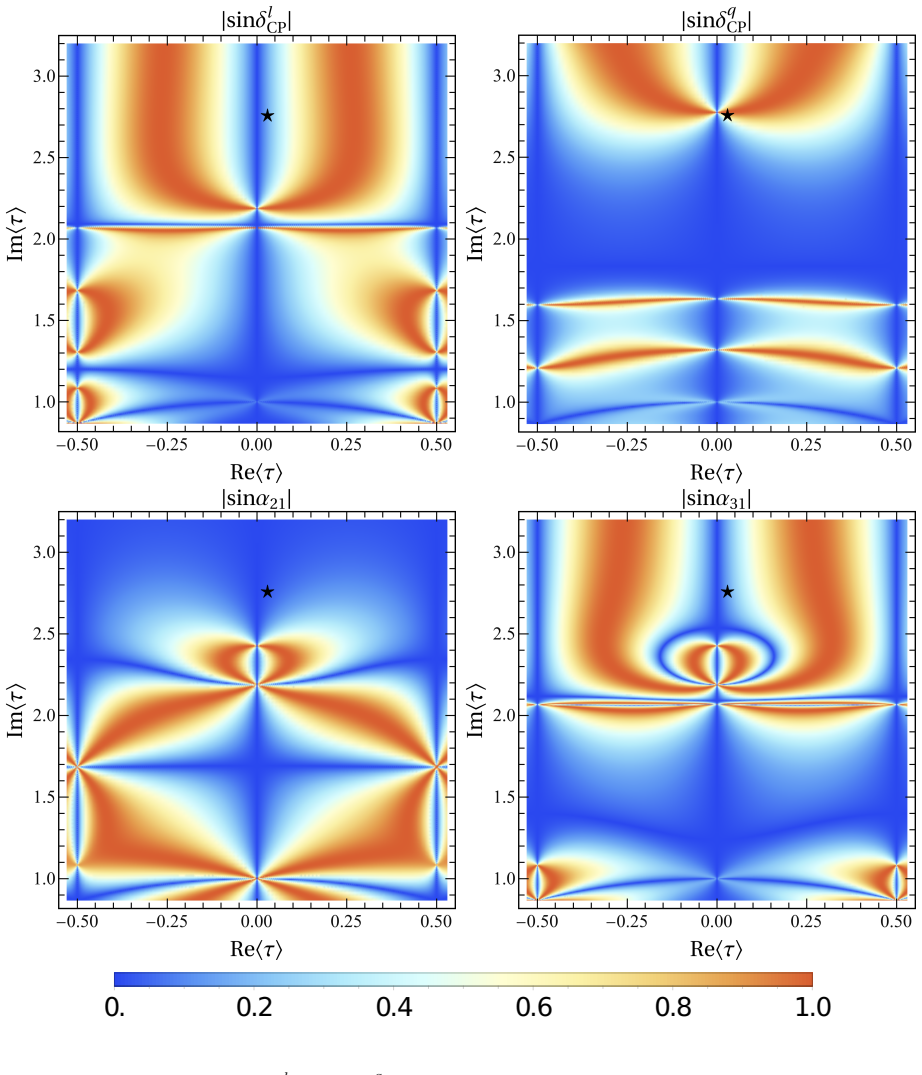
Under the modular group, the Yukawa couplings are holomorphic modular forms with a convergent Fourier expansion in $q$, and invariance under the $T$ generator forces the first non-zero term of each entry to be a definite power of $q^{1/N}$. The paper's step is to couple every Yukawa operator to powers of the weighton, whose modular weight contributes additively to the total weight, so that the leading size of each matrix element is $C\, \tilde{\phi}^{J} q^{(N-k)/N}$ with an order-one coefficient $C$. This turns fermion masses and the Cabibbo-like rotation angles into products of powers of the two small parameters $\tilde{\phi}$ and $|q|$, with the exponents fixed purely by representation and modular-weight assignments. The systematic tables for $N = 3, 4, 5$ give the resulting mass and mixing patterns for all assignments in which at least one of the two fermion representations is an irreducible triplet. Two explicit $T'$ models, one near the imaginary axis and one near the left boundary of the fundamental domain, show that this power-counting reproduces quark and charged-lepton hierarchies while a small departure from the CP-conserving boundary generates large CP phases; both models require one accidental cancellation among order-one coefficients, which the authors flag.
Load-bearing premise
The framework assumes that every non-zero leading-order coefficient in the power-counting expansion is naturally of order one and that independent contributions never cancel by accident; both presented models need one such accidental cancellation to reproduce the data.
Editorial extensions
If this is right
- If the weighton mechanism is correct, the electron/muon/tau and up/down/strange/charm/top mass ratios become outputs: each is a product of powers of $\tilde{\phi}$ and $|q|$ with exponents fixed by the chosen representations, so a model's flavour structure can be read off from its assignment table.
- The CP problem decouples from the mass problem: on the CP-conserving boundary (the imaginary axis or the fundamental-domain edge) all phases vanish while masses and mixings are nearly unchanged, and a small real part of $\tau$ generates the observed CP violation.
- The systematic tables for $N = 3, 4, 5$ identify which representation assignments produce which hierarchy patterns, so the framework is directly testable by scanning assignments and comparing predicted exponents with measured mass ratios.
- In the two explicit $T'$ models, all quoted flavour observables — quark and lepton masses, CKM and PMNS parameters, neutrino mass-squared differences, and CP phases — are reproduced within $3\sigma$ with 18 real parameters including the weighton VEV.
- A shared modulus $\tau$ links the quark and lepton sectors, so precise determinations of $\tau$ from the lepton sector can be cross-checked against quark-sector predictions.
Reading between the lines
- My inference: the same $T$-eigenvalue power-counting should also constrain non-holomorphic variants such as polyharmonic Maaß-form Yukawas, which the paper mentions; measuring the exponent of each mass ratio in such a framework would separate the weighton idea from the holomorphy assumption.
- My inference: the smallness of $\tilde{\phi} \approx 10^{-3}$ is the next hierarchy to explain; a modular-invariant potential that stabilizes the weighton at that value would make the mechanism self-contained, and the tables here show exactly which exponents would then be fixed.
- My inference: the two required accidental cancellations could be promoted to predictions by imposing a discrete symmetry that relates the two coefficients involved, which would produce a testable relation among down-type (or up-type) Yukawa couplings at the GUT scale.
- My inference: because only leading-order powers are used, higher-order $q$ and $\tilde{\phi}$ corrections should shift each predicted mass ratio by predictable relative amounts; a careful next-order calculation would tell whether the quoted $3\sigma$ fits survive without re-tuning.
Signed reviews
Editorial analysis
A structured set of objections, weighed in public.
Referee Report
Summary. The paper develops the weighton mechanism as a systematic way to generate hierarchical quark and charged-lepton masses in modular flavor models. A new chiral superfield φ, a complete singlet under the SM and finite modular symmetries with modular weight 1, is introduced; its VEV ratio φ̃ = ⟨φ⟩/M_fl provides a Froggatt–Nielsen-like suppression, supplemented by the q-expansion suppression of modular forms, q = e^{2πiτ}. The key technical result, Eq. (20), shows that T-covariance fixes the leading q power of every Yukawa entry, and the paper then classifies possible mass and mixing hierarchies for N = 3, 4, 5 in Appendix B under the assumption that at least one matter representation is an irreducible triplet. Two detailed T′ models are presented: Model A uses the Weinberg operator with τ near the imaginary axis, and Model B uses type-I seesaw with τ near the left boundary of the fundamental domain. Both models fit quark and lepton observables within 3σ with 18 real parameters, but each requires one 'unexplained cancellation' among otherwise order-one coefficients in a mass-matrix entry. The conclusion states that hierarchies emerge 'without finely tuned dimensionless couplings,' and this claim is the central point at issue.
Significance. The technical core of the paper is sound: Eq. (20) is a correct and clean application of modular T-transformation properties, and the leading-power estimates in Tables 3–6 are parameter-free once the representation and weight assignments are fixed. The classification for N = 3, 4, 5 is comprehensive and will be a useful resource for model builders, and the CP-boundary strategy is attractive. The two numerical fits are worked out in detail, with analytic approximations for masses and mixings. However, the central naturalness claim is only partially established. Both benchmark models fall inside the paper's own caveat, stated in Section 4 and footnote 6, that accidental cancellations can spoil the general results; each model requires one percent-level cancellation among order-one coefficients. Consequently, the statement that quark and charged-lepton hierarchies emerge without finely tuned dimensionless couplings is not demonstrated by the presented examples. In addition, the smallness of the weighton VEV ratio, φ̃ ≈ 0.001–0.002, is an input parameter rather than a dynamically derived quantity, which itself is a naturalness assumption that should be acknowledged.
major comments (4)
- [Section 5.1, Eqs. (46) and (55)] In Model A, the (31) entry of M_d is y_d3 Y^(6)_3A,1 + y_d4 Y^(6)_3B,1; at the best fit in Eq. (48), y_d4/y_d3 = 1.7297, which nearly cancels the independent coefficient √3 ≈ 1.7320 and reduces the entry to order η^3 instead of order one. The text explicitly says that 'one unexplained cancellation is required.' This is exactly the kind of fine-tuned relation among dimensionless couplings that the weighton mechanism was introduced to avoid, so this example does not support the conclusion that hierarchies arise 'without finely tuned dimensionless couplings.'
- [Section 5.2, Eqs. (67) and (68)] Model B requires a similar cancellation in the (32) entry of M_u between the y_u3 and y_u4 terms; the text again acknowledges that 'one unexplained cancellation is required' and that the predictions differ from the general estimates in Table 3. Since Model B is the second of the two existence proofs, both flagship examples fall inside footnote 6's caveat. The paper should either exhibit a viable model that avoids such cancellations or explicitly retract the no-fine-tuning claim.
- [Section 4, Tables 3–5 and footnote 6] The classification tables are explicitly conditional on 'no accidental cancellation' and on all leading q-expansion coefficients being of order one. Because the two phenomenological models in Section 5 violate this condition, the tables cannot be used as unconditional predictions for realistic models. Their value as order-of-magnitude estimates should be stated more carefully, and the implications of the no-cancellation assumption should be quantified, for example by estimating the tuning in the two benchmark fits.
- [Section 3.2, Eqs. (23)–(24) and best-fit values in Eqs. (48) and (62)] The smallness of φ̃ = ⟨φ⟩/M_fl ≈ 0.001–0.002 is an input parameter, not a dynamically derived quantity. Because the weighton is a complete singlet of both the SM and the finite modular symmetry, there is no symmetry-based reason for its VEV to be small; this is an additional naturalness assumption that should be stated as such or addressed by a mechanism.
minor comments (5)
- [Section 3, before Eq. (11)] 'modular invaraint' should be 'modular invariant'; please proofread the manuscript for similar typos.
- [Throughout] The flavour scale is denoted both M_fl and Mfl; please unify the notation.
- [Section 4, after Eq. (34)] The phrase 'are are determined' should read 'are determined.'
- [Introduction and Figures 1–2] The term 'CP boundary' is used for both the imaginary axis and the Re τ = ±1/2 boundary of the fundamental domain; a formal definition in Section 2 would help readers who are not experts in modular flavor model building.
- [Section 5, parameter counting] The statement that Model A and Model B have 18 real free parameters is not itemized; a table listing the free parameters and the fitted inputs would improve reproducibility.
Circularity Check
No significant circularity: the q-expansion and weighton power counting follow from modular T-transformation constraints with representation/weight assignments as inputs, and the admitted accidental cancellations are a correctness caveat rather than a circular step.
full rationale
The central derivation chain is self-contained. Equations (20) and (26) follow from the modular T-transformation property of holomorphic modular forms, with the leading power q^{(N-k_ij)/N} determined purely by T-representation eigenvalues; no fitted parameter enters that power-index formula. The weighton suppression powers are fixed by the modular weight assignments, which are explicit model-building inputs rather than outputs of the χ² fits. The two T′ examples then fit the order-one coefficients and ⟨φ̃⟩ to the measured fermion masses and mixings, and the analytical mass formulae in Eqs. (53)–(56) and (66)–(69) are leading-order approximations of those fitted matrices, not fitted parameters relabeled as predictions. The paper explicitly warns that accidental cancellations can spoil the general estimates and admits that each benchmark model requires one unexplained cancellation (Sections 5.1 and 5.2); this undermines the strength of the no-fine-tuning claim as an empirical matter, but it is a correctness/robustness limitation, not a circularity, because the cancellation is identified rather than hidden and the general power counting is not defined in terms of the result it claims to predict. No self-citation is load-bearing for the derivation, and no uniqueness theorem is imported to force the models.
Assumptions & free parameters
free parameters (3)
- Weighton VEV ratio <phi~> = <phi>/M_fl =
0.002 (Model A); 0.001 (Model B)
- Modulus VEV <tau> =
0.03055 + 2.7572i (Model A); -0.4800 + 1.5817i (Model B)
- Yukawa coefficients (ratios and VEV-normalized values) =
Example values: yu3/yu4 = 24.44, yu2/yu4 = 11.50, yd3*vd = 61.41 GeV, ynu3/ynu1 = 3.59 (Model A)
assumptions (6)
- standard math Modular forms of level N are holomorphic with a Fourier expansion in q^(1/N); T-covariance fixes the leading power q^((N-k)/N) in each mass-matrix entry (Eqs. 17-20).
- domain assumption The framework is global supersymmetry with a minimal Kaehler potential; kinetic normalization is absorbed into the couplings (Eq. 9).
- domain assumption Generalized CP is imposed so all dimensionless couplings are real and tau is the only CP source (Eq. 21, Appendix C).
- ad hoc to paper At least one of the three generations of psi or psi^c transforms as an irreducible triplet of Gamma'_N.
- ad hoc to paper No accidental cancellation occurs and all leading-order coefficients are of order one (Tables 3-6).
- domain assumption Higher-order weighton insertions, carrying extra powers of phi~^2, are subleading and neglected (footnote 5, Section 3.2).
invented entities (1)
-
Weighton phi: chiral superfield, complete singlet under the SM and finite modular groups, with modular weight 1
Cite this review
Pith. "Pith review of Modular Symmetry with Weighton." pith.science (2026). https://pith.science/paper/OSO5AHHQ
@misc{pith2026250512916,
  author       = {Pith},
  title        = {Pith review of: Modular Symmetry with Weighton},
  year         = {2026},
  howpublished = {\url{https://pith.science/paper/OSO5AHHQ}},
  note         = {Machine review of arXiv:2505.12916}
}
abstract
We systematically develop the weighton mechanism for natural quark and charged lepton mass hierarchies in the framework of modular symmetry with a single modulus field $\tau$. The weighton $\phi$ is defined as a complete singlet with unit modular weight, leading to fermion mass suppression by powers of $\tilde{\phi}$, which is the vacuum expectation value of the field scaled by a flavour cut-off. Further mass and mixing angle suppression comes from powers of the small parameter, $q\equiv e^{i2\pi \tau}$. Assuming some fields transform as triplets under the finite modular symmetry, with general assignments for the other fields, we perform a complete analysis for the levels $N=3, 4, 5$, expressing fermion masses and mixings in terms of powers of the small parameters $\tilde{\phi}$ and $q$. We present two examples in detail, based on the modular group $T'$, close to the CP boundary of $\tau$, which can address both fermion mass and mixing hierarchies using a weighton field.
Figures


Forward citations
Cited by 1 Pith paper
-
Modular Flavor Symmetries and Fermion Mass Hierarchies
In modular flavor models, fermion mass hierarchies require the modulus to sit near the critical points i, i∞, or ω; the paper classifies the near-critical mass patterns for reducible 2⊕1 matter assignments.
Reference graph
Works this paper leans on
-
[1]
Review of particle physics,
Particle Data Group Collaboration, S. Navas et al. , “Review of particle physics,” Phys. Rev. D 110 no. 3, (2024) 030001
2024
-
[2]
Unified Models of Neutrinos, Flavour and CP Violation,
S. F. King, “Unified Models of Neutrinos, Flavour and CP Violation,” Prog. Part. Nucl. Phys. 94 (2017) 217–256, arXiv:1701.04413 [hep-ph]
arXiv 2017
-
[3]
Discrete Flavour Symmetries, Neutrino Mixing and Leptonic CP Violation,
S. T. Petcov, “Discrete Flavour Symmetries, Neutrino Mixing and Leptonic CP Violation,” Eur. Phys. J. C 78 no. 9, (2018) 709, arXiv:1711.10806 [hep-ph] . 77
arXiv 2018
-
[4]
Flavor structures of charged fermions and massive neutrinos,
Z.-z. Xing, “Flavor structures of charged fermions and massive neutrinos,” Phys. Rept. 854 (2020) 1–147, arXiv:1909.09610 [hep-ph]
arXiv 2020
-
[5]
F. Feruglio and A. Romanino, “Lepton flavor symmetries,” Rev. Mod. Phys. 93 no. 1, (2021) 015007, arXiv:1912.06028 [hep-ph]
arXiv 2021
-
[6]
The symmetry approach to quark and lepton masses and mixing,
G.-J. Ding and J. W. F. Valle, “The symmetry approach to quark and lepton masses and mixing,” Phys. Rept. 1109 (2025) 1–105, arXiv:2402.16963 [hep-ph]
arXiv 2025
-
[7]
Are neutrino masses modular forms?,
F. Feruglio, “Are neutrino masses modular forms?,” in From My Vast Repertoire ...: Guido Altarelli’s Legacy, A. Levy, S. Forte, and G. Ridolfi, eds., pp. 227–266. 2019. arXiv:1706.08749 [hep-ph]
arXiv 2019
-
[8]
Modular flavor symmetric models,
T. Kobayashi and M. Tanimoto, “Modular flavor symmetric models,” 7, 2023. arXiv:2307.03384 [hep-ph]
arXiv 2023
Show all 70 references
-
[9]
Neutrino mass and mixing with modular symmetry,
G.-J. Ding and S. F. King, “Neutrino mass and mixing with modular symmetry,” Rept. Prog. Phys. 87 no. 8, (2024) 084201, arXiv:2311.09282 [hep-ph]
2024 arXiv
-
[10]
A minimal modular invariant neutrino model,
G.-J. Ding, X.-G. Liu, and C.-Y. Yao, “A minimal modular invariant neutrino model,” JHEP 01 (2023) 125, arXiv:2211.04546 [hep-ph]
2023 arXiv
-
[11]
Modular binary octahedral symmetry for flavor structure of Standard Model,
G.-J. Ding, X.-G. Liu, J.-N. Lu, and M.-H. Weng, “Modular binary octahedral symmetry for flavor structure of Standard Model,” JHEP 11 (2023) 083, arXiv:2307.14926 [hep-ph]
2023 arXiv
-
[12]
Interplay and correlations between quark and lepton observables in modular symmetry models,
G.-J. Ding, E. Lisi, A. Marrone, and S. T. Petcov, “Interplay and correlations between quark and lepton observables in modular symmetry models,” Phys. Rev. D 111 no. 7, (2025) 075024, arXiv:2409.15823 [hep-ph]
2025 arXiv
-
[13]
Kahler moduli inflation,
J. P. Conlon and F. Quevedo, “Kahler moduli inflation,” JHEP 01 (2006) 146, arXiv:hep-th/0509012
2006 arXiv
-
[14]
Models of Modular Inflation and Their Phenomenological Consequences,
I. Ben-Dayan, R. Brustein, and S. P. de Alwis, “Models of Modular Inflation and Their Phenomenological Consequences,” JCAP 07 (2008) 011, arXiv:0802.3160 [hep-th]
2008 arXiv
-
[15]
Modular invariant inflation,
T. Kobayashi, D. Nitta, and Y. Urakawa, “Modular invariant inflation,” JCAP 08 (2016) 014, arXiv:1604.02995 [hep-th]
2016 arXiv
-
[16]
Moduli inflation from modular flavor symmetries,
Y. Abe, T. Higaki, F. Kaneko, T. Kobayashi, and H. Otsuka, “Moduli inflation from modular flavor symmetries,” JHEP 06 (2023) 187, arXiv:2303.02947 [hep-ph]
2023 arXiv
-
[17]
Modular invariant slow roll inflation,
G.-J. Ding, S.-Y. Jiang, and W. Zhao, “Modular invariant slow roll inflation,” JCAP 10 (2024) 016, arXiv:2405.06497 [hep-ph]
2024 arXiv
-
[18]
Modular invariant hilltop inflation,
S. F. King and X. Wang, “Modular invariant hilltop inflation,” JCAP 07 (2024) 073, arXiv:2405.08924 [hep-ph]
2024 arXiv
-
[19]
Modular invariant Starobinsky inflation and the Species Scale,
G. F. Casas and L. E. Ib´ a˜ nez, “Modular invariant Starobinsky inflation and the Species Scale,” JHEP 04 (2025) 041, arXiv:2407.12081 [hep-th]
2025 arXiv
-
[20]
SL(2, Z) Cosmological Attractors,
R. Kallosh and A. Linde, “ SL(2, Z) Cosmological Attractors,” arXiv:2408.05203 [hep-th]
-
[21]
Modular invariant inflation, reheating and leptogenesis,
G.-J. Ding, S.-Y. Jiang, Y. Xu, and W. Zhao, “Modular invariant inflation, reheating and leptogenesis,” arXiv:2411.18603 [hep-ph] . 78
-
[22]
Modular invariant flavor model of A4 and hierarchical structures at nearby fixed points,
H. Okada and M. Tanimoto, “Modular invariant flavor model of A4 and hierarchical structures at nearby fixed points,” Phys. Rev. D 103 no. 1, (2021) 015005, arXiv:2009.14242 [hep-ph]
2021 arXiv
-
[23]
Fermion mass hierarchies, large lepton mixing and residual modular symmetries,
P. P. Novichkov, J. T. Penedo, and S. T. Petcov, “Fermion mass hierarchies, large lepton mixing and residual modular symmetries,” JHEP 04 (2021) 206, arXiv:2102.07488 [hep-ph]
2021 arXiv
-
[24]
A4 modular flavour model of quark mass hierarchies close to the fixed point τ =ω,
S. T. Petcov and M. Tanimoto, “ A4 modular flavour model of quark mass hierarchies close to the fixed point τ =ω,” Eur. Phys. J. C 83 no. 7, (2023) 579, arXiv:2212.13336 [hep-ph]
2023 arXiv
-
[25]
Quark hierarchical structures in modular symmetric flavor models at level 6,
S. Kikuchi, T. Kobayashi, K. Nasu, S. Takada, and H. Uchida, “Quark hierarchical structures in modular symmetric flavor models at level 6,” Phys. Rev. D 107 no. 5, (2023) 055014, arXiv:2301.03737 [hep-ph]
2023 arXiv
-
[26]
Quark mass hierarchies and CP violation in A 4 × A4 × A4 modular symmetric flavor models,
S. Kikuchi, T. Kobayashi, K. Nasu, S. Takada, and H. Uchida, “Quark mass hierarchies and CP violation in A 4 × A4 × A4 modular symmetric flavor models,” JHEP 07 (2023) 134, arXiv:2302.03326 [hep-ph]
2023 arXiv
-
[27]
Quark and lepton hierarchies from S4’ modular flavor symmetry,
Y. Abe, T. Higaki, J. Kawamura, and T. Kobayashi, “Quark and lepton hierarchies from S4’ modular flavor symmetry,” Phys. Lett. B 842 (2023) 137977, arXiv:2302.11183 [hep-ph]
2023 arXiv
-
[28]
A4 Modular Flavour Model of Quark Mass Hierarchies close to the Fixed Point τ =i∞,
S. T. Petcov and M. Tanimoto, “ A4 Modular Flavour Model of Quark Mass Hierarchies close to the Fixed Point τ =i∞,” arXiv:2306.05730 [hep-ph]
-
[29]
Quarks at the modular S 4 cusp,
I. de Medeiros Varzielas, M. Levy, J. T. Penedo, and S. T. Petcov, “Quarks at the modular S 4 cusp,” JHEP 09 (2023) 196, arXiv:2307.14410 [hep-ph]
2023 arXiv
-
[30]
Universal Predictions of Modular Invariant Flavor Models near the Self-Dual Point,
F. Feruglio, “Universal Predictions of Modular Invariant Flavor Models near the Self-Dual Point,” Phys. Rev. Lett. 130 no. 10, (2023) 101801, arXiv:2211.00659 [hep-ph]
2023 arXiv
-
[31]
Fermion masses, critical behavior and universality,
F. Feruglio, “Fermion masses, critical behavior and universality,” JHEP 03 (2023) 236, arXiv:2302.11580 [hep-ph]
2023 arXiv
-
[32]
Modular invariant dynamics and fermion mass hierarchies around τ =i,
F. Feruglio, V. Gherardi, A. Romanino, and A. Titov, “Modular invariant dynamics and fermion mass hierarchies around τ =i,” JHEP 05 (2021) 242, arXiv:2101.08718 [hep-ph]
2021 arXiv
-
[33]
Universal predictions of Siegel modular invariant theories near the fixed points,
G.-J. Ding, F. Feruglio, and X.-G. Liu, “Universal predictions of Siegel modular invariant theories near the fixed points,” JHEP 05 (2024) 052, arXiv:2402.14915 [hep-ph]
2024 arXiv
-
[34]
Fermion mass hierarchies from modular symmetry,
S. J. D. King and S. F. King, “Fermion mass hierarchies from modular symmetry,” JHEP 09 (2020) 043, arXiv:2002.00969 [hep-ph]
2020 arXiv
-
[35]
Hierarchy of Quark Masses, Cabibbo Angles and CP Violation,
C. D. Froggatt and H. B. Nielsen, “Hierarchy of Quark Masses, Cabibbo Angles and CP Violation,” Nucl. Phys. B147 (1979) 277–298
1979
-
[36]
Modular Invariant Models of Lepton Masses at Levels 4 and 5,
J. C. Criado, F. Feruglio, and S. J. King, “Modular Invariant Models of Lepton Masses at Levels 4 and 5,” JHEP 02 (2020) 001, arXiv:1908.11867 [hep-ph]
2020 arXiv
-
[37]
Duality and the Role of Nonperturbative Effects on the World Sheet,
J. Lauer, J. Mas, and H. P. Nilles, “Duality and the Role of Nonperturbative Effects on the World Sheet,” Phys. Lett. B226 (1989) 251–256
1989
-
[38]
Target Space Modular Invariance and Low-Energy Couplings in Orbifold Compactifications,
S. Ferrara, D. Lust, and S. Theisen, “Target Space Modular Invariance and Low-Energy Couplings in Orbifold Compactifications,” Phys. Lett. B 233 (1989) 147–152. 79
1989
-
[39]
Modular Invariance in Supersymmetric Field Theories,
S. Ferrara, D. Lust, A. D. Shapere, and S. Theisen, “Modular Invariance in Supersymmetric Field Theories,” Phys. Lett. B225 (1989) 363
1989
-
[40]
A note on the predictions of models with modular flavor symmetries,
M.-C. Chen, S. Ramos-S´ anchez, and M. Ratz, “A note on the predictions of models with modular flavor symmetries,” Phys. Lett. B 801 (2020) 135153, arXiv:1909.06910 [hep-ph]
2020 arXiv
-
[41]
Trimaximal Neutrino Mixing from Modular A4 Invariance with Residual Symmetries,
P. Novichkov, S. Petcov, and M. Tanimoto, “Trimaximal Neutrino Mixing from Modular A4 Invariance with Residual Symmetries,” Phys. Lett. B 793 (2019) 247–258, arXiv:1812.11289 [hep-ph]
2019 arXiv
-
[42]
Modular S 4 and A4 symmetries and their fixed points: new predictive examples of lepton mixing,
G.-J. Ding, S. F. King, X.-G. Liu, and J.-N. Lu, “Modular S 4 and A4 symmetries and their fixed points: new predictive examples of lepton mixing,” JHEP 12 (2019) 030, arXiv:1910.03460 [hep-ph]
2019
-
[43]
Generalised CP Symmetry in Modular-Invariant Models of Flavour,
P. P. Novichkov, J. T. Penedo, S. T. Petcov, and A. V. Titov, “Generalised CP Symmetry in Modular-Invariant Models of Flavour,” JHEP 07 (2019) 165, arXiv:1905.11970 [hep-ph]
2019 arXiv
-
[44]
NuFit-6.0: updated global analysis of three-flavor neutrino oscillations,
I. Esteban, M. C. Gonzalez-Garcia, M. Maltoni, I. Martinez-Soler, J. a. P. Pinheiro, and T. Schwetz, “NuFit-6.0: updated global analysis of three-flavor neutrino oscillations,” JHEP 12 (2024) 216, arXiv:2410.05380 [hep-ph]
2024 arXiv
-
[45]
Unification and fermion mass structure,
G. Ross and M. Serna, “Unification and fermion mass structure,” Phys. Lett. B 664 (2008) 97–102, arXiv:0704.1248 [hep-ph]
2008 arXiv
-
[46]
Search for Majorana Neutrinos with the Complete KamLAND-Zen Dataset,
KamLAND-Zen Collaboration, S. Abe et al. , “Search for Majorana Neutrinos with the Complete KamLAND-Zen Dataset,” arXiv:2406.11438 [hep-ex]
-
[47]
Toward the discovery of matter creation with neutrinoless ββ decay,
M. Agostini, G. Benato, J. A. Detwiler, J. Men´ endez, and F. Vissani, “Toward the discovery of matter creation with neutrinoless ββ decay,” Rev. Mod. Phys. 95 no. 2, (2023) 025002, arXiv:2202.01787 [hep-ex]
2023 arXiv
-
[48]
Automorphic Forms and Fermion Masses,
G.-J. Ding, F. Feruglio, and X.-G. Liu, “Automorphic Forms and Fermion Masses,” JHEP 01 (2021) 037, arXiv:2010.07952 [hep-th]
2021 arXiv
-
[49]
Non-holomorphic modular flavor symmetry,
B.-Y. Qu and G.-J. Ding, “Non-holomorphic modular flavor symmetry,” JHEP 08 (2024) 136, arXiv:2406.02527 [hep-ph]
2024 arXiv
-
[50]
Texture-zero patterns of lepton mass matrices from modular symmetry,
G.-J. Ding, F. R. Joaquim, and J.-N. Lu, “Texture-zero patterns of lepton mass matrices from modular symmetry,” JHEP 03 (2023) 141, arXiv:2211.08136 [hep-ph]
2023 arXiv
-
[51]
Neutrino Masses and Mixing from Double Covering of Finite Modular Groups,
X.-G. Liu and G.-J. Ding, “Neutrino Masses and Mixing from Double Covering of Finite Modular Groups,” JHEP 08 (2019) 134, arXiv:1907.01488 [hep-ph]
2019 arXiv
-
[52]
Modular symmetry origin of texture zeros and quark lepton unification,
J.-N. Lu, X.-G. Liu, and G.-J. Ding, “Modular symmetry origin of texture zeros and quark lepton unification,” Phys. Rev. D 101 no. 11, (2020) 115020, arXiv:1912.07573 [hep-ph]
2020 arXiv
-
[53]
CP violation and modular symmetries,
T. Dent, “CP violation and modular symmetries,” Phys. Rev. D64 (2001) 056005, arXiv:hep-ph/0105285 [hep-ph]
2001 arXiv
-
[54]
On the modular invariance of mass eigenstates and CP violation,
T. Dent, “On the modular invariance of mass eigenstates and CP violation,” JHEP 12 (2001) 028, arXiv:hep-th/0111024
2001 arXiv
-
[55]
Unification of Flavor, CP, and Modular Symmetries,
A. Baur, H. P. Nilles, A. Trautner, and P. K. S. Vaudrevange, “Unification of Flavor, CP, and Modular Symmetries,” Phys. Lett. B 795 (2019) 7–14, arXiv:1901.03251 [hep-th] . 80
2019 arXiv
-
[56]
A String Theory of Flavor andCP ,
A. Baur, H. P. Nilles, A. Trautner, and P. K. S. Vaudrevange, “A String Theory of Flavor andCP ,” Nucl. Phys. B 947 (2019) 114737, arXiv:1908.00805 [hep-th]
2019 arXiv
-
[57]
Lepton Mixing Parameters from Discrete and CP Symmetries,
F. Feruglio, C. Hagedorn, and R. Ziegler, “Lepton Mixing Parameters from Discrete and CP Symmetries,” JHEP 07 (2013) 027, arXiv:1211.5560 [hep-ph]
2013 arXiv
-
[58]
Lepton Flavor Mixing and CP Symmetry,
P. Chen, C.-C. Li, and G.-J. Ding, “Lepton Flavor Mixing and CP Symmetry,” Phys. Rev. D91 (2015) 033003, arXiv:1412.8352 [hep-ph]
2015 arXiv
-
[59]
Neutrino Mixing from CP Symmetry,
P. Chen, C.-Y. Yao, and G.-J. Ding, “Neutrino Mixing from CP Symmetry,” Phys. Rev. D92 no. 7, (2015) 073002, arXiv:1507.03419 [hep-ph]
2015 arXiv
-
[60]
Target space duality, supersymmetry breaking and the stability of classical string vacua,
M. Cvetic, A. Font, L. E. Ibanez, D. Lust, and F. Quevedo, “Target space duality, supersymmetry breaking and the stability of classical string vacua,” Nucl. Phys. B361 (1991) 194–232
1991
-
[61]
Modular flavour symmetries and modulus stabilisation,
P. P. Novichkov, J. T. Penedo, and S. T. Petcov, “Modular flavour symmetries and modulus stabilisation,” JHEP 03 (2022) 149, arXiv:2201.02020 [hep-ph]
2022 arXiv
-
[62]
Heterotic de Sitter beyond modular symmetry,
J. M. Leedom, N. Righi, and A. Westphal, “Heterotic de Sitter beyond modular symmetry,” JHEP 02 (2023) 209, arXiv:2212.03876 [hep-th]
2023 arXiv
-
[63]
Landscape of Modular Symmetric Flavor Models,
K. Ishiguro, T. Kobayashi, and H. Otsuka, “Landscape of Modular Symmetric Flavor Models,” JHEP 03 (2021) 161, arXiv:2011.09154 [hep-ph]
2021 arXiv
-
[64]
Residual flavor symmetry breaking in the landscape of modular flavor models,
K. Ishiguro, H. Okada, and H. Otsuka, “Residual flavor symmetry breaking in the landscape of modular flavor models,” JHEP 09 (2022) 072, arXiv:2206.04313 [hep-ph]
2022 arXiv
-
[65]
Matter matters in moduli fixing and modular flavor symmetries,
V. Knapp-Perez, X.-G. Liu, H. P. Nilles, S. Ramos-Sanchez, and M. Ratz, “Matter matters in moduli fixing and modular flavor symmetries,” arXiv:2304.14437 [hep-th]
-
[66]
Beauty is attractive: Moduli trapping at enhanced symmetry points,
L. Kofman, A. D. Linde, X. Liu, A. Maloney, L. McAllister, and E. Silverstein, “Beauty is attractive: Moduli trapping at enhanced symmetry points,” JHEP 05 (2004) 030, arXiv:hep-th/0403001
2004 arXiv
-
[67]
Beauty is more attractive: particle production and moduli trapping with higher dimensional interaction,
S. Enomoto, S. Iida, N. Maekawa, and T. Matsuda, “Beauty is more attractive: particle production and moduli trapping with higher dimensional interaction,” JHEP 01 (2014) 141, arXiv:1310.4751 [hep-ph]
2014 arXiv
-
[68]
Moduli trapping mechanism in modular flavor symmetric models,
S. Kikuchi, T. Kobayashi, K. Nasu, and Y. Yamada, “Moduli trapping mechanism in modular flavor symmetric models,” JHEP 08 (2023) 081, arXiv:2307.13230 [hep-ph]
2023 arXiv
-
[69]
Radiative correction on moduli stabilization in modular flavor symmetric models,
T. Kobayashi, K. Nasu, R. Sakuma, and Y. Yamada, “Radiative correction on moduli stabilization in modular flavor symmetric models,” Phys. Rev. D 108 no. 11, (2023) 115038, arXiv:2310.15604 [hep-ph]
2023 arXiv
-
[70]
Modulus Stabilization in Finite Modular Symmetric Models,
Y. Abe, K. Goto, T. Higaki, T. Kobayashi, and K. Nasu, “Modulus Stabilization in Finite Modular Symmetric Models,” PTEP 2025 no. 2, (2025) 023B02, arXiv:2405.08316 [hep-ph]. 81
2025 arXiv
Reviewed August 15, 2026 · model on record in the stance chip above.
Discussion (0). Continue with ORCID to comment.