REVIEW 3 major objections 5 minor 1 cited by
NUQSGD: Provably Communication-efficient Data-parallel SGD via Nonuniform Quantization
T0 review · 3 major / 5 minor · reviewed 2026-08-14 · deepseek-v4-flash
Pith's one-line read NUQSGD replaces QSGD's uniform grid with logarithmic levels, yielding provably lower communication and matching the fast QSGDinf heuristic.
desk verdict Worth refereeing: the variance and code-length analysis is real and checkable, but the paper's 'provably matches QSGDinf' claim is undercut by an unspecified per-bucket normalization and several unproved theorems. read the letter →
The pith
A machine-rendered reading of the paper's core claim, the machinery that carries it, and where it could break.
The reading
What carries the argument
The load-bearing object is the nonuniform logarithmic quantization grid $\mathcal{L} = \{0, 1/2^s, \ldots, (2^s-1)/2^s, 1\}$ with randomized rounding to the two nearest levels. For a normalized coordinate magnitude $r_i = |v_i|/\|v\|$, the random level $h_i$ equals the lower neighbor with probability that makes $E[h_i] = r_i$, which is exactly the minimum-variance unbiased distribution supported on $\mathcal{L}$. The identity doing the work is the coordinate-wise variance formula $E[\|Q_s(v) - v\|^2] = \|v\|^2 \sum_{i=1}^d \tau(r_i)^2 p(r_i)(1-p(r_i))$, combined with the norm constraint that bounds how many coordinates of a unit vector can fall in each bin; that constraint is what turns a $d$-dimensional sum into $\sqrt{d}$ behavior. The same counting feeds the expected code-length bound via a universal integer code, and the combination of the two bounds yields the communication-complexity theorem.
What would settle it
Construct the vector from Theorem 23, with one coordinate 1 and the rest $\Theta(1/d)$, and measure variance of NUQSGD versus QSGDinf for increasing $d$ and $s$: the inequalities stated there predict NUQSGD wins exactly in that regime, so a mismatch would falsify the variance comparison; independently, rerunning the ImageNet benchmark with each 8192-coordinate bucket explicitly L2-normalized and checking whether accuracy and variance still match QSGDinf would test whether the claimed theory-practice closure depends on the unspecified normalization.
Extended reading notes
Core claim
On the paper's own terms, the discovery is that a carefully chosen nonuniform level set changes the worst-case variance of unbiased gradient quantization from order $d$ to order $\sqrt{d}$. For a vector $v$, the quantizer sets $Q_s(v)_i = \|v\| \operatorname{sign}(v_i) h_i$, where each $h_i$ is randomly drawn from the adjacent levels in $\mathcal{L} = (0, 1/2^s, \ldots, (2^s-1)/2^s, 1)$ with probabilities chosen so $E[h_i] = |v_i|/\|v\|$. Theorem 4 bounds the quantization variance by $\varepsilon_Q\|v\|^2$ with the piecewise formula above, and the paper's counting lemma bounds the expected number of nonzero entries by $2^{2s} + \sqrt{d}\,2^s$, which drives both the code-length bound and the communication improvement. The authors also give matching lower bounds, an exact worst-case variance characterization as a quadratically constrained program for arbitrary level sets, and convergence theorems for momentum, asynchronous, and decentralized variants; they conclude that NUQSGD closes the gap between QSGD's theoretical guarantees and QSGDinf's empirical performance.
Load-bearing premise
The variance and communication theorems assume the whole gradient vector is rescaled to unit length before quantization; the experiments quantize gradients in 8192-coordinate chunks and never state what normalization each chunk uses, so the headline guarantee may not cover the code that was actually benchmarked.
Editorial extensions
If this is right
- In the overparameterized regime, the per-iteration communication bound improves from $O(d \log \sqrt{d})$ to $O(\sqrt{d(d-2^{2s})} \log(\sqrt{d}/2^s))$ bits to reach a given suboptimality gap, so the savings grow with model dimension.
- Users can take full-precision SGD hyperparameters as-is; the paper's experiments reuse the standard learning rate, momentum, and weight decay and still match QSGDinf accuracy on ImageNet.
- With Huffman coding on the nonzero positions and levels, the implementation sends about 2.7 bits per component and achieves positive strong scaling on ResNet34, ResNet50, and ResNet152 where full-precision SGD's wall time grows with more nodes.
- The same NUQSGD core plugs into synchronous, momentum, asynchronous parameter-server, and decentralized averaging algorithms, each with its own convergence theorem, so the compression method is not tied to one topology.
Reading between the lines
- Beyond the paper's own claims, the strongest theorem treats each vector as a single unit, so bucket-wise quantization changes the effective dimension and normalization; the experiments do not state the per-bucket normalization rule, which means the headline guarantee may not cover the exact code that was benchmarked.
- The paper's QCQP and LP machinery for arbitrary level sequences shows the logarithmic grid is nearly but not exactly optimal in some regimes; the same machinery could select data-dependent levels that keep the same code cost but lower variance further, a step the authors leave implicit.
- Because the lower bound shows any unbiased quantizer with fixed levels has variance at least $\Omega(\sqrt{d})$ for some vectors, the $\sqrt{d}$ scaling is a floor for this class of schemes; further communication reductions would need to exploit gradient structure, sparsity, or error feedback rather than level placement alone.
Signed reviews
Editorial analysis
A structured set of objections, weighed in public.
Referee Report
Summary. The paper proposes NUQSGD, an unbiased nonuniform (logarithmically spaced) gradient quantizer for data-parallel SGD. The main theoretical results are a variance bound (Theorem 4) that scales as O(2^{-s}\sqrt{d}) in the overparameterized regime, a matching lower bound (Theorem 7), an expected code-length bound (Theorem 5), and a resulting bound on the total communication bits needed to reach a specified suboptimality gap (Theorem 13) that improves on the corresponding QSGD bound. Convergence guarantees for convex and nonconvex settings, with momentum, asynchronous, and decentralized variants, are stated as extensions. Experiments on CIFAR10 and ImageNet with ResNet models show that NUQSGD matches the accuracy and variance of the QSGDinf heuristic and outperforms QSGD, and a Horovod implementation demonstrates wall-clock speedups.
Significance. If the results hold, NUQSGD would be the first compression scheme that provably matches the practical performance of the L-infinity-normalized QSGDinf heuristic while retaining QSGD-style variance and code-length guarantees. The variance and code-length bounds are derived from first-principles counting and analytic arguments with no fitted constants; the lower bound in Theorem 7 is a genuine tightness result in the dimension; and the communication bound in Theorem 13 is a clean improvement over QSGD in the overparameterized regime. The empirical study is extensive, covering multiple datasets, models, and baselines. However, the stated theory applies to an L2-normalized whole-vector quantizer, whereas the experiments quantize per bucket without specifying the normalization used, so the central 'closes the gap' claim is not yet substantiated by the written manuscript.
major comments (3)
- [Section 5 vs. Definition 3/Theorem 4] The quantizer analyzed in Definition 3 and Theorem 4 normalizes the entire gradient vector by its Euclidean norm, with r_i = |v_i|/||v|| and quantization levels in [0,1]. The experiments in Section 5 quantize gradients per bucket of 8192 coordinates but do not state which norm is used for each bucket. If the implementation uses per-bucket L-infinity normalization, as the QSGDinf heuristic does, then the variance of a quantized bucket is controlled by the squared L-infinity norm of the bucket, not its squared L2 norm, and the bound epsilon_Q ||v_bucket||^2 of Theorem 4 does not follow. Since the central claim is that NUQSGD matches QSGDinf while retaining QSGD-style guarantees, the paper must specify the per-bucket normalization used in the experiments and either prove the corresponding variance bound for that normalization or restrict the theoretical claim to the L2-normalized variant. As written, the bridge between the proof and the benchmarked algorithm is missing.
- [Theorems 8, 11, 12, 21, 22] These theorems state convergence guarantees for nonconvex optimization, momentum variants, asynchronous training, and decentralized training, but they are presented without proofs or proof sketches, justified only by the phrase 'along the lines of' prior work. Since these guarantees are listed among the paper's contributions, the manuscript should provide complete proofs in the appendix, or at least a precise derivation showing exactly how the cited theorems combine with the NUQSGD variance bound, including the required assumptions and constants. The current level of detail is not sufficient for a journal publication.
- [Section 5, 'Efficient Encoding'] The provable code-length bound in Theorem 5 applies to the Elias-coded ENCODE of Appendix A, but the variant that achieves the reported 2.7 bits per component uses Huffman coding. The text should state clearly that the theoretical bit-count guarantee applies to the Elias-coded scheme, and that Huffman coding is an implementation optimization whose performance is empirical. As written, the sentence 'its code-length guarantees also hold in practice' could be read as claiming the theoretical bound covers the Huffman-coded variant, which is not established.
minor comments (5)
- [Section 5] The text uses 'k GPUs' inconsistently with the earlier notation K for the number of processors; please unify the notation.
- [Section 4.1.1] The sentence 'problem Q1 can be solved efficiently using standard standard interior point-based solvers' contains a duplicated 'standard'.
- [Appendix H, Theorem 22] The displayed norm expression in Theorem 22 has malformed notation; please fix the typesetting so that the statement is readable.
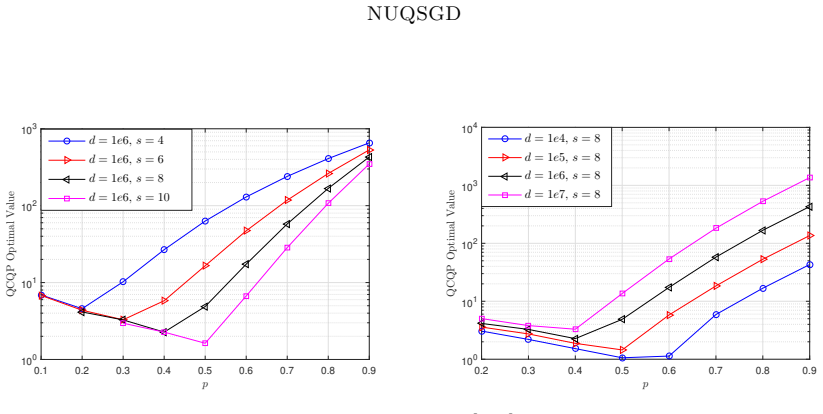
- [Appendix D] The expression for epsilon_Q in the overparameterized case is unclear as printed ('2−s√d− 22s +O(s)'); it should be typeset consistently with Theorem 4, e.g., 2^{-s}\sqrt{d-2^{2s}} + O(s) if that is the intended bound.
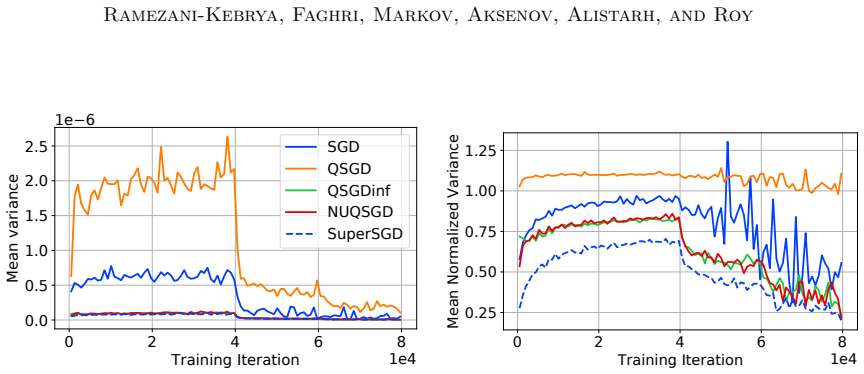
- [Section 5] The bucket size is reported as 8192 for the variance/accuracy experiments and 512 for the end-to-end speedup experiments; clarify whether different settings were used and whether the theoretical claims are sensitive to bucket size.
Circularity Check
No significant circularity: the variance, code-length, and convergence bounds are derived from first-principles arguments and standard external results, with no fitted constants or self-referential reductions.
full rationale
The paper's claimed derivation chain is self-contained. Theorem 4 derives the variance bound from Definition 3 via explicit bin-counting arguments, Hölder's inequality, Jensen's inequality, and an analytic optimization over an auxiliary scalar p; no empirical data, fitted constants, or target-dependent assumptions enter. Theorem 5 derives the code-length bound from the Elias recursive coding properties and a separate nonzero-coordinate count (Lemma 17); again the proof is analytic. The convergence guarantees in Theorems 6, 8, 11, 12, and 13 simply insert the proven variance bound into standard SGD convergence results (Bubeck 2015; Ghadimi and Lan 2013; Yan et al. 2018), which are external parameter-free facts and do not presuppose NUQSGD's conclusions. The empirical section validates the theory after the fact rather than calibrating it: comparisons with QSGD, QSGDinf, DGC, SignSGD, TernGrad, and ATOMO are against independent baselines and are not used to set any theoretical parameter. The paper explicitly acknowledges limitations that are relevant to correctness and novelty but not to circularity: the implementation 'diverges slightly from the theoretical analysis' (Section 5, tensor fusion and full-precision biases), the coded variant uses Huffman coding rather than the analyzed Elias coding, and the footnote discloses earlier independent work by Horváth et al. on exponentially spaced levels. These caveats create a possible gap between the analyzed algorithm and the benchmarked implementation, but they do not reduce a prediction to its own input. Citations to Alistarh et al. (2017) are load-bearing only as standard coding lemmas and convergence corollaries with independently stated assumptions; they do not constitute a self-citation chain that forces the result. Accordingly, the circularity score is 0.
Assumptions & free parameters
assumptions (5)
- domain assumption The objective f is beta-smooth and stochastic gradients are unbiased with a second-moment bound B.
- domain assumption For momentum results, gradients are uniformly bounded: ||grad f(w)|| <= V.
- standard math Prior convergence theorems from Bubeck, Ghadimi and Lan, Yan et al., Lian et al., and Tang et al. are valid.
- domain assumption The quantizer is unbiased conditional on the stochastic gradient, so the cross term in the variance decomposition vanishes.
- domain assumption In the decentralized setting, the mixing matrix W is symmetric doubly stochastic with second-largest eigenvalue rho < 1.
Cite this review
Pith. "Pith review of NUQSGD: Provably Communication-efficient Data-parallel SGD via Nonuniform Quantization." pith.science (2026). https://pith.science/paper/OSYJYY2Z
@misc{pith2026190806077,
  author       = {Pith},
  title        = {Pith review of: NUQSGD: Provably Communication-efficient Data-parallel SGD via Nonuniform Quantization},
  year         = {2026},
  howpublished = {\url{https://pith.science/paper/OSYJYY2Z}},
  note         = {Machine review of arXiv:1908.06077}
}
read the original abstract
As the size and complexity of models and datasets grow, so does the need for communication-efficient variants of stochastic gradient descent that can be deployed to perform parallel model training. One popular communication-compression method for data-parallel SGD is QSGD (Alistarh et al., 2017), which quantizes and encodes gradients to reduce communication costs. The baseline variant of QSGD provides strong theoretical guarantees, however, for practical purposes, the authors proposed a heuristic variant which we call QSGDinf, which demonstrated impressive empirical gains for distributed training of large neural networks. In this paper, we build on this work to propose a new gradient quantization scheme, and show that it has both stronger theoretical guarantees than QSGD, and matches and exceeds the empirical performance of the QSGDinf heuristic and of other compression methods.
Figures


Figures from the paper (18 more)




Forward citations
Cited by 1 Pith paper
-
RATQ: A Universal Fixed-Length Quantizer for Stochastic Optimization
RATQ is a fixed-length quantizer based on random Hadamard rotation and adaptive uniform quantization that nearly attains the information-theoretic lower bound on gradient precision for convex stochastic optimization.
Reference graph
Works this paper leans on
- [1]
-
[2]
D. Alistarh, D. Grubic, J. Z. Li, R. Tomioka, and M. Vojnovic. QSGD : Communication-efficient SGD via gradient quantization and encoding. In Proc. Advances in Neural Information Processing Systems (NIPS), 2017
work page 2017
-
[3]
R. Bekkerman, M. Bilenko, and J. Langford. Scaling up machine learning: Parallel and distributed approaches. Cambridge University Press, 2011
work page 2011
-
[4]
J. Bernstein, Y.-X. Wang, K. Azizzadenesheli, and A. Anandkumar. sign SGD : Compressed optimisation for non-convex problems. In Proc. International Conference on Machine Learning (ICML), 2018
work page 2018
-
[5]
S. Boyd and L. Vandenberghe. Convex Optimization. Cambridge Univ. Press, 2004
work page 2004
-
[6]
S. Bubeck. Convex optimization: Algorithms and complexity. Foundations and Trends in Machine Learning , 8(3-4): 0 231--358, 2015
work page 2015
-
[7]
K. W. Cattermole. Principles of pulse code modulation. Iliffe, 1969
work page 1969
-
[8]
T. Chilimbi, Y. Suzue J. Apacible, and K. Kalyanaraman. Project adam: Building an efficient and scalable deep learning training system. In Proc. USENIX Symposium on Operating Systems Design and Implementation (OSDI), 2014
work page 2014
Show all 49 references
-
[9]
Coates, B
A. Coates, B. Huval, T. Wang, D. Wu, B. Catanzaro, and A. Ng. Deep learning with cots hpc systems. In Proc. International Conference on Machine Learning (ICML), 2013
2013
-
[10]
J. Dean, G. Corrado, R. Monga K. Chen, M. Devin, M. Mao, M. Ranzato, A. Senior, P. Tucker, K. Yang, Q. V. Le, and A. Y. Ng. Large scale distributed deep networks. In Proc. Advances in Neural Information Processing Systems (NIPS), 2012
2012
-
[11]
J. Deng, W. Dong, R. Socher, L.-J. Li, K. Li, and L. Fei-Fei. ImageNet : A large-scale hierarchical image database. In Proc. IEEE Conference on Computer Vision and Pattern Recognition (CVPR), 2009
2009
-
[12]
J. C. Duchi, S. Chaturapruek, and C. R\' e . Asynchronous stochastic convex optimization. In Proc. Advances in Neural Information Processing Systems (NIPS), 2015
2015
-
[13]
P. Elias. Universal codeword sets and representations of the integers. IEEE Transactions on Information Theory , 21(2): 0 194--203, 1975
1975
-
[14]
Ghadimi and G
S. Ghadimi and G. Lan. Stochastic first- and zeroth-order methods for nonconvex stochastic programming. SIAM Journal on Optimization , 23(4): 0 2341--2368, 2013
2013
-
[15]
Gupta, A
S. Gupta, A. Agrawal, K. Gopalakrishnan, and P. Narayanan. Deep learning with limited numerical precision. In Proc. International Conference on Machine Learning (ICML), 2015
2015
-
[16]
Deep speech: Scaling up end-to-end speech recognition
Awni Hannun, Carl Case, Jared Casper, Bryan Catanzaro, Greg Diamos, Erich Elsen, Ryan Prenger, Sanjeev Satheesh, Shubho Sengupta, Adam Coates, et al. Deep speech: Scaling up end-to-end speech recognition. arXiv:1412.5567, 2014
2014 arXiv
-
[17]
K. He, X. Zhang, S. Ren, and J. Sun. Deep residual learning for image recognition. In Proc. IEEE Conference on Computer Vision and Pattern Recognition (CVPR), 2016
2016
-
[18]
Horv\' a th, C.-Y Ho, L
S. Horv\' a th, C.-Y Ho, L. Horv\' a th, A. N. Sahu, M. Canini, and P. Richt\' a rik. Natural compression for distributed deep learning. arXiv:1905.10988v1, 2019
1905 arXiv
-
[19]
Hou and J
L. Hou and J. T. Kwok. Loss-aware weight quantization of deep networks. In Proc. International Conference on Learning Representations (ICLR), 2018
2018
-
[20]
Hubara, M
I. Hubara, M. Courbariaux, D. Soudry, R. El-Yaniv, and Y. Bengio. Binarized neural networks. In Proc. Advances in Neural Information Processing Systems (NIPS), 2016
2016
-
[21]
S. P. Karimireddy, Q. Rebjock, S. Stich, and M. Jaggi. Error feedback fixes S ign SGD and other gradient compression schemes. In Proc. International Conference on Machine Learning (ICML), 2019
2019
-
[22]
Krizhevsky
A. Krizhevsky. Learning multiple layers of features from tiny images. 2009. Technical report, University of Toronto
2009
-
[23]
E. H. Lee, D. Miyashita, E. Chai, B. Murmann, and S. S. Wong. LogNet : Energy-efficient neural networks using logarithmic computation. In Proc. IEEE International Conference on Acoustics, Speech and Signal Processing (ICASSP), 2017
2017
-
[24]
M. Li, D. G. Andersen, J. W. Park, A. J. Smola, A. Ahmed, V. Josifovski, J. Long, E. J. Shekita, and B.-Y. Su. Scaling distributed machine learning with the parameter server. In Proc. USENIX Symposium on Operating Systems Design and Implementation (OSDI), 2014
2014
-
[25]
Li and C
Z. Li and C. M. De Sa. Dimension-free bounds for low-precision training. In Proc. Advances in Neural Information Processing Systems (NeurIPS), 2019
2019
-
[26]
X. Lian, Y. Huang, Y. Li, and J. Liu. Asynchronous parallel stochastic gradient for nonconvex optimization. In Proc. Advances in Neural Information Processing Systems (NIPS), 2015
2015
-
[27]
Y. Lin, S. Han, H. Mao, Y. Wang, and W. J. Dally. Deep gradient compression: Reducing the communication bandwidth for distributed training. In Proc. International Conference on Learning Representations (ICLR), 2018
2018
-
[28]
Miyashita, E
D. Miyashita, E. H. Lee, and B. Murmann. Convolutional neural networks using logarithmic data representation. arXiv:1603.01025v2, 2016
2016 arXiv
-
[29]
Nesterov
Y. Nesterov. A method of solving a convex programming problem with convergence O(1/k^2) . Soviet Mathematics Doklady, 27(2): 0 372--376, 1983
1983
-
[30]
J. Park, S. Li, W. Wen, P. Tang, H. Li, Y. Chen, and P. Dubey. Faster CNN s with direct sparse convolutions and guided pruning. In Proc. International Conference on Learning Representations (ICLR), 2017
2017
-
[31]
B. T. Polyak. Some methods of speeding up the convergence of iteration methods. USSR Computational Mathematics and Mathematical Physics , 4(5): 0 1--17, 1964
1964
-
[32]
Recht, C
B. Recht, C. R\' e , S. Wright, and F. Niu. Hogwild: A lock-free approach to parallelizing stochastic gradient descent. In Proc. Advances in Neural Information Processing Systems (NIPS), 2011
2011
-
[33]
C. M. D. Sa, Ce. Zhang, K. Olukotun, and C. R\' e . Taming the wild: A unified analysis of hogwild-style algorithms. In Proc. Advances in Neural Information Processing Systems (NIPS), 2015
2015
-
[34]
Seide, H
F. Seide, H. Fu, J. Droppo, G. Li, and D. Yu. 1-bit stochastic gradient descent and its application to data-parallel distributed training of speech DNN s. In Proc. INTERSPEECH, 2014
2014
-
[35]
Horovod: fast and easy distributed deep learning in TensorFlow
Alexander Sergeev and Mike Del Balso. Horovod: fast and easy distributed deep learning in TensorFlow . arXiv:1802.05799, 2018
2018 arXiv
-
[36]
N. Strom. Scalable distributed DNN training using commodity GPU cloud computing. In Proc. INTERSPEECH, 2015
2015
-
[37]
H. Tang, S. Gan, C. Zhang, T. Zhang, and J. Liu. Communication compression for decentralized training. In Proc. Advances in Neural Information Processing Systems (NIPS), 2018
2018
-
[38]
H. Wang, S. Sievert, Z. Charles, S. Liu, S. Wright, and D. Papailiopoulos. ATOMO : Communication-efficient learning via atomic sparsification. In Proc. Advances in Neural Information Processing Systems (NIPS), 2018
2018
-
[39]
W. Wen, C. Wu, Y. Wang, Y. Chen, and H. Li. Learning structured sparsity in deep neural networks. In Proc. Advances in Neural Information Processing Systems (NIPS), 2016
2016
-
[40]
W. Wen, C. Xu, F. Yan, C. Wu, Y. Wang, Y. Chen, and H. Li. TernGrad : Ternary gradients to reduce communication in distributed deep learning. In Proc. Advances in Neural Information Processing Systems (NIPS), 2017
2017
-
[41]
E. P. Xing, Q. Ho, W. Dai, J. K. Kim, J. Wei, S. Lee, X. Zheng, P. Xie, A. Kumar, and Y. Y. Petuum. Petuum: A new platform for distributed machine learning on big data. IEEE transactions on Big Data , 1(2): 0 49--67, 2015
2015
-
[42]
Y Yan, T. Yang, Q. Lin, Z. Li, and Y Yang. A unified analysis of stochastic momentum methods for deep learning. In Proc. International Joint Conference on Artificial Intelligence (IJCAI), 2018
2018
-
[43]
Zhang, J
H. Zhang, J. Li, K. Kara, D. Alistarh, J. Liu, and C. Zhang. ZipML : Training linear models with end-to-end low precision, and a little bit of deep learning. In Proc. International Conference on Machine Learning (ICML), 2017
2017
-
[44]
Zhang, A
S. Zhang, A. E. Choromanska, and Y. LeCun. Deep learning with elastic averaging SGD . In Proc. Advances in Neural Information Processing Systems (NIPS), 2015
2015
-
[45]
S. Zhou, Y. Wu, Z. Ni, X. Zhou, H. Wen, and Y. Zou. Dorefa-net: Training low bitwidth convolutional neural networks with low bitwidth gradients. arXiv:1606.06160, 2018
2018 arXiv
-
[46]
Zinkevich, M
M. Zinkevich, M. Weimer, L. Li, and A. J. Smola. Parallelized stochastic gradient descent. In Proc. Advances in Neural Information Processing Systems (NIPS), 2010
2010
-
[47]
@esa (Ref
\@ifxundefined[1] #1\@undefined \@firstoftwo \@secondoftwo \@ifnum[1] #1 \@firstoftwo \@secondoftwo \@ifx[1] #1 \@firstoftwo \@secondoftwo [2] @ #1 \@temptokena #2 #1 @ \@temptokena \@ifclassloaded agu2001 natbib The agu2001 class already includes natbib coding, so you should ...
-
[48]
\@lbibitem[] @bibitem@first@sw\@secondoftwo \@lbibitem[#1]#2 \@extra@b@citeb \@ifundefined br@#2\@extra@b@citeb \@namedef br@#2 \@nameuse br@#2\@extra@b@citeb \@ifundefined b@#2\@extra@b@citeb @num @parse #2 @tmp #1 NAT@b@open@#2 NAT@b@shut@#2 \@ifnum @merge>\@ne @bibitem@firs...
-
[49]
@open @close @open @close and [1] URL: #1 \@ifundefined chapter * \@mkboth \@ifxundefined @sectionbib * \@mkboth * \@mkboth\@gobbletwo \@ifclassloaded amsart * \@ifclassloaded amsbook * \@ifxundefined @heading @heading NAT@ctr thebibliography [1] @ \@biblabel @NAT@ctr \@bibset...
Reviewed August 14, 2026 · model on record in the stance chip above.
Discussion (0). Continue with ORCID to comment.