REVIEW 4 major objections 5 minor 33 references
Network Time Synchronization of the Readout Electronics for a New Radioactive Gas Detection System
T0 review · 4 major / 5 minor · reviewed 2026-08-14 · deepseek-v4-flash
Pith's one-line read Network time synchronization over ordinary Ethernet can replace dedicated clock cables in multi-module radiation detector readouts without losing true coincidence events.
desk verdict Solid engineering demonstration that PTP over commodity Ethernet can replace shared-clock cabling for compact DAQ, with a switch-dependent caveat that needs more testing. read the letter →
The pith
A machine-rendered reading of the paper's core claim, the machinery that carries it, and where it could break.
The reading
What carries the argument
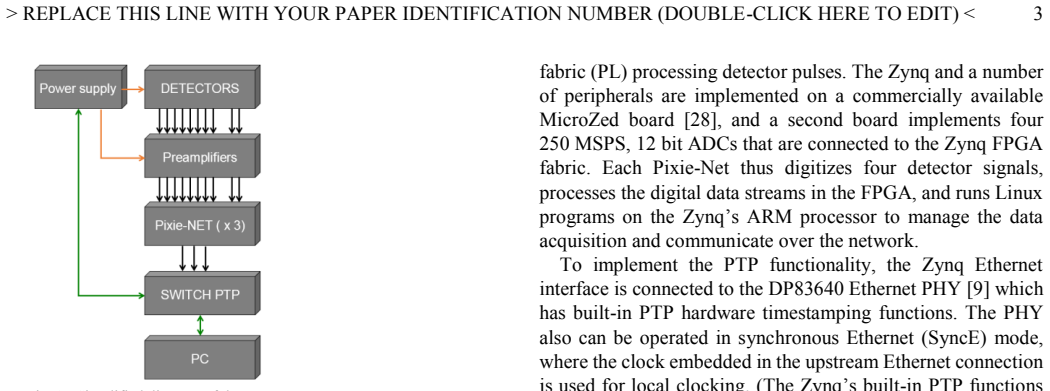
The load-bearing mechanism is an Ethernet PHY that adds hardware timestamping of PTP packets and can output a locally generated but system-wide synchronized clock. That clock directly drives the ADCs and the FPGA pulse-processing logic, so event time stamps and digitized waveforms live in the same synchronized time base. An open-source PTP stack computes network delays and adjusts the local clock frequency, and synchronous Ethernet mode derives the local clock from the upstream link. What makes or breaks the application is the stability of the switch's internal delay: one non-PTP switch kept a small, nearly constant offset, while another showed a large and fluctuating offset. The detector-specific measurement method, constant-fraction timing on captured waveforms, provides the reference for judging these offsets.
What would settle it
Run the same 22Na coincidence measurement for an extended period (for example 24 hours) in the final three-module configuration while streaming data through the same non-PTP switch under realistic network load; if the time-difference FWHM grows beyond roughly 320 ns, or the 511 keV region-of-interest count deviates from the shared-clock control by more than about 5%, the sufficiency claim would be disproved.
Extended reading notes
Core claim
The central claim is that IEEE 1588 PTP, with hardware timestamping integrated into the data-acquisition clock path, is sufficient for reconstructing multi-detector coincidence events even when the network passes through a switch that does not support PTP. Timing precision of the synchronization, measured by the FWHM of the time-difference distribution between two modules, was about 6-10 ns on all-PTP networks, about 190-1000 ps with synchronous Ethernet and a pulser, and about 250 ns with one non-PTP switch. Using that switch for 22Na coincidence measurements with NaI(Tl) detectors, the total count in the 511 keV coincidence region of interest differed from the shared-clock setup by 3.3%, while a different non-PTP switch with a large, unstable offset lost most true coincidences and added fortuitous ones. The result is presented as validating network time synchronization as a replacement for shared clocks in this compact detector system, with the caveat that switch characteristics dominate performance and must be selected and tested.
Load-bearing premise
The central result depends on the tested non-PTP switch keeping its small, nearly constant time offset under real operating conditions; if that stability does not hold in the final three-module system, under extended operation, or under real network load, the claim that PTP over a non-PTP network is sufficient would no longer stand.
Editorial extensions
If this is right
- Dedicated clock and trigger distribution cabling can be omitted from multi-module detector systems whenever the coincidence window is several hundred nanoseconds or wider.
- A detector system's network infrastructure can be chosen to match its timing needs: cheap non-PTP switches for coarse coincidence windows, PTP switches for about 10 ns resolution, and synchronous Ethernet for sub-nanosecond resolution.
- PTP gives synchronized acquisition start at an absolute date and time with no extra cabling, whereas synchronous Ethernet synchronizes frequency only and still needs a start/stop signal.
- With timestamped data buffered locally, centralized software-trigger decisions can be made over the network with round-trip times near 250 µs, enabling quasi-real-time global event selection without hard-wired trigger logic.
Reading between the lines
- A practical qualification rule for any candidate switch is to measure its time-offset drift over hours before trusting it; the deciding property here was offset stability, not the switch's PTP label.
- Because the timing characterization used two modules and the detector system uses three, scaling to more synchronized modules could make switch-latency asymmetries accumulate; a multi-node timing test would show whether the 254 ns figure is preserved as the system grows.
- The paper notes the silicon pixel detectors were still being manufactured when the coincidence tests were done, so the full electron/X-ray coincidence mode remains untested; the same synchronization should hold, but the optimal coincidence window and region-of-interest structure may shift once those detectors are installed.
- The sub-nanosecond results with synchronous Ethernet suggest that network synchronization could reach into time-of-flight territory if dedicated low-jitter synchronization hardware is used, since the practical limit here was the detector response, not the network.
Signed reviews
Editorial analysis
A structured set of objections, weighed in public.
Referee Report
Summary. The paper reports an implementation of IEEE 1588 precision time protocol (PTP) and synchronous Ethernet (SyncE) on XIA Pixie-Net readout modules, with the goal of replacing dedicated clock and trigger cabling in a prototype radioxenon detection system at CEA. The authors characterize timing resolution for various network switches and synchronization methods using LaBr3 detectors and a pulse generator, and then perform 22Na coincidence measurements with two NaI(Tl) detectors. They report that PTP through a non-PTP Dell PowerConnect 2216 switch achieves 254 ns FWHM time accuracy and that the 511 keV coincidence ROI count differs by only 3.3% from a shared-clock control, leading to the conclusion that PTP synchronization is sufficient to reconstruct true coincidences without loss or added fortuitous coincidences. They also compare against a Geant4 simulation and report good agreement.
Significance. If the central engineering claim holds, the paper provides a useful practical result: for detector systems requiring a few hundred nanoseconds of synchronization, network-based PTP with an appropriately selected non-PTP switch can replace a dedicated clock distribution tree, reducing cabling and power consumption. The main strengths are the direct comparison against a shared-clock baseline, the use of an independent Geant4 simulation as a control, and the systematic survey of multiple switches and synchronization methods. The significance is moderate, however, because the headline conclusion rests on the empirical stability of a single switch model and on a two-module, NaI(Tl)-only test, so the generality of the claim is not yet established.
major comments (4)
- [Section III.B and Conclusions] The central claim that PTP through a non-PTP switch allows reliable coincidence reconstruction 'without any loss, nor by adding fortuitous coincidences' is supported only by a single two-hour measurement with two Pixie-Net modules and two NaI(Tl) detectors using the Dell PowerConnect 2216 switch (Fig. 13, Table II). The same protocol through a NetGear GS108 switch loses more than 89% of true coincidences and adds fortuitous ones, so the reported behavior is an empirical property of one switch, not a property of PTP. The final CEA system will use three modules, silicon detectors, and sustained list-mode streaming, none of which is exercised in this test. Please either add a load-stress stability test in the final topology, or explicitly limit the validation claim to the tested configuration and state the qualification tests planned before deployment.
- [Section III.B and Section II.C] The text states that the shared-clock reference time resolution is ~20 ps, 'measured by the time stamp differences of every coincident pulse pair,' but Section II.C states that time stamps have 8 ns precision and Table II lists 129 ns for the shared-clock NaI(Tl) configuration. These statements are mutually inconsistent. If the 20 ps value was obtained from a constant-fraction waveform analysis rather than from time stamps, that must be stated explicitly; as written, the reference resolution is not reproducible.
- [Table II and Section III.B] The reported 3.3% difference between the Dell PTP ROI count (35,440) and the shared-clock ROI count (36,640) is quoted without uncertainty. From Poisson counting statistics alone, the difference of about 1,200 counts is roughly 4.5 sigma, so it is not statistical evidence of 'no loss.' Please report statistical and systematic uncertainties, and quantify the expected survival of true coincidences within the optimized 320 ns window given the measured 254 ns FWHM time distribution.
- [Fig. 13 and Fig. 14] The 320 ns coincidence window was optimized post hoc for the Dell switch data, and the same data are then used to assess whether coincidences were lost or added. This creates a circularity in the claim of 'no fortuitous coincidences.' Reporting the ROI count as a function of window width (Fig. 14) is helpful, but the plateau should be quantified with uncertainties and, ideally, an independent background or random-coincidence estimate should be used to show that the chosen window lies in a stable region rather than in a locally favorable fluctuation.
minor comments (5)
- [Abstract and Section III.A] The abstract states timing precisions 'between 300 ns and 200 ps,' while Section III.A reports ~250 ns for the best non-PTP switch; please make the numbers consistent or define whether 300 ns refers to a different measurement.
- [Section III.A] The sentence 'All-PTP networks have better time resolution that non-PTP networks' contains a typo: 'that' should be 'than.'
- [Section III.B] The terms 'time resolution,' 'time accuracy,' and 'timing precision' are used interchangeably; a short definition of each would avoid ambiguity, especially in Table II where the first row is labeled 'Time resolution (ns).'
- [References] The switch identifiers [A] through [I] are defined only after the numbered reference list and are not integrated into the main reference list; consider citing them where they first appear in Section II.C or moving the definitions into the text.
- [Figures 8-10] The timing resolution values in Figs. 8-10 are presented as single points without error bars or a statement about the number of repetitions; adding this information would improve confidence in the comparisons across switches.
Circularity Check
No circularity: the PTP/SyncE timing result is an empirical measurement benchmarked against independent shared-clock and Geant4 references.
full rationale
The paper's central claim—that PTP synchronization through a suitable non-PTP switch is sufficient for coincidence reconstruction—rests on direct measurements of ΔT distributions and ROI counts, not on a parameter fitted and then re-labeled as a prediction. The Dell PowerConnect 2216 result (254 ns FWHM, ROI count within 3.3% of the shared-clock control) is an experimental comparison: the 0.32 µs window was chosen after inspecting the measured ΔT spread, but the ROI count is still an independent observable that could have disagreed with the shared-clock and Geant4 references, and it did not. No equation defines the claimed conclusion in terms of its inputs, and no load-bearing premise is supplied solely by the authors' self-citations; the cited prior work ([6], [8], [12]) documents hardware and timing methods rather than the network-synchronization conclusion. The acknowledged need to select and test a suitable switch is an empirical limitation, not a circular step.
Assumptions & free parameters
assumptions (4)
- domain assumption IEEE 1588 PTP and synchronous Ethernet operate as specified by the standards, and the DP83640 PHY implements them correctly.
- domain assumption The selected network switch has a sufficiently stable internal latency over time.
- domain assumption The Geant4 simulation provides an adequate control spectrum for comparing coincidence counts.
- domain assumption The intended coincidence window of 0.5 to 1.0 microseconds matches the actual detector charge collection and timing needs.
Cite this review
Pith. "Pith review of Network Time Synchronization of the Readout Electronics for a New Radioactive Gas Detection System." pith.science (2026). https://pith.science/paper/OTAFSTF6
@misc{pith2026190808009,
  author       = {Pith},
  title        = {Pith review of: Network Time Synchronization of the Readout Electronics for a New Radioactive Gas Detection System},
  year         = {2026},
  howpublished = {\url{https://pith.science/paper/OTAFSTF6}},
  note         = {Machine review of arXiv:1908.08009}
}
read the original abstract
In systems with multiple radiation detectors, time synchronization of the data collected from different detectors is essential to reconstruct multi-detector events such as scattering and coincidences. In cases where the number of detectors exceeds the readout channels in a single data acquisition electronics module, multiple modules have to be synchronized, which is traditionally accomplished by distributing clocks and triggers via dedicated connections. To eliminate this added cabling complexity in the case of a new radioactive gas detection system prototype under development at the French Atomic Energy Commission, we implemented time synchronization between multiple XIA Pixie-Net detector readout modules through the existing Ethernet network, based on the IEEE 1588 precision time protocol. The detector system is dedicated to the measurement of radioactive gases at low activity and consists of eight large silicon pixels and two NaI(Tl) detectors, instrumented with a total of three 4-channel Pixie-Net modules. Detecting NaI(Tl)/silicon coincidences will make it possible to identify each radioisotope present in the sample. To allow these identifications at low activities, the Pixie-Net modules must be synchronized to a precision well below the targeted coincidence window of 500-1000 ns. Being equipped with an Ethernet PHY compatible with IEEE 1588 and synchronous Ethernet that outputs a locally generated but system-wide synchronized clock, the Pixie-Net can operate its analog to digital converters and digital processing circuitry with that clock and match time stamps for captured data across the three modules. Depending on the network configuration and synchronization method, the implementation is capable to achieve timing precisions between 300 ns and 200 ps.
Figures


Reference graph
Works this paper leans on
-
[1]
AGATA—Advanced GAmma Tracking Array
S. Akkoyun et al, “AGATA—Advanced GAmma Tracking Array”, NIM A 668 (2012), 26-58, doi.org/10.1016/j.nima.2011.11.081
-
[2]
Clock and Trigger Synchronization between Several Chassis of Digital Data Acquisition Modules
W. Hennig, H. Tan, M. Walby, P. Grudberg, A. Fallu -Labruyere, W. K. Warburton, C. Vaman, K. Starosta, D. Miller “Clock and Trigger Synchronization between Several Chassis of Digital Data Acquisition Modules”, NIM B 261 (2007) 1000–1004
work page 2007
-
[3]
Performance of a data acquisition system for a large germanium detector array
A. Kimura, M. Koizumi, Y. Toh, J. Goto and M. Oshima, "Performance of a data acquisition system for a large germanium detector array", International Conference on Nuclear Data for Science and Technology 2007, https://doi.org/10.1051/ndata:07400
-
[4]
Clock and timing distribution in the LHCb upgraded detector and readout system
F. Alessio, S. Baron, M. Barros Marin, J.P. Cachemiche, F. Hachon, R. Jacobsson and K. Wyllie, "Clock and timing distribution in the LHCb upgraded detector and readout system" Journal of Instrumentat ion, Volume 10, February 2015, https://doi.org/10.1088/1748-0221/10/02/C02033
-
[5]
Clock distribution for BaF2 readout electronics at CSNS - WNS
Bing He, Ping Cao, De-Liang Zhang, Qi Wang, Ya-Xi Zhang, Xin-Cheng Qi, Qi An, "Clock distribution for BaF2 readout electronics at CSNS - WNS", 2017 Chinese Phys. C 41 016104, https://doi.org/10.1088/1674- 1137/41/1/016104
doi:10.1088/1674- 2017
-
[6]
Development of 500 MHz Multi -Channel Readout Electronics for Fast Radiation Detectors
W. Hennig, S. Asztalos, D. Breus, K. Sabourov, W.K. Warburton, “Development of 500 MHz Multi -Channel Readout Electronics for Fast Radiation Detectors”, IEEE Trans. Nucl. Sci, Vol. 57, No. 4, August 2010, p. 2365-2370
work page 2010
-
[7]
Impact of digitization for timing and pulse shape analysis of scintillator detector signals
C. Hellesen, M. Skiba, G. Ericsson, E. Andersson Sundén, F. Binda, S. Conroy, J. Eriksson, M. Weiszflog, “Impact of digitization for timing and pulse shape analysis of scintillator detector signals”, NIM A 720 (2013), 135-140
work page 2013
-
[8]
New Algorithms For Improved Digital Pulse Arrival Timing With Sub-GSps ADCs
W. K. Warburton, W. Hennig, “New Algorithms For Improved Digital Pulse Arrival Timing With Sub-GSps ADCs”, IEEE Trans. Nucl. Sci Vol 64, No 12, Dec. 2017, p. 2938-2950; DOI: 10.1109/TNS.2017.2766074
arXiv 2017
Show all 33 references
-
[9]
https://standards.ieee.org/findstds/standard/1588-2008.html
2008
-
[10]
www.ti.com/product/DP83640/technicaldocuments
-
[11]
Zynq-7000 AP SoC - Precision Timing with IEEE1588 v2 Protocol
“Zynq-7000 AP SoC - Precision Timing with IEEE1588 v2 Protocol”, www.xilinx.com
-
[12]
www.xia.com/Pixie-Net.html
-
[13]
Bowyer, S.R
T.W. Bowyer, S.R. Biegalski, M. Cooper, P.W. Eslinger, D. Haas, J.C. Hayes, H.S. Miley, D.J. Strom, V. Woods, ”Elevated radioxenon detected remotely following the Fukushima nuclear accident”, Journal o f Environmental Radioactivity, Volume 102, Issue 7, 2011, Pages 681-687, ht...
2011 doi
-
[14]
Achim , S
P. Achim , S. Generoso, M. Morin, P. Gross, G. Le Petit, C. Moulin, “Characterization of Xe ‐133 global atmospheric background: Implications for the International Monitoring System of the > REPLACE THIS LINE WITH YOUR PAPER IDENTIFICATION NUMBER (DOUBLE -CLICK HERE TO EDIT) < ...
2016 doi
-
[15]
Generoso, P
S. Generoso, P. Achim, M. Morin, P. Gross, G. Le Petit, C. Moulin , “Seasonal variability of Xe ‐133 global atmospheric background: Characterization and implications for the international monitoring system of the Comprehensive Nuclear‐Test‐Ban Treaty”, Journal of Geophysical R...
2018 doi
-
[16]
https://www.nndc.bnl.gov/nudat2/decaysearchdirect.jsp?nuc=135XE&u nc=nds
-
[17]
Measurements of ambient ra dioxenon levels using the automated radioxenon sampler/analyzer (ARSA)
McIntyre, J.I., Abel, K.H., Bowyer, T.W., Hayes, J.C., Heimbigner, T.R., Panisko, M.E., Reeder, P.L., Thompson, R.C., 2001. "Measurements of ambient ra dioxenon levels using the automated radioxenon sampler/analyzer (ARSA)". J. Radioanal. Nucl. Chem. 248 (3), 629-635. http://d...
2001 doi
-
[18]
SAUNA a system for automatic sampling, processing, and analysis of radioactive xenon." NIM A 508 (3), 542 -553
Ringbom, A., Larson, T., Axelsson, A., Elmgren, K., Johansson, C., 2003. SAUNA a system for automatic sampling, processing, and analysis of radioactive xenon." NIM A 508 (3), 542 -553. http://dx.doi.org/10.1016/s0168-9002(03)01657-7
2003 doi
-
[19]
Development of a phoswich detector system for radioxenon monitoring
W. Hennig, W. K. Warburton, A. Fallu -Labruyere, K. Sabourov, M. W. Cooper, J. I. McIntyre, A. Gleyzer, M. Bean, E. P. Korpach, K. Ungar, W. Zhang, P. Mekarski, "Development of a phoswich detector system for radioxenon monitoring", J. Radioanal. Nucl. Chem (2009) 282: 681. htt...
2009 doi
-
[20]
A phoswich detector with Compton suppression capability for radioxenon measurements
Farsoni, A.T., Alemayehu, B., Alhawsawi, A., Becker, E.M., 2013. "A phoswich detector with Compton suppression capability for radioxenon measurements". IEEE Trans. Nucl. Sci. 60, 456-464
2013
-
[21]
Innov ative concept for a major breakthrough in atmospheric radioactive xenon detection for nuclear explosion monitoring
Le Petit,G., Cagniant,A., Morelle,M., Gross,P., Achim,P., Douysset,G., Taffary,T., Moulin, C., 2013 "Innov ative concept for a major breakthrough in atmospheric radioactive xenon detection for nuclear explosion monitoring", .J. Radioanal. Nucl. Chem. (2013) 298:1159 - 1169, ht...
2013 doi
-
[22]
S ilicon PIN diode based electron-gamma coincidence detector system for Noble Gases monitoring
K. Khrustalev, V. Yu Popov, Yu S. Popov, "S ilicon PIN diode based electron-gamma coincidence detector system for Noble Gases monitoring", Applied Radiation and Isotopes, Volume 126, 2017, Pages 237-239, https://doi.org/10.1016/j.apradiso.2017.02.010
2017 doi
-
[23]
A 24 -element Silicon PIN diode detector for high resolution radioxenon measurements using simultaneous X-ray and electron spectroscopy,
C. E. Cox, W. Hennig, A. C. Huber, W. K. Wa rburton, P. M. Grudberg, S. J. Asztalos, H. Tan, S. Biegalski , "A 24 -element Silicon PIN diode detector for high resolution radioxenon measurements using simultaneous X-ray and electron spectroscopy," 2013 IEEE Nuclear Science Symp...
2013
-
[24]
http://www.nucleide.org/DDEP_WG/DDEPdata.htm
-
[26]
Geant4—a simulation toolkit
S. Agostinelli et al., "Geant4—a simulation toolkit", "Nuclear Instruments and Methods in Physics Research Section A: Accelerators, Spectrometers, Detectors and Associated Equipment, Volume 503, 3, Pages 250 -303, 2003, https://doi.org/10.1016/S0168-9002(03)01368-8
2003 doi
-
[27]
Recent developments in Geant4
J. Allison et al., “Recent developments in Geant4”, Nuclear Instruments and Methods in Physics Research Section A: Accelerators, Spectrometers, Detectors and Associated Equipment, Volume 835, Pages 186-225, 2016, https://doi.org/10.1016/j.nima.2016.06.125
2016 doi
-
[28]
http://zedboard.org/product/microzed
-
[29]
http://xillybus.com/xillybus-lite
-
[30]
http://linuxptp.sourceforge.net
-
[31]
https://sourceforge.net/projects/net-tools/
-
[32]
https://www.ohwr.org/projects/white-rabbit
-
[33]
White Rabbit: a PTP application for robust sub-nanosecond synchronization,
M. Lipiński, T. Włostowski, J. Serrano and P. Alvarez, "White Rabbit: a PTP application for robust sub-nanosecond synchronization," 2011 IEEE International Symposium on Precision Clock Synchronization for Measurement, Control and Communication, Munich, 2011, pp. 25 -30. doi: 1...
2011
-
[34]
http://sevensols.com/index.php/products/wr-len/ [A] Dell PowerConnect 2216, non-PTP [B] back to back, PTP [C] Netgear ProSAFE GS108, non-PTP [D] Toplink TK 1005G, non-PTP [E] Linksys EZXS55W , non-PTP [F] Moxa EDS-405A-PTP, non-PTP (disabled) [G] Moxa EDS-405A-PTP, PTP [H] Ore...
Reviewed August 14, 2026 · model on record in the stance chip above.
Discussion (0). Continue with ORCID to comment.