The Right Measure for Physics-Constrained Generation: A Co-Area Correction for Posterior-Consistent PDE Inverse Problems
Pith reviewed 2026-06-28 07:07 UTC · model grok-4.3
The pith
Conditioning generative models on hard PDE constraints samples the wrong posterior unless a co-area Jacobian factor is included.
A machine-rendered reading of the paper's core claim, the machinery that carries it, and where it could break.
Core claim
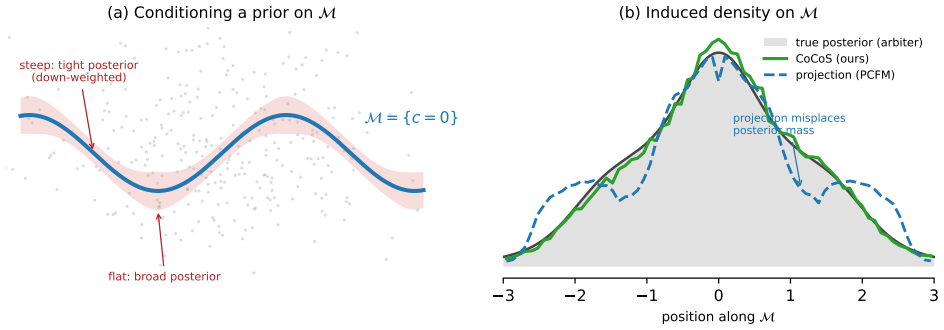
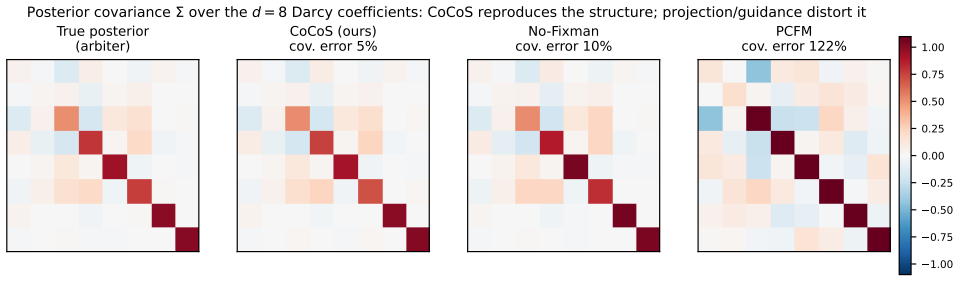
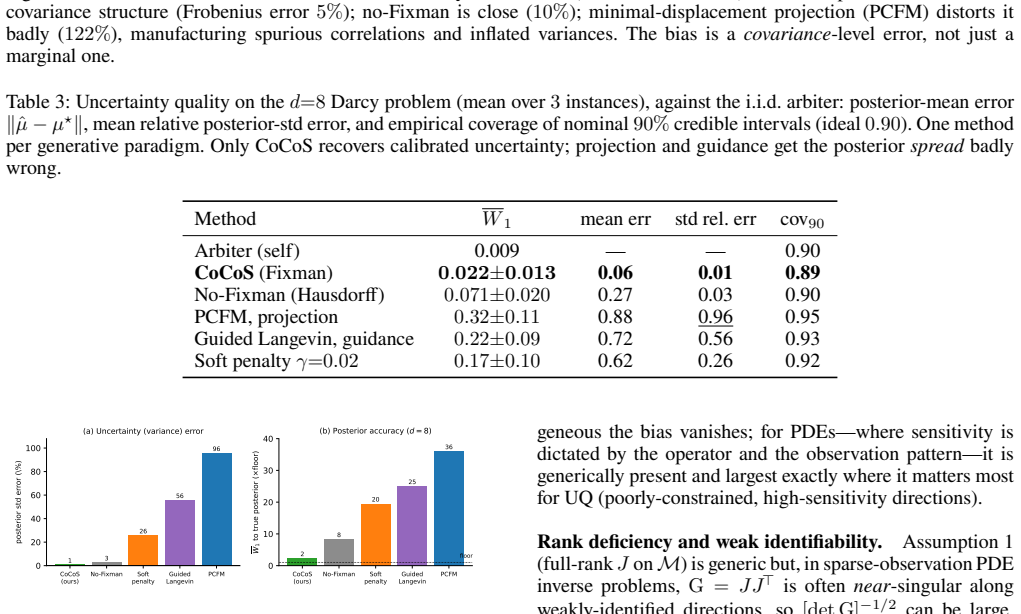
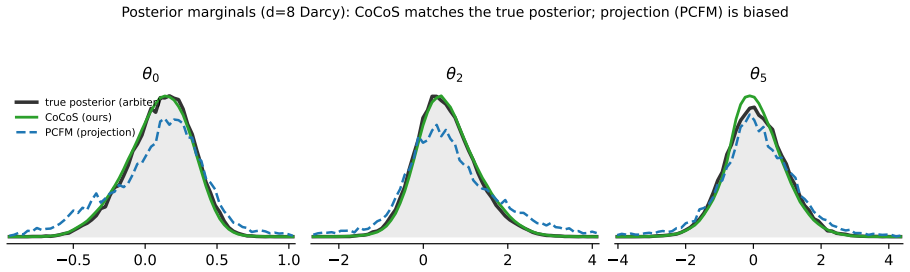
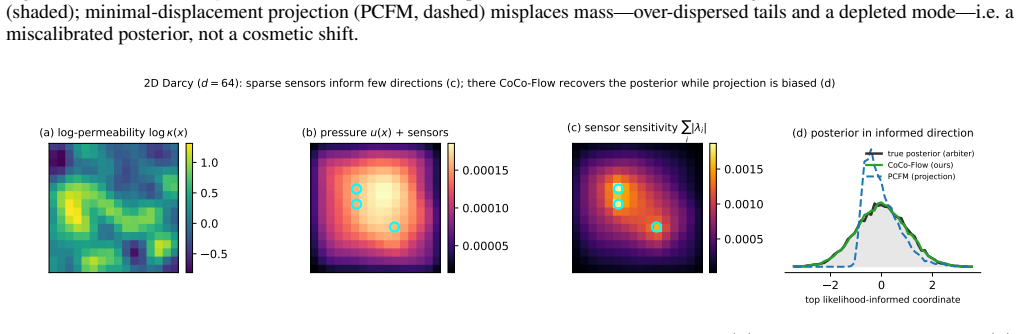
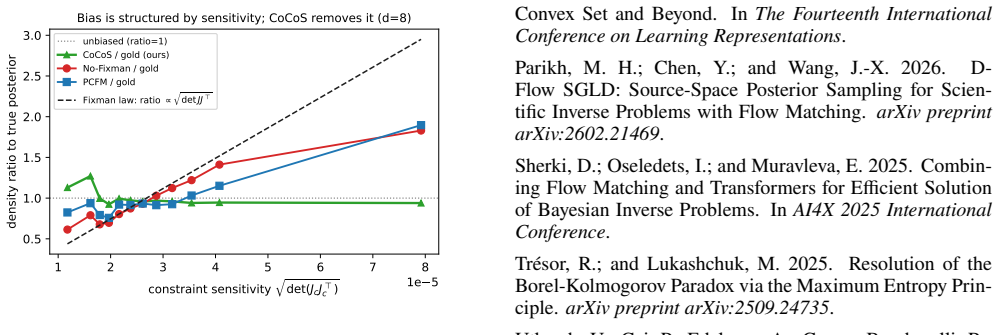
Conditioning a generative prior on a hard PDE constraint is conditioning on a measure-zero manifold whose physically correct resolution in the small-residual-noise limit carries the co-area Jacobian factor [det(JJ^T)]^{-1/2}; projection- and guidance-based methods omit this factor, inflating posterior error to 20 times the sampling-noise floor, while minimal-displacement projection is biased at 9 times the floor and naive reweighting does not correct it; CoCoS targets the co-area posterior and matches the gold-standard i.i.d. arbiter to within sampling noise.
What carries the argument
The co-area (Fixman) Jacobian factor [det(JJ^T)]^{-1/2} that resolves the Borel-Kolmogorov paradox when conditioning a generative prior on the PDE manifold.
If this is right
- Projection- and guidance-based methods omit the Jacobian factor and produce biased posteriors.
- The bias inflates posterior error to 20 times the sampling-noise floor.
- Minimal-displacement projection is biased at 9 times the sampling-noise floor.
- CoCoS targets the correct co-area posterior and matches the i.i.d. ground-truth arbiter within sampling noise.
Where Pith is reading between the lines
- The result implies that manifold geometry must be explicitly accounted for in uncertainty quantification for physics-constrained generative models.
- Similar Jacobian corrections may apply to other equality-constrained sampling problems in optimization and statistics.
- Estimating the Jacobian in high dimensions could limit practical adoption of the corrected sampler.
Load-bearing premise
The small-residual-noise limit is the appropriate physical resolution of the Borel-Kolmogorov paradox for PDE-constrained inverse problems, and the i.i.d. ground-truth arbiter correctly represents the target posterior.
What would settle it
On a controlled PDE problem, compare posterior samples from CoCoS, standard projection, and guidance against an independent i.i.d. ground-truth sampler and check whether only CoCoS stays within sampling noise while others reach 20 times that floor.
Figures
read the original abstract
Generative models -- diffusion and flow matching -- are increasingly used to solve partial differential equation (PDE) inverse problems, enforcing the governing physics as a \emph{hard constraint} (via projection or guidance) and reporting the resulting samples as a Bayesian posterior with calibrated uncertainty. We show that this widely adopted recipe samples the wrong distribution. Conditioning a generative prior on a hard PDE constraint is conditioning on a measure-zero manifold -- an operation that is intrinsically ambiguous (the Borel--Kolmogorov paradox) and whose physically correct resolution, the small-residual-noise limit, carries a co-area (Fixman) Jacobian factor $[det(JJ^{\top})]^{-1/2}$ that projection- and guidance-based methods silently omit. We make the bias precise, show that it grows with the heterogeneity of the constraint sensitivity, and validate it on controlled problems against an \emph{i.i.d.} ground-truth arbiter. The omitted factor is not a second-order detail: removing it inflates the posterior error to $20\times$ the sampling-noise floor; minimal-displacement projection (as in PCFM) is biased at $9\times$ the floor; and a naive scalar reweighting does not fix it. We introduce \textbf{CoCoS}, a measure-aware constrained sampler that targets the correct co-area posterior, and show that it matches the gold-standard posterior to within sampling noise. Our results imply that ``satisfying the physics'' is not the same as ``sampling the posterior,'' and give a principled correction for uncertainty-aware scientific inference.
Editorial analysis
A structured set of objections, weighed in public.
Referee Report
Summary. The manuscript claims that conditioning generative models on hard PDE constraints via projection or guidance samples from an incorrect posterior distribution due to the Borel-Kolmogorov paradox. The physically appropriate resolution in the small-residual-noise limit requires a co-area Jacobian factor [det(JJ^T)]^{-1/2} that is omitted by existing methods, leading to posterior error inflated by up to 20x the sampling-noise floor (and 9x for minimal-displacement projection). The paper validates this bias against an i.i.d. ground-truth arbiter on controlled problems and introduces the CoCoS sampler to target the corrected co-area posterior.
Significance. If the small-residual-noise limit is the appropriate physical resolution, the work identifies a fundamental and previously overlooked source of bias in physics-constrained generative sampling for PDE inverse problems, with direct implications for calibrated uncertainty in scientific inference. Strengths include the concrete error multiples reported from validation against an i.i.d. arbiter and the introduction of a measure-aware sampler (CoCoS) that matches the target posterior to within sampling noise. The result would be significant for the growing use of diffusion and flow-matching models in physics-constrained settings.
major comments (1)
- The choice of the small-residual-noise limit as the canonical resolution of the Borel-Kolmogorov paradox is load-bearing for the claim that the omitted co-area factor [det(JJ^T)]^{-1/2} produces 20x error inflation. The manuscript adopts this limit without deriving it from an underlying stochastic PDE model or measurement process, even though the paradox admits multiple resolutions depending on the limiting procedure (e.g., isotropic vs. anisotropic noise or different approximating sets). This justification gap must be addressed to establish that the Jacobian correction is required rather than one of several possible conditionings.
Simulated Author's Rebuttal
We thank the referee for the thoughtful comment on the justification of the small-residual-noise limit. We address the point directly below and will revise the manuscript to close the identified gap.
read point-by-point responses
-
Referee: The choice of the small-residual-noise limit as the canonical resolution of the Borel-Kolmogorov paradox is load-bearing for the claim that the omitted co-area factor [det(JJ^T)]^{-1/2} produces 20x error inflation. The manuscript adopts this limit without deriving it from an underlying stochastic PDE model or measurement process, even though the paradox admits multiple resolutions depending on the limiting procedure (e.g., isotropic vs. anisotropic noise or different approximating sets). This justification gap must be addressed to establish that the Jacobian correction is required rather than one of several possible conditionings.
Authors: We agree that an explicit derivation from a stochastic measurement model would strengthen the paper. In the revised manuscript we will add a new subsection (in Section 2) that begins from the noisy observation model y = f(u) + ε η with isotropic Gaussian noise η and takes the limit ε → 0. Application of the co-area formula to the joint density shows that the conditional density on the manifold {f(u)=y} acquires exactly the factor [det(J J^T)]^{-1/2}. We will also briefly discuss alternative limiting procedures (anisotropic noise, different approximating sets) and explain why the isotropic small-residual-noise limit is the physically appropriate canonical choice for hard-constraint PDE inverse problems, as it corresponds to unbiased, high-precision measurements without additional directional assumptions. This revision directly addresses the justification gap while preserving the claim that the omitted factor produces the reported error inflation. revision: yes
Circularity Check
No circularity; central derivation rests on external co-area formula and Borel-Kolmogorov resolution
full rationale
The paper's argument invokes the co-area formula [det(JJ^T)]^{-1/2} and the small-residual-noise limit as the physically correct resolution of the Borel-Kolmogorov paradox for measure-zero PDE manifolds. These are standard external mathematical facts, not quantities defined in terms of the paper's own outputs or fitted from its validation data. The i.i.d. ground-truth arbiter is independent, and no equation or claim reduces by construction to a self-citation, ansatz smuggled from prior work, or renamed empirical pattern. The derivation therefore remains self-contained against external benchmarks.
Axiom & Free-Parameter Ledger
axioms (1)
- domain assumption The small-residual-noise limit supplies the physically correct resolution of the Borel-Kolmogorov paradox for hard PDE constraints.
invented entities (1)
-
CoCoS sampler
no independent evidence
Forward citations
Cited by 1 Pith paper
-
Constraint residuals, graph posteriors, and determinant-corrected full-space targets in Bayesian inverse problems
Uncorrected Gaussian residual penalties in full-space sampling converge after marginalization to the graph-lifted reduced posterior multiplied by the inverse absolute determinant of the state Jacobian, requiring expli...
Reference graph
Works this paper leans on
-
[1]
arXiv preprint arXiv:2509.24735 , year=
Resolution of the Borel-Kolmogorov Paradox via the Maximum Entropy Principle , author=. arXiv preprint arXiv:2509.24735 , year=
-
[2]
arXiv preprint arXiv:2508.14807 , year=
Source-Guided Flow Matching , author=. arXiv preprint arXiv:2508.14807 , year=
-
[3]
The Fourteenth International Conference on Learning Representations , year=
Physics vs Distributions: Pareto Optimal Flow Matching with Physics Constraints , author=. The Fourteenth International Conference on Learning Representations , year=
-
[4]
International Conference on Learning Representations , volume=
Physics-informed diffusion models , author=. International Conference on Learning Representations , volume=
-
[5]
Inverse Problems , volume=
Likelihood-informed dimension reduction for nonlinear inverse problems , author=. Inverse Problems , volume=. 2014 , publisher=
2014
-
[6]
2014 , publisher=
Geometric measure theory , author=. 2014 , publisher=
2014
-
[7]
Proceedings of the National Academy of Sciences , volume=
Classical statistical mechanics of constraints: a theorem and application to polymers , author=. Proceedings of the National Academy of Sciences , volume=
-
[8]
Journal of Scientific Computing , volume=
ODE-DPS: ODE-based diffusion posterior sampling for linear inverse problems in partial differential equation , author=. Journal of Scientific Computing , volume=. 2025 , publisher=
2025
-
[9]
Proceedings of the IEEE/CVF International Conference on Computer Vision , pages=
Flowdps: Flow-driven posterior sampling for inverse problems , author=. Proceedings of the IEEE/CVF International Conference on Computer Vision , pages=
-
[10]
Mathematics of computation , volume=
Langevin dynamics with constraints and computation of free energy differences , author=. Mathematics of computation , volume=
-
[11]
The Fourteenth International Conference on Learning Representations , year=
Gauge Flow Matching: Efficient Constrained Generative Modeling over General Convex Set and Beyond , author=. The Fourteenth International Conference on Learning Representations , year=
-
[12]
arXiv preprint arXiv:2602.21469 , year=
D-Flow SGLD: Source-Space Posterior Sampling for Scientific Inverse Problems with Flow Matching , author=. arXiv preprint arXiv:2602.21469 , year=
-
[13]
AI4X 2025 International Conference , year=
Combining Flow Matching and Transformers for Efficient Solution of Bayesian Inverse Problems , author=. AI4X 2025 International Conference , year=
2025
-
[14]
Advances in Neural Information Processing Systems , volume=
Physics-constrained flow matching: Sampling generative models with hard constraints , author=. Advances in Neural Information Processing Systems , volume=
-
[15]
Journal of Computational Physics , volume=
B-PINNs: Bayesian physics-informed neural networks for forward and inverse PDE problems with noisy data , author=. Journal of Computational Physics , volume=. 2021 , publisher=
2021
-
[16]
Journal of Computational Physics , volume=
DGenNO: a novel physics-aware neural operator for solving forward and inverse PDE problems based on deep, generative probabilistic modeling , author=. Journal of Computational Physics , volume=. 2025 , publisher=
2025
-
[17]
Communications on Pure and Applied Mathematics , volume=
Monte Carlo on manifolds: sampling densities and integrating functions , author=. Communications on Pure and Applied Mathematics , volume=. 2018 , publisher=
2018
-
[18]
arXiv preprint arXiv:2510.09534 , year=
Conditional Flow Matching for Bayesian Posterior Inference , author=. arXiv preprint arXiv:2510.09534 , year=
discussion (0)
Sign in with ORCID, Apple, or X to comment. Anyone can read and Pith papers without signing in.