REVIEW 6 major objections 6 minor 40 references
Neural Architecture based on Fuzzy Perceptual Representation For Online Multilingual Handwriting Recognition
T0 review · 6 major / 6 minor · reviewed 2026-08-14 · deepseek-v4-flash
Pith's one-line read Decomposing online handwriting into nine fuzzy perceptual stroke codes lets LSTM recognizers exceed 98 percent accuracy on Arabic and Latin digits and words.
desk verdict Plausible pipeline, but the accuracy claims don't survive contact with the paper's own tables, and the fuzzy ground-truth protocol needs serious scrutiny before anyone bets on it. read the letter →
The pith
A machine-rendered reading of the paper's core claim, the machinery that carries it, and where it could break.
The reading
What carries the argument
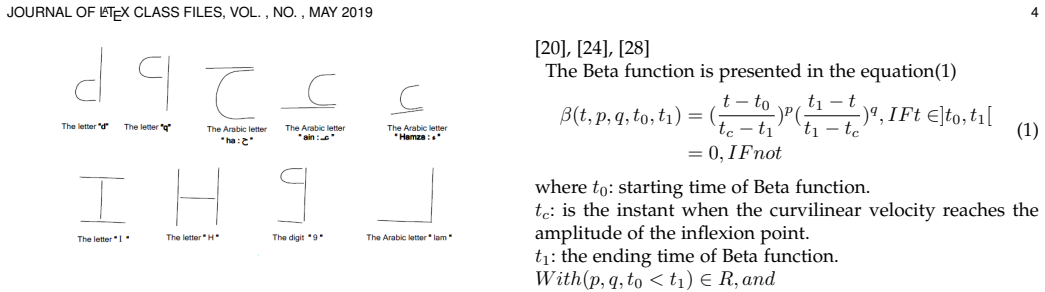
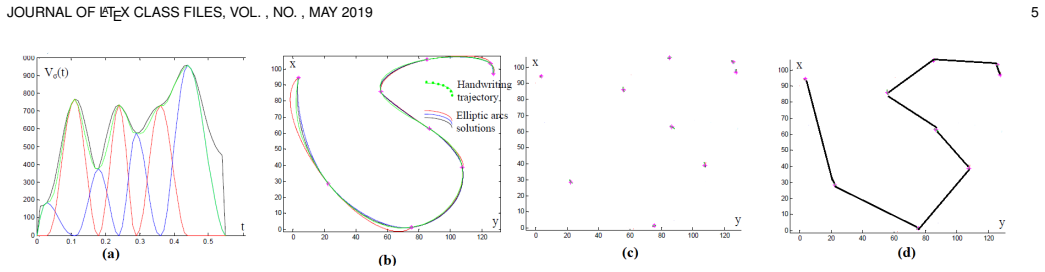
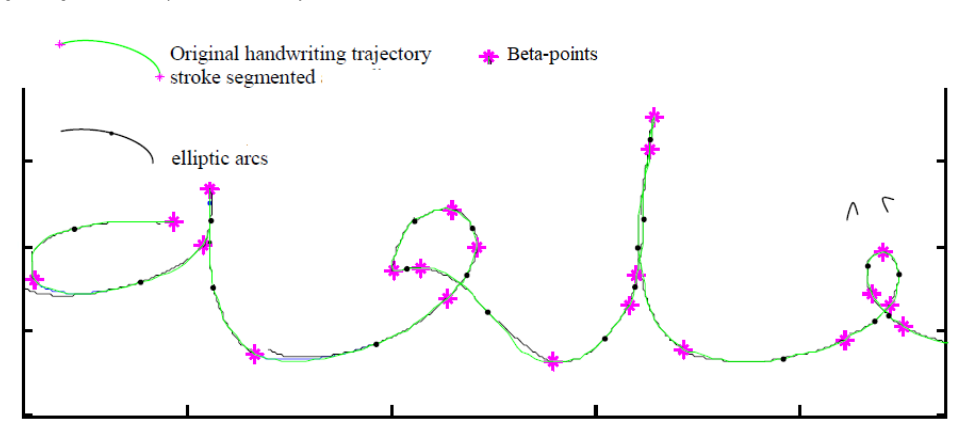
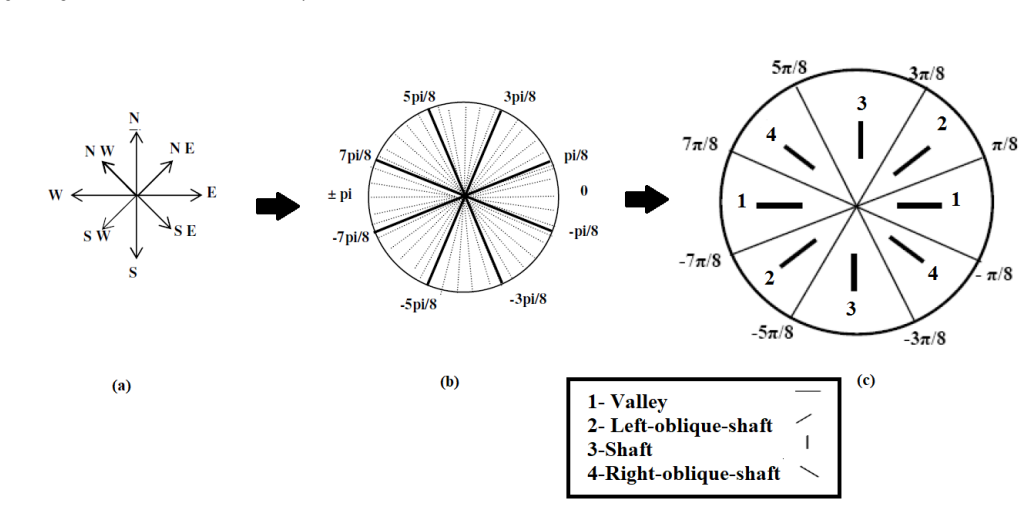
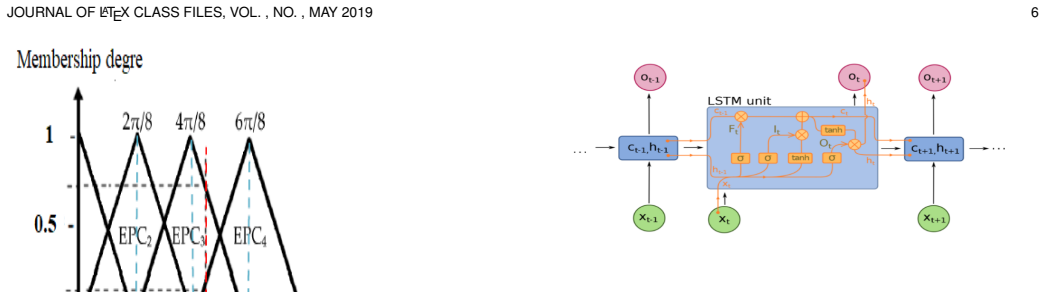
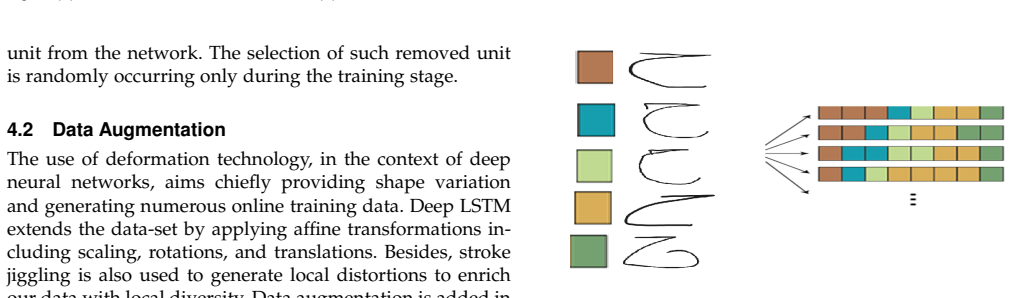
The load-bearing object is the nine-code perceptual alphabet—Valley, left-oblique shaft, shaft, right-oblique shaft, four half-occlusions, and Occlusion—which the paper asserts can form any script. The Beta-elliptic model turns the pen trace into elliptic strokes bounded by three beta-points, and each stroke receives fuzzy membership in one of four elementary perceptual code regions via a hand-set overlap constant. An LSTM maps the code sequence to a label, CTC removes timing alignment, and fuzzy ground truth replaces one-hot targets with membership values computed from Euclidean distances between stroke lengths.
What would settle it
A direct reproduction of the MAYASTROUN digit experiment where the perceptual-code front end is replaced by raw (x,y,z) coordinates, keeping the same LSTM and fuzzy training, settles whether the reported 98.5 percent is caused by the perceptual representation; if raw-input accuracy is not clearly lower, the central claim is falsified.
Extended reading notes
Core claim
The paper's central claim is that online handwriting is a concatenation of perceptual codes: with the Beta-elliptic model, any trace can be segmented into elliptic strokes, each stroke receives fuzzy membership over four elementary perceptual code regions, and sequences of these codes identify characters, digits, and words. On that representation, an LSTM with CTC labeling and fuzzy ground truth training reaches 98.5 percent on MAYASTROUN Arabic digits, 97.5 percent on the UNIPEN Latin set, and up to 98.4 percent on a mobile-acquired Arabic database. The companion system, OnHR-convLSTM, reads raw (x,y,z) signals through convolutional LSTM layers and reaches 98 percent on IRONOFF words. The authors therefore claim the perceptual front end is not required for high accuracy, but that it is the component that survives injected noise, dropping only to 96 percent where the raw-signal convLSTM falls to 50.45 percent.
Load-bearing premise
The load-bearing premise is that every Arabic or Latin online trace can be reliably cut into strokes that each belong to one of nine perceptual shapes, a coverage claim the paper states without proof or segmentation error analysis.
Editorial extensions
If this is right
- On Arabic digits from MAYASTROUN, OnHSR-LSTM with fuzzy ground truth reaches 98.5 percent, exceeding the circular-trajectory baseline and the smart-device recognizer reported for the same task.
- Fuzzy ground truth training improves accuracy over framewise training in every reported pairing: 91.5 to 97.5 percent on LMCA/ADAB letters, 90.5 to 97.5 percent on UNIPEN set 1(c), and 90 to 96 percent on ADAB.
- OnHR-convLSTM reaches 98 percent on IRONOFF words and 97 percent on ADAB words, making the raw-signal convolutional LSTM the stronger word-level pipeline in these experiments.
- Under injected noise, OnHSR-LSTM keeps 96 percent accuracy while OnHR-convLSTM on raw (x,y,z) drops to 50.45 percent, supporting the claim that Beta-elliptic preprocessing removes tremor and sampling noise before classification.
- The same nine-code perceptual alphabet is used for both Arabic and Latin scripts, so the system is claimed to be multilingual without changing the feature representation.
Reading between the lines
- A natural test the authors do not run is to apply the same nine-code pipeline to another cursive script such as Farsi or Urdu; if the alphabet is truly universal, accuracy should remain in the high 90s with no architectural change.
- Because fuzzy membership assigns each stroke to several codes with degrees, the method could flag low-confidence strokes for human review or active learning; the paper reports accuracies but does not analyze per-stroke ambiguity.
- The 50.45 percent collapse of the raw convLSTM under noise suggests the perceptual front end functions as an implicit denoiser; comparing it against standard tremor-removal filters on Parkinsonian handwriting would quantify how much of the gain is segmentation versus preprocessing.
Signed reviews
Editorial analysis
A structured set of objections, weighed in public.
Referee Report
Summary. The paper proposes two online handwriting recognition systems: OnHSR-LSTM, which segments a script into Beta-elliptic strokes, converts each stroke into fuzzy Elementary and Basic Perceptual Codes, and classifies the resulting code sequence with an LSTM and CTC; and OnHR-convLSTM, which applies a convolutional LSTM directly to raw (x,y,z) traces. Experiments are reported on MAYASTROUN, LMCA/ADAB, UNIPEN, IRONOFF, and an in-house mobile database, with rates up to 98.5%. The abstract claims that the recognition rate exceeds 98%, but this is contradicted by several rows in the paper's own tables. The best result for system 1 is obtained under a 'Fuzzy Ground Truth' training protocol whose target memberships are computed from the same stroke-length features that form the network input, which makes the reported gain over framewise training difficult to interpret.
Significance. If the reported results were valid, the paper would offer a distinctive integration of perceptual-code theory with deep sequence classifiers for multilingual online handwriting, with potential applications to Arabic and Latin scripts and to tremor/robustness analysis. The paper's strengths include the use of an established Beta-elliptic segmentation model, the use of CTC for sequence alignment, and the application of data augmentation and dropout. However, the central quantitative claim is not currently supported: the abstract's >98% statement does not match the tabulated rates, the evaluation protocol is severely underspecified, and the best system-1 result relies on a training-target construction that is a deterministic function of the input representation. The contribution as presented is therefore not established, despite the plausibility of the general approach.
major comments (6)
- [Abstract and Tables 4-9] The abstract's claim that 'the recognition rate exceeds 98%' is not supported by the paper's own numbers. Table 4 reports framewise rates of 91.5%, 94.5%, and 90.0% and Fuzzy Ground Truth rates of 97.5%, 98.5%, and 96.0%; Table 5 reports 90.5% and 97.5%; Table 9 reports 93% and 98%. Only a few settings reach or exceed 98%, so the unqualified headline claim is contradicted by the experimental section.
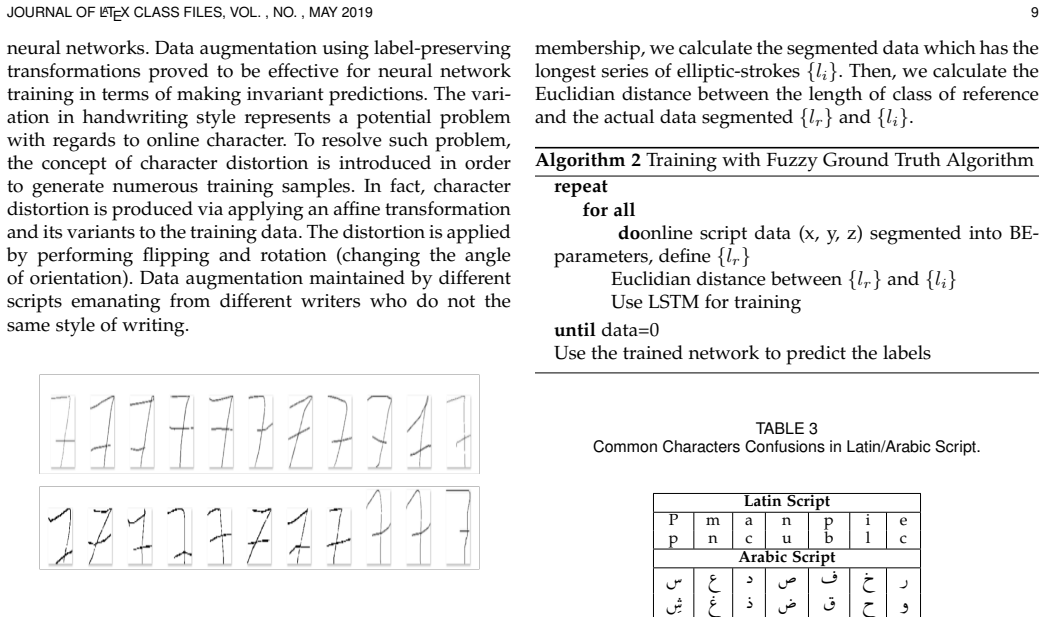
- [Section 4.3.2, Algorithm 2] The Fuzzy Ground Truth training target is constructed as the Euclidean distance between a reference stroke-length series {lr} and the input-derived segmented stroke-length series {li}, both obtained from the Beta-elliptic segmentation that constitutes the network's input representation. This makes the target a deterministic function of the input, so the LSTM can learn to approximate a distance-to-prototype mapping without necessarily learning the semantic perceptual-code recognition the paper claims. The headline 98.5% MAYASTROUN result in Table 4 is exactly the Fuzzy Ground Truth condition, and no independent label source, split, or prototype construction details are given; this circularity is load-bearing and must be resolved.
- [Section 5.1 and all experimental tables] The experimental methodology is critically underspecified. Section 5.1 states only that 'we use 24861 samples for training and test' without giving the train/test split, writer independence, number of runs, or hyperparameter values; no error bars or confidence intervals are provided. Tables 4-9 compare the proposed systems with prior work without standardizing train/test protocols, database subsets, or evaluation measures, making the numerical comparisons unreliable.
- [Sections 3.1.1.2 and 3.1.1.3] The load-bearing assumption that 'we use only 9 basic perceptual shapes which can form any script' is asserted without proof, coverage analysis, or an error analysis of the segmentation stage. The EPC assignment also depends on a hand-chosen overlap constant 'cst equal to /16' and on hand-defined direction-region boundaries, with no sensitivity analysis. As written, the reported rates cannot be expected to transfer to new writing styles or scripts.
- [Tables 6, 8, and 9 and Section 5.2] The tables contain unresolved internal contradictions. Tables 6 and 9 both report IRONOFF results but give different OnHSR-LSTM rates (97.5% vs 93%) and appear to refer to different tasks (digits vs words). Section 5.2 says IRONOFF digit results are illustrated in Table 8, but Table 8 actually reports ADAB word recognition, while Section 5.3 refers to Table 8 for the mobile database when the mobile results are in Table 7. These inconsistencies make the reliability of the reported numbers impossible to assess.
- [Section 7, Table 10] The noise robustness experiment reports that OnHR-convLSTM with raw (x,y,z) input drops to 50.45% accuracy, which is near chance for a digit task, while the same architecture under other conditions reaches 96-98%. No noise level, noise generation procedure, number of trials, or train/test protocol is given, so the robustness claim is not substantiated and the 50.45% figure suggests a possible training or evaluation problem that needs explanation.
minor comments (6)
- [Section 3.1.1.3] The overlap constant is written as 'cst equal to /16'; this should be cst = π/16, and the use of π should be made explicit.
- [Throughout] Table numbering is inconsistent: the text refers to 'Table 2' for the comparison with Tagougui et al., while the actual comparison is in Table 4; several other table references (e.g., Section 5.2 citing Table 8 for IRONOFF) are mismatched and must be corrected.
- [Section 3.1.1.2, Equation (1)] The Beta function in Equation (1) contains likely typographical errors in the exponents and in the definition of tc; please verify the equation against the standard Beta-elliptic model references.
- [Section 5.1] The statement 'We used 54 shapes instead of 56 Shapes' is unexplained; if two LMCA letter shapes were excluded from training or testing, the authors must state which shapes and why.
- [Equations (3)-(7)] The notation uses p for both a Beta parameter and the number of strokes (e.g., Equations (5)-(6)), which is ambiguous; please use distinct symbols.
- [Figures 15 and 16] Figure 16 is referenced twice with different content (noise sample and perceptual illusions); the figures need to be renumbered coherently.
Circularity Check
Fuzzy ground-truth membership is computed by Euclidean distance on the same stroke-length series fed to the LSTM; the paper's headline 98.5% result is thus partly a prediction of a target that is a function of the input.
-
fitted input called prediction
[Section 4.3.2 (Algorithm 2), evaluated in Table 4 (OnHSR-LSTM MAYASTROUN, 98.5%)]
"To define the value of membership, we calculate the segmented data which has the longest series of elliptic-strokes{li}. Then, we calculate the Euclidian distance between the length of class of reference and the actual data segmented{lr} and{li}."
The fuzzy ground-truth targets used to train OnHSR-LSTM are derived from the Euclidean distance between the sample's own stroke-length series {li} and the class reference series {lr}. The same {li} are the LSTM's input representation, so the training target is a deterministic function of the input plus a per-class prototype. The reported recognition rate with fuzzy ground truth (98.5% on MAYASTROUN, vs 94.5% framewise) measures the LSTM's ability to reproduce a distance-to-prototype mapping rather than to assign independent class labels. It is therefore a fitted target renamed as a prediction, and the abstract's 'recognition rate exceeds 98%' rests in part on this construction.
full rationale
The most load-bearing reported number, 98.5% on MAYASTROUN for OnHSR-LSTM, comes from the Fuzzy Ground Truth protocol: Algorithm 2 constructs the target membership from a Euclidean distance between the input stroke-length series and class-reference series. Because the target is computed from the same features used as input, high agreement with this target does not independently validate the perceptual-code recognition claim; the framewise baseline on the same database is 94.5%, and many reported rows in Tables 4-10 are below 98%. The second system (OnHR-convLSTM) achieves 98% on IRONOFF words without this fuzzy-target construction, so the paper is not wholly circular. The claim that '9 basic perceptual shapes can form any script' (Section 3.1.1.2) is an unsupported coverage assumption rather than a circular step, and the many self-citations to prior REGIM work define the feature vocabulary but are not invoked as a uniqueness theorem. Because one central prediction reduces, by the paper's own equations, to a target computed from its input, the partial circularity score is 6.
Assumptions & free parameters
free parameters (3)
- Fuzzy overlap constant cst for EPC indecision intervals =
pi/16 (text renders it as '/16')
- EPC direction region boundaries on the trigonometric circle =
not stated
- LSTM and convLSTM hyperparameters =
not reported
assumptions (4)
- domain assumption Nine basic perceptual codes suffice to compose any Arabic or Latin script.
- domain assumption Beta-elliptic segmentation identifies the same strokes a human perceiver would.
- ad hoc to paper Fuzzy membership derived from stroke-length Euclidean distance forms a valid training target.
- standard math LSTM, CTC, and convLSTM work as described in the cited literature.
Cite this review
Pith. "Pith review of Neural Architecture based on Fuzzy Perceptual Representation For Online Multilingual Handwriting Recognition." pith.science (2026). https://pith.science/paper/OUVTO2X6
@misc{pith2026190800634,
  author       = {Pith},
  title        = {Pith review of: Neural Architecture based on Fuzzy Perceptual Representation For Online Multilingual Handwriting Recognition},
  year         = {2026},
  howpublished = {\url{https://pith.science/paper/OUVTO2X6}},
  note         = {Machine review of arXiv:1908.00634}
}
read the original abstract
Due to the omnipresence of mobile devices, online handwritten scripts have become the most important feeding input to smartphones and tablet devices. To increase online handwriting recognition performance, deeper neural networks have extensively been used. In this context, our paper handles the problem of online handwritten script recognition based on extraction features system and deep approach system for sequences classification. Many solutions have appeared in order to facilitate the recognition of handwriting. Accordingly, we used an existent method and combined with new classifiers in order to get a flexible system. Good results are achieved compared to online characters and words recognition system on Latin and Arabic scripts. The performance of our two proposed systems is assessed by using five databases. Indeed, the recognition rate exceeds 98%.
Figures

Figures from the paper (14 more)




Reference graph
Works this paper leans on
-
[1]
Recognizing online arabic handwritten characters using a deep architecture,
N. Tagougui and M. Kherallah, “Recognizing online arabic handwritten characters using a deep architecture,” Proc.SPIE, vol. 10341, pp. 1– 5, 2017. [Online]. Available: https://doi.org/10. 1117/12.2268419
work page 2017
-
[2]
A Hybrid NN/HMM Modeling Technique for Online Arabic Handwriting Recognition
N. Tagougui, H. Boubaker, M. Kherallah, and A. M. Alimi, “A hybrid NN/HMM modeling technique for online arabic handwriting recognition,” CoRR, vol. abs/1401.0486, 2014. [Online]. Available: http://arxiv.org/abs/1401.0486
work page Pith review arXiv 2014
-
[3]
Multi-language online handwriting recognition,
D. Keysers, T. Deselaers, H. A. Rowley, L. L. Wang, and V . Car- bune, “Multi-language online handwriting recognition,” IEEE T ransactions on Pattern Analysis and Machine Intelligence , vol. 39, no. 6, pp. 1180–1194, June 2017
work page 2017
-
[4]
Online farsi handwritten character recognition using hidden markov model,
V . Ghods and M. K. Sohrabi, “Online farsi handwritten character recognition using hidden markov model,” JCP, vol. 11, pp. 169– 175, 2016
work page 2016
-
[5]
Off- lexicon online arabic handwriting recognition using neural net- work,
Y. Hamdi, A. Chaabouni, B. Houcine, and A. M. Alimi, “Off- lexicon online arabic handwriting recognition using neural net- work,” pp. 1–5, 2016
work page 2016
-
[6]
W. Yang, L. Jin, Z. Xie, and Z. Feng, “Improved deep convolutional neural network for online handwritten chinese character recogni- tion using domain-specific knowledge,” pp. 551–555, Aug 2015
work page 2015
-
[7]
J. Zhang, J. Du, and L. Dai, “A gru-based encoder-decoder ap- proach with attention for online handwritten mathematical ex- pression recognition,” 12 2017
work page 2017
-
[8]
X. Xiao, Y. Yang, T. Ahmad, L. Jin, and T. Chang, “Design of a very compact cnn classifier for online handwritten chinese character recognition using dropweight and global pooling,” 2017 14th IAPR International Conference on Document Analysis and Recognition (ICDAR), vol. 01, pp. 891–895, 2017
work page 2017
Show all 40 references
-
[9]
Drawing and recognizing chinese characters with recurrent neural network,
X. Zhang, F. Yin, Y. Zhang, C. Liu, and Y. Bengio, “Drawing and recognizing chinese characters with recurrent neural network,” IEEE T ransactions on Pattern Analysis and Machine Intelligence , vol. 40, no. 4, pp. 849–862, April 2018
2018
-
[10]
Real time handwriting recognition for mathematic expressions using hidden markov model,
Y. M.Pranoto, E. Setyati, E. Pramana, Y. Kristian, and R. Budiman, “Real time handwriting recognition for mathematic expressions using hidden markov model,” pp. 1–6, 07 2016
2016
-
[11]
Fast multi-language lstm-based online handwriting recognition,
V . Carbune, P . Gonnet, T. Deselaers, H. A. Rowley, A. N. Daryin, M. Calvo, L. Wang, D. Keysers, S. Feuz, and P . Gervais, “Fast multi-language lstm-based online handwriting recognition,” CoRR, vol. abs/1902.10525, 2019. [Online]. Available: http://arxiv.org/abs/1902.10525
1902 arXiv
-
[12]
Recognition of online handwriting with variability on smart devices,
G. Ren and V . Ganapathy, “Recognition of online handwriting with variability on smart devices,” pp. 7605–7609, May 2019
2019
-
[13]
Online arabic handwriting recognition: A survey,
N. Tagougui, M. Kherallah, and A. M. Alimi, “Online arabic handwriting recognition: A survey,” Int. J. Doc. Anal. Recognit. , vol. 16, no. 3, pp. 209–226, Sep. 2013. [Online]. Available: http://dx.doi.org/10.1007/s10032-012-0186-8
2013 doi
-
[14]
The state of the art in online handwriting recognition,
C. C. Tappert, C. Y. Suen, , and T. Wakahara, “The state of the art in online handwriting recognition,” IEEE T rans. Pattern Anal. Mach. Intell., vol. 12, p. 787808, August 1990
1990
-
[15]
Online hand- writing recognition: The npen++ recognizer,
S. Jaeger, S. Manke, J. Reichert, and A. Waibel, “Online hand- writing recognition: The npen++ recognizer,” Int. J. Doc. Anal. Recognit., vol. 3, p. 169180, 2001
2001
-
[16]
Novel hybrid nn/hmm modelling tech- niques for on-line handwriting recognition,
J. Schenk and G. Rigoll, “Novel hybrid nn/hmm modelling tech- niques for on-line handwriting recognition,” in Proc. Int. Workshop Frontiers Handwriting Recognit. , p. 619623, 2006
2006
-
[17]
A novel connectionist system for unconstrained handwriting recognition,
A. Graves, M. Liwicki, S. Fernandez, R. Bertolami, and H. B. andJ. Schmidhuber, “A novel connectionist system for unconstrained handwriting recognition,” IEEE T rans. Pattern Anal. Mach. Intell. , vol. 31, p. 855868, May 2009
2009
-
[18]
A new encoding system: Application to on-line arabic handwriting,
S. Njah, H. Bezine, and A. M. Alimi, “A new encoding system: Application to on-line arabic handwriting,” pp. 451–456, 2010
2010
-
[19]
The pertohs theory for on-line handwriting segmentation,
S. Njah, M. Ltaief, H. Bezine, and A. M. Alimi, “The pertohs theory for on-line handwriting segmentation,” IJCSI, vol. 9, pp. 142–151, 2012
2012
-
[20]
On-line arabic handwriting segmentation via perceptual codes: application to mayastroun database,
S. Njah, H. Bezine, and A. M. Alimi, “On-line arabic handwriting segmentation via perceptual codes: application to mayastroun database,” pp. 1–5, March 2011
2011
-
[21]
Reconnaissance hors-ligne de lcriture cursive par lutilisation de modles perceptifs et neuronaux,
J.R.Pinales, “Reconnaissance hors-ligne de lcriture cursive par lutilisation de modles perceptifs et neuronaux,” PhD, University of Paris, 2002
2002
-
[22]
A fuzzy online hand- writing recognition system: Fohres,
A.Malaviya, L.Peters, and P .Camposano, “A fuzzy online hand- writing recognition system: Fohres,” Proceedings of the International Conference on fuzzy theory and technology , pp. 1–15, 1993
1993
-
[23]
Decision trees based on perceptual codes for on-line arabic char- acter recognition,
H. Akouaydi, S. Abdelhedi, S. Njah, M. Zaied, and A. M. Alimi, “Decision trees based on perceptual codes for on-line arabic char- acter recognition,” no. 1-5, pp. 153–157, April 2017
2017
-
[24]
Genetic algorithms for perceptual codes extraction,
M. Ltaief, S. Njah, H. Bezine, and A. M. Alimi, “Genetic algorithms for perceptual codes extraction,” International Journal of Intelligent Learning Systems and Applications, JILSA , pp. 256–265, 2012
2012
-
[25]
A new approach for the extraction of handwriting perceptual codes using fuzzy logic,
S. Njah, H. Bezine, and A. M. Alimi, “A new approach for the extraction of handwriting perceptual codes using fuzzy logic,” pp. 302–307, 2008
2008
-
[26]
A developmental theory of the relation between geometry and kinematics in handwriting,
H.Bezine, A.M.Alimi, and N.Derbel, “A developmental theory of the relation between geometry and kinematics in handwriting,” IEEE International Conference Systems, Man and Cybernetics , p. 5, 2002
2002
-
[27]
A spiking neural network model for complex handwriting movements generation,
M.Ltaief, H.Bezine, and A.M.Alimi, “A spiking neural network model for complex handwriting movements generation,” Interna- JOURNAL OF LATEX CLASS FILES, VOL. , NO. , MAY 2019 14 tional Journal of Computer Science and Information Security 14 , p. 7, 2016
2019
-
[28]
A fuzzy genetic system for segmentation of on-line handwriting: Application to adab database,
S. Njah, H. Bezine, and A. M. Alimi, “A fuzzy genetic system for segmentation of on-line handwriting: Application to adab database,” pp. 95–102, April 2011
2011
-
[29]
Online arabic writer identification based on beta-elliptic model,
T.Dhieb, W.Ouarda, H.Boubaker, M.B.Hlima, and A. M. Alimi, “Online arabic writer identification based on beta-elliptic model,” pp. 74–79, 2015
2015
-
[30]
Beta-elliptic model for writer identification from online arabic handwriting,
T.Dhieb, W.Ouarda, H.Boubaker, and A. M. Alimi, “Beta-elliptic model for writer identification from online arabic handwriting,” vol. 11, p. 6, 2016
2016
-
[31]
An online writer identification system based on beta- elliptic model and fuzzy elementary perceptual codes,
T.Dhieb, S.Njah, W.Ouarda, H.Boubaker, M.B.Ayed, and A. M. Alimi, “An online writer identification system based on beta- elliptic model and fuzzy elementary perceptual codes,” p. 12, 2018
2018
-
[32]
Connectionist temporal classification: Labelling unsegmented sequence data with recurrent neural networks,
G. Alex, F. Santiago, G. Faustino, and S. Jurgen, “Connectionist temporal classification: Labelling unsegmented sequence data with recurrent neural networks,” New York, NY, USA, pp. 369–376, 2006. [Online]. Available: http://doi.acm.org/10.1145/ 1143844.1143891
2006
-
[33]
Framewise and ctc training of neural networks for handwriting recognition,
T. Bluche, H. Ney, J. Louradour, and C. Kermorvant, “Framewise and ctc training of neural networks for handwriting recognition,” pp. 81–85, Aug 2015
2015
-
[34]
Mayastroun: A multilanguage handwriting database,
S. Njah, B. B. Nouma, H. Bezine, and A. M. Alimi, “Mayastroun: A multilanguage handwriting database,” pp. 308–312, Sept 2012
2012
-
[35]
Recognition of on-line handwritten digits by neural networks using circular and beta approaches,
M. Kherallah, S. Njah, A. M. Alimi, and N. Derbel, “Recognition of on-line handwritten digits by neural networks using circular and beta approaches,” vol. 2, pp. 164–169, Oct 2002
2002
-
[36]
The on/off (lmca) dual arabic handwriting database,
M.Kherallah, A.Elbaati, H.ElAbed, and A.M.Alimi, “The on/off (lmca) dual arabic handwriting database,” 2008
2008
-
[37]
Unipen project of on-line data exchange and recognizer bench- marks,
I. Guyon, L. Schomaker, R. Plamondon, M. Liberman, and S. Janet, “Unipen project of on-line data exchange and recognizer bench- marks,” vol. 2, pp. 29–33 vol.2, Oct 1994
1994
-
[38]
The ireste on/off (ironoff) dual handwriting database,
V . Gaudin, P . Lallican, S. Knerr, and P . Binter, “The ireste on/off (ironoff) dual handwriting database,” p. 455 458, 1999
1999
-
[39]
Android application for handwriting segmentation using pertohs theory,
H.Akouaydi, S.Njah, and A. M. Alimi, “Android application for handwriting segmentation using pertohs theory,” Proc.SPIE, vol. 10341, pp. 10 341 – 10 341 – 5, 2016. [Online]. Available: https://doi.org/10.1117/12.2269059
2016 doi
-
[40]
On-line arabic handwriting recognition competition, adab database and participating systems,
H. E. Abed, M. Kherallah, V . Mrgner, and A. M. Alimi, “On-line arabic handwriting recognition competition, adab database and participating systems,” International Journal on Document Analysis and Recognition, vol. 14, pp. 15–23, 2011. Hanen Akouaydi currently a PhD student in...
2011
Reviewed August 14, 2026 · model on record in the stance chip above.
Discussion (0). Continue with ORCID to comment.