Thermodynamic-limit dispersion relations on trapped-ion quantum hardware
Pith reviewed 2026-06-29 12:16 UTC · model grok-4.3
The pith
A 20-qubit trapped-ion processor combined with linked-cluster expansion computes ground-state energies and quasi-particle dispersions in the thermodynamic limit.
A machine-rendered reading of the paper's core claim, the machinery that carries it, and where it could break.
Core claim
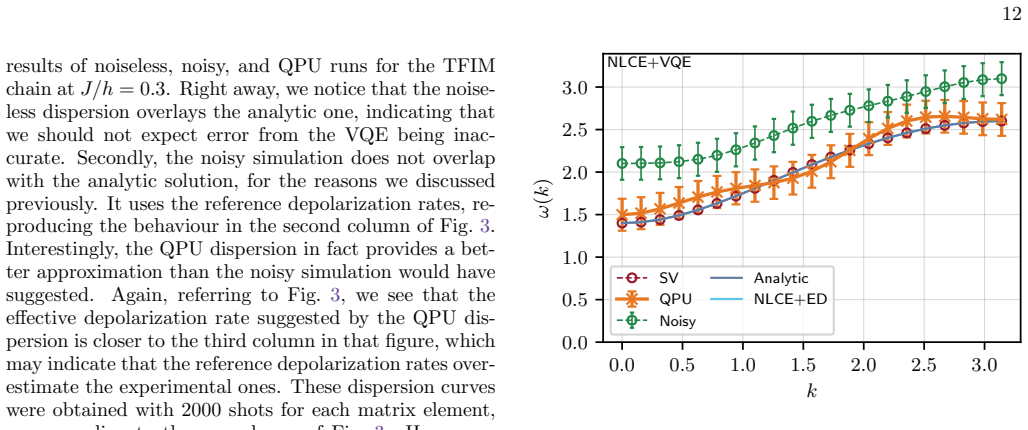
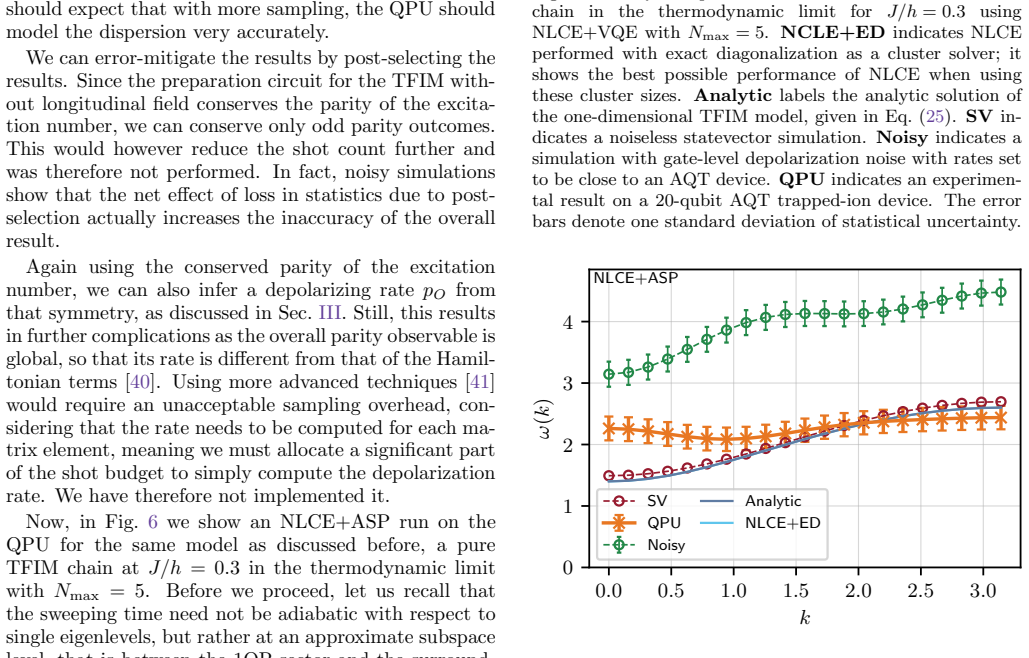
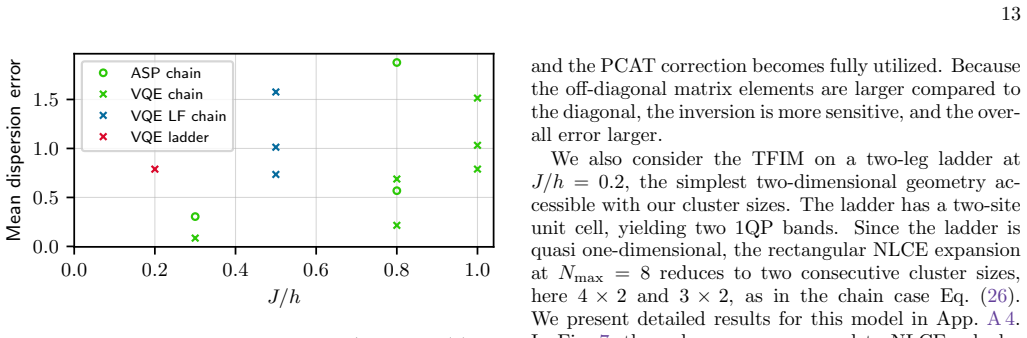
NLCE+QA extracts thermodynamic-limit ground-state energies and one-quasi-particle dispersions from small-cluster calculations on a 20-qubit trapped-ion QPU. Projector-based block-diagonalization via PCAT is performed after adiabatic state preparation or VQE, with final expectation values obtained from the device using the CX-test. The method is shown to function for the transverse-field Ising model in one dimension, on ladders, and in a longitudinal field, establishing that current hardware noise levels permit the required non-linear classical post-processing for these cases.
What carries the argument
The NLCE+QA framework, which combines quantum state preparation and measurement on small clusters with classical linked-cluster expansion and PCAT block-diagonalization to reach thermodynamic-limit quantities.
If this is right
- Thermodynamic-limit ground-state energies and quasi-particle dispersions become accessible from small-cluster quantum calculations without simulating the full infinite system.
- The NLCE+QA approach succeeds for the transverse-field Ising model in one dimension, on ladder geometries, and with longitudinal fields.
- A CX-test provides a practical alternative to the Hadamard test for extracting the required expectation values on the trapped-ion device.
- Current noise levels on 20-qubit trapped-ion hardware allow the non-linear post-processing steps in PCAT for the models examined.
Where Pith is reading between the lines
- If noise tolerance improves, the same hybrid expansion could be applied to models whose classical linked-cluster expansions become prohibitive at larger cluster sizes.
- Better error mitigation on future devices would permit larger clusters inside the expansion and therefore tighter control over extrapolation errors.
- The demonstrated noise resilience of the post-processing pipeline indicates that hybrid quantum-classical schemes of this type may reach classically inaccessible regimes sooner than full quantum simulation of large lattices.
Load-bearing premise
Expectation values supplied by the quantum processor remain accurate enough after the matrix inversion and square-root operations of the projective cluster-additive transformation.
What would settle it
A computed ground-state energy or dispersion relation for the transverse-field Ising model that deviates from the known exact thermodynamic-limit value by an amount traceable to amplified measurement noise in the PCAT step would show the hardware is not yet accurate enough.
Figures
read the original abstract
We run a numerical linked-cluster expansion with a quantum algorithm (NLCE+QA), computing ground-state energies and one quasi-particle dispersions in the thermodynamic limit using a 20-qubit trapped-ion quantum processing unit (QPU). The NLCE+QA framework extracts thermodynamic-limit properties from small-cluster calculations, making it naturally suited for near-term quantum devices. Projector-based block-diagonalization schemes such as projective cluster-additive transformation (PCAT) are essential to NLCE+QA, and they involve matrix inversion and square root operations that amplify measurement noise. A central question is therefore whether current hardware can provide expectation values that are accurate enough to withstand non-linear classical post-processing. We explore this challenge for the transverse-field Ising model (TFIM) in one dimension, on a ladder geometry, as well as in a longitudinal field in one dimension. For the quantum algorithm, we consider adiabatic state preparation (ASP), as well as a variational quantum eigensolver (VQE) trained on a classical device. The final expectation values are obtained from the QPU, using a novel alternative to the Hadamard test that we name the CX-test. We explore the regimes currently attainable on quantum devices and comment on the improvements needed for quantum computers to achieve results beyond classical reach.
Editorial analysis
A structured set of objections, weighed in public.
Referee Report
Summary. The paper introduces NLCE+QA, combining numerical linked-cluster expansions with quantum algorithms to extract thermodynamic-limit ground-state energies and single-quasiparticle dispersions for the transverse-field Ising model (TFIM) on 1D, ladder, and longitudinal-field geometries. Computations use a 20-qubit trapped-ion QPU with adiabatic state preparation (ASP) or classically trained VQE, PCAT block-diagonalization, and a novel CX-test for expectation values; the central question addressed is whether current hardware expectation values remain usable after the noise-amplifying matrix inversion and square-root steps inside PCAT.
Significance. If the hardware-derived values prove stable under PCAT post-processing, the work would constitute a concrete experimental demonstration that near-term QPUs can contribute to thermodynamic-limit many-body calculations that are otherwise limited by cluster size. The explicit focus on error amplification in projector schemes and the introduction of the CX-test are positive steps toward reproducible quantum-assisted NLCE.
major comments (2)
- [Abstract / PCAT section] Abstract and § on PCAT: the central claim that QPU expectation values survive the non-linear operations requires a quantitative error budget showing how shot noise and gate errors propagate through matrix inversion and square-root steps into the linked-cluster series; without explicit stability tests or bounds on the extrapolated energies/dispersions, the thermodynamic-limit results rest on an unverified assumption.
- [Results (TFIM ladder / longitudinal field)] Results for TFIM ladder and longitudinal-field cases: the manuscript must include direct comparisons of QPU+PCAT dispersions against exact or high-precision classical benchmarks, with error bars from finite shots; absent these, the claim that hardware values remain usable after non-linear post-processing cannot be assessed.
minor comments (2)
- [Methods / CX-test] Clarify the precise definition and circuit implementation of the CX-test relative to the standard Hadamard test, including any additional assumptions on state preparation.
- [NLCE setup] Provide the cluster sizes used in the NLCE and the truncation order of the linked-cluster series for each geometry.
Simulated Author's Rebuttal
We thank the referee for their careful reading of the manuscript and for the constructive feedback on the need for explicit error analysis. We address each major comment below.
read point-by-point responses
-
Referee: [Abstract / PCAT section] Abstract and § on PCAT: the central claim that QPU expectation values survive the non-linear operations requires a quantitative error budget showing how shot noise and gate errors propagate through matrix inversion and square-root steps into the linked-cluster series; without explicit stability tests or bounds on the extrapolated energies/dispersions, the thermodynamic-limit results rest on an unverified assumption.
Authors: We agree that a quantitative error budget would strengthen the central claim regarding stability under PCAT post-processing. In the revised manuscript we will add an appendix containing both analytical estimates of error propagation through the matrix inversion and square-root steps and numerical simulations that inject realistic shot noise and gate errors into the expectation values before PCAT. These will be used to bound the uncertainty in the final linked-cluster coefficients and extrapolated thermodynamic-limit energies and dispersions. revision: yes
-
Referee: [Results (TFIM ladder / longitudinal field)] Results for TFIM ladder and longitudinal-field cases: the manuscript must include direct comparisons of QPU+PCAT dispersions against exact or high-precision classical benchmarks, with error bars from finite shots; absent these, the claim that hardware values remain usable after non-linear post-processing cannot be assessed.
Authors: We will add the requested direct comparisons in the revised manuscript. For the ladder and longitudinal-field geometries we will present QPU+PCAT dispersions side-by-side with exact or high-precision classical benchmarks (obtained from exact diagonalization on small clusters and classical NLCE extrapolations), together with error bars obtained by propagating the finite-shot statistical uncertainties through the PCAT operations and the subsequent linked-cluster extrapolation. revision: yes
Circularity Check
No circularity: experimental hardware demonstration of NLCE+QA
full rationale
The paper presents an empirical demonstration of running numerical linked-cluster expansion with quantum algorithms (NLCE+QA) on a 20-qubit trapped-ion QPU to extract thermodynamic-limit ground-state energies and dispersions for the TFIM. The workflow applies established projector-based methods (PCAT) and state-preparation techniques (ASP, classically-trained VQE) plus a new CX-test for measurements; none of these steps reduce a claimed result to its own inputs by construction, rename a fitted quantity as a prediction, or rest on a load-bearing self-citation chain. The central claim is the feasibility of the hardware pipeline under realistic noise, which is an external, falsifiable assertion rather than a self-referential definition. No equations or sections exhibit the enumerated circularity patterns.
Axiom & Free-Parameter Ledger
Reference graph
Works this paper leans on
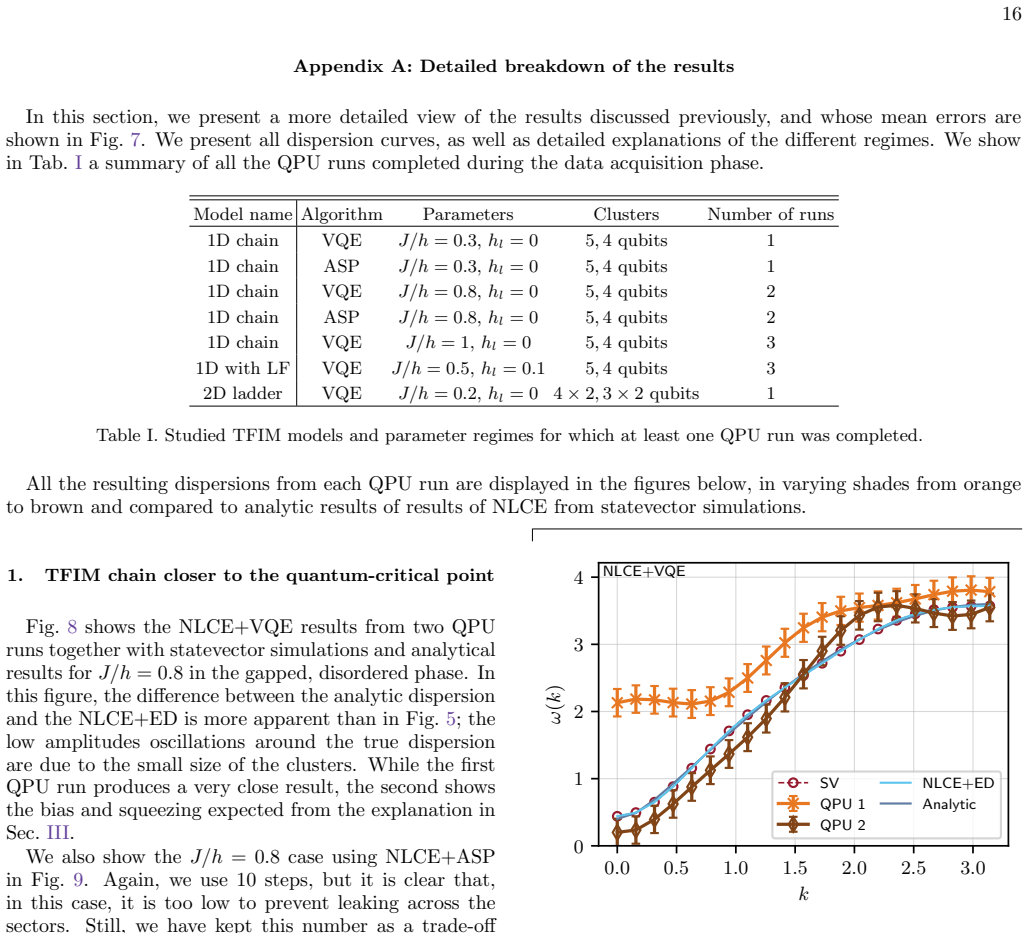
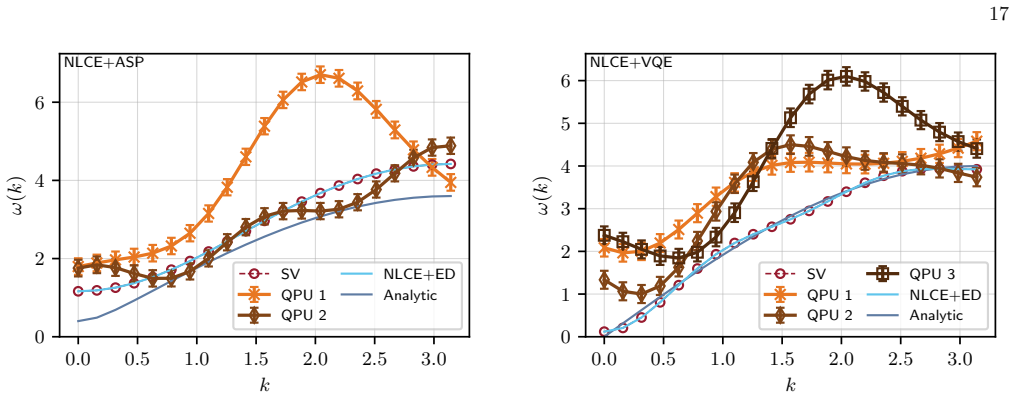
-
[1]
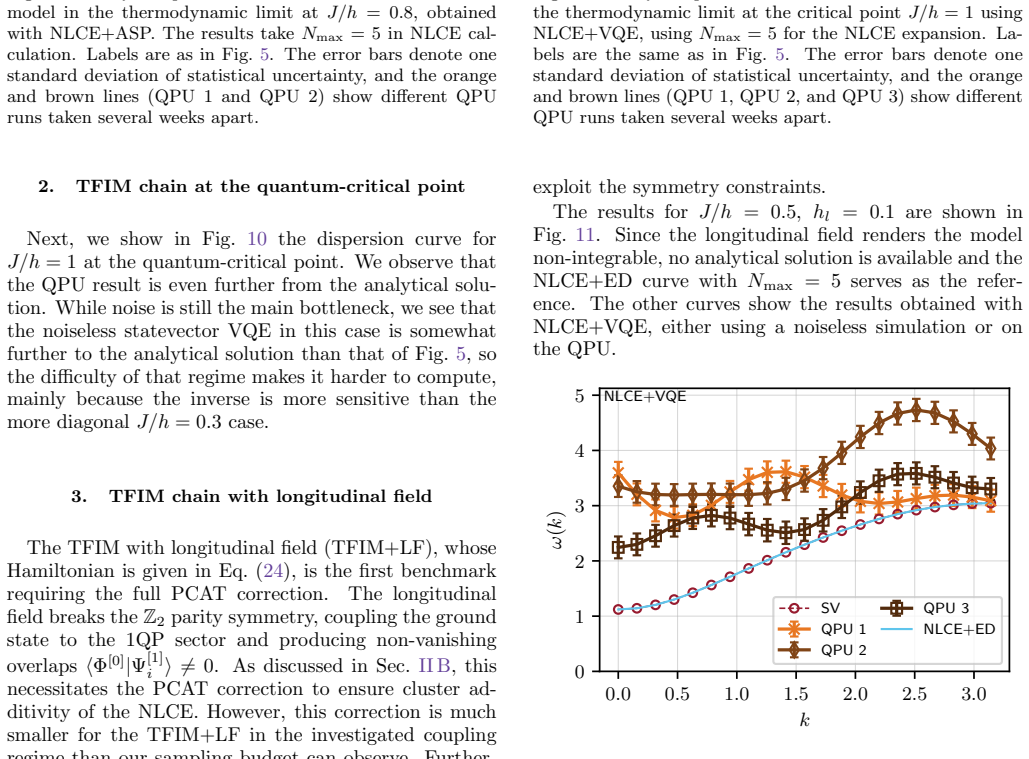
For an undressed HamiltonianH 0 =P j Zj, the 1QP sector corresponds to spin-flip excitations, i.e
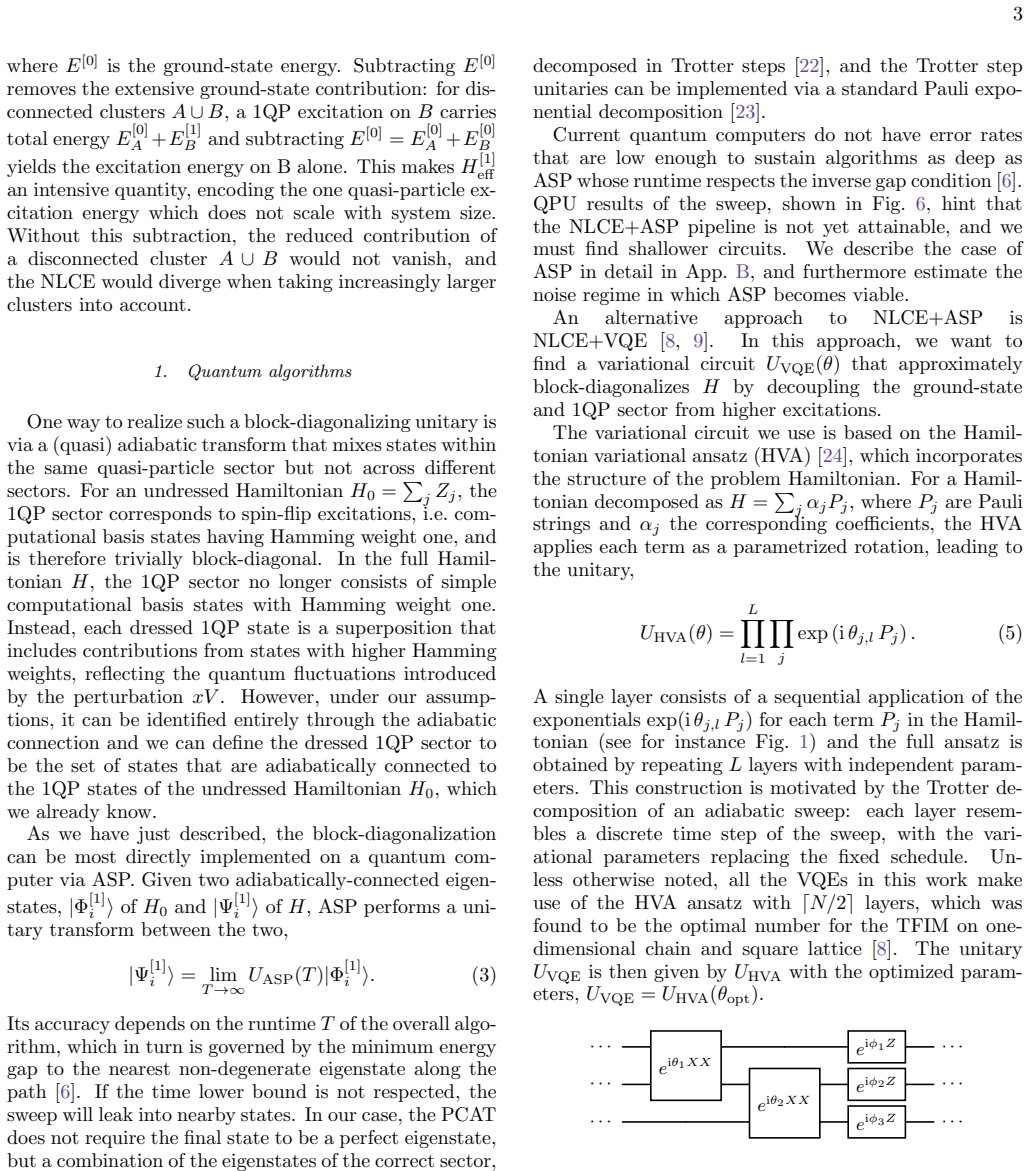
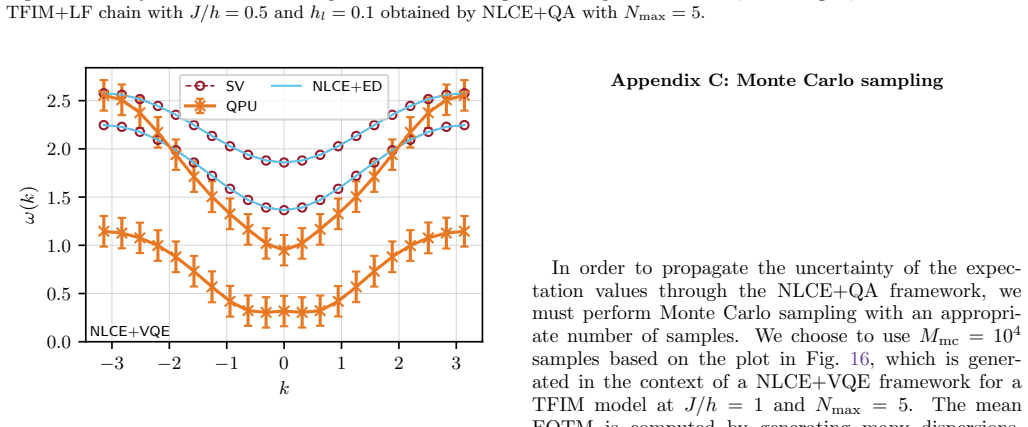
Quantum algorithms One way to realize such a block-diagonalizing unitary is via a (quasi) adiabatic transform that mixes states within the same quasi-particle sector but not across different sectors. For an undressed HamiltonianH 0 =P j Zj, the 1QP sector corresponds to spin-flip excitations, i.e. com- putational basis states having Hamming weight one, an...
-
[2]
Standard block-diagonalization transformations like Schrieffer-Wolff [26] can violate this property, which mo- tivates the process described below
Projective cluster-additive transformation In an NLCE, thermodynamic-limit quantities are re- constructed from calculations on small connected clus- ters via a procedure that converges only if the effective HamiltonianH eff on two disconnected clustersAandB decomposes as Heff(A∪B) =H eff(A)⊗1 B +1 A ⊗H eff(B).(10) Without such cluster additivity, the effe...
-
[3]
(16) depends on ˜O[1] only through the combinations ˜O[1] ˜O[1]† and ˜O[1] ˜H[1] ˜O[1]†, which are unchanged if one rotates the ba- sis within the 1QP sector [10]
Computing PCAT on quantum hardware The final resultV [1]†H[1]V [1] in Eq. (16) depends on ˜O[1] only through the combinations ˜O[1] ˜O[1]† and ˜O[1] ˜H[1] ˜O[1]†, which are unchanged if one rotates the ba- sis within the 1QP sector [10]. In practice, this means that the states prepared by the QA do not need to be eigenstates ofH; it is sufficient that the...
-
[4]
Ground-state energy For the calculation of the ground-state energy, we train the VQE on a classical computer, with an energy min- imization cost function, as in Eq. (9). For ASP, which we use as well, no training is required. On the quantum device, we then sample the state obtained with the quan- tum circuit in theZ-basis, and perform sample-based quantum...
-
[5]
HereUdenotes any unitary acting on the full 2 N Hilbert space, either VQE or ASP
Hamiltonian matrix Beyond the ground-state energy, we must measure off- diagonal Hamiltonian elementsH ij =⟨Φ [1] i |U †HU|Φ [1] j ⟩ fori, j= 1, ..., N. HereUdenotes any unitary acting on the full 2 N Hilbert space, either VQE or ASP. Recall that|Φ [1] j ⟩are Hamming weight one computational basis states,|Φ [1] j ⟩=X j|0⟩⊗N, whereX j is the PauliXma- trix...
-
[6]
uncertainty
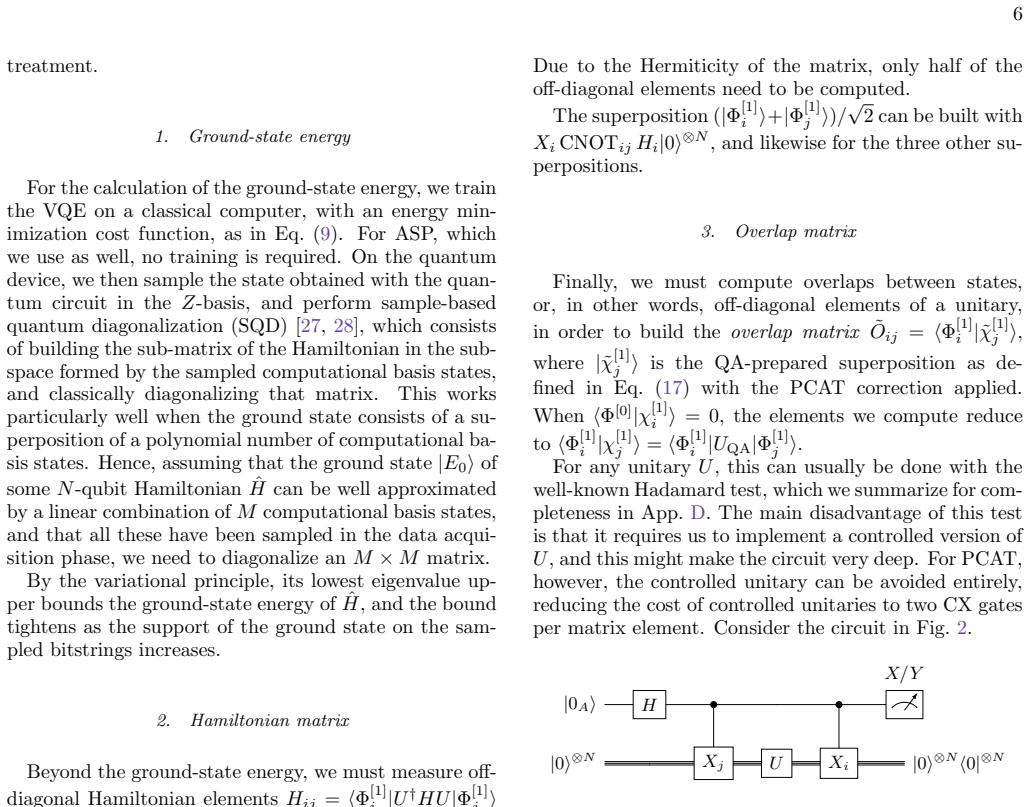
Overlap matrix Finally, we must compute overlaps between states, or, in other words, off-diagonal elements of a unitary, in order to build theoverlap matrix ˜Oij =⟨Φ [1] i |˜χ[1] j ⟩, where|˜χ[1] j ⟩is the QA-prepared superposition as de- fined in Eq. (17) with the PCAT correction applied. When⟨Φ [0]|χ[1] i ⟩= 0, the elements we compute reduce to⟨Φ [1] i ...
2000
-
[7]
Rigol, T
M. Rigol, T. Bryant, and R. R. P. Singh, Phys. Rev. Lett. 97, 187202 (2006)
2006
-
[8]
B. Tang, E. Khatami, and M. Rigol, Computer Physics Communications184, 557 (2013)
2013
-
[9]
Maier, M
T. Maier, M. Jarrell, T. Pruschke, and M. H. Hettler, Rev. Mod. Phys.77, 1027 (2005)
2005
- [10]
-
[11]
Jordan, R
J. Jordan, R. Or´ us, G. Vidal, F. Verstraete, and J. I. Cirac, Phys. Rev. Lett.101, 250602 (2008)
2008
-
[12]
Albash and D
T. Albash and D. A. Lidar, Reviews of Modern Physics 90, 015002 (2018)
2018
-
[13]
Peruzzo, J
A. Peruzzo, J. McClean, P. Shadbolt, M.-H. Yung, X.-Q. Zhou, P. J. Love, A. Aspuru-Guzik, and J. L. O’Brien, Nature Communications5, 4213 (2014)
2014
-
[14]
H¨ ormann, and K
Sumeet, M. H¨ ormann, and K. P. Schmidt, Physical Re- view B110, 155128 (2024)
2024
-
[15]
Sumeet, M. H¨ ormann, and K. P. Schmidt, Quantum al- gorithm for one quasi-particle excitations in the thermo- dynamic limit via cluster-additive block-diagonalization (2025), arXiv:2511.06623 [quant-ph]
-
[16]
H¨ ormann and K
M. H¨ ormann and K. P. Schmidt, SciPost Physics15, 097 (2023)
2023
-
[17]
O. Friedrich and T. Eifler, Monthly Notices of the Royal Astronomical Society473, 4150 (2018), arXiv:1703.07786 [astro-ph]
work page internal anchor Pith review Pith/arXiv arXiv 2018
-
[18]
A. Lischke, G. Pang, M. Gulian, F. Song, C. Glusa, X. Zheng, Z. Mao, W. Cai, M. M. Meerschaert, M. Ainsworth, and G. E. Karniadakis, What Is the Frac- tional Laplacian? (2019), arXiv:1801.09767 [math]
-
[19]
Lakes,Viscoelastic Materials(Cambridge University Press, Cambridge, 2009)
R. Lakes,Viscoelastic Materials(Cambridge University Press, Cambridge, 2009)
2009
-
[20]
G. Romano and R. Barretta, Fundamental Topics in Continuum Mechanics: Grand Ideas, Errors & Horrors (2025), arXiv:2511.08129 [physics]
-
[21]
M. Lefebvre, R. K. Keeler, R. Sobie, and J. White, Nuclear Instruments and Methods in Physics Research Section A: Accelerators, Spectrometers, Detectors and Associated Equipment451, 520 (2000), arXiv:hep- ex/9909031
-
[22]
G. Carleo and M. Troyer, Science355, 602 (2017), https://www.science.org/doi/pdf/10.1126/science.aag2302
-
[23]
M. J. Hartmann and G. Carleo, Phys. Rev. Lett.122, 250502 (2019)
2019
- [24]
- [25]
-
[26]
Huang, R
H.-Y. Huang, R. Kueng, and J. Preskill, Nature Physics 16, 1050 (2020)
2020
-
[27]
Mind the gaps: The fraught road to quantum advantage
J. Eisert and J. Preskill, Mind the gaps: The fraught road to quantum advantage (2025), arXiv:2510.19928 [quant- ph]
work page internal anchor Pith review Pith/arXiv arXiv 2025
-
[28]
Suzuki, Journal of Mathematical Physics26, 601 (1985)
M. Suzuki, Journal of Mathematical Physics26, 601 (1985)
1985
-
[29]
M. A. Nielsen and I. L. Chuang,Quantum Computa- tion and Quantum Information: 10th Anniversary Edi- tion(Cambridge University Press, 2010)
2010
-
[30]
Wecker, M
D. Wecker, M. B. Hastings, and M. Troyer, Physical Re- view A - Atomic, Molecular, and Optical Physics92, 1 (2015)
2015
-
[31]
Peruzzo, J
A. Peruzzo, J. McClean, P. Shadbolt, M.-H. Yung, X.-Q. Zhou, P. J. Love, A. Aspuru-Guzik, and J. L. O’Brien, Nature Communications5, 4213 (2014). 15
2014
-
[32]
Bravyi, D
S. Bravyi, D. P. DiVincenzo, and D. Loss, Annals of Physics326, 2793 (2011)
2011
-
[33]
K. Kanno, M. Kohda, R. Imai, S. Koh, K. Mitarai, W. Mizukami, and Y. O. Nakagawa, Quantum-Selected Configuration Interaction: Classical diagonalization of Hamiltonians in subspaces selected by quantum comput- ers (2023), arXiv:2302.11320 [quant-ph]
work page internal anchor Pith review Pith/arXiv arXiv 2023
-
[34]
Sample-Based Quantum Diagonalization with Amplitude Amplification
N. Stockinger, L. N¨ utzel, and M. J. Hartmann, Sample- based quantum diagonalization with amplitude amplifi- cation (2026), arXiv:2605.02565 [quant-ph]
work page internal anchor Pith review Pith/arXiv arXiv 2026
-
[35]
M. Larocca, S. Thanasilp, S. Wang, K. Sharma, J. Bia- monte, P. J. Coles, L. Cincio, J. R. McClean, Z. Holmes, and M. Cerezo, A Review of Barren Plateaus in Vari- ational Quantum Computing (2024), arXiv:2405.00781 [quant-ph, stat]
-
[36]
J. Zhang, Modern Monte Carlo Methods for Efficient Uncertainty Quantification and Propagation: A Survey (2020), arXiv:2011.00680 [stat]
-
[37]
J. C. for Guides in Metrology,Evaluation of Measure- ment Data — Guide to the Expression of Uncertainty in Measurement(International Organization for Standard- ization, 2008)
2008
-
[38]
Arute, K
F. Arute, K. Arya, R. Babbush, D. Bacon, J. C. Bardin, R. Barends, R. Biswas, S. Boixo, F. G. S. L. Brandao, D. A. Buell, B. Burkett, Y. Chen, Z. Chen, B. Chiaro, R. Collins, W. Courtney, A. Dunsworth, E. Farhi, B. Foxen, A. Fowler, C. Gidney, M. Giustina, R. Graff, K. Guerin, S. Habegger, M. P. Harrigan, M. J. Hartmann, A. Ho, M. Hoffmann, T. Huang, T. S...
2019
-
[39]
Wan and R
E. Wan and R. Van Der Merwe, inProceedings of the IEEE 2000 Adaptive Systems for Signal Process- ing, Communications, and Control Symposium (Cat. No.00EX373)(2000) pp. 153–158
2000
- [40]
-
[41]
M. Urbanek, B. Nachman, V. R. Pascuzzi, A. He, C. W. Bauer, and W. A. de Jong, Physical Review Letters127, 270502 (2021), 2103.08591
-
[42]
A. A. Mele, A. Angrisani, S. Ghosh, S. Khatri, J. Eisert, D. Stilck Fran¸ ca, and Y. Quek, Nature Physics , 1 (2026)
2026
-
[43]
A. Javadi-Abhari, M. Treinish, K. Krsulich, C. J. Wood, J. Lishman, J. Gacon, S. Martiel, P. D. Nation, L. S. Bishop, A. W. Cross, B. R. Johnson, and J. M. Gambetta, Quantum computing with Qiskit (2024), arXiv:2405.08810 [quant-ph]
work page internal anchor Pith review Pith/arXiv arXiv 2024
-
[44]
MARMOT - The first commercial 19- inch rack-mounted quantum computer, https://www.aqt.eu/products/marmot/ (2026)
2026
-
[45]
Pfeuty, Annals of Physics57, 79 (1970)
P. Pfeuty, Annals of Physics57, 79 (1970)
1970
-
[46]
Granet and H
E. Granet and H. Dreyer, PRX Quantum6, 010333 (2025)
2025
-
[47]
J. O. del Moral, O. S. Larrarte, J. Fraxanet, D. Mishagli, and J. E. Martinez, Noise mitigation of quantum observ- ables via learning from Hamiltonian symmetry decays (2026)
2026
- [48]
-
[49]
J. C. Xavier, R. G. Pereira, M. E. S. Nunes, and J. A. Plascak, Phys. Rev. B105, 024430 (2022)
2022
-
[50]
L. N¨ utzel, M. J. Hartmann, H. Dreyer, and E. Granet, Ground State Energy via Adiabatic Evolution and Phase Measurement for a Molecular Hamiltonian on an Ion-Trap Quantum Computer (2025), arXiv:2512.14415 [quant-ph]
work page internal anchor Pith review Pith/arXiv arXiv 2025
-
[51]
Demko, W
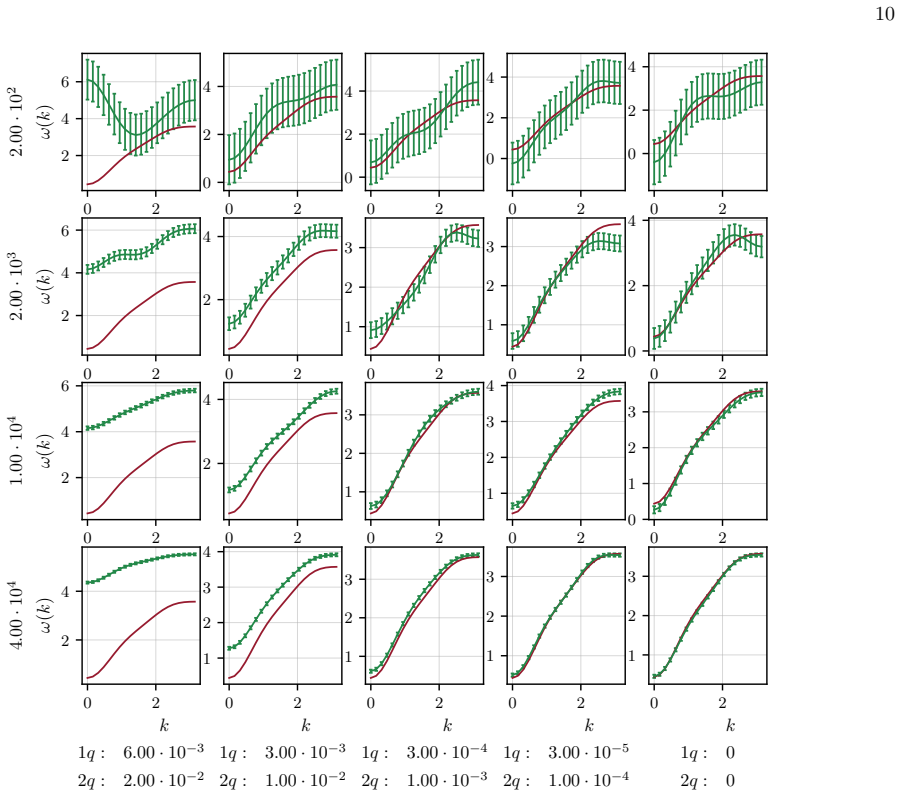
S. Demko, W. F. Moss, and P. W. Smith, Mathematics of Computation43, 491 (1984). 16 Appendix A: Detailed breakdown of the results In this section, we present a more detailed view of the results discussed previously, and whose mean errors are shown in Fig. 7. We present all dispersion curves, as well as detailed explanations of the different regimes. We sh...
1984
-
[52]
8 shows the NLCE+VQE results from two QPU runs together with statevector simulations and analytical results forJ/h= 0.8 in the gapped, disordered phase
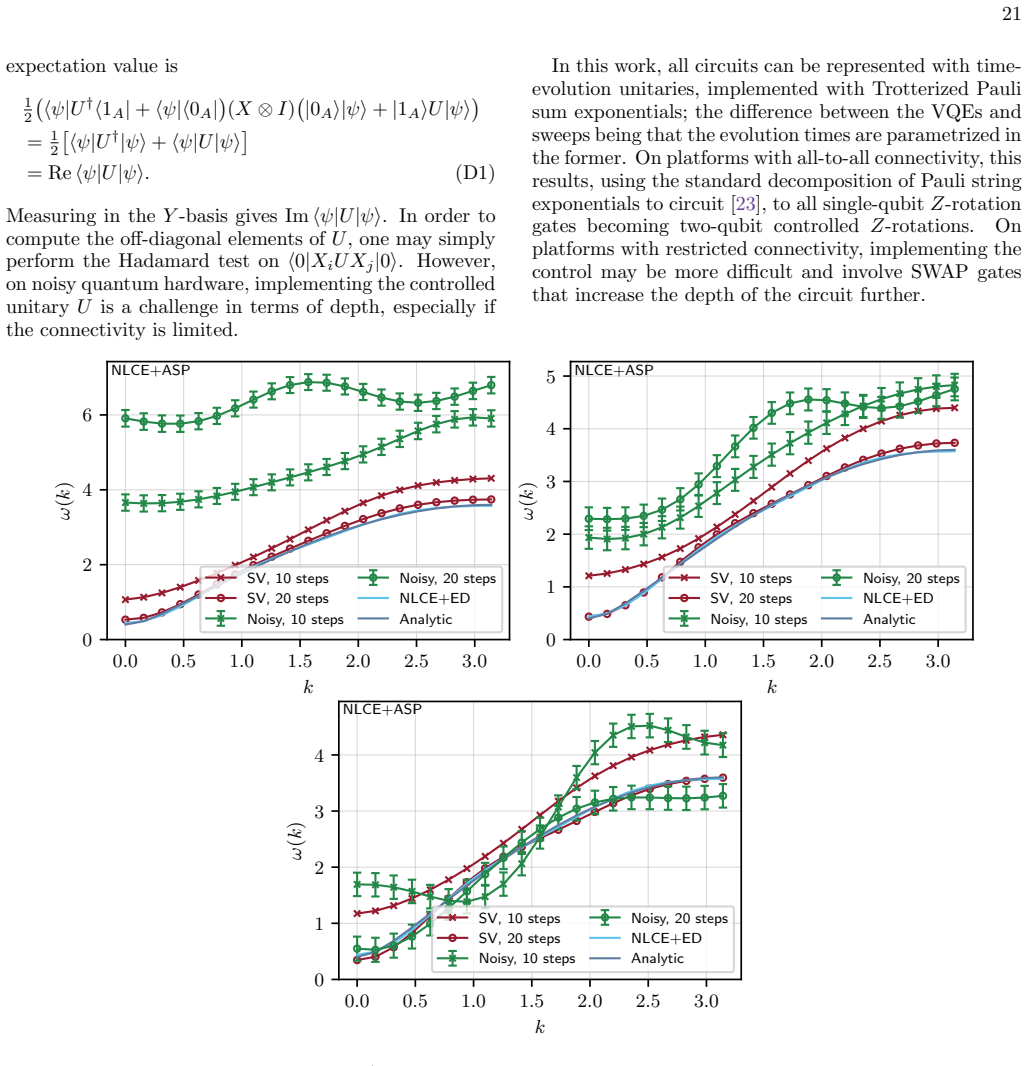
TFIM chain closer to the quantum-critical point Fig. 8 shows the NLCE+VQE results from two QPU runs together with statevector simulations and analytical results forJ/h= 0.8 in the gapped, disordered phase. In this figure, the difference between the analytic dispersion and the NLCE+ED is more apparent than in Fig. 5; the low amplitudes oscillations around ...
-
[53]
10 the dispersion curve for J/h= 1 at the quantum-critical point
TFIM chain at the quantum-critical point Next, we show in Fig. 10 the dispersion curve for J/h= 1 at the quantum-critical point. We observe that the QPU result is even further from the analytical solu- tion. While noise is still the main bottleneck, we see that the noiseless statevector VQE in this case is somewhat further to the analytical solution than ...
-
[54]
(24), is the first benchmark requiring the full PCAT correction
TFIM chain with longitudinal field The TFIM with longitudinal field (TFIM+LF), whose Hamiltonian is given in Eq. (24), is the first benchmark requiring the full PCAT correction. The longitudinal field breaks theZ 2 parity symmetry, coupling the ground state to the 1QP sector and producing non-vanishing overlaps⟨Φ [0]|Ψ[1] i ⟩ ̸= 0. As discussed in Sec. II...
-
[55]
The Hamiltonian for this model is given by Eq
TFIM on a ladder Finally, we turn to the TFIM on a two-leg ladder, the simplest two-dimensional geometry accessible with our cluster sizes. The Hamiltonian for this model is given by Eq. (24) forh l = 0, with the nearest-neighbor cou- plings along both rungs and legs of the ladder. Unlike the one-dimensional TFIM, the ladder does not have an exact analyti...
-
[56]
14 the matrix elements computed using the CX-test, that is the ˜Omatrix elements
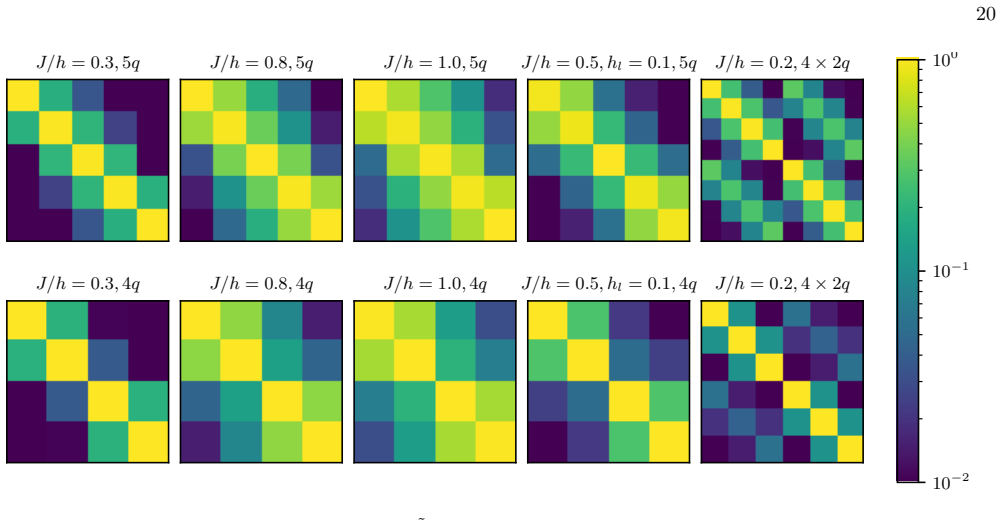
Matrix elements To give a sense of the difficulty in inverting the ma- trices of all the models that we have studied so far, we show in Fig. 14 the matrix elements computed using the CX-test, that is the ˜Omatrix elements. As we get closer to criticality, the matrix gets denser and further away from an easy inversion, since it grows out from the diag- ona...
discussion (0)
Sign in with ORCID, Apple, or X to comment. Anyone can read and Pith papers without signing in.