REVIEW 3 major objections 4 minor 1 cited by
Notes on the Loop Equation in Loop Space
T0 review · 3 major / 4 minor · reviewed 2026-08-05 · deepseek-v4-flash
Pith's one-line read The paper shows that iterating the functional Laplace form of the large-N QCD loop equation reproduces the perturbative Wilson-loop diagrams through order (g^2N)^2, including the three-gluon vertex.
desk verdict Old notes, one new claim, and the crux step is handed over with a wave: worth refereeing for the record, not for the claimed proof. read the letter →
The pith
A machine-rendered reading of the paper's core claim, the machinery that carries it, and where it could break.
The reading
What carries the argument
The central object is the smeared functional Laplacian $\Delta^{(G)}$, defined with a Gaussian kernel $G(\sigma,\sigma')=e^{-|\sigma-\sigma'|/\epsilon}$ (or its reparametrization-invariant version). At finite $\epsilon$ its Green's function is a Gaussian path integral whose action is that of an Euclidean harmonic oscillator at finite temperature. The load-bearing identities are the velocity averages (4.33), (4.39), and (4.40): they tell how ordered contour integrals involving $\dot\xi(\sigma)$ are averaged against the exponential measure, and they produce the $1/\epsilon$ factors. The $\epsilon\times\epsilon^{-1}$ limit of these averages converts the smeared, reparametrization-noninvariant e
What would settle it
Perform the order-$\lambda^2$ iteration with a generic admissible smearing function $G$ rather than the exponential kernel, keeping all velocity-correlation terms at finite $\epsilon$. If the resulting $\epsilon\to0$ limit depends on the shape of $G$, or if the unordered velocity pairs produce a surviving $\epsilon\times\epsilon^{-1}$ piece, the reconstruction of the three-gluon vertex fails. The direct cross-check is to compare expression (5.21) with the standard Yang-Mills three-gluon amplitude in $d\neq4$ dimensional regularization.
Extended reading notes
Core claim
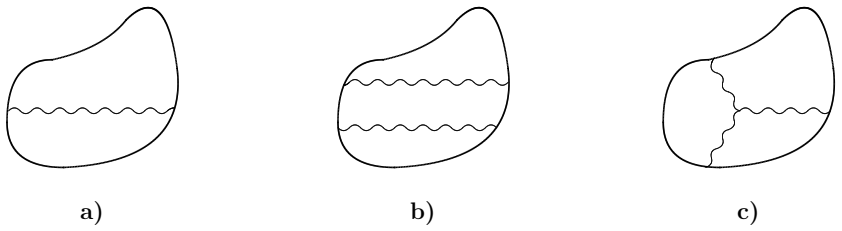
Restated on the paper's own terms, the claim is this: the scalar loop equation $$\$\Delta$ W(C) = \$\lambda$ \oint_C dx_\mu \oint_C\!\!\!\!\not\; dx'_\mu\, \$delta^{{(d)}}$(x-x') W(C_{xx'})W(C_{x'x})$$ has an explicit iterative solution $$W[x]=1-\frac12\int_0^\infty dA\left(\langle J[x+\sqrt A\,\xi]\rangle_\$xi^{{(G)}}$-\langle J[\sqrt A\,\xi]\rangle_\$xi^{{(G)}}$\right),$$ where the average over $\xi$ is Gaussian with kernel $G(\sigma,\sigma')=e^{-|\sigma-\sigma'|/\epsilon}$. Through order $\lambda$ this reproduces the diagram with a single gluon propagator, and through order $\lambda^2$ the two-gluon diagram together with the diagram containing the three-gluon vertex. The derivation handles the removal of t
Load-bearing premise
The derivation rests on the assumption that, as the smearing parameter epsilon tends to zero, the ordered velocity averages that build the three-gluon vertex are well defined and reparametrization invariant through the cancellation of epsilon-times-1-over-epsilon contributions — a property checked explicitly for one prototype average in Eq. (4.35) but not for the full set of terms entering the vertex.
Editorial extensions
If this is right
- The same iteration can in principle be pushed to higher orders in $\lambda$: the momentum-space expansion in ordered contour integrals and the Gaussian-average formulas are all-order identities, so planar diagrams are generated systematically.
- The three-gluon vertex result shows that the smearing method captures genuinely non-Abelian interactions, not just Abelian-like propagator exchanges.
- Because the polygon discretization provides a finite-dimensional Laplacian whose continuum limit is a well-defined Gaussian path integral, it supplies a fully loop-space regularization of the Wilson-loop dynamics.
- In dimensional regularization the spurious non-reparametrization-invariant terms vanish identically for any $\epsilon$; with a cutoff they vanish for smooth contours as $\epsilon\to0$, so the scheme is compatible with two regularization strategies.
- The same functional Laplacian applies to scalar Wilson loops and to supersymmetric loops, so the iterative solution extends beyond pure gluodynamics.
Reading between the lines
- The paper demonstrates only orders $\lambda$ and $\lambda^2$; a natural extension is to prove that the $\epsilon\times\epsilon^{-1}$ mechanism yields the standard Yang-Mills vertices at every loop order, which would turn this into a derivation of planar perturbation theory from the loop equation.
- The Gaussian measure behind the Green's function suggests a stochastic interpretation of Wilson-loop averages: the loop evolves in a proper time $A$ under harmonic-oscillator fluctuations, which could be simulated numerically on discretized loop space.
- The scalar-loop example in the paper is a clean test bed: applying the same iterative machinery to the Abelian case should reproduce the exponentiated photon propagator with no three-gluon vertex, isolating the non-Abelian contribution.
- The smeared Laplacian may be useful for computing cusp anomalous dimensions, where ordered contour integrals and velocity insertions play the same role as in the three-gluon vertex derivation.
Editorial analysis
A structured set of objections, weighed in public.
Referee Report
Summary. The paper reformulates the large-N QCD loop equation as a scalar functional Laplace equation on loop space. A polygon discretization of loop space is introduced, with a specific Toeplitz matrix Q_ij chosen so that the discretized Laplacian tends to the functional Laplacian in the continuum limit; the Green function is represented as a Gaussian path integral. The paper then develops a continuum smearing version (parameter ε) and derives rules for Gaussian averages, including averages involving velocities. Section 5 applies these rules iteratively: to order λ it reproduces the gluon-propagator diagram, and to order λ² it claims to reproduce the two-gluon diagram and the three-gluon-vertex diagram. The manuscript is presented as historical notes from the late 1980s/early 1990s, with recent references added.
Significance. If the derivation in Section 5.3 is completed, the paper would provide a self-contained, ansatz-free derivation of the first nontrivial Feynman diagrams of the Wilson-loop average directly from the loop equation, with no fitted parameters and with the discretization and smearing parameters removed in controlled limits. The order-λ calculation is explicit and clean, and the polygon-discretization construction is well motivated. However, the central new claim—the emergence of the three-gluon vertex—is asserted rather than demonstrated, and the paper explicitly defers the remaining order-λ² diagrams. The significance therefore hinges on whether the missing calculation can be supplied.
major comments (3)
- [§5.3, Eqs. (5.20)–(5.21)] The transition from Eq. (5.20) to Eq. (5.21) is the central new result and is not derived. The text states that the first four terms 'result, roughly speaking, in 2/3 of the three-gluon vertex' and that the two ẍ terms are transformed 'by parts', but no intermediate formulas are given, no control is shown for the domains |σ1−σ2|∼ε and |σ3−σ4|∼ε, and no check is made that the ε→0 limit is independent of the smearing function G. Since this ε×ε^{-1} limit is exactly what produces the vertex coefficient and its Lorentz structure, the claimed reproduction of the three-gluon vertex is not established. Please provide the complete calculation or explicitly label the step as a conjecture.
- [§5.3, final paragraph] The text concedes that the remaining order-λ² terms with two ẋ's/two ξ̇'s, one ẋ/three ξ̇'s, and four ξ̇'s 'should reproduce' the gluon and ghost loop insertions, but no calculation is presented. Consequently the abstract's statement that Feynman diagrams are 'reproduced through order (g²N)²' is stronger than what is actually verified. Either perform these computations or weaken the abstract to state that the three-gluon vertex emerges at order λ² while the self-energy insertions are expected and not shown.
- [§4.5 and §4.4] Reparametrization invariance of the ε→0 limit is proved in §4.5 only for the single prototype average in Eq. (4.35). The vertex calculation uses the multi-velocity formulas (4.33), (4.39), and (4.40), together with ordered θ_c integrals, and the same shape-independence of the limit must be demonstrated for those objects. The statement in §4.4 that 'general arguments' guarantee the vanishing of unordered terms is plausible, but it does not by itself show that the coefficient of the three-gluon vertex in Eq. (5.21) is independent of the smearing function. A concrete check for the exponential G of Eq. (4.10) would address this concern.
minor comments (4)
- [Introduction, p. 3] Typo: 'discterization' should be 'discretization'.
- [§2.7, Eq. (2.40)] Typo: 'whith' should be 'with'.
- [Eq. (4.35)] The notation 'dG' for the integration variable is confusing; suggest using an integration variable g with dg and writing G explicitly as a function of the separation.
- [Eqs. (5.2)–(5.3)] The expansion in ordered contour integrals assumes convergence and a regulator for the θ_c integrals; a brief comment on the sense in which this expansion is used would improve readability.
Circularity Check
No circularity: the iterative solution is a consistency check of the loop equation; the three-gluon vertex step is sketchy but not self-referential.
full rationale
The derivation chain is: large-N QCD loop equation (2.18), derived from the path integral via stochastic quantization, is converted to an integral equation with a smeared Green function; iteration with W0=1 produces W1 and W2. The claimed result — reproduction of Feynman diagrams through λ² including the three-gluon vertex — is a consistency check: the loop equation is known to encode the same Schwinger-Dyson content as perturbation theory, so recovering the propagator and vertex by iterating it is not circular. No parameter is fitted to the target diagrams: q and ε are regulator parameters taken to limits; the (1−G) factors and the ε×ε−1 cancellation are prescribed by the Gaussian averaging, not adjusted to match the vertex. The self-citations [17] (Halpern–Makeenko) and [22] (Makeenko) supply the discretization and regularization technique but are not load-bearing: the ε-smearing construction of Sect. 4 is rederived in the text, and the final order-λ² calculation uses dimensional regularization, independent of [17]. The step (5.20)→(5.21) is asserted rather than fully shown ('roughly speaking', 'can be transformed'), which is an incompleteness/correctness risk, not circularity: the claimed vertex is not assumed as an input anywhere in the derivation. No self-definitional reduction, fitted-input-as-prediction, or uniqueness-imported-from-authors pattern is present. The paper does not force its choice by an unverified self-citation; its central derivation has independent content.
Assumptions & free parameters
free parameters (2)
- q =
none (regulator; limit q→1 with M(1-q)→∞)
- ε (smearing parameter) =
none (regulator; limit ε→0)
assumptions (5)
- domain assumption The Makeenko-Migdal loop equation (2.13) holds for large-N QCD Wilson loops, and its scalar form (2.18) is equivalent to the vector form.
- standard math The functional Laplacian defined by Eq. (2.17) is the correct second-variation operator for the relevant class of functionals, with the first-order Leibniz property (2.21).
- ad hoc to paper The polygon discretization with Q_K = (q^K + q^{M-K})/(1-q^M) converges to the functional Laplacian as M→∞, q→1, M(1-q)→∞.
- ad hoc to paper For smearing functions G(σ,σ') obeying (4.7), the ε→0 limit of Gaussian averages is unique and reparametrization-invariant for reparametrization-invariant functionals.
- domain assumption The stochastic-quantization-derived regularized loop equation (2.36) of ref. [17] is the correct nonperturbative regularization of the loop equation.
Cite this review
Pith. "Pith review of Notes on the Loop Equation in Loop Space." pith.science (2026). https://pith.science/paper/OVHXLVGM
@misc{pith2026250809705,
  author       = {Pith},
  title        = {Pith review of: Notes on the Loop Equation in Loop Space},
  year         = {2026},
  howpublished = {\url{https://pith.science/paper/OVHXLVGM}},
  note         = {Machine review of arXiv:2508.09705}
}
abstract
The loop equation satisfied by Wilson's loops in QCD is reformulated as a functional Laplace equation. Discretizing the loop space by polygons, Green's function of the functional Laplacian is represented as a path integral of the Euclidean harmonic oscillator and is applied for an iterative solution of the equation. It is shown how the usual Feynman's diagrams are reproduced through order $(g^2N)^2$ including the one with the three-gluon vertex.
Figures


Figures from the paper (3 more)


Forward citations
Cited by 1 Pith paper
-
Evaluating the Role of Large Language Models in Legal Practice in India
The submitted full text is an unrelated high-energy physics article, so the abstract's legal-AI findings have no present supporting material.
Reference graph
Works this paper leans on
-
[22]
Makeenko, Polygon discretization of the loop-space equation , Phys
Yu.M. Makeenko, Polygon discretization of the loop-space equation , Phys. Lett. B212 (1988) 221
work page 1988
-
[1]
Yu.M. Makeenko and A.A. Migdal, Exact equation for the loop average in multicolor QCD , Phys. Lett. 88B (1979) 135
work page 1979
-
[2]
Yu.M. Makeenko and A.A. Migdal, Quantum chromodynamics as dynamics of loops , Nucl. Phys. B188 (1981) 269
work page 1981
-
[3]
Migdal, Loop equations and 1/N expansion, Phys
A.A. Migdal, Loop equations and 1/N expansion, Phys. Rep. 102 (1983) 199
work page 1983
-
[4]
L´ evy,Probl` emes concrets d’analyse fonctionnelle, Paris 1951
P. L´ evy,Probl` emes concrets d’analyse fonctionnelle, Paris 1951
work page 1951
-
[5]
Feller, The L´ evy Laplacian, 166 Cambridge Tracts in Mathematics, Cambridge Univ
M.N. Feller, The L´ evy Laplacian, 166 Cambridge Tracts in Mathematics, Cambridge Univ. Press (2005). 39
work page 2005
-
[6]
Makeenko, Methods of contemporary gauge theory, Cambridge Univ
Y. Makeenko, Methods of contemporary gauge theory, Cambridge Univ. Press (2002), Chap- ter 12
work page 2002
-
[7]
P. Anderson and M. Kruczenski, Loop equations and bootstrap methods in the lattice, Nucl. Phys. B 921 (2017) 702 [e-Print: 1612.08140 [hep-th]]
arXiv 2017
Show all 31 references
-
[8]
Kazakov and Z
V. Kazakov and Z. Zheng, Bootstrap for lattice Yang-Mills theory, Phys. Rev. D 107 (2023) L051501 [e-Print: 2203.11360 [hep-th]]
2023 arXiv
-
[9]
Li and S
Z. Li and S. Zhou, Bootstrapping the Abelian lattice gauge theories, JHEP 08 (2024) 154 [e-Print: 2404.17071 [hep-th]]
2024 arXiv
-
[10]
Kazakov and Z
V. Kazakov and Z. Zheng, Bootstrap for finite N lattice Yang-Mills theory , JHEP 03 (2025) 099 [e-Print: 2404.16925 [hep-th]]
2025 arXiv
-
[11]
Y. Guo, Z. Li, G. Yang, and G. Zhu, Bootstrapping SU(3) lattice Yang-Mills theory, e-Print: 2502.14421 [hep-th]
-
[12]
Migdal, Exact confining solution of the planar QCD loop equation via a matrix ensemble , e-Print: 2507.05096 [hep-th]
A. Migdal, Exact confining solution of the planar QCD loop equation via a matrix ensemble , e-Print: 2507.05096 [hep-th]
-
[13]
Migdal, Statistical equilibrium of circulating fluids , Phys
A. Migdal, Statistical equilibrium of circulating fluids , Phys. Rept. 1011 (2023) 1 [e-Print: 2209.12312 [physics.flu-dyn]]
2023 arXiv
-
[14]
Tavares, Chen integrals, generalized loops and loop calculus , preprint DF/IST 5.93 (May, 1993), hep-th/9305173
J.N. Tavares, Chen integrals, generalized loops and loop calculus , preprint DF/IST 5.93 (May, 1993), hep-th/9305173
1993 arXiv
-
[15]
Polyakov, Gauge fields as rings of glue , Nucl
A.M. Polyakov, Gauge fields as rings of glue , Nucl. Phys. B164 (1980) 172
1980
-
[16]
Gervais and A
J.L. Gervais and A. Neveu, Local harmonicity of the Wilson loop integral in classical Yang- Mills theory , Nucl. Phys. B153 (1979) 445
1979
-
[17]
Halpern, Yu.M
M.B. Halpern, Yu.M. Makeenko, Continuum regularized loop-space equation , Phys. Lett. B218 (1989) 230
1989
-
[18]
Parisi, Y.-S
G. Parisi, Y.-S. Wu, Perturbation theory without gauge fixing , Sci. Sin. 24 (1981) 483
1981
-
[19]
Zwanziger, Covariant quantization of gauge fields without gribov ambiguity , Nucl
D. Zwanziger, Covariant quantization of gauge fields without gribov ambiguity , Nucl. Phys. B192 (1981) 259
1981
-
[20]
Marchesini, A somment on the stochastic quantization: the loop equation of gauge theory as the equilibrium condition , Nucl
G. Marchesini, A somment on the stochastic quantization: the loop equation of gauge theory as the equilibrium condition , Nucl. Phys. B191 (1981) 214
1981
-
[21]
Bern, M.B
Z. Bern, M.B. Halpern, L. Sadun and C. Taubes, Continuum regularization of quantum field theory. 2. Gauge theory , Nucl. Phys. B284 (1987) 35
1987
-
[23]
Maldacena, Wilson loops in large N field theories , Phys
J. Maldacena, Wilson loops in large N field theories , Phys. Rev. Lett. 80 (1998) 4859 [hep-th/9803002]
1998 arXiv
-
[24]
Rey and J
S.-J. Rey and J. Yee, Macroscopic strings as heavy quarks in large N gauge theory and anti-de Sitter supergravity, Eur. Phys. J. C 22 (2001) 379 [hep-th/9803001]
2001 arXiv
-
[25]
Drukker, D
N. Drukker, D. J. Gross and H. Ooguri, Wilson loops and minimal surfaces , Phys. Rev. D 60 (1999) 125006 [hep-th/9904191]
1999 arXiv
-
[26]
Makeenko, P
Y. Makeenko, P. Olesen and G. W. Semenoff, Cusped SYM Wilson loop at two loops and beyond, Nucl. Phys. bf B748 (2006) 170 [hep-th/0602100]. 40
2006 arXiv
-
[27]
Fukuma, H
M. Fukuma, H. Kawai, Y. Kitazawa and A. Tsuchiya, String field theory from IIB matrix model, Nucl. Phys. B 510 (1998) 158 [hep-th/9705128]
1998 arXiv
-
[28]
H. Aoki, S. Iso, H. Kawai, Y. Kitazawa, and A. Tsuchiya, IIB matrix model , Prog. Theor. Phys. Suppl. 134 (1999) 47 [hep-th/9908038]
1999 arXiv
-
[29]
Gˆ ateaux,Th´ eorie generale des fonctionnelles, Gauthier-Villars, Paris (1937)
R. Gˆ ateaux,Th´ eorie generale des fonctionnelles, Gauthier-Villars, Paris (1937)
1937
-
[30]
Migdal, Momentum loop dynamics and random surfaces in QCD , Nucl
A.A. Migdal, Momentum loop dynamics and random surfaces in QCD , Nucl. Phys. B265 [FS15] (1986) 594
1986
-
[31]
Bershadski, I.D
M.A. Bershadski, I.D. Vaisburd and A.A. Migdal, Fourier functional transformations and loop equation, Sov. J. Nucl. Phys. 43 (1986) 319. 41
1986
Reviewed August 5, 2026 · model on record in the stance chip above.
Discussion (0). Continue with ORCID to comment.