REVIEW 3 major objections 5 minor 25 references
Mathematical methods of diagonalization of quadratic forms applied to the study of stability of thermodynamic systems
T0 review · 3 major / 5 minor · reviewed 2026-08-14 · deepseek-v4-flash
Pith's one-line read A consistent derivation ties the nonnegativity of $c_v$, $c_p$, $k_T$, and $k_s$ to the curvature classification of thermodynamic potentials by diagonalizing quadratic forms obtained from Taylor expansions.
desk verdict A well-intended teaching note whose central derivation rests on a false premise: setting the first derivatives of u(s,v) to zero at equilibrium, which is not true and not needed. read the letter →
The pith
A machine-rendered reading of the paper's core claim, the machinery that carries it, and where it could break.
The reading
What carries the argument
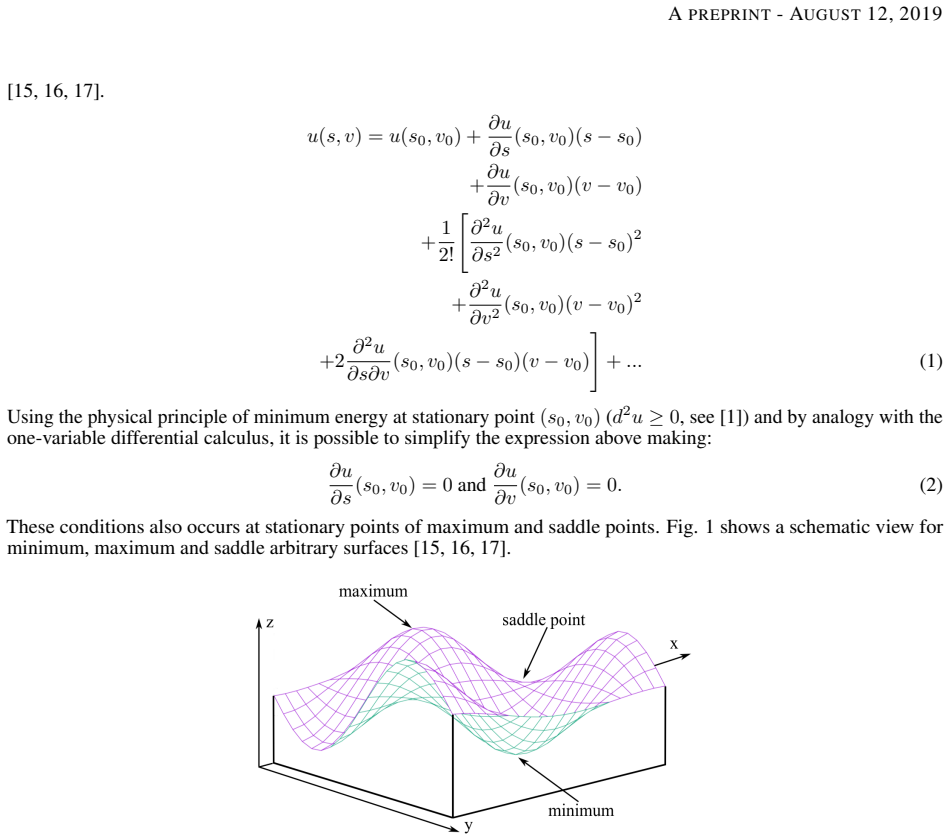
The load-bearing object is the Hessian matrix of each thermodynamic potential, written as a symmetric quadratic form from the second-order Taylor expansion, with entries $a = \partial^2 u/\partial s^2$, $b = \partial^2 u/\partial v^2$, and $c = 2\,\partial^2 u/\partial s\partial v$. Diagonalizing this matrix reduces the quadratic form to $\lambda_1 \Delta s'^2 + \lambda_2 \Delta v'^2$, converting stability questions into eigenvalue-sign questions: nonnegative eigenvalues for a minimum, nonpositive for a maximum, and mixed signs for a saddle. The same procedure is repeated for the entropy, Helmholtz, enthalpy, and Gibbs potentials, and the relevant response coefficients are identified with the curvature signs.
What would settle it
Take any known stable simple fluid, such as an ideal gas with $u = c_v T$, and compute the first derivatives $\partial u/\partial s = T$ and $\partial u/\partial v = -p$ at an equilibrium state: neither is zero, so Eq. (2) is not satisfied while the stability inequalities still hold; this would show the paper's derivation route cannot be the actual source of the inequalities. Alternatively, if any empirical equation of state produced a stable state with negative $c_v$ or $k_T$, the claimed curvature-stability link would be refuted.
Extended reading notes
Core claim
The paper's central claim is that the type of each thermodynamic potential surface—minimum, maximum, or saddle—is fixed by the signs of the eigenvalues of its second-derivative matrix, and that these eigenvalue signs are exactly what the stability principles select. For $u(s,v)$, the requirement that the canonical form $\lambda_1 \Delta s'^2 + \lambda_2 \Delta v'^2$ stay nonnegative forces both eigenvalues to be nonnegative, which is equivalent to the three inequalities in Eq. (13). The same diagonalization applied to $s(u,v)$ gives the opposite signs required by the maximum-entropy principle, while the Legendre-transformed potentials $f$, $h$, and $g$ inherit a sign flip in each transformed variable: $f$ and $h$ are saddle surfaces and $g$ is a maximum. In Section 4 the derivatives that define $c_v$, $c_p$, $k_T$, and $k_s$ are matched to these curvatures, yielding $c_v \ge 0$, $c_p \ge 0$, $k_T \ge 0$, and $k_s \ge 0$. Thus the paper presents a consistent demonstration that thermal and mechanical stability are immediate corollaries of the curvature classification of thermodynamic potentials.
Load-bearing premise
The whole eigenvalue analysis rests on Eq. (2), which sets $\partial u/\partial s = 0$ and $\partial u/\partial v = 0$ at the equilibrium state; for a real one-component system $T = \partial u/\partial s > 0$ and $p = -\partial u/\partial v > 0$, so those first derivatives do not vanish there, and if that premise is removed the derivation as written collapses.
Editorial extensions
If this is right
- The nonnegativity of $c_v$ and $c_p$ follows directly from the concavity of the Helmholtz and Gibbs potentials in temperature, without invoking microscopic models.
- The nonnegativity of $k_T$ and $k_s$ follows from the convexity of the Helmholtz potential in volume and the concavity of the enthalpy in pressure.
- The determinant inequality $u_{ss}u_{vv} - u_{sv}^2 \ge 0$ is the same requirement that the energy surface be locally convex, so thermal and mechanical stability are two faces of one curvature condition.
- The Legendre-transform sign-flip rule means every potential with a mix of extensive and intensive variables is a saddle, and only a fully transformed potential such as the Gibbs function can be a maximum.
- Since $\alpha$ changes sign in real materials such as water below $4\,^\circ\mathrm{C}$, the curvature analysis does not constrain $\alpha$; stability only constrains combinations like $c_p - c_v = T v \alpha^2 / k_T \ge 0$.
Reading between the lines
- The stationarity premise in Eq. (2) is not physically satisfied, so a charitable reconstruction of the argument would use convexity of $u$ and concavity of $s$ as the actual premises; the paper's inequalities would still follow without requiring the first derivatives to vanish.
- The same Hessian-diagonalization logic generalizes to multicomponent or multi-variable systems, where stability would require the leading principal minors of the Hessian to satisfy alternating or nonnegative sign conditions.
- The determinant inequality could be tested directly on empirical equations of state as a local stability diagnostic, independent of the pedagogical route used here.
Signed reviews
Editorial analysis
A structured set of objections, weighed in public.
Referee Report
Summary. The manuscript claims to provide a consistent mathematical demonstration of the minimum, maximum, and saddle conditions of thermodynamic potentials by expanding the energy, entropy, Helmholtz, enthalpy, and Gibbs functions in Taylor series, expressing the second-order terms as quadratic forms, and diagonalizing the associated matrices. From this procedure the authors derive the standard stability inequalities u_ss≥0, u_vv≥0, u_ss u_vv - u_sv²≥0 and, via the curvatures of the Legendre-transformed potentials, the positivity of c_v, c_p, k_T, and k_s. Section 4 connects these curvature conditions to the signs of physical quantities and concludes that thermal and mechanical stability follow from the minimum-energy principle. The paper is pedagogical in intent and treats a one-component system in the entropy and energy representations.
Significance. If the derivation were correct, the paper would offer an accessible, self-contained derivation of standard thermodynamic stability conditions. Its strength is that Section 4 correctly identifies the derivative identities (e.g., ∂²f/∂T² = -∂s/∂T and ∂v/∂p = ∂²h/∂p²) that link potential curvatures to measurable coefficients, and the final inequalities c_v≥0, c_p≥0, k_T≥0, k_s≥0 are the correct textbook results. However, the central derivation in Section 2 rests on an incorrect physical premise and an inconsistent matrix formulation, so the claimed 'consistent mathematical demonstration' is not achieved as written. The paper also provides no machine-checkable proofs, and several sign assignments for Legendre-transformed potentials are asserted rather than derived. The correct results are standard and are not placed in a new or more rigorous framework, so the contribution is at best a draft of a pedagogical note.
major comments (3)
- [Section 2, Eq. (2)] The derivation of the quadratic form in Eq. (4) depends on setting ∂u/∂s=0 and ∂u/∂v=0 at the expansion point (s0,v0). For a one-component thermodynamic system these derivatives are the intensive fields: ∂u/∂s=T>0 and ∂u/∂v=-p<0 (with p>0) in any ordinary equilibrium state. Thus Eq. (2) is false unless one is considering an artificial stationary point of the energy surface, which is not the physical equilibrium of a simple system. The minimum-energy principle does not imply stationarity of u(s,v) with respect to independent variations of s and v; it implies convexity of u(s,v). Without Eq. (2), the Taylor expansion retains the linear terms TΔs - pΔv, and the truncation cannot be written as the homogeneous quadratic form of Eq. (4). The subsequent eigenvalue analysis, and hence Eq. (13), therefore does not apply to the physical energy difference. Since the inequalities for c_v, c_p, k_T, and k_s in Section 4 are presented as consequences of these curvature conditions, the central claim of the abstract is unsupported.
- [Section 2, Eqs. (4)-(11)] There is an inconsistency between the quadratic form and its matrix representation. With a≡u_ss, b≡u_vv, and c≡2u_sv, the quadratic form in Eq. (4) is a(Δs)² + b(Δv)² + cΔsΔv, which corresponds to the symmetric matrix [[a, c/2], [c/2, b]], not [[a, c], [c, b]] as written in Eq. (5). The eigenvalue equation should involve (a-λ)(b-λ) - c²/4 = 0, not (a-λ)(b-λ) - c² = 0. Consequently the determinant condition for positive eigenvalues is ab - c²/4 > 0, which, with c=2u_sv, is exactly u_ss u_vv - u_sv² > 0. The paper's calculation ab - c² > 0 would give u_ss u_vv - 4u_sv² > 0. Thus the third inequality in Eq. (13) does not follow from the stated matrix; the correct factor arises only if the off-diagonal matrix element is c/2. This is a load-bearing mathematical error in the derivation of the stability determinant.
- [Section 2, Eqs. (21), (25), and (26)] The sign assignments for the Legendre-transformed potentials f, h, and g are asserted rather than derived from the stated quadratic-form methodology. For f the paper states that one 'needs to set eigenvalues with opposite signs', and for h and g that the signs follow 'by analogy with the previous cases', but no Taylor expansion or diagonalization is actually performed for these functions. In particular, Eq. (21) is not derived from the minimum-energy principle or from the Legendre transformation; the correct result ∂²f/∂T² = -1/(∂²u/∂s²) is stated in the text but is not used to derive the determinantal inequality. Moreover, Eq. (25) contains an undefined derivative: h(s,p) is a function of s and p, yet the first inequality is written as ∂²h/∂u²≥0. This appears to be a typo for ∂²h/∂s², but as printed the expression is meaningless and the claimed derivation is incomplete. The same applies to the eigenvalue assignments for g in Eq. (26).
minor comments (5)
- [Section 3, Eq. (29)] The definitions of c_v and c_p are both written as T ∂s/∂T without indicating the variable held constant; c_v should have v constant and c_p should have p constant. The subscript is present in the names but absent in the formulas.
- [Section 4, around Eq. (51)] The text says 'Helmholtz's potential h' when it is describing the enthalpy h(s,p); the Helmholtz potential is f(T,v). This naming error appears just before Eq. (51).
- [Throughout] The English is often ungrammatical or awkward (e.g., 'the almost infinite fredom degrees envolved', 'the solid princicle of minimum energy'), and there are numerous typos. A careful language revision is needed for a journal submission.
- [References] Reference [2] and [3] are in Portuguese, which is acceptable, but the capitalization and formatting are inconsistent (e.g., 'V ol.', 'Wreszinski, Termodinâmica V ol. 50'). Reference [18] is in Portuguese; this is fine, but all entries should be formatted uniformly.
- [Section 2, Eqs. (12) and (13)] The definitions a, b, c in Eq. (12) omit the evaluation at (s0,v0), despite the earlier definitions in the text including it. Adding the evaluation point would make the notation consistent.
Circularity Check
Mild circularity: Eq. (13) restates the d2u≥0 premise, and the f/h/g sign patterns are imposed before diagonalization.
-
self definitional
[Sec. 2, Eqs. (1)–(13)]
"Using the physical principle of minimum energy at stationary point (s0,v 0) (d2u≥ 0, see [1]) ... The physical principle of minimum energy imposes the function ˜u(s,v ) ... ≥ 0 that occurs only when λ1≥ 0 and λ2≥ 0 ... ∂2u ∂s2 ≥ 0 , ∂2u ∂v 2 ≥ 0 and ∂2u ∂s2 ∂2u ∂v 2 − ( ∂2u ∂s∂v )2 ≥ 0. (13)"
The derivation starts from the premise d2u≥0, which already states that the Hessian quadratic form is positive semidefinite. For a symmetric 2×2 matrix, positive semidefiniteness is equivalent, by the principal-minor criterion, to exactly the three inequalities in Eq. (13). The diagonalization step (λ1≥0 and λ2≥0) is the same statement in the eigenbasis. Thus Eq. (13) is not a new consequence derived from the minimum-energy principle; it is an entrywise restatement of the input 'd2u≥0' that was assumed at the outset.
-
self definitional
[Sec. 2, Eqs. (21), (25), (26)]
"If we employ the same method used foru in the Helmholtz potential, in this case we need to set eigenvalues with opposite signs in canonical form off (similarly to the Eq. 6). Remembering that we achievedf by Legendre transformation ons parameter ofu function whereby we introduceT as variable off. This surface of two variablesf has a maximum in relation to the temperature but a minimum in relation to the volume."
To obtain Eq. (21), the paper first asserts that f is a saddle surface and then imposes opposite-sign eigenvalues in the diagonalization; the resulting inequalities ∂2f/∂T2≤0, ∂2f/∂v2≥0, and det≤0 are exactly that prior assertion. The same pattern is used for h and g: h is declared to be a maximum in p and a minimum in s, and for g the signs are announced before Eq. (26), with the diagonalization 'obtained by analogy' or by a Taylor expansion after the signs have already been put in. The sign patterns therefore are not consequences of the diagonalization; they are inputs smuggled in as requirements.
full rationale
The paper contains no data fitting, no benchmark prediction, and no load-bearing self-citation chain; its references to Callen and standard mathematics are external and non-circular. The core energy-function analysis is a pedagogical unpacking: once 'minimum energy' is written as d2u≥0, the eigenvalue argument leading to Eq. (13) restates positive semidefiniteness of the Hessian in terms of principal minors. That is mathematically correct but does not add physical content beyond the postulate. The more genuinely circular element is in the treatment of the Legendre-transformed potentials: the saddle/maximum character of f, h, and g is asserted or imposed before the diagonalization is performed, so Eqs. (21), (25), and (26) are not independently derived from the minimum-energy principle. Separately, Eq. (2) sets ∂u/∂s=0 and ∂u/∂v=0 at equilibrium, which is physically incorrect for a one-component system because those derivatives are T and -p; this is a correctness problem for the motivating expansion, not itself a circularity, but it reinforces that the quadratic-form argument is not a faithful representation of the physical energy difference. Overall the stability conclusions are standard and the proof is mostly self-contained, but the imposed Legendre-potential signs and the restatement of d2u≥0 as Eq. (13) warrant a mild circularity score of 3.
Assumptions & free parameters
assumptions (5)
- domain assumption A well-defined fundamental equation u(s,v) exists and is twice differentiable.
- domain assumption The minimum energy principle and maximum entropy principle are valid.
- ad hoc to paper At the equilibrium state, the first derivatives ∂u/∂s and ∂u/∂v vanish.
- domain assumption Legendre transformation changes the curvature of the transformed function with respect to the introduced intensive variable and leaves other curvatures unchanged.
- standard math Taylor's theorem and the spectral theorem for symmetric matrices are applicable.
Cite this review
Pith. "Pith review of Mathematical methods of diagonalization of quadratic forms applied to the study of stability of thermodynamic systems." pith.science (2026). https://pith.science/paper/OVJWOZAH
@misc{pith2026190803211,
  author       = {Pith},
  title        = {Pith review of: Mathematical methods of diagonalization of quadratic forms applied to the study of stability of thermodynamic systems},
  year         = {2026},
  howpublished = {\url{https://pith.science/paper/OVJWOZAH}},
  note         = {Machine review of arXiv:1908.03211}
}
read the original abstract
In this paper, we use quadratic forms diagonalization methods applied to the function thermodynamic energy to analyze the stability of physical systems. Taylor's expansion was useful to write a quadratic expression for the energy function. We consider the same methodology to expanding the thermodynamic entropy and investigate the signs of the second-order derivatives of the entropy as well as previously to the thermodynamic energy function. The signs of the second-order derivatives to the Helmholtz, enthalpy and Gibbs functions are also analysed. We show the immediate consequences on the stability of physical systems due to the signs or curvatures of the second-order derivatives of these thermodynamic functions. The thermodynamic potentials are presented and constructed pedagogically as well as demonstrated the main mathematical aspects these surfaces. We demonstrate the power of superposition of mathematical and physical aspects to understand the stability of thermodynamic systems. Besides, we provide a consistent mathematical demonstration of the minimum, maximum, and saddle conditions of the potentials. We present here a detailed approach on aspects related to the curvature of the thermodynamic functions of physical interest with consequences on stability. This work can be useful as a part or supplement material of the traditional physics curriculum that requires a solid formation in thermodynamics, particularly about formal aspects on the stability.
Figures
Reference graph
Works this paper leans on
-
[1]
H. B. Callen, Thermodynamics and an introduction to thermostatistics (1998)
work page 1998
-
[2]
M. J. de Oliveira, Termodinâmica, Editora Livraria da Física, 2005
work page 2005
-
[3]
W. F. Wreszinski, Termodinâmica V ol. 50, Edusp, 2003
work page 2003
-
[4]
R. P. Feynman, R. B. Leighton, M. Sands, The Feynman lectures on physics, V ol. I: The new millennium edition: mainly mechanics, radiation, and heat, V ol. 1, Basic books, 2011
work page 2011
-
[5]
P. M. Harman, P. M. Harman, Energy, force and matter: the conceptual development of nineteenth-century physics, Cambridge University Press, 1982
work page 1982
-
[6]
D. H. Perkins, D. H. Perkins, Introduction to high energy physics, CAMBRIDGE university press, 2000
work page 2000
-
[7]
J. Shrimpton, Charge injection systems: physical principles, experimental and theoretical work, Springer Science & Business Media, 2009
work page 2009
-
[8]
D. Zhou, G. G. Zhang, D. Law, D. J. Grant, E. A. Schmitt, Physical stability of amorphous pharmaceuticals: importance of configurational thermodynamic quantities and molecular mobility, Journal of pharmaceutical sciences 91 (8) (2002) 1863–1872
work page 2002
Show all 25 references
-
[9]
Zeck, Thermodynamics in process development in the chemical industry-importance, benefits, current state and future development, Fluid phase equilibria 70 (2-3) (1991) 125–140
S. Zeck, Thermodynamics in process development in the chemical industry-importance, benefits, current state and future development, Fluid phase equilibria 70 (2-3) (1991) 125–140
1991
-
[10]
D. C. Rapaport, D. C. R. Rapaport, The art of molecular dynamics simulation, Cambridge university press, 2004
2004
-
[11]
M. P. Allen, D. J. Tildesley, Computer simulation of liquids, Oxford university press, 2017
2017
-
[12]
K. T. O’Neil, W. F. DeGrado, A thermodynamic scale for the helix-forming tendencies of the commonly occurring amino acids, Science 250 (4981) (1990) 646–651
1990
-
[13]
W. R. Fawcett, Thermodynamic parameters for the solvation of monatomic ions in water, The Journal of Physical Chemistry B 103 (50) (1999) 11181–11185
1999
-
[14]
J. D. Forman-Kay, The’dynamics’ in the thermodynamics of binding, Nature Structural & Molecular Biology 6 (12) (1999) 1086
1999
-
[15]
K. F. Riley, M. P. Hobson, S. J. Bence, Mathematical methods for physics and engineering: a comprehensive guide, Cambridge university press, 2006
2006
-
[16]
T. M. Apostol, Calculus, V olume I, One-variable Calculus, with an Introduction to Linear Algebra, V ol. 1, John Wiley & Sons, 2007
2007
-
[17]
G. B. Arfken, H. J. Weber, Mathematical methods for physicists (1999)
1999
-
[18]
Anton, C
H. Anton, C. Rorres, Álgebra linear com aplicações, V ol. 8, Bookman Porto Alegre, 2001
2001
-
[19]
M. L. Boas, Mathematical methods in the physical sciences, John Wiley & Sons, 2006
2006
-
[20]
Yoon, Y .-W
D. Yoon, Y .-W. Son, H. Cheong, Negative thermal expansion coefficient of graphene measured by raman spectroscopy, Nano letters 11 (8) (2011) 3227–3231
2011
-
[21]
Cavillon, P
M. Cavillon, P. D. Dragic, J. Ballato, Additivity of the coefficient of thermal expansion in silicate optical fibers, Optics letters 42 (18) (2017) 3650–3653
2017
-
[22]
P. Kim, L. Shi, A. Majumdar, P. L. McEuen, Thermal transport measurements of individual multiwalled nanotubes, Physical review letters 87 (21) (2001) 215502
2001
-
[23]
M. S. Dresselhaus, G. Dresselhaus, P. C. Eklund, Science of fullerenes and carbon nanotubes: their properties and applications, Elsevier, 1996
1996
-
[24]
Taulier, T
N. Taulier, T. V . Chalikian, Compressibility of protein transitions, Biochimica et Biophysica Acta (BBA)-Protein Structure and Molecular Enzymology 1595 (1-2) (2002) 48–70
2002
-
[25]
Marcus, On the compressibility of liquid metals, The Journal of Chemical Thermodynamics 109 (2017) 11–15
Y . Marcus, On the compressibility of liquid metals, The Journal of Chemical Thermodynamics 109 (2017) 11–15. 12
2017
Reviewed August 14, 2026 · model on record in the stance chip above.
Discussion (0). Continue with ORCID to comment.