REVIEW 2 major objections 5 minor 1 cited by
Making Non-Markovian master equations accessible with approximate environments
T0 review · 2 major / 5 minor · reviewed 2026-08-06 · deepseek-v4-flash
Pith's one-line read Replacing the environment's correlation function with a sum of decaying exponentials turns non-Markovian master-equation coefficients into algebraic expressions, giving near-exact weak-coupling dynamics roughly three orders of magnitude…
desk verdict A useful speedup for non-Markovian master equations, but the closed-form coefficients hinge on the invalid symmetry C(-t)=C(t); the diagonal formulas survive, off-diagonal ones need correction. read the letter →
The pith
A machine-rendered reading of the paper's core claim, the machinery that carries it, and where it could break.
The reading
What carries the argument
The load-bearing object is the approximation $C(\tau)=\sum_{k=0}^{m} c_k e^{-\nu_k \tau}$ of the environment's two-time correlation function, with complex coefficients and decay exponents supplied by fitting routines compared in the paper. Because exponentials have elementary integrals, every integral that defines the master-equation coefficients becomes a closed-form sum; this is what lets the paper write $\Gamma$ and $\xi$ from Eqs. (61)-(63) and (74)-(75) without numerical quadrature or principal-value integration. Auxiliary variables $y_k(t)=\int_0^t ds\, c_1(s) c_k e^{-\nu_k(t-s)}$ mediate the conversion of the Volterra integrodifferential equation into $m+1$ ordinary differential equations.
What would settle it
Numerically integrate Eq. (57) for a finite-temperature underdamped spectral density using a fixed sum-of-exponentials $C(\tau)$, and compare the result point by point with the closed form Eq. (61). A mismatch that persists as the quadrature tolerance decreases, while matching after replacing $C$ by its real-even part, would show the symmetry assumption is load-bearing; adding the conjugate term should restore agreement.
Extended reading notes
Core claim
The central claim is that sum-of-exponentials approximations of the environment, already a standard ingredient of numerically exact methods, make non-Markovian master equations genuinely practical. For the cumulant (refined weak-coupling) equation and the second-order time-convolutionless (Redfield) equation, the paper derives closed forms for the decay rates $\Gamma(\omega,\omega',t)$ and the Lamb-shift coefficients $\xi(\omega,\omega',t)$: substituting $C(\tau)=\sum_k c_k e^{-\nu_k \tau}$ turns the double time integrals into elementary sums over $k$, with $\Gamma_k$ a combination of exponentials and rational functions of $\nu_k-i\omega$ and $\xi_k$ its imaginary-part counterpart. The same substitution turns higher-order time-convolutionless coefficients into $O(m^n)$ sums and converts Volterra integrodifferential equations into systems of ordinary differential equations. The paper further claims that the Lamb shift, usually dropped because of principal-value integrals, is non-negligible in heat-transport scenarios and is needed to reproduce heat currents; GKLS generators miss this because their Lamb shift commutes with the Hamiltonian.
Load-bearing premise
The formulas collapse the two integration triangles through the stated symmetry $C(-t)=C(t)$; for the complex thermal correlation defined in the paper the standard relation is $C(-t)=C(t)^*$, so the algebra as written presupposes a real, even (or specially symmetric) correlation function.
Editorial extensions
If this is right
- Decay rates and Lamb-shift coefficients of the cumulant and TCL2 equations can be evaluated algebraically, so non-Markovian simulations no longer need per-time-step quadrature.
- Lamb-shift corrections become cheap enough to include routinely, and the paper shows they are required for an accurate heat-current description in two-qubit heat transport.
- Higher-order TCL equations, normally avoided because of high-dimensional integrals, become feasible at $O(m^n)$ cost and can handle structured experimental spectral densities such as the FMO phonon environment.
- Memory-kernel integrodifferential equations of Volterra type can be solved as systems of ODEs, extending the technique beyond master equations.
- In the weak-coupling regime, the approximate generators reproduce numerically exact HEOM dynamics to near-unit fidelity while cutting coefficient computation time by roughly three orders of magnitude.
Reading between the lines
- The derivation collapses the two triangular integration regions using the identity $C(-t)=C(t)$, but the thermal correlation function defined in Eq. (1), with its sine imaginary part, satisfies $C(-t)=C(t)^*$; for genuinely complex baths the closed forms as written may need an additional conjugate contribution or hold exactly only for real, even correlation functions.
- Because the Lamb shift contributes to heat only through non-commuting, off-diagonal Bohr-frequency terms, finite-time engine cycles previously optimized with local or global GKLS equations are a natural place to re-test efficiency and power bounds with these methods.
- The same ODE-conversion trick for Volterra equations could speed up non-equilibrium Green's function and Mori-Zwanzig memory-kernel calculations, wherever the kernel is a sum of exponentials.
- Since master equations keep the system Hilbert space fixed while HEOM and pseudomode methods grow their auxiliary space with the number of exponents, the technique may scale better for multi-bath or highly structured environments.
Signed reviews
Editorial analysis
A structured set of objections, weighed in public.
Referee Report
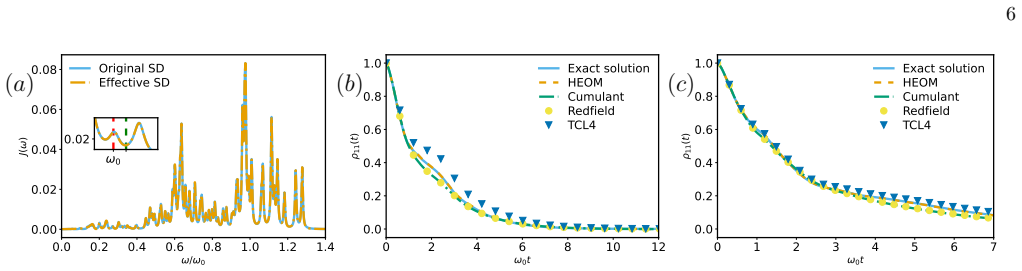
Summary. The paper proposes approximating the environment two-time correlation function by a finite sum of decaying exponentials, and uses this decomposition to turn the decay rates and Lamb-shift coefficients of non-Markovian master equations (the cumulant equation and TCL2) into algebraic expressions. The authors benchmark the resulting master equations against HEOM in four examples: spin-boson dynamics, heat transport between two qubits, a Kerr nonlinear oscillator, and a structured spectral density taken from FMO. They report speedups of about three orders of magnitude, accuracy comparable to HEOM in the weak-coupling regime, and find that the Lamb-shift correction is non-negligible for heat currents. The paper also provides a comparative study of methods for obtaining the exponential decomposition and code to reproduce the examples.
Significance. If the central derivation is correct, the paper offers a practical and broadly applicable acceleration of non-Markovian master equations, making Lamb-shift corrections routinely available and extending the reach of finite-time quantum thermodynamics. The strengths include reproducible code, a useful comparison of exponent-fitting methods, and numerical benchmarks against HEOM for several distinct models. The paper does not fit system dynamics to system observables, so there is no circularity in the usual sense. However, the algebraic closed forms rest on a symmetry identity for the correlation function that is false for the complex correlation function used throughout, so the main computational claim is not yet fully supported.
major comments (2)
- [Appendix, The Cumulant Equation, Eqs. (57)-(62) and (74)-(75)] Equation (58) states C(-t)=C(t), but the correlation function defined in Eq. (1) satisfies C(-t)=C(t)^* for real J(ω). The relabeling in Eq. (60) is therefore not valid for the complex, non-even correlation function considered in the paper. In the second triangular region one must use the conjugate coefficients c_k^* and ν_k^*, or equivalently C^*(t1-t2) after relabeling. Consequently Eqs. (61)-(62) and (74) omit conjugate terms whenever ω≠ω'. The diagonal limits in Eqs. (63) and (75) are protected because for ω=ω' the two triangles become complex conjugates of each other, but the off-diagonal coefficients entering the generator in Eq. (3) are not protected. Because the claimed algebraic speedup and the non-commuting Lamb-shift in Example 2 rely on these off-diagonal coefficients, this is a load-bearing issue. The authors should either derive the corrected expressions with c_k^* and ν_k^*, or explicitly restrict the closed forms to the diagonal/real-even case and use numerical integration for off-diagonal terms.
- [Example 2 (Heat Transport), Figs. 3 and 10; Appendix on heat currents] The physical claim that the Lamb-shift is necessary for an accurate heat-current description depends on the HEOM reference being converged, but the paper reports no convergence check for the HEOM heat current (hierarchy depth, number of Matsubara/exponential terms, or bath discretization). Heat currents are known to be more sensitive to truncation than state fidelities, so a convergence study is needed. In addition, the cumulant heat current is computed using the approximation d/dt e^{X(t)}ρ(0) ≈ d/dt X(t)ρ(t) in Eq. (92), and the text says only that the validity was checked without showing the comparison. Please provide a direct comparison between this approximation and the numerical differentiation of Eq. (91) for the parameter regime of Fig. 10, especially at early times where the claimed failure of GKLS is most visible. Without these checks, the quantitative heat-current statement is not fully established.
minor comments (5)
- [Appendix, Volterra ODE conversion, Eqs. (21)-(24)] Differentiating Eq. (21) gives ˙y_k(t)=c_k c_1(t) - ν_k y_k(t), not c_1(t)-ν_k y_k(t) as written in Eq. (24). Please correct the missing factor c_k or redefine y_k without the amplitude.
- [Appendix, NLSQ-PS, Eq. (33)] The expression C_k(t)=(a_k+ib_k)e^{-(c_k+id_k)} appears to be missing the time variable in the exponent; it should read e^{-(c_k+id_k)t}.
- [Throughout] There are several typos and formatting issues, including 'acknkowledges', 'Futhermore', 'optmiality', 'volterra', and spacing issues in Table I and the text. A careful proofread is recommended.
- [Conclusions] The complexity statement 'O(m^{n/2})' in the Conclusions is not derived or explained; the earlier discussion suggests an O(m^n) sum over n indices for n-th order coefficients. Please clarify the scaling and define the notation precisely.
- [Introduction and abstract] The abstract and introduction would benefit from a precise statement of the domain of validity of the exponential-decomposition formulas: in particular, whether C is assumed real-even or whether the complex case requires conjugate terms, and whether the weak-coupling condition is quantified.
Circularity Check
No significant circularity: the exponential decomposition is an input approximation fitted to the environment, and the predicted master-equation coefficients are benchmarked against independent HEOM and exact solutions.
full rationale
The paper's central derivation is self-contained: it takes C(t)=sum_k c_k exp(-nu_k t) (Eqs. 2 and 54) as an approximation of the environmental correlation function, substitutes it into the cumulant/TCL integrals (Eqs. 4-5, 57, 66), and evaluates the integrals in closed form (Eqs. 61-63, 74-75, 77). The fit parameters c_k and nu_k are obtained from the environment correlation function, spectral density, or power spectrum, never from the system master-equation coefficients being predicted. The resulting decay rates and Lamb shifts are then checked against Gauss-Kronrod integration of the original correlation function and against numerically exact HEOM or exact solutions (Figs. 2, 5, 8-10), so no fitted input is renamed as a prediction. The paper cites its own earlier work on the refined weak-coupling/cumulant equation (refs. 9, 10, 12, 41), but that is background methodology and is independently benchmarked here; no uniqueness theorem or ansatz is imported solely through those citations. A non-circular correctness caveat should be noted: Eq. (58) states C(-t)=C(t), whereas the complex correlation function of Eq. (1) satisfies C(-t)=C(t)^*. If the omitted conjugate terms are not accounted for, the closed forms in Eqs. (61)-(62) and (74) may require a corrected derivation or an explicit restriction to real, even correlations. This is a mathematical-error concern, not a circularity, because the formulas do not presuppose the system dynamics they are used to predict.
Assumptions & free parameters
free parameters (2)
- Exponential decomposition coefficients c_k and exponents ν_k per bath =
example-dependent, e.g., m=50 for the FMO structured spectral density
- Number of exponents m (truncation order) per example =
chosen per tolerance, e.g., m=50 for FMO; smaller m for underdamped examples
assumptions (5)
- domain assumption Gaussian environment assumption
- domain assumption Weak-coupling and second-order Born approximation
- domain assumption Finite exponential representation is sufficiently accurate
- ad hoc to paper C(-t) = C(t)
- domain assumption Heat-current derivative linearization for the cumulant map
Cite this review
Pith. "Pith review of Making Non-Markovian master equations accessible with approximate environments." pith.science (2026). https://pith.science/paper/OW6GAA5X
@misc{pith2026250622346,
  author       = {Pith},
  title        = {Pith review of: Making Non-Markovian master equations accessible with approximate environments},
  year         = {2026},
  howpublished = {\url{https://pith.science/paper/OW6GAA5X}},
  note         = {Machine review of arXiv:2506.22346}
}
read the original abstract
Accurate and efficient simulation of open quantum systems remains a significant challenge, particularly for Non-Markovian dynamics. We demonstrate the profound utility of expressing the environmental correlation function as a sum of damped sinusoidals within master equations. While not strictly required, this decomposition offers substantial benefits, crucially reducing the cost of Lamb-shift and decay rates calculations without sacrificing accuracy. Furthermore, this approach enables straightforward calculation of Lamb-shift corrections, bypassing the need for complex principal value integration. We show that these Lamb-shift effects are demonstrably non-negligible in heat transport scenarios, and are needed for an accurate description. Unlike in the Gorini-Kossakowski-Lindblad-Sudarshan(GKLS) master equation, the non-commuting nature of the Lamb-shift with the Hamiltonian in non-Markovian descriptions, coupled with GKLS's inaccuracies at early times, brings the necessity of Non-Markovian descriptions for finite-time thermodynamics. In the weak coupling regime, our Master Equation formulations with exponential decomposition achieve accuracy comparable to numerically exact methods. This methodology significantly simplifies and accelerates the simulation of non-Markovian dynamics in open quantum systems, offering a more reliable and computationally tractable alternative akin to a Global Master Equation.
Figures


Figures from the paper (8 more)



Forward citations
Cited by 1 Pith paper
-
Pareto Front Engineering of Dynamical Sweet Spots in Superconducting Qubits
Optimized arbitrary periodic flux waveforms yield Pareto-optimal T1/Tphi trade-offs and an upper bound on T1 for superconducting fluxonium qubits.
Reference graph
Works this paper leans on
-
[1]
Breuer and F
H.-P. Breuer and F. Petruccione, The Theory of Open Quantum Systems (Oxford University Press, Oxford, 2007)
2007
-
[2]
Rivas and S
A. Rivas and S. F. Huelga, Open Quantum Systems: An Introduction (Springer Berlin Heidelberg, 2012)
2012
-
[3]
J. O. Gonz´ alez, L. A. Correa, G. Nocerino, J. P. Palao, D. Alonso, and G. Adesso, Testing the va- lidity of the ‘local’ and ‘global’ gkls master equa- tions on an exactly solvable model, Open Sys- tems & Information Dynamics 24, 1740010 (2017), https://doi.org/10.1142/S1230161217400108
-
[4]
P. P. Hofer, M. Perarnau-Llobet, L. D. M. Miranda, G. Haack, R. Silva, J. B. Brask, and N. Brunner, Marko- vian master equations for quantum thermal machines: local versus global approach, New Journal of Physics 19, 123037 (2017)
2017
-
[5]
Cattaneo, G
M. Cattaneo, G. L. Giorgi, S. Maniscalco, and R. Zam- brini, Local versus global master equation with common and separate baths: superiority of the global approach in partial secular approximation, New Journal of Physics 21, 113045 (2019)
2019
-
[6]
Levy and R
A. Levy and R. Kosloff, The local approach to quantum transport may violate the second law of thermodynamics, Europhysics Letters 107, 20004 (2014)
2014
-
[8]
A. S. Trushechkin, M. Merkli, J. D. Cresser, and J. Anders, Open quantum system dynamics and the mean force gibbs state, A VS Quantum Science 4, 012301 (2022), https://pubs.aip.org/avs/aqs/article- pdf/doi/10.1116/5.0073853/19803511/012301 1 online.pdf
-
[9]
Lobejko, M
M. Lobejko, M. Winczewski, G. Su´ arez, R. Alicki, and M. Horodecki, Corrections to the hamiltonian induced by finite-strength coupling to the environment, Phys. Rev. E 110, 014144 (2024)
2024
Show all 102 references
-
[10]
Su´ arez, M
G. Su´ arez, M. Lobejko, and M. Horodecki, Dynamics of the nonequilibrium spin-boson model: A benchmark of master equations and their validity, Phys. Rev. A 110, 042428 (2024)
2024
-
[11]
Hartmann and W
R. Hartmann and W. T. Strunz, Accuracy assessment of perturbative master equations: Embracing nonpositivity, Phys. Rev. A 101, 012103 (2020)
2020
-
[12]
In this section we con- sider the Hamiltonian H = ω0a†a+ χ 2 (a†)2a2 + X k wka† kak +(a + a†) X k gk(ak + a† k)
for an in-depth discussion ). In this section we con- sider the Hamiltonian H = ω0a†a+ χ 2 (a†)2a2 + X k wka† kak +(a + a†) X k gk(ak + a† k). (13) We used an underdamped spectral density. To perform the simulation we truncated the Hilbert space of the os- cillator such that i...
2021
-
[13]
Winczewski, A
M. Winczewski, A. Mandarino, G. Suarez, R. Alicki, and M. Horodecki, Intermediate-times dilemma for open quantum system: Filtered approximation to the refined weak-coupling limit, Phys. Rev. E 110, 024110 (2024)
2024
-
[14]
R. Dann, N. Megier, and R. Kosloff, Non-markovian dynamics under time-translation symmetry, Phys. Rev. Res. 4, 043075 (2022)
2022
-
[15]
Tanimura, Numerically “exact” approach to open quantum dynamics: The hierarchical equations of motion (HEOM), The Journal of Chemical Physics 153, 020901 (2020)
Y. Tanimura, Numerically “exact” approach to open quantum dynamics: The hierarchical equations of motion (HEOM), The Journal of Chemical Physics 153, 020901 (2020)
2020
-
[16]
Lambert, T
N. Lambert, T. Raheja, S. Cross, P. Menczel, S. Ahmed, A. Pitchford, D. Burgarth, and F. Nori, QuTiP-BoFiN: A bosonic and fermionic numerical hierarchical-equations- of-motion library with applications in light-harvesting, quantum control, and single-molecule electronics, Phys...
2023 arXiv
-
[17]
B. M. Garraway, Decay of an atom coupled strongly to a reservoir, Phys. Rev. A 55, 4636 (1997)
1997
-
[18]
Lambert, S
N. Lambert, S. Ahmed, M. Cirio, and F. Nori, Mod- 7 elling the ultra-strongly coupled spin-boson model with unphysical modes, Nature Communications 10, 3721 (2019)
2019
-
[19]
A. D. Somoza, O. Marty, J. Lim, S. F. Huelga, and M. B. Plenio, Dissipation-assisted matrix product factorization, Phys. Rev. Lett. 123, 100502 (2019)
2019
-
[20]
Rosenbach, J
R. Rosenbach, J. Cerrillo, S. F. Huelga, J. Cao, and M. B. Plenio, Efficient simulation of non-markovian system- environment interaction, New Journal of Physics 18, 023035 (2016)
2016
-
[21]
N¨ ußeler, I
A. N¨ ußeler, I. Dhand, S. F. Huelga, and M. B. Plenio, Efficient simulation of open quantum systems coupled to a fermionic bath, Phys. Rev. B 101, 155134 (2020)
2020
-
[22]
R. Doll, D. Zueco, M. Wubs, S. Kohler, and P. H¨ anggi, On the conundrum of deriving exact solutions from approximate master equations, Chemical Physics 347, 243–249 (2008)
2008
-
[23]
Winczewski and R
M. Winczewski and R. Alicki, Renormalization in the theory of open quantum systems via the self-consistency condition (2023), arXiv:2112.11962 [quant-ph]
2023 arXiv
-
[24]
L. A. Correa and J. Glatthard, Potential renormalisation, lamb shift and mean-force gibbs state – to shift or not to shift? (2024), arXiv:2305.08941 [quant-ph]
2024
-
[25]
Y. Xiao, D. Liu, J. He, L. Zhuang, W.-M. Liu, L.-L. Yan, and J. Wang, Thermodynamics and fluctuations in finite-time quantum heat engines under reservoir squeez- ing, Phys. Rev. Res. 5, 043185 (2023)
2023
-
[26]
Hamedani Raja, S
S. Hamedani Raja, S. Maniscalco, G. S. Paraoanu, J. P. Pekola, and N. Lo Gullo, Finite-time quantum stirling heat engine, New Journal of Physics 23, 033034 (2021)
2021
-
[27]
Bourgeois, G
J. Bourgeois, G. Blasi, S. Khandelwal, and G. Haack, Finite-time dynamics of an entanglement engine: Cur- rent, fluctuations and kinetic uncertainty relations, En- tropy 26, 10.3390/e26060497 (2024)
2024 doi
-
[28]
Van Vu and K
T. Van Vu and K. Saito, Finite-time quantum landauer principle and quantum coherence, Physical Review Let- ters 128, 10.1103/physrevlett.128.010602 (2022)
2022 doi
-
[29]
Rolandi, P
A. Rolandi, P. Abiuso, and M. Perarnau-Llobet, Col- lective advantages in finite-time thermodynamics, Physi- cal Review Letters 131, 10.1103/physrevlett.131.210401 (2023)
2023 doi
-
[30]
P. A. Erdman, A. Rolandi, P. Abiuso, M. Perarnau- Llobet, and F. No´ e, Pareto-optimal cycles for power, effi- ciency and fluctuations of quantum heat engines using re- inforcement learning, Phys. Rev. Res. 5, L022017 (2023)
2023
-
[31]
R. B. S, V. Mukherjee, U. Divakaran, and A. del Campo, Universal finite-time thermodynamics of many- body quantum machines from kibble-zurek scaling, Phys. Rev. Res. 2, 043247 (2020)
2020
-
[32]
P. A. Erdman, V. Cavina, R. Fazio, F. Taddei, and V. Giovannetti, Maximum power and corresponding effi- ciency for two-level heat engines and refrigerators: opti- mality of fast cycles, New Journal of Physics 21, 103049 (2019)
2019
-
[33]
Abiuso and M
P. Abiuso and M. Perarnau-Llobet, Optimal cycles for low-dissipation heat engines, Phys. Rev. Lett. 124, 110606 (2020)
2020
-
[34]
R¨ atsep and A
M. R¨ atsep and A. Freiberg, Electron–phonon and vi- bronic couplings in the fmo bacteriochlorophyll a antenna complex studied by difference fluorescence line narrow- ing, Journal of Luminescence 127, 251 (2007), proceed- ings of the Ninth International Meeting on Hole Burn- i...
2007
-
[35]
Lorenzoni, N
N. Lorenzoni, N. Cho, J. Lim, D. Tamascelli, S. F. Huelga, and M. B. Plenio, Systematic coarse graining of environments for the nonperturbative simulation of open quantum systems, Phys. Rev. Lett. 132, 100403 (2024)
2024
-
[36]
Suarez, Non markovian methods https://github.com/gsuarezr/nonmarkovianmethods
G. Suarez, Non markovian methods https://github.com/gsuarezr/nonmarkovianmethods
-
[37]
Takahashi, S
H. Takahashi, S. Rudge, C. Kaspar, M. Thoss, and R. Borrelli, High accuracy exponential decomposition of bath correlation functions for arbitrary and structured spectral densities: Emerging methodologies and new ap- proaches, The Journal of Chemical Physics 160, 204105 (2024)
2024
-
[38]
Lambert, E
N. Lambert, E. Gigu` ere, P. Menczel, B. Li, P. Hopf, G. Su´ arez, M. Gali, J. Lishman, R. Gadhvi, R. Agar- wal, A. Galicia, N. Shammah, P. Nation, J. R. Johans- son, S. Ahmed, S. Cross, A. Pitchford, and F. Nori, Qutip 5: The quantum toolbox in python (2024), arXiv:2412.04705...
2024 arXiv
-
[39]
In the literature, often the Redfield equation name refers to the one with decay rates computed with t → ∞, here we refer to the one with time dependent coefficients as Redfield and the one with time independent coefficients as Bloch-Redfield
-
[40]
Lampert, S
L. Lampert, S. Gadamsetty, S. Chaudhary, Y. Pei, J. Chen, E. Crowder, and D. Davidovi´ c, Sixth-order time- convolutionless master equation and beyond: Late-time resummations, two types of divergences, and the limits of validity, Phys. Rev. A 111, 042214 (2025)
2025
-
[41]
Smirne and B
A. Smirne and B. Vacchini, Nakajima-zwanzig ver- sus time-convolutionless master equation for the non- markovian dynamics of a two-level system, Phys. Rev. A 82, 022110 (2010)
2010
-
[42]
Rivas, Refined weak-coupling limit: Coherence, entan- glement, and non-markovianity, Phys
A. Rivas, Refined weak-coupling limit: Coherence, entan- glement, and non-markovianity, Phys. Rev. A95, 042104 (2017)
2017
-
[43]
Strathearn, P
A. Strathearn, P. Kirton, D. Kilda, J. Keeling, and B. W. Lovett, Efficient non-markovian quantum dynamics using time-evolving matrix product operators, Nature Commu- nications 9, 3322 (2018)
2018
-
[44]
Rivas, Quantum thermodynamics in the refined weak coupling limit, Entropy 21, 10.3390/e21080725 (2019)
A. Rivas, Quantum thermodynamics in the refined weak coupling limit, Entropy 21, 10.3390/e21080725 (2019)
2019 doi
-
[45]
Tamascelli, A
D. Tamascelli, A. Smirne, S. F. Huelga, and M. B. Plenio, Nonperturbative treatment of non-markovian dynamics of open quantum systems, Phys. Rev. Lett. 120, 030402 (2018)
2018
-
[46]
Guarnieri, M
G. Guarnieri, M. Kol´ aˇ r, and R. Filip, Steady-state coher- ences by composite system-bath interactions, Phys. Rev. Lett. 121, 070401 (2018)
2018
-
[47]
Purkayastha, G
A. Purkayastha, G. Guarnieri, M. T. Mitchison, R. Filip, and J. Goold, Tunable phonon-induced steady-state co- herence in a double-quantum-dot charge qubit, npj Quantum Information 6, 27 (2020)
2020
-
[48]
Popovic, M
M. Popovic, M. T. Mitchison, A. Strathearn, B. W. Lovett, J. Goold, and P. R. Eastham, Quantum heat statistics with time-evolving matrix product operators, PRX Quantum 2, 020338 (2021)
2021
-
[49]
Menczel, K
P. Menczel, K. Funo, M. Cirio, N. Lambert, and F. Nori, Non-hermitian pseudomodes for strongly coupled open quantum systems: Unravelings, correlations, and ther- modynamics, Phys. Rev. Res. 6, 033237 (2024)
2024
-
[50]
Blasi, S
G. Blasi, S. Khandelwal, and G. Haack, Exact finite-time correlation functions for multiterminal setups: Connect- ing theoretical frameworks for quantum transport and thermodynamics, Phys. Rev. Res. 6, 043091 (2024). 8
2024
-
[51]
Leonhardt, Essential Quantum Optics: From Quan- tum Measurements to Black Holes(Cambridge Univer- sity Press, 2010)
U. Leonhardt, Essential Quantum Optics: From Quan- tum Measurements to Black Holes(Cambridge Univer- sity Press, 2010)
2010
-
[52]
Alicki, Master equations for a damped nonlinear os- cillator and the validity of the markovian approximation, Phys
R. Alicki, Master equations for a damped nonlinear os- cillator and the validity of the markovian approximation, Phys. Rev. A 40, 4077 (1989)
1989
-
[53]
B. M. Garraway, Nonperturbative decay of an atomic sys- tem in a cavity, Phys. Rev. A 55, 2290 (1997)
1997
-
[54]
In this section only TCL and the exact solution are simulated with the rotating wave approximation, the other methods were simulated without this approxima- tion, their agreement is due to the rotating wave approx- imation being valid in this regime
-
[55]
Crowder, L
E. Crowder, L. Lampert, G. Manchanda, B. Shoffeitt, S. Gadamsetty, Y. Pei, S. Chaudhary, and D. Davi- dovi´ c, Invalidation of the bloch-redfield equation in the sub-ohmic regime via a practical time-convolutionless fourth-order master equation, Physical Review A 109, 10.1103/...
2024 doi
-
[56]
Tian, Y.-G
M. Tian, Y.-G. Huang, S.-S. Wen, X.-Y. Wang, H. Yang, J.-Z. Peng, and H.-P. Zhao, Level shift and decay dynam- ics of a quantum emitter around a plasmonic nanostruc- ture, Phys. Rev. A 99, 053844 (2019)
2019
-
[57]
S. Izvekov, Mori-zwanzig projection operator formalism: Generalized langevin equation dynamics of a classical system perturbed by an external generalized potential and far from equilibrium, Phys. Rev. E 111, 034130 (2025)
2025
-
[58]
M. t. Vrugt and R. Wittkowski, Projection operators in statistical mechanics: a pedagogical approach, European Journal of Physics 41, 045101 (2020)
2020
-
[59]
Stahl, N
C. Stahl, N. Dasari, J. Li, A. Picano, P. Werner, and M. Eckstein, Memory truncated kadanoff-baym equa- tions, Phys. Rev. B 105, 115146 (2022)
2022
-
[60]
Stefanucci and R
G. Stefanucci and R. van Leeuwen, Nonequilibrium Many-Body Theory of Quantum Systems: A Modern In- troduction, 2nd ed. (Cambridge University Press, 2025)
2025
-
[61]
J. Chen, E. Crowder, L. Xiang, and D. Davidovic, Bench- marking tcl4: Assessing the usability and reliability of fourth-order approximations (2025), arXiv:2501.04192 [quant-ph]
2025 arXiv
-
[62]
Meier and D
C. Meier and D. J. Tannor, Non-markovian evo- lution of the density operator in the presence of strong laser fields, The Journal of Chemical Physics 111, 3365 (1999), https://pubs.aip.org/aip/jcp/article- pdf/111/8/3365/19148048/3365 1 online.pdf
1999
-
[63]
Z. Tang, X. Ouyang, Z. Gong, H. Wang, and J. Wu, Extended hierarchy equation of motion for the spin- boson model, The Journal of Chemical Physics 143, 224112 (2015), https://pubs.aip.org/aip/jcp/article- pdf/doi/10.1063/1.4936924/15506380/224112 1 online.pdf
2015 doi
-
[64]
Virtanen, R
P. Virtanen, R. Gommers, T. E. Oliphant, M. Haber- land, T. Reddy, D. Cournapeau, E. Burovski, P. Pe- terson, W. Weckesser, J. Bright, S. J. van der Walt, M. Brett, J. Wilson, K. J. Millman, N. Mayorov, A. R. J. Nelson, E. Jones, R. Kern, E. Larson, C. J. Carey, ˙I. Po- lat, Y...
2020
-
[65]
M. Xu, Y. Yan, Q. Shi, J. Ankerhold, and J. T. Stock- burger, Taming quantum noise for efficient low temper- ature simulations of open quantum systems, Phys. Rev. Lett. 129, 230601 (2022)
2022
-
[66]
Nakatsukasa, O
Y. Nakatsukasa, O. S` ete, and L. N. Trefethen, The aaa algorithm for rational approximation, SIAM Journal on Scientific Computing 40, A1494–A1522 (2018)
2018
-
[67]
X. Dan, M. Xu, J. T. Stockburger, J. Ankerhold, and Q. Shi, Efficient low-temperature simulations for fermionic reservoirs with the hierarchical equations of motion method: Application to the anderson impurity model, Phys. Rev. B 107, 195429 (2023)
2023
-
[68]
Derevianko, G
N. Derevianko, G. Plonka, and M. Petz, From esprit to es- pira: estimation of signal parameters by iterative rational approximation, IMA Journal of Numerical Analysis 43, 789 (2022), https://academic.oup.com/imajna/article- pdf/43/2/789/49629978/drab108.pdf
2022
-
[69]
Derevianko, G
N. Derevianko, G. Plonka, and R. Razavi, Esprit versus espira for reconstruction of short cosine sums and its ap- plication, Numerical Algorithms 92, 437 (2023)
2023
-
[70]
Time Evolution of a Quantum System in Con- tact with a Nearly Gaussian-Markoffian Noise Bath, https://journals.jps.jp/doi/epdf/10.1143/JPSJ.58.101
-
[71]
Ishizaki and G
A. Ishizaki and G. R. Fleming, Theoretical exam- ination of quantum coherence in a photosynthetic system at physiological temperature, Proceedings of the National Academy of Sciences 106, 17255 (2009), https://www.pnas.org/doi/pdf/10.1073/pnas.0908989106
2009 doi
-
[72]
M. G. Mustafa, An introduction to thermal field theory and some of its application, The European Physical Jour- nal Special Topics 232, 1369–1457 (2023)
2023
-
[73]
Lambert, M
N. Lambert, M. Cirio, J.-D. Lin, P. Menczel, P. Liang, and F. Nori, Fixing detailed balance in ancilla-based dis- sipative state engineering, Physical Review Research 6, 10.1103/physrevresearch.6.043229 (2024)
2024 doi
-
[74]
In general, we recommend ESPIRA or NLSQ for transient dynamics and AAA when one wants to obtain the steady state
Which method works better depends largely on the tem- perature of the environment, and the sampling points used. In general, we recommend ESPIRA or NLSQ for transient dynamics and AAA when one wants to obtain the steady state
-
[75]
The principal value is a consequence of (58), as imposing this condition will later result on the Fourier transform of the sign function
-
[76]
Li and Y
J. Li and Y. Cheng, Extrapolation algorithm for com- puting multiple cauchy principal value integrals, Mathe- matical Problems in Engineering 2020, 6340231 (2020), https://onlinelibrary.wiley.com/doi/pdf/10.1155/2020/6340231
2020 doi
-
[77]
Kosloff, Quantum thermodynamics: A dynamical viewpoint, Entropy 15, 2100–2128 (2013)
R. Kosloff, Quantum thermodynamics: A dynamical viewpoint, Entropy 15, 2100–2128 (2013)
2013
-
[78]
R. E. Wengert, A simple automatic derivative evaluation program, Commun. ACM 7, 463–464 (1964)
1964
-
[79]
C. C. Margossian, A review of automatic differ- entiation and its efficient implementation, WIREs Data Mining and Knowledge Discovery 9, e1305 (2019), https://wires.onlinelibrary.wiley.com/doi/pdf/10.1002/widm.1305
2019 doi
-
[80]
Quarteroni, R
A. Quarteroni, R. Sacco, and F. Saleri, Numerical math- ematics (Springer, Berlin, Heidelberg, 2007). 9 TURNING THE INTEGRO-DIFFERENTIAL EQUA TION INTO A SYSTEM OF ODES In this section, we will briefly discuss how to turn a Volterra equation into a system of ordinary different...
2007
-
[81]
Supply the sample set Z = (Z1, . . . , ZN )
-
[82]
Start the Loop and repeat until |F (Z) − r(z)| < tolwhere F is the original function and r its rational approxi- mation
-
[83]
Initialize the rational approximation r, support points z, and a vector f to be vectors of zeros
-
[84]
Find the k for which |F (Zk) − r(Zk)| is maximum and add Zk to the support points z, add the value of the function at the support point to the vector f
-
[85]
Compute the Cauchy and matrices for Z and z (substraction via outer product) C = 1 Z − z . (38)
-
[86]
Compute the Loewner Matrix L = F − f Z − z . (39)
-
[87]
Perform SVD on the Loewner matrix L = U DWand keep the matrix w which denotes the weights of the approximation
-
[88]
We get the rational approximation of the function r(z) = q(z) r(z) by computing the numerator and denominator as q(z) = C(wF ), p (z) = Cw. (40)
-
[89]
We check if our rational approximation satisfies our required tolerance, it it does we break the Loop |f (Z) − r(Z)| < tol. 12
-
[90]
The Loop ran 2 N + 1 times before breaking, compute the 2 N , poles and residues. residues are obtained via the simple quotient rule on r residues = − C(wf ) C 2w , (41) while poles correspond to the eigenvalues of the generalized eigenvalue problem 0 w1 w2 · · ·wm 1 ...
-
[91]
35 we see that ck and νk − iω come in complex conjugate pairs
From Eq. 35 we see that ck and νk − iω come in complex conjugate pairs. to find them. We filter the poles in the lower half on the complex plane, and identify the ck and νk with Eq. 36. Prony Polynomial based methods The Prony polynomial forms the mathematical foundation for m...
-
[92]
Supply f = (fk)2N −1 k=0 equidistant samples of the signal, and the required tolerance for the rational approximation
-
[93]
Compute the DFT-vector ˆf = ( ˆfk)2N −1 k=0 with ˆfk = P2N −1 j=0 fjωkj 2N of f (with ω2N := e−2πi/2N )
-
[94]
Use AAA to compute a rational function rM (z) of (smallest possible) type ( M − 1, M) (M ≤ N ), such that |rM (ω−k 2N ) − ω−k 2N ˆfk| < tol, k = 0, . . . ,2N − 1
-
[95]
Compute the rational function representation of rM (z), rM (z) = MX k=1 ak z − zk ,
-
[96]
obtain the amplitudes by ck := ak 1−z2 k , k = 1, . . . , M. The best thing about this method when compared to AAA alone, is that it is a lot less sensitive to the support points used, the original AAA scheme is a lot more sensitive, though it is usually not a problem when usi...
-
[97]
The sum converges quickly when the T ≫ 0, giving us the ability to express the correlation function as a sum of a small number of decaying exponentials
-
[98]
The correlation function expressed this way, has simple derivatives that allow for the derivation of useful dy- namical equations such as HEOM while its main drawbacks are
-
[99]
In the regime where T → 0, the expansion converges slowly, needing many exponents to correctly describe the correlation function as figure 6 shows. 16
-
[100]
Only a handful of spectral densities allow for such a nice, analytical expansion
-
[101]
One of the disadvantages of methods that make use of this decomposition is that they typically enlarge the Hilbert space of the system significantly [14, 15, 17, 44, 48]
The Fourier transform of the correlation function (The power spectrumS(ω)) may not be correctly approximated leading to violations of the detailed balance condition [17, 72], in the cumulant equation used in this manuscript this may lead to the loss of complete positivity, dep...
-
[102]
We put particular emphasis on the cumulant equation (Refined Weak coupling limit)[10, 12, 41] a method for Non-Markovian dynamics that preserves positivity
In this paper, we show the usefulness of these methods in Master equations, methods that do not require this decomposition but that greatly benefits from it. We put particular emphasis on the cumulant equation (Refined Weak coupling limit)[10, 12, 41] a method for Non-Markovia...
-
[103]
both implementations can be found in [35], using the code there, one can see towards the steady state both ways of computing currents tend to diverge as numerical differentiation runs into issues in this regime. DEVIA TION FROM GKLS IN THE KERR EXAMPLE In the main text, we obs...
Reviewed August 6, 2026 · model on record in the stance chip above.
Discussion (0). Continue with ORCID to comment.