REVIEW 2 major objections 4 minor 4 references
Rare Events Govern Defect Formation under Weak Symmetry Breaking
T0 review · 2 major / 4 minor · reviewed 2026-08-02 · deepseek-v4-flash
Pith's one-line read Defect formation under weak symmetry breaking is controlled by rare thermal fluctuations that bias entire Kibble–Zurek domains, yielding an exponential correction to the standard quench scaling.
desk verdict A plausible rare-event extension of Kibble-Zurek for weak symmetry breaking, with a clean scaling prediction and supporting numerics, but the keystone action is asserted rather than derived. read the letter →
The pith
A machine-rendered reading of the paper's core claim, the machinery that carries it, and where it could break.
The reading
What carries the argument
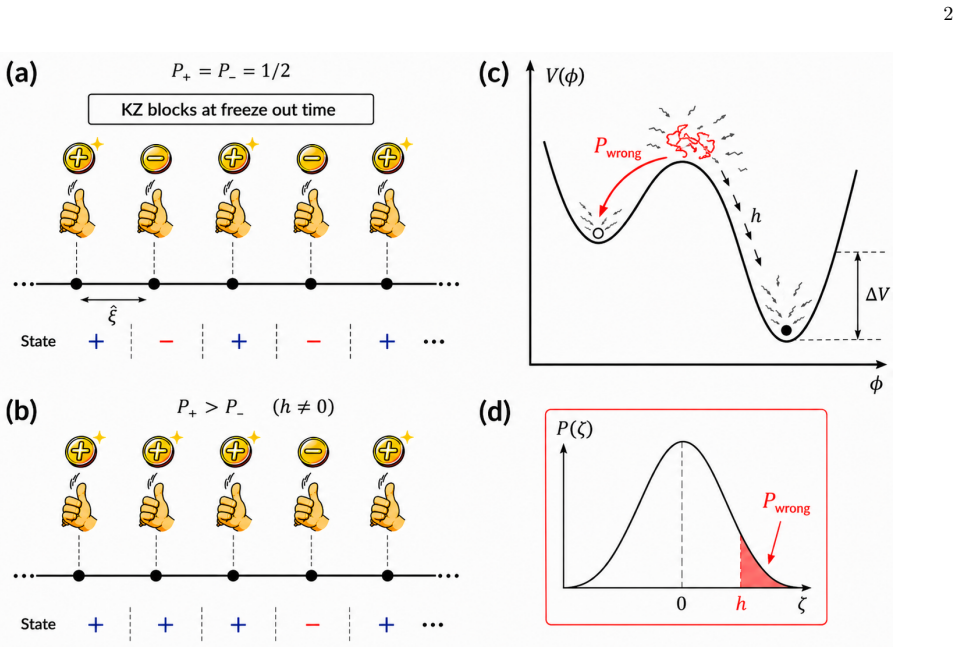
The central object is the Kibble–Zurek domain: a correlated region of size ξ̂ whose symmetry-breaking choice is frozen at the quench timescale. The argument then computes the probability that such a domain ends up in the disfavored state by estimating the cost of a rare thermal fluctuation in Gaussian noise. That cost is the action S_h = (h^2/(4ηθ)) Ω_KZ, where Ω_KZ ~ t̂ ξ̂^d is the freeze-out spacetime volume. Using the critical scalings t̂ ~ τ_Q^{zν/(1+zν)} and ξ̂ ~ τ_Q^{ν/(1+zν)} converts this into the closed-form exponent in Eq. (5). The mechanism is explicitly distinguished from nucleation theory: no activation over a free-energy barrier is involved; instead, a whole domain is coherentl
What would settle it
Compute the optimal noise history by numerically minimizing the large-deviation action for a stochastic Ginzburg–Landau quench and check whether the minimizer is indeed a constant noise of magnitude ~h over the Kibble–Zurek volume. If the optimal path is non-uniform, the scaling in Eq. (5) is falsified. Equivalently, measure the probability P_wrong that a domain selects the disfavored state in a 1D quench and test whether log P_wrong ∝ (h^2/θ)(τ_Q/η)^{3/4} across a broad range of parameters.
Extended reading notes
Core claim
The central claim is that under weak explicit symmetry breaking, the probability for a Kibble–Zurek domain to select the disfavored vacuum is exponentially small and set by a rare-event action S_h ~ (h^2/θ)(τ_Q/η)^{ν(d+z)/(1+zν)}. The defect density then becomes n_defects ~ (η/τ_Q)^{dν/(1+zν)} exp[−A_d (h^2/θ)(τ_Q/η)^{ν(d+z)/(1+zν)}]. This expression reduces to standard Kibble–Zurek scaling when the field h is zero, and in the weak-field, weak-noise limit it predicts an exponential suppression that cannot be captured by any perturbative correction. The derivation assumes that the rare event is a coherent thermal noise of magnitude ~h persisting throughout the entire freeze-out spacetime volu
Load-bearing premise
The paper assumes that the rare event that flips a domain is a single coherent thermal fluctuation of size ~h acting uniformly over the entire freeze-out space-time volume; if the optimal fluctuation has nontrivial spatial or temporal structure, the predicted exponential exponent would no longer hold.
Editorial extensions
If this is right
- Defect densities in quenched systems with weak symmetry breaking should show an exponential falloff with quench time, not just a power law, with an exponent set by the combination ν(d+z)/(1+zν).
- The correction factor is non-universal in its prefactor A_d but universal in its scaling combination, so the scaling collapse of the suppression coefficient λ versus h^2/(θ η^{(d+2)/4}) should persist across different microscopic models in the same universality class.
- The framework extends straightforwardly to defects of arbitrary dimensionality, so the same exponential suppression is expected for strings and membranes, not just point defects.
- In the limit of very weak field or very fast quench, the exponential factor approaches one and standard Kibble–Zurek scaling is recovered, providing a smooth crossover between the two regimes.
- The distinction from nucleation corrections means that the exponential suppression here appears even when the metastable minimum is only slightly disfavored and no barrier crossing is required.
Reading between the lines
- If the rare-event picture is correct, the same exponential suppression should appear in non-mean-field universality classes (e.g., Wilson–Fisher) but with the exponent ν(d+z)/(1+zν) evaluated with the appropriate ν and z, a prediction that could be tested in classical or quantum quench experiments.
- The action S_h may be measurable directly from the probability distribution of domain choices in Monte Carlo simulations, giving a direct probe of the large-deviation functional without needing to count rare defects.
- The result suggests practical ways to control topological defect densities in ultracold atomic gases or superconducting systems by applying a weak external field, exponentially suppressing unwanted defects even for slow quenches.
- The assumption of uniform coherent noise can be relaxed; if the optimal fluctuation profile is non-uniform, the exponent in Eq. (5) would change, offering a route to test the theory's core mechanism through path-integral minimization.
Signed reviews
Editorial analysis
A structured set of objections, weighed in public.
Referee Report
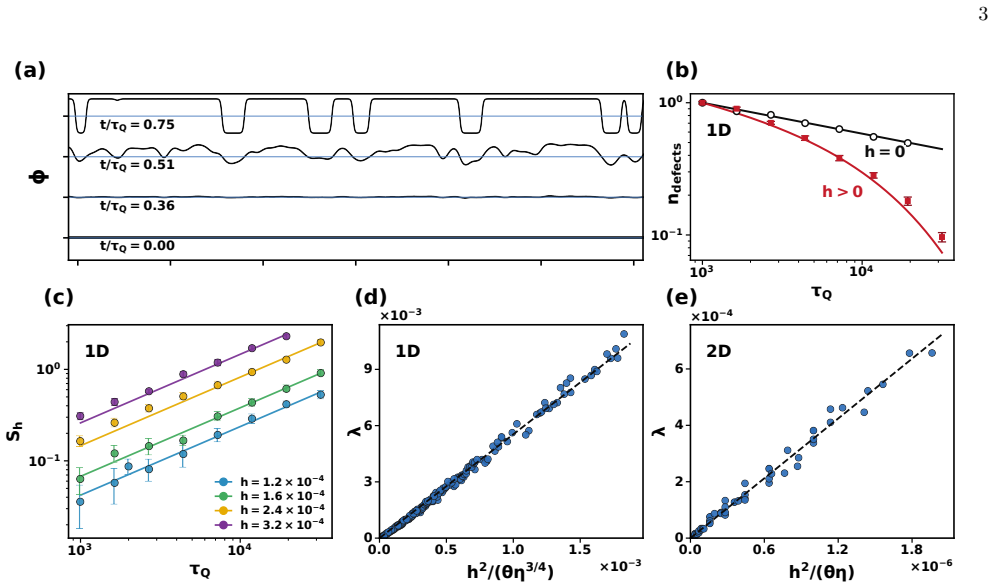
Summary. The paper addresses defect formation in continuous phase transitions when a weak explicit symmetry-breaking field h is present, where recent numerics show an exponential correction to Kibble–Zurek scaling. The authors propose that this correction is a rare-event problem: with probability P_wrong, a Kibble–Zurek domain of spacetime volume Ω_KZ = t̂ξ̂^d is driven by a coherent thermal fluctuation ζ∼h into the disfavored symmetry-broken state. This leads to the action S_h ∼ (h^2/θ)(τ_Q/η)^{ν(d+z)/(1+zν)} and the closed-form prediction Eq. (5) for the defect density in arbitrary dimensions. The paper reports simulations of stochastic Ginzburg–Landau models in 1D and 2D which show an exponential suppression of defect density and a collapse of the fitted suppression coefficient λ onto the scaling variable h^2/(θη^{(d+2)/4}).
Significance. If the central prediction Eq. (5) is correct, the paper provides a missing general framework for a recently observed numerical phenomenon and makes a falsifiable, universality-class-dependent prediction. The master-curve collapse in Figs. 2(d,e) is genuinely encouraging, and the combination of a closed-form formula with direct simulation is a strength. However, the derivation of the exponential action S_h is not actually carried out: the optimal-fluctuation profile is assumed rather than derived, and the promised Freidlin–Wentzell minimization is only stated. In addition, the numerical verification fixes the τ_Q exponent before extracting λ, so the confirmation of the central exponent is weaker than it appears. The significance is therefore conditional on the missing large-deviation calculation being supplied and on a more independent numerical test of the τ_Q scaling.
major comments (2)
- [Eqs. (3)–(4), text below Eq. (2)] The central step of the paper is the identification of the exponential action S_h. The sentence 'A domain can end in the disfavored state only if a coherent thermal fluctuation of magnitude ζ∼h persists throughout the entire freeze-out spacetime volume' is a scaling assumption, not a derivation. The subsequent statement that a formal Freidlin–Wentzell minimization 'yields the same result' is not shown. This matters because the optimal noise history for the linearized dynamics η∂_tφ = (t/τ_Q)φ + h + ζ is not obviously a constant over Ω_KZ; it is proportional to the adjoint Green's function and is peaked near t=0. If the effective duration or spatial profile of the optimal fluctuation differs from t̂ξ̂^d, the exponent ν(d+z)/(1+zν) in Eq. (5) would change. The authors should either provide the Freidlin–Wentzell calculation, including the optimal noise profile and the resulting action, or g
- [Figs. 2(c)–2(e) and text near 'We find that the action cost...'] The numerical verification does not independently test the τ_Q exponent in Eq. (5). The suppression coefficient λ is extracted by fitting the simulation data to n_defects = n_KZ exp[−λ τ_Q^{(d+2)/4}], so the exponent (d+2)/4 is already imposed before λ is obtained. The collapse in Figs. 2(d,e) then confirms the h-, θ-, and η-dependence of λ, but not the τ_Q dependence, once the nonuniversal constant A_d is adjusted. The reported 'S_h ∝ τ_Q^{3/4}' in Fig. 2(c) should be presented as a fit with error bars and, ideally, with λ extracted from a fit that does not fix the exponent a priori. Without this, the claim that simulations verify the predicted exponential scaling is overstated.
minor comments (4)
- [Introduction, first paragraph] Typo: 'vacuam' should be 'vacua'.
- [Eq. (2)] The path-probability functional P[ζ] is written without the normalization factor. This is harmless for the scaling argument, but including the partition function would make the large-deviation statement more precise.
- [Fig. 2(c)] The label 'Action cost S_h' is used for what appears to be numerically extracted −log(n_defects/n_KZ) or a related quantity. Please clarify the definition used in the plot, especially because the y-axis values are not dimensionless and no error bars are shown.
- [Eq. (5) and the paragraph before it] The paper says Eq. (5) holds 'in arbitrary dimensions,' but the derivation is heuristic and the simulations are limited to d=1,2. A d=3 test would strengthen the claim, or the claim should be softened to 'any d in the same universality class.'
Circularity Check
No significant circularity: Eqs. (3)-(5) form a self-contained scaling derivation; the omitted Freidlin-Wentzell derivation is a completeness gap, not a circular step.
full rationale
The central derivation is a self-contained scaling calculation. Eq. (3) evaluates the Gaussian noise weight (Eq. (2)) for a coherent fluctuation of magnitude zeta~h over the KZ spacetime volume Omega_KZ; Eq. (4) then inserts the standard KZ freeze-out scales. Eq. (5) multiplies the resulting probability by the KZ domain density. The constant A_d is explicitly stated to be non-universal and is not claimed as a prediction, so its role does not convert a fit into a prediction. The numerical test parameterizes the measured exponential suppression with the theoretically expected tau_Q exponent and then tests the h, theta, eta dependence through a collapse; this is a genuine consistency check rather than a construction. The statement that a formal Freidlin-Wentzell minimization 'yields the same result' is asserted without proof (after Eq. (5)), which is an omitted derivation and a limitation, but it does not make the heuristic derivation circular. Reference [3] is a self-citation used for corroboration and motivation, and the paper reports its own 1D and 2D simulations, so the self-citation is not load-bearing. No step reduces, by the paper's own equations, to a fitted parameter renamed as a prediction or to a definitional identity.
Assumptions & free parameters
free parameters (1)
- A_d =
not reported; fitted to simulation data
assumptions (5)
- domain assumption The standard KZ picture remains valid with weak h; each correlated domain of size \hat ξ independently chooses a broken-symmetry state.
- ad hoc to paper The optimal rare fluctuation is a coherent noise of magnitude ζ∼h over the entire freeze-out spacetime volume Ω_KZ.
- standard math Gaussian thermal noise with correlator ⟨ζζ⟩ = 2ηθ δ...
- domain assumption The Ginzburg-Landau critical point in the simulated systems is in the mean-field universality class with ν=1/2 and z=2.
- domain assumption Weak-field and weak-noise limit: the probability of selecting the disfavored state is exponentially small.
Cite this review
Pith. "Pith review of Rare Events Govern Defect Formation under Weak Symmetry Breaking." pith.science (2026). https://pith.science/paper/OX33YL3E
@misc{pith2026260627835,
  author       = {Pith},
  title        = {Pith review of: Rare Events Govern Defect Formation under Weak Symmetry Breaking},
  year         = {2026},
  howpublished = {\url{https://pith.science/paper/OX33YL3E}},
  note         = {Machine review of arXiv:2606.27835}
}
read the original abstract
Crossing a continuous phase transition out of equilibrium typically generates topological defects whose density obeys a universal power-law scaling predicted by the Kibble-Zurek mechanism. Recent numerical studies have revealed systematic deviations from this scaling in the presence of weak explicit symmetry breaking, manifested as an additional exponential suppression of defect formation. However, the origin of this correction and a general theoretical framework to describe it have remained elusive. Here, using large-deviation theory, we show that defect formation under weak symmetry breaking is controlled by rare fluctuations that drive local regions into the disfavored symmetry-broken state. This mechanism yields a closed-form expression for the defect density in arbitrary dimensions, valid in the weak-field and weak-noise limits. These theoretical predictions are verified through direct simulations of stochastic Ginzburg-Landau models in one and two spatial dimensions.
Figures
Reference graph
Works this paper leans on
-
[3]
P. Yang, C.-Y. Xia, S. Grieninger, H.-B. Zeng, and M. Baggioli, Phys. Rev. Lett.136, 051602 (2026), URL https://link.aps.org/doi/10.1103/clvs-yk7v
-
[1]
del Campo and W
A. del Campo and W. H. Zurek, International Journal of Modern Physics A29, 1430018 (2014)
2014
-
[2]
Suzuki and W
F. Suzuki and W. H. Zurek, Phys. Rev. Lett.132, 241601 (2024), URLhttps://link.aps.org/doi/10. 1103/PhysRevLett.132.241601
2024
-
[4]
M. I. Freidlin and A. D. Wentzell,Random Perturbations of Dynamical Systems(Springer, Berlin, 2012), 3rd ed
2012
Reviewed August 2, 2026 · model on record in the stance chip above.
Discussion (0). Continue with ORCID to comment.