REVIEW 3 major objections 5 minor 4 cited by
On consistency of the interacting (anti)holomorphic higher-spin sector
T0 review · 3 major / 5 minor · reviewed 2026-08-15 · deepseek-v4-flash
Pith's one-line read The generating system for (anti)holomorphic higher-spin vertices is consistent: every vertex it produces satisfies $d_x^2 = 0$, with the proof resting on two new star-product identities.
desk verdict Korybut identifies a genuine gap in Didenko's consistency proof and supplies useful new identities, but the generic-ordering proof has a load-bearing unproven step that needs to be filled before the main claim is solid. read the letter →
The pith
A machine-rendered reading of the paper's core claim, the machinery that carries it, and where it could break.
The reading
What carries the argument
The load-bearing objects are the limiting star product (1.7); the graded function classes $\mathcal{C}_r$; the shifted homotopy operators $\triangle_q$ with cohomology projectors $h_q$, satisfying $d_z\triangle_q + \triangle_q d_z = 1 - h_q$; and the Klein-like element $\gamma = \tfrac{1}{2}\theta^\alpha\theta_\alpha e^{i z_\alpha y^\alpha}$. The shifted homotopies encode the $z$-dependence of vertices, and the star-exchange relations move them through ordinary products. What is new here is that the identities (5.64) and (5.68) extend this exchange to the limiting product with both factors genuinely $z$-dependent; these identities are what make every field ordering cancel in $d_x^2 C$, and they also supply the projective property that lets shifted-homotopy expressions serve as vertices.
What would settle it
Evaluate identity (5.68) on a concrete element of $\mathcal{C}_0$, say $\Gamma(z,y) = (z_\alpha y^\alpha)e^{i z^\alpha(y-B)_\alpha}$ with fixed spinors $B$ and generic shifts $a,e,f$; if the two sides differ, the load-bearing lemma fails and the consistency proof collapses. Alternatively, compute the vertex in the $\omega C \omega C$ ordering at fourth order in $C$ for a plane-wave pair $\omega, C$ and check whether $d_x^2 C$ vanishes; a nonzero residue refutes the central claim.
Extended reading notes
Core claim
The central claim is that the generating system (3.1)–(3.6) is $d_x$-consistent on all of its vertices even though the limiting star product (1.7) is not associative on the relevant function classes and the auxiliary differential $d_z$ has no Leibniz rule. Concretely, the paper proves that the consistency condition $d_x^2 C * \gamma = 0$ reduces, through the homotopy resolution of identity and the definition of $W$, to the manifestly vanishing expression $d_z\big(-d_z(W-\omega)*W + W*d_z(W-\omega)\big)$, so no Leibniz rule is ever needed. Two identities carry the argument: the generalized projection identity $d_z(\Gamma(z,y)*\triangle_e\gamma) = h_{y-e}\Gamma(z,y)*\gamma$ for every $\Gamma \in \mathcal{C}_0$, and the star-exchange-like identity $h_{y+e}(\triangle_a\triangle_f\gamma * \pi(\Gamma)) = h_{-y+a}\triangle_{-y+f}(\Gamma * \triangle_e\gamma)$, both proved by explicit computation for genuinely $z$-dependent functions. The paper also shows that replacing $d_z$ by a different odd linear operator in a twisted version of the system can violate $d_x^2 = 0$ already at order $\omega\omega CC$, so the consistency is tied to the specific canonical choice.
Load-bearing premise
The generic-ordering proof reduces all field orderings to a single vanishing expression using two identities that are established only by very long explicit integral computations in the appendices, and the final cancellation assumes every higher-order contribution built by the homotopy recursion stays in the same restricted function class; if either condition fails, the consistency proof does not go through.
Editorial extensions
If this is right
- The generating system (3.1)–(3.6) can be used to produce spin-local vertices at any order without hidden constraints: $d_x^2 = 0$ holds for every ordering of $\omega$ and $C$.
- Every vertex admits a factorized shifted-homotopy form, for instance $W_{\omega C^N} = \omega * C * C(-y) * \cdots * \triangle_{t+p_1-p_2+\cdots}(\cdots)$, which can simplify explicit all-order computations.
- The $\Lambda$-field is not rigidly fixed: one may add exact forms of the type (5.73) without destroying the projective property, opening a route to generalizations that include the mixed sector.
- At the lowest nonlinear order the vertices coincide exactly with those of the (anti)holomorphic sector of the standard 4d higher-spin theory, written in shifted-homotopy form.
- Consistency of the off-shell $d$-dimensional system does not depend on the concrete associative product chosen for the extra variables; associativity alone suffices.
Reading between the lines
- If the proof is correct, the loss of the Leibniz rule acts as a selection principle: among the many odd linear operators that could define $d_z$, only the canonical one keeps vertices consistent, so the apparent ambiguity is fixed by consistency itself.
- Identity (5.68) is likely the correct star-exchange relation for the limiting product and may be the missing tool for putting the $d$-dimensional off-shell system on-shell by subtracting traces.
- The exact cubic-order match with the standard 4d theory suggests a generating-system-level field redefinition $C \to F(C,\ldots,C)$ might map the self-dual system onto the (anti)holomorphic truncation; whether such an $F$ exists beyond cubic order is a concrete open question.
- Because all vertices live in shifted-homotopy form while the minimal-derivative $B_2$ vertices come from a different homotopy, a parameter-dependent bridge between the two homotopy formalisms should exist; finding it would let locality results flow in both directions.
Signed reviews
Editorial analysis
A structured set of objections, weighed in public.
Referee Report
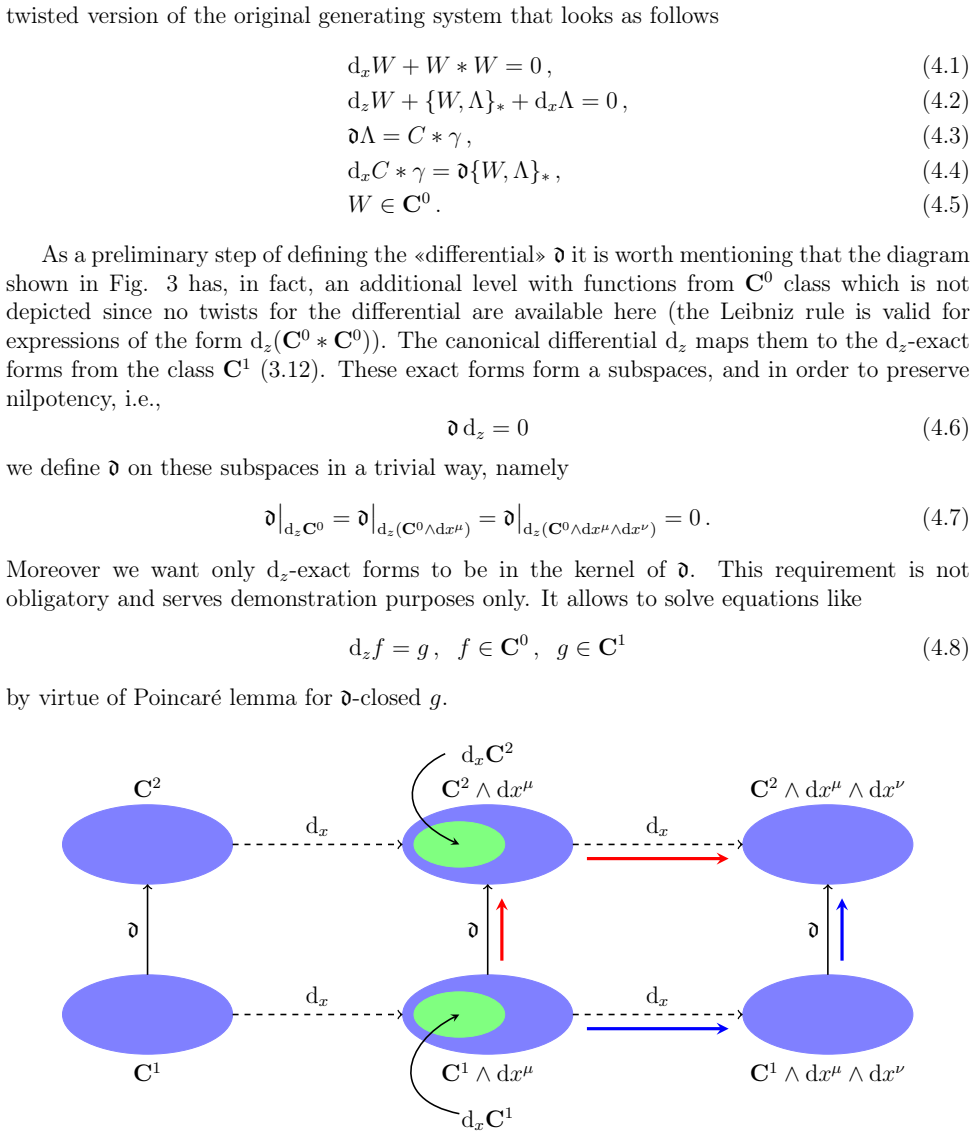
Summary. The paper addresses a gap in the consistency proof of the generating system proposed by Didenko for the (anti)holomorphic sector of four-dimensional higher-spin theory, and of its off-shell analogue in general dimension. Because the limiting star product is not defined for all products of the functional classes C_r, the operator dz = θ^α ∂/∂z^α does not obey a Leibniz rule and its extension to one-forms in θ is ambiguous. The manuscript first exhibits this ambiguity in a toy model, then constructs a 'twisted' differential d that formally satisfies the same algebraic relations as dz but leads to dx-inconsistent vertices (Section 4 and Appendix C). The main part of the paper attempts a direct proof that the original system (3.1)-(3.6) is nevertheless consistent: the zero-form dynamics is recast as the pair (5.10)-(5.11), the orderings ωωC...C and ωCωC...C are checked explicitly in Sections 5.1 and 5.3 using two new identities, the generalized projection identity (5.64) and the star-exchange-like identity (5.68), whose proofs are relegated to Appendices A and B, and a generic-ordering argument is sketched in Section 5.4. The paper also expresses interaction vertices in the shifted-homotopy formalism and discusses possible relations with the (anti)holomorphic truncation of the 4d Vasiliev theory.
Significance. If the consistency proof can be completed, the paper would establish the all-order dx-consistency of the Didenko generating system, a central open point in the spin-locality program for higher-spin theories. The two new identities (5.64) and (5.68), proved in Appendices A and B, are concrete and potentially reusable tools, and the explicit demonstration that a superficially equivalent twisted differential can generate inconsistent vertices is a useful cautionary result. The shifted-homotopy expressions for vertices in Section 6 are a further valuable output. However, the generic-ordering proof in Section 5.4 contains an unproven final cancellation and an algebraic error in the displayed derivation, so the central claim is not established as the manuscript currently stands.
major comments (3)
- [§5.4, Eqs. (5.86)-(5.88)] As printed, the step from (5.86) to (5.87) is not algebraically correct: substituting Δ0 dz = 1 − dzΔ0 − h0 into (5.86) produces exactly one '+ W∗W∗Λ' term, but (5.87) contains '+ W∗W∗Λ + W∗W∗Λ'. Moreover, the sign in (5.88) is inconsistent with the substitution: using W = ω − Δ0{W,Λ} one obtains dzΔ0{W,Λ} = −dz(W−ω), which converts the unduplicated part of (5.87) into dz(W−ω)∗W − W∗dz(W−ω), the negative of the printed expression. These are not cosmetic issues, because the subsequent cancellation is quoted as the conclusion of the generic-ordering proof.
- [§5.4, Eq. (5.88)] The claim that the right-hand side of (5.88) 'vanishes identically' is not demonstrated. The expression to which dz is applied is a sum of products C1∗C0 and C0∗C1. Since the Leibniz rule for dz is explicitly unavailable and products such as C2∗C0 are undefined by (3.13)-(3.14), the vanishing cannot be inferred from dz² = 0 or from W∈C0 alone. Property (3.5) ensures W∗W∈C0, but it does not by itself imply the cancellation of dz(−dz(W−ω)∗W + W∗dz(W−ω)). A direct computation using the integral representation (A.2) and the projection identities (5.64) and (5.69), or an independent argument, is required. This step is the pivot of the generic-ordering consistency proof, so without it the central claim of the paper is not established.
- [§5.4, Eqs. (5.81)-(5.85)] The reduction of (5.48) to (5.86) relies on five identities, but only the last one is derived in the text, via Eqs. (5.76)-(5.79); the other four are stated as 'final expressions' with no derivation. Since these identities are load-bearing for the generic-ordering proof and are not immediate consequences of (5.64) and (5.68), a derivation or a reference to an appendix containing the computations should be provided. Without this, the generic-ordering consistency check is not verifiable.
minor comments (5)
- [Introduction, paragraph after Eq. (3.28)] The phrase 'In the following section 3.31' should read 'In the following Section 5'; the current wording refers to a nonexistent section number.
- [§5.4, Eq. (5.78)] The notation dz(C1) is ambiguous because C1 denotes a functional class, not an element; rewriting the identity as dz(F)·f(y) = dz(F·f(y)) and f(y)·dzF = dz(f(y)·F) for F∈C1 would remove the ambiguity.
- [§7, Eq. (7.9)] The Klein operator k appears in the definition of B_2^{η loc} before it is introduced in the following paragraph; a brief definition at first use would improve readability.
- [Throughout] There are numerous typographical errors and unbalanced parentheses in displayed equations (for example, 'vely likely', 'differential contracting homotopy', and broken parentheses in several formulas); a careful proofreading pass is needed.
- [Footnote 2 and §3] The non-associativity of the limiting star product is stated in a footnote but not defined with precision; a short explicit example of the failure of associativity for three functions would help the reader understand the limitations of the product.
Circularity Check
No significant circularity: the consistency proof rests on new identities (5.64) and (5.68) proved from definitions in Appendices A and B; same-group citations are used only as technical tools.
full rationale
The paper's central claim is the dx-consistency of the generating system (3.1)-(3.6) taken from [1]. Rather than assuming that system's consistency, the paper verifies it by direct computation on the vertices of the reduced system (5.10)-(5.12). The load-bearing identities (5.64) and (5.68) are derived in Appendices A and B from the explicit class-C0 representation (A.3), the limiting star product (1.7), and the shifted-homotopy definitions (5.26) and (5.29); they are not imported as conclusions. The earlier star-exchange relations (5.34)-(5.41) are cited from [37,38], which include authors of the present group, but they are parameter-free algebraic lemmas with stated assumptions and serve as tools rather than as the target result; the genuinely new z-dependent case is proved in this paper. The linear-space property of the C_r classes is cited from [52], also by the author's group, but this property is peripheral and does not carry the consistency claim. No parameter is fitted and renamed as a prediction, and no quantity is defined in terms of the result it is meant to establish. The reviewer-identified issue at (5.87)-(5.88), namely the duplicated '+ W*W*Lambda' term and the asserted 'obvious' vanishing of dz(-dz(W-omega)*W + W*dz(W-omega)), is a potential gap or typo in the written algebraic justification; however, a gap in a proof step is a correctness concern, not circularity. The derivation is therefore self-contained with respect to the circularity criteria.
Assumptions & free parameters
assumptions (4)
- domain assumption The functional classes C0, C1 (degree in theta, regularity in z) with closures C0*C0 subset C0, C0*C1 subset C1, dz: Cr -> Cr+1, and W in C0 for the homotopy-constructed W.
- domain assumption The limiting star product (1.7) is associative and well-defined for the products used, namely C0*C0, C0*C1, and C1*C0.
- domain assumption The base manifold is topologically trivial, H^1(dx) = 0, and the (Y,Z) bundle is a global Cartesian product.
- standard math Perturbation theory in powers of C is a valid formal expansion, and solutions obtained by the Poincare lemma or homotopy operators △0 and shifted △q are the relevant particular solutions.
Cite this review
Pith. "Pith review of On consistency of the interacting (anti)holomorphic higher-spin sector." pith.science (2026). https://pith.science/paper/OX6WDIIY
@misc{pith2026250513125,
  author       = {Pith},
  title        = {Pith review of: On consistency of the interacting (anti)holomorphic higher-spin sector},
  year         = {2026},
  howpublished = {\url{https://pith.science/paper/OX6WDIIY}},
  note         = {Machine review of arXiv:2505.13125}
}
abstract
In the recently proposed generating systems for the (anti)holomorphic sector of the 4d higher spin theory and for the off-shell higher spin theory in generic dimension locality was achieved due to a peculiar limiting star product. Even though the generating systems exhibit all-order locality, the product itself encounters uncertainties when functions from specific classes are multiplied. This fact leads to the absence of the Leibniz rule for the differential operator acting on the auxiliary variables $z$ and, hence, its ambiguous definition in the generating equations. We identify the gap in the original proof of consistency associated with this freedom. Nonetheless considered generating systems are perfectly consistent as shown by direct computations on the resulting vertices. Considering specific orderings of fields we show that consistency rests on the star-exchange-like identities for the limiting star product formulated and proved here. Connection with the 4d Vasiliev theory is discussed.
Figures


Figures from the paper (1 more)

Forward citations
Cited by 4 Pith papers
-
Unfolded hypermultiplet in harmonic superspace
A single unfolded first-order system reproduces the massless hypermultiplet in harmonic, N=2, N=1, and Minkowski formulations.
-
BRST-BV approach to fields in Poincare patch of AdS
A universal BRST-BV Lagrangian for free AdS fields is obtained by solving algebraic defining equations for spin operators, with explicit solutions for totally symmetric integer-spin and continuous-spin fields.
-
Gauge transformations in Z-space in (anti)holomorphic sector of HS theory
Allowing the master field Lambda to shift by exact auxiliary-space forms yields an explicit second-order field redefinition, whose z-dependent part cannot be gauged away.
-
On symmetry breaking in the self-dual higher-spin theory
In the self-dual higher-spin theory, a scalar vacuum that breaks AdS symmetry to 3D Poincaré makes all higher-spin gauge fields decouple except spin one, and makes higher-spin currents non-conserved except the spin-on...
Reference graph
Works this paper leans on
-
[2]
V. E. Didenko and A. V. Korybut, Phys. Rev. D 108 (2023) no.8, 086031 [erratum: Phys. Rev. D 109 (2024) no.6, 069901] doi:10.1103/PhysRevD.108.086031 [a rXiv:2304.08850 [hep-th]]
arXiv 2023
-
[1]
V. E. Didenko, JHEP 10 (2022), 191 doi:10.1007/JHEP10(2022)191 [arXiv:2209.01 966 [hep-th]]
-
[3]
M. A. Vasiliev, JHEP 10 (2017), 111 doi:10.1007/JHEP10(2017)111 [arXiv:1605.02 662 [hep-th]]
-
[4]
I. R. Klebanov and A. M. Polyakov, Phys. Lett. B 550 (2002), 213-219 doi:10.1016/S0370- 2693(02)02980-5 [arXiv:hep-th/0210114 [hep-th]]
arXiv 2002
-
[5]
A. O. Barvinsky, Phys. Rev. D 93 (2016) no.10, 103530 doi:10.1103/PhysRevD.93.103530 [arXiv:1511.07625 [hep-th]]
arXiv 2016
-
[6]
A. K. H. Bengtsson, I. Bengtsson and L. Brink, Nucl. Phys. B 227 (1983), 31-40 doi:10.1016/0550-3213(83)90140-2
-
[7]
F. A. Berends, G. J. H. Burgers and H. Van Dam, Z. Phys. C 24 (1984), 247-254 doi:10.1007/BF01410362
-
[8]
E. S. Fradkin and M. A. Vasiliev, Phys. Lett. B 189 (1987), 89-95 doi:10.1016/0370- 2693(87)91275-5
doi:10.1016/0370- 1987
Show all 57 references
-
[9]
E. S. Fradkin and R. R. Metsaev, Class. Quant. Grav. 8 (1991), L89-L94 doi:10.1088/0264- 9381/8/4/004
1991 doi
-
[10]
M. A. Vasiliev, JHEP 11 (2023), 048 doi:10.1007/JHEP11(2023)048 [arXiv:2307.09 331 [hep-th]]
2023 doi
-
[11]
Misuna, Phys
N. Misuna, Phys. Lett. B 778 (2018), 71-78 doi:10.1016/j.physletb.2018.01.019 [arXiv:1706.04605 [hep-th]]
2018 arXiv
-
[12]
Y. A. Tatarenko and M. A. Vasiliev, JHEP 07 (2024), 246 doi:10.1007/JHEP07(2024)246 [arXiv:2405.02452 [hep-th]]. 37
2024 arXiv
-
[13]
O. A. Gelfond, Eur. Phys. J. C 83 (2023) no.12, 1154 doi:10.1140/epjc/s10052-023-12308-x [arXiv:2308.16281 [hep-th]]
2023 arXiv
-
[14]
Bekaert, S
X. Bekaert, S. Cnockaert, C. Iazeolla and M. A. Vasiliev , [arXiv:hep-th/0503128 [hep-th]]
-
[15]
V. E. Didenko and E. D. Skvortsov, Lect. Notes Phys. 1028 (2024), 269-456 doi:10.1007/978-3-031-59656-8_3 [arXiv:1401.2975 [hep -th]]
2024 arXiv
-
[16]
Ponomarev, Int
D. Ponomarev, Int. J. Theor. Phys. 62 (2023) no.7, 146 doi:10.1007/s10773-023-05399-5 [arXiv:2206.15385 [hep-th]]
2023 arXiv
-
[17]
Aharony, S
O. Aharony, S. M. Chester and E. Y. Urbach, JHEP 03 (2021), 208 doi:10.1007/JHEP03(2021)208 [arXiv:2011.06328 [hep-th ]]
2021 arXiv
-
[18]
S. R. Das and A. Jevicki, Phys. Rev. D 68 (2003), 044011 doi:10.1103/PhysRevD.68.044011 [arXiv:hep-th/0304093 [hep-th]]
2003 arXiv
-
[19]
Jevicki and J
A. Jevicki and J. Yoon, JHEP 02 (2016), 090 doi:10.1007/JHEP02(2016)090 [arXiv:1503.08484 [hep-th]]
2016 arXiv
-
[20]
M. A. Vasiliev, Phys. Lett. B 243 (1990), 378-382 doi:10.1016/0370-2693(90)91400-6
1990 doi
-
[21]
M. A. Vasiliev, Phys. Lett. B 285 (1992), 225-234 doi:10.1016/0370-2693(92)91457-K
1992 doi
-
[22]
M. A. Vasiliev, Phys. Lett. B 209 (1988), 491-497 doi:10.1016/0370-2693(88)91179-3
1988 doi
-
[23]
M. A. Vasiliev, Annals Phys. 190 (1989), 59-106 doi:10.1016/0003-4916(89)90261-3
1989 doi
-
[24]
Boulanger, C
N. Boulanger, C. Iazeolla and P. Sundell, JHEP 07 (2009), 013 doi:10.1088/1126- 6708/2009/07/013 [arXiv:0812.3615 [hep-th]]
2009 arXiv
-
[25]
Boulanger, C
N. Boulanger, C. Iazeolla and P. Sundell, JHEP 07 (2009), 014 doi:10.1088/1126- 6708/2009/07/014 [arXiv:0812.4438 [hep-th]]
2009 arXiv
-
[26]
Misuna, [arXiv:2408.13212 [hep-th]]
N. Misuna, [arXiv:2408.13212 [hep-th]]
-
[27]
Misuna, JHEP 12 (2024), 090 doi:10.1007/JHEP12(2024)090 [arXiv:2402.14 164 [hep- th]]
N. Misuna, JHEP 12 (2024), 090 doi:10.1007/JHEP12(2024)090 [arXiv:2402.14 164 [hep- th]]
2024 doi
-
[28]
N. G. Misuna, [arXiv:2301.02207 [hep-th]]
-
[29]
Misuna, JHEP 12 (2023), 119 doi:10.1007/JHEP12(2023)119 [arXiv:2208.04 306 [hep- th]]
N. Misuna, JHEP 12 (2023), 119 doi:10.1007/JHEP12(2023)119 [arXiv:2208.04 306 [hep- th]]
2023 doi
-
[30]
N. G. Misuna, Phys. Lett. B 840 (2023), 137845 doi:10.1016/j.physletb.2023.137845 [arXiv:2201.01674 [hep-th]]
2023
-
[31]
Misuna, Phys
N. Misuna, Phys. Lett. B 798 (2019), 134956 doi:10.1016/j.physletb.2019.134956 [arXiv:1905.06925 [hep-th]]
2019
-
[32]
M. V. Khabarov and Y. M. Zinoviev, Class. Quant. Grav. 38 (2021) no.19, 195012 doi:10.1088/1361-6382/ac1c1e [arXiv:2105.01325 [hep-t h]]. 38
2021 arXiv
-
[33]
Iazeolla, P
C. Iazeolla, P. Sundell and B. C. Vallilo, [arXiv:2503. 14673 [hep-th]]
- [34]
-
[35]
M. A. Vasiliev, doi:10.1142/9789812793850_0030 [arX iv:hep-th/9910096 [hep-th]]
-
[36]
E. D. Skvortsov and M. Taronna, JHEP 11 (2015), 044 doi:10.1007/JHEP11(2015)044 [arXiv:1508.04764 [hep-th]]
2015 arXiv
-
[37]
O. A. Gelfond and M. A. Vasiliev, Phys. Lett. B 786 (2018), 180-188 doi:10.1016/j.physletb.2018.09.038 [arXiv:1805.11941 [hep-th]]
2018 arXiv
-
[38]
V. E. Didenko, O. A. Gelfond, A. V. Korybut and M. A. Vasil iev, J. Phys. A 51 (2018) no.46, 465202 doi:10.1088/1751-8121/aae5e1 [arXiv:1807 .00001 [hep-th]]
2018 doi
-
[39]
V. E. Didenko, O. A. Gelfond, A. V. Korybut and M. A. Vasil iev, JHEP 12 (2019), 086 doi:10.1007/JHEP12(2019)086 [arXiv:1909.04876 [hep-th ]]
2019 arXiv
-
[40]
O. A. Gelfond and M. A. Vasiliev, JHEP 03 (2020), 002 doi:10.1007/JHEP03(2020)002 [arXiv:1910.00487 [hep-th]]
2020 arXiv
-
[41]
V. E. Didenko, O. A. Gelfond, A. V. Korybut and M. A. Vasil iev, JHEP 12 (2020), 184 doi:10.1007/JHEP12(2020)184 [arXiv:2009.02811 [hep-th ]]
2020 arXiv
-
[42]
O. A. Gelfond and A. V. Korybut, Eur. Phys. J. C 81 (2021) no.7, 605 doi:10.1140/epjc/s10052-021-09401-4 [arXiv:2101.0168 3 [hep-th]]
2021
-
[43]
A. A. Tarusov, K. A. Ushakov and M. A. Vasiliev, JHEP 03 (2023), 128 doi:10.1007/JHEP03(2023)128 [arXiv:2212.01908 [hep-th ]]
2023 arXiv
-
[44]
S. F. Prokushkin and M. A. Vasiliev, Nucl. Phys. B 545 (1999), 385 doi:10.1016/S0550- 3213(98)00839-6 [arXiv:hep-th/9806236 [hep-th]]
1999 arXiv
-
[45]
M. A. Vasiliev, JHEP 08 (2018), 051 doi:10.1007/JHEP08(2018)051 [arXiv:1804.06 520 [hep-th]]
2018 doi
-
[46]
A. V. Korybut, A. A. Sevostyanova, M. A. Vasiliev and V. A . Vereitin, Phys. Lett. B 838 (2023), 137718 doi:10.1016/j.physletb.2023.137718 [arX iv:2211.15778 [hep-th]]
2023
-
[47]
A. A. Tarusov, K. A. Ushakov and M. A. Vasiliev, [arXiv:2 503.05948 [hep-th]]
-
[48]
V. E. Didenko and M. A. Povarnin, Phys. Rev. D 110 (2024) no.12, 126012 [erratum: Phys. Rev. D 111 (2025) no.10, 109901] doi:10.1103/PhysRevD.110.126012 [ arXiv:2409.00808 [hep-th]]
2024 arXiv
-
[49]
Sharapov, E
A. Sharapov, E. Skvortsov, A. Sukhanov and R. Van Dongen , Nucl. Phys. B 990 (2023), 116152 doi:10.1016/j.nuclphysb.2023.116152 [arXiv:220 9.15441 [hep-th]]
2023
-
[50]
Ponomarev and E
D. Ponomarev and E. D. Skvortsov, J. Phys. A 50 (2017) no.9, 095401 doi:10.1088/1751- 8121/aa56e7 [arXiv:1609.04655 [hep-th]]. 39
2017 arXiv
-
[51]
Sharapov, E
A. Sharapov, E. Skvortsov, A. Sukhanov and R. Van Dongen , JHEP 09 (2022), 134 [erra- tum: JHEP 02 (2023), 183] doi:10.1007/JHEP09(2022)134 [arXiv:2205.0 7794 [hep-th]]
2022 doi
-
[52]
V. E. Didenko and A. V. Korybut, JHEP 05 (2023), 133 doi:10.1007/JHEP05(2023)133 [arXiv:2212.05006 [hep-th]]
2023 arXiv
-
[53]
De Filippi, C
D. De Filippi, C. Iazeolla and P. Sundell, JHEP 10 (2019), 215 doi:10.1007/JHEP10(2019)215 [arXiv:1905.06325 [hep-th ]]
2019 arXiv
-
[54]
F. Diaz, C. Iazeolla and P. Sundell, JHEP 09 (2024), 109 doi:10.1007/JHEP09(2024)109 [arXiv:2403.02283 [hep-th]]
2024 arXiv
-
[55]
V. E. Didenko, N. G. Misuna and M. A. Vasiliev, JHEP 07 (2016), 146 doi:10.1007/JHEP07(2016)146 [arXiv:1512.04405 [hep-th ]]
2016 arXiv
-
[56]
M. A. Vasiliev, JHEP 01 (2018), 062 doi:10.1007/JHEP01(2018)062 [arXiv:1707.03 735 [hep-th]]
2018 doi
-
[57]
M. A. Vasiliev, [arXiv:2503.10967 [hep-th]]. 40
Reviewed August 15, 2026 · model on record in the stance chip above.
Discussion (0). Continue with ORCID to comment.