REVIEW 4 major objections 5 minor 44 references
Radii of spherical timelike geodesics in Kerr-Newman black holes
T0 review · 4 major / 5 minor · reviewed 2026-08-07 · deepseek-v4-flash
Pith's one-line read One quintic determines all radii of spherical timelike orbits in Kerr-Newman spacetimes, with analytic critical case and boundary surfaces for subcritical energies.
desk verdict A legitimate Kerr-Newman extension with a genuinely useful closed-form ISCO radius, but the universal gamma>1 'always one unstable orbit' claim is asserted from a single numerical sample and needs a real argument. read the letter →
The pith
A machine-rendered reading of the paper's core claim, the machinery that carries it, and where it could break.
The reading
What carries the argument
The central object is the quintic polynomial $P_5(x)$ of Eq. (13), whose positive roots are the radii $x=r/M$ of spherical timelike orbits; it is built by demanding $R(r)=0$ and $dR/dr=0$, i.e., a turning point that is also a spherical orbit, and then cancelling the Carter constant between the two equations. The polynomial's behaviour with $\gamma$ organizes the paper: at $\gamma=1$ it becomes a quartic with analytic Ferrari-type roots; for $0<\gamma<1$ the existence and stability thresholds are found by imposing the marginal-stability condition $d^2R/dr^2=0$ as well, which after elimination yields a quadratic for the polar ISSPO radius and the closed-form ISCO radius for equatorial orbits. Stability is read off from the sign of $\tilde R''(x_i)$ at each root: positive means radially unstable, negative means radially stable.
What would settle it
Scan Eq. (13) over a grid of $(u,w,\beta)$ for a value of $\gamma>1$ other than $1.5$ (for example $\gamma=2$), keep the real positive roots, and compare each with the horizon radius $x_h=1+\sqrt{1-u^2-w^2}$ while evaluating $\tilde R''$ at each root; one parameter point with two roots outside the horizon or with a negative $\tilde R''$ refutes the always-one-unstable-orbit claim. As a separate check for $0<\gamma<1$, solve $R=R'=R''=0$ numerically for equatorial orbits and compare the resulting radius with Eq. (42); any disagreement would invalidate the ISCO formula.
Extended reading notes
Core claim
The paper's central claim is that the radii $x$ of spherical timelike geodesics in Kerr-Newman spacetime are the positive real roots of the quintic $P_5(x)=0$ (Eq. 13), obtained by equating the two forms of the Carter constant extracted from the conditions $R(r)=0$ and $dR/dr=0$. For $\gamma=1$ the equation reduces to a quartic whose analytic roots the paper writes out; in the $(u,w,\beta)$ space it identifies a no-orbit surface on which the would-be outer spherical orbit coincides with the event horizon, while off the surface there is always exactly one spherical orbit outside the horizon, and that orbit is radially unstable. For polar orbits with $0<\gamma<1$, a boundary surface in $(u,w,\gamma)$ separates a no-orbit region from a two-orbit region, with the outer orbit radially stable and the inner one unstable, and on the boundary lies the innermost stable spherical polar orbit. For equatorial orbits with $0<\gamma<1$, the same two-orbit/no-orbit split occurs in both prograde and retrograde families, and the boundary parameters give the ISCO, whose radius the paper derives analytically as $$x_I = \frac{\sqrt{4(\$gamma^{2}$-1)^2 $w^{4}$+5(\$gamma^{2}$-1)$w^{2}$+1}}{3(1-\$gamma^{2}$)} + \frac{2(1-\$gamma^{2}$)$w^{2}$+1}{3(1-\$gamma^{2}$)}.$$ For $\gamma>1$, the paper argues that there is always exactly one radially unstable spherical orbit outside the horizon, supported by numerical evidence at $\gamma=1.5$.
Load-bearing premise
The claim that for $\gamma>1$ there is always exactly one spherical orbit outside the horizon, always radially unstable, is verified numerically only at $\gamma=1.5$; if some other $\gamma>1$ value admitted two orbits or a stable orbit outside the horizon, the stated conclusion would be wrong.
Editorial extensions
If this is right
- At $\gamma=1$, for any parameter point off the no-orbit surface, a Kerr-Newman black hole has exactly one spherical timelike orbit outside its event horizon, and it is always radially unstable.
- For $0<\gamma<1$, spherical polar or equatorial orbits exist outside the horizon only when the particle's conserved energy exceeds a parameter-dependent minimum; at exactly that minimum the surviving orbit is the innermost stable one.
- The ISCO radius for equatorial motion with $0<\gamma<1$ is given by the closed formula (42) in terms of the black hole charge and the particle energy, for both prograde and retrograde orbits.
- Whenever two orbits exist for $0<\gamma<1$, the outer orbit is radially stable and the inner one radially unstable, with the threshold orbit separating them.
- In the massless limit $\gamma\to\infty$, the quintic reproduces the previously derived spherical photon-orbit equation for Kerr-Newman, so the photon results are recovered consistently.
Reading between the lines
- If the ISCO formula (42) is exact, then for fixed $w$ and $\gamma$ the inner edge of an equatorial accretion disk around a Kerr-Newman black hole can be computed directly from the closed expression instead of by solving the three marginal-orbit equations numerically; this is a practical shortcut that can be tested against ray-traced images.
- The always-one-unstable-orbit conclusion for $\gamma>1$ is verified numerically only at $\gamma=1.5$; an exact real-root count of Eq. (13) for general $\gamma>1$ would either upgrade the numerical evidence to a theorem or expose parameter values where the statement fails.
- The same elimination strategy that produces boundary surfaces for polar and equatorial orbits should extend to the full four-parameter space for general spherical orbits with $\gamma\neq1$, yielding a no-orbit hypersurface analogous to the $\gamma=1$ surface rather than only a numerical scan.
- Because the coefficients of the quintic are polynomial in $\beta$ and $\gamma$, discriminant and resultant methods could be used to derive analytic conditions for the number of real roots, giving a complete algebraic classification of orbit counting in Kerr-Newman.
Editorial analysis
A structured set of objections, weighed in public.
Referee Report
Summary. The paper studies spherical timelike geodesics of neutral massive particles in Kerr-Newman spacetimes. Starting from the geodesic equations, the authors derive a quintic polynomial (Eq. 13) whose positive real roots give orbit radii. For the critical case γ=1 they obtain analytical formulas for polar, equatorial, and general orbits, identify a discriminant curve and a no-orbit surface, and check limiting cases against Schwarzschild, Reissner-Nordström, and Kerr results. For 0<γ<1 they derive boundary surfaces and an analytical ISCO formula (Eq. 42). For γ>1 they claim, on the basis of numerical examples with γ=1.5, that there is always exactly one radially unstable spherical orbit outside the event horizon for both polar and equatorial orbits.
Significance. If the main claims hold, the paper provides a systematic and partly analytic characterization of spherical timelike orbits in Kerr-Newman spacetimes, including an explicit ISCO formula that is not restricted to the equatorial Kerr limit. The derivation of the quintic equation and its reduction to known limits (Schwarzschild x=4, RN cubic, Kerr quartic) are standard and checked against prior results, which is a clear strength. The analytical formulas for γ=1 and the ISCO expression are potentially useful reference results. However, the universal statements about γ>1 and the no-orbit surface currently rest on isolated numerical samples and unproved assertions, so the significance is conditional on supplying the missing root-count and surface proofs.
major comments (4)
- [IV.A and IV.B, Eqs. (29) and (39), Figs. 20-21 and 27-28] The abstract and conclusion state that for γ>1 there is always exactly one spherical orbit outside the event horizon and that it is radially unstable, for both polar and equatorial orbits. The only evidence presented is the single value γ=1.5: Figs. 20-21 for polar orbits and Figs. 27-28 for equatorial orbits. The number of real roots of a quintic can change as γ varies, and the sign of R'' at the selected root is not guaranteed by these examples. Please supply a root-count argument valid for the full range 1<γ<∞ and the entire parameter domain 0≤u,w, u^2+w^2≤1 (e.g., a Sturm sequence, Descartes-rule bounds, or a monotonicity argument on x>x_h), or else explicitly restrict the claims to the sampled parameter values. As written, the headline universal statement is not established.
- [III.B.3, no-orbit surface] The paper's central claim for general orbits with γ=1 is the existence of a no-orbit surface in (u,w,β): when parameters lie on the surface there is no orbit outside the event horizon, and otherwise there is always one. The text only states 'It can be demonstrated that there exists a surface' and plots it in Fig. 13; the equation of the surface is never given and no proof is supplied. Please derive the surface (apparently from the condition x3=x4=x_h with x_h=1+sqrt(1-u^2-w^2)) and prove the claimed dichotomy. Without this, the no-orbit surface remains an unverified numerical observation.
- [III.B.1, Eq. (23)] The discriminant curve in Eq. (23) is used to separate the (u,w) plane into regions with two and four real roots of Eq. (22). The paper does not show that the sign of this discriminant indeed controls the number of real roots for this specific quartic, nor does it prove that exactly one of those roots lies outside the event horizon throughout each region. Please provide the missing argument, or state the relevant standard theorem and verify its hypotheses for Eq. (22).
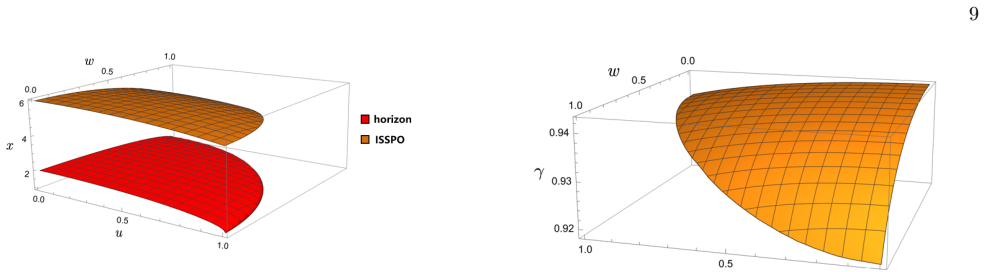
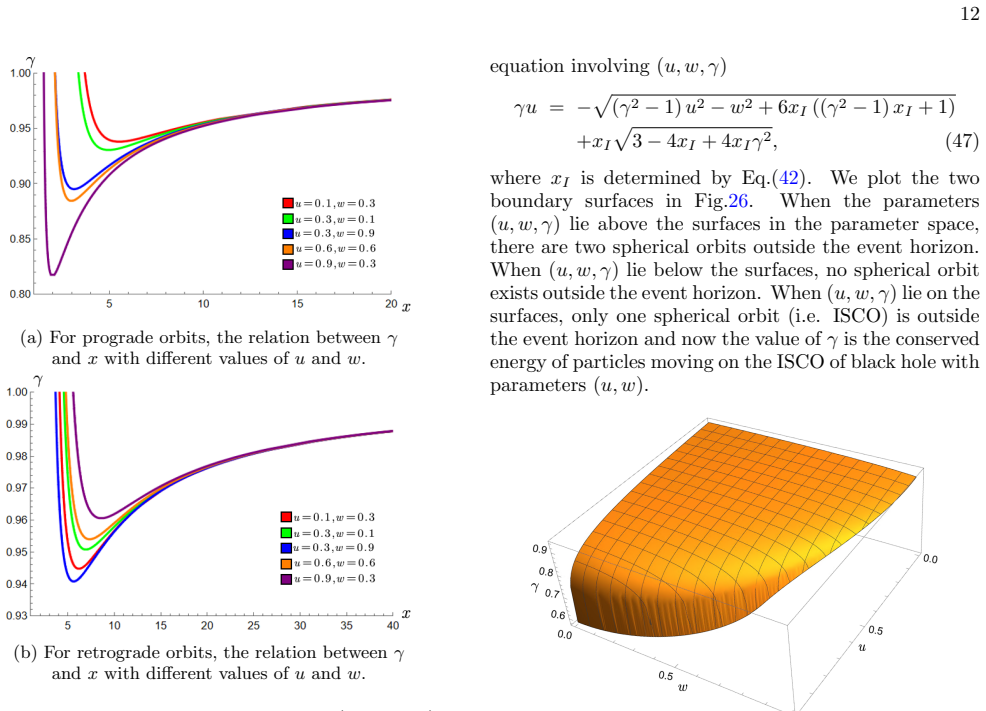
- [IV, Eqs. (36), (46), (47)] For 0<γ<1, the boundary surfaces for polar and equatorial orbits are derived from the ISSPO/ISCO conditions, but the claim that the whole parameter space splits into a region with two orbits and a region with no orbit outside the horizon is supported only by the sampled values γ=0.5 and γ=0.97 (Figs. 17 and 25). Please provide an analytic or systematic numerical proof of this dichotomy over the full domain, or rephrase the conclusions to apply to the specifically sampled parameter regions. This matters because the number of real roots could, in principle, change before the boundary surface is reached.
minor comments (5)
- [Eq. (13)] The displayed quintic contains typographical artifacts in several terms, such as '2βγuw 2' and '−2βγu 3'; please check the typesetting of all polynomials in the paper, including Eqs. (29) and (39).
- [Introduction, reference for Sagittarius A*] The sentence about the Event Horizon Telescope image of Sagittarius A* contains an unresolved citation placeholder 'released[? ]'; please add the appropriate reference.
- [IV.A, Fig. 14 caption] The caption says 'the radii of the three orbits' but the surrounding text discusses three roots; please clarify whether the figure shows all three real roots or only those outside the horizon, and correct any inconsistent wording.
- [References [26] and [27]] The references contain misspellings: 'Kerr-Newmann' should be 'Kerr-Newman'; please correct throughout the bibliography.
- [Eq. (42)] The derivation of the ISCO formula is stated as 'by solving the above three equations' without showing the intermediate algebra. Given that Eq. (42) is a headline result, please provide the derivation in an appendix or state the solving procedure more explicitly.
Circularity Check
No significant circularity: central derivation is self-contained, with only non-load-bearing self-citation as a limit check.
full rationale
The derivation chain starts from the Kerr-Newman geodesic Lagrangian, the first-order equations (6)-(7), and the spherical-orbit conditions R=0 and R'=0 in Eq. (8). Eliminating the Carter constant yields the quintic (13), which is a genuine necessary condition rather than an assumed result. The gamma=1 analytical radii, the gamma=1 no-orbit surface, the ISSPO boundary Eq. (36), and the equatorial ISCO formula Eq. (42) are all obtained by substituting the orbit and stability conditions into these equations and solving algebraically. No parameter in these formulas is fitted to data, and no predicted quantity is reused as an input. The limiting checks (Schwarzschild x=4, the RN cubic (17), the Kerr quartic (20)-(21), and the gamma-to-infinity photon-orbit limit [39]) are comparisons against independent published results; the self-citation [39] is used only as a cross-check benchmark and is not load-bearing. The statements for all gamma>1 are supported in the text only at gamma=1.5, and the no-orbit surface is asserted with 'It can be demonstrated' without an explicit proof; these are rigor and completeness concerns, not circularity. No step reduces to its own input by construction.
Assumptions & free parameters
assumptions (4)
- domain assumption The Kerr-Newman spacetime admits a fourth constant of motion (Carter constant) making the geodesic equations separable.
- domain assumption Spherical timelike orbits are fully characterized by R(r)=0 and dR/dr=0.
- ad hoc to paper The existence structure found at gamma=1.5 extends to all gamma>1.
- standard math The general quartic root formula in the Appendix is correct and applicable.
Cite this review
Pith. "Pith review of Radii of spherical timelike geodesics in Kerr-Newman black holes." pith.science (2026). https://pith.science/paper/OYHLXIPP
@misc{pith2026250611473,
  author       = {Pith},
  title        = {Pith review of: Radii of spherical timelike geodesics in Kerr-Newman black holes},
  year         = {2026},
  howpublished = {\url{https://pith.science/paper/OYHLXIPP}},
  note         = {Machine review of arXiv:2506.11473}
}
abstract
The existence, radii and radial stability of the equatorial and non-equatorial (particularly, the polar) spherical orbits are discussed for particles with different conserved energy. The radii of these orbits generally are solutions of a quintic polynomial equation with four dimensionless parameters. For the case with $\gamma=1$, we obtain the analytical expressions for the radii of the polar, equatorial and general orbits. The radial stability of the orbits outside the event horizon is also discussed. In the $(u, w, \beta)$ space, a no-orbit surface is found. When the parameters lies on this surface there is no orbit outside the event horizon, otherwise there is always one spherical orbit outside the event horizon. For the cases with $\gamma\neq1$, we focus on the study of polar and equatorial orbits. For polar orbits with $0<\gamma<1$, a boundary surface in $(u, w, \gamma)$ space is identified which determines the existence of spherical polar orbits outside the event horizon. Numerical results of the radii and radial stability of the polar orbits are shown for examples with specific values of $\gamma$. For polar orbits with $\gamma>1$, it is found that there is always one unstable orbit outside the event horizon. For equatorial orbits with $0<\gamma<1$, in each rotating case (prograde case and retrograde case), a boundary surface in $(u, w, \gamma)$ space is also identified which divides the parameter space into two regions: one region with two orbits (one stable and the other unstable) and the other with no orbit outside the event horizon. Parameters on the boundary surface correspond to ISCOs. An analytical formula for the ISCOs is derived by choosing $(w,\gamma)$ as independent variables. For equatorial orbits with $\gamma>1$, it is found that there is always one unstable orbit outside the event horizon.
Figures


Figures from the paper (18 more)








Reference graph
Works this paper leans on
- [39]
-
[1]
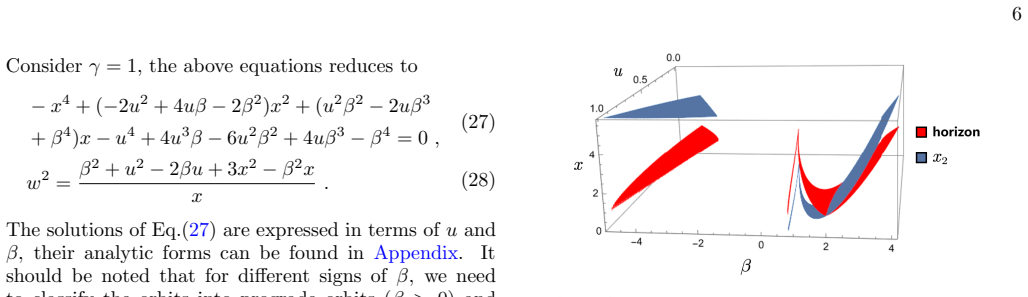
Polar orbits For the spherical polar orbits, the angular momentum parameter of the particle vanishes, i.e. β = 0 ( L = 0). Then, the equation (14) reduces to the following quartic equation, x4 − 4x3 + (2u2 + 4w2)x2 − w4x + u4 = 0. (22) The analytical expressions of its four roots can be ob- tained from the general formula in the Appendix. Given the expres...
-
[2]
In this case, the Carter constant C = 0, i.e., Eqs.(9) and (10) vanish
Equatorial orbits Spherical orbits constrained on the black hole equa- torial plane are circular orbits. In this case, the Carter constant C = 0, i.e., Eqs.(9) and (10) vanish. Now, there are three parameters in Eqs.(9) and (10), charge param- eter w and rotation parameter u of the black hole and angular momentum parameter β of the massive parti- cle. Usu...
-
[3]
General cases In this section, we consider the most general case for spherical timelike orbits around Kerr-Newman black holes. The equation satisfied by the orbit radius is given by equation (14), and its solutions are functions of u, w, and β, their analytic forms can also be obtained with formula in the Appendix. 7 In Fig.12, we fix the rotation paramet...
-
[4]
(38) β+ > 0 corresponds to the prograde orbit, and β− < 0 corresponds to the retrograde orbit
The righthand side of Eq.(9) can be considered as a quadratic equation in β, and with the dimensionless pa- rameters defined in Eq.(11), we can solve the parameter β and get β± = −γu ± p γ2u2 − (x − 1)K1 x − 1 , (37) K1 = 2 1 − γ2 x3 − 3x2 + w2 − u2(γ2 − 1) x − γ2u2. (38) β+ > 0 corresponds to the prograde orbit, and β− < 0 corresponds to the retrograde o...
-
[5]
B. P. Abbott, R. Abbott, T. D. Abbott, M. R. Aber- nathy, F. Acernese, K. Ackley, C. Adams, T. Adams, P. Addesso, R. X. Adhikari, et al., Observation of gravi- tational waves from a binary black hole merger, Physical review letters 116, 061102 (2016)
work page 2016
-
[6]
K. Akiyama et al. (Event Horizon Telescope), First M87 Event Horizon Telescope Results. I. The Shadow of the Supermassive Black Hole, Astrophys. J. Lett. 875, L1 (2019), arXiv:1906.11238 [astro-ph.GA]
arXiv 2019
-
[7]
K. Akiyama et al. (Event Horizon Telescope), First M87 Event Horizon Telescope Results. V. Physical Origin of the Asymmetric Ring, Astrophys. J. Lett. 875, L5 (2019), arXiv:1906.11242 [astro-ph.GA]
arXiv 2019
Show all 44 references
-
[8]
Akiyama et al
K. Akiyama et al. (Event Horizon Telescope), First M87 Event Horizon Telescope Results. VI. The Shadow and Mass of the Central Black Hole, Astrophys. J. Lett. 875, L6 (2019), arXiv:1906.11243 [astro-ph.GA]
2019 arXiv
-
[9]
Carter, Global structure of the Kerr family of gravi- tational fields, Phys
B. Carter, Global structure of the Kerr family of gravi- tational fields, Phys. Rev. 174, 1559 (1968)
1968
-
[10]
J. M. Bardeen, W. H. Press, and S. A. Teukolsky, Ro- tating black holes: Locally nonrotating frames, energy extraction, and scalar synchrotron radiation, Astrophys. J. 178, 347 (1972)
1972
-
[11]
D. C. Wilkins, Bound Geodesics in the Kerr Metric, Phys. Rev. D 5, 814 (1972)
1972
-
[12]
Teo, Spherical Photon Orbits Around a Kerr Black Hole, Gen
E. Teo, Spherical Photon Orbits Around a Kerr Black Hole, Gen. Rel. Grav. 35, 1909 (2003)
2003
-
[13]
Pugliese, H
D. Pugliese, H. Quevedo, and R. Ruffini, Equatorial cir- cular motion in Kerr spacetime, Phys. Rev. D 84, 044030 (2011), arXiv:1105.2959 [gr-qc]
2011 arXiv
-
[14]
Hod, Spherical null geodesics of rotating Kerr black holes, Phys
S. Hod, Spherical null geodesics of rotating Kerr black holes, Phys. Lett. B 718, 1552 (2013), arXiv:1210.2486 [gr-qc]
2013 arXiv
-
[15]
Tavlayan and B
A. Tavlayan and B. Tekin, Exact Formulas for Spherical Photon Orbits Around Kerr Black Holes, Phys. Rev. D 102, 104036 (2020), arXiv:2009.07012 [gr-qc]
2020 arXiv
-
[16]
D. N. Page, Photon boomerang in a nearly extreme Kerr metric, Class. Quant. Grav. 39, 135015 (2022), arXiv:2106.13262 [gr-qc]
2022 arXiv
-
[17]
S. E. Gralla and A. Lupsasca, Null geodesics of the Kerr exterior, Phys. Rev. D 101, 044032 (2020), arXiv:1910.12881 [gr-qc]
2020 arXiv
-
[18]
Teo, Spherical orbits around a Kerr black hole, Gen
E. Teo, Spherical orbits around a Kerr black hole, Gen. Rel. Grav. 53, 10 (2021), arXiv:2007.04022 [gr-qc]. 15
2021 arXiv
-
[19]
Tavlayan and B
A. Tavlayan and B. Tekin, Radii of spherical timelike orbits around Kerr black holes, Phys. Rev. D104, 124059 (2021), arXiv:2110.13070 [gr-qc]
2021 arXiv
-
[20]
Comp` ere, Y
G. Comp` ere, Y. Liu, and J. Long, Classification of radial Kerr geodesic motion, Phys. Rev. D 105, 024075 (2022), arXiv:2106.03141 [gr-qc]
2022 arXiv
-
[21]
Cie´ slik, E
A. Cie´ slik, E. Hackmann, and P. Mach, Kerr geodesics in terms of Weierstrass elliptic functions, Phys. Rev. D 108, 024056 (2023), arXiv:2305.07771 [gr-qc]
2023 arXiv
-
[22]
Levin and G
J. Levin and G. Perez-Giz, Homoclinic Orbits around Spinning Black Holes. I. Exact Solution for the Kerr Sep- aratrix, Phys. Rev. D 79, 124013 (2009), arXiv:0811.3814 [gr-qc]
2009 arXiv
-
[23]
Perez-Giz and J
G. Perez-Giz and J. Levin, Homoclinic Orbits around Spinning Black Holes II: The Phase Space Portrait, Phys. Rev. D 79, 124014 (2009), arXiv:0811.3815 [gr-qc]
2009 arXiv
-
[24]
L. C. Stein and N. Warburton, Location of the last sta- ble orbit in Kerr spacetime, Phys. Rev. D 101, 064007 (2020), arXiv:1912.07609 [gr-qc]
2020 arXiv
-
[25]
Johnston and R
M. Johnston and R. Ruffini, Generalized Wilkins effect and selected orbits in a Kerr-Newman geometry, Phys. Rev. D 10, 2324 (1974)
1974
-
[26]
Dadhich and P
N. Dadhich and P. P. Kale, Equatorial circular geodesics in the Kerr-Newman geometry, J. Math. Phys. (N.Y.) 18, 1727 (1977)
1977
-
[27]
Pugliese, H
D. Pugliese, H. Quevedo, and R. Ruffini, Equatorial circular orbits of neutral test particles in the Kerr- Newman spacetime, Phys. Rev. D 88, 024042 (2013), arXiv:1303.6250 [gr-qc]
2013 arXiv
-
[28]
Liu, D.-S
C.-Y. Liu, D.-S. Lee, and C.-Y. Lin, Geodesic motion of neutral particles around a Kerr–Newman black hole, Class. Quant. Grav. 34, 235008 (2017), arXiv:1706.05466 [gr-qc]
2017 arXiv
-
[29]
Wang, D.-S
C.-Y. Wang, D.-S. Lee, and C.-Y. Lin, Null and timelike geodesics in the Kerr-Newman black hole exterior, Phys. Rev. D 106, 084048 (2022), arXiv:2208.11906 [gr-qc]
2022 arXiv
-
[30]
Hackmann and H
E. Hackmann and H. Xu, Charged particle motion in Kerr-Newmann space-times, Phys. Rev. D 87, 124030 (2013), arXiv:1304.2142 [gr-qc]
2013 arXiv
-
[31]
Li, C.-Y
Y.-T. Li, C.-Y. Wang, D.-S. Lee, and C.-Y. Lin, Homo- clinic orbits in Kerr-Newman black holes, Phys. Rev. D 108, 044010 (2023), arXiv:2302.09471 [gr-qc]
2023 arXiv
-
[32]
Calvani and R
M. Calvani and R. Turolla, Complete Description of Photon Trajectories in the Kerr-Newman Space-time, J. Phys. A 14, 1931 (1981)
1981
-
[33]
Calvani, F
M. Calvani, F. De Felice, and L. Nobili, PHOTON TRA- JECTORIES IN THE KERR-NEWMAN METRIC, J. Phys. A 13, 3213 (1980)
1980
-
[34]
de Vries, The apparent shape of a rotating charged black hole, closed photon orbits and the bifurcation set A4, Class
A. de Vries, The apparent shape of a rotating charged black hole, closed photon orbits and the bifurcation set A4, Class. Quant. Grav. 17, 123 (1999)
1999
-
[35]
D. V. Gal’tsov and K. V. Kobialko, Completing characterization of photon orbits in Kerr and Kerr- Newman metrics, Phys. Rev. D 99, 084043 (2019), arXiv:1901.02785 [gr-qc]
2019 arXiv
-
[36]
Hsiao, D.-S
Y.-W. Hsiao, D.-S. Lee, and C.-Y. Lin, Equatorial light bending around Kerr-Newman black holes, Phys. Rev. D 101, 064070 (2020), arXiv:1910.04372 [gr-qc]
2020 arXiv
-
[37]
B.-R. Chen, T. Hsieh, and D.-S. Lee, Null geodesics in extremal Kerr-Newman black holes, Phys. Rev. D 111, 024058 (2025), arXiv:2411.00458 [gr-qc]
2025 arXiv
-
[38]
P. V. P. Cunha and C. A. R. Herdeiro, Stationary black holes and light rings, Phys. Rev. Lett. 124, 181101 (2020), arXiv:2003.06445 [gr-qc]
2020 arXiv
-
[40]
Wei, Topological Charge and Black Hole Pho- ton Spheres, Phys
S.-W. Wei, Topological Charge and Black Hole Pho- ton Spheres, Phys. Rev. D 102, 064039 (2020), arXiv:2006.02112 [gr-qc]
2020 arXiv
-
[41]
Ghosh and S
R. Ghosh and S. Sarkar, Light rings of station- ary spacetimes, Phys. Rev. D 104, 044019 (2021), arXiv:2107.07370 [gr-qc]
2021 arXiv
-
[42]
A. S. Alam, L. C. Andaru, B. N. Jayawiguna, and H. S. Ramadhan, Spherical orbits around Kerr–Newman and Ghosh black holes, Gen. Rel. Grav. 56, 79 (2024), arXiv:2404.17277 [gr-qc]
2024 arXiv
-
[43]
Chen, J.-H
Y.-X. Chen, J.-H. Huang, and H. Jiang, Radii of spherical photon orbits around Kerr-Newman black holes, Phys. Rev. D 107, 044066 (2023), arXiv:2210.08509 [gr-qc]
2023 arXiv
-
[44]
Barack, M
L. Barack, M. Colleoni, T. Damour, S. Isoyama, and N. Sago, Self-force effects on the marginally bound zoom- whirl orbit in Schwarzschild spacetime, Phys. Rev. D 100, 124015 (2019), arXiv:1909.06103 [gr-qc]
2019 arXiv
Reviewed August 7, 2026 · model on record in the stance chip above.
Discussion (0). Sign in to comment.