REVIEW 3 major objections 5 minor 53 references
Logic could be learned from images
T0 review · 3 major / 5 minor · reviewed 2026-08-14 · deepseek-v4-flash
Pith's one-line read The paper claims that logical operations over numbers can be learned directly from images of those numbers, with no reasoning pattern supplied in advance, and that a divide-and-conquer network using extra label images lifts multiplication…
desk verdict The datasets and negative results on multiplication are the real contribution; the DCM's 84.5% success relies on human-supplied carry labels, so the 'no preset reasoning patterns' claim is overreach. read the letter →
The pith
A machine-rendered reading of the paper's core claim, the machinery that carries it, and where it could break.
The reading
What carries the argument
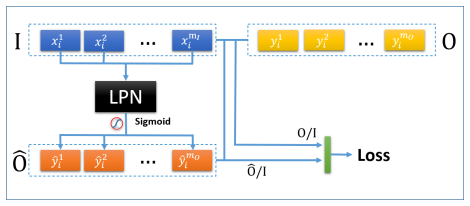
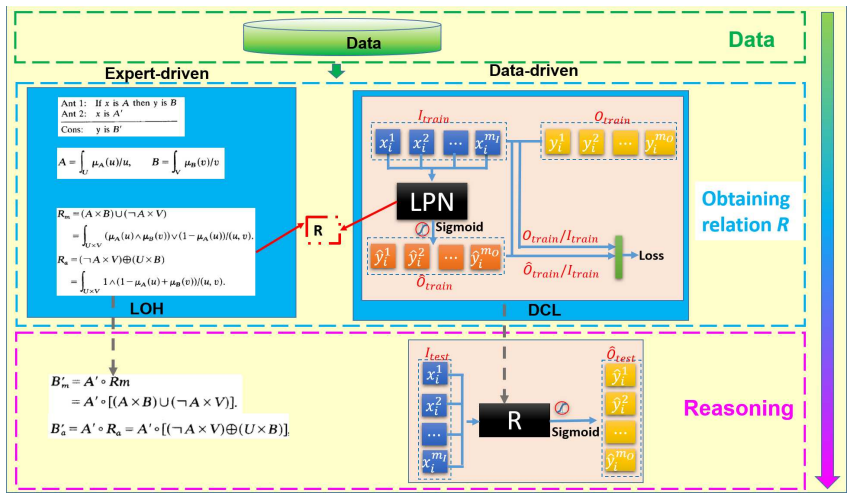
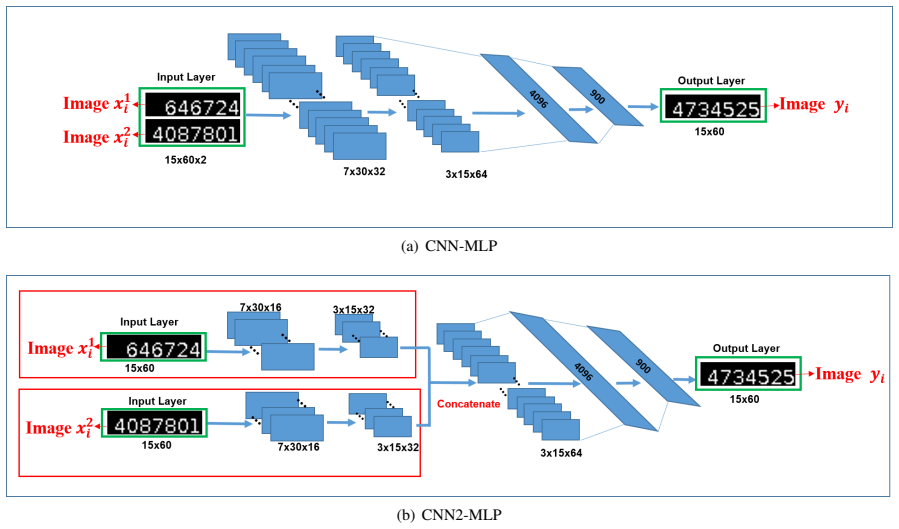
The load-bearing objects are the data concept logic, defined as a triple $(I,R,O)$ in which $R$ is an unknown relation from input sequences to outputs; the LiLi task, which instantiates $I$ as pairs of images and $O$ as a result image; the Logical Pattern Network (LPN), a neural network trained by mean-square error that is supposed to absorb $R$ from data; and the divide-and-conquer model (DCM), an MLP-based pipeline that splits multiplication into carry, non-carry, and synthetic subtasks. The DCM carries the argument for the hard case by showing that a hand-chosen decomposition with intermediate label images reduces the uncertainty of each predicted digit and lifts multiplication accuracy from below one percent to 84.5 percent.
What would settle it
Regrade the same test predictions by exact pixel comparison with ground-truth images, and also measure the OCR software's accuracy on clean ground-truth output images; if exact-pixel accuracy differs substantially from the OCR-based percentages, or if the OCR reader misreads clean ground-truth digits, then the reported results are artifacts of the recognition step rather than of logic learning.
Extended reading notes
Core claim
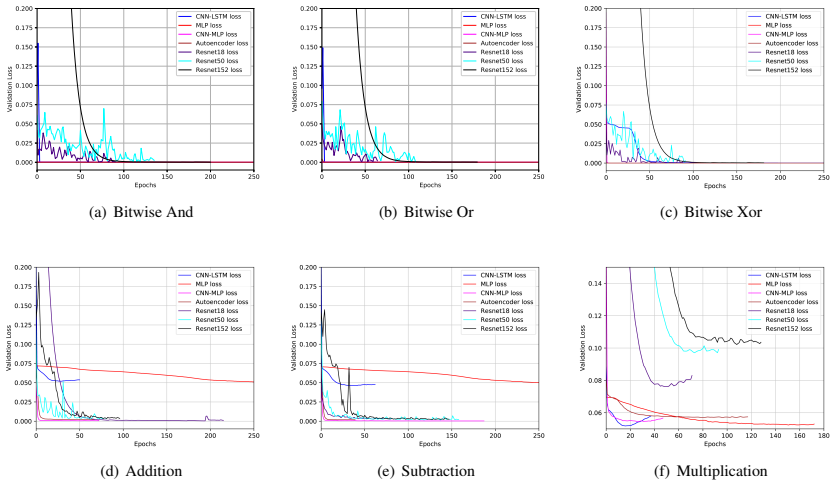
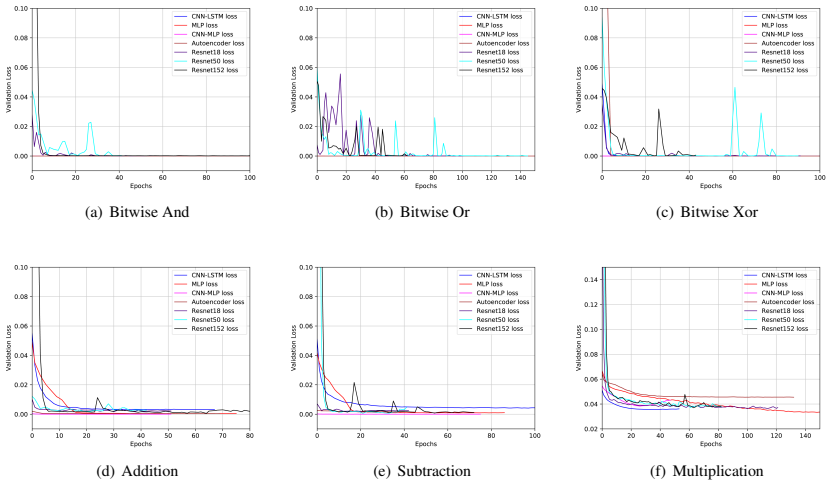
The central claim is that a logic relation can be treated as a high-dimensional mapping $R:[-1,1]^{2K}\to\{0,1\}^K$ between pixel values and learned by a neural network called the Logical Pattern Network, with no reasoning pattern specified in advance. On six synthetic image datasets, the paper reports that this succeeds almost perfectly for bitwise operations, succeeds for addition and subtraction once training data reaches 150,000 samples, and fails for multiplication with every tested standard architecture. The paper's explanation is that each output digit of a product depends on all preceding digit positions, so the uncertainty per digit is far larger than for addition or subtraction. The divide-and-conquer model attacks this by training separate MLP branches to predict the carry part and the non-carry part of the product, then a synthetic branch to combine them, reducing per-digit uncertainty from roughly 900 possibilities to 90 and yielding 84.5 percent test accuracy as the paper measures it.
Load-bearing premise
Every reported accuracy depends on the OCR software's ability to read digits from the predicted images; the paper itself notes that at least some correctly predicted digits are not recognized by the OCR, so if OCR errors are non-negligible, both the failures of standard models and the 84.5 percent success of the DCM could be misstated.
Editorial extensions
If this is right
- If the results hold, bitwise logic operations can be acquired from raw pixels with no symbolic supervision: all tested models reach about 100 percent accuracy even with only 10,000 training samples.
- Addition and subtraction, which require tracking a carry or borrow between adjacent digit positions, become learnable by CNN-MLP, Autoencoder, and ResNet models once the training set grows to 150,000 samples, supporting the paper's data-scaling strategy for hard logic.
- Multiplication marks a sharp boundary for end-to-end neural networks: every standard model stays below 0.35 percent accuracy even at 150,000 samples, so the LiLi task isolates a genuinely hard reasoning step.
- The DCM result implies that decomposing a complex visual logic task into subtasks, with extra images as labels, turns an unsolved problem into one that is mostly solvable: 84.5 percent test accuracy.
- The same decomposition idea can be carried to other complex logic tasks, such as computing decimal bit operations by first converting to binary, as the paper's conclusion suggests.
Reading between the lines
- If the central claim is right, the LiLi task could serve as a cleaner probe of machine reasoning than question-answering style benchmarks, because the only way to answer is to actually compute the relation from the two input images.
- The OCR-based accuracy measure probably makes the reported numbers conservative: the paper states that some correct predicted digits are not recognized by the OCR software, so exact pixel-level grading might raise the reported accuracies.
- The DCM's carry/non-carry decomposition is a human-specified reasoning pattern, which sits in tension with the paper's 'no reasoning patterns beforehand' slogan; the pure data-driven claim is really established only for the base tasks, while the hard-task success comes from injecting domain knowledge.
- A testable extension is whether a sufficiently scaled end-to-end model, or an architecture with explicit positional alignment, can eventually match the DCM without decomposition; the paper's data-scaling results for addition suggest the gap may shrink with data.
Signed reviews
Editorial analysis
A structured set of objections, weighed in public.
Referee Report
Summary. This paper introduces a 'data concept logic' (DCL) and a 'learning logic from images' (LiLi) task in which a model receives two rendered images of numbers and must output the rendered image of the result of an unknown binary operation. Six datasets are constructed: bitwise AND/OR/XOR, addition, subtraction, and multiplication. The authors train CNN-LSTM, MLP, CNN-MLP, autoencoder, and ResNet variants; with 150,000 training samples these models reach near-100% accuracy on the bitwise tasks and roughly 99% on addition/subtraction, while all remain below 0.4% on multiplication. To address multiplication, the paper proposes a divide-and-conquer model (DCM) that is trained with additional human-defined carry and non-carry images and reports 84.5% accuracy. The paper concludes that logic patterns can be learned from images without preset reasoning patterns, while also stating that the DCM combines domain expert knowledge with data-driven models.
Significance. The LiLi benchmark is a useful diagnostic: it has a clear single-answer evaluation, a controlled difficulty gradient, and the experiments show that ordinary architectures can learn arithmetic from raw pixel pairs surprisingly well. The consistently high accuracies on bitwise and addition/subtraction tasks across several architectures are credible and constitute the paper's main empirical contribution. The complete failure of all tested networks on multiplication, and the substantial improvement from a hand-decomposed training target, are informative for the community even though the decomposition is provided by the authors. The paper does not provide code or data links, and no formal or machine-checked proofs are included, so reproducibility rests on the textual dataset description and hyperparameter tables.
major comments (3)
- [Section 3.2 / Section 5] The claim in Section 3.2, after Eq. (9), that 'the LPN merely needs to be provided some training data to automatically learn the logical patterns... without providing any reasoning patterns beforehand' is not supported for the hard task. In Section 5 and Fig. 13, the DCM is trained on a regenerated multiplication dataset in which the carry image C and non-carry image D are human-defined intermediate targets; this is exactly a preset decomposition of the multiplication reasoning pattern. The paper's own conclusion states that the DCM works by 'combing the domain expert knowledge with data-driven model.' The central claim should be revised to apply only to the easy and intermediate tasks, or the DCM should be presented as a hybrid method rather than evidence for unsupervised logic discovery.
- [Section 4.2] Accuracy is measured by Tesseract OCR on predicted images, and the authors note that 'Some are right but OCR can not recognize them.' Because no OCR accuracy on the ground-truth images is reported, the percentages in Tables 2-5 are uncalibrated with respect to actual image-level correctness. The 100% easy-task results are robust to this concern, but the DCM's 84.5% and the multiplication failure rates could shift if OCR errors are not symmetric; an OCR baseline on ground-truth outputs or a pixel/character-level metric should be provided.
- [Table 5 / Fig. 14] The relationship between the reported 84.5% DCM accuracy and the per-subtask accuracies (carry 86.25%, non-carry 98.38%, synthetic 84.46%) is unclear. The testing procedure passes predicted carry/non-carry images c' and d' into the synthetic subtask, so errors in the first two subtasks propagate; if the 84.5% is instead the synthetic subtask accuracy evaluated with ground-truth c and d, then the end-to-end accuracy on the original a,b inputs is not reported. The authors should state exactly which pipeline is evaluated and report end-to-end accuracy.
minor comments (5)
- [Section 2.2] Formulas 5-7 contain repeated typos, including 'squence' for 'sequence' and 'T he' for 'The.'
- [Section 4.2] The text contains 'CNN-NLP' where 'CNN-MLP' is clearly intended, and 'verity' should be 'verify.'
- [Section 5] Eq. (14) is not operationalized: no definition or proxy for 'difficulty' is given, so the inequality H > f(h1,...,hk) reads as a heuristic rather than a testable criterion.
- [Section 4.1] Table 1 does not include learning rates, optimizers, or epoch counts for all models, despite the text saying that the hyper-parameter settings are shown in Table 1; adding these details would improve reproducibility.
- [Section 1] The relationship between the LiLi task and the Fashion-Logic dataset of reference [23] should be stated explicitly, since both are described as data-driven visual logic tasks.
Circularity Check
No circular derivation; the DCM's human-specified decomposition weakens the headline claim but is not a circular prediction.
full rationale
The core LiLi experiments (bitwise, addition, subtraction) train standard networks on (x1,x2)->y image pairs and report genuine generalization on held-out images; these results are self-contained empirical findings, not derived from the claim being tested. The DCM section is the only place where a circularity concern could arise, but it does not reduce by construction: although the paper defines the multiplication target as E = C + D and trains the synthetic subtask on (c,d)->e, at test time the DCM receives only the original images a and b and must predict c', d' and then e; the reported 84.5% is an end-to-end generalization result, not an identity or a refit of the labels. The real problem is scope: Section 3.2 claims the LPN learns 'without providing any reasoning patterns beforehand,' yet Section 5 regenerates the multiplication set with carry/non-carry labels and the conclusion concedes the DCM works by 'combining the domain expert knowledge with data-driven model.' That makes the 'logic learned from images' claim unsupported for the difficult multiplication task, but it is a claim-support gap and a correctness risk rather than a circular step. Likewise, Section 4.2's note that 'Some are right but OCR can not recognize them' makes reported accuracies lower bounds, a measurement caveat rather than circularity. Reference [23] is a same-author citation, but it is only used as related work and is not load-bearing. No circular step is present; the paper is transparent about the DCM's extra label information.
Assumptions & free parameters
assumptions (4)
- standard math Universal approximation theorem: a sufficiently large neural network can represent the logical relation R.
- domain assumption The rendered digit images present numbers in a fixed visual layout that CNNs and Tesseract OCR can reliably extract.
- ad hoc to paper Multiplication can be decomposed into carry and non-carry components C and D such that the product E equals C plus D.
- domain assumption OCR errors are rare enough that reported accuracies approximately equal model accuracies.
Cite this review
Pith. "Pith review of Logic could be learned from images." pith.science (2026). https://pith.science/paper/OYYS7YN2
@misc{pith2026190801931,
  author       = {Pith},
  title        = {Pith review of: Logic could be learned from images},
  year         = {2026},
  howpublished = {\url{https://pith.science/paper/OYYS7YN2}},
  note         = {Machine review of arXiv:1908.01931}
}
read the original abstract
Logic reasoning is a significant ability of human intelligence and also an important task in artificial intelligence. The existing logic reasoning methods, quite often, need to design some reasoning patterns beforehand. This has led to an interesting question: can logic reasoning patterns be directly learned from given data? The problem is termed as a data concept logic. In this study, a learning logic task from images, called a LiLi task, first is proposed. This task is to learn and reason the logic relation from images, without presetting any reasoning patterns. As a preliminary exploration, we design six LiLi data sets (Bitwise And, Bitwise Or, Bitwise Xor, Addition, Subtraction and Multiplication), in which each image is embedded with a n-digit number. It is worth noting that a learning model beforehand does not know the meaning of the n-digit numbers embedded in images and the relation between the input images and the output image. In order to tackle the task, in this work we use many typical neural network models and produce fruitful results. However, these models have the poor performances on the difficult logic task. For furthermore addressing this task, a novel network framework called a divide and conquer model by adding some label information is designed, achieving a high testing accuracy.
Figures

Figures from the paper (13 more)




Reference graph
Works this paper leans on
- [1]
-
[2]
J. Johnson, B. Hariharan, L. V . D. Maaten, F. F. Li, C. L. Zitnick, R. Girshick, CLEVR: A diagnostic dataset for compositional language and elementary visual reasoning, in: IEEE Conference on Computer Vision and Pattern Recognition, Honolulu, USA, 2017, pp. 1988–1997
work page 2017
-
[3]
G. Wang, Fuzzy reasoning and fuzzy logic, in: Soft Computing in Intelligent Systems and Information Processing. Proceedings of the 1996 Asian Fuzzy Systems Symposium, Kenting, China, 1996, pp. 478–483
work page 1996
-
[4]
Mizumoto, Comparison of fuzzy reasoning methods, Fuzzy Sets and Systems 8 (3) (1982) 253–283
M. Mizumoto, Comparison of fuzzy reasoning methods, Fuzzy Sets and Systems 8 (3) (1982) 253–283
work page 1982
-
[5]
J. Yen, Fuzzy logic-a modern perspective, IEEE Transactions on Knowledge and Data Engineering 11 (1) (1999) 153–165
work page 1999
-
[6]
D. W. Pei, On the strict logic foundation of fuzzy reasoning, Soft Computing 8 (8) (2004) 539–545
work page 2004
-
[7]
Wille, Restructuring lattice theory: an approach based on hierarchies of concepts, in: I
R. Wille, Restructuring lattice theory: an approach based on hierarchies of concepts, in: I. Rival (Ed.), Ordered sets, Springer, 1982, pp. 445–470
work page 1982
- [8]
Show all 53 references
-
[9]
Golinskapilarek, E
J. Golinskapilarek, E. Orlowska, Relational reasoning in formal concept analysis, in: IEEE International Fuzzy Systems Conference, London, UK, 2007
2007
-
[10]
M. W. Shao, M. M. Lv, K. W. Li, C. Z. Wang, The construction of attribute (object)-oriented multi-granularity concept lattices, International Journal of Machine Learning and Cybernetics 11 (4) (2020) 1017–1032
2020
-
[11]
N. J. Nilsson, Probabilistic logic, Artificial Intelligence 28 (1) (1986) 71–87
1986
-
[12]
N. J. Nilsson, Probabilistic logic revisited, Artificial Intelligence 59 (1-2) (1993) 39–42
1993
-
[13]
Y . She, X. He, Y . Qian, W. Xu, J. Li, A quantitative approach to reasoning about incomplete knowledge, Information Sciences 451-452 (2018) 100–111
2018
-
[14]
S. Y . Li, L. M. Tam, H. K. Chen, C. S. Chen, A novel-designed fuzzy logic control structure for control of distinct chaotic systems, International Journal of Machine Learning and Cybernetics (11) (2020) 2391–2406
2020
-
[15]
Pearl, Evidential reasoning using stochastic simulation of causal models, Artificial Intelligence 32 (2) (1987) 245–257
J. Pearl, Evidential reasoning using stochastic simulation of causal models, Artificial Intelligence 32 (2) (1987) 245–257
1987
-
[16]
Chen, S.-H
S.-M. Chen, S.-H. Cheng, C.-H. Chiou, Fuzzy multiattribute group decision making based on intuitionistic fuzzy sets and evidential reasoning methodology, Information Fusion 27 (2016) 215–227
2016
-
[17]
Z. Yang, S. Bonsall, J. Wang, Fuzzy rule-based bayesian reasoning approach for prioritization of failures in fmea, IEEE Transactions on Reliability 57 (3) (2008) 517–528
2008
-
[18]
J. B. Tenenbaum, T. L. Gri ffiths, C. Kemp, Theory-based bayesian models of inductive learning and reasoning, Trends in Cognitive Sciences 10 (7) (2006) 309–318
2006
-
[19]
Y . Qian, X. Liang, W. Qi, J. Liang, L. Bing, A. Skowron, Y . Yao, J. Ma, C. Dang, Local rough set: A solution to rough data analysis in big data, International Journal of Approximate Reasoning 97 (2018) 38–63
2018
-
[20]
Y . She, X. He, H. Shi, Y . Qian, A multiple-valued logic approach for multigranulation rough set model, International Journal of Approximate Reasoning 82 (2017) 270–284
2017
-
[21]
Y . Lin, J. Li, A. Tan, J. Zhang, Granular matrix-based knowledge reductions of formal fuzzy contexts, International Journal of Machine Learning and Cybernetics (11) (2020) 643–656
2020
-
[22]
M. Li, M. Chen, W. Xu, Double-quantitative multigranulation decision-theoretic rough fuzzy set model, International Journal of Machine Learning and Cybernetics 10 (5) (2019) 3225–3244
2019
-
[23]
Q. Guo, Y . Qian, X. Liang, Mining logic patterns from visual data, in: International Conference on Data Mining Workshops, Beijing, China, 2019
2019
-
[24]
W. Z. Dai, Q. Xu, Y . Yu, Z. H. Zhou, Bridging machine learning and logical reasoning by abductive learning, in: Advances in Neural Information Processing Systems, Vancouver, Canada, 2019
2019
-
[25]
Huang, Z
G. Huang, Z. Liu, L. Van Der Maaten, K. Q. Weinberger, Densely connected convolutional networks, in: IEEE Conference on Computer Vision and Pattern Recognition, Honolulu, USA, 2017, pp. 4700–4708
2017
-
[26]
K. He, X. Zhang, S. Ren, J. Sun, Deep residual learning for image recognition, in: IEEE Conference on Computer Vision and Pattern Recognition, Las Vegas, USA, 2016, pp. 770–778
2016
-
[27]
Liang, Q
X. Liang, Q. Guo, Y . Qian, W. Ding, Q. Zhang, Evolutionary deep fusion method and its application in chemical structure recognition, IEEE Transactions on Evolutionary Computation (2021) 1–1doi:10.1109/TEVC.2021.3064943. 21
2021
-
[28]
S. Ren, K. He, R. Girshick, J. Sun, Faster r-cnn: Towards real-time object detection with region proposal networks, IEEE Transactions on Pattern Analysis and Machine Intelligence 39 (6) (2017) 1137–1149
2017
-
[29]
K. He, G. Gkioxari, P. Doll ´ar, R. Girshick, Mask r-cnn, in: IEEE International Conference on Computer Vision, Venice, Italy, 2017, pp. 2961–2969
2017
-
[30]
Shelhamer, J
E. Shelhamer, J. Long, T. Darrell, Fully convolutional networks for semantic segmentation, IEEE Transactions on Pattern Analysis and Machine Intelligence 39 (4) (2017) 640–651
2017
-
[31]
L.-C. Chen, G. Papandreou, I. Kokkinos, K. Murphy, A. L. Yuille, Deeplab: Semantic image segmentation with deep convolutional nets, atrous convolution, and fully connected crfs, IEEE Transactions on Pattern Analysis and Machine Intelligence 40 (4) (2018) 834–848
2018
-
[32]
Vinyals, A
O. Vinyals, A. Toshev, S. Bengio, D. Erhan, Show and tell: Lessons learned from the 2015 mscoco image captioning challenge, IEEE Transactions on Pattern Analysis and Machine Intelligence 39 (4) (2016) 652–663
2016
-
[33]
Johnson, A
J. Johnson, A. Karpathy, L. Fei-Fei, Densecap: Fully convolutional localization networks for dense captioning, in: IEEE Conference on Computer Vision and Pattern Recognition, Las Vegas, USA, 2016, pp. 4565–4574
2016
-
[34]
Z. Yang, X. He, J. Gao, L. Deng, A. Smola, Stacked attention networks for image question answering, in: IEEE Conference on Computer Vision and Pattern Recognition, Las Vegas, USA, 2016, pp. 21–29
2016
-
[35]
Q. Wu, C. Shen, P. Wang, A. Dick, A. van den Hengel, Image captioning and visual question answering based on attributes and external knowledge, IEEE Transactions on Pattern Analysis and Machine Intelligence 40 (6) (2018) 1367–1381
2018
-
[36]
Goodfellow, J
I. Goodfellow, J. Pouget-Abadie, M. Mirza, B. Xu, D. Warde-Farley, S. Ozair, A. Courville, Y . Bengio, Generative adversarial nets, in: Advances in Neural Information Processing Systems, Montr´eal, Canada, 2014, pp. 2672–2680
2014
-
[37]
S. Reed, Z. Akata, X. Yan, L. Logeswaran, B. Schiele, H. Lee, Generative adversarial text to image synthesis, in: International Conference on Machine Learning, New York City, USA, 2016, pp. 1060–1069
2016
-
[38]
R. Hu, J. Andreas, M. Rohrbach, T. Darrell, K. Saenko, Learning to reason: End-to-end module networks for visual question answering, in: IEEE International Conference on Computer Vision, Venice, Italy, 2017, pp. 804–813
2017
-
[39]
Zhang, Y
P. Zhang, Y . Goyal, D. Summers-Stay, D. Batra, D. Parikh, Yin and yang: Balancing and answering binary visual questions, in: IEEE Conference on Computer Vision and Pattern Recognition, Las Vegas, USA, 2016, pp. 5014–5022
2016
-
[40]
Hornik, M
K. Hornik, M. Stinchcombe, H. White, Multilayer feedforward networks are universal approximators, Neural Networks 2 (5) (1989) 359–366
1989
-
[41]
A., Outline of a new approach to the analysis of complex systems and decision processes, IEEE Transactions on Systems, Man and Cybernetics SMC-3 (1) (1973) 28–44
Zadeh, L. A., Outline of a new approach to the analysis of complex systems and decision processes, IEEE Transactions on Systems, Man and Cybernetics SMC-3 (1) (1973) 28–44
1973
-
[42]
Antol, A
S. Antol, A. Agrawal, J. Lu, M. Mitchell, D. Parikh, VQA: Visual question answering, International Journal of Computer Vision 123 (1) (2015) 4–31
2015
-
[43]
Graves, Long short-term memory, Neural Computation 9 (8) (1997) 1735–1780
A. Graves, Long short-term memory, Neural Computation 9 (8) (1997) 1735–1780
1997
-
[44]
Hoshen, S
Y . Hoshen, S. Peleg, Visual learning of arithmetic operation, in: Association for the Advancement of Artificial Intelligence, Phoenix, USA, 2016, pp. 3733–3739
2016
-
[45]
LeCun, Y
Y . LeCun, Y . Bengio, G. Hinton, Deep learning, Nature 521 (7553) (2015) 436
2015
-
[46]
G. E. Hinton, R. R. Salakhutdinov, Reducing the dimensionality of data with neural networks, Science 313 (5786) (2006) 504–507
2006
-
[47]
Smith, An overview of the tesseract ocr engine, in: Ninth International Conference on Document Analysis and Recognition, V ol
R. Smith, An overview of the tesseract ocr engine, in: Ninth International Conference on Document Analysis and Recognition, V ol. 2, Curitiba, Brazil, 2007, pp. 629–633
2007
-
[48]
Y . Qian, J. Liang, Y . Yao, C. Dang, Mgrs: A multi-granulation rough set, Information Sciences 180 (6) (2010) 949–970
2010
-
[49]
L. Ke, Q. Zhang, R. Battiti, Hybridization of decomposition and local search for multiobjective optimization, IEEE Transactions Cybernetics 44 (10) (2014) 1808–1820
2014
-
[50]
Liang, J
J. Liang, J. Fadili, G. Peyr´e, A multi-step inertial forward-backward splitting method for non-convex optimization, in: Advances in Neural Information Processing Systems, Barcelona, Spain, 2016, pp. 4035–4043
2016
-
[51]
Y . Qian, J. Liang, W. Pedrycz, C. Dang, Positive approximation: An accelerator for attribute reduction in rough set theory, Artificial Intelligence 174 (2010) 597–618
2010
-
[52]
A. Tan, W. Z. Wu, S. Shia, S. Zhao, Granulation selection and decision making with multigranulation rough set over two universes, International journal of machine learning and cybernetics 10 (9) (2019) 2501–2513
2019
-
[53]
L. Chen, P. Huang, Y . Li, Z. Meng, Edge-dependent efficient grasp rectangle search in robotic grasp detection, IEEE/ASME Transactions on Mechatronics (2020) 1–1doi:10.1109/TMECH.2020.3048441. 22
2020
Reviewed August 14, 2026 · model on record in the stance chip above.
Discussion (0). Continue with ORCID to comment.