REVIEW 3 major objections 5 minor 20 references
Higgs physics beyond the Standard Model
T0 review · 3 major / 5 minor · reviewed 2026-08-14 · deepseek-v4-flash
Pith's one-line read LHC measurements of the 125 GeV Higgs force beyond-Standard-Model scalar sectors into an approximate alignment limit, yet leave room for new Higgs states and signatures that upcoming runs could discover.
desk verdict A competent, clearly written workshop review that is worth reading for the HL-LHC planning, but its most interesting claim—2HDM h-vs-H discrimination via H→γγ—rests on an unquantified bound in Eq. (3.3) and should be treated as provisional until the in-preparation paper appears. read the letter →
The pith
A machine-rendered reading of the paper's core claim, the machinery that carries it, and where it could break.
The reading
What carries the argument
The central object is the alignment limit of a two-Higgs-doublet model: when $\sin(\beta-\alpha)\to 1$ the lighter state $h$ has Standard-Model-like couplings, and when $\cos(\beta-\alpha)\to 1$ the heavier state $H$ does. The argument that separates these two cases is a non-decoupling relation for the charged-Higgs coupling in the $H$-aligned limit, $g_{HH^+H^-}\to -2M_{H^\pm}^2/v$, which holds because the soft mass parameter $m^2\equiv 2m_{12}^2/\sin(2\beta)$ is bounded by $\mathcal{O}(v^2)$ from unitarity and vacuum stability. This coupling prevents the charged-Higgs loop from vanishing as $M_{H^\pm}$ grows, leaving a measurable suppression of about 10% in $H\to\gamma\gamma$. In the singlet models, the analogous machinery is a universal suppression of all Standard Model couplings by a mixing-angle factor, which lets measured Higgs rates be translated directly into limits on singlet mixing and on Higgs-to-Higgs decay rates.
What would settle it
An HL-LHC measurement of the 125 GeV diphoton rate that matches the Standard Model within a few percent, while a charged Higgs is known or assumed to exist below 1 TeV, would rule out the H-at-125 interpretation, as would a dedicated $H^\pm\to W^\pm h$ search that excludes the model's predicted order-one branching ratios across the allowed mass plane.
Extended reading notes
Core claim
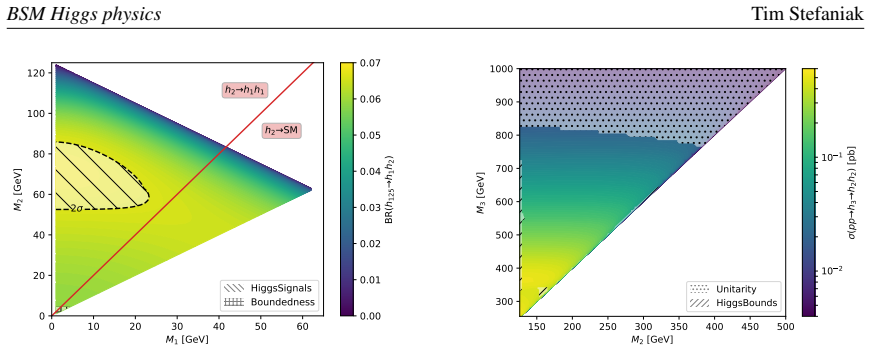
The paper's central claim is that the absence of new scalar signals plus the measured properties of the 125 GeV state do not simply close the book on beyond-Standard-Model Higgs sectors; they place those sectors in an approximate alignment limit and, at the same time, leave open a set of signatures that current searches have not covered. In the two-Higgs-doublet model, the paper shows that the two possible alignments are distinguishable: if the heavier $H$ is the 125 GeV state, the charged-Higgs loop in $H\to\gamma\gamma$ cannot decouple, producing a roughly 10% rate suppression, and $H^\pm\to W^\pm h$ becomes the dominant charged-Higgs decay over most of the allowed Type-I parameter space. In singlet extensions, Higgs rate measurements bound the singlet mixing to $g/g_{\rm SM}\lesssim 0.26$ and cap any new-physics decay of the 125 GeV state at a branching ratio of about 7%, while resonant $h_2\to h_1h_1$ production remains beyond current search sensitivity. In the Minimal Supersymmetric Standard Model, $\tau^+\tau^-$ searches for $H/A$ will cover heavy Higgs masses below about 1 TeV at the high-luminosity LHC, except where those states decay to neutralinos and charginos, a channel in need of dedicated searches.
Load-bearing premise
The h-versus-H distinguishability argument depends on the soft mass parameter $m^2 \equiv 2m_{12}^2/\sin(2\beta)$ being bounded by roughly the weak scale, as unitarity and stability require; if that parameter could be much larger, the charged-Higgs coupling would decouple and the predicted diphoton-rate shift would not occur.
Editorial extensions
If this is right
- New scalar states discovered at the LHC will characteristically have suppressed couplings to fermions and gauge bosons, so they are more likely to surface in Higgs-to-Higgs cascades or diboson final states than in standard Higgs-like single-production searches.
- A precise high-luminosity LHC measurement of $H\to\gamma\gamma$ can probe charged-Higgs masses far above the direct reach, because the predicted suppression grows with $M_{H^\pm}$ instead of decoupling.
- Dedicated searches for $H^\pm\to W^\pm h$ are required to decide whether the observed 125 GeV state is the lighter or the heavier CP-even scalar of a two-Higgs-doublet model.
- In the Minimal Supersymmetric Standard Model, the high-luminosity LHC will cover essentially all $H/A\to\tau^+\tau^-$ signatures below about 1 TeV, making the $H/A\to$ neutralino/chargino channel the principal remaining blind spot.
- Resonant double-Higgs production from a heavy singlet is currently unconstrained, so the high-luminosity phase of the LHC, not Run 2, is the first real opportunity to discover that signature.
Reading between the lines
- A testable extension of the h-versus-H argument would combine the diphoton rate with other loop-induced couplings such as $H\to Z\gamma$, since the same non-decoupling charged-Higgs loop should enter both and could discriminate the two alignments with less integrated luminosity than the diphoton channel alone.
- The paper leaves implicit that the $\mathrm{BR}(H\to\mathrm{NP})\lesssim 7\%$ bound in the singlet model can be read as a generic cap on any exotic or invisible decay of the 125 GeV Higgs induced by mixing with a hidden scalar, and tightening it to the projected 4% would make the constraint comparable to the strongest direct invisible-Higgs searches.
- A concrete search strategy suggested by the two-singlet benchmark planes is to optimize existing multi-$b$-tag analyses for the three- and four-$b$-jet final states of the $h_3\to h_2h_2\to h_1h_1h_1h_1$ cascade, since the paper identifies the softness of the final state as the main experimental challenge.
Signed reviews
Editorial analysis
A structured set of objections, weighed in public.
Referee Report
Summary. This proceedings paper reviews BSM Higgs sectors in increasing complexity: a real singlet extension, two real singlets, the CP-conserving 2HDM, and the MSSM Higgs sector. It uses the public codes HiggsBounds and HiggsSignals, together with published benchmark scans, to translate current LHC Higgs rate measurements and searches into constraints. The main quantitative results are the allowed region in (kappa, BR(h125 -> hS hS)) for the singlet, maximal rates for pp -> hS -> h125 h125, Higgs-to-Higgs decay benchmark planes for the two-singlet model, a Type-I 2HDM scan with the heavy CP-even state H as the 125 GeV boson, and HL-LHC MSSM H/A -> tau tau projections. The paper concludes that current data require approximate alignment (SM-like couplings for the 125 GeV state) but leave room for additional lighter or heavier scalars and for so-far-uncovered signatures such as H+/- -> W+/- h, hi -> hj hk cascades, and H/A -> neutralino/chargino decays.
Significance. If the 2HDM distinguishability claim holds, the paper identifies a testable and non-decoupling signature: the charged-Higgs loop correction to H -> gamma gamma and the dominance of H+/- -> W+/- h in the H-as-125 interpretation. This is a timely observation that could motivate dedicated searches. The review is useful as a compact summary of the HL-LHC BSM Higgs landscape, and it benefits from the use of publicly released tools (HiggsBounds/HiggsSignals) and from reproducible published benchmark planes in Refs. [10], [14], and [1]. The Higgs-to-Higgs-decay benchmark planes and the explicit upper limit on BR(h125 -> NP) are concrete, falsifiable predictions. However, the paper's most original claim is not self-contained: it rests on an unpublished scan (Ref. [19]) and on a one-line bound on m^2 that is not established in the text, so the significance is currently conditional on the documentation of that analysis.
major comments (3)
- [Sec. 3.1, Eq. (3.3)] The crucial bound m^2 = 2 m12^2 / sin(2 beta) <= O(v^2), described as 'imposed by unitarity and stability conditions', is not derived and, as stated, is not an immediate consequence of either condition; unitarity and stability constrain the quartic couplings, not the soft-breaking mass m12^2 directly. Using the standard relation M_H+-^2 = m^2 - (lambda4 + lambda5) v^2 / 2, a large charged-Higgs mass is consistent with m^2 ~ M_H+-^2, in which case the two '-2 M_H+-^2' contributions in Eq. (3.3) cancel and the H -> gamma gamma loop decouples rather than approaching -10%. The limit M_H+- >> M_H used in Eq. (3.3) therefore requires an additional alignment condition or a quantitative perturbativity bound on lambda4 + lambda5 that the text does not state. Please supply this derivation, state the precise criterion, and identify the region of parameter space in which the -10% result holds.
- [Sec. 3.1, Fig. 3] Fig. 3 and the accompanying statements that the H -> gamma gamma modification is 'around -10% at large M_H+-' and that H+/- -> W+/- h is 'generally dominant' are based on a parameter scan whose ranges and constraint implementation are not described in this paper; the details are deferred to Ref. [19], which is in preparation. Because the h-versus-H distinguishability conclusion is the paper's most original claim, the reader cannot assess the scan coverage (for example the ranges of tan beta, Mh, and m12^2, and the treatment of perturbative unitarity, boundedness, and electroweak precision constraints) or reproduce the allowed-point ensembles. Either include the scan details and constraints or explicitly frame the -10% and H+/- -> W+/- h dominance statements as benchmark-specific expectations from Ref. [19].
- [Sec. 3.1, large-tan beta regime] The soft-breaking combination m^2 = 2 m12^2 / sin(2 beta) grows like m12^2 tan beta for tan beta >> 1, so the bound m^2 <= O(v^2) is not parameter-independent. The manuscript does not state the tan beta range used in the Fig. 3 scan; the text only notes that tan beta >~ 2 is essentially unconstrained by flavor observables in Type-I. If the scan excludes or does not cover the large-tan beta region, the statement that the H -> gamma gamma rate is modified by about -10% at large M_H+- is not a general 2HDM conclusion. A quantified bound, or a demonstration that the relaxed regions are excluded by the scan, is needed to support the distinguishability claim.
minor comments (5)
- [Sec. 3.1] The text uses both 'Type-1' and 'Type-I' for the same fermion coupling scenario; please unify the notation.
- [Sec. 3.1, Eq. (3.3) and Fig. 3] The charged-Higgs mass is written both as M_H+ and as M_H+-; please use a single symbol consistently in equations, captions, and running text.
- [Sec. 2.1] The statement that the HL-LHC is expected to become sensitive to pp -> hS -> h125 h125 for hS masses below about 500 GeV should cite the projection source, as is done for the BR(H -> NP) limit in the same section.
- [Sec. 3.2] The text contains the typo 'threrefore', and the benchmark scenarios M_h^125 and M_h^125(chi tilde) should be defined at first use rather than only referenced.
- [Acknowledgments] The acknowledgment contains a garbled character in the German Research Foundation grant string; please repair the encoding.
Circularity Check
No constructional circularity: the 2HDM distinguishability argument is analytic and the numerical constraints come from publicly released tools fitted to external LHC data.
full rationale
The paper is a proceedings review, not a derivation that identifies its conclusion with its input. In the singlet sections, the allowed parameter regions are obtained by running HiggsSignals on LHC Run 1+2 rate measurements; the outputs (e.g. cos(alpha) <~ 0.26, BR(H->NP) <~ 7.2%) are constraint fits, not quantities defined by the fit. The two-singlet benchmark planes are imported from Ref. [14], whose authors include the present author; however, that is a normal citation of prior detailed work, and the paper does not invoke an unverified uniqueness theorem to force its choice. The 2HDM h-versus-H argument is analytic: Eq. (3.3) derives the non-decoupling charged-Higgs coupling from the scalar potential, and the claim that m^2 = 2 m12^2 / sin(2 beta) <~ O(v^2) is a stated dynamical input from unitarity and stability, not a parameter fitted to the predicted H->gamma gamma shift. If that bound is wrong or weaker at large tan beta, the 'around -10%' result would change; that is a correctness risk, not a circularity. Self-citations to HiggsBounds/HiggsSignals and to Refs. [10,14,19] are numerous, but they support computational infrastructure and prior model studies, and the central claims remain externally anchored to LHC measurements and analytically derived formulas. No equation is shown to be equal to its input by construction, and no fitted parameter is renamed as a prediction. Score 1 acknowledges the non-load-bearing self-citation weight; there is no constructional circularity.
Assumptions & free parameters
free parameters (3)
- kappa = sin alpha (real singlet mixing angle) =
constrained; hS coupling g/gSM <= 0.26
- BR(H to NP) = BR(h125 to hS hS) =
<= 7.2% at 95% CL for kappa = 1
- 2HDM scan parameters (tan beta, m12^2, Mh, MH+) =
scanned; gHH+H-/MH+^2 varied in Fig. 3 (left)
assumptions (6)
- domain assumption The Standard Model with one Higgs doublet is the correct low-energy description; all quoted LHC measurements are correctly interpreted in that framework.
- domain assumption Weak-scale Z2 symmetries in the singlet and doublet models, and the softly broken Z2 in the 2HDM, provide valid model constructions and suppress flavor-changing neutral currents.
- domain assumption Perturbative unitarity, boundedness from below, and perturbative couplings define the allowed parameter space.
- domain assumption The bound m^2 = 2 m12^2 / sin(2 beta) <= O(v^2) holds from unitarity and stability in the 2HDM.
- domain assumption HiggsBounds and HiggsSignals correctly encode all relevant LHC analyses and likelihoods.
- domain assumption The MSSM benchmark scenarios Mh125 and Mh125(chi) adequately represent the MSSM Higgs sector for HL-LHC projections.
Cite this review
Pith. "Pith review of Higgs physics beyond the Standard Model." pith.science (2026). https://pith.science/paper/OZ6MN4OD
@misc{pith2026190810900,
  author       = {Pith},
  title        = {Pith review of: Higgs physics beyond the Standard Model},
  year         = {2026},
  howpublished = {\url{https://pith.science/paper/OZ6MN4OD}},
  note         = {Machine review of arXiv:1908.10900}
}
read the original abstract
We give a brief review of beyond-the-Standard Model (BSM) extensions of the Standard Model (SM) Higgs sector. Going from very simple to more complicated models, our survey includes models with additional scalar singlet fields, the Two Higgs Doublet Model (2HDM) and the Higgs sector of the Minimal Supersymmetric Standard Model (MSSM). We discuss the impact of current experimental results from LHC Higgs searches and measurements and the prospective reach of the LHC in the high-luminosity (HL) phase. We furthermore highlight possible new collider signatures within these models that have not been experimentally probed to date.
Figures


Figures from the paper (1 more)

Reference graph
Works this paper leans on
- [19]
-
[10]
T. Robens and T. Stefaniak, Eur. Phys. J. C 75 (2015) 104 [arXiv:1501.02234 [hep-ph]]. T. Robens and T. Stefaniak, Eur. Phys. J. C 76 (2016) no.5, 268 [arXiv:1601.07880 [hep-ph]]. A. Ilnicka, T. Robens and T. Stefaniak, Mod. Phys. Lett. A33 (2018) no.10n11, 1830007 [arXiv:1803.03594 [hep-ph]]
arXiv 2015
- [14]
- [1]
- [2]
-
[3]
D. E. Morrissey and M. J. Ramsey-Musolf, New J. Phys. 14 (2012) 125003 [arXiv:1206.2942 [hep-ph]]. G. Servant and S. Tulin, Phys. Rev. Lett.111 (2013) no.15, 151601 [arXiv:1304.3464 [hep-ph]]
arXiv 2012
- [4]
-
[5]
A. Crivellin and M. Hoferichter, PoS(ALPS2019)009, arXiv:1905.03789 [hep-ph]
arXiv 1905
Show all 20 references
-
[6]
Mimasu, PoS(ALPS2019)035
K. Mimasu, PoS(ALPS2019)035
-
[7]
Bechtle, O
P. Bechtle, O. Brein, S. Heinemeyer, O. Stål, T. Stefaniak, G. Weiglein and K. E. Williams, Eur. Phys. J. C 74 (2014) no.3, 2693 [arXiv:1311.0055 [hep-ph]]. P. Bechtle, S. Heinemeyer, O. Stål, T. Stefaniak and G. Weiglein, Eur. Phys. J. C75 (2015) no.9, 421 [arXiv:1507.06706 [hep-ph]]
2014 arXiv
-
[8]
Bechtle, S
P. Bechtle, S. Heinemeyer, O. Stål, T. Stefaniak and G. Weiglein, Eur. Phys. J. C 74 (2014) no.2, 2711 [arXiv:1305.1933 [hep-ph]]. P. Bechtle, S. Heinemeyer, O. Stål, T. Stefaniak and G. Weiglein, JHEP 1411 (2014) 039 [arXiv:1403.1582 [hep-ph]]
2014 arXiv
-
[9]
Scott, PoS(ALPS2019)027
P. Scott, PoS(ALPS2019)027. P. Athron et al. [GAMBIT Collaboration], Eur. Phys. J. C 79 (2019) no.1, 38 [arXiv:1808.10465 [hep-ph]]
2019 arXiv
-
[11]
Barate et al
R. Barate et al. [ALEPH and DELPHI and L3 and OPAL Collaborations and LEP Working Group for Higgs boson searches], Phys. Lett. B 565 (2003) 61 [hep-ex/0306033]
2003 arXiv
-
[12]
A. M. Sirunyan et al. [CMS Collaboration], Phys. Rev. Lett. 122 (2019) no.12, 121803 [arXiv:1811.09689 [hep-ex]]
2019 arXiv
-
[13]
Khachatryan et al
V . Khachatryan et al. [CMS Collaboration], JHEP 1510 (2015) 144 [arXiv:1504.00936 [hep-ex]]. CMS Collaboration [CMS Collaboration], CMS-PAS-HIG-17-012. ATLAS collaboration, ATLAS-CONF-2016-016
2015 arXiv
-
[15]
Aaboud et al
M. Aaboud et al. [ATLAS Collaboration], JHEP 1905 (2019) 124 [arXiv:1811.11028 [hep-ex]]
2019 arXiv
-
[16]
J. F. Gunion, H. E. Haber, G. L. Kane and S. Dawson, Front. Phys. 80 (2000) 1. G. C. Branco, P. M. Ferreira, L. Lavoura, M. N. Rebelo, M. Sher and J. P. Silva, Phys. Rept.516 (2012) 1 [arXiv:1106.0034 [hep-ph]]
2000 arXiv
-
[17]
Bernon, J
J. Bernon, J. F. Gunion, H. E. Haber, Y . Jiang and S. Kraml, Phys. Rev. D93 (2016) no.3, 035027 [arXiv:1511.03682 [hep-ph]]
2016 arXiv
-
[18]
Arbey, F
A. Arbey, F. Mahmoudi, O. Stål and T. Stefaniak, Eur. Phys. J. C 78 (2018) no.3, 182 [arXiv:1706.07414 [hep-ph]]
2018 arXiv
-
[20]
Bagnaschi et al., Eur
E. Bagnaschi et al., Eur. Phys. J. C 79 (2019) no.7, 617 [arXiv:1808.07542 [hep-ph]]. 8
2019 arXiv
Reviewed August 14, 2026 · model on record in the stance chip above.
Discussion (0). Continue with ORCID to comment.