REVIEW 1 major objections 1 minor 16 references
Reviewed by Pith at T0; open to challenge.
T0 means a machine referee read the full paper against a public rubric. The mark states how deep the mechanical check went, never who wrote it. the ladder, T0–T4 →
T0 review · grok-4.3
MXB 1659-298 soft-state spectra require inner-disk thermal emission plus Comptonisation, smeared reflection and an ionised absorber, while the hard state is described by hotter Comptonisation above 150 keV together with reflection and the同一
2026-05-25 15:25 UTC pith:OZ6RHG73
load-bearing objection Incremental spectral fits for MXB 1659-298 using standard models on broadband data. the 1 major comments →
Broadband spectral analysis of MXB 1659-298 in its soft and hard state
The pith
A machine-rendered reading of the paper's core claim, the machinery that carries it, and where it could break.
Core claim
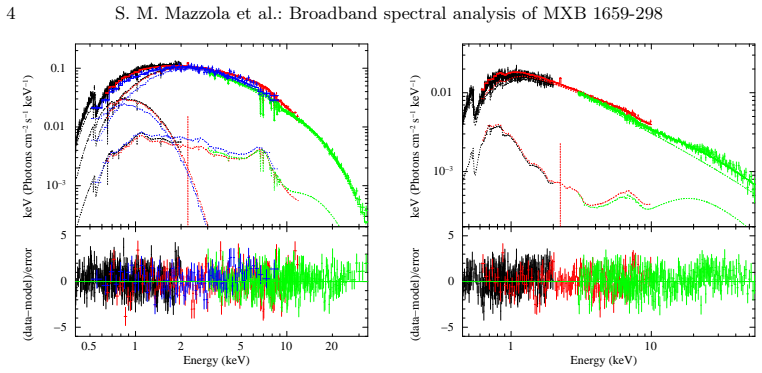
The soft state can be modelled with a thermal component associated with the inner accretion disc plus a Comptonised component. A smeared reflection component and the presence of an ionised absorber are also requested in the best-fit model. On the other hand, the direct continuum emission in the hard state can be described by a Comptonised component with a temperature larger than 150 keV. Also in this case a reflection component and a ionised absorber are observed.
What carries the argument
Spectral decomposition of the broadband continuum into thermal disk emission, Comptonisation, smeared reflection and ionised absorption components.
Load-bearing premise
The chosen spectral models for thermal emission, Comptonisation, reflection and absorption are assumed to be physically adequate and free of large systematic mismatches with the true processes or instrument responses.
What would settle it
A future observation with higher spectral resolution or broader energy coverage that shows no reflection features or a significantly different continuum shape in either state would falsify the necessity of these model components.
If this is right
- Both states exhibit a reflection component, indicating reprocessing of the primary emission by surrounding material.
- An ionised absorber is present in both states, implying persistent absorbing material along the line of sight.
- The soft state includes an additional thermal disk component absent or negligible in the hard state.
- The hard-state Comptonising region reaches electron temperatures above 150 keV.
Where Pith is reading between the lines
- The persistence of reflection across states suggests the accretion disk remains illuminated even when the spectrum hardens.
- The ionised absorber may trace a disk wind whose properties can be compared with other low-mass X-ray binaries.
- The temperature jump in the hard state implies a change in coronal properties that could be tested with timing or polarisation data.
Editorial analysis
A structured set of objections, weighed in public.
Referee Report
Summary. The manuscript reports a broadband spectral analysis of the eclipsing X-ray transient MXB 1659-298 using XMM-Newton, NuSTAR and Swift observations from the 1999 and 2015 outbursts. It models the soft state as a combination of thermal disk emission plus Comptonisation, with a smeared reflection component and an ionised absorber also required; the hard state is described by a Comptonised continuum with electron temperature exceeding 150 keV, again including reflection and ionised absorption.
Significance. If the model selections are statistically robust, the work supplies concrete constraints on the continuum and reprocessing components across state transitions in a neutron-star LMXB, taking advantage of the source's eclipses for geometric context and the broadband coverage to separate thermal, Comptonised and reflected emission.
major comments (1)
- [Abstract] Abstract: the claim that the listed components are 'required in the best-fit model' or 'requested in the best-fit model' is unsupported by any fit statistics (chi-squared, null-hypothesis probability), parameter uncertainties, or explicit comparisons to simpler models. This is load-bearing for the central claim, which rests entirely on the statistical necessity of each component.
minor comments (1)
- [Abstract] The abstract uses the non-standard phrase 'requested in the best-fit model'; replace with 'statistically required' or 'preferred at >3 sigma' for clarity.
Simulated Author's Rebuttal
We thank the referee for their careful reading of the manuscript and for highlighting this important point about the abstract. We address the comment below.
read point-by-point responses
-
Referee: [Abstract] Abstract: the claim that the listed components are 'required in the best-fit model' or 'requested in the best-fit model' is unsupported by any fit statistics (chi-squared, null-hypothesis probability), parameter uncertainties, or explicit comparisons to simpler models. This is load-bearing for the central claim, which rests entirely on the statistical necessity of each component.
Authors: We agree that the abstract phrasing is too assertive without direct reference to the supporting statistics. The full analysis in Sections 3.2 and 4.2 reports the chi-squared improvements, null-hypothesis probabilities, and parameter constraints when the smeared reflection and ionised absorber are added (e.g., Delta-chi^2 values and F-test results relative to simpler continua). The abstract summarises those results but does not cite the numbers. We will revise the abstract to include brief references to the fit statistics and to qualify the language (e.g., 'statistically preferred' or 'significantly improves the fit'). revision: yes
Circularity Check
No significant circularity detected
full rationale
The paper is an observational spectral-fitting report that applies standard XSPEC-style continuum models (disk thermal emission + Comptonisation, plus smeared reflection and ionised absorber) to independent broadband X-ray data from XMM-Newton, NuSTAR and Swift in two accretion states. No derivation, first-principles prediction, or parameter that is fitted and then re-labelled as a prediction appears; the central statements are simply which components are statistically required by the data. No self-citation chain, uniqueness theorem, or ansatz smuggling is invoked. The work is therefore self-contained against external benchmarks and receives the default non-circularity finding.
Axiom & Free-Parameter Ledger
read the original abstract
The X-ray transient eclipsing source MXB 1659-298 went in outburst in 1999 and 2015, respectively, during which it was observed by XMM-Newton, NuSTAR and Swift. Using these observations we studied the broadband spectrum of the source to constrain the continuum components and to verify the presence of a reflection component. We analysed the soft and hard state of the source, finding that the soft state can be modelled with a thermal component associated with the inner accretion disc plus a Comptonised component. A smeared reflection component and the presence of an ionised absorber are also requested in the best-fit model. On the other hand, the direct continuum emission in the hard state can be described by a Comptonised component with a temperature larger than 150 keV. Also in this case a reflection component and a ionised absorber are observed.
Figures
Reference graph
Works this paper leans on
-
[1]
O., Wijnands, R., & Degenaar, N
Bahramian, A., Heinke, C. O., Wijnands, R., & Degenaar, N. 2016, The Astronomer’s Telegram, 8699
work page 2016
-
[2]
Cominsky, L., Ossmann, W., & Lewin, W. H. G. 1983, ApJ, 270, 226
work page 1983
-
[3]
Cominsky, L. R. & Wood, K. S. 1984, ApJ, 283, 765
work page 1984
-
[4]
Cominsky, L. R. & Wood, K. S. 1989, ApJ, 337, 485
work page 1989
- [5]
-
[6]
Begelman, M. C. 1997, ApJ, 487, 759
work page 1997
-
[7]
Iaria, R., Gambino, A. F., Di Salvo, T., et al. 2018, MNRAS, 473, 3490 in ’t Zand, J., Heise, J., Smith, M. J. S., et al. 1999, IAU Circ., 7138
work page 2018
-
[8]
Jain, C., Paul, B., Sharma, R., Jaleel, A., & Dutta, A. 2017, MNRAS, 468, L118
work page 2017
-
[9]
Kolehmainen, M., Done, C., & D ´ ıaz Trigo, M. 2011, MNRAS, 416, 311
work page 2011
- [10]
-
[11]
Oosterbroek, T., Parmar, A. N., Sidoli, L., in’t Zand, J. J. M., & Heise, J. 2001, A&A, 376, 532
work page 2001
-
[12]
Reeves, J., Done, C., Pounds, K., et al. 2008, MNRAS, 385, L108
work page 2008
-
[13]
Sharma, R., Jaleel, A., Jain, C., et al. 2018, MNRAS, 481, 5560
work page 2018
-
[14]
Lumb, D., & Erd, C. 2001, A&A, 379, 540 S. M. Mazzola et al.: Broadband spectral analysis of MXB 1659 -298 5
work page 2001
- [15]
-
[16]
1996, MNRAS, 283, 193 ˙Zycki, P
Magdziarz, P. 1996, MNRAS, 283, 193 ˙Zycki, P. T., Done, C., & Smith, D. A. 1999, MNRAS, 309, 561
work page 1996
discussion (0)
Sign in with ORCID, Apple, or X to comment. Anyone can read and Pith papers without signing in.