REVIEW 2 major objections 4 minor 164 references
Adaptive, Robust and Scalable Bayesian Filtering for Online Learning
T0 review · 2 major / 4 minor · reviewed 2026-08-15 · deepseek-v4-flash
Pith's one-line read Bayesian filtering can serve as a single principled framework for online learning, and a new weighted-likelihood filter makes it provably robust to outliers at the computational cost of a standard Kalman filter.
desk verdict A well-written thesis that compiles the author's already-published Bayesian filtering work; the flagship robustness theorem has a real but easily patchable proof gap around exactly-zero weights. read the letter →
The pith
A machine-rendered reading of the paper's core claim, the machinery that carries it, and where it could break.
The reading
What carries the argument
The central object carrying the robustness argument is the weighted observation likelihood: the loss (4.2) that replaces the standard log-likelihood in the recursive posterior update (4.1). Concretely, the update equals the Kalman filter with the measurement precision $R_t^{-1}$ replaced by $W^2(y_t,\hat y_t) R_t^{-1}$, so a single scalar weight controls how much the current observation moves the posterior. The proof of Theorem 4.5 decomposes the posterior influence function—the KL divergence between the posterior under a contaminated observation and the uncontaminated posterior—into three terms ((T.1), (T.2), (T.3)) and bounds each using spectral-norm inequalities; the key condition is that the weight decays fast enough relative to the growth of the contaminated point. For non-stationarity, the auxiliary variable $\psi_t$ (e.g., a runlength) is the object that encodes regime information, and the BONE framework's five components parameterise the design space. For scalability, the machinery is low-rank structure: a projection matrix $A \in \mathbb{R}^{D\times d}$ for subspace filters, and a diagonal-plus-low-rank precision matrix for LoFi.
What would settle it
Take the one-dimensional linear Gaussian state-space model from Section 4.7.1, use the threshold weight (4.7) with a finite threshold $c$, and send the contaminated observation $y_t^c$ to infinity. Since the weight becomes exactly zero for $\|y_t^c-\hat y_t\|>c$, the theorem's bound on the log-determinant term (T.3) may fail; compute the KL divergence between the contaminated and uncontaminated posteriors numerically as $y_t^c$ grows, and check whether it remains bounded as Theorem 4.5 would require.
Extended reading notes
Core claim
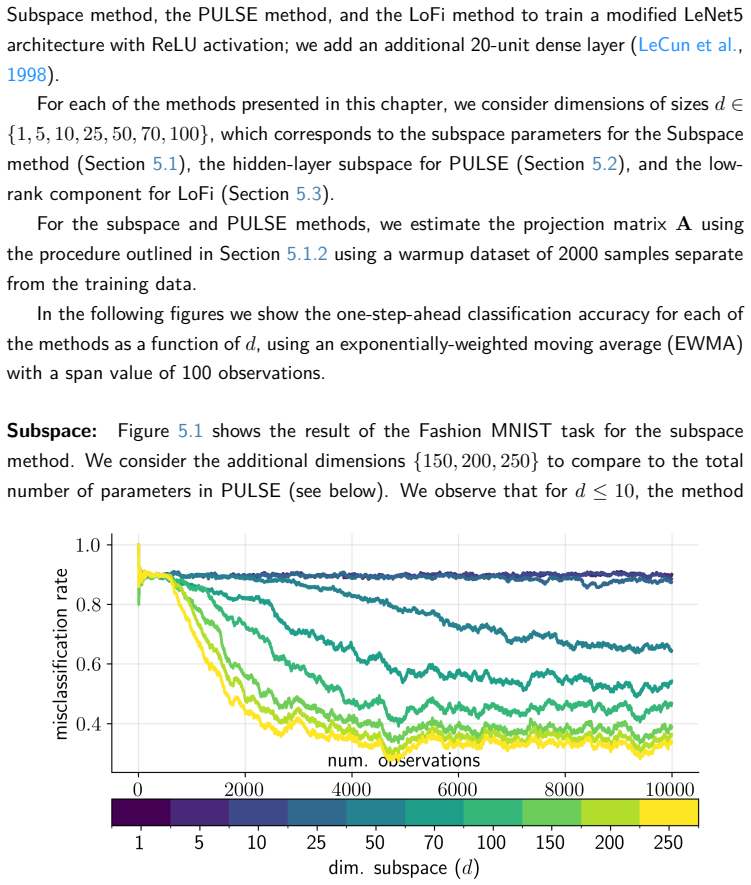
On the paper's own terms, the discovery is that generalised Bayesian inference can be imported into filtering without sacrificing closed-form updates: defining the loss as $\ell_t(\theta_t) = -W^2(y_t,\hat y_t)\log p(y_t|\theta_t)$ and using it in place of the log-likelihood yields the same Kalman precision update with $R_t^{-1}$ scaled by $W^2$. Theorem 4.5 proves that whenever the weight satisfies $\sup_y W(y,\hat y)<\infty$ and $\sup_y W(y,\hat y)^k \|y-\hat y\|<\infty$ for $k\ge 2$, the posterior influence function is bounded, so a single arbitrarily large contaminated observation has bounded effect. The thesis also claims that its BONE framework, with components (M.1) measurement model, (M.2) auxiliary variable, (M.3) conditional prior, (A.1) posterior algorithm, and (A.2) weighting, subsumes a wide range of prior online-learning methods and that a new instantiation, RL[1]-OUPR*, handles both gradual and abrupt change; and that the low-rank/subspace filters make neural-network-scale filtering practical. These are presented as a unified toolkit for Bayesian online learning rather than as separate tricks.
Load-bearing premise
The proof of the robustness theorem assumes that no observation is ever assigned weight exactly zero; the threshold weight WoLF-TMD does assign weight exactly zero to sufficiently far-out observations, so the written proof has a gap there, although the result can be repaired by treating zero-weight observations as making the posterior equal to the prior.
Editorial extensions
If this is right
- A single weighting function converts the standard Kalman filter into an outlier-robust filter with the same $O(D^3)$ update cost, so robust filtering no longer requires repeated variational inner iterations.
- The BONE framework provides a common language for adaptive online learning methods, so existing algorithms like BOCD, runlength priors, and changepoint-probability models become interchangeable design choices.
- The new hybrid rule RL[1]-OUPR* gives a single-hypothesis algorithm that tracks both gradual drift and abrupt changepoints, which the experiments show outperforms pure runlength and pure OU methods on several benchmarks.
- The scalable variants—subspace EKF, PULSE, and LoFi—reduce memory and time to the point where Bayesian filtering can update a deep neural network online; LoFi maintains a diagonal-plus-low-rank precision matrix to achieve this.
Reading between the lines
- The W=0 gap for WoLF-TMD suggests a general design principle for future robust filters: either choose weights bounded strictly away from zero, or handle the zero-weight branch explicitly so that the log-determinant bound remains valid.
- The bounded-influence condition $\sup_y W(y,\hat y)^k \|y-\hat y\|<\infty$ for $k\ge 2$ can be used as a recipe for designing new weighting functions beyond the IMQ and threshold families; smooth compactly-supported weights would need a zero-branch treatment.
- Combining WoLF with online changepoint detection (as done in Section 4.7.4) opens a testable hypothesis: outlier contamination and genuine regime change can be disentangled, so a robust filter should reduce false changepoint alarms on datasets with labelled outliers and labelled changepoints.
- The BONE framework's design space suggests that adaptive methods' performance differences often reduce to the choice of auxiliary variable and prior-reset rule, which could allow a systematic empirical comparison rather than the current ad-hoc benchmarking.
Signed reviews
Editorial analysis
A structured set of objections, weighed in public.
Referee Report
Summary. This PhD thesis develops Bayesian filtering methods for online machine learning, organized around three goals: adaptivity, robustness, and scalability. Chapter 3 introduces BONE, a framework that unifies existing online-learning algorithms as choices of measurement model, auxiliary variable, conditional prior, posterior approximation, and weighting scheme, and proposes a new method RL[1]-OUPR* for environments with both gradual drift and abrupt changes. Chapter 4 introduces WoLF, a generalized-Bayes filter that replaces the log-likelihood with a weighted version, yielding closed-form KF/EKF-style updates at the same O(D^3) cost as the Kalman filter. The chapter states Theorem 4.5, which claims that WoLF has a bounded posterior influence function under weight conditions satisfied by the proposed IMQ, MD, and TMD weights, and presents experiments on 2D tracking, MLP regression, heavy-tailed regression, and EWMA smoothing. Chapter 5 proposes subspace and low-rank approximations for scaling filtering to neural networks. The central theoretical risk is the proof of Theorem 4.5, which has a gap for exactly-zero weights and singular information matrices; the gap is local and repairable.
Significance. If Theorem 4.5 is correct, WoLF is a practically valuable contribution: outlier-robust Bayesian filtering with closed-form updates, computational cost matching the standard Kalman filter, and a bounded posterior influence function under explicit conditions on the weight function. The empirical comparisons against KF-B, KF-IW, OGD, and RBPF on multiple tasks support the practical relevance, and the experiments are reported with clear metrics and baselines. The BONE framework is a useful descriptive taxonomy that connects Bayesian online changepoint detection, continual learning, and bandit algorithms, although it is not itself a new algorithm. Strengths include explicit assumptions rather than data-fitted claims, reproducible pseudocode, and the fact that the robustness theorem is a parameter-free derivation from stated moment conditions rather than a circular argument.
major comments (2)
- [§4.6.2, Proposition 4.18 (bound for T.3)] The proof of Theorem 4.5 is incomplete as written. Equation (4.39) gives the valid bound log|bar Sigma_t| <= -log(|Sigma_pred^{-1}| + bar(w_t)^{2D}|H'R^{-1}H|), whose right-hand side is bounded above by -log|Sigma_pred^{-1}| < infinity because Sigma_pred^{-1} is positive definite. Instead of stopping there, the proof passes to the 'minimum' bound (4.40) and then to (4.41), which invokes -2D log(bar(w_t)). For the threshold weight WoLF-TMD in (4.7), bar(w_t) can be exactly zero, and -log(0) = +infinity; the assertion 'sup bar(w_t) < infinity implies sup log bar(w_t) < infinity' is false when the weight attains zero. The same branch fails whenever H'R^{-1}H is singular, which occurs whenever the observation dimension is less than the state dimension, including the 2D tracking experiment of Section 4.7.1 with D=4 and o=2. The theorem is repairable by stopping at (4.39), but as written the proof does not establish the claimed robustness for the recommended WoLF-TMD weight or for common singular information matrices.
- [§4.6.2, Lemma 4.15 and Eq. (4.29)] The derivation of the bound for the mean-difference term (T.2) contains a division-by-zero issue when weights can be zero. In the chain leading to (4.29), the proof introduces an expression with w_t^{-2} in the denominator; for W = 0, this is undefined. The desired bound can be obtained directly from Lemma 4.14 without this step, because the denominator in the expression before the w^{-2} substitution is at least sigma_min(Sigma_pred^{-1})^2 > 0, so the proof should be rewritten to avoid the undefined intermediate expression. As written, this is a technical error in a load-bearing bound, though it is also locally repairable.
minor comments (4)
- [§4.5, Theorem 4.5 statement] The theorem states the weight condition as 'sup_y W(y, ŷ) < inf' and 'sup_y W(y, ŷ)^k ||y|| < inf'; presumably these should be '< infinity'. This formulation should be corrected.
- [§4.4, Eq. (4.7)] The text says the weighting functions satisfy W : R^o x R^o -> R_{++}, but the threshold weight WoLF-TMD in (4.7) takes the value 0. The codomain should be R_{+} or the statement should be adjusted.
- [§4.6.2, proof of Theorem 4.5] In the paragraph before Lemma 4.13, the goal is stated as showing that 'qLG is outlier robust'; this should read q^{W-LG} to avoid confusion with the non-robust linear Gaussian filter of Theorem 4.4.
- [§3.4, Algorithm 10 (RL[1]-OUPR*)] There are minor notation inconsistencies: the changepoint probability is denoted 'pi' in the pseudocode but 'kappa' in the text, and the weight 'nu_t(r(1))' is missing a subscript in some places. These should be harmonized for readability.
Circularity Check
No significant circularity: the robustness theorem is proved from explicit weight-moment assumptions, BONE is a descriptive taxonomy, and the new methods are validated against external baselines; the only issue is a repairable proof gap in Prop 4.18, which is a correctness concern, not circularity.
full rationale
The central derivation in Chapter 4 is not circular. Theorem 4.5 states that a weighted-observation posterior has bounded posterior influence when the weight function satisfies sup_y W(y,yhat) < infinity and sup_y W(y,yhat)^k ||y|| < infinity for k >= 2. The proof then bounds the three KL terms (T.1), (T.2), and (T.3) using the Kalman precision update and these moment conditions. The assumptions are not the same as the conclusion: for unweighted KF, W = 1 violates the moment condition, and Theorem 4.4 separately proves an unbounded PIF, so the theorem has genuine content. The proposed weights (IMQ, MD, TMD) are inputs whose robustness is established by the theorem, not fitted values dressed up as predictions. The BONE framework in Chapter 3 is explicitly a unifying representation of existing methods through modelling and algorithmic choices; it does not derive a numerical prediction from its own definitions, and the new RL[1]-OUPR* method is a specific combination of an OU prior and prior reset that is evaluated empirically against external baselines on forecasting, classification, and bandit tasks. Chapter 5 presents previously published scalable-filter methods and compares them on Fashion MNIST; the self-citations are to prior papers by the same group, but they are not used as the sole justification for the thesis's new claims. The empirical sections tune hyperparameters on warmup data and then compare on held-out or sequential data, so there is no fitted parameter being renamed as a prediction. One technical issue is present in the written proof of Proposition 4.18: the min-branch (4.40)-(4.41) can be infinite for the threshold weight W = 0 (WoLF-TMD) or when H'R^{-1}H is singular. This is a correctness gap in the proof, not a circularity, and it is repairable by stopping at the finite bound in (4.39). Overall, no load-bearing self-citation, no ansatz smuggled in by citation, and no derivation that reduces to its inputs by construction.
Assumptions & free parameters
free parameters (5)
- hazard rate kappa =
tuned during warmup per experiment
- restart threshold epsilon =
chosen per experiment
- soft threshold c for weights =
c=4 in Section 4.7.4, c=0.05 in Section 4.7.5
- dynamics covariance Qt =
e.g., Qt=10^-4 I in Section 4.7.3; tuned in Section 3.5.1
- subspace dimension d =
not specified in available text
assumptions (5)
- domain assumption State and measurement noise are Gaussian with known covariances
- domain assumption Posterior density over model parameters is approximated as Gaussian
- domain assumption Weight function W satisfies sup_y W(y,yhat) < inf and sup_y W(y,yhat)^k ||y - yhat|| < inf for k>=2
- domain assumption The lottery-ticket or subspace hypothesis: neural network parameters live in a low-dimensional affine subspace
- ad hoc to paper The proof of Theorem 4.5 implicitly assumes W > 0 for the log-determinant bound
Cite this review
Pith. "Pith review of Adaptive, Robust and Scalable Bayesian Filtering for Online Learning." pith.science (2026). https://pith.science/paper/OZAQECUA
@misc{pith2026250507267,
  author       = {Pith},
  title        = {Pith review of: Adaptive, Robust and Scalable Bayesian Filtering for Online Learning},
  year         = {2026},
  howpublished = {\url{https://pith.science/paper/OZAQECUA}},
  note         = {Machine review of arXiv:2505.07267}
}
read the original abstract
In this thesis, we introduce Bayesian filtering as a principled framework for tackling diverse sequential machine learning problems, including online (continual) learning, prequential (one-step-ahead) forecasting, and contextual bandits. To this end, this thesis addresses key challenges in applying Bayesian filtering to these problems: adaptivity to non-stationary environments, robustness to model misspecification and outliers, and scalability to the high-dimensional parameter space of deep neural networks. We develop novel tools within the Bayesian filtering framework to address each of these challenges, including: (i) a modular framework that enables the development adaptive approaches for online learning; (ii) a novel, provably robust filter with similar computational cost to standard filters, that employs Generalised Bayes; and (iii) a set of tools for sequentially updating model parameters using approximate second-order optimisation methods that exploit the overparametrisation of high-dimensional parametric models such as neural networks. Theoretical analysis and empirical results demonstrate the improved performance of our methods in dynamic, high-dimensional, and misspecified models.
Figures


Figures from the paper (36 more)











Reference graph
Works this paper leans on
-
[1]
Adaptive time series forecasting with markovian variance switching, 2024
Baptiste Abélès, Joseph de Vilmarest, and Olivier Wintemberger. Adaptive time series forecasting with markovian variance switching, 2024
2024
-
[2]
Ryan Prescott Adams and David J. C. MacKay. Bayesian online changepoint detection, 2007
2007
-
[3]
Approximate inference in state-space models with heavy-tailed noise
G Agamennoni, J I Nieto, and E M Nebot. Approximate inference in state-space models with heavy-tailed noise. IEEE Transactions on Signal Processing, 2012
2012
-
[4]
Bayesian online prediction of change points
Diego Agudelo-Espa \ n a, Sebastian Gomez-Gonzalez, Stefan Bauer, Bernhard Sch \"o lkopf, and Jan Peters. Bayesian online prediction of change points. In Conference on Uncertainty in Artificial Intelligence, pages 320--329. PMLR, 2020
2020
-
[5]
Bayesian change-point detection for bandit feedback in non-stationary environments
Reda Alami. Bayesian change-point detection for bandit feedback in non-stationary environments. In Asian Conference on Machine Learning, pages 17--31. PMLR, 2023
2023
-
[6]
Restarted bayesian online change-point detector achieves optimal detection delay
R \'e da Alami, Odalric Maillard, and Raphael F \'e raud. Restarted bayesian online change-point detector achieves optimal detection delay. In International conference on machine learning, pages 211--221. PMLR, 2020
2020
-
[7]
Concentration of tempered posteriors and of their variational approximations
Pierre Alquier and James Ridgway. Concentration of tempered posteriors and of their variational approximations . The Annals of Statistics, 48 0 (3): 0 1475 -- 1497, 2020. doi:10.1214/19-AOS1855. URL https://doi.org/10.1214/19-AOS1855
-
[8]
Robust and scalable B ayesian online changepoint detection
Matias Altamirano, Francois-Xavier Briol, and Jeremias Knoblauch. Robust and scalable B ayesian online changepoint detection. In International Conference on Machine Learning, 2023 a
2023
Show all 164 references
-
[9]
Robust and conjugate G aussian process regression
Matias Altamirano, Fran c ois-Xavier Briol, and Jeremias Knoblauch. Robust and conjugate G aussian process regression. arXiv:2311.00463, 2023 b
2023 arXiv
-
[10]
Robust and scalable bayesian online changepoint detection, 2023 c
Matias Altamirano, François-Xavier Briol, and Jeremias Knoblauch. Robust and scalable bayesian online changepoint detection, 2023 c
2023
-
[11]
A survey of methods for time series change point detection
Samaneh Aminikhanghahi and Diane J Cook. A survey of methods for time series change point detection. Knowledge and information systems, 51 0 (2): 0 339--367, 2017
2017
-
[12]
Strategic learning and trading in broker-mediated markets, 2024
Alif Aqsha, Fayçal Drissi, and Leandro Sánchez-Betancourt. Strategic learning and trading in broker-mediated markets, 2024. URL https://arxiv.org/abs/2412.20847
2024
-
[13]
Dynamic portfolio cuts: A spectral approach to graph-theoretic diversification
Alvaro Arroyo, Bruno Scalzo, Ljubi s a Stankovi \'c , and Danilo P Mandic. Dynamic portfolio cuts: A spectral approach to graph-theoretic diversification. In ICASSP 2022-2022 IEEE International Conference on Acoustics, Speech and Signal Processing (ICASSP), pages 5468--5472. I...
2022
-
[14]
Deep attentive survival analysis in limit order books: Estimating fill probabilities with convolutional-transformers
Alvaro Arroyo, Alvaro Cartea, Fernando Moreno-Pino, and Stefan Zohren. Deep attentive survival analysis in limit order books: Estimating fill probabilities with convolutional-transformers. Quantitative Finance, 24 0 (1): 0 35--57, 2024
2024
-
[15]
On vanishing gradients, over-smoothing, and over-squashing in gnns: Bridging recurrent and graph learning
\'A lvaro Arroyo, Alessio Gravina, Benjamin Gutteridge, Federico Barbero, Claudio Gallicchio, Xiaowen Dong, Michael Bronstein, and Pierre Vandergheynst. On vanishing gradients, over-smoothing, and over-squashing in gnns: Bridging recurrent and graph learning. arXiv preprint ar...
2025
-
[16]
Td convergence: An optimization perspective
Kavosh Asadi, Shoham Sabach, Yao Liu, Omer Gottesman, and Rasool Fakoor. Td convergence: An optimization perspective. Advances in Neural Information Processing Systems, 36, 2024
2024
-
[17]
On warm-starting neural network training
Jordan T Ash and Ryan P Adams. On warm-starting neural network training. In NIPS, 2020. URL http://arxiv.org/abs/1910.08475
2020 arXiv
-
[18]
Monte carlo methods, volume 35
Adrian Barbu, Song-Chun Zhu, et al. Monte carlo methods, volume 35. Springer, 2020
2020
-
[19]
Barp, F.-X
A. Barp, F.-X. Briol, A. B. Duncan, M. Girolami, and L. Mackey. Minimum Stein discrepancy estimators . In Neural Information Processing Systems, pages 12964--12976, 2019
2019
-
[20]
Product partition models for change point problems
Daniel Barry and John A Hartigan. Product partition models for change point problems. The Annals of Statistics, pages 260--279, 1992
1992
-
[21]
Detection of abrupt changes: theory and application, volume 104
Michele Basseville, Igor V Nikiforov, et al. Detection of abrupt changes: theory and application, volume 104. prentice Hall Englewood Cliffs, 1993
1993
-
[22]
Space guidance evolution-a personal narrative
Richard H Battin. Space guidance evolution-a personal narrative. Journal of Guidance, Control, and Dynamics, 5 0 (2): 0 97--110, 1982
1982
-
[23]
The infinite hidden markov model
Matthew Beal, Zoubin Ghahramani, and Carl Rasmussen. The infinite hidden markov model. Advances in neural information processing systems, 14, 2001
2001
-
[24]
Implicit maximum a posteriori filtering via adaptive optimization
Gianluca M Bencomo, Jake C Snell, and Thomas L Griffiths. Implicit maximum a posteriori filtering via adaptive optimization. arXiv:2311.10580, 2023
2023 arXiv
-
[25]
A mean field game between informed traders and a broker
Philippe Bergault and Leandro S \'a nchez-Betancourt. A mean field game between informed traders and a broker. SIAM Journal on Financial Mathematics, 16 0 (2): 0 358--388, 2025
2025
-
[26]
Bernardo and A
J. Bernardo and A. Smith. Bayesian Theory. John Wiley, 1994
1994
-
[27]
Bayesian fractional posteriors
Anirban Bhattacharya, Debdeep Pati, and Yun Yang. Bayesian fractional posteriors . The Annals of Statistics, 47 0 (1): 0 39 -- 66, 2019. doi:10.1214/18-AOS1712. URL https://doi.org/10.1214/18-AOS1712
2019 doi
-
[28]
A general framework for updating belief distributions
Pier Giovanni Bissiri, Chris C Holmes, and Stephen G Walker. A general framework for updating belief distributions. Journal of the Royal Statistical Society: Series B (Statistical Methodology), 78 0 (5): 0 1103--1130, 2016
2016
-
[29]
Weight uncertainty in neural network
Charles Blundell, Julien Cornebise, Koray Kavukcuoglu, and Daan Wierstra. Weight uncertainty in neural network. In Francis Bach and David Blei, editors, Proceedings of the 32nd International Conference on Machine Learning, volume 37 of Proceedings of Machine Learning Research,...
2015
-
[30]
Generalised B ayesian filtering via sequential monte carlo
Ayman Boustati, Omer Deniz Akyildiz, Theodoros Damoulas, and Adam Johansen. Generalised B ayesian filtering via sequential monte carlo. Advances in neural information processing systems, 33: 0 418--429, 2020
2020
-
[31]
JAX : composable transformations of P ython+ N um P y programs, 2018
James Bradbury, Roy Frostig, Peter Hawkins, Matthew James Johnson, Chris Leary, Dougal Maclaurin, George Necula, Adam Paszke, Jake Vander P las, Skye Wanderman- M ilne, and Qiao Zhang. JAX : composable transformations of P ython+ N um P y programs, 2018. URL http://github.com/...
2018
-
[32]
Statistical modeling: The two cultures (with comments and a rejoinder by the author)
Leo Breiman. Statistical modeling: The two cultures (with comments and a rejoinder by the author). Statistical science, 16 0 (3): 0 199--231, 2001
2001
-
[33]
Online continual learning with natural distribution shifts: An empirical study with visual data
Zhipeng Cai, Ozan Sener, and Vladlen Koltun. Online continual learning with natural distribution shifts: An empirical study with visual data. In Proceedings of the IEEE/CVF international conference on computer vision, pages 8281--8290, 2021
2021
-
[34]
Nonlinear bayesian filtering with natural gradient gaussian approximation
Wenhan Cao, Tianyi Zhang, Zeju Sun, Chang Liu, Stephen S-T Yau, and Shengbo Eben Li. Nonlinear bayesian filtering with natural gradient gaussian approximation. arXiv [eess.SY], October 2024. URL http://arxiv.org/abs/2410.15832
2024
-
[35]
Cartea and L
\' A . Cartea and L. S\' a nchez-Betancourt. Brokers and informed traders: Dealing with toxic flow and extracting trading signals. SIAM Journal on Financial Mathematics, 16 0 (2): 0 243--270, 2025
2025
-
[36]
Optimal execution with stochastic delay
\'A lvaro Cartea and Leandro S \'a nchez-Betancourt. Optimal execution with stochastic delay. Finance and Stochastics, 27 0 (1): 0 1--47, 2023
2023
-
[37]
Bandits for algorithmic trading with signals
\'A lvaro Cartea, Fay c al Drissi, and Pierre Osselin. Bandits for algorithmic trading with signals. Available at SSRN 4484004, 2023 a
2023
-
[38]
Decentralized finance and automated market making: Predictable loss and optimal liquidity provision
\'A lvaro Cartea, Fay c al Drissi, and Marcello Monga. Decentralized finance and automated market making: Predictable loss and optimal liquidity provision. SIAM Journal on Financial Mathematics, 15 0 (3): 0 931--959, 2024 a
2024
-
[39]
Nash equilibrium between brokers and traders
\'A lvaro Cartea, Sebastian Jaimungal, and Leandro S \'a nchez-Betancourt. Nash equilibrium between brokers and traders. arXiv preprint arXiv:2407.10561, 2024 b
2024 arXiv
-
[40]
Detecting toxic flow, 2023 b
Álvaro Cartea, Gerardo Duran-Martin, and Leandro Sánchez-Betancourt. Detecting toxic flow, 2023 b
2023
-
[41]
A mixture-of-experts framework for adaptive kalman filtering
Wassim S Chaer, Robert H Bishop, and Joydeep Ghosh. A mixture-of-experts framework for adaptive kalman filtering. IEEE Transactions on Systems, Man, and Cybernetics, Part B (Cybernetics), 27 0 (3): 0 452--464, 1997
1997
-
[42]
State estimation for discrete systems with switching parameters
Chaw-Bing Chang and Michael Athans. State estimation for discrete systems with switching parameters. IEEE Transactions on Aerospace and Electronic Systems, AES-14 0 (3): 0 418--425, 1978
1978
-
[43]
On diagonal approximations to the extended kalman filter for online training of bayesian neural networks
Peter G Chang, Kevin Patrick Murphy, and Matt Jones. On diagonal approximations to the extended kalman filter for online training of bayesian neural networks. In Continual Lifelong Learning Workshop at ACML 2022, 2022
2022
-
[44]
Low-rank extended kalman filtering for online learning of neural networks from streaming data
Peter G Chang, Gerardo Duran-Martin, Alex Shestopaloff, Matt Jones, and Kevin Patrick Murphy. Low-rank extended kalman filtering for online learning of neural networks from streaming data. In Conference on Lifelong Learning Agents, pages 1025--1071. PMLR, 2023
2023
-
[45]
S tein point m arkov chain M onte C arlo
Wilson Ye Chen, Alessandro Barp, Fran c ois-Xavier Briol, Jackson Gorham, Mark Girolami, Lester Mackey, and Chris Oates. S tein point m arkov chain M onte C arlo. In International Conference on Machine Learning, pages 1011--1021, 2019
2019
-
[46]
Autodifferentiable ensemble kalman filters
Yuming Chen, Daniel Sanz-Alonso, and Rebecca Willett. Autodifferentiable ensemble kalman filters. SIAM Journal on Mathematics of Data Science, 4 0 (2): 0 801--833, 2022. doi:10.1137/21M1434477. URL https://doi.org/10.1137/21M1434477
2022 doi
-
[47]
Bayesian filtering: From kalman filters to particle filters, and beyond
Zhe Chen et al. Bayesian filtering: From kalman filters to particle filters, and beyond. Statistics, 182 0 (1): 0 1--69, 2003
2003
-
[48]
Inequalities of rayleigh quotients and bounds on the spectral radius of nonnegative symmetric matrices
Don Coppersmith, Alan J Hoffman, and Uriel G Rothblum. Inequalities of rayleigh quotients and bounds on the spectral radius of nonnegative symmetric matrices. Linear algebra and its applications, 263: 0 201--220, 1997
1997
-
[49]
Gee, and Arnaud Doucet
Joao FG de Freitas, Mahesan Niranjan, Andrew H. Gee, and Arnaud Doucet. Sequential monte carlo methods to train neural network models. Neural computation, 12 0 (4): 0 955--993, 2000
2000
-
[50]
A S tein variational newton method
Gianluca Detommaso, Tiangang Cui, Youssef Marzouk, Alessio Spantini, and Robert Scheichl. A S tein variational newton method. Advances in Neural Information Processing Systems, 2018
2018
-
[51]
Robustifying likelihoods by optimistically re-weighting data
Miheer Dewaskar, Christopher Tosh, Jeremias Knoblauch, and David B Dunson. Robustifying likelihoods by optimistically re-weighting data. arXiv:2303.10525, 2023
2023 arXiv
-
[52]
Loss of plasticity in deep continual learning
Shibhansh Dohare, J Fernando Hernandez-Garcia, Qingfeng Lan, Parash Rahman, A Rupam Mahmood, and Richard S Sutton. Loss of plasticity in deep continual learning. Nature, 632 0 (8026): 0 768--774, 2024
2024
-
[53]
Rao-Blackwellised particle filtering for dynamic bayesian networks
Arnaud Doucet, Nando de Freitas, Kevin Murphy, and Stuart Russell. Rao-Blackwellised particle filtering for dynamic bayesian networks. In UAI , 2000. URL http://arxiv.org/abs/1301.3853
2000 arXiv
-
[54]
A tutorial on particle filtering and smoothing: Fifteen years later
Arnaud Doucet, Adam M Johansen, et al. A tutorial on particle filtering and smoothing: Fifteen years later. Handbook of nonlinear filtering, 12 0 (656-704): 0 3, 2009
2009
-
[55]
Solvability of differential riccati equations and applications to algorithmic trading with signals
Fay c al Drissi. Solvability of differential riccati equations and applications to algorithmic trading with signals. Applied Mathematical Finance, 29 0 (6): 0 457--493, 2022
2022
-
[56]
Efficient online bayesian inference for neural bandits
Gerardo Duran-Martin, Aleyna Kara, and Kevin Murphy. Efficient online bayesian inference for neural bandits. In Gustau Camps-Valls, Francisco J. R. Ruiz, and Isabel Valera, editors, Proceedings of The 25th International Conference on Artificial Intelligence and Statistics, vol...
2022
-
[57]
Shestpaloff, Leandro S \'a nchez-Betancourt, Jeremias Knoblauch, Matt Jones, Briol Fran c ois-Xavier, and Kevin P
Gerardo Duran-Martin, Matias Altamirano, Alexander Y. Shestpaloff, Leandro S \'a nchez-Betancourt, Jeremias Knoblauch, Matt Jones, Briol Fran c ois-Xavier, and Kevin P. Murphy. Outlier-robust kalman filtering through generalised bayes. In International Conference on Machine Le...
2024
-
[58]
A unifying framework for generalised bayesian online learning in non-stationary environments
Gerardo Duran-Martin, Leandro S \'a nchez-Betancourt, Alex Shestopaloff, and Kevin Patrick Murphy. A unifying framework for generalised bayesian online learning in non-stationary environments. Transactions on Machine Learning Research, 2025. ISSN 2835-8856. URL https://openrev...
2025
-
[59]
A Kalman filter primer
Randall L Eubank. A Kalman filter primer. Chapman and Hall/CRC, 2005
2005
-
[60]
Sequential data assimilation with a nonlinear quasi-geostrophic model using monte carlo methods to forecast error statistics
Geir Evensen. Sequential data assimilation with a nonlinear quasi-geostrophic model using monte carlo methods to forecast error statistics. Journal of Geophysical Research: Oceans, 99 0 (C5): 0 10143--10162, 1994
1994
-
[61]
The ensemble kalman filter: Theoretical formulation and practical implementation
Geir Evensen. The ensemble kalman filter: Theoretical formulation and practical implementation. Ocean dynamics, 53: 0 343--367, 2003
2003
-
[62]
Day-ahead electricity demand forecasting competition: Post-covid paradigm
Mostafa Farrokhabadi, Jethro Browell, Yi Wang, Stephen Makonin, Wencong Su, and Hamidreza Zareipour. Day-ahead electricity demand forecasting competition: Post-covid paradigm. IEEE Open Access Journal of Power and Energy, 9: 0 185--191, 2022. doi:10.1109/OAJPE.2022.3161101
2022
-
[63]
On-line inference for multiple changepoint problems
Paul Fearnhead and Zhen Liu. On-line inference for multiple changepoint problems. Journal of the Royal Statistical Society Series B: Statistical Methodology, 69 0 (4): 0 589--605, 2007
2007
-
[64]
Efficient bayesian analysis of multiple changepoint models with dependence across segments
Paul Fearnhead and Zhen Liu. Efficient bayesian analysis of multiple changepoint models with dependence across segments. Statistics and Computing, 21: 0 217--229, 2011
2011
-
[65]
Changepoint detection in the presence of outliers
Paul Fearnhead and Guillem Rigaill. Changepoint detection in the presence of outliers. Journal of the American Statistical Association, 114 0 (525): 0 169--183, 2019
2019
-
[66]
The sticky hdp-hmm: Bayesian nonparametric hidden markov models with persistent states
Emily B Fox, Erik B Sudderth, Michael I Jordan, and Alan S Willsky. The sticky hdp-hmm: Bayesian nonparametric hidden markov models with persistent states. Arxiv preprint, 2, 2007
2007
-
[67]
The Lottery Ticket Hypothesis: On Sparse, Trainable Neural Networks
Jonathan Frankle. The Lottery Ticket Hypothesis: On Sparse, Trainable Neural Networks. PhD thesis, Massachusetts Institute of Technology, 2023
2023
-
[68]
Non-stationary learning of neural networks with automatic soft parameter reset
Alexandre Galashov, Michalis K Titsias, András György, Clare Lyle, Razvan Pascanu, Teh Yee Whye, and Maneesh Sahani. Non-stationary learning of neural networks with automatic soft parameter reset. In NIPS, November 2024. URL https://arxiv.org/abs/2411.04034
2024 arXiv
-
[69]
Knowledge discovery from data streams
Joao Gama, Jesus Aguilar-Ruiz, and Ralf Klinkenberg. Knowledge discovery from data streams. Intelligent Data Analysis, 12 0 (3): 0 251--252, 2008
2008
-
[70]
Variational learning for switching state-space models
Zoubin Ghahramani and Geoffrey E Hinton. Variational learning for switching state-space models. Neural computation, 12 0 (4): 0 831--864, 2000
2000
-
[71]
Tractable approximate gaussian inference for bayesian neural networks
James-A Goulet, Luong Ha Nguyen, and Saeid Amiri. Tractable approximate gaussian inference for bayesian neural networks. Journal of Machine Learning Research, 22 0 (251): 0 1--23, 2021
2021
-
[72]
Optimization or architecture: How to hack kalman filtering
Ido Greenberg, Netanel Yannay, and Shie Mannor. Optimization or architecture: How to hack kalman filtering. In A. Oh, T. Naumann, A. Globerson, K. Saenko, M. Hardt, and S. Levine, editors, Advances in Neural Information Processing Systems, volume 36, pages 50482--50505. Curran...
2023
-
[73]
Applications of kalman filtering in aerospace 1960 to the present [historical perspectives]
Mohinder S Grewal and Angus P Andrews. Applications of kalman filtering in aerospace 1960 to the present [historical perspectives]. IEEE Control Systems Magazine, 30 0 (3): 0 69--78, 2010
1960
-
[74]
The safe Bayesian
Peter Gr \"u nwald. The safe Bayesian . In International Conference on Algorithmic Learning Theory, pages 169--183, 2012
2012
-
[75]
Inconsistency of B ayesian inference for misspecified linear models, and a proposal for repairing it
Peter Gr \"u nwald and Thijs van Ommen. Inconsistency of B ayesian inference for misspecified linear models, and a proposal for repairing it. Bayesian Analysis, 12 0 (4): 0 1069 -- 1103, 2017
2017
-
[76]
Survey on online streaming continual learning
Nuwan Gunasekara, Bernhard Pfahringer, Heitor Murilo Gomes, and Albert Bifet. Survey on online streaming continual learning. In IJCAI, pages 6628--6637, 2023
2023
-
[77]
Comprehensive analysis of change-point dynamics detection in time series data: A review
Muktesh Gupta, Rajesh Wadhvani, and Akhtar Rasool. Comprehensive analysis of change-point dynamics detection in time series data: A review. Expert Systems with Applications, page 123342, 2024
2024
-
[78]
Variational bayesian last layers, 2024
James Harrison, John Willes, and Jasper Snoek. Variational bayesian last layers, 2024. URL https://arxiv.org/abs/2404.11599
2024 arXiv
-
[79]
The elements of statistical learning: data mining, inference, and prediction, volume 2
Trevor Hastie, Robert Tibshirani, Jerome H Friedman, and Jerome H Friedman. The elements of statistical learning: data mining, inference, and prediction, volume 2. Springer, 2009
2009
-
[80]
Assigning a value to a power likelihood in a general Bayesian model
Chris C Holmes and Stephen G Walker. Assigning a value to a power likelihood in a general Bayesian model . Biometrika, 104 0 (2): 0 497--503, 2017
2017
-
[81]
Matrix analysis
Roger A Horn and Charles R Johnson. Matrix analysis. Cambridge university press, 2012
2012
-
[82]
Lora: Low-rank adaptation of large language models
Edward J Hu, Yelong Shen, Phillip Wallis, Zeyuan Allen-Zhu, Yuanzhi Li, Shean Wang, Lu Wang, and Weizhu Chen. Lora: Low-rank adaptation of large language models. arXiv preprint arXiv:2106.09685, 2021
2021 arXiv
-
[83]
A robust G aussian approximate filter for nonlinear systems with heavy tailed measurement noises
Yulong Huang, Yonggang Zhang, Ning Li, and Jonathon Chambers. A robust G aussian approximate filter for nonlinear systems with heavy tailed measurement noises. In IEEE International Conference on Acoustics, Speech and Signal Processing, pages 4209--4213, 2016
2016
-
[84]
Robust statistics
Peter J Huber. Robust statistics. Wiley Series in Probability and Mathematical Statistics, 1981
1981
-
[85]
Gradual changes versus abrupt changes
M Hu s kov \'a . Gradual changes versus abrupt changes. Journal of Statistical Planning and Inference, 76 0 (1-2): 0 109--125, 1999
1999
-
[86]
Improving predictions of bayesian neural nets via local linearization
Alexander Immer, Maciej Korzepa, and Matthias Bauer. Improving predictions of bayesian neural nets via local linearization. In International conference on artificial intelligence and statistics, pages 703--711. PMLR, 2021
2021
-
[87]
Equivalence between rls algorithms and the ridge regression technique
MY Ismail and JC Principe. Equivalence between rls algorithms and the ridge regression technique. In Conference Record of The Thirtieth Asilomar Conference on Signals, Systems and Computers, pages 1083--1087. IEEE, 1996
1996
-
[88]
Bayesian online natural gradient ( BONG )
Matt Jones, Peter Chang, and Kevin Murphy. Bayesian online natural gradient ( BONG ). In Advances in Neural Information Processing Systems, May 2024. URL http://arxiv.org/abs/2405.19681
2024 arXiv
-
[89]
R. E. Kalman. A New Approach to Linear Filtering and Prediction Problems . Journal of Basic Engineering, 82 0 (1): 0 35--45, 03 1960. ISSN 0021-9223. doi:10.1115/1.3662552. URL https://doi.org/10.1115/1.3662552
1960 doi
-
[90]
Reducing geometric dilution of precision using ridge regression
RJ Kelly. Reducing geometric dilution of precision using ridge regression. IEEE transactions on aerospace and electronic systems, 26 0 (1): 0 154--168, 1990
1990
-
[91]
Kingma and Jimmy Ba
Diederik P. Kingma and Jimmy Ba. Adam: A method for stochastic optimization. In Yoshua Bengio and Yann LeCun, editors, 3rd International Conference on Learning Representations, ICLR 2015 , 2015
2015
-
[92]
Spatio-temporal bayesian on-line changepoint detection with model selection
Jeremias Knoblauch and Theodoros Damoulas. Spatio-temporal bayesian on-line changepoint detection with model selection. In International Conference on Machine Learning, pages 2718--2727. PMLR, 2018
2018
-
[93]
Doubly robust bayesian inference for non-stationary streaming data with -divergences
Jeremias Knoblauch, Jack E Jewson, and Theodoros Damoulas. Doubly robust bayesian inference for non-stationary streaming data with -divergences. In S. Bengio, H. Wallach, H. Larochelle, K. Grauman, N. Cesa-Bianchi, and R. Garnett, editors, Advances in Neural Information Proces...
2018
-
[94]
An optimization-centric view on bayes' rule: Reviewing and generalizing variational inference
Jeremias Knoblauch, Jack Jewson, and Theodoros Damoulas. An optimization-centric view on bayes' rule: Reviewing and generalizing variational inference. Journal of Machine Learning Research, 23 0 (132): 0 1--109, 2022. URL http://jmlr.org/papers/v23/19-1047.html
2022
-
[95]
Ridge regression signal processing
Mark R Kuhl. Ridge regression signal processing. NASA, Langley Research Center, Joint University Program for Air Transportation Research, 1989-1990, 1990
1989
-
[96]
On information and sufficiency
Solomon Kullback and Richard A Leibler. On information and sufficiency. The annals of mathematical statistics, 22 0 (1): 0 79--86, 1951
1951
-
[97]
Continual learning with bayesian neural networks for non-stationary data
Richard Kurle, Botond Cseke, Alexej Klushyn, Patrick Van Der Smagt, and Stephan G \"u nnemann. Continual learning with bayesian neural networks for non-stationary data. In International Conference on Learning Representations, 2019
2019
-
[98]
The recursive variational gaussian approximation (r-vga)
Marc Lambert, Silv \`e re Bonnabel, and Francis Bach. The recursive variational gaussian approximation (r-vga). Statistics and Computing, 32 0 (1): 0 10, 2022
2022
-
[99]
The limited-memory recursive variational gaussian approximation (l-rvga)
Marc Lambert, Silv \`e re Bonnabel, and Francis Bach. The limited-memory recursive variational gaussian approximation (l-rvga). Statistics and Computing, 33 0 (3): 0 70, 2023
2023
-
[100]
Larsen, Stanislav Fort, Nic Becker, and Surya Ganguli
Brett W. Larsen, Stanislav Fort, Nic Becker, and Surya Ganguli. How many degrees of freedom do we need to train deep networks: a loss landscape perspective. In International Conference on Learning Representations, 2022. URL https://openreview.net/forum?id=ChMLTGRjFcU
2022
-
[101]
Gradient-based learning applied to document recognition
Yann LeCun, L \'e on Bottou, Yoshua Bengio, and Patrick Haffner. Gradient-based learning applied to document recognition. Proceedings of the IEEE, 86 0 (11): 0 2278--2324, 1998
1998
-
[102]
Theory and applications of kalman filtering
C T Leondes. Theory and applications of kalman filtering. Technical Report AGARDOGRAPH-139, NASA, February 1970
1970
-
[103]
Detecting and adapting to irregular distribution shifts in bayesian online learning, 2021
Aodong Li, Alex Boyd, Padhraic Smyth, and Stephan Mandt. Detecting and adapting to irregular distribution shifts in bayesian online learning, 2021
2021
-
[104]
Measuring the intrinsic dimension of objective landscapes
Chunyuan Li, Heerad Farkhoor, Rosanne Liu, and Jason Yosinski. Measuring the intrinsic dimension of objective landscapes. In International Conference on Learning Representations, 2018
2018
-
[105]
A contextual-bandit approach to personalized news article recommendation
Lihong Li, Wei Chu, John Langford, and Robert E Schapire. A contextual-bandit approach to personalized news article recommendation. In Proceedings of the 19th international conference on World wide web, pages 661--670, 2010
2010
-
[106]
Stein's lemma for the reparameterization trick with exponential family mixtures
Wu Lin, Mohammad Emtiyaz Khan, and Mark Schmidt. Stein's lemma for the reparameterization trick with exponential family mixtures. arXiv preprint arXiv:1910.13398, 2019
1910 arXiv
-
[107]
Bayesian learning and inference in recurrent switching linear dynamical systems
Scott Linderman, Matthew Johnson, Andrew Miller, Ryan Adams, David Blei, and Liam Paninski. Bayesian learning and inference in recurrent switching linear dynamical systems. In Artificial intelligence and statistics, pages 914--922. PMLR, 2017
2017
-
[108]
Robust sequential online prediction with dynamic ensemble of multiple models: A review
Bin Liu. Robust sequential online prediction with dynamic ensemble of multiple models: A review. Neurocomputing, page 126553, 2023
2023
-
[109]
Nonstationary bandit learning via predictive sampling
Yueyang Liu, Benjamin Van Roy, and Kuang Xu. Nonstationary bandit learning via predictive sampling. In International Conference on Artificial Intelligence and Statistics, pages 6215--6244. PMLR, 2023
2023
-
[110]
Learning under concept drift: A review
Jie Lu, Anjin Liu, Fan Dong, Feng Gu, Joao Gama, and Guangquan Zhang. Learning under concept drift: A review. IEEE transactions on knowledge and data engineering, 31 0 (12): 0 2346--2363, 2018
2018
-
[111]
Optimal adaptive estimation of sampled stochastic processes
David Magill. Optimal adaptive estimation of sampled stochastic processes. IEEE Transactions on Automatic Control, 10 0 (4): 0 434--439, 1965
1965
-
[112]
Robust generalised B ayesian inference for intractable likelihoods
Takuo Matsubara, Jeremias Knoblauch, Fran c ois-Xavier Briol, and Chris J Oates. Robust generalised B ayesian inference for intractable likelihoods. Journal of the Royal Statistical Society: Series B, 84 0 (3): 0 997--1022, 2022
2022
-
[113]
Approaches to adaptive filtering
Raman Mehra. Approaches to adaptive filtering. IEEE Transactions on automatic control, 17 0 (5): 0 693--698, 1972
1972
-
[114]
Thompson sampling in switching environments with bayesian online change point detection
Joseph Mellor and Jonathan Shapiro. Thompson sampling in switching environments with bayesian online change point detection. arXiv preprint arXiv:1302.3721, 2013
2013 arXiv
-
[115]
Robust B ayesian inference via coarsening
Jeffrey W Miller and David B Dunson. Robust B ayesian inference via coarsening. Journal of the American Statistical Association, 2018
2018
-
[116]
Expectation propagation for approximate bayesian inference
Thomas P Minka. Expectation propagation for approximate bayesian inference. arXiv preprint arXiv:1301.2294, 2013
2013 arXiv
-
[117]
Slang: Fast structured covariance approximations for bayesian deep learning with natural gradient
Aaron Mishkin, Frederik Kunstner, Didrik Nielsen, Mark Schmidt, and Mohammad Emtiyaz Khan. Slang: Fast structured covariance approximations for bayesian deep learning with natural gradient. Advances in neural information processing systems, 31, 2018
2018
-
[118]
Rough transformers: Lightweight and continuous time series modelling through signature patching
Fernando Moreno-Pino, \'A lvaro Arroyo, Harrison Waldon, Xiaowen Dong, and \'A lvaro Cartea. Rough transformers: Lightweight and continuous time series modelling through signature patching. Advances in Neural Information Processing Systems, 37: 0 106264--106294, 2024
2024
-
[119]
Novel outlier-resistant extended K alman filter for robust online structural identification
He-Qing Mu and Ka-Veng Yuen. Novel outlier-resistant extended K alman filter for robust online structural identification. Journal of Engineering Mechanics, 141 0 (1): 0 04014100, 2015
2015
-
[120]
Kevin P. Murphy. Probabilistic Machine Learning: An introduction. MIT Press, 2022. URL http://probml.github.io/book1
2022
-
[121]
Kevin P. Murphy. Probabilistic Machine Learning: Advanced Topics. MIT Press, 2023. URL http://probml.github.io/book2
2023
-
[122]
Elements of sequential monte carlo
Christian A Naesseth, Fredrik Lindsten, Thomas B Sch \"o n, et al. Elements of sequential monte carlo. Foundations and Trends in Machine Learning , 12 0 (3): 0 307--392, 2019
2019
-
[123]
Bam: Bayes with adaptive memory
Josue Nassar, Jennifer Brennan, Ben Evans, and Kendall Lowrey. Bam: Bayes with adaptive memory. arXiv preprint arXiv:2202.02405, 2022
2022 arXiv
-
[124]
Variational continual learning
Cuong V Nguyen, Yingzhen Li, Thang D Bui, and Richard E Turner. Variational continual learning. arXiv preprint arXiv:1710.10628, 2017
2017 arXiv
-
[125]
The extended kalman filter is a natural gradient descent in trajectory space
Yann Ollivier. The extended kalman filter is a natural gradient descent in trajectory space. arXiv preprint arXiv:1901.00696, 2019
1901 arXiv
-
[126]
From hmm's to segment models: A unified view of stochastic modeling for speech recognition
Mari Ostendorf, Vassilios V Digalakis, and Owen A Kimball. From hmm's to segment models: A unified view of stochastic modeling for speech recognition. IEEE Transactions on speech and audio processing, 4 0 (5): 0 360--378, 1996
1996
-
[127]
Bayesian approach to system identification
V \'a clav Peterka. Bayesian approach to system identification. In Trends and Progress in System identification, pages 239--304. Elsevier, 1981
1981
-
[128]
Towards robust inference for bayesian filtering of linear gaussian dynamical systems subject to additive change
Hans Reimann. Towards robust inference for bayesian filtering of linear gaussian dynamical systems subject to additive change. masterthesis, Universit \"a t Potsdam, 2024
2024
-
[129]
Niederer, Lester Mackey, and Chris
Marina Riabiz, Wilson Chen, Jon Cockayne, Pawel Swietach, Steven A. Niederer, Lester Mackey, and Chris. J. Oates. Optimal thinning of MCMC output. arXiv:2005.03952, 2022
2005 arXiv
-
[130]
Deep bayesian bandits showdown
Carlos Riquelme, George Tucker, and Jasper Snoek. Deep bayesian bandits showdown. In International conference on learning representations, volume 9, 2018
2018
-
[131]
The Bayesian choice: from decision-theoretic foundations to computational implementation, volume 2
Christian P Robert et al. The Bayesian choice: from decision-theoretic foundations to computational implementation, volume 2. Springer, 2007
2007
-
[132]
The ensemble kalman filter: a signal processing perspective
Michael Roth, Gustaf Hendeby, Carsten Fritsche, and Fredrik Gustafsson. The ensemble kalman filter: a signal processing perspective. EURASIP J. Adv. Signal Processing , 2017 0 (1): 0 56, 2017. URL https://doi.org/10.1186/s13634-017-0492-x
2017 doi
-
[133]
Learning internal representations by error propagation, parallel distributed processing, explorations in the microstructure of cognition, ed
David E Rumelhart, Geoffrey E Hinton, and Ronald J Williams. Learning internal representations by error propagation, parallel distributed processing, explorations in the microstructure of cognition, ed. de rumelhart and j. mcclelland. vol. 1. 1986. Biometrika, 71 0 (599-607): ...
1986
-
[134]
Gaussian process change point models
Yunus Saat c i, Ryan D Turner, and Carl E Rasmussen. Gaussian process change point models. In Proceedings of the 27th International Conference on Machine Learning (ICML-10), pages 927--934, 2010
2010
-
[135]
Recursive noise adaptive kalman filtering by variational bayesian approximations
Simo Sarkka and Aapo Nummenmaa. Recursive noise adaptive kalman filtering by variational bayesian approximations. IEEE Transactions on Automatic control, 54 0 (3): 0 596--600, 2009
2009
-
[136]
Bayesian filtering and smoothing, volume 17
Simo S \"a rkk \"a and Lennart Svensson. Bayesian filtering and smoothing, volume 17. Cambridge university press, 2023
2023
-
[137]
Nonstationary portfolios: Diversification in the spectral domain
Bruno Scalzo, Alvaro Arroyo, Ljubi s a Stankovi \'c , and Danilo P Mandic. Nonstationary portfolios: Diversification in the spectral domain. In ICASSP 2021-2021 IEEE International Conference on Acoustics, Speech and Signal Processing (ICASSP), pages 5155--5159. IEEE, 2021
2021
-
[138]
The graph neural network model
Franco Scarselli, Marco Gori, Ah Chung Tsoi, Markus Hagenbuchner, and Gabriele Monfardini. The graph neural network model. IEEE transactions on neural networks, 20 0 (1): 0 61--80, 2008
2008
-
[139]
Test-time adaptation with state-space models
Mona Schirmer, Dan Zhang, and Eric Nalisnick. Test-time adaptation with state-space models. arXiv preprint arXiv:2407.12492, 2024
2024
-
[140]
The rank-reduced kalman filter: Approximate dynamical-low-rank filtering in high dimensions
Jonathan Schmidt, Philipp Hennig, J \"o rg Nick, and Filip Tronarp. The rank-reduced kalman filter: Approximate dynamical-low-rank filtering in high dimensions. Advances in Neural Information Processing Systems, 36: 0 61364--61376, 2023
2023
-
[141]
Bayesian online change point detection with hilbert space approximate student-t process
Jeremy Sellier and Petros Dellaportas. Bayesian online change point detection with hilbert space approximate student-t process. In International Conference on Machine Learning, pages 30553--30569. PMLR, 2023
2023
-
[142]
Training multilayer perceptrons with the extended kalman algorithm
Sharad Singhal and Lance Wu. Training multilayer perceptrons with the extended kalman algorithm. Advances in neural information processing systems, 1, 1988
1988
-
[143]
The book of statistical proofs
Joram Soch, Thomas J Faulkenberry, Kenneth Petrykowski, and Carsten Allefeld. The book of statistical proofs. Open, Zenodo, 10, 2020
2020
-
[144]
254a, notes 3a: Eigenvalues and sums of hermitian matrices
Terence Tao. 254a, notes 3a: Eigenvalues and sums of hermitian matrices. https://terrytao.wordpress.com/2010/01/12/254a-notes-3a-eigenvalues-and-sums-of-hermitian-matrices/, 2010. Accessed: 2024-12-18
2010
-
[145]
Outlier-robust iterative extended kalman filtering
Yangtianze Tao and Stephen Shing-Toung Yau. Outlier-robust iterative extended kalman filtering. IEEE Signal Processing Letters, 30: 0 743--747, 2023. doi:10.1109/LSP.2023.3285118
2023
-
[146]
On the likelihood that one unknown probability exceeds another in view of the evidence of two samples
William R Thompson. On the likelihood that one unknown probability exceeds another in view of the evidence of two samples. Biometrika, 25 0 (3-4): 0 285--294, 1933
1933
-
[147]
Learning an outlier-robust kalman filter
Jo-Anne Ting, Evangelos Theodorou, and Stefan Schaal. Learning an outlier-robust kalman filter. In European Conference on Machine Learning, pages 748--756. Springer, 2007
2007
-
[148]
Kalman filter for online classification of non-stationary data
Michalis K Titsias, Alexandre Galashov, Amal Rannen-Triki, Razvan Pascanu, Yee Whye Teh, and Jorg Bornschein. Kalman filter for online classification of non-stationary data. In ICLR, 2024
2024
-
[149]
An evaluation of change point detection algorithms
Gerrit JJ Van den Burg and Christopher KI Williams. An evaluation of change point detection algorithms. arXiv preprint arXiv:2003.06222, 2020
2003 arXiv
-
[150]
Asymptotic statistics, volume 3
Aad W Van der Vaart. Asymptotic statistics, volume 3. Cambridge university press, 2000
2000
-
[151]
Beam sampling for the infinite hidden markov model
Jurgen Van Gael, Yunus Saatci, Yee Whye Teh, and Zoubin Ghahramani. Beam sampling for the infinite hidden markov model. In Proceedings of the 25th international conference on Machine learning, pages 1088--1095, 2008
2008
-
[152]
Attention is all you need
Ashish Vaswani, Noam Shazeer, Niki Parmar, Jakob Uszkoreit, Llion Jones, Aidan N Gomez, ukasz Kaiser, and Illia Polosukhin. Attention is all you need. In I. Guyon, U. Von Luxburg, S. Bengio, H. Wallach, R. Fergus, S. Vishwanathan, and R. Garnett, editors, Advances in Neural In...
2017
-
[153]
Viking: variational bayesian variance tracking
Joseph de Vilmarest and Olivier Wintenberger. Viking: variational bayesian variance tracking. Statistical Inference for Stochastic Processes, pages 1--22, 2024
2024
-
[154]
Dare: The deep adaptive regulator for control of uncertain continuous-time systems
Harrison Waldon, Fay c al Drissi, Yannick Limmer, Uljad Berdica, Jakob Nicolaus Foerster, and Alvaro Cartea. Dare: The deep adaptive regulator for control of uncertain continuous-time systems. In ICML 2024 Workshop: Foundations of Reinforcement Learning and Control--Connection...
2024
-
[155]
Robust G aussian K alman filter with outlier detection
Hongwei Wang, Hongbin Li, Jun Fang, and Heping Wang. Robust G aussian K alman filter with outlier detection. IEEE Signal Processing Letters, 25 0 (8): 0 1236--1240, 2018
2018
-
[156]
The Kalman filter in finance, volume 32
Curt Wells. The Kalman filter in finance, volume 32. Springer Science & Business Media, 2013
2013
-
[157]
Robust sequential approximate bayesian estimation
Mike West. Robust sequential approximate bayesian estimation. Journal of the Royal Statistical Society Series B: Statistical Methodology, 43 0 (2): 0 157--166, 1981
1981
-
[158]
Bayesian forecasting and dynamic models
Mike West and Jeff Harrison. Bayesian forecasting and dynamic models. Springer, 1997
1997
-
[159]
Bayesian online learning of the hazard rate in change-point problems
Robert C Wilson, Matthew R Nassar, and Joshua I Gold. Bayesian online learning of the hazard rate in change-point problems. Neural computation, 22 0 (9): 0 2452--2476, 2010
2010
-
[160]
Fashion-mnist: a novel image dataset for benchmarking machine learning algorithms, 2017
Han Xiao, Kashif Rasul, and Roland Vollgraf. Fashion-mnist: a novel image dataset for benchmarking machine learning algorithms, 2017
2017
-
[161]
A note on the trace inequality for products of hermitian matrix power
Zhong Peng Yang and Xiao Xia Feng. A note on the trace inequality for products of hermitian matrix power. Journal of Inequalities in Pure and Applied Mathematics, 3 0 (5), 2002
2002
-
[162]
Catastrophic interference in reinforcement learning: A solution based on context division and knowledge distillation
Tiantian Zhang, Xueqian Wang, Bin Liang, and Bo Yuan. Catastrophic interference in reinforcement learning: A solution based on context division and knowledge distillation. IEEE Transactions on Neural Networks and Learning Systems, 34 0 (12): 0 9925--9939, 2022
2022
-
[163]
Mathematical Analysis of Machine Learning Algorithms
Tong Zhang. Mathematical Analysis of Machine Learning Algorithms. Cambridge University Press, 2023. doi:10.1017/9781009093057
2023 doi
-
[164]
A sliding window variational outlier-robust kalman filter based on student’s t-noise modeling
Fengchi Zhu, Yulong Huang, Chao Xue, Lyudmila Mihaylova, and Jonathon Chambers. A sliding window variational outlier-robust kalman filter based on student’s t-noise modeling. IEEE Transactions on Aerospace and Electronic Systems, 58 0 (5): 0 4835--4849, 2022
2022
Reviewed August 15, 2026 · model on record in the stance chip above.
Discussion (0). Continue with ORCID to comment.