REVIEW 3 major objections 6 minor 14 references
A Reproducible Analysis of RSSI Fingerprinting for Outdoor Localization Using Sigfox: Preprocessing and Hyperparameter Tuning
T0 review · 3 major / 6 minor · reviewed 2026-08-14 · deepseek-v4-flash
Pith's one-line read Careful preprocessing, not algorithm choice, drives Sigfox localization accuracy.
desk verdict A careful, reproducible kNN tuning study on public Sigfox data with a genuinely useful public split, but the headline 298 m error comes from a single random split that likely leaks temporally and spatially correlated messages from the same postal vehicles into train and test. read the letter →
The pith
A machine-rendered reading of the paper's core claim, the machinery that carries it, and where it could break.
The reading
What carries the argument
The central object is the parametric fingerprint transform applied to each RSSI vector before nearest-neighbour search. A threshold $\tau$ replaces every value below it, including the artificial $-200$ placeholder for non-received signals, and the surviving values are mapped by one of four representations: positive shift, normalized, exponential $\exp(\mathrm{Positive}/\alpha)$, or power-law $\mathrm{Positive}^{\beta}$. These transforms matter because RSSI is already logarithmic, so linear scaling distorts the distances between fingerprints; tuning $\tau$, $\alpha$, and $\beta$ to the Sigfox signal distribution adapts the geometry of the fingerprint space. The work this machinery does is to turn a fixed preprocessing recipe into a tunable part of model selection, and the paper shows most of the accuracy gain comes from that step.
What would settle it
Re-run the reported best configuration ($\tau = -159$, $\beta = 2.6$, Bray-Curtis distance, $k = 6$) with a split that keeps all messages from each vehicle trajectory in one partition; if the mean test error rises substantially above 298 meters, the random-split result was inflated by correlated samples.
Extended reading notes
Core claim
Within a k-nearest-neighbour fingerprinting pipeline, the paper's central claim is that the way RSSI values are transformed before distance computation determines localization accuracy more than the choice of distance metric or $k$. On a public Sigfox dataset from Antwerp, representing each message as a vector of per-base-station RSSIs and comparing fingerprints with the Bray-Curtis distance, the authors find that replacing missing receptions with a threshold just below the smallest observed RSSI ($\tau = -159$) and using a power-law transform with exponent $\beta = 2.6$ gives a mean test error of 298 meters and a median of 109 meters. This improves on a 344-meter validation error with default transform parameters and on a 552-meter error from linear scaling. The same tuning also flips the preferred representation from exponential to power-law, showing that the preprocessing choices interact.
Load-bearing premise
The load-bearing premise is that randomly splitting the 14,378 messages into 70/15/15 gives independent training and test samples; if messages from the same vehicle trajectory appear on both sides, the reported 298-meter test error is optimistically biased.
Editorial extensions
If this is right
- On this urban Sigfox test set, tuned nonlinear transforms bring mean error down from above 500 meters under linear scaling to 298 meters, so preprocessing deserves the same scrutiny as the learning algorithm.
- Setting the out-of-range placeholder just below the smallest received RSSI (here $-159$) outperforms keeping the dataset's artificial $-200$ value.
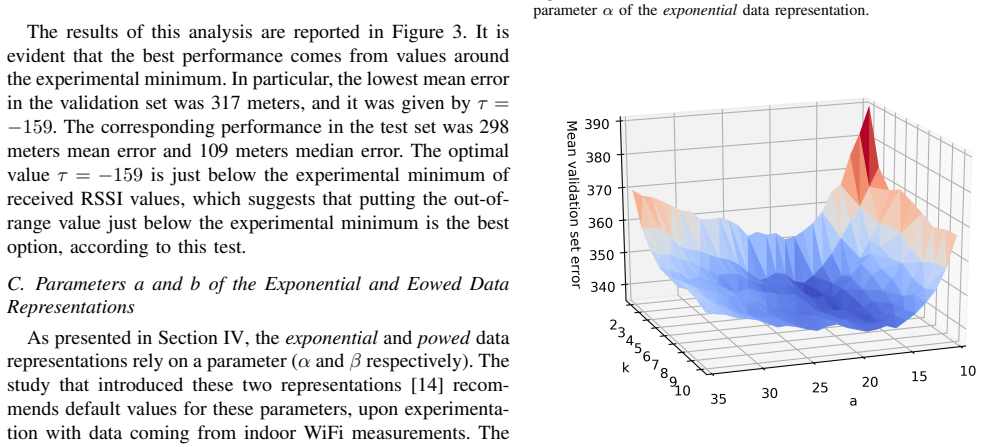
- Default transform parameters imported from indoor Wi-Fi fingerprinting ($\alpha = 24$, $\beta = e$) are not transferable; retuning $\beta$ to $2.6$ alone lowers the validation error.
- Because the code and exact train/validation/test split are public, future methods can report test error on the same 2,157-message test set, making cross-paper comparisons meaningful.
Reading between the lines
- A trajectory-aware split, holding out entire vehicle trips rather than individual messages, would test whether the random split inflates the reported accuracy; the paper does not report this check.
- The same threshold-and-exponent tuning recipe should transfer to the companion LoRaWAN and rural Sigfox datasets released with the Antwerp data; if it does, preprocessing tuning is a general LPWAN fingerprinting step rather than a dataset-specific fix.
- The gap between mean error (298 m) and median error (109 m) implies a heavy-tailed error distribution; reporting error quantiles or a map of failures would show where the remaining errors concentrate.
Signed reviews
Editorial analysis
A structured set of objections, weighed in public.
Referee Report
Summary. The paper presents a reproducible study of RSSI fingerprinting for outdoor localization using a public Sigfox dataset from Antwerp, Belgium. The authors evaluate k-nearest-neighbor localization with several distance metrics and four data preprocessing schemes (positive, normalized, exponential, and powed representations), and they tune preprocessing parameters τ, α, β and the neighbor count k on a validation set. After selecting the best configuration on the validation set, they report a test-set mean error of 298 meters and a median error of 109 meters. The train/validation/test split and the code are made publicly available, and the results are compared with prior work by Janssen et al. and Aernouts et al.
Significance. If the reported accuracy holds, the paper provides a useful benchmark and a careful analysis of preprocessing choices for LPWAN fingerprinting, extending prior work on the same dataset. The strengths include the use of a public dataset, a clear separation of training, validation, and test sets, and the release of code and the exact data split, which facilitates reproducibility and comparability. However, the validity of the headline result depends critically on the test set being truly representative of unseen locations; the random message-level split raises a serious leakage concern that is not addressed in the manuscript. The paper also lacks statistical uncertainty quantification for the reported improvements.
major comments (3)
- [Section III and Section V] The random 70/15/15 split of the 14,378 messages is performed at the message level without considering that the data were collected by only 20 postal vehicles, each emitting many messages along the same trajectories. A test message from a vehicle route that also appears in the training set will have an almost identical RSSI fingerprint to nearby training messages, so kNN will return an artificially small error. The paper does not report any analysis of temporal or spatial correlation between the train and test partitions, nor does it use vehicle identity to enforce independence. The reported 298 m mean and 109 m median test errors are therefore not yet established as unbiased estimates for unseen locations. The authors should either split by vehicle or by contiguous trajectory segments, or demonstrate (e.g., by computing the minimum time or distance gap between training and test points) that leakage is negligible. Because the split is published, this concern is directly testable.
- [Section VI-A and VI-B] Hyperparameters and preprocessing parameters are selected on a single validation split, and the reported improvements are not accompanied by any uncertainty estimates. For instance, the best threshold τ = −159 yields a mean validation error of 317 m versus 319 m for τ = −157 (Section VI-B), and the β tuning in Section VI-C changes the validation mean from 319 m to 318 m. These differences are far smaller than the sampling variability one would expect from a single split of this size, and the paper provides no confidence intervals, repeated splits, or significance tests. The claim that tuning these parameters 'further improves' accuracy requires evidence that the improvements are not within the noise of the evaluation protocol.
- [Section VI-A through VI-C] The test set is used for informal evaluation at multiple stages of the hyperparameter search: the paper reports test errors for the configuration of Table II (301 m), for τ = −159 (298 m), for α = 19 (318 m), for α = 18 with k = 4 (322 m), and for β = 2.6 (298 m). Although the final model is chosen on the validation set, each of these reported test results can influence the authors' subsequent choices, which is a form of adaptive data analysis that inflates the probability that the final test number is a favorable outlier. The authors should either pre-commit to a single final test evaluation, or clearly state that the test set was used multiple times and treat the reported values as exploratory rather than as a confirmatory estimate.
minor comments (6)
- [Section VI-B and VI-C] The median test error for the final configuration is reported as 109 m in Section VI-B and in the abstract, but as 108 m in Section VI-C.2; please reconcile this discrepancy.
- [Section VI-C.2] In the paragraph discussing Figure 7, the text says 'several tuples of values α and k' but the figure and analysis concern the parameters β and k; this should be corrected.
- [Section VI-A] The sentence 'the following conclusions can be drown' contains a typo; it should be 'drawn'.
- [Section III] The citation to the dataset authors is misspelled as 'Aenrouts et al.'; it should be 'Aernouts et al.'.
- [Section VI-C heading] The heading 'Parameters a and b of the Exponential and Eowed Data Representations' contains a typo: 'Eowed' should be 'Powed'.
- [Section VII] The word 'preproseccing' appears in the second paragraph; it should be 'preprocessing'.
Circularity Check
No circularity: the paper performs an empirical hyperparameter and preprocessing study on an external public dataset, tunes on a validation split, and reports held-out test error.
full rationale
The paper's central claims are empirical: that certain RSSI preprocessing transformations and hyperparameter settings improve kNN fingerprinting accuracy on a publicly available Sigfox dataset. The preprocessing equations (Equations 1–5) come from the cited external work of Torres-Sospedra et al. [14], not from the authors' own prior results. The dataset is external (Aernouts et al. [3]), and the authors explicitly describe a train/validation/test protocol in Section V, stating that 'the test set is inaccessible, and no information stemming from it is to be used.' Hyperparameters k, tau, alpha, and beta are selected using validation-set error (Sections VI-B and VI-C), and the final reported 298 m mean error is a test-set evaluation, not a fitted quantity. The authors do not invoke any self-citation as load-bearing evidence, do not rename a known result, and do not define any claimed output in terms of the data used to produce it. The reviewer's concern about random-split leakage is a data-independence or correctness risk, not a circularity: it concerns whether the test set is representative, not whether the derivation reduces to its inputs by construction. The paper is self-contained and its reported results are independently reproducible from the released code and split.
Assumptions & free parameters
free parameters (5)
- k (number of neighbors) =
6
- tau (replacement threshold for out-of-range RSSI) =
-159
- beta (powed representation exponent) =
2.6
- alpha (exponential representation scale) =
18 or 19
- distance metric =
Bray-Curtis
assumptions (3)
- domain assumption RSSI values from Sigfox base stations contain sufficient location information for kNN fingerprinting to achieve hundred-meter-scale accuracy in an urban area.
- domain assumption GPS-reported positions are an adequate ground truth for evaluating localization error.
- domain assumption The random split creates independent training, validation, and test samples suitable for unbiased performance estimation.
Cite this review
Pith. "Pith review of A Reproducible Analysis of RSSI Fingerprinting for Outdoor Localization Using Sigfox: Preprocessing and Hyperparameter Tuning." pith.science (2026). https://pith.science/paper/OZOGZR5M
@misc{pith2026190806851,
  author       = {Pith},
  title        = {Pith review of: A Reproducible Analysis of RSSI Fingerprinting for Outdoor Localization Using Sigfox: Preprocessing and Hyperparameter Tuning},
  year         = {2026},
  howpublished = {\url{https://pith.science/paper/OZOGZR5M}},
  note         = {Machine review of arXiv:1908.06851}
}
read the original abstract
Fingerprinting techniques, which are a common method for indoor localization, have been recently applied with success into outdoor settings. Particularly, the communication signals of Low Power Wide Area Networks (LPWAN) such as Sigfox, have been used for localization. In this rather recent field of study, not many publicly available datasets, which would facilitate the consistent comparison of different positioning systems, exist so far. In the current study, a published dataset of RSSI measurements on a Sigfox network deployed in Antwerp, Belgium is used to analyse the appropriate selection of preprocessing steps and to tune the hyperparameters of a kNN fingerprinting method. Initially, the tuning of hyperparameter k for a variety of distance metrics, and the selection of efficient data transformation schemes, proposed by relevant works, is presented. In addition, accuracy improvements are achieved in this study, by a detailed examination of the appropriate adjustment of the parameters of the data transformation schemes tested, and of the handling of out of range values. With the appropriate tuning of these factors, the achieved mean localization error was 298 meters, and the median error was 109 meters. To facilitate the reproducibility of tests and comparability of results, the code and train/validation/test split used in this study are available.
Figures


Figures from the paper (3 more)


Reference graph
Works this paper leans on
-
[1]
LoRa Alliance Strategy Committee. Geolocalization whitepaper. Accessed on 24.05.2019. [Online]. Available: https://lora-alliance.org/ resource-hub/lora-alliance-geolocation-whitepaper
work page 2019
-
[2]
Sigfox. Sigfox geolocalization. Accessed on 24.05.2019. [Online]. Available: https://www.sigfox.com/sites/default/files/Sigfox% 20Geolocation%20Flyer%20Digital%20A4.pdf
work page 2019
-
[3]
Sigfox and lorawan datasets for fingerprint localization in large urban and rural areas,
M. Aernouts, R. Berkvens, K. Van Vlaenderen, and M. Weyn, “Sigfox and lorawan datasets for fingerprint localization in large urban and rural areas,” Data, vol. 3, no. 2, 2018. [Online]. Available: http://www.mdpi.com/2306-5729/3/2/13
2018
-
[4]
In- doorloc platform: A public repository for comparing and evaluating indoor positioning systems,
R. Montoliu, E. Sansano, J. Torres-Sospedra, and O. Belmonte, “In- doorloc platform: A public repository for comparing and evaluating indoor positioning systems,” in2017 International Conference on Indoor Positioning and Indoor Navigation (IPIN) , Sep. 2017, pp. 1–8
work page 2017
-
[5]
A survey of experimental evaluation in indoor localization research,
S. Adler, S. Schmitt, K. Wolter, and M. Kyas, “A survey of experimental evaluation in indoor localization research,” in 2015 International Con- ference on Indoor Positioning and Indoor Navigation (IPIN) , Oct 2015, pp. 1–10
work page 2015
-
[6]
Indoor fingerprint positioning based on wi-fi: An overview,
S. Xia, Y . Liu, G. Yuan, M. Zhu, and Z. Wang, “Indoor fingerprint positioning based on wi-fi: An overview,” ISPRS International Journal of Geo-Information , vol. 6, no. 5, 2017. [Online]. Available: http://www.mdpi.com/2220-9964/6/5/135
2017
-
[7]
A survey of selected indoor positioning methods for smartphones,
P. Davidson and R. Pich ´e, “A survey of selected indoor positioning methods for smartphones,” IEEE Communications Surveys Tutorials , vol. 19, no. 2, pp. 1347–1370, Secondquarter 2017
work page 2017
-
[8]
A comparison of signal strength localization methods with sigfox,
M. Aernouts, B. Bellekens, R. Berkvens, and M. Weyn, “A comparison of signal strength localization methods with sigfox,” in 2018 15th Workshop on Positioning, Navigation and Communications (WPNC), Oct 2018, pp. 1–6
work page 2018
Show all 14 references
-
[9]
Experimen- tal performance evaluation of outdoor tdoa and rss positioning in a public lora network,
D. Plets, N. Podevijn, J. Trogh, L. Martens, and W. Joseph, “Experimen- tal performance evaluation of outdoor tdoa and rss positioning in a public lora network,” in 2018 International Conference on Indoor Positioning and Indoor Navigation (IPIN) , Sep. 2018, pp. 1–8
2018
-
[10]
Tdoa-based outdoor positioning with tracking algorithm in a public lora network,
N. Podevijn, D. Plets, J. Trogh, L. Martens, P. Suanet, K. Hendrikse, and W. Joseph, “Tdoa-based outdoor positioning with tracking algorithm in a public lora network,” WIRELESS COMMUNICATIONS & MOBILE COMPUTING , p. 9, 2018. [Online]. Available: http: //dx.doi.org/10.1155/2018/1864209
2018 doi
-
[11]
Low-power lora signal-based outdoor positioning using fingerprint algorithm,
W. Choi, Y .-S. Chang, Y . Jung, and J. Song, “Low-power lora signal-based outdoor positioning using fingerprint algorithm,” ISPRS International Journal of Geo-Information , vol. 7, no. 11, 2018. [Online]. Available: http://www.mdpi.com/2220-9964/7/11/440
2018
-
[12]
Low-cost car park localization using rssi in supervised lora mesh networks,
P. Gotthard and T. Jankech, “Low-cost car park localization using rssi in supervised lora mesh networks,” in 2018 15th Workshop on Positioning, Navigation and Communications (WPNC) , Oct 2018, pp. 1–6
2018
-
[13]
Outdoor finger- printing localization using sigfox,
T. Janssen, M. Aernouts, R. Berkvens, and M. Weyn, “Outdoor finger- printing localization using sigfox,” in 2018 International Conference on Indoor Positioning and Indoor Navigation (IPIN) , Sep. 2018, pp. 1–6
2018
-
[14]
Comprehensive analysis of distance and similarity measures for wi-fi fingerprinting indoor positioning systems,
J. Torres-Sospedra, R. Montoliu, S. Trilles, scar Belmonte, and J. Huerta, “Comprehensive analysis of distance and similarity measures for wi-fi fingerprinting indoor positioning systems,” Expert Systems with Applications, vol. 42, no. 23, pp. 9263 – 9278, 2015. [Online]. Availa...
2015
Reviewed August 14, 2026 · model on record in the stance chip above.
Discussion (0). Continue with ORCID to comment.