REVIEW 3 major objections 4 minor 18 references
3D Marketplace: Distributed Attestation of 3D Designs on Blockchain
T0 review · 3 major / 4 minor · reviewed 2026-08-14 · deepseek-v4-flash
Pith's one-line read A reward-and-penalty scheme tied to material cost and a quality threshold makes truthful validation of 3D designs a Nash equilibrium in a blockchain marketplace.
desk verdict A well-motivated but mathematically broken attestation marketplace: the payment formulas contradict each other and the equilibrium reduction is unproved. read the letter →
The pith
A machine-rendered reading of the paper's core claim, the machinery that carries it, and where it could break.
The reading
What carries the argument
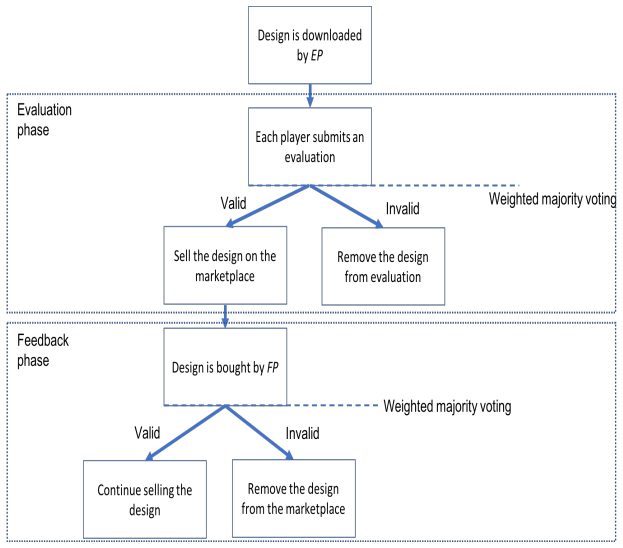
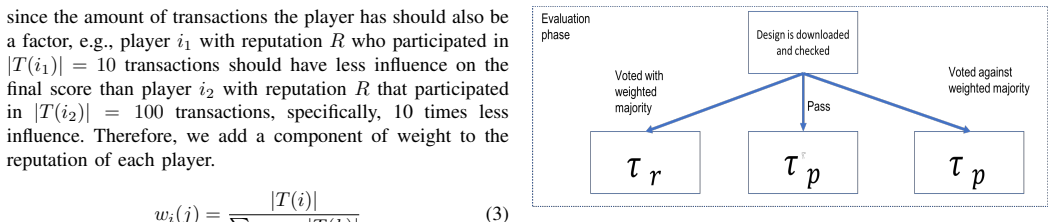
The load-bearing mechanism is the payment pair $(\tau_r, \tau_p)$ together with the reputation-weighted final score. The final score is $FS(j) = \tfrac{1}{2}\bigl(\sum_i a_i(j)\mathrm{rep}(i)w_i(j) \big/ \sum_i \mathrm{rep}(i)w_i(j) + 1\bigr)$, and the design's verdict $r_j$ is decided by comparing $FS(j)$ with the threshold $q^*$. A player is rewarded when the sign of their weighted vote matches the sign of the weighted vote of the rest of the players, and penalized otherwise; reputation is updated from agreement with past weighted majorities. The argument's work is done by importing an equilibrium theorem from a cited peer-prediction game and applying it, by asserted logical reduction, to this more complex weighted-majority voting game.
What would settle it
Compute both expressions the paper gives for the reward in Eq. (6) at a concrete threshold such as $q^*=3/4$ (so $x^*=1/2$): the first reads $2C^*/(1/4+1/2)=8C^*/3$ and the second reads $C^*/(2\cdot(9/16))=8C^*/9$, which are not equal; a reader could therefore settle the mechanism's definition by determining which payment is actually used and then simulating the two-phase game to test whether truth-telling remains a Nash equilibrium.
Extended reading notes
Core claim
The paper claims that by setting evaluation rewards and penalties to specific values, and by comparing each player's weighted vote to the weighted majority of the remaining players, a marketplace of rational, selfish, and independent agents will choose to invest effort and report truthfully. The reward is given as $\tau_r = 2C^*/(x^{*2}+x^*)$ and the penalty as $\tau_p = -2C^*/(x^{*2}+x^* - \varepsilon)$, where $C^*$ is the cost of printing material and $q^* = (x^*+1)/2$ is the quality threshold. The paper identifies these expressions with $C^*/(2q^{*2})$ and $-C^*/(2q^{*2}-\varepsilon)$, asserting that this choice imports a previously proven peer-prediction equilibrium result into the proposed weighted-majority setting. It further claims that the whole process, including reputation calculation, final-score computation, and payments, can be run transparently by a smart contract on a blockchain.
Load-bearing premise
The truthfulness guarantee depends on the assumption, asserted rather than proved in Section V-D, that this weighted-majority two-phase voting game is the same game as the peer-comparison game whose equilibrium result is imported, and that the stated reward and penalty formulas are consistent with that result.
Editorial extensions
If this is right
- If the equilibrium claim holds, a vendor can post a design for free community testing, pay testers only when their verdict matches the weighted majority, and sell only designs that pass both the evaluation and feedback phases.
- Because rewards scale with the cost of printing material $C^*$, expensive or resource-intensive designs would carry larger rewards, matching compensation to the effort required for physical attestation.
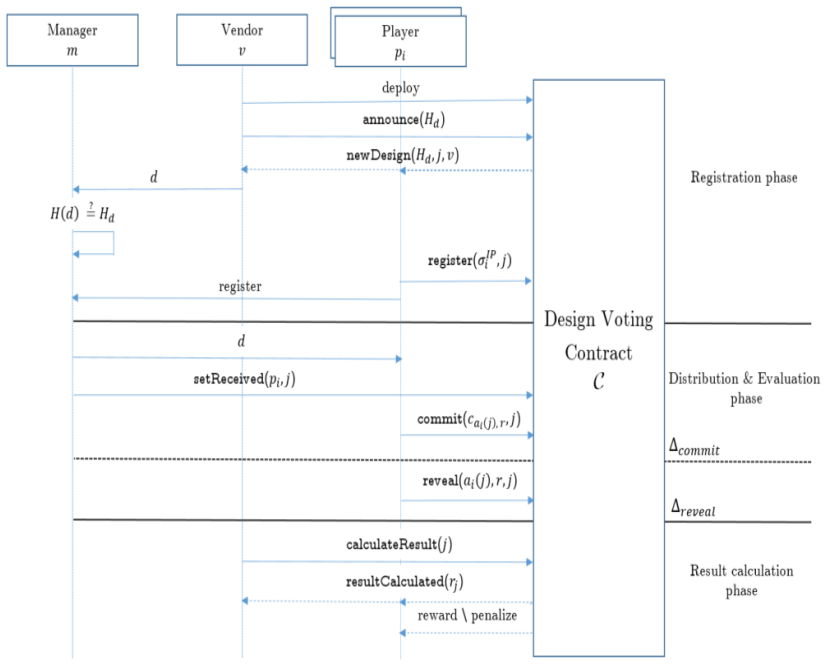
- The commit-reveal voting scheme prevents late voters from copying earlier votes, and the collateral requirement makes abstention or deliberate non-revelation costly.
- The same incentive core could be packaged as a generic attestation service for other tasks without known ground truth, such as community verification of open-source code or bug reports.
- Publicly verifiable reputation and final scores would let buyers compare designs by an integrity score that no single authority can silently alter.
Reading between the lines
- If the equality between the two payment formulas in Eqs. (6)-(7) is not restored, a real deployment would have to choose one schedule; the two choices pay very different amounts for the same threshold, so the equilibrium argument may not transfer to either.
- The paper's own discussion concedes that coalitions of players are outside the model; a natural testable extension is a vote-correlation detector that flags groups who always vote together and reduces their influence, as the authors themselves identify as future work.
- A proof-of-print mechanism, in which a trusted component of the 3D printer attests that a design was physically printed, would make the cost-of-effort assumption more concrete and could be used to scale each player's vote weight.
- The generic incentive design suggests an immediate experiment: run the two-phase voting game in a simulated marketplace with artificial agents and check whether the specified payments actually induce effort and truthful reporting before any blockchain deployment.
Signed reviews
Editorial analysis
A structured set of objections, weighed in public.
Referee Report
Summary. The paper proposes a blockchain-based decentralized marketplace for the attestation of 3D-printing design files. The core mechanism is a two-phase trust model: an evaluation phase and a feedback phase, in which players vote on the validity of a design, a reputation-weighted majority score is computed, and players are rewarded or penalized according to whether their vote agrees with the majority outcome. The authors claim that, with suitable reward and penalty values, rational, selfish, and independent agents are incentivized to invest effort and report truthfully, making truthfulness a Nash equilibrium. The claimed incentive-compatible payments are taken from a peer-prediction model by Witkowski et al. and are presented in Eqs. (6) and (7). The paper also describes an Ethereum smart-contract implementation with a commit-reveal voting scheme and a semi-trusted manager for fair exchange of designs for evaluations.
Significance. If the central game-theoretic claim were rigorously established, the paper would make a useful contribution: it applies peer-prediction ideas to a concrete, high-stakes crowdsourced validation problem, and it sketches a blockchain implementation with public verifiability. The paper has several praiseworthy features: it builds on a well-known incentive-compatibility result rather than inventing an ad hoc mechanism, it uses a commit-reveal scheme to reduce herding, and it clearly describes the protocol flow and smart-contract logic. However, the central equilibrium claim is not supported as written. The payment formulas in Eqs. (6) and (7) are algebraically inconsistent, so the reward and penalty values are undefined. Moreover, the claimed reduction of Witkowski et al.'s pairwise peer-prediction game to this paper's aggregate weighted-majority comparison is asserted but not proved. Because the paper's main contribution is precisely this trust model, these issues are load-bearing and currently prevent acceptance.
major comments (3)
- [Section V-D, Eqs. (6)-(7)] The two formulas printed for the reward τ_r are not equal except at q*=0, which is outside the domain q*>1/2. Substituting x* = 2q* - 1 gives 2C*/(x*^2 + x*) = C*/(q*(2q* - 1)), whereas the second expression is C*/(2(q*)^2); for q* = 0.75, these evaluate to approximately 2.67C* and 0.89C*, respectively. The same inconsistency appears in Eq. (7) for τ_p. Since the equilibrium theorem borrowed from Witkowski et al. is parameterized by specific payment values, the paper does not actually define an incentive scheme, and the claim that the displayed payments induce truthfulness as a Nash equilibrium is unsupported.
- [Section V-D] The reduction from Witkowski et al.'s model to the model of this paper is asserted, not proved. The original model compares an agent's answer to the answer of a randomly selected peer, whereas this paper compares the agent's weighted vote with the weighted majority of all other players. In the aggregate comparison, the reference is endogenous: a player's own reputation weight and vote can affect the comparison, and the distribution of the reference signal is different from the pairwise setting. The sentence 'we reduce the complexity by assuming that the player's vote is compared to another peer with the weighted answer' does not establish that the equilibrium properties of [11] carry over. This gap affects the central claim of the paper, namely that the proposed reward/penalty system makes truthfulness a Nash equilibrium.
- [Section V-D] The identification of the effort cost C* with the cost of the material needed to 3D print the design is not justified. In the application, effort includes printing time, testing or integration of the printed object, and the evaluator's expertise, not merely material cost. If C* underestimates the true effort cost, the computed payments τ_r and τ_p will be too low to satisfy the incentive-compatibility thresholds from Witkowski et al., so the claimed equilibrium would not hold. The authors need either to justify this assumption with a cost model or to treat C* as a parameter that includes all costs of effort.
minor comments (4)
- [Section V-C and VI-B] The definition of τ_p as a negative value in Eq. (7) conflicts with the text stating that players 'will pay a penalty of τp' and with Algorithm 1's requirement that a player's collateral be 'at least τp'; if τ_p is negative, this condition is vacuous. Please clarify by using |τ_p| or by defining the penalty as a positive amount.
- [Algorithm 1, commit handler] The condition 'discard if playerStates[j].received ≠ TRUE' appears to be a typo: it should refer to playerStates[pi].received[j], since the contract otherwise stores per-player, per-design received flags.
- [Section V-B and Algorithm 2] The final-score formula in Eq. (4) uses w_i(j) = |T(i)|/Σ_k |T(k)|, but Algorithm 2 does not show how the contract computes |T(i)| or updates the stored weight according to Eq. (3). The pseudocode should be aligned with the formulas it claims to implement.
- [Section V-B] The outcome r_j = 0, in which the game is annulled because FS(j) falls in [1-q*, q*], is not handled in the compensation rules; the paper should state whether players receive rewards, penalties, or nothing in this case.
Circularity Check
No circularity: the incentive guarantee is imported from an external theorem (Witkowski et al.), and the authors' self-citations appear only in background motivation, not in the load-bearing derivation.
full rationale
The paper's central truthfulness claim is not derived from its own outputs. Section V-D explicitly relies on the results of Witkowski et al. [11] and states that the authors 'logically reduce their problem to the problem presented in this paper' and then 'project their model onto our model' to set the payment formulas. This is a citation of an external result, not a prediction reduced by construction from the paper's own definitions. The two inconsistent formulas for τr and τp in Eqs. (6)–(7) are an algebraic flaw that leaves the incentive scheme ill-defined, but they do not make the argument circular: the paper does not fit parameters to data, rename its own earlier results, or invoke a self-citation chain to justify the equilibrium. The self-citations in references [4] and [5] support the motivating threat model (AM security attacks), not the trust model, so they are not load-bearing. No step in the derivation exhibits the specific reduction pattern—such as Eq. X being equivalent to Eq. Y by construction—that would constitute circularity. The main weakness is an unsupported transfer of a known game-theoretic result, which is a correctness and rigor concern, not a circularity concern.
Assumptions & free parameters
free parameters (3)
- q*
- C*
- epsilon =
epsilon -> 0
assumptions (4)
- domain assumption Agents are rational, selfish, and independent, and do not collude.
- domain assumption After paying effort cost C*, a reviewer observes the correct validity of the design with probability at least q*, and all reviewers share the same q* and C*.
- ad hoc to paper The weighted-majority comparison is equivalent to the pairwise peer comparison in Witkowski et al.'s model.
- domain assumption The final score FS from a weighted majority vote can serve as the ground truth for updating reputation.
invented entities (1)
-
Semi-trusted manager
Cite this review
Pith. "Pith review of 3D Marketplace: Distributed Attestation of 3D Designs on Blockchain." pith.science (2026). https://pith.science/paper/P23YUD6E
@misc{pith2026190806921,
  author       = {Pith},
  title        = {Pith review of: 3D Marketplace: Distributed Attestation of 3D Designs on Blockchain},
  year         = {2026},
  howpublished = {\url{https://pith.science/paper/P23YUD6E}},
  note         = {Machine review of arXiv:1908.06921}
}
read the original abstract
Additive manufacturing (AM), or 3D printing, is an emerging manufacturing technology that is expected to have far-reaching socioeconomic, environmental, and geopolitical implications. As the use of this technology increases, the need for validation of 3D designs grows. In order to create a marketplace in which 3D designs are traded, it is necessary to develop a platform that enables the attestation of the 3D designs and promotes truthfulness. In this paper, we introduce a novel concept of a distributed marketplace that will support the attestation of 3D printing designs. We build a mathematical trust model that ensures truthfulness among rational, selfish, and independent agents, which is based on a reward/penalty system. The payment for participating in the evaluation is calculated by factoring in agents' reputation and peer feedback. Moreover, we describe the architecture and the implementation of the trust model on blockchain using smart contracts for the creation of a distributed marketplace. Our model relies both on theoretical and practical best practices to create an unique platform that elicit effort and truthfulness from the participants.
Figures

Figures from the paper (1 more)
Reference graph
Works this paper leans on
-
[11]
Dwelling on the negative: Incentivizing effort in peer prediction,
J. Witkowski, Y . Bachrach, P. Key, and D. C. Parkes, “Dwelling on the negative: Incentivizing effort in peer prediction,” in First AAAI Conference on Human Computation and Crowdsourcing , 2013
work page 2013
-
[1]
L. Murr, S. Gaytan, F. Medina, H. Lopez, E. Martinez, B. Machado, D. Hernandez, L. Martinez, M. Lopez, R. Wickeret al., “Next-generation biomedical implants using additive manufacturing of complex, cellular and functional mesh arrays,” Philosophical Transactions of the Royal Society of London A: Mathematical, Physical and Engineering Sciences , vol. 368, ...
work page 1917
-
[2]
Meet rambo, the army’s badass new 3d-printed grenade launcher,
K. Hodgkins, “Meet rambo, the army’s badass new 3d-printed grenade launcher,” Tech. Rep., 2017. [Online]. Available: https: //www.digitaltrends.com/cool-tech/army-3d-printed-grenade-launcher/
work page 2017
-
[3]
The faa cleared the first 3d printed part to fly in a commercial jet engine from ge,
G. Reports, “The faa cleared the first 3d printed part to fly in a commercial jet engine from ge,” Tech. Rep., 2015. [Online]. Available: http://www.gereports.com/post/116402870270/ the-faa-cleared-the-first-3d-printed-part-to-fly/
-
[4]
Security of Additive Manufacturing: Attack Taxonomy and Survey,
M. Yampolskiy, W. E. King, J. Gatlin, S. Belikovetsky, A. Brown, A. Skjellum, and Y . Elovici, “Security of Additive Manufacturing: Attack Taxonomy and Survey,” Additive Manufacturing , vol. 21, pp. 431–457, 2018
work page 2018
-
[5]
dr0wned - cyber-physical attack with additive manufacturing,
S. Belikovetsky, M. Yampolskiy, J. Toh, J. Gatlin, and Y . Elovici, “dr0wned - cyber-physical attack with additive manufacturing,” in 11th U SEN IX Workshop on Offensive Technologies ( W OOT 17). U SEN IX Association
-
[6]
Cyber- physical vunerabilities in additive manufacturing systems,
L. Sturm, C. Williams, J. Camelio, J. White, and R. Parker, “Cyber- physical vunerabilities in additive manufacturing systems,” Context, vol. 7, p. 8, 2014
work page 2014
-
[7]
Modeling and simulation methods for design of engineering systems,
R. Sinha, C. J. Paredis, V .-C. Liang, and P. K. Khosla, “Modeling and simulation methods for design of engineering systems,” Journal of computing and information science in engineering , vol. 1, no. 1, pp. 84–91, 2001
work page 2001
Show all 18 references
-
[8]
Trust and e-commerce: a study of consumer perceptions,
B. J. Corbitt, T. Thanasankit, and H. Yi, “Trust and e-commerce: a study of consumer perceptions,” Electronic commerce research and applications, vol. 2, no. 3, pp. 203–215, 2003
2003
-
[9]
Peertrust: Supporting reputation-based trust for peer-to-peer electronic communities,
L. Xiong and L. Liu, “Peertrust: Supporting reputation-based trust for peer-to-peer electronic communities,” IEEE transactions on Knowledge and Data Engineering , vol. 16, no. 7, pp. 843–857, 2004
2004
-
[10]
Crowdsourced judgement elicitation with endogenous proficiency,
A. Dasgupta and A. Ghosh, “Crowdsourced judgement elicitation with endogenous proficiency,” in Proceedings of the 22nd international conference on World Wide Web. ACM, 2013, pp. 319–330
2013
-
[12]
Protecting the additive manufacturing workflow with blockchain technology,
D. E. Chris Adkins, “Protecting the additive manufacturing workflow with blockchain technology,” Tech. Rep., 2018, https://www.ncms.org/ncms-releases-protecting-the-additive- manufacturing-workflow-with-blockchain-technology-white-paper/
2018
-
[13]
Copyright protection in additive manufacturing with blockchain approach,
M. Holland, C. Nigischer, and J. Stjepandi ´c, “Copyright protection in additive manufacturing with blockchain approach,” Transdisciplinary Engineering: A Paradigm Shift, IOS Press, Amsterdam , pp. 914–921, 2017
2017
-
[14]
Enhanced anti-counterfeiting measures for additive manufacturing: coupling lanthanide nanomaterial chemical signatures with blockchain technology,
Z. C. Kennedy, D. E. Stephenson, J. F. Christ, T. R. Pope, B. W. Arey, C. A. Barrett, and M. G. Warner, “Enhanced anti-counterfeiting measures for additive manufacturing: coupling lanthanide nanomaterial chemical signatures with blockchain technology,” Journal of Materials Che...
2017
-
[15]
A next-generation smart contract and decentralized application platform,
V . Buterin et al. , “A next-generation smart contract and decentralized application platform,” white paper, 2014
2014
-
[16]
Reviews and ratings verified by payments on blockchains,
Chlu, “Reviews and ratings verified by payments on blockchains,” Tech. Rep., 2018. [Online]. Available: https://chlu.io/papers/position-paper.pdf
2018
-
[17]
Blockchain and the internet of things in the industrial sector,
D. Miller, “Blockchain and the internet of things in the industrial sector,” IT Professional, vol. 20, no. 3, pp. 15–18, 2018
2018
-
[18]
The rise of personal fabrication,
C. Mota, “The rise of personal fabrication,” in Proceedings of the 8th ACM conference on Creativity and cognition. ACM, 2011, pp. 279–288
2011
Reviewed August 14, 2026 · model on record in the stance chip above.
Discussion (0). Continue with ORCID to comment.