REVIEW 3 major objections 5 minor 1 cited by
Sarcasm Detection using Hybrid Neural Network
T0 review · 3 major / 5 minor · reviewed 2026-08-14 · deepseek-v4-flash
Pith's one-line read A hybrid CNN-BiLSTM-attention model detects sarcastic news headlines with 89.7 percent test accuracy on a new dataset, beating a CNN baseline by about 5 percent.
desk verdict The paper's real contribution is a reusable headlines dataset; the 5% accuracy gain is probably real but may just be source-identity classification. read the letter →
The pith
A machine-rendered reading of the paper's core claim, the machinery that carries it, and where it could break.
The reading
What carries the argument
The load-bearing mechanism is the hybrid architecture itself: a CNN module that extracts regular n-gram word patterns, a bidirectional LSTM that annotates each word with its left and right context, and an attention layer that turns those annotations into a weighted context vector via a softmax over MLP-scored hidden states. The CNN output and the attention context vector are concatenated and fed to an MLP that outputs a binary sarcasm probability. This attention mechanism is what the qualitative results use to show which phrase pairs the model treats as incongruent.
What would settle it
Take a random sample of several hundred headlines from the dataset, have independent human annotators mark each as sarcastic or not, then compare human labels to the source-based labels; if agreement is near chance, the model's 89.7% accuracy is mostly distinguishing The Onion from HuffPost, not detecting sarcasm.
Extended reading notes
Core claim
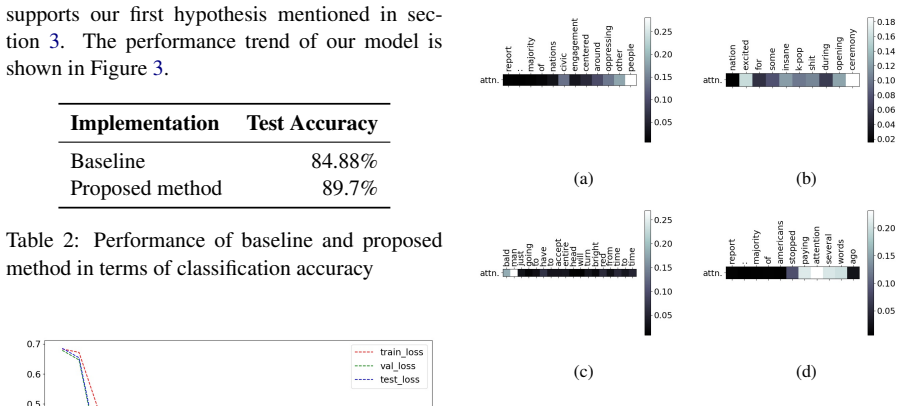
The paper's central claim is empirical: on a newly collected dataset of 26,709 news headlines, a hybrid network that combines a CNN with a bidirectional LSTM and an attention layer reaches 89.7% test accuracy, outperforming the CNN-only baseline at 84.88% by roughly 5 percentage points. The paper also claims this Headlines dataset is a cleaner testbed than Twitter datasets because labels come from the source websites: The Onion stands for sarcasm, HuffPost for sincerity, and the formal language reduces vocabulary sparsity. Finally, the attention weights are offered as evidence of mechanism: the model assigns high weight to incongruent co-occurring phrases like 'civic engagement' and 'oppressing other people,' which the authors take as the cue that makes a sentence sarcastic.
Load-bearing premise
The load-bearing assumption is that website of origin is a reliable sarcasm label—every The Onion headline is sarcastic and every HuffPost headline is not—so any systematic mislabeling by source would make the reported accuracies measure source identification rather than sarcasm detection.
Editorial extensions
If this is right
- Adding a BiLSTM and attention to the CNN-based model yields about a 5-point accuracy gain on this Headlines dataset, and the attention weights allow phrase-level inspection of the model's decision.
- The new Headlines dataset provides a more formal benchmark with better embedding coverage: only 23.35% of words are missing from word2vec, versus 35.53% for the Semeval Twitter data.
- Because the model no longer depends on author-specific context, it applies to self-contained short texts and could be used as a pretrained feature extractor before fine-tuning on smaller sarcasm datasets.
- The attention examples are consistent with the claim that context incongruity, rather than isolated sarcastic words, drives the model's predictions.
Reading between the lines
- The authors do not test for label noise, so the accuracy figures are best read as measuring how well the model separates The Onion from HuffPost; if source labels disagree with human judgments, the true sarcasm-detection accuracy would be lower.
- The same incongruity-attention mechanism could transfer to other tasks where phrase-level surprise matters, such as clickbait detection or stance detection.
- A natural next experiment would be to feed the model literal paraphrases of the same headlines; if accuracy collapses, the model is tracking semantic incongruity rather than lexical patterns.
Signed reviews
Editorial analysis
A structured set of objections, weighed in public.
Referee Report
Summary. The paper introduces a new 'Headlines' dataset of 26,709 news headlines, labeled as 11,725 sarcastic examples collected from The Onion and 14,984 non-sarcastic examples collected from HuffPost. It then proposes a hybrid neural network that combines a CNN module with a bidirectional LSTM and an attention mechanism, reasoning that the LSTM captures sequential context and attention highlights incongruous word phrases. On an 80:10:10 split of the new dataset, the proposed model is reported to reach 89.7% test accuracy, beating a CNN-only baseline at 84.88%, a gain of roughly 5%. The paper also presents attention visualizations on a few correctly classified sarcastic headlines as qualitative evidence, and lists ablation and knowledge integration as future work.
Significance. If the dataset labels validly encode sarcasm, the dataset itself is a useful contribution: it is larger and lexically cleaner than the Semeval Twitter collection used in prior work, and the paper reports a lower out-of-vocabulary rate for word2vec (23.35% vs. 35.53%). The empirical evaluation is genuinely out-of-sample, and the authors make both the dataset and code publicly available, which supports reproducibility and follow-up work. The attention visualizations provide a concrete, interpretable example of the model's behavior on incongruent phrases. However, the significance is substantially limited by two load-bearing gaps: the source-based labeling assumption is not validated, and the architecture comparison rests on a single accuracy number without variance or ablations. As presented, the paper cannot fully distinguish 'sarcasm detection' from 'source/domain classification,' nor can it attribute the reported gain to the LSTM or attention components.
major comments (3)
- [Section 2, Dataset] The label construction is the load-bearing assumption of the paper. The statement that 'the sole purpose of TheOnion is to publish sarcastic news' conflates satire with per-headline sarcasm and does not establish that every Onion headline is sarcastic; similarly, HuffPost contains opinion and humorous content, so not every HuffPost headline is necessarily non-sarcastic. If the binary labels mostly separate the two websites' writing styles or topical coverage, then the 5% accuracy gain in Table 2 may measure source or domain discrimination rather than sarcasm detection. Please validate the label construct with human annotation on a stratified sample, report inter-annotator agreement and per-source label purity, and if needed reframe the task as satirical-headline detection.
- [Section 5.1, Table 2] The central quantitative claim rests on a single test-accuracy number for each model, with no standard deviation, confidence interval, or significance test. Given the number of free hyper-parameters (learning rate, regularization constant, output channels, filter width, hidden units, dropout fraction) and the stochasticity of neural network training, run-to-run variation could plausibly exceed the reported 4.8 percentage-point gap. Please report mean and standard deviation over multiple random seeds, use a paired significance test, and clarify explicitly that hyper-parameters were selected on the validation split rather than the test split.
- [Section 5.2 and Section 6] The qualitative attention analysis selects only high-confidence, correctly classified sarcastic examples, so it demonstrates that the attention weights are interpretable on favorable cases but does not establish that the attention mechanism causes the accuracy improvement. The paper's own Section 6 lists an ablation study as future work, leaving the contribution of the BiLSTM and attention modules relative to the CNN baseline unattributed. Please add an ablation study (CNN only, CNN+BiLSTM, CNN+attention, and the full proposed model) and, if possible, a quantitative analysis of attention behavior across the test set, to substantiate the architectural claim.
minor comments (5)
- [Abstract and Section 2] The abstract and dataset description call The Onion a 'sarcastic news website' and use the spelling 'TheOnion'; the more standard and accurate term for the genre is 'satirical,' and the spacing should be corrected.
- [Section 4.2] The text says code for both methods is available on GitHub, but the given URL (Sarcasm-Detection-using-CNN) appears to name only the baseline; please provide the repository link for the hybrid model as well.
- [Section 5.1] The dataset is described as 'mostly balanced,' but reporting accuracy alone hides potential per-class differences; precision, recall, and F1 for the sarcastic class would be more informative, especially given the 44%/56% class split.
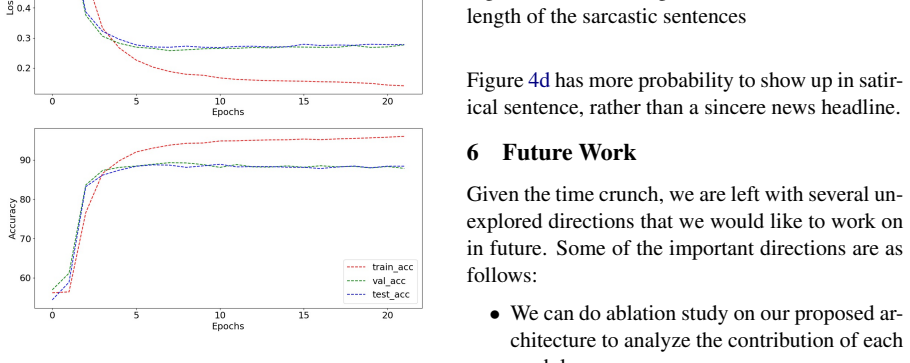
- [Figure 3] The caption and surrounding text do not specify which split the loss and accuracy curves are plotted for, nor the number of epochs; please add axis labels, epoch range, and split information.
- [Section 5.2] Terms such as 'insincere' and 'satirical' are used informally to interpret attention examples; please define these terms or link them to the sarcasm label consistently.
Circularity Check
No significant circularity: the reported accuracy is an out-of-sample evaluation, and no fitted parameter or self-citation is disguised as a prediction.
full rationale
The derivation chain is a standard supervised learning experiment. The dataset labels (Section 2) are assumed from the source website (Onion = sarcastic, HuffPost = non-sarcastic); this is a construct-validity assumption about the ground truth, not a circular step, because the labels are not defined by the model's predictions or by the target result. The baseline (Section 4.1) is the CNN of Amir et al. with author embeddings removed; the proposed model adds BiLSTM and attention. Section 5.1 reports test accuracy on a held-out 10% split after random 80:10:10 splitting and grid-search hyperparameter tuning on validation; this is a genuine out-of-sample measurement. The roughly 5% gain is not a fitted value renamed as a prediction, nor does it reduce by construction to a training input. The attention visualizations in Section 5.2 are post hoc interpretation and do not affect the loss or accuracy. The paper's own admission in Section 6 that no ablation study was done is a limitation on attributing the gain to specific modules, but it is not circularity. Likewise, concern that Onion/HuffPost labels measure source identity rather than sarcasm is a question of label validity, not a self-referential reduction; under the hard rules, validity concerns belong to correctness risk, not the circularity score. No self-citation is load-bearing: the prior-work citations are external baselines and standard methods, not an unverified uniqueness claim or a fitted input. Therefore the paper receives a circularity score of 0.
Assumptions & free parameters
free parameters (6)
- learning_rate
- regularization_constant
- output_channels
- filter_width
- hidden_units
- dropout_fraction
assumptions (4)
- domain assumption All The Onion headlines are sarcastic and all HuffPost headlines are non-sarcastic.
- domain assumption Sarcasm in news headlines is self-contained and does not depend on author identity, so the user-embedding path can be removed.
- domain assumption Attention weights are interpretable as evidence of incongruent phrases that cause sarcasm.
- standard math Standard neural network training with backpropagation and AdaDelta is assumed.
Cite this review
Pith. "Pith review of Sarcasm Detection using Hybrid Neural Network." pith.science (2026). https://pith.science/paper/P24IKNHR
@misc{pith2026190807414,
  author       = {Pith},
  title        = {Pith review of: Sarcasm Detection using Hybrid Neural Network},
  year         = {2026},
  howpublished = {\url{https://pith.science/paper/P24IKNHR}},
  note         = {Machine review of arXiv:1908.07414}
}
read the original abstract
Sarcasm Detection has enjoyed great interest from the research community, however the task of predicting sarcasm in a text remains an elusive problem for machines. Past studies mostly make use of twitter datasets collected using hashtag based supervision but such datasets are noisy in terms of labels and language. To overcome these shortcoming, we introduce a new dataset which contains news headlines from a sarcastic news website and a real news website. Next, we propose a hybrid Neural Network architecture with attention mechanism which provides insights about what actually makes sentences sarcastic. Through experiments, we show that the proposed model improves upon the baseline by ~ 5% in terms of classification accuracy.
Figures


Figures from the paper (1 more)
Forward citations
Cited by 1 Pith paper
-
Class Distillation with Mahalanobis Contrast: An Efficient Training Paradigm for Pragmatic Language Understanding Tasks
A Mahalanobis-distance contrast loss plus a Beta-distribution decision rule lets small-parameter models match or beat larger LLMs on sexism, sarcasm, and metaphor detection with one epoch of training.
Reference graph
Works this paper leans on
-
[1]
, " * write output.state after.block = add.period write newline
ENTRY address author booktitle chapter doi edition editor howpublished institution journal key month note number organization pages publisher school series title type url volume year label extra.label sort.label short.list INTEGERS output.state before.all mid.sentence after.sentence after.block FUNCTION init.state.consts #0 'before.all := #1 'mid.sentence...
-
[2]
write newline
" write newline "" before.all 'output.state := FUNCTION n.dashify 't := "" t empty not t #1 #1 substring "-" = t #1 #2 substring "--" = not "--" * t #2 global.max substring 't := t #1 #1 substring "-" = "-" * t #2 global.max substring 't := while if t #1 #1 substring * t #2 global.max substring 't := if while FUNCTION word.in bbl.in capitalize " " * FUNCT...
-
[3]
Silvio Amir, Byron C Wallace, Hao Lyu, and Paula Carvalho M \'a rio J Silva. 2016. Modelling context with user embeddings for sarcasm detection in social media. arXiv preprint arXiv:1607.00976\/
arXiv 2016
-
[4]
Dzmitry Bahdanau, Kyunghyun Cho, and Yoshua Bengio. 2014. Neural machine translation by jointly learning to align and translate. arXiv preprint arXiv:1409.0473\/
arXiv 2014
-
[5]
Aditya Joshi, Pushpak Bhattacharyya, and Mark J Carman. 2017. Automatic sarcasm detection: A survey. ACM Computing Surveys (CSUR)\/ 50(5):73
work page 2017
-
[6]
Aditya Joshi, Vinita Sharma, and Pushpak Bhattacharyya. 2015. Harnessing context incongruity for sarcasm detection. In Proceedings of the 53rd Annual Meeting of the Association for Computational Linguistics and the 7th International Joint Conference on Natural Language Processing (Volume 2: Short Papers)\/ . volume 2, pages 757--762
work page 2015
-
[7]
Christine Liebrecht, Florian Kunneman, and Antal van den Bosch. 2013. The perfect solution for detecting sarcasm in tweets \#not. In WASSA@NAACL-HLT\/
work page 2013
-
[8]
Sinno Jialin Pan and Qiang Yang. 2010. A survey on transfer learning. IEEE Transactions on knowledge and data engineering\/ 22(10):1345--1359
work page 2010
Show all 10 references
-
[9]
Wenpeng Yin, Katharina Kann, Mo Yu, and Hinrich Sch \"u tze. 2017. Comparative study of cnn and rnn for natural language processing. arXiv preprint arXiv:1702.01923\/
2017 arXiv
-
[10]
Tom Young, Erik Cambria, Iti Chaturvedi, Minlie Huang, Hao Zhou, and Subham Biswas. 2017. Augmenting end-to-end dialog systems with commonsense knowledge. arXiv preprint arXiv:1709.05453\/
2017 arXiv
Reviewed August 14, 2026 · model on record in the stance chip above.
Discussion (0). Continue with ORCID to comment.