Anderson localization on the Bethe lattice
Pith reviewed 2026-06-25 22:09 UTC · model grok-4.3
The pith
The full probability distribution of the local density of states serves as the order parameter for the Anderson localization transition on the Bethe lattice.
A machine-rendered reading of the paper's core claim, the machinery that carries it, and where it could break.
Core claim
On the Bethe lattice the Anderson transition is captured by the statistical properties of Green's functions. The cavity self-consistent equations for the diagonal resolvent are derived and solved both numerically by population dynamics and analytically in the large-connectivity limit; the resulting fixed-point distribution of the local density of states functions as the natural order parameter, giving access to critical disorder, localization length, and correlation volume while also linking the problem to directed polymers in random media.
What carries the argument
The cavity self-consistent equations for the diagonal resolvent, whose fixed-point solution is the probability distribution of the local density of states.
If this is right
- The critical disorder strength follows from the point at which the distribution of local density of states changes character.
- The localization length in the insulating phase is obtained from the typical decay of the resolvent.
- The correlation volume that controls the delocalized phase is extracted from the same distribution near criticality.
- Rare resonant paths and associated freezing map the localization problem onto directed polymers in random media.
Where Pith is reading between the lines
- The same distribution-based order parameter could be monitored in numerical studies of finite-dimensional lattices or many-body systems to locate transitions without relying on averaged quantities.
- Connections to directed polymers suggest that rare-region effects might dominate near the transition in real materials, offering a route to predict Griffiths-like singularities.
- Analytical large-connectivity results could serve as benchmarks for approximate theories of localization on graphs with different topologies.
Load-bearing premise
The Bethe lattice realizes the infinite-dimensional limit of the Anderson problem and serves as a useful mean-field description of localization in many-body configuration spaces.
What would settle it
A direct numerical computation on large finite Bethe lattices showing that the full distribution of the local density of states fails to separate localized from delocalized regimes would falsify the central claim.
Figures
read the original abstract
Anderson localization is a paradigmatic disorder-driven quantum phase transition in which interference effects can completely suppress wave propagation. Its formulation on the Bethe lattice -- an infinite tree with fixed coordination number -- provides a unique setting in which the transition becomes analytically tractable. Owing to its exponential volume growth, the Bethe lattice realizes the infinite-dimensional limit of the Anderson problem and also serves as a useful mean-field-like description of localization in many-body configuration spaces. These lecture notes provide a pedagogical review of Anderson localization on the Bethe lattice, focusing on the resolvent (Green's function) formalism and the cavity approach. We discuss the main diagnostics of localization and show how they are encoded in the statistical properties of Green's functions, with the full probability distribution of the local density of states emerging as the natural order parameter of the transition. We derive the cavity self-consistent equations for the diagonal resolvent and review both their numerical solution by population dynamics and their analytical treatment in the large-connectivity limit. This framework gives access to the critical disorder and the critical behavior near the transition, including the localization length in the insulating phase and the correlation volume that controls the delocalized phase. We also discuss the connection with directed polymers in random media and its interpretation in terms of rare resonant paths and freezing phenomena. These notes originated from a series of lectures delivered by one of the authors at the Oropa Summer School on "Fundamental Problems in Statistical Physics XVI" (July 2025).
Editorial analysis
A structured set of objections, weighed in public.
Referee Report
Summary. This manuscript is a set of lecture notes that review Anderson localization on the Bethe lattice. It employs the resolvent formalism and cavity method to derive self-consistent equations whose solution is the full probability distribution of the local density of states (the order parameter). The notes cover numerical solution via population dynamics, analytic treatment in the large-connectivity limit, the critical disorder strength, the localization length on the insulating side, the correlation volume on the delocalized side, and the mapping to directed polymers in random media that interprets rare resonant paths and freezing.
Significance. If the derivations and numerical procedures are presented accurately, the notes would constitute a compact pedagogical resource for a technique that remains central to mean-field treatments of localization, both for the infinite-dimensional Anderson model and as an approximation for many-body configuration spaces. The explicit identification of the full distribution of the local density of states as the order parameter, together with the discussion of population dynamics and the large-connectivity limit, reproduces standard but non-trivial results from the literature in a single, accessible source.
minor comments (3)
- [Abstract] Abstract, final paragraph: the origin of the notes (Oropa Summer School, July 2025) is stated; a short sentence indicating which parts of the text are original derivations versus direct reproductions of earlier literature would help readers assess novelty.
- The manuscript repeatedly refers to 'the cavity self-consistent equations' without an early numbered equation that collects the full set of distributional equations; adding such an equation (e.g., after the first derivation) would improve readability.
- Section on the large-connectivity limit: the scaling of the critical disorder with coordination number is discussed, but the precise asymptotic expression is not written as a numbered equation; doing so would make the analytic result easier to cite.
Simulated Author's Rebuttal
We thank the referee for the positive assessment of our lecture notes and for recommending acceptance. The report contains no major comments requiring a point-by-point reply.
Circularity Check
No significant circularity: pedagogical review of established results
full rationale
The paper is explicitly a review of prior derivations in the cavity-method literature for Anderson localization on the Bethe lattice. The central claim that the full distribution of the local density of states is the natural order parameter follows directly from the structure of the self-consistent resolvent equations (which close on the distribution rather than moments), a standard feature already present in the cited foundational works. No new parameters are fitted within the paper, no self-citation chain is load-bearing for a novel result, and no ansatz or uniqueness theorem is smuggled in. The derivation chain is therefore self-contained against external benchmarks.
Axiom & Free-Parameter Ledger
Reference graph
Works this paper leans on
-
[1]
5 for the Anderson model on the Bethe lattice must be interpreted as self-consistent integral equations for the probability CONTENTS52 distribution of the cavity Green’s functions
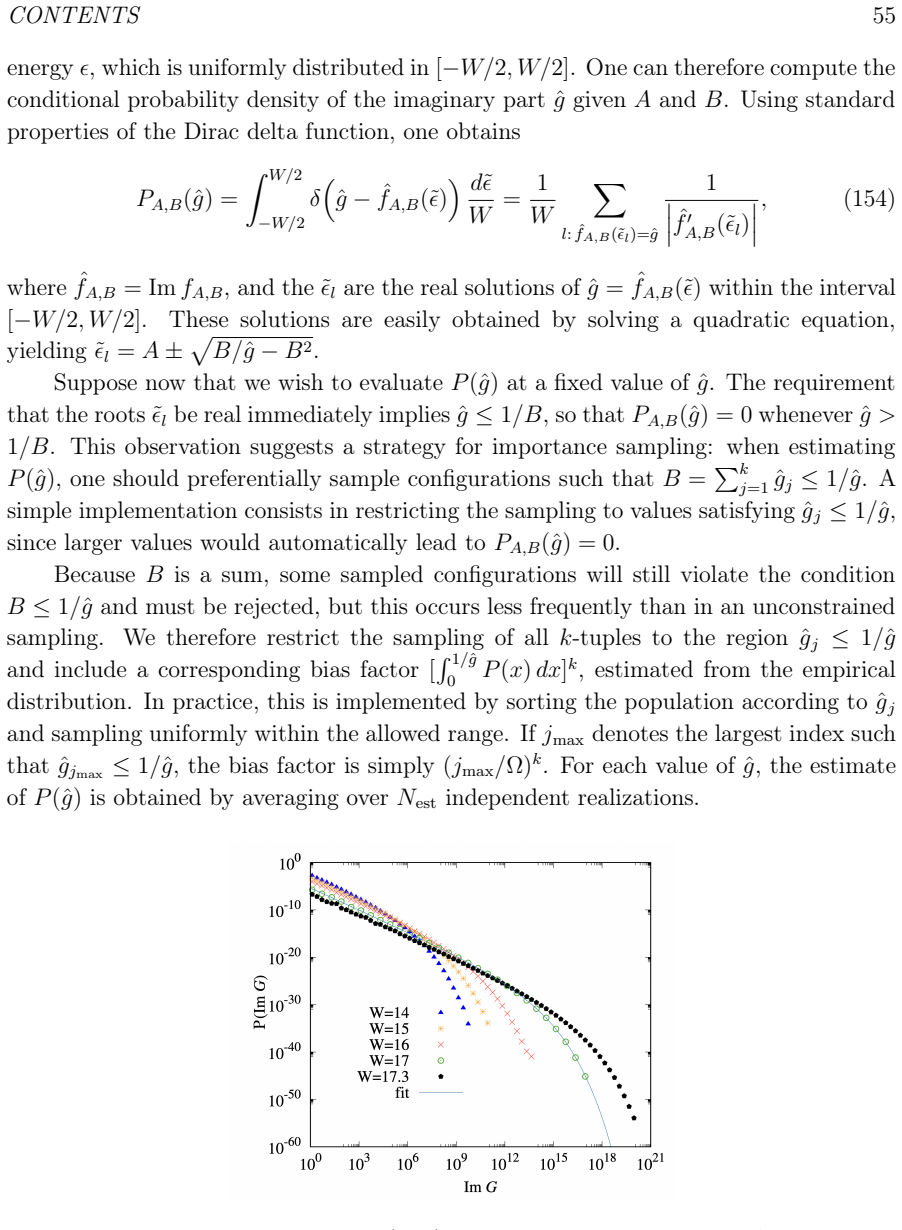
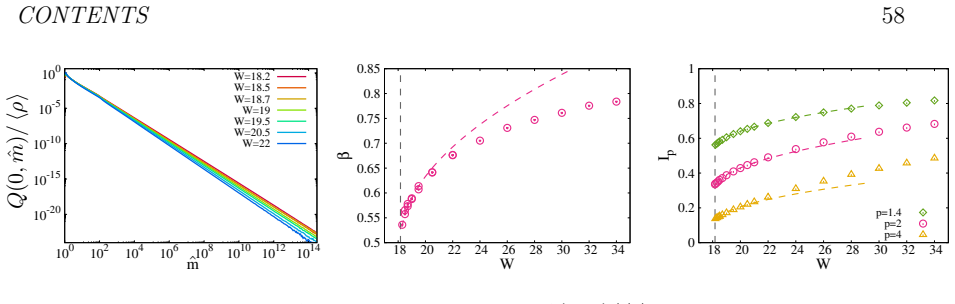
Population Dynamics algorithm(s) As discussed above, the cavity equations derived in Sec. 5 for the Anderson model on the Bethe lattice must be interpreted as self-consistent integral equations for the probability CONTENTS52 distribution of the cavity Green’s functions. These equations are given by Eqs. (87) and (88). The local density of states, the inve...
-
[2]
Connection with Derrida’s directed polymers in random media Before concluding this review, we would like to discuss the close relationship between Anderson localization on the Bethe lattice and a paradigmatic problem of classical disordered systems, namely the freezing glass transition of directed polymers in random media (DPRM), first introduced and stud...
-
[3]
Plugging the expression ofm ⋆ into the replicated free energy, one recovers the expression (167). It is easy to check that for the particular case in whichγ(ω)is a Gaussian distribution with zero mean and varianceσ2 ω one recovers the results (165) and (166)— withβ ⋆ = √ 2 lnk/σ ω—corresponding to the approximation in which one neglects the correlations b...
-
[4]
Fundamental Problems in Statistical Physics XVI
Conclusions and perspectives 9.1. Summary More than six decades after Philip W. Anderson’s seminal discovery [1], the problem of quantum localization driven by disorder continues to reveal new frontiers, challenges, and subtleties. This pedagogical review has been dedicated to exploring this phenomenon within a unique and highly singular framework: the in...
2025
-
[5]
Rev.109(5) 1492–1505 URLhttps://link.aps.org/doi/10.1103/ PhysRev.109.1492
Anderson P W 1958Phys. Rev.109(5) 1492–1505 URLhttps://link.aps.org/doi/10.1103/ PhysRev.109.1492
-
[6]
Bloch F 1928Zeitschrift für Physik52555–600
-
[7]
Drude P 1900Annalen der Physik306566–613 (Preprinthttps://onlinelibrary.wiley.com/ doi/pdf/10.1002/andp.19003060312) URLhttps://onlinelibrary.wiley.com/doi/abs/ 10.1002/andp.19003060312
-
[8]
Sommerfeld A 1927Naturwissenschaften15825–832
-
[9]
Lee P A and Ramakrishnan T V 1985Rev. Mod. Phys.57(2) 287–337 URLhttps://link.aps. org/doi/10.1103/RevModPhys.57.287
-
[10]
Evers F and Mirlin A D 2008Rev. Mod. Phys.80(4) 1355–1417 URLhttps://link.aps.org/ doi/10.1103/RevModPhys.80.1355 CONTENTS69
-
[11]
Lagendijk A, Tiggelen B v and Wiersma D S 2009Physics today6224–29 URLhttps: //physicstoday.aip.org/features/fifty-years-of-anderson-localization
-
[12]
Scardicchio A and Thiery T 2017 Perturbation theory approaches to anderson and many-body localization: some lecture notes (Preprint1710.01234) URLhttps://arxiv.org/abs/1710. 01234
Pith/arXiv arXiv 2017
-
[13]
Pascazio S, Scardicchio A and Tarzia M 2023 Anderson localization on the bethe latticeSpin Glass Theory and Far Beyond: Replica Symmetry Breaking After 40 Years(World Scientific) pp 335–352
2023
-
[14]
Mott N 1967Advances in Physics1649–144 (Preprinthttps://doi.org/10.1080/ 00018736700101265) URLhttps://doi.org/10.1080/00018736700101265
-
[15]
Abrahams E, Anderson P W, Licciardello D C and Ramakrishnan T V 1979Physical Review Letters42673
-
[16]
Slevin K and Ohtsuki T 1999Physical Review Letters82382–385 ISSN 1079-7114 URL http://dx.doi.org/10.1103/PhysRevLett.82.382
-
[17]
Slevin K and Ohtsuki T 2014New Journal of Physics16015012 ISSN 1367-2630 URLhttp: //dx.doi.org/10.1088/1367-2630/16/1/015012
-
[18]
Tarquini E, Biroli G and Tarzia M 2017Physical Review B95094204
-
[19]
Hikami S 1992Progress of Theoretical Physics Supplement107213–227
-
[20]
Wegner F 1979Zeitschrift für Physik B Condensed Matter35207–210
-
[21]
Schäfer L and Wegner F 1980Zeitschrift für Physik B Condensed Matter38113–126
-
[22]
John S 1984Phys. Rev. Lett.53(22) 2169–2172 URLhttps://link.aps.org/doi/10.1103/ PhysRevLett.53.2169
-
[23]
1080/13642818508240619) URLhttps://doi.org/10.1080/13642818508240619
Anderson P W 1985Philosophical Magazine B52505–509 (Preprinthttps://doi.org/10. 1080/13642818508240619) URLhttps://doi.org/10.1080/13642818508240619
-
[24]
Billy J, Josse V, Zuo Z, Bernard A, Hambrecht B, Lugan P, Clément D, Sanchez-Palencia L, Bouyer P and Aspect A 2008Nature453891–894
-
[25]
Roati G, D’Errico C, Fallani L, Fattori M, Fort C, Zaccanti M, Modugno G, Modugno M and Inguscio M 2008Nature453895–898
-
[26]
Kondov S S, McGehee W R, Zirbel J J and DeMarco B 2011Science33466–68 ISSN 1095-9203 URLhttp://dx.doi.org/10.1126/science.1209019
-
[27]
Jendrzejewski F, Bernard A, Müller K, Cheinet P, Josse V, Piraud M, Pezzé L, Sanchez- Palencia L, Aspect A and Bouyer P 2012Nature Physics8398–403 ISSN 1745-2481 URL http://dx.doi.org/10.1038/nphys2256
-
[28]
Semeghini G, Landini M, Castilho P, Roy S, Spagnolli G, Trenkwalder A, Fattori M, Inguscio M and Modugno G 2015Nature Physics11554–559 ISSN 1745-2481 URLhttp://dx.doi.org/ 10.1038/nphys3339
-
[29]
Chabé J, Lemarié G, Grémaud B, Delande D, Szriftgiser P and Garreau J C 2008Physical Review Letters101ISSN 1079-7114 URLhttp://dx.doi.org/10.1103/PhysRevLett.101.255702
-
[30]
Hu H, Strybulevych A, Page J H, Skipetrov S E and van Tiggelen B A 2008Nature Physics4 945–948 ISSN 1745-2481 URLhttp://dx.doi.org/10.1038/nphys1101
-
[31]
Abou-Chacra R, Thouless D J and Anderson P W 1973Journal of Physics C: Solid State Physics 61734 URLhttps://doi.org/10.1088/0022-3719/6/10/009
-
[33]
Rizzo T and Tarzia M 2024Phys. Rev. B110(18) 184210 URLhttps://link.aps.org/doi/ 10.1103/PhysRevB.110.184210
-
[34]
Tikhonov K S and Mirlin A D 2019Phys. Rev. B99(2) 024202 URLhttps://link.aps.org/ doi/10.1103/PhysRevB.99.024202
-
[35]
Tikhonov K S and Mirlin A D 2019Phys. Rev. B99(21) 214202 URLhttps://link.aps.org/ doi/10.1103/PhysRevB.99.214202
-
[36]
Efetov K 1985Sov. Phys. JETP61606–617 URLhttps://jetp.ras.ru/cgi-bin/dn/e_061_ CONTENTS70 03_0606.pdf
-
[37]
Efetov K 1987Sov. Phys. JETP65360–370 URLhttps://jetp.ras.ru/cgi-bin/dn/e_065_ 02_0360.pdf
-
[38]
Efetov K 1987Sov. Phys. JETP66634–642 URLhttps://jetp.ras.ru/cgi-bin/dn/e_066_ 03_0634.pdf
-
[39]
Zirnbauer M R 1986Phys. Rev. B34(9) 6394–6408 URLhttps://link.aps.org/doi/10.1103/ PhysRevB.34.6394
-
[42]
sciencedirect.com/science/article/pii/055032139190028V
Mirlin A D and Fyodorov Y V 1991Nuclear Physics B366507–532 URLhttps://www. sciencedirect.com/science/article/pii/055032139190028V
-
[43]
Mirlin A and Fyodorov Y V 1991Journal of Physics A: Mathematical and General242273 URL https://doi.org/10.1088/0305-4470/24/10/016
-
[44]
Fyodorov Y V and Mirlin A D 1991Phys. Rev. Lett.67(15) 2049–2052 URLhttps://link.aps. org/doi/10.1103/PhysRevLett.67.2049
-
[45]
Fyodorov Y V, Mirlin A D and Sommers H J 1992J. Phys. I France21571–1605 ISSN 1286-4862 URLhttp://dx.doi.org/10.1051/jp1:1992229
-
[46]
Mirlin A D and Fyodorov Y V 1994Journal de Physique I4655–673
-
[47]
Mirlin A D and Fyodorov Y V 1994Phys. Rev. Lett.72(4) 526–529 URLhttps://link.aps. org/doi/10.1103/PhysRevLett.72.526
-
[48]
Gornyi I V, Mirlin A D and Polyakov D G 2005Phys. Rev. Lett.95(20) 206603 URLhttps: //link.aps.org/doi/10.1103/PhysRevLett.95.206603
-
[49]
Basko D, Aleiner I and Altshuler B 2006Ann. Phys. (N. Y.)3211126–1205 ISSN 0003-4916 URLhttp://dx.doi.org/10.1016/j.aop.2005.11.014
-
[50]
Nandkishore R and Huse D A 2015Annu. Rev. Condens. Mat. Phys.615–38 ISSN 1947-5462 URLhttps://doi.org/10.1146/annurev-conmatphys-031214-014726
-
[51]
Abanin D A, Altman E, Bloch I and Serbyn M 2019Rev. Mod. Phys.91(2) 021001 URL https://link.aps.org/doi/10.1103/RevModPhys.91.021001
-
[52]
Physique19498–525 ISSN 1878-1535 URL http://dx.doi.org/10.1016/j.crhy.2018.03.003
Alet F and Laflorencie N 2018Comptes Rendus. Physique19498–525 ISSN 1878-1535 URL http://dx.doi.org/10.1016/j.crhy.2018.03.003
-
[53]
Sierant P, Lewenstein M, Scardicchio A, Vidmar L and Zakrzewski J 2025Reports on Progress in Physics88026502 ISSN 1361-6633 URLhttp://dx.doi.org/10.1088/1361-6633/ad9756
-
[54]
Huse D A, Nandkishore R and Oganesyan V 2014Phys. Rev. B90ISSN 1550-235X URL http://dx.doi.org/10.1103/PhysRevB.90.174202
-
[55]
Altshuler B L, Gefen Y, Kamenev A and Levitov L S 1997Physical Review Letters782803–2806 ISSN 1079-7114 URLhttp://dx.doi.org/10.1103/PhysRevLett.78.2803
-
[56]
Tikhonov K and Mirlin A 2021Annals of Physics435168525 ISSN 0003-4916 URLhttp: //dx.doi.org/10.1016/j.aop.2021.168525
-
[57]
Tikhonov K S and Mirlin A D 2021Phys. Rev. B103(6) 064204 URLhttps://link.aps.org/ doi/10.1103/PhysRevB.103.064204
-
[58]
Tarzia M 2020Physical Review B102ISSN 2469-9969 URLhttp://dx.doi.org/10.1103/ PhysRevB.102.014208
-
[59]
De Luca A and Scardicchio A 2013EPL (Europhysics Letters)10137003 ISSN 1286-4854 URL http://dx.doi.org/10.1209/0295-5075/101/37003
-
[60]
Biroli G and Tarzia M 2017Phys. Rev. B96(20) 201114(R) URLhttps://link.aps.org/doi/ 10.1103/PhysRevB.96.201114
-
[61]
Biroli G and Tarzia M 2020Phys. Rev. B102(6) 064211 URLhttps://link.aps.org/doi/10. 1103/PhysRevB.102.064211
-
[62]
Logan D E and Welsh S 2019Physical Review B99ISSN 2469-9969 URLhttp://dx.doi.org/ CONTENTS71 10.1103/PhysRevB.99.045131
-
[63]
García-Mata I, Martin J, Giraud O, Georgeot B, Dubertrand R and Lemarié G 2022Phys. Rev. B106(21) 214202 URLhttps://link.aps.org/doi/10.1103/PhysRevB.106.214202
-
[64]
Herre J N, Karcher J F, Tikhonov K S and Mirlin A D 2023Physical Review B108ISSN 2469-9969 URLhttp://dx.doi.org/10.1103/PhysRevB.108.014203
-
[65]
Biroli G, Ribeiro-Teixeira A C and Tarzia M 2012 Difference between level statistics, ergodicity and localization transitions on the bethe lattice (Preprint1211.7334) URLhttps://arxiv. org/abs/1211.7334
Pith/arXiv arXiv 2012
-
[66]
Kravtsov V, Altshuler B and Ioffe L 2018Annals of Physics389148–191 ISSN 0003-4916 URL http://dx.doi.org/10.1016/j.aop.2017.12.009
-
[67]
Pino M 2020Phys. Rev. Res.2(4) 042031 URLhttps://link.aps.org/doi/10.1103/ PhysRevResearch.2.042031
-
[68]
Bera S, De Tomasi G, Khaymovich I M and Scardicchio A 2018Phys. Rev. B98(13) 134205 URLhttps://link.aps.org/doi/10.1103/PhysRevB.98.134205
-
[69]
De Tomasi G, Bera S, Scardicchio A and Khaymovich I M 2020Phys. Rev. B101(10) 100201 URLhttps://link.aps.org/doi/10.1103/PhysRevB.101.100201
-
[70]
Wormald N Cet al.1999London mathematical society lecture note series239–298
-
[71]
Tikhonov K S, Mirlin A D and Skvortsov M A 2016Phys. Rev. B94(22) 220203 URL https://link.aps.org/doi/10.1103/PhysRevB.94.220203
-
[72]
García-Mata I, Giraud O, Georgeot B, Martin J, Dubertrand R and Lemarié G 2017Phys. Rev. Lett.118(16) 166801 URLhttps://link.aps.org/doi/10.1103/PhysRevLett.118.166801
-
[73]
Tarquini E, Biroli G and Tarzia M 2016Phys. Rev. Lett.116(1) 010601 URLhttps://link. aps.org/doi/10.1103/PhysRevLett.116.010601
-
[74]
Biroli G and Tarzia M 2018 Delocalization and ergodicity of the anderson model on bethe lattices (Preprint1810.07545) URLhttps://arxiv.org/abs/1810.07545
Pith/arXiv arXiv 2018
-
[75]
Baroni M, Lorenzana G G, Rizzo T and Tarzia M 2024Phys. Rev. B109(17) 174216 URL https://link.aps.org/doi/10.1103/PhysRevB.109.174216
-
[77]
Efetov K 1983Advances in Physics3253–127 (Preprinthttps://doi.org/10.1080/ 00018738300101531) URLhttps://doi.org/10.1080/00018738300101531
-
[78]
Rep.326259–382 ISSN 0370-1573 URLhttps://www.sciencedirect
Mirlin A D 2000Phys. Rep.326259–382 ISSN 0370-1573 URLhttps://www.sciencedirect. com/science/article/pii/S0370157399000915
-
[79]
Sierant P, Lewenstein M and Scardicchio A 2023SciPost Physics15045
-
[80]
García-Mata I, Martin J, Dubertrand R, Giraud O, Georgeot B and Lemarié G 2020Phys. Rev. Res.2(1) 012020(R) URLhttps://link.aps.org/doi/10.1103/PhysRevResearch.2. 012020
-
[81]
Vanoni C, Altshuler B L, Kravtsov V E and Scardicchio A 2024Proceedings of the National Academy of Sciences121e2401955121
-
[82]
Sonner M, Tikhonov K and Mirlin A 2017Physical Review B96214204
-
[83]
Tikhonov K S and Mirlin A D 2016Physical Review B94184203
-
[84]
Derrida B and Spohn H 1988Journal of Statistical Physics51817–840
discussion (0)
Sign in with ORCID, Apple, or X to comment. Anyone can read and Pith papers without signing in.