REVIEW 3 major objections 5 minor 53 references
Resonant control of magnetization in a shunted $\varphi_0$ junction with LC circuit
T0 review · 3 major / 5 minor · reviewed 2026-08-12 · deepseek-v4-flash
Pith's one-line read Shunting a φ0 Josephson junction with an LC circuit lets circuit resonance tilt and precess the ferromagnet's magnetization without a magnetic field.
desk verdict Plausible new mechanism, but the analytical 'confirmation' is a self-referential consistency check and needs a time-averaged derivation. read the letter →
The pith
A machine-rendered reading of the paper's core claim, the machinery that carries it, and where it could break.
The reading
What carries the argument
The organizing object is the coupled LLG–RCSJ–LC system, in which the phase–magnetization coupling enters the effective field as $H_y = (K/M_0)\,G r \sin(\phi - r m_y)$. The resonance engine is the LC circuit eigenfrequency $\omega_{\mathrm{rc}} = \sqrt{(C+1)/(LC)}$; when the Josephson frequency $\omega_J = V$ matches $\omega_{\mathrm{rc}}$, a time-independent superconducting current $I_s$ appears. The analytical bridge is the static fixed-point equation for the magnetization, which collapses to $m_y^c = G r I_s$; this identity converts an electrical circuit-resonance feature into a predicted orientation of the magnetic moment, and it is what the paper tests against simulation.
What would settle it
Compute the full dynamics on the resonant branch and separately force the phase to be static at the same average supercurrent; if the time-averaged tilt from the full run does not equal $G r I_s$ to within the reported agreement, the formula derived for zero voltage does not explain the resonant tilt. Experimentally, sweep the LC frequency through $\omega_{\mathrm{rc}}$ while reading $m_y$ with a DC SQUID: a tilt peak coinciding with a steady supercurrent peak supports the claim, while a tilt that grows without a proportional $I_s$ would refute it.
Extended reading notes
Core claim
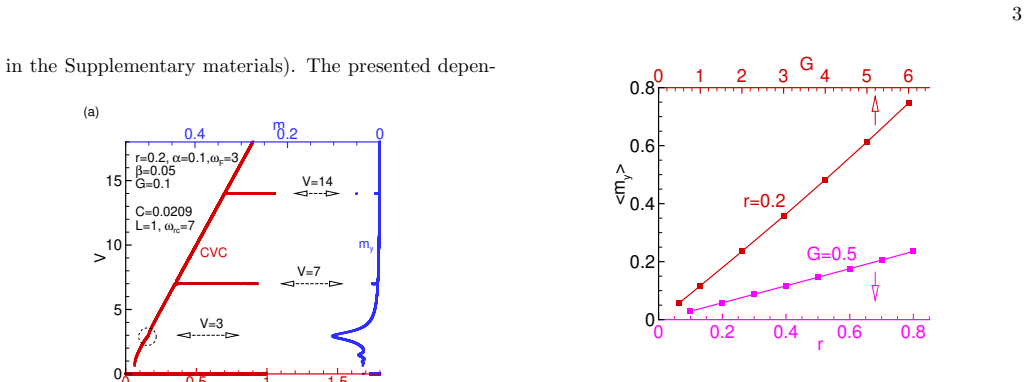
Within the coupled Landau–Lifshitz–Gilbert, resistively-and-capacitively-shunted-junction, and LC-circuit equations, the paper identifies a mechanism: the parallel resonance of Josephson oscillations with the LC circuit produces a direct superconducting current. In the static zero-voltage limit, the fixed-point equations for the magnetization reduce to $m_y^c = G r I_s$, so the tilt is proportional to the spin-orbit parameter, to the Josephson-to-magnetic-energy ratio, and to the resonance-generated steady current. On the resonant branch at $V = \omega_{\mathrm{rc}}$, the numerical time-averaged value of $m_y$ is 0.1164, against the formula's prediction 0.1162 using the numerically obtained $I_s = 0.581$; the magnetization oscillates about this value, demonstrating precession about the tilted axis. The tilt magnitude increases linearly with $r$ and $G$, and it tracks the circuit-resonance frequency when $L$ or $C$ is varied. This is the paper's central claim: resonant circuit shunting gives a controllable, predictable magnetization tilt in a $\varphi_0$ junction.
Load-bearing premise
The load-bearing assumption is that a formula for the tilt worked out when the junction voltage is exactly zero also describes the average tilt when the same steady current is produced by fast oscillations at nonzero voltage.
Editorial extensions
If this is right
- Tuning the shunt capacitance or inductance moves the voltage position of the resonant branch and, with it, the magnetization tilt, giving frequency-selective control of the magnetic state.
- The tilt grows linearly with the spin-orbit coupling parameter $r$ and the Josephson-to-magnetic energy ratio $G$, so materials with stronger spin-orbit coupling should show larger, easier-to-measure deflections.
- The relation $m_y^c = G r I_s$ gives a calibration tool: measuring the average supercurrent and the average $m_y$ at resonance allows one to extract $r$ and $G$ from experiment.
- Because the magnetization precesses about the tilted axis, the same shunt controls both the new equilibrium direction and the precession motion, not just a static orientation.
- The effect should be observable with a DC SQUID measuring $m_y(t)$ in a shunted $\varphi_0$ junction at experimentally reasonable $L$ and $C$ values.
Reading between the lines
- Beyond the paper: the same $G r I_s$ relation should be testable on higher harmonic branches, such as $V = 2\omega_{\mathrm{rc}}$, which the paper's CVC already shows; if it holds there, the control protocol extends to multiple resonant voltages.
- Beyond the paper: if the quiet-state formula transfers to the oscillating branch, the resonance acts as a switch — sweeping the bias current across the branch turns the steady supercurrent on and off, so a magnetic orientation could be written and erased without any external magnetic field.
- Beyond the paper: a short bias-current pulse parked on the resonant branch should tip the magnetization by a predictable angle, a resonant version of current-pulse reversal that the paper does not explore.
- Beyond the paper: the linear law will saturate at larger $I_s$ or $r$, because $m_z = \sqrt{1 - m_y^2}$ bounds the tilt; a nonlinear correction should be included when the resonance is driven hard.
Editorial analysis
A structured set of objections, weighed in public.
Referee Report
Summary. The manuscript studies a φ0 superconductor-ferromagnet-superconductor Josephson junction shunted by an LC circuit, with the magnetization dynamics described by the Landau-Lifshitz-Gilbert equation coupled to the RCSJ equations. The central claim is that at the parallel resonance between Josephson oscillations and the LC-circuit oscillations, a time-averaged superconducting current appears, which tilts the time-averaged magnetization away from the easy axis and leads to precession around the tilted direction. The authors derive an analytical relation m_y^c = G r I_s for the static zero-voltage regime (Eq. (8)), report numerical CVCs and magnetization dynamics, and claim good quantitative agreement between this formula and the time-averaged magnetization at the resonant branch. The manuscript also discusses parameter dependences and possible experimental realization with DC-SQUID readout.
Significance. If the central claim is correct, the paper offers an all-electrical, resonance-based method for controlling magnetization in a superconducting spintronics device, which is of clear interest to the field. The static derivation leading to Eq. (8) is clean, and the numerical approach (fourth-order Runge-Kutta on the coupled LLG-RCSJ-LC system) is standard. However, the main analytical confirmation of the resonant effect rests on applying a static, zero-voltage relation to an oscillating resonant state and on a single-point comparison that uses the simulation's own value of I_s as input. The phenomenology is plausible and the numerical tilt may well be real, but the paper's central quantitative claim is not yet established with the level of rigor expected for the claimed 'good agreement.'
major comments (3)
- [Section 'In order to analytically confirm this effect' and Eq. (8)] Equation (8) is derived by setting dM/dt=0 and dφ/dt=0 in Eqs. (7), which corresponds to the stationary Josephson regime with V=0. The paper then uses this relation at the resonant branch where V=ω_rc≠0 and Josephson oscillations are present. A time-averaged analog of Eq. (8) is never derived. In the time-dependent case, averaging the LLG equation gives constraints such as ⟨m_z(m_y−rG sin(φ−r m_y))⟩=0 only if one factors out m_z and ignores Gilbert damping; neither approximation is quantitated. The authors should either derive the averaged relation from the dynamical equations, including estimates of corrections from oscillations and damping, or present this step explicitly as an assumption and support it with a multi-point numerical test.
- [Figure 5 and the text following it] The quantitative check of Eq. (8) at the resonant branch uses I_s=0.581 taken from the same numerical simulation and then compares <m_y>=0.1164 with G r I_s=0.1162. This is a single-point consistency check, not an independent confirmation, because I_s and <m_y> are both outputs of the same run. A stronger test would compare Eq. (8) with numerical data across a range of bias currents along the resonant branch, or across G and r, with I_s either measured independently or predicted from the circuit equations. The zero-voltage segment OB0 already provides a genuine check of Eq. (8); the resonant-branch claim needs comparable support.
- [Figure 3 caption and main text] The main text states that Fig. 3(a) is calculated with C=0.0209, L=1, giving ω_rc=7, and the CVC shows resonant branches at V=7 and V=14. The caption of Fig. 3, however, states C=0.125, L=1, ω_rc=3. This is a direct contradiction on parameters that determine the position of the resonant branch and therefore the central phenomenon. The authors must correct this and ensure that all parameters quoted in the text, captions, and figures are consistent.
minor comments (5)
- [Abstract and Introduction] The phrase 'time-independent superconducting current arises' should be clarified as 'time-averaged (dc) superconducting current,' because in the resonant state with V≠0 the Josephson current oscillates; only its average is constant.
- [Section with Fig. 3] The description 'deviation of the easy axis from its initial position' is imprecise: the easy axis of the ferromagnet remains the z-axis, while the magnetization precesses around the effective field tilted toward the y-axis. Rewording would avoid confusion.
- [Figure 4 caption] The caption contains a typo: 'on the the Josephson to magnetic energy ratio' should be 'on the Josephson-to-magnetic energy ratio.'
- [Figure 6] Part (d) of Fig. 6 and its caption are difficult to read; the label 'y m m m' appears garbled, and the three curves for G=1, 2, 3 are not clearly distinguished in the grayscale reproduction. Please improve the figure and legend.
- [References] Several references contain obvious typos or missing author initials (e.g., 'Cai and E. M. Chudnovsky', 'Rfenacht', 'Wel p'), and they should be checked against the original sources.
Circularity Check
No significant circularity: the resonant-control result is numerically self-contained, though the analytical confirmation is a single-point consistency check rather than an independent prediction.
full rationale
The paper's central claim—that parallel resonance in the LC-shunted φ0 junction produces a time-independent superconducting current that tilts and drives precession of the magnetization—is supported by direct numerical solution of the coupled RCSJ, LLG, and LC equations (Eqs. (1)–(5) and the Supplementary system), not by a self-citation chain or by an ansatz imported from prior work. Equation (8), m_y = G r I_s, is derived explicitly from the stationary limit of the model (Eq. (7), with dM/dt = 0 and dφ/dt = 0), and the numerical simulation does not assume this relation. The quantitative check at point B1 uses the numerically computed average supercurrent I_s = 0.581 from the same simulation to obtain m_y^c = 0.1162 and compares it with the numerically averaged ⟨m_y⟩ = 0.1164. This is correctly described in the present analysis as a consistency check rather than an independent prediction: the paper does not derive a time-averaged analogue of Eq. (8) for the oscillating resonant branch, nor does it estimate corrections from m_z oscillations or Gilbert damping. However, this weakness does not amount to circularity, because the agreement is a falsifiable test of the quasi-static relation and could in principle have failed. The self-citations (Refs. [3,5,16–18,33,34,37,44]) are used for standard φ0-junction and shunted-junction phenomena and do not provide an unverified uniqueness theorem or forbid alternative explanations. No step in the claimed derivation reduces to its own inputs by construction.
Assumptions & free parameters
free parameters (3)
- r (spin-orbit interaction parameter) =
0.2, varied up to 0.8
- G (Josephson-to-magnetic energy ratio) =
0.1, 1, 3, 5
- Average superconducting current at resonance, I_s =
0.581 (numeric value at point B1)
assumptions (4)
- domain assumption The RCSJ model with a series LC shunt (Eqs. 4-5) captures the junction and circuit dynamics.
- domain assumption The magnetization dynamics are governed by the LLG equation with the effective field (Eq. 2) derived from the total energy in Supplementary Sec. II.
- ad hoc to paper The static equilibrium relation m_y = G r I_s (Eq. 8), derived for V=0, remains valid for the time-averaged magnetization at the resonant branch where V != 0.
- standard math Fourth-order Runge-Kutta integration is accurate for the reported parameter values.
Cite this review
Pith. "Pith review of Resonant control of magnetization in a shunted $\varphi_0$ junction with LC circuit." pith.science (2026). https://pith.science/paper/P2NALTEC
@misc{pith2026241116037,
  author       = {Pith},
  title        = {Pith review of: Resonant control of magnetization in a shunted $\varphi_0$ junction with LC circuit},
  year         = {2026},
  howpublished = {\url{https://pith.science/paper/P2NALTEC}},
  note         = {Machine review of arXiv:2411.16037}
}
abstract
The possibility of magnetization resonant control in a Josephson superconductor-ferromagnet-superconductor $\varphi_{0}$ junction shunted by an $LC$ circuit is demonstrated. As a result of the resonance of Josephson oscillations with oscillations in the circuit, a time-independent superconducting current arises in the junction. Due to the coupling of the Josephson phase and the magnetization of the ferromagnetic layer, the resulting superconducting current leads to a deviation of the easy axis from its initial position and to a precession of the magnetization around the tilted axis. We show that the tilt value increases with the increasing spin-orbit interaction and the Josephson to magnetic energy ratio. An analytical expression for the magnetization tilt is obtained, which agrees well with the results of numerical calculations. The emerging possibility of resonant control of magnetization in a shunted $\varphi_{0}$ junction can be used in the development of novel technologies in the field of superconducting electronics and spintronics.
Figures


Figures from the paper (5 more)


Reference graph
Works this paper leans on
-
[1]
Yu. M. Shukrinov, Phys. Usp. 65 317–354 (2022)
work page 2022
-
[2]
P. Kh. Atanasova, S. Panayotova, E. V. Zemlyanaya, Yu. M. Shukrinov, I. R. Rahmonov, Lecture Notes in Computer Sciences 11189 , 301 (2019)
work page 2019
-
[3]
Yu.\,M. Shukrinov, I.\,R. Rahmonov, and K. Sengupta. Physical Review B, 99 , 224513 (2019)
work page 2019
-
[4]
A. A. Golubov and M. Yu. Kupriyanov, Nature Materials 16 , 156 (2017)
work page 2017
-
[5]
Yu. M. Shukrinov, I. R. Rahmonov, K. Sengupta, and A. Buzdin, Appl. Phys. Lett. 110 , 182407 (2017)
work page 2017
-
[6]
E. M. Chudnovsky, Physical Review B 93 , 144422 (2016)
work page 2016
-
[7]
J. Linder and W. A. Jason Robinson, Superconducting spintronics, Nature Physics 11 , 307 (2015)
work page 2015
-
[8]
Eschrig, Reports on Progress in Physics 78 , 104501 (2015)
M. Eschrig, Reports on Progress in Physics 78 , 104501 (2015)
work page 2015
Show all 53 references
-
[9]
Konschelle, I
F. Konschelle, I. V. Tokatly, and F. S. Bergeret, Physical Review B 92 , 125443 (2015)
2015
-
[10]
Cai and E. M. Chudnovsky, Phys. Rev. B 82 , 104429 (2010)
2010
-
[11]
Konschelle, A
F. Konschelle, A. Buzdin, Physical Review Letters 102 , 017001 (2009)
2009
-
[12]
Petkovic, M
I. Petkovic, M. Aprili, S. E. Barnes, F. Beuneu, and S. Maekawa, Physical Review B 80 , 220502(R) (2009)
2009
-
[13]
Buzdin, Physical Review Letters 101 , 107005 (2008)
A. Buzdin, Physical Review Letters 101 , 107005 (2008)
2008
-
[14]
Houzet, Physical Review Letters 101 , 157009 (2008)
M. Houzet, Physical Review Letters 101 , 157009 (2008)
2008
-
[15]
E. M. Chudnovsky, Physical Review B 95 , 100503(R) (2017)
2017
-
[16]
Yu. M. Shukrinov, I. R. Rahmonov, A. Janalizadeh, and M. R. Kolahchi, Phys. Rev. B 104 , 224511 (2021)
2021
-
[17]
Janalizadeh, I
A. Janalizadeh, I. R. Rahmonov, S. A. Abdelmoneim, Yu. M. Shukrinov and M. R. Kolahchi, Beilstein J. Nanotechnology 13 , 1155–1166 (2022)
2022
-
[18]
Yu. M. Shukrinov, A. Mazanik, I. R. Rahmonov, A. E. Botha and A. Buzdin, EPL 122 , 370012 (2018)
2018
-
[19]
I. R. Rahmonov, A. R. Rahmonova and Yu. M. Shukrinov, Physics of Particles and Nuclei Letters, 20 , 1161–1164 (2023)
2023
-
[20]
Guarcello and F.S
C. Guarcello and F.S. Bergeret, Phys. Rev. Applied 13 , 034012 (2020)
2020
-
[21]
Hadley and M
P. Hadley and M. R. Beasley, Appl. Phys. Lett. 50 , 621 (1987)
1987
-
[22]
A. A. Chernikov and G. Schmidt, Phys. Rev. E 52 , 3415 (1995)
1995
-
[23]
Wiesenfeld, P
K. Wiesenfeld, P. Colet, and S. H. Strogatz, Phys. Rev. Lett. 76 , 404 (1996)
1996
-
[24]
A. B. Cawthorne, C. B. Whan, and C. J. Lobb, J. Appl. Phys. 84 , 1126 (1998)
1998
-
[25]
Filatrella, N
G. Filatrella, N. F. Pedersen, and K. Wiesenfeld, Phys. Rev. E 61 , 2513 (2000)
2000
-
[26]
A. N. Grib, P. Seidel, and J. Scherbel, Phys. Rev. B 65 , 094508 (2002)
2002
-
[27]
M. V. Fistul, Phys. Rev. B 75 , 014502 (2007)
2007
-
[28]
Tolpygo, V
S.K. Tolpygo, V. Bolkhovsky, S. Zarr, T. J. Weir, A. Wynn, A. L. Day, L. M. Johnson, M. A. Gouker, IEEE Trans. Appl. Supercond. 27 1100815 (2017)
2017
-
[29]
H. D. Jensen, A. Larsen and J. Mygind, Physica B 65 1661 (1990)
1990
-
[30]
Larsen , H
A. Larsen , H. D. Jensen and J. Mygind, Phys. Rev. B 43 10179 (1991)
1991
-
[31]
Tachiki, K
M. Tachiki, K. Ivanovic, K. Kadowaki and T. Koyama, Phys. Rev. B 83 014508 (2011)
2011
-
[32]
T. Zhou, J. Mao, H. Cui, X. Zhao, L. Fang and S. Yan, Physica C 469 785 (2009)
2009
-
[33]
Y. M. Shukrinov, I. R. Rahmonov and K. V. Kulikov, JETP Lett. 96 , 657 (2012)
2012
-
[34]
Yu. M. Shukrinov, I. R. Rahmonov, and G. Filatrella, JETP, 125 , 781–788 (2017)
2017
-
[35]
Likharev K K 1986 Dynamics of Josephson Junctions and Circuits (New York: Gordon and Breach)
1986
-
[36]
and Stroud D
Almaas E. and Stroud D. Phys. Rev. B 65 134502 (2002)
2002
-
[37]
Shukrinov Y M, Rahmonov I R, Kulikov K V and Seidel P Europhys. Lett. 110 47001 (2015)
2015
-
[38]
V. K. Kornev, and N. V. Kolotinskiy, IEEE Trans. Appl. Supercond. 26 1601605 (2016)
2016
-
[39]
Jeanneret and S
B. Jeanneret and S. P. Benz, Eur. Phys. J. Spec. Top. 172 181 (2009)
2009
-
[40]
Rfenacht, N.E
A. Rfenacht, N.E. Flowers-Jacobs, S.P. Benz, Metrologia 55 S152 (2018)
2018
-
[41]
U. Welp, K. Kadowaki, R. Kleiner, Nat. Photonics 7 , 702 (2013)
2013
-
[42]
J. Ma, P. Zhou, B. Ahmad, G. Ren, C. Wang, PLoS ONE 13 e0191120 (2018)
2018
-
[43]
Atanasov, Phys
V. Atanasov, Phys. Lett. A 384 126042 (2020)
2020
-
[44]
Yu. M. Shukrinov, I. R. Rahmonov, K. V. Kulikov, A. E. Botha, A. Plecenik, P. Seidel and W. Nawrocki, Supercond. Sci. Technol. 30 024006 (2017)
2017
-
[45]
Hrabec, F
A. Hrabec, F. J. T. Goncalves, C. S. Spencer, E. Arenholz, A. T. N’Diaye, R. L. Stamps, and C. H. Marrows, Phys. Rev. B 93 , 014432 (2016)
2016
-
[46]
Szombati, S
D. Szombati, S. Nadj-Perge, D. Car, S. Plissard, E. Bakkers, and L. Kouwenhoven, Nat. Phys. 12 , 568 (2016)
2016
-
[47]
К. К. Лихарев, Введение в динамику джозефсоновских переходов, Наука, Москва (1985)
1985
-
[48]
Kh.Atanasova, S.A
P. Kh.Atanasova, S.A. Panayotova, I.R. Rahmonov, Yu.M. Shukrinov, E.V. Zemlyanaya, M.V
-
[49]
D. S. Rabinovich, I. V. Bobkova, A. M. Bobkov, M. A. Silaev, Cond-Mat ArXiv 1904.03449 (2019)
2019 arXiv
-
[50]
P. Kh. Atanasova, S. Panayotova, Yu. M. Shukrinov, I. R. Rahmonov, E. V. Zemlyanaya, EPJ Web of Conf. 173 , 05002 (2018)
2018
-
[51]
Shukrinov , I.R
Yu.M. Shukrinov , I.R. Rahmonov and A.E. Botha, IEEE Transactions on Applied Superconductivity 28 , 1800505 (2018)
2018
-
[52]
Мендель, Э
Л. Мендель, Э. Вольф, Оптическая когерентность и квантовая оптика, Москва ``Физматлит'' 2000 (L. Mendel, E. Wolf, ``Optical coherence and quantum optics'' Cambridge University Press 1995)
2000
- [53]
Reviewed August 12, 2026 · model on record in the stance chip above.
Discussion (0). Continue with ORCID to comment.